
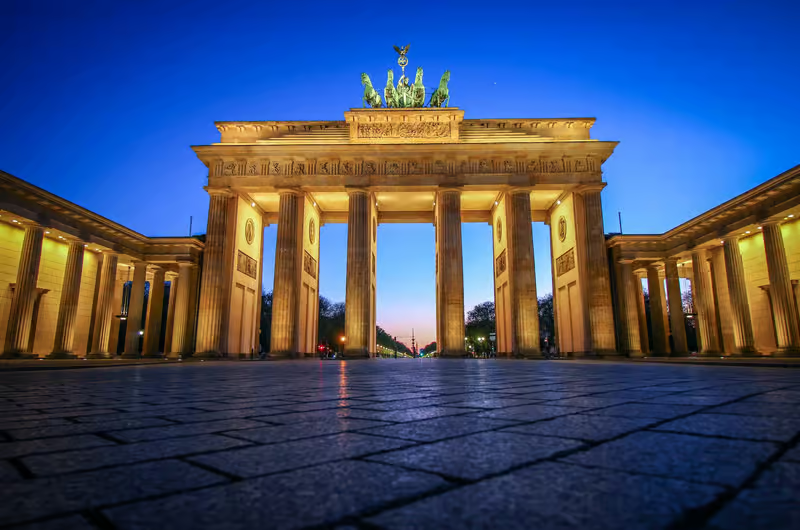
A capital defined by its ruptures
Berlin was rebuilt from near-total wartime ruin, then split by a wall for 28 years, then reunified in 1990, and all three eras remain visible within a single afternoon's walk. The Brandenburg Gate stood in the Wall's death strip for decades and is now a normal city landmark you can walk straight through. A former mayor's line, "poor but sexy," is still the closest thing the city has to an official motto: rents have risen since it was coined but Berlin remains cheaper and rawer than Paris, London or Amsterdam, with a creative and nightlife scene that draws as much on that unfinished quality as on any polished attraction.
What Berlin has going for it beyond the history is scale and value. The centre and inner-ring neighbourhoods are well connected by U-Bahn and S-Bahn, a currywurst or döner costs about the same as a coffee in most Western European capitals, and the city's museums, especially the Museum Island cluster, rank among the best value cultural experiences in Europe. For a first stop in Germany or a long weekend on its own, three focused days cover the essentials without feeling rushed.
The honest complications
Berlin runs on more bureaucracy and cash than many first-time visitors expect: plenty of bars, bakeries and small restaurants are cash-only, and Berlin Brandenburg Airport (BER) itself carries a reputation, not entirely undeserved historically, for construction delays before it finally opened in 2020. Grey skies and short days dominate from November through February, and the city's sheer size (Berlin covers nearly nine times the area of Paris) means neighbourhoods you don't plan for can end up feeling like an afterthought. None of this is a reason to skip the city, but Berlin is not a compact, postcard-pretty capital, and it doesn't pretend to be.
A sprawling capital, five areas that matter
Berlin is far bigger and more spread out than most European capitals, so choice of base matters more than usual. First-timers do best staying central; repeat visitors chasing nightlife or food tend to drift east and south.
Mitte
Mitte holds the Brandenburg Gate, the Reichstag, Museum Island and Checkpoint Charlie, and is the natural base for a first visit: everything a sightseeing-focused itinerary needs sits within walking distance or a short U-Bahn ride. It's touristy in the immediate vicinity of the big landmarks but genuinely local a few streets back around Hackescher Markt and the Scheunenviertel.
Kreuzberg
Kreuzberg, once hard against the western side of the Wall and now one of the city's most diverse and creative districts, has the strongest concentration of Berlin's Turkish-German food culture along with a dense cluster of bars, street art and independent shops. Expect noise on weekend nights if staying near Oranienstraße or Kottbusser Tor.
Prenzlauer Berg
A former East Berlin district of restored 19th-century apartment blocks, now full of cafes, independent boutiques and the Sunday Mauerpark flea market. Quieter and more residential than Mitte or Kreuzberg, and a good base for travellers who want charm without constant nightlife noise.
Friedrichshain
Home to the East Side Gallery's longest surviving stretch of the Wall and Berlin's most serious techno clubs, including the notoriously door-picky Berghain. Friedrichshain skews younger and louder than Prenzlauer Berg next door, with cheap eats along Boxhagener Platz.
Neukölln
Berlin's most rapidly changing neighbourhood, a mix of long-standing Arab and Turkish communities and a fast-growing creative and expat scene along Weserstraße and Sonnenallee. Cheaper accommodation than Mitte or Kreuzberg, at the cost of a slightly longer commute to the main sights.
From design hotels to a hostel bed near Rosa-Luxemburg-Platz
Berlin's hotel scene spans grand historic addresses to some of Europe's most design-forward boutique properties, and prices remain reasonable by Western European capital standards outside of major events and Christmas market season.
At the top, Orania.Berlin in Kreuzberg occupies a restored 1913 building on Oranienstraße and pairs design-hotel rooms with a well-regarded restaurant and live-music bar, from roughly €200-300 a night. SO/ Berlin Das Stue, in a former Royal Danish Embassy building beside the zoo and Tiergarten, is the city's other standout luxury design address.
In the boutique bracket, Casa Camper Berlin on Weinmeisterstraße in Mitte puts guests within easy walking distance of the Scheunenviertel's galleries and cafes, while Michelberger Hotel in Friedrichshain, a longtime favourite of the city's creative and music crowd, keeps rooms playful and unfussy from around €90-190 depending on season.
At the budget end, Wombat's City Hostel Berlin, next to Rosa-Luxemburg-Platz U-Bahn station in Mitte, is a reliable, social, well-run hostel with a rooftop bar, dorm beds typically in the €20-30 range and private rooms above that.
Currywurst for five euros, a Kölsch-style Berliner Weisse after
Berlin eats well and cheaply, and its defining dishes were shaped by immigration as much as German tradition: the döner kebab as most of the world eats it today was popularized here by Turkish-German vendors, and it sits alongside currywurst as the city's real culinary signature, not the Bavarian stereotypes visitors sometimes expect.
Currywurst
Konnopke's Imbiss, operating since 1930 under the U-Bahn tracks at Eberswalder Straße, is the city's benchmark currywurst stand: sliced sausage in curry-spiced ketchup, served with fries, for about 5 to 7 euros, with a queue of regulars that moves fast even at lunch.
Döner Kebab
Rüyam Gemüse Kebab, with locations spanning Schöneberg and around Prenzlauer Berg, is frequently ranked alongside the more famous Mustafa's Gemüse Kebab near Mehringdamm, without Mustafa's routine hour-long queue; the chicken yaprak döner with fried vegetables is the order.
Bars & an evening out
Berlin's bar culture runs from unpretentious neighbourhood Kneipen to some of the world's most talked-about techno clubs. Klunkerkranich, a rooftop bar above a Neukölln shopping centre car park, is a lower-key way to spend an evening than queuing for Berghain in Friedrichshain, which remains one of the most famous and most difficult clubs in the world to get into.
Christmas markets & Glühwein
Berlin runs dozens of Christmas markets each winter; the one at Gendarmenmarkt, framed by the German and French Cathedrals and the Konzerthaus, is the most photogenic, while the Ku'damm market draws a livelier, more local crowd. Mulled wine (Glühwein) is served in a collectible mug with a small refundable deposit.
A gate, a dome, five museums on an island, and a wall
Berlin's major sights are spread across a genuinely large city, so grouping them by neighbourhood, rather than trying to see everything in one sweep, saves the most time.
Brandenburg Gate and the Reichstag
The Brandenburg Gate, an 18th-century neoclassical monument that spent 28 years sitting in the Wall's no-man's-land, is the natural starting point and free to see at any hour. A ten-minute walk away, the Reichstag building's glass dome offers free entry and sweeping city views, but registration at visite.bundestag.de is mandatory, must be booked weeks ahead in summer, and walk-ins are turned away.
Museum Island
Museum Island, a UNESCO World Heritage Site holding five major museums on a single stretch of the Spree, is the best single-ticket cultural experience in the city: a day pass covering the Neues Museum (home to the Nefertiti bust), the Pergamon complex and others costs around €24, cheaper than buying two individual tickets. Note that the Pergamon Museum's main building remains closed for renovation until at least mid-2027, with a scaled-down "Pergamon Panorama" experience open in the meantime.
The Berlin Wall Memorial and East Side Gallery
The Berlin Wall Memorial on Bernauer Straße preserves an actual surviving section of the death strip, complete with a watchtower and documentation centre, and is the most sobering, informative Wall site in the city, free to enter. The East Side Gallery, the longest remaining stretch of the Wall at 1.3km along the Spree in Friedrichshain, is covered in murals painted by international artists after 1990 and free to view 24/7.
Checkpoint Charlie and the Topography of Terror
Checkpoint Charlie, the most famous Cold War border crossing between East and West Berlin, is now a reconstructed guard post surrounded by tourist-facing photo ops; it's worth a brief stop but the nearby Topography of Terror documentation centre, built on the former Gestapo and SS headquarters site, does more to actually explain the era, and is also free.
One, two or three days, planned neighbourhood by neighbourhood
Three full days cover Berlin properly given its size; two focused days hit the essentials. A third day is best spent either on the Potsdam day trip or a slower neighbourhood day in Kreuzberg or Prenzlauer Berg.
- Morning
Brandenburg Gate and the Reichstag dome (pre-booked), then a walk down Unter den Linden.
- Midday
Museum Island. Pick two museums with the day pass, then lunch in the Scheunenviertel.
- Afternoon
Berlin Wall Memorial on Bernauer Straße, then the Topography of Terror.
- Evening
Currywurst at Konnopke's, then a bar in Prenzlauer Berg or Kreuzberg.
- Day 1
The one-day route: Brandenburg Gate, Reichstag, Museum Island, Wall Memorial, dinner in Prenzlauer Berg.
- Day 2 morning
Checkpoint Charlie and a slow walk through Kreuzberg's street art and independent shops.
- Day 2 afternoon
East Side Gallery along the Spree in Friedrichshain, then a döner at Rüyam.
- Day 2 evening
Boxhagener Platz or Klunkerkranich for a relaxed final night.
- Days 1-2
The two-day route above, at a gentler pace.
- Day 3
Potsdam. S-Bahn out to Sanssouci Palace and its gardens, back in Berlin by evening for a final dinner in Mitte.
A big city with an excellent train network to match
Berlin Brandenburg Airport (BER) sits about 24km southeast of the centre. The FEX Airport Express reaches Berlin Hauptbahnhof in about 23 minutes for €5, running every 15 minutes; the S9 and regional trains cost similarly and take a little longer. A taxi runs roughly €60-70 and takes about 40 minutes depending on traffic.
Within the city, the U-Bahn and S-Bahn network is extensive, frequent and easy to navigate; a single AB-zone ticket costs €4, a 24-hour ticket €11.20, and the Berlin WelcomeCard (from about €28.50 for 48 hours) bundles transport with discounts at 170+ partner attractions, worth it for a transport-and-sightseeing-heavy visit. Trams run in the former East (Mitte, Prenzlauer Berg, Friedrichshain) but not the west. Uber operates but mostly dispatches licensed taxis under German regulation, so fares track standard taxi rates; FreeNow is the other commonly used app.
Best time to visit
May, June and September are the most comfortable months: warm without the occasional 30°C+ peaks of July and August, and without the cold of winter. Late November and December bring the Christmas markets, worth planning a trip around despite the cold, while January through March is the quietest, cheapest and greyest stretch of the year.
Still one of Western Europe's better-value capitals
Berlin is noticeably cheaper than Paris, London or Amsterdam, and cheaper than Munich for accommodation outside of major events. The main cost trap is the same as everywhere: eating at the handful of tourist-facing restaurants right on Unter den Linden instead of walking a few minutes into any surrounding neighbourhood.
- Hostel dorm bed €20-30
- Currywurst and döner meals €5-8
- Single or day BVG transit tickets
- Free sights: Wall Memorial, East Side Gallery, Brandenburg Gate
- Boutique or 3-star hotel €90-190
- Restaurant dinners €15-25/person
- Berlin WelcomeCard for transport and discounts
- Museum Island day pass and Reichstag (free but book ahead)
- Orania.Berlin or SO/ Das Stue €200-300+
- Fine dining across Mitte and Charlottenburg
- Private guided tours of the Wall sites
- Christmas-market season premium rates
Safe by capital-city standards, with the usual caveats
Berlin is safe for tourists. Violent crime against visitors is rare, the central and inner-ring neighbourhoods are fine to walk at night with normal urban awareness, and Germany's overall Level 2 (Exercise Increased Caution) US State Department rating reflects standard precautions rather than any elevated concern. The practical risks are pickpocketing and, occasionally, scam attempts, not violent crime.
The three things that actually catch visitors: pickpocketing, concentrated on crowded U-Bahn and S-Bahn trains and at busy squares like Alexanderplatz, so keep bags closed and in front of you; fake petition scams, where someone with a clipboard distracts you while an accomplice goes through an open bag; and unofficial "help" at ticket machines near major stations, avoidable by using official DB counters or the app. Berlin rates well for solo female travellers by big-city standards: harassment is uncommon in the centre and inner-ring neighbourhoods, and late-night transit runs reasonably safely, though the usual caution applies around Alexanderplatz and nightlife strips after dark.
Emergency numbers match the rest of Germany: 112 ambulance and fire, 110 police, both free, 24/7 and answered with English-speaking operators generally available.
Potsdam, Frederick the Great's Sanssouci
Berlin's position at the centre of Brandenburg makes it a workable base for one standout day trip; the Rhine Valley and Bavaria's castles are better tackled as their own stops rather than rushed from the capital.
Potsdam & Sanssouci Palace
Potsdam, Prussia's former royal seat just outside Berlin, is built around Sanssouci Palace, Frederick the Great's 18th-century summer retreat and one of Germany's most visited palaces. The S7 line from Berlin Hauptbahnhof or Friedrichstraße reaches Potsdam Hauptbahnhof in around 30 to 40 minutes, covered by a standard Berlin ABC-zone ticket (about €10 for a day ticket). From the station, bus 695 runs directly to the palace, or it's a 20-minute walk through Potsdam's old town. Palace entry runs about €12, or €19 for a day ticket covering the wider Sanssouci Park and its other pavilions and follies, easily worth a full day if the gardens are in bloom.
Berlin FAQ
Is Berlin safe for tourists?
Yes. Violent crime against visitors is rare and Berlin is fine to walk at night in the central and inner-ring neighbourhoods with normal urban awareness. Pickpocketing on crowded U-Bahn/S-Bahn trains and at busy squares is the main practical risk, not violent crime.
How many days do I need in Berlin?
Three full days covers the city well: one for the historic centre and Museum Island, one for the Wall sites and Kreuzberg, one for a neighbourhood-and-food day in Prenzlauer Berg or Friedrichshain. Two days works if you're tighter on time.
How much does Berlin cost per day?
Budget travellers manage on €50-70 a day with hostel beds and street food; mid-range runs €100-150. Berlin remains one of Western Europe's cheaper capital cities.
When is the best time to visit Berlin?
May, June and September: warm without peak crowds. Late November and December bring the Christmas markets, genuinely worth a cold-weather trip, while January-March is quiet, cheap and grey.
Do I need to book the Reichstag dome in advance?
Yes. Entry is free but registration at visite.bundestag.de is mandatory and slots fill 3-5 weeks ahead in summer; walk-ins are not permitted. Book as early as your dates allow.
What is the Berlin WelcomeCard?
A tourist transport pass covering unlimited public transport plus discounts at 170+ partner attractions, priced from about €28.50 for 48 hours in the AB zone. Worth it if you're using transport heavily and visiting several paid attractions; casual sightseers may do better with single or day BVG tickets.
How do I get from BER airport to central Berlin?
The FEX Airport Express train reaches Berlin Hauptbahnhof in about 23 minutes for €5, running every 15 minutes. The S9 and regional trains are similar in price and take slightly longer. A taxi costs roughly €60-70 and takes about 40 minutes.
What is the best area to stay in Berlin?
Mitte for first-timers: central, walkable to the major sights, with easy transport connections everywhere else. Kreuzberg and Friedrichshain suit visitors prioritising food and nightlife over sightseeing proximity.
Can I do a day trip to Potsdam from Berlin?
Yes, easily. Potsdam and Sanssouci Palace are about 30-40 minutes from central Berlin by S-Bahn, covered by a standard Berlin ABC transit ticket, and a comfortable half-day to full-day trip.
Is Uber available in Berlin?
Uber operates in Berlin but mostly dispatches licensed taxis rather than private drivers due to German regulations, so fares are similar to hailing a taxi directly. FreeNow is the other widely used app.
What Stays With You
Berlin does not have Paris's uniform elegance or Rome's ancient weight, and it is not trying to. What it has is a city that was destroyed, divided and stitched back together within one lifetime, and instead of hiding the scars it built museums into them: a Wall memorial where the Wall actually stood, a Gestapo headquarters site turned documentation centre, a Cold War checkpoint that's now just a street corner. None of it is staged, and all of it is oddly grounding once you notice the pattern.
Sit at a Späti (the city's ubiquitous late-night corner shops, most of which sell cold beer to drink right there on the curb) on your last evening, and understand why a city with this much history in its concrete can still feel, block by block, like it's only just getting started.