
What You're Actually Getting Into
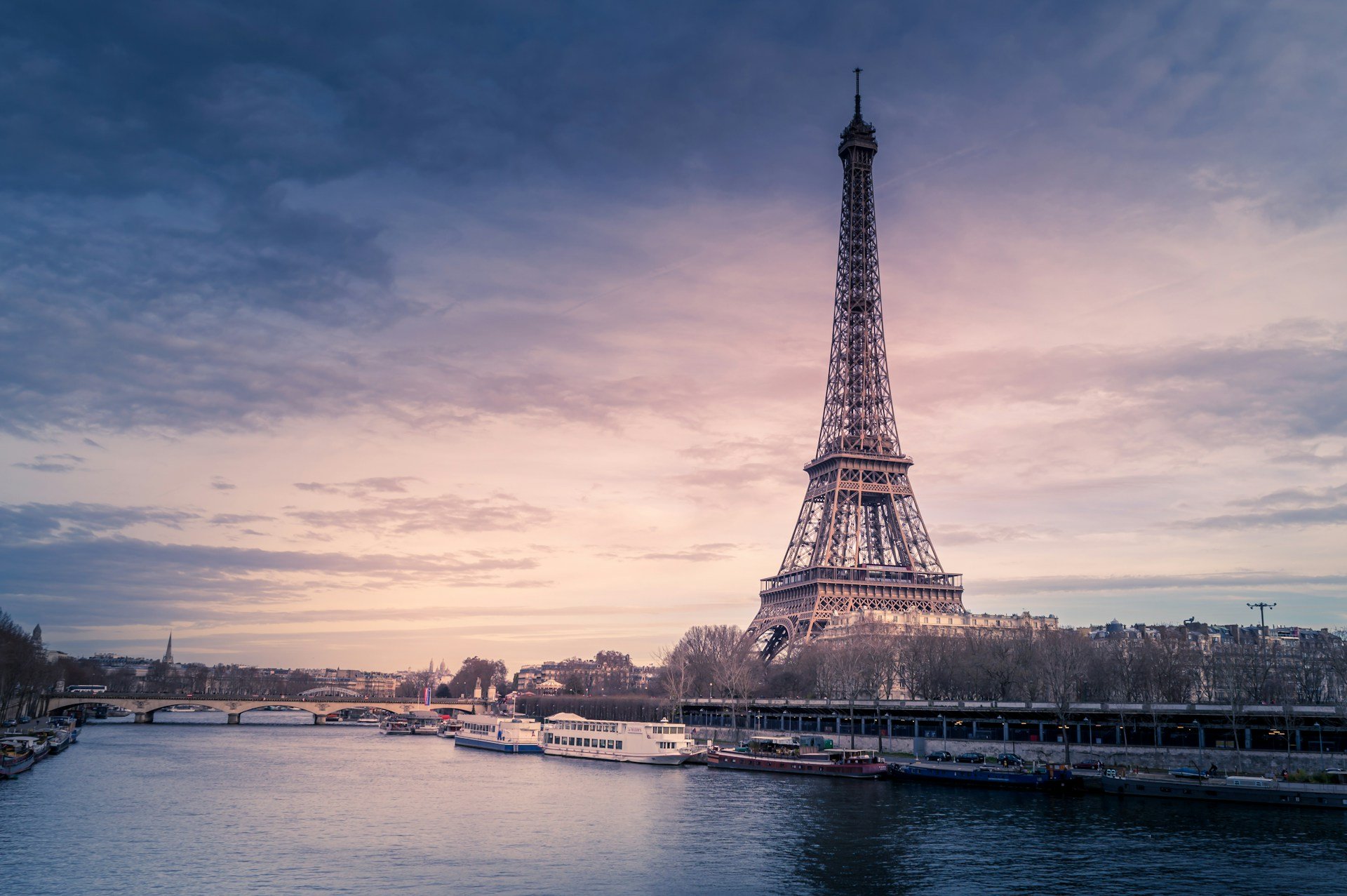
France is the world's most-visited country, and it earns that position on range rather than on any single attraction. Paris supplies the postcard image, but the country behind it is enormous by European standards: thirteen metropolitan regions running from the Channel coast to the Mediterranean, each with its own architecture, dialect traces, wine, and idea of what a proper meal looks like. A trip that only sees Paris has seen a real and remarkable city, and also a small fraction of what the ticket bought.
The food and wine culture is not staged for visitors. Bakeries open before dawn because the neighborhood expects fresh bread by breakfast, a two-hour lunch is a normal Tuesday rather than a special occasion, and the appellation system that governs wine labeling exists to protect a genuine agricultural identity, not to sell bottles to tourists. The TGV high-speed rail network makes the geography forgiving: Lyon, Bordeaux and Marseille are all under three hours from Paris by train, which means an itinerary combining several regions is a realistic plan rather than a fantasy.
The honest complications
France runs on its own schedule and does not apologize for it. Many independent restaurants, bakeries and small shops close for two to four weeks in August, the traditional French summer holiday, and this hits Paris especially hard: entire streets of favorite addresses go dark at once. National strikes (grèves) affecting trains, airports or the Paris metro happen with enough regularity that building a single point of failure into a tight itinerary is a real risk, not a hypothetical one; check strike calendars before booking non-refundable connections in shoulder season. Paris and the Riviera run noticeably more expensive than the rest of the country, and the pickpocketing reputation of central Paris, while sometimes overstated online, reflects a genuine and persistent problem around major sights and on crowded metro lines. None of this makes France difficult to visit. It makes France a country that rewards a flexible itinerary over a rigid one.
A History Worth Knowing
France's borders trace roughly the old Roman province of Gaul, conquered by Julius Caesar in the first century BCE and Latinized over the following centuries. Frankish kingdoms, a Capetian dynasty that ruled for over 800 years, an absolute monarchy at Versailles, the Revolution that ended it, an Empire, five republics and two world wars: the short version of how the country you're visiting got here.
- 58-50 BCE
Roman Gaul. Julius Caesar conquers Gaul; the region is Latinized under Roman rule for the following five centuries.
- 987
The Capetian dynasty. Hugh Capet is crowned King of the Franks, founding a royal line that, through its branches, rules France until 1848.
- 1337-1453
The Hundred Years' War. A century of intermittent conflict with England, turned by Joan of Arc's intervention in 1429, ends with France's eventual victory.
- 1643-1715
Louis XIV, the Sun King. The longest reign in European history builds Versailles and cements absolute monarchy at its European peak.
- 1789
The French Revolution. The storming of the Bastille begins the end of the monarchy and the birth of modern republican France.
- 1804-1815
Napoleon. Crowned Emperor in 1804, he reshapes European law and borders before defeat at Waterloo in 1815.
- 1914-1945
Two world wars. Devastating losses in WWI, then Nazi occupation from 1940 to 1944 and Liberation, reshape the 20th-century nation.
- 1958-present
The Fifth Republic. Charles de Gaulle's constitution still governs France today; a founding member of what becomes the European Union.
Read the full history: Gaul, the Capetians, the Revolution and the Republics
Before Rome, the region was home to Celtic Gallic tribes; Caesar's conquest and the centuries of Roman rule that followed left the roads, aqueducts and amphitheaters still visible in Provence today, along with the Latin roots of the French language. The collapse of Roman authority brought Frankish kingdoms, and Charlemagne, crowned Holy Roman Emperor in 800, briefly united much of Western Europe under Frankish rule before his empire split among his heirs.
The Capetian dynasty founded in 987 proved remarkably durable, and its various branches, the Valois and then the Bourbons, ruled France through the medieval and early modern periods. The Hundred Years' War against England tested the kingdom's survival directly; Joan of Arc, a teenage peasant who claimed divine visions, led French forces to a turning victory at Orléans in 1429 before being captured and burned at the stake by 1431, a story that remains central to French national identity.
The 17th century brought the absolute monarchy to its European high point under Louis XIV, the Sun King, whose 72-year reign remains the longest in European history and whose palace at Versailles became the template every European court tried to copy. The system's excesses, and a fiscal crisis the monarchy could not resolve, produced the French Revolution in 1789: the storming of the Bastille, the execution of Louis XVI in 1793, and a decade of upheaval that ended the old order permanently, even after the monarchy was briefly restored.
Napoleon Bonaparte rose from the Revolution's chaos to crown himself Emperor in 1804, reshaping European law through the Napoleonic Code, whose influence on civil law systems persists worldwide today, before his eventual defeat at Waterloo in 1815. The 19th century cycled through further monarchies, empires and republics before the Third Republic settled in for good in 1870. The 20th century brought catastrophic losses in the First World War, fought partly on French soil, followed by Nazi occupation from 1940 to 1944, the Resistance, and Liberation. Charles de Gaulle's Fifth Republic, established in 1958, remains the governing constitution today, and France has been a founding member of the European project since the 1957 Treaty of Rome.
Top Destinations
France divides into distinct travel zones with genuinely different characters: the capital and Île-de-France, the Loire Valley's château country, Provence and the Mediterranean Riviera, Normandy and Brittany's Atlantic and Channel coasts, and the Alps and wine country to the east and southwest. The TGV network makes combining two or three of these in a single trip realistic; trying to see all of them in under two weeks is not.
Paris, the obvious starting point
Paris earns its reputation: the Louvre, the Eiffel Tower, a rebuilt Notre-Dame, and entire neighborhoods that reward wandering more than checklist sightseeing. It is also just the beginning of Île-de-France, the wider region around the capital. Budget at least four days for the city itself; see our full Paris city guide for neighborhoods, food, and a day-by-day plan.
The Loire Valley châteaux
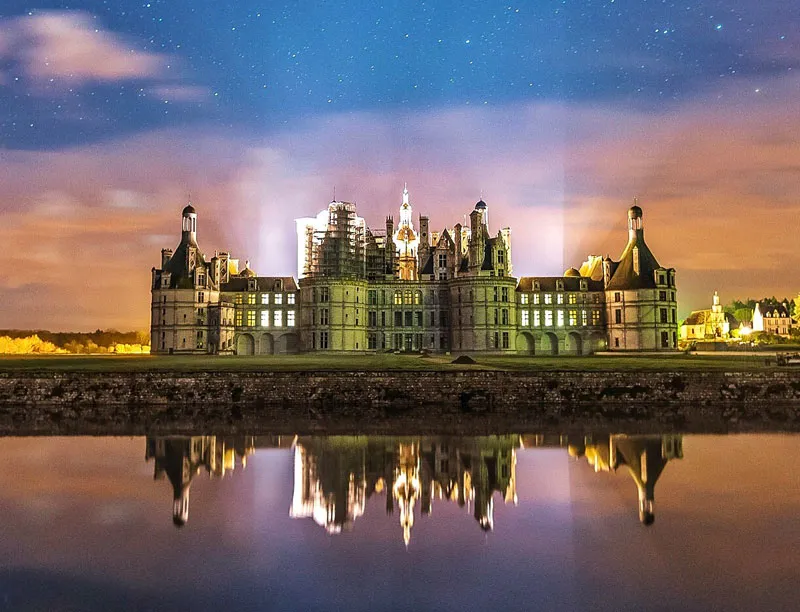
Over 300 châteaux line the Loire and its tributaries, the country retreats of French royalty and nobility from the Renaissance onward. Picking three or four rather than rushing through a dozen is the difference between a trip you remember and a blur of gilt ceilings. Chambord, the largest of them, has a double-helix staircase whose design is traditionally linked to Leonardo da Vinci, who spent his final years nearby at the king's invitation. Chenonceau arches directly over the river Cher on a series of stone piers and holds a notable collection of period furniture and tapestries. Base yourself in Tours or Amboise, both well connected to Paris by train, and rent a car locally since public transport between the châteaux themselves is thin.
Provence & the French Riviera
Provence layers Roman ruins, lavender fields and hilltop villages over a Mediterranean climate; the Riviera to its east adds the glamour economy of Nice, Cannes and Antibes. Aix-en-Provence and the Luberon villages suit a slower, food-and-market pace; Nice's old town and long pebble beach work as a base for day trips along the coast. Lavender season runs roughly mid-June to late July in the Luberon and Valensole plateau, and books out accommodation accordingly.
Normandy, Brittany & Mont Saint-Michel
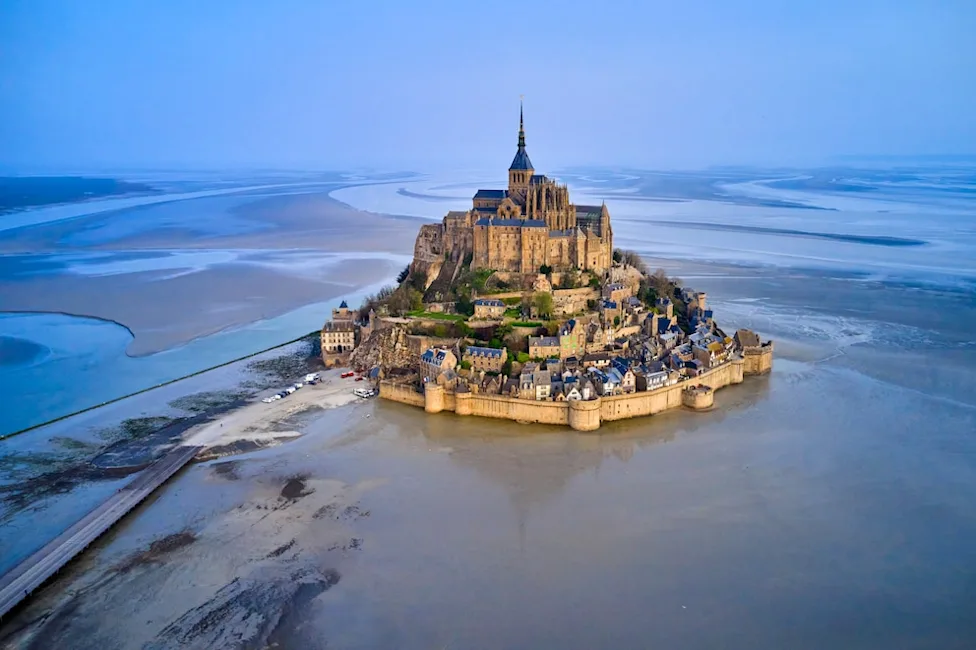
The Atlantic and Channel coasts hold a different France: half-timbered towns, apple orchards turned into cider and Calvados, and two of the country's most striking sights. Mont Saint-Michel, the tidal island abbey on the Normandy-Brittany border, is best seen either very early or with an overnight stay nearby to catch it without the midday tour-bus crowds. Normandy's D-Day beaches and the American, British and Canadian cemeteries above them are essential, sobering stops for anyone tracing WWII history. Brittany's granite coastline and Celtic-inflected culture, its own language still spoken in pockets, feels culturally distinct from the rest of France.
The Alps & wine country
The French Alps hold some of Europe's best skiing in winter and genuinely spectacular hiking in summer; Chamonix, beneath Mont Blanc, is the classic base for both. Annecy, with its canals and Alpine lake, works as a gentler mountain-adjacent stop that does not require ski gear. To the west and south, Burgundy and Bordeaux anchor two of the world's most storied wine regions, both organized around the AOC appellation system that ties a wine's name to a specific patch of land, and both easily visited on a day trip with a designated driver or an organized tasting tour.
Hidden gems beyond the main circuit
The zones above cover a first or second trip well. With extra days, these are the spots that rarely make the standard guides but reward the detour.
The Dordogne & Sarlat
Medieval market towns, prehistoric cave art near Les Eyzies, and canoe trips down the Dordogne river past clifftop castles. Quieter and cheaper than Provence, with equally good food.
Colmar & Strasbourg
Half-timbered, canal-laced towns with a Franco-German culinary identity: choucroute, tarte flambée and Riesling. Strasbourg's Christmas market is one of Europe's oldest and most famous.
The Luberon villages
Gordes, Roussillon and Ménerbes: hilltop stone villages that supply the postcard image of Provence, with fewer crowds than the coast and excellent Saturday markets.
Corsica's interior
Napoleon's birthplace has a mountainous, maquis-scented interior that feels closer to the Alps than the Riviera, plus a coastline that rivals Sardinia's. Reachable by ferry or a short flight from Nice or Marseille.
Beaune's wine cellars
The unofficial capital of Burgundy wine, with a historic Hôtel-Dieu roofed in glazed tiles and cellar tours that go deeper into the appellation system than a Paris wine bar ever will.
The volcanic Puy de Dôme
A chain of dormant volcanic peaks in central France, largely unknown outside the country, with hiking, cheese-making villages and almost no international tourists.
Culture & Etiquette
French social interaction runs on a formality most visitors underestimate. Saying bonjour before anything else, in a shop, to a stranger, before asking for help, is not a nicety, it's the entry fee for a friendly exchange; skip it and the same request reads as rude regardless of how good your French otherwise is. Meals move slower than most visitors expect and that is deliberate, not inefficient service.
Do
- Say bonjour first, every time. Entering a shop, approaching a stranger for directions, sitting at a café: bonjour comes before the request, not after.
- Dress a notch smarter than at home. The French dress code leans smart-casual even for errands; athletic wear outside the gym reads as distinctly foreign.
- Let meals run long. A two-hour lunch is normal, not a special occasion. Rushing a French waiter to bring the bill early can come across as odd.
- Learn a handful of phrases. Bonjour, merci, s'il vous plaît, excusez-moi go a long way even when the rest of the conversation switches to English.
- Check opening hours in August. Many independent restaurants and shops close for two to four weeks; verify before planning around a specific address.
Don't
- Assume loud is universal. French dining rooms and public transport run quieter than many visitors are used to; conversation volume that feels normal at home can draw looks in Paris.
- Ask for substitutions or rush the kitchen. Menus are generally fixed as written, and asking for heavy modifications is read differently than in casual-dining cultures.
- Snap fingers or wave down waitstaff. Catch a server's eye instead; French restaurant service intentionally does not hover.
- Expect every rural town to run on English. Coverage is strong in Paris and tourist zones, thinner outside them; a translation app closes most gaps.
- Discuss salary or the price of someone's home. Money talk is more private in French social norms than in many English-speaking cultures.
Deeper culture: laïcité, the AOC system, and regional identity
Laïcité. France's specific, constitutionally enshrined form of secularism separates religion from the state more strictly than most Western countries, visible in rules like the ban on conspicuous religious symbols in public schools. It shapes public debate in ways visitors sometimes find unfamiliar.
The AOC appellation system. Appellation d'Origine Contrôlée ties a wine, cheese or food product's name to a specific, legally defined region and production method; Champagne can only be called Champagne if it's from Champagne. Understanding this explains a surprising amount about how the French talk about food and wine.
Regional identity. Brittany, Alsace, the Basque Country and Corsica all retain strong distinct identities, some with their own living languages (Breton, Alsatian, Basque, Corsican), and residents there may identify with the region as strongly as with France itself. Don't assume "French culture" is uniform across the whole country.
The 35-hour week & Sunday closures. Many shops, especially outside Paris, close on Sundays and sometimes Mondays; French labor culture protects rest time more strongly than in many countries, which occasionally surprises visitors used to round-the-clock retail.
Food & Drink
French food resists generalization because the regions genuinely differ: butter and cream in Normandy, duck and cassoulet in the southwest, bouillabaisse on the Mediterranean coast, choucroute in Alsace. What holds the whole country together is a baseline standard, even an ordinary bakery croissant or a neighborhood bistro's plat du jour tends to be very good, because the culture simply expects it to be.
Bread & pastry ~€1-2
The baguette (a legally protected recipe in its "tradition" form) and the croissant are the daily baseline; a good neighborhood boulangerie sells out of both most mornings. Fresh, warm and cheap almost everywhere.
Cheese Varies widely
Over 400 recognized varieties, from Camembert and Roquefort to hundreds of regional AOC cheeses most visitors never see outside their home region. A proper cheese course after the main dish, before dessert, is standard at a sit-down meal.
Wine €3-8/glass, house
Bordeaux, Burgundy, Champagne, the Loire and the Rhône each produce genuinely distinct styles under the AOC system. House wine (vin de la maison) at an ordinary bistro is usually solid and inexpensive; you don't need a wine list to eat and drink well.
Regional classics
Bouillabaisse (Marseille's saffron fish stew), cassoulet (southwest bean and duck stew), choucroute garnie (Alsace's sauerkraut and sausage) and crêpes and galettes (Brittany's buckwheat savory pancakes) mark the regional food map more than any single "French" dish.
Steak-frites & bistro classics €18-28
Steak au poivre, confit de canard, and coq au vin anchor the traditional Paris bistro menu; a good neighborhood address does these better than a tourist-zone restaurant charging double.
Pâtisserie €1.50-6
Pain au chocolat, éclairs, tarte au citron and the macaron: French pastry is a genuine craft tradition, and a well-regarded neighborhood pâtisserie will outclass a tourist-strip bakery every time.
When to Go & Itineraries
May, June, September and October are the best months for most of France: warm enough for outdoor sightseeing, cooler and less crowded than peak summer, and priced below the July-August spike. July and August bring the heat, the crowds and the closures, but they're also when the Riviera and Alpine hiking trails are at their best, a genuine trade-off rather than a simple downside.
All four seasons compared, with temperatures
| Season | Verdict | Temps (Paris) | Prices & crowds |
|---|---|---|---|
| May-Jun & Sep-Oct | Best | 13-22°C | Mid prices, manageable crowds |
| Jul-Aug | Good (hot & busy) | 18-26°C, hotter in the south | Peak prices; many small businesses close in Aug |
| Mar-Apr | Good | 8-16°C | Lower prices, fewer tourists; can be wet |
| Nov-Feb | Quiet | 3-9°C, colder in the Alps | Lowest city prices; the Alps are in ski season |
Year-round regional notes: Paris and the north run cooler and wetter; Provence and the Riviera stay noticeably warmer and drier most of the year; the Alps hold snow into spring at altitude and get genuinely hot in summer valleys.
Itineraries
A week covers Paris plus one region well. Two weeks adds a second region reached directly by TGV. Three weeks allows a genuine grand tour without the rushed, one-night-per-city pace that undercuts most short France trips.
- Days 1-4
Paris. The Louvre, Musée d'Orsay, Notre-Dame, the Eiffel Tower, Montmartre and a full day exploring Le Marais and Saint-Germain-des-Prés.
- Day 5
Versailles. A day trip by RER C, roughly 45 minutes each way; the Palace, gardens and Trianon estate easily fill a full day.
- Days 6-7
Loire Valley. TGV to Tours (about 1 hour), then Chambord and Chenonceau by rental car or organized tour before returning to Paris.
- Days 1-4
Paris, as above, plus an extra half-day for Sainte-Chapelle and the Latin Quarter.
- Days 5-6
Loire Valley. Base in Amboise or Tours, two full days for three or four châteaux.
- Days 7-10
Provence. TGV to Avignon or Aix-en-Provence (about 3 hours from Paris), Roman ruins at Arles and Orange, and the Luberon villages.
- Days 11-14
The French Riviera. Train along the coast to Nice, day trips to Antibes and Èze, and a slower final few days by the water.
- Days 1-4
Paris extended, with a day trip to Giverny added.
- Days 5-7
Normandy & Mont Saint-Michel. The D-Day beaches, Bayeux, and an early morning or overnight stay at Mont Saint-Michel.
- Days 8-9
Brittany. A coastal detour before circling back toward the Loire.
- Days 10-12
Loire Valley, unhurried, three or four châteaux at a relaxed pace.
- Days 13-17
Provence & the Riviera, the full circuit above with an extra Luberon village day.
- Days 18-21
The Alps. Chamonix or Annecy for a final few days of mountain air before flying home from Lyon or Geneva.
Getting there & around
Paris has two main airports: Charles de Gaulle (CDG), the primary international gateway, and Orly (ORY), used more for domestic and some European routes. Regional airports at Nice, Lyon, Marseille and Bordeaux also take direct international flights, useful if your trip skips Paris entirely. Inside the country, the TGV high-speed rail network is the backbone of independent travel: Paris to Lyon runs about 2 hours, Paris to Marseille or Nice about 3 to 3.5 hours, Paris to Bordeaux about 2 hours. Book TGV tickets via SNCF Connect in advance for the lowest fares; prices rise closer to departure.
Renting a car, tolls, and when you actually need one
| Option | Notes |
|---|---|
| TGV high-speed rail | Best for city to city travel; Paris-Lyon ~2 hrs, Paris-Bordeaux ~2 hrs, Paris-Marseille/Nice ~3-3.5 hrs. |
| Rental car | Necessary for the Loire châteaux, rural Provence, the Dordogne and Alpine villages, where train coverage thins out fast. |
| Autoroute tolls | France's motorways are mostly tolled (péage); a Paris-Nice drive can run €50-70 in tolls alone. |
| Regional TER trains | Slower local trains connect smaller towns the TGV skips; a reasonable alternative to a car within a single region. |
Practical prep: an EU or international driving license is required for rentals, and French roundabout etiquette (yield to traffic already in the circle) differs from some countries. Rural fuel stations sometimes close on Sundays, plan fill-ups accordingly. An eSIM before landing covers navigation and translation apps without hunting for wifi.
Budget Planning
France is a mid-to-high-cost Western European destination, with Paris and the Riviera running noticeably above the national average and rural regions running well below it. Daily costs excluding flights sit roughly in the ranges below; the single biggest lever on your budget is which region you're in and whether you're paying Paris prices for a meal or hotel room outside Paris.
- Hostel dorm or budget hotel
- Bakery lunches, market meals
- Regional trains, walking
- Free sights: churches, parks, viewpoints
- 3-star hotel or B&B
- Bistro dinners with wine
- TGV between regions
- Museum entries, one wine or château tour
- Boutique or luxury hotels
- Fine dining, Michelin-level meals
- Private guides and drivers
- Riviera or Alpine peak-season stays
Quick reference prices: coffee, transit, museum entries
| Croissant from a boulangerie | ~€1.50 |
| Coffee at the bar (café comptoir) | ~€2-3 |
| Paris metro single ticket | €2.55 |
| Paris-Lyon TGV (advance fare) | from ~€30-40 |
| Louvre ticket (non-EEA) | €32 |
| Musée d'Orsay ticket | €16 |
| Bistro lunch menu (2-3 courses) | €18-28 |
| House wine, glass | €3-8 |
Prices reflect August 2026 research and drift over time, especially transport fares and museum tickets, which have shifted more than usual in 2026 with the Louvre and Versailles both introducing dual EEA/non-EEA pricing. Treat them as a planning baseline, not a quote.
Visa & Entry
France is a founding Schengen member: US, UK, Canadian, Australian and New Zealand citizens enter visa-free for up to 90 days within any 180-day period, and that allowance is shared across the entire Schengen Area, not reset by crossing into France specifically. The Entry/Exit System (EES), a biometric border system replacing manual passport stamps, became fully operational across the Schengen Area in April 2026, and ETIAS, a low-cost online travel authorization (not a visa) for visa-exempt visitors, is set to launch in late 2026. Check the official France-Visas government site before travel, not third-party paid "visa" services that rank well in search but charge for something that is often free to check directly.
✓ Valid passport
Valid for at least 3 months beyond your planned departure from the Schengen Area, issued within the last 10 years.
✓ Proof of onward travel
May be requested at the border, particularly for one-way tickets.
✓ Accommodation & funds
Border officers can ask for proof of accommodation and sufficient funds for the stay, rarely enforced strictly for tourists from visa-exempt countries but worth having on hand.
✓ ETIAS from late 2026
A separate, low-cost online authorization for visa-exempt visitors, expected around €20 for adults 18-70; it is not a visa and does not change the 90/180-day limit.
| France | Belgium | |
|---|---|---|
| Trip scope | A genuine multi-region country; needs 1-3 weeks to see beyond Paris | Small and dense; Brussels, Bruges and Antwerp cover comfortably in under a week |
| Daily budget | €85-120 outside Paris, €100-120+ in the capital | Broadly comparable to provincial France, often slightly cheaper |
| Food identity | Regional and wine-driven: bistros, Michelin tiers, AOC everything | Beer culture, chocolate, and Franco-Flemish cuisine in a smaller footprint |
| Getting around | TGV high-speed rail across a large country | Compact rail network; most towns under an hour apart |
| Schengen | Founding member, same 90-day allowance | Also Schengen, same allowance, easily combined in one trip |
Safety, Solo Women & Family
France is safe for tourists. Violent crime against visitors is rare, and the practical risk for almost every traveler is petty theft, not personal safety. Pickpocketing is a genuine and persistent problem around major sights, on crowded Paris metro lines and at train stations; national strikes affecting transport happen with enough regularity to plan around, especially in shoulder season. Neither should stop you from visiting, both are worth knowing about before you land.
Pickpocketing
Concentrated at the Eiffel Tower, the Louvre queue, Montmartre, and on crowded metro lines, especially line 1. Keep bags zipped and in front of you, and be wary of strangers with clipboards, "found rings," or friendship bracelets, all classic distraction setups.
Transport strikes
National strikes (grèves) affecting trains, airports or the Paris metro occur periodically. They're usually announced in advance; check SNCF and RATP alerts before booking non-refundable connections, especially around planned strike dates.
Scam patterns
Fake "transit inspectors" demanding on-the-spot cash fines, petition-signature distractions, and unofficial "friendship bracelet" sellers near major monuments are the recurring patterns. Real transit inspectors carry official ID and don't demand cash on the spot.
One more thing worth knowing: the Vigipirate security posture
France maintains a visible national security posture (Vigipirate) with armed patrols at major stations, airports and landmarks, a legacy of the terror attacks of the 2010s. This is a background reality of visiting rather than an active daily risk for tourists; France sees tens of millions of visitors a year without incident.
Solo women travelers
France is a reasonable choice for solo women, particularly in Paris and other major cities where street harassment is present but not markedly worse than other large European capitals. Standard precautions apply: stay aware on crowded metro lines and around nightlife areas late at night, and use licensed taxis or ride-hailing apps rather than unmarked cars. Full detail on our Solo Woman Explorer pages.
Family travel
France works well for families. Disneyland Paris is a direct RER A ride from central Paris, most French museums offer free entry for visitors under 18, and outside the cities, the Loire châteaux, Brittany's beaches and Provence's villages give kids room to run that a dense city itinerary doesn't. Many restaurants outside the tourist zones still expect a slower, sit-down pace at dinner, which suits some traveling families better than others; a bakery lunch is a reliable faster option with kids in tow.
Emergency numbers
Which number to call, and embassy contact
112 works from any phone, including locked handsets, and reaches an English-speaking operator; it's the safest default if you're unsure which service you need. 15, 17 and 18 route directly to medical, police and fire respectively. Foreign embassies in Paris are concentrated around the 7th and 8th arrondissements; check your government's travel advisory page for the current phone number and address before you travel rather than relying on a number printed in any guide, since embassy contact details change.
France FAQ
Is France safe to visit?
Yes. Violent crime against tourists is rare across France. The real risk is petty theft, pickpocketing on the Paris metro and at crowded landmarks, plus the occasional transport strike, not personal safety.
Do I need a visa for France?
Citizens of the US, UK, Canada, Australia and New Zealand can enter visa-free for up to 90 days within any 180-day period under the Schengen rules. From late 2026, most of these visitors will also need to register for ETIAS before departure, a low-cost online authorization, not a visa.
How many days do you need in France?
A week covers Paris plus one region well. Two weeks adds a second region such as the Loire Valley or Provence. Three weeks allows a genuine grand tour: Paris, the châteaux, the south, and Normandy or the Alps.
When is the best time to visit France?
May, June, September and October: warm weather, manageable crowds, and prices below the July-August peak. July and August are hot, crowded, and the month when many small restaurants and shops close for the traditional French summer holiday.
How much does France cost per day?
Budget travelers manage on roughly €85-100 a day outside Paris and €100-120 a day in the capital. Mid-range trips run €170-230 a day. Paris and the French Riviera are the most expensive regions; rural areas and smaller cities cost noticeably less.
Is Paris safe from pickpockets?
Pickpocketing is the main practical risk, concentrated on crowded metro lines, at the Eiffel Tower, Montmartre and other major sights. Keep bags zipped and in front of you and be wary of strangers with clipboards or friendship bracelets; violent crime against tourists is rare.
Do the French really not speak English?
English is widely spoken in Paris, tourist areas and among younger French people. Opening with a simple bonjour before switching to English changes how the interaction goes; skipping the greeting is read as rude far more than imperfect French is.
What is the ETIAS and do I need it in 2026?
ETIAS is a new online travel authorization launching in late 2026 for visa-exempt visitors including US, UK, Canadian and Australian citizens, costing around €20 for adults aged 18-70 and valid for multiple entries. It is an authorization to travel, not a visa, and is separate from the 90/180-day Schengen limit.
Is it better to rent a car or take the train in France?
The train for city to city travel: the TGV high-speed network connects Paris to most major cities in two to three hours. A car is better for the Loire châteaux, rural Provence, Normandy's coast and Dordogne villages, where public transport thins out.
What is the deal with August in France?
Many independent restaurants, bakeries and small shops close for two to four weeks in August as owners take the traditional French summer break, especially in Paris. Cities feel emptier of locals while coastal and rural tourist areas get busier and pricier.
Is France in the Schengen Area?
Yes, France is a founding Schengen member and uses the euro. Time spent in France counts toward the shared 90-day-in-180-days Schengen limit along with every other Schengen country you visit.
Is France good for families with kids?
Yes. Disneyland Paris is a short RER ride from the city, French museums generally offer free entry for under-18s, and the countryside regions, Loire châteaux, Brittany beaches and Provence villages, work well for children who tire of city sightseeing.
What Stays With You
Every traveler arrives in France with some idea of what they're about to see, and the country's real trick is being exactly that familiar and still surprising. The croissant is as good as advertised. The châteaux are as extravagant as the photos suggest. And then there is the version of France nobody warned you about: a canoe trip under a Dordogne clifftop castle, a Beaune wine cellar with nobody else in it, a volcanic ridge in the Auvergne that looks nothing like the country you thought you were visiting.
The French phrase worth taking home is savoir-vivre, roughly "knowing how to live," the unhurried, deliberate way the culture treats a meal, a conversation, an afternoon. It is not a marketing line. Go find the version of it that fits your trip.