
What You're Actually Getting Into
The Netherlands is a small, flat, densely populated country that has spent the last thousand years arguing with the sea and mostly winning. Roughly a quarter of the country sits below sea level, held back by dikes, dunes and pumping stations, and the windmills that appear on every postcard were originally industrial machines built to drain that land, not decoration. What's left is one of the most efficient, well-organized and quietly wealthy countries in Europe: trains run on time, bike lanes outnumber car lanes in most cities, and the culture prizes directness over politeness in a way that first-time visitors sometimes mistake for rudeness before realizing it's just honesty without the padding.
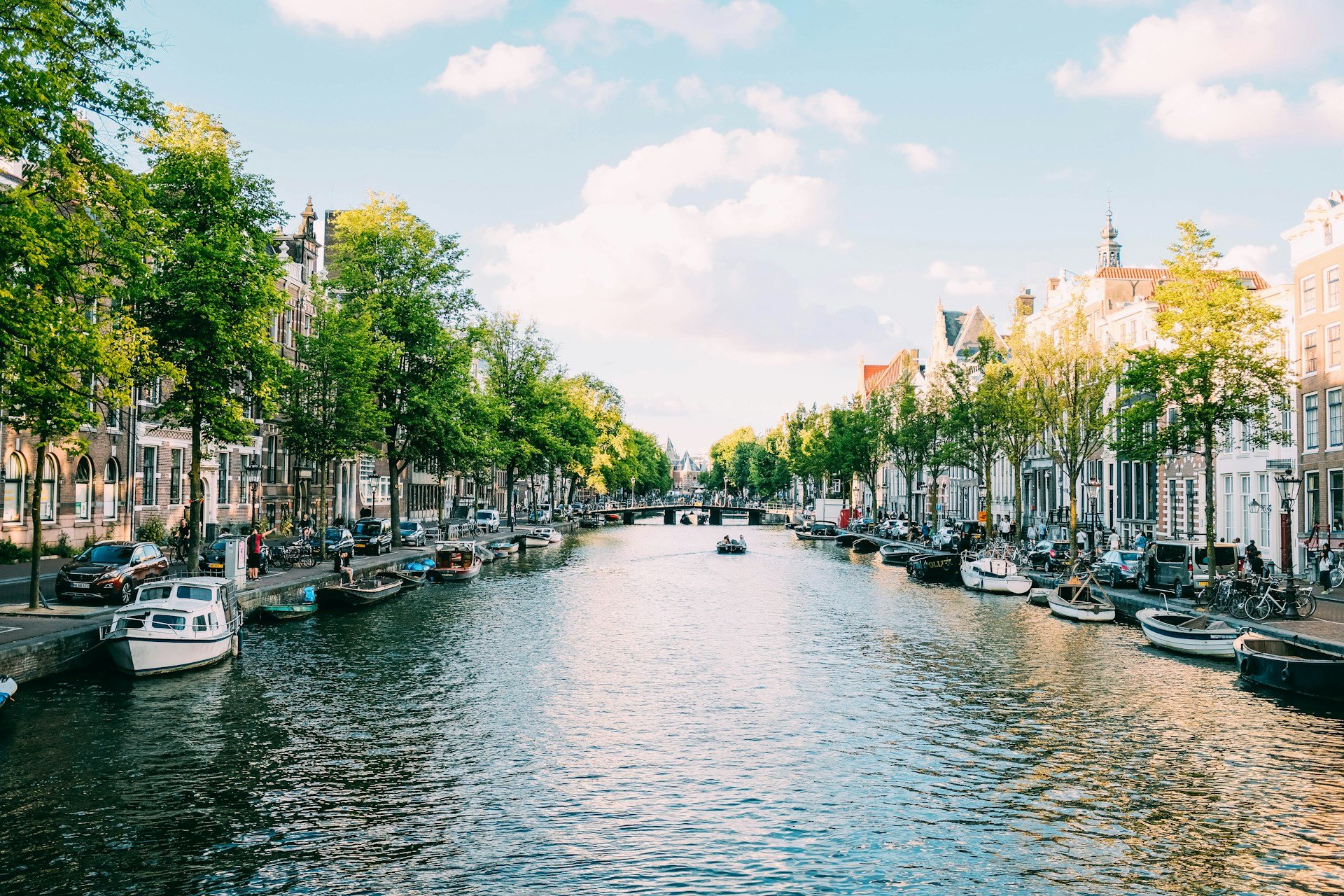
Amsterdam gets the tourist traffic, and for good reason: the 17th-century canal ring is a UNESCO World Heritage Site, the museums are world class, and the city is genuinely beautiful in a way photos undersell. But the Netherlands rewards getting out of the capital. Rotterdam rebuilt itself after near-total destruction in World War II into Europe's most interesting modern architecture city. Utrecht and Delft are quieter, canal-laced versions of the Amsterdam experience without the crowds. And the windmill villages, tulip fields and Wadden Sea coastline are a short train ride from anywhere in the country, which is itself smaller than the state of Maryland.
The honest complications
Amsterdam in peak summer is genuinely overcrowded around Dam Square, the Red Light District and Central Station, and the city has actively campaigned to discourage the rowdiest end of its tourism (loud stag parties, public drunkenness) with real fines. Prices in the capital have risen sharply and now sit close to London levels for hotels and restaurants. The weather is unglamorous: grey, windy and wet more days than not, even in summer, so pack for rain regardless of season. And the single most common way visitors get hurt is stepping into a bike lane without looking: cyclists have the right of way, ride fast, and will not swerve for a distracted tourist checking a phone.
A History Worth Knowing
The short version: eighty years of war to break free of Spanish rule, a 17th-century Golden Age that briefly made a small trading republic one of the wealthiest and most powerful states on earth, a modern kingdom stitched together in 1815, a devastating Nazi occupation from 1940 to 1945, and a postwar reinvention as one of Europe's most progressive, engineering-obsessed societies. Knowing this turns Amsterdam's canal houses, Rotterdam's absence of an old town and the country's relationship with water from background scenery into a story that explains almost everything you'll see.
- 1568-1648
The Eighty Years' War. The Dutch provinces revolt against Spanish Habsburg rule under William of Orange, "Father of the Fatherland," winning de facto independence early and formal recognition in 1648.
- 17th century
The Dutch Golden Age. The Dutch East India Company (VOC), founded in 1602, becomes the world's first company to issue tradable stock. Amsterdam becomes the world's leading trade and finance center; Rembrandt and Vermeer paint during this period.
- 1815
Kingdom of the Netherlands. Formed after Napoleon's defeat, initially including modern Belgium, which secedes in 1830.
- 1940-1945
Nazi occupation. Germany invades on 10 May 1940. The Netherlands' Jewish population, including Anne Frank's family, is deported in large numbers. The 1944-45 "Hunger Winter" kills thousands before liberation on 5 May 1945.
- 1953
The North Sea flood. A catastrophic storm surge kills over 1,800 people and triggers the Delta Works, a decades-long flood-defense engineering program still considered one of the modern wonders of civil engineering.
- 2013-present
King Willem-Alexander. Crowned after Queen Beatrix's abdication, the first king to reign since 1890. The Netherlands is a founding member of NATO, the EU and the Schengen Area.
Read the full history: the VOC, the Golden Age, occupation and the Delta Works
Before independence, the Low Countries were a patchwork of wealthy trading provinces under Habsburg Spanish control. Religious and political tension, sharpened by the spread of Protestantism, boiled over into open revolt in 1568. William of Orange, assassinated in 1584 before seeing the outcome, is still considered the founding father of the modern Dutch state and gave his name to the House of Orange, the royal family today.
The Dutch Golden Age that followed independence is difficult to overstate. The VOC, founded in 1602, is widely considered the first multinational corporation and the first to be listed on a stock exchange, and at its peak commanded a private army and navy larger than some nation-states. Amsterdam became the financial capital of the world, religious tolerance (relative to the rest of Europe at the time) drew persecuted thinkers and craftspeople from across the continent, and the wealth funded the paintings of Rembrandt, Vermeer and Frans Hals that now fill the Rijksmuseum. The era's brutal underside, the VOC's colonial exploitation in the East Indies and Dutch participation in the Atlantic slave trade, is now addressed directly in Dutch museums rather than glossed over, including at the Rijksmuseum's own dedicated slavery history galleries.
The 19th century brought the modern kingdom, industrialization and a large colonial empire centered on the Dutch East Indies (now Indonesia), whose culinary legacy is why rijsttafel is considered a Dutch national dish today. Neutrality kept the Netherlands out of World War I, but Nazi Germany invaded anyway in 1940, bombing Rotterdam's city center into rubble in a single raid and occupying the country for five years. Roughly three-quarters of the prewar Dutch Jewish population, including the Frank family, did not survive the Holocaust, a proportion higher than almost any other occupied Western European country. Liberation came on 5 May 1945, still celebrated as Bevrijdingsdag (Liberation Day) every year.
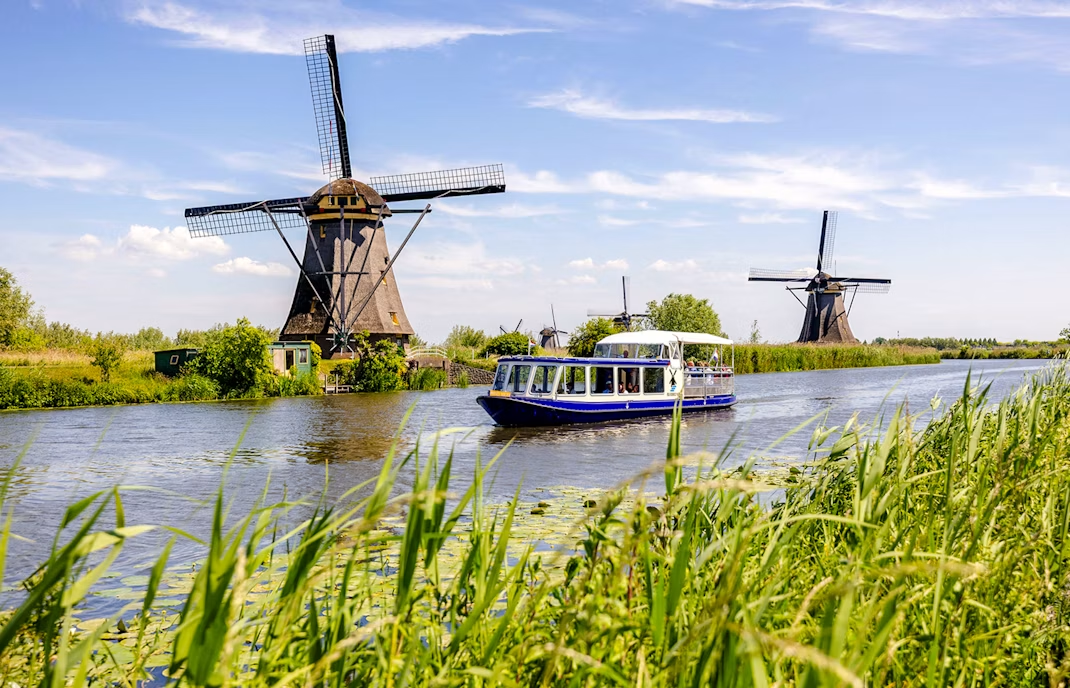
Living with water. The Netherlands has been engineering its own land for centuries: roughly 17 percent of current Dutch territory is reclaimed polder, land pumped dry and protected by dikes, historically by windmill and now by electric pumping stations. The 1953 flood disaster, which killed more people than any other Dutch peacetime catastrophe in living memory, led directly to the Delta Works, a network of dams, sluices and storm barriers across the southwest that is still expanded and maintained today as sea levels rise. Kinderdijk's UNESCO-listed windmill network is the most visible historical piece of this same water-management story.
Top Destinations
The Netherlands is compact and the train network is excellent, so distance is rarely the constraint. The country divides naturally into the Randstad (the ring of major cities: Amsterdam, Rotterdam, The Hague and Utrecht, none more than 45 minutes apart by train), the windmill-and-tulip countryside just outside it, and the quieter northern and southern provinces most visitors skip. A week covers Amsterdam plus two Randstad cities and a windmill day trip comfortably.
Amsterdam, the capital that outkicks its size
Amsterdam is small for a capital, under a million people in the city proper, but punches far above its weight: the 17th-century canal ring is UNESCO-listed, the Rijksmuseum and Van Gogh Museum hold two of the finest collections in Europe, and the city's cycling culture, coffeeshop tolerance policy and canal-house architecture make it unlike anywhere else. It's covered in full depth in our dedicated Amsterdam city guide. Budget at least three days.
Rotterdam, rebuilt from the ground up
Rotterdam's medieval center was flattened by German bombing in May 1940, and rather than rebuild a replica, the city chose to become Europe's laboratory for contemporary architecture. The tilted, forest-like Cube Houses (Kijk-Kubus) are the postcard image; one is open as a small museum for €2.50. The Markthal, a horseshoe-shaped covered market with a huge ceiling mural of fruit and flowers, has food stalls on the ground floor and apartments built into the arch itself. The Erasmusbrug, a cable-stayed bridge nicknamed "the Swan," and Europe's largest port complete the modern skyline. A water taxi across the Nieuwe Maas is the cheapest good view in the city.
The Hague, the seat of government
Confusingly, the Netherlands' capital (Amsterdam) and its seat of government are different cities: parliament, the cabinet and most embassies sit in The Hague (Den Haag), along with the International Court of Justice at the Peace Palace. Beyond government, The Hague has the Mauritshuis, a compact museum built around Vermeer's "Girl with a Pearl Earring," Madurodam's miniature-Netherlands theme park, and Scheveningen, the North Sea beach a tram ride from downtown.
Utrecht, the Netherlands' fourth city and least crowded gem
Utrecht has canals as pretty as Amsterdam's, with the distinctive feature of wharf-level cellars (werven) built directly at water height, now cafes and restaurants with tables on the water's edge. The Dom Tower, the tallest church tower in the country, is climbable for a view over the whole city and, on a clear day, toward Amsterdam. The city center is compact, walkable, and noticeably less touristy than the capital despite being under 30 minutes away by train.
Delft, small, blue and Vermeer's hometown
Delft is a compact university town easy to cover in an afternoon: the Royal Delft factory and museum explains the blue-and-white Delftware pottery the city gave its name to, the Nieuwe Kerk holds the royal family's crypt, and the town where Johannes Vermeer lived and painted his entire life has a quiet, unhurried scale that Amsterdam has largely lost. Both cities are under an hour from Amsterdam by direct train.
Kinderdijk, the postcard windmills
Nineteen 18th-century windmills along a UNESCO-listed canal network south of Rotterdam, built to drain the surrounding polder and still functional today, though only one is regularly demonstrated for visitors. Best reached by a combined water taxi and bus from Rotterdam, or as an organized day trip from Amsterdam (roughly 1.5 hours each way). Quietest early morning before tour buses arrive.
Keukenhof & the tulip fields
Keukenhof, one of the world's largest flower gardens, opens for a single roughly seven-week season each spring (19 March to 10 May in 2026) timed to tulip bloom, with the best flowering typically mid-April to early May. Beyond the garden itself, the surrounding Bollenstreek bulb region between Leiden and Haarlem has commercial tulip fields in full color during the same window, best seen by rented bike.
Giethoorn, the car-free canal village
A village in the northeastern province of Overijssel built almost entirely around a network of narrow canals rather than roads, with thatched farmhouses reachable only by footbridge or boat. Genuinely picturesque and genuinely small, which means it's overwhelmed by day-trip crowds at midday in summer; visit early morning or rent a "whisper boat" (electric, silent) to get away from the main canal.
Beyond the Randstad
The zones above cover a first or second trip well. With extra days, these are further afield but well worth the detour.
Maastricht
The Netherlands' southernmost city feels more Burgundian than Dutch: hillier, older, with a lively Vrijthof square and the underground tunnels of Fort Sint Pieter. Where the 1992 Maastricht Treaty founding the EU was signed.
The Wadden Islands
A chain of North Sea islands, including Texel and Terschelling, backing onto the UNESCO-listed Wadden Sea tidal flats. Beaches, dunes and a slower pace than anywhere in the Randstad.
Efteling
The Netherlands' best-known theme park, built around fairy-tale and folklore themes rather than franchise characters, with a devoted following well beyond the country's borders.
Culture & Etiquette
Dutch directness is the single most important cultural fact for a visitor to absorb. Saying exactly what you think, including mild criticism a British or American visitor might soften, is considered honest and respectful in the Netherlands, not rude. The flip side is "gezelligheid," a word with no direct English translation covering coziness, togetherness and a specific kind of relaxed conviviality, which the Dutch pursue with real intent in their homes, cafes and brown bars.
Do
- Use the bike lane correctly, or not at all. If you're walking, never step into a marked bike lane (usually reddish asphalt) without checking both directions. Cyclists have right of way and move fast.
- Book museums online in advance. The Anne Frank House, Van Gogh Museum and Rijksmuseum all sell out timed slots days or weeks ahead in peak season; there is often no walk-up option at all.
- Split the bill evenly. "Going Dutch," splitting costs evenly regardless of who ordered what, is a genuine, unremarkable Dutch social norm, not a stereotype invented elsewhere.
- Say a few words of Dutch. Dank je wel (thank you), Alsjeblieft (please/here you go), Hallo (hello). Nearly everyone will answer in English anyway, but the attempt is appreciated.
- Expect direct feedback and give it back. If a Dutch person tells you your plan is a bad idea, they are being helpful, not hostile.
Don't
- Photograph sex workers in the Red Light District. It's illegal and enforced, with fines and confiscated phones. Treat the area as someone's workplace, because it is.
- Smoke cannabis in the street outside a coffeeshop. Public smoking is banned and fined (€100) in central Amsterdam zones including Dam Square, Damrak and Nieuwmarkt; it's meant to be consumed on the coffeeshop premises.
- Assume "Holland" and "the Netherlands" are interchangeable. Holland is only the two western provinces (North and South Holland); locals from Utrecht, Friesland or Limburg will (politely, directly) correct you.
- Rent a car for city travel. Randstad city centers actively discourage cars with limited, expensive parking and one-way systems; trains and bikes are faster and cheaper.
- Confuse Dutch bluntness for anger. A flat, matter-of-fact tone is the cultural default, not a sign of irritation.
Deeper culture: gedoogbeleid, Sinterklaas and egalitarianism
Gedoogbeleid, the tolerance policy. Cannabis remains technically illegal under Dutch law, but a formal policy of non-prosecution allows licensed coffeeshops to sell small quantities to adults. It's a pragmatic compromise, not full legalization, and the rules (age 18+, ID required, no public consumption in restricted zones) are enforced.
Sinterklaas, not Santa. The main children's gift-giving tradition is Sinterklaas on the evening of 5 December, distinct from Christmas Day, which is more low-key and family-focused in Dutch homes.
A famously flat social hierarchy. The Netherlands ranks among the world's most egalitarian societies: bosses are addressed informally, ostentatious wealth display is culturally frowned upon even among the genuinely wealthy, and consensus-based decision-making (the "polder model") is a matter of national pride traced back to the historical necessity of neighboring landowners cooperating on shared water management.
Food & Drink
Dutch food has a reputation, not entirely fair, for blandness, built on a history of simple farm cooking rather than a refined court cuisine. The reality is heartier and more interesting than the stereotype: good bread and cheese, deep-fried snack culture that rivals anywhere in Europe, and a genuinely excellent Indonesian food tradition inherited from the colonial era that most visitors don't expect.
Bitterballen €6-8
Deep-fried breaded balls of ragout, usually beef, served with mustard as a bar snack. The single most ordered thing with a beer in any Dutch "bruin cafe" (brown cafe).
Stroopwafel ~€1-3
Two thin waffle layers with caramel syrup in between, best bought warm and fresh from a market stall rather than the packaged supermarket version, which is a different, lesser thing.
Haring €3-5
Raw, lightly salt-cured herring, traditionally eaten held by the tail and lowered into the mouth, chopped with onion and pickles from a street stall. An acquired taste worth acquiring at least once.
Rijsttafel €25-40/person
An Indonesian-Dutch "rice table" of many small shared dishes, a colonial-era invention now considered a Dutch culinary institution in its own right. Widely available in Amsterdam and The Hague, which has the country's largest Indonesian-Dutch community.
Stamppot €10-15
Mashed potato mixed with a vegetable (kale, sauerkraut or endive), served with smoked sausage. Traditional winter comfort food, hearty and cheap.
Dutch cheese & FEBO €3-6
Gouda and Edam are the exports, but a proper aged (oude) Gouda from a market stall is a different order of flavor. FEBO, the coin-operated wall-vending fast food chain, is a genuine Dutch cultural experience for a late-night croquette, love it or hate it.
When to Go & Itineraries
April through June and September through October are the sweet spots: mild temperatures, manageable crowds outside tulip season, and the best balance of daylight and price. Mid-April to early May adds Keukenhof and the tulip fields but also the year's highest prices and biggest crowds in Amsterdam. Winter is quiet and atmospheric, especially around Christmas markets and canal-side lights, though days are short and weather is genuinely raw.
All four seasons compared, with temperatures
| Season | Verdict | Temps | Prices & crowds |
|---|---|---|---|
| Apr-Jun & Sep-Oct | Best | 10-20°C | Mid prices, manageable crowds outside tulip season |
| Mid-Apr to early May | Good (busy) | 10-17°C | Keukenhof and tulip fields; peak Amsterdam prices and crowds |
| Jul-Aug | Good | 17-23°C | Warmest, longest days; busy in Amsterdam, easier elsewhere |
| Nov-Feb | Quiet | 2-8°C | Lowest prices; short days, frequent rain and wind |
Year-round city averages: Amsterdam 11°C, Rotterdam 11°C, Utrecht 11°C, The Hague 11°C, Maastricht 11°C. Rain is possible in every month; there is no reliably dry season.
Itineraries
A week covers Amsterdam properly plus a comfortable spread across the Randstad. Two weeks adds the northern provinces, a Wadden island, or a much slower pace throughout. Distance is rarely the constraint in a country this size and this well-connected by rail.
- Days 1-3
Amsterdam. The canal ring, Rijksmuseum, Van Gogh Museum, Anne Frank House (book weeks ahead), Jordaan and De Pijp neighborhoods. Full detail in our Amsterdam city guide.
- Day 4
Zaanse Schans or Kinderdijk. A half or full day at one windmill site, whichever fits your route better.
- Days 5-7
Rotterdam & Utrecht or The Hague. Rotterdam for modern architecture and the port, Utrecht for the Dom Tower and canals, or The Hague for Mauritshuis and Scheveningen beach.
- Days 1-4
Amsterdam extended. Add Amsterdam-Noord (NDSM, EYE Film Museum) and a full day trip to Keukenhof if visiting March-May.
- Days 5-6
Utrecht & Delft. A night in Utrecht, day trip to Delft for the Royal Delft factory and Vermeer connection.
- Days 7-9
Rotterdam & The Hague. Cube Houses, Markthal, water taxi in Rotterdam; Mauritshuis and Scheveningen in The Hague, 25 minutes apart by train.
- Days 10-11
Kinderdijk & Giethoorn. Windmills in the morning, the car-free canal village of Giethoorn as an overnight or long day trip.
- Days 12-14
Return to Amsterdam. Unhurried final days: museums missed the first time, a canal cruise, King's Day if the dates align.
- Days 1-5
Amsterdam & the Randstad, the 14-day route at a slower pace.
- Days 6-9
The south. Maastricht, the Vrijthof, Fort Sint Pieter's tunnels, and the border-hopping feel of a city closer to Belgium and Germany than the rest of the Netherlands.
- Days 10-14
The Wadden Islands. Ferry to Texel or Terschelling for beaches, dunes and the UNESCO-listed Wadden Sea, a genuinely different pace from the Randstad.
- Days 15-18
Windmills & countryside. Kinderdijk, Giethoorn, and the tulip region if timed for spring.
- Days 19-21
Amsterdam finale. Anything missed, plus a slow last few days in the Jordaan or De Pijp.
Getting there & around
Amsterdam Schiphol (AMS) is the main international gateway, one of Europe's busiest hubs, with a train station directly under the terminal connecting to Amsterdam Centraal in about 17 minutes for roughly €6-7. NS (Nederlandse Spoorwegen) trains connect every major city every 10-30 minutes; the network is dense, punctual by European standards, and makes a rental car actively unnecessary for a Randstad-focused trip. Cycling is the default way to get around inside any Dutch city; renting a bike (from around €15-18/day) is less a novelty and more the fastest way to move.
All transport options with prices: trains, OV-chipkaart, bikes
| Option | Price | Notes |
|---|---|---|
| NS intercity trains | €5-25/route | Amsterdam-Rotterdam ~40 min, Amsterdam-Utrecht ~28 min, Amsterdam-The Hague ~50 min. Book via ns.nl or use an OV-chipkaart. |
| OV-chipkaart | €7.50 card + credit | Reloadable card for all Dutch public transport: trains, trams, buses and metro. Tap in and out every time, including on trains. |
| Schiphol to Amsterdam Centraal | ~€6-7 | NS Sprinter train, about 17 minutes, departs roughly every 7 minutes from the station beneath the terminal. |
| City bike rental | €15-18/day | MacBike and similar operators have multiple locations in every major city; e-bikes cost more (€9-25/day extra). |
Driving: a rental car is genuinely unnecessary for a Randstad-focused itinerary and actively unhelpful in city centers, where parking is scarce, expensive and often restricted to residents. A car becomes useful for reaching rural windmill villages, the Wadden coast or the far south off the main rail lines. Roundabouts give priority to cyclists in a specific, non-obvious way; read up before driving.
Practical prep: buy a Dutch SIM at Schiphol or an eSIM before landing; coverage is excellent nationwide, including on trains. Standard travel insurance suffices for a Netherlands trip; the main claim category is theft, not medical evacuation. GetTransfer offers fixed-price airport pickups from Schiphol, though the train is faster and cheaper for anyone without heavy luggage.
Where to stay
City hostels
Amsterdam has some of Europe's best-regarded hostels, with social atmospheres and included breakfasts. Full picks in our Amsterdam city guide.
Mid-range city hotels
Every Randstad city has a solid mid-range tier; Rotterdam, Utrecht and The Hague run 20-30 percent cheaper than equivalent Amsterdam quality.
Canal-house B&Bs
Converted 17th-century canal houses turned small guesthouses, common in Amsterdam, Utrecht and Delft, with steep original staircases and genuine period character.
Luxury & design hotels
Amsterdam's top tier includes converted canal-house complexes and design-forward properties across the water in Noord; detailed picks in the Amsterdam city guide.
Budget Planning
The Netherlands is a Western European price country, closer to Germany or France than to the Balkans or southern Europe, and Amsterdam specifically runs close to London-level pricing for hotels and restaurants. The good news: the moment you leave the capital, prices drop noticeably, and the excellent train network makes basing yourself somewhere cheaper and day-tripping in a genuinely viable strategy.
- Hostel dorm €25-45
- Supermarket meals & snack bars €10-18
- OV-chipkaart public transport
- Free museums (first Sunday of the month at some) and parks
- Mid-range hotel or B&B
- Restaurant meals €20-35/person
- Museum tickets €20-27 each
- Bike rental & occasional taxi
- Design or canal-house luxury hotels
- Fine dining, including Michelin-starred options
- Private guides and tours
- Peak-season Amsterdam and King's Day accommodation
Quick reference prices: coffee, museums, transport
| Coffee | €3-4 |
| Stroopwafel from a stall | €1-3 |
| Casual restaurant meal | €15-25 |
| Rijksmuseum / Van Gogh Museum | ~€25-27 |
| Anne Frank House | €16.50 adult |
| Schiphol-Amsterdam Centraal train | ~€6-7 |
| GVB 1-hour ticket (Amsterdam) | €3.40 |
| City bike rental | €15-18/day |
| Mid-range hotel, Amsterdam | €100-150/night |
| Mid-range hotel, other Randstad cities | €80-120/night |
Prices reflect August 2026 research and drift over time, especially Amsterdam accommodation around King's Day and peak tulip season. Treat them as a planning baseline, not a quote.
Visa & Entry
The Netherlands is a founding member of the Schengen Area: US, UK, Australian, Canadian and New Zealand citizens enter visa-free for up to 90 days in any 180-day period, and this time is shared across every Schengen country, not reset at each border. There are no passport checks at the land borders with Belgium or Germany. The Dutch Immigration and Naturalisation Service (IND) is the authoritative source for current entry rules.
✓ Valid passport
At least 3 months validity beyond your planned departure from the Schengen Area. Keep a photocopy separate from the original.
✓ Proof of onward travel
May be requested at immigration, along with proof of sufficient funds for the stay.
✓ Accommodation details
Hotels and registered short-term rentals report guest stays automatically; have your first night's address available.
✓ ETIAS: watch this space
ETIAS travel authorization for visa-exempt visitors had been targeted for late 2026, but as of August 2026 the EU has removed that date from its official pages, with a 2027 start now considered more realistic. It is not required yet; don't pay third-party sites claiming otherwise.
| Netherlands | Belgium | |
|---|---|---|
| Daily budget | €55-75 outside Amsterdam; pricier in the capital | Noticeably cheaper across the board, including Brussels |
| Signature city | Amsterdam's canal ring and museums | Bruges' medieval core and Brussels' Art Nouveau |
| Food & drink | Cheese, herring, jenever, Indonesian rijsttafel | Waffles, chocolate, fries, one of the world's great beer cultures |
| Getting around | Best cycling infrastructure on earth | Excellent trains, less cycling-first than the Netherlands |
| Schengen | Yes, founding member | Yes, same advantage |
Safety, Solo Women & Family
The Netherlands is safe for tourists by any measure. Violent crime against visitors is rare, cities are fine to walk at night with normal urban awareness, and emergency services are fast and English-speaking. The real everyday hazard isn't crime, it's bicycle traffic: cyclists move fast, have right of way in most situations, and will not swerve for a distracted pedestrian. Look both ways before stepping into any reddish-asphalt bike lane, every time.
Bike lane injuries
The single most common way visitors get hurt. Never walk in a marked bike lane, and look both ways, cyclists come from both directions and don't always announce themselves.
Pickpocketing
Concentrated around Amsterdam Centraal, Dam Square, the Rijksmuseum and Albert Cuyp Market, and especially on crowded trams. Keep bags zipped and in front.
Scam taxis
Unofficial drivers approach arrivals at Schiphol and Centraal Station with inflated fixed fares. Use the official taxi rank, an app like Uber or Bolt, or take the train.
Two more things worth knowing: canals at night and coffeeshop etiquette
Canals after dark. Amsterdam's canal edges have low or no railings in many places, and a combination of alcohol, unlit stretches and a late-night bike or scooter is a genuine (if rare) cause of drowning incidents most years. Stay alert near the water after dark, especially after drinking.
Coffeeshops and edibles. Cannabis edibles are significantly stronger and slower-acting than smoking, and a meaningful number of tourist hospital visits each year are from visitors overestimating their tolerance with edibles bought at a coffeeshop. Start with a small amount and wait at least an hour before considering more.
The 3 scams to actually know about
The Netherlands is not a high-scam destination by European standards, and the three patterns below cover nearly everything a visitor is likely to encounter. The full country list lives on our Netherlands travel alerts page.
Tram & market pickpocketing
Distraction techniques on crowded trams and at busy markets like Albert Cuyp remain the leading tourist-targeted crime. Keep valuables zipped and in front pockets, not back pockets or open tote bags.
Unofficial taxi touts
Drivers approaching arrivals directly, rather than waiting at the marked rank, typically overcharge. Only use the official taxi rank, a booked app ride, or the train.
Fake museum ticket sites
Third-party sites mimicking the Anne Frank House or Van Gogh Museum sell inflated or invalid tickets. Book only through the museum's own official website.
Solo women travelers
The Netherlands rates among the best countries in the world for solo women travelers. Streets in every major city are well lit, public transport runs late and feels safe, and harassment is uncommon even walking alone at night in central Amsterdam, Rotterdam or Utrecht. The main practical advice is the same as for any visitor: watch for pickpockets in crowds and stay alert near unlit canal edges late at night. Full detail on our Solo Woman Explorer pages.
Emergency numbers
Embassies (in The Hague, not Amsterdam) and hospital info
112 is the EU-standard emergency number, and English-speaking operators and responders are the norm, not the exception. Nearly all embassies and consulates, including for the US, UK, Australia and Canada, are located in The Hague, the seat of Dutch government, not in Amsterdam. The US Embassy in The Hague maintains a separate consulate in Amsterdam for routine passport services.
Amsterdam's major hospitals, including OLVG and Amsterdam UMC, have English-speaking staff and are used to treating international visitors. Standard Schengen-compliant travel insurance covers routine care; the Netherlands does not require special coverage beyond that.
Family travel & pets
The Netherlands is an excellent family destination. Cities are flat, stroller-friendly and easy to navigate, canal boat rides and windmill villages hold children's attention well, and purpose-built family attractions like Madurodam (a miniature Netherlands) and the Efteling theme park are designed with kids specifically in mind. The main safety note for families is the same as for adults: teach children early to look both ways before stepping into a bike lane, since drivers and cyclists both assume pedestrians will yield.
Kids on canal cruises, cycling with children, and bringing pets
Canal cruises and boats: most operators are comfortable with young children, though supervise closely near open railings. Cycling with kids is completely normal in the Netherlands; rental shops offer bikes with child seats and even cargo bikes, the standard way Dutch parents move multiple children around.
Pets: EU pet passport holders can enter with dogs, cats and ferrets given valid rabies vaccination and microchipping. Non-EU visitors need a veterinary health certificate issued within 10 days of travel plus current rabies vaccination. The Netherlands has no mandatory quarantine for pets meeting these requirements, and dogs are welcome in many outdoor cafe seating areas.
Netherlands FAQ
Is the Netherlands safe to visit?
Yes, the Netherlands is one of Europe's safest countries. Violent crime against visitors is rare. The real everyday hazard is bicycle traffic, not crime: look both ways for cyclists before stepping into a bike lane.
How much does a trip to the Netherlands cost?
Budget travelers manage on 55-75 euros a day with hostels and supermarket or snack-bar food. Mid-range runs 120-180 euros a day. Amsterdam is the most expensive city; Rotterdam, Utrecht and The Hague run noticeably cheaper.
Do I need a visa for the Netherlands?
Citizens of the US, UK, Australia, Canada and New Zealand can enter visa-free for up to 90 days in any 180-day period under the Schengen rules. The Netherlands is a founding Schengen member.
When is the best time to visit the Netherlands?
April to June and September to October, for mild weather and manageable crowds. Mid-April to early May adds tulip season at Keukenhof, though this is also the busiest and most expensive stretch.
How many days do you need in the Netherlands?
A week covers Amsterdam plus two or three Randstad cities or a windmill day trip. Two weeks adds Utrecht, Delft, the Wadden Islands or a slower pace throughout.
Is Amsterdam the same as the Netherlands?
No. Amsterdam is the capital and largest city of the Netherlands, a country of about 18.4 million people. Holland refers only to two western provinces, North and South Holland, which include Amsterdam and Rotterdam but not the rest of the country.
Is it better to rent a car in the Netherlands?
Not for the Randstad cities, where trains are frequent and city centers are hostile to cars. A car helps for windmill villages and rural provinces off the rail network, but is a liability, not an asset, inside Amsterdam.
Is the Netherlands in the Schengen Area?
Yes. The Netherlands is a founding Schengen member and uses the euro. There are no passport checks at land borders with Belgium or Germany.
What language is spoken in the Netherlands?
Dutch is the official language, with Frisian co-official in the northern province of Friesland. English proficiency is among the highest in the world outside native-English countries; most Dutch people switch to English immediately with visitors.
Is the Netherlands safe for solo female travelers?
Yes, consistently rated among the best countries in the world for solo women. Streets are well lit, public transport runs late, and harassment is uncommon even at night in city centers.
Is the Netherlands good for families with kids?
Yes. Cities are flat, cycling-friendly and easy to navigate with a stroller, canal boat rides and windmill villages appeal to kids, and Madurodam and the Efteling theme park are built with families in mind.
Is the Netherlands cheaper than the UK?
Broadly comparable to London-level prices in Amsterdam, but noticeably cheaper the moment you leave the capital. Rotterdam, Utrecht and The Hague run 20-30 percent below Amsterdam for the same quality of hotel and meal.
What Stays With You
Every traveler who visits the Netherlands walks away with a slightly different postcard: the bike bell ringing behind you on a canal-side street, the impossible symmetry of a tulip field seen from a rented bicycle, the specific gold light on the Amstel at nine on a summer evening when it still hasn't set. None of it feels accidental, and that's the point. This is a country that engineered its own land out of the sea, built a society around consensus and directness in roughly equal measure, and then quietly became one of the most livable places on earth.
Go for the museums and the windmills, and leave understanding why the Dutch built a nation around cooperating with water instead of fighting it.