
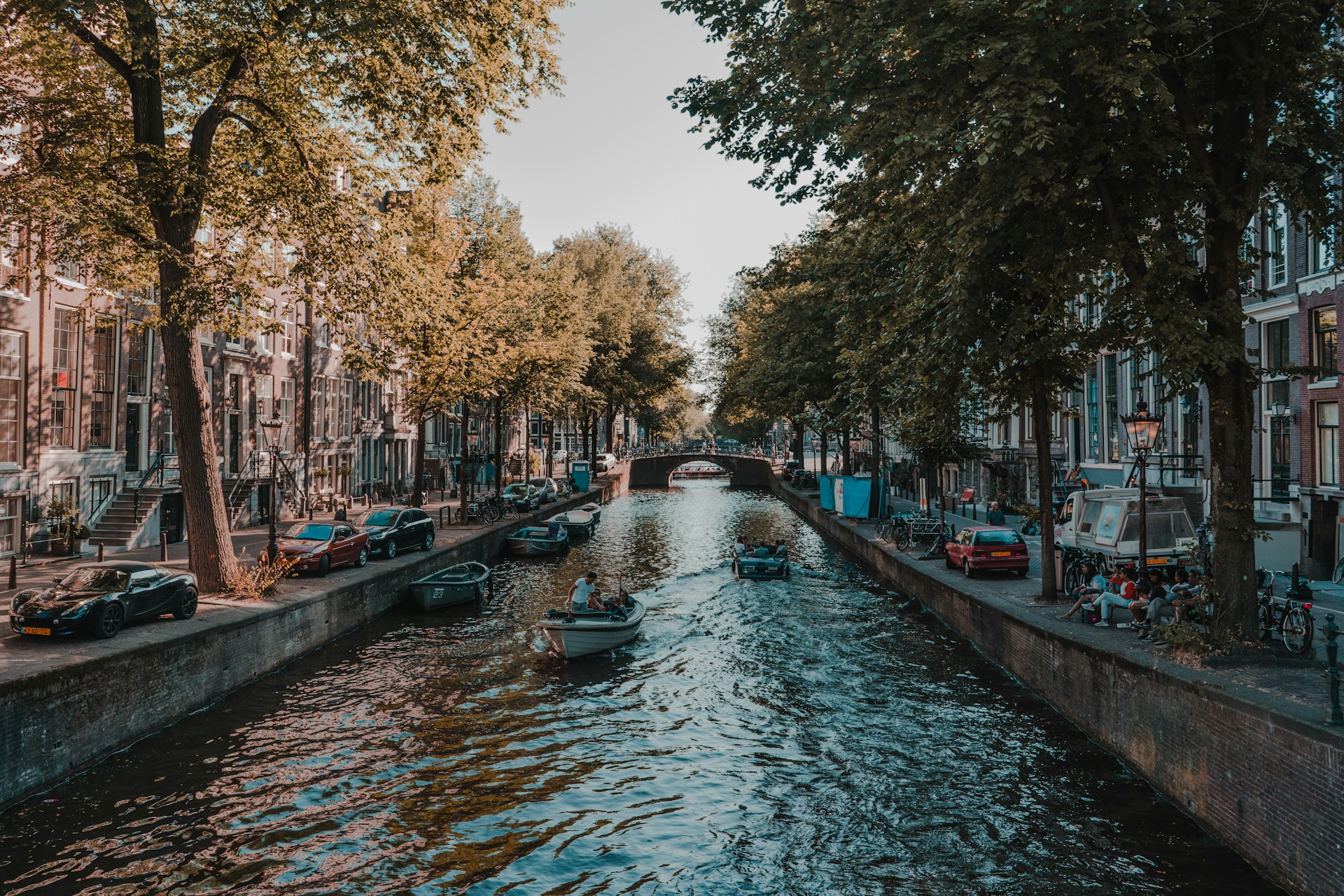
A capital built on 17th-century wealth and a healthy disregard for straight lines
Amsterdam's canal ring, the Grachtengordel, was planned in the 1600s as an orderly expansion of a suddenly wealthy trading city, and it remains one of the most complete pieces of 17th-century urban planning left on earth, UNESCO-listed and still fully lived in rather than preserved behind glass. What makes the city work today isn't nostalgia, though: it's that Amsterdam kept building a genuinely modern, cycling-first, socially liberal city on top of that historic frame instead of freezing it in place.
What changed in the last fifteen years is that the world found out in a bigger way than the city was ready for. Overtourism around Dam Square and the Red Light District got bad enough that Amsterdam has actively worked to discourage its rowdiest visitors with real fines and a marketing campaign literally telling stag parties to stay away. The response is instructive: walk two streets back from the main canals into the Jordaan or De Pijp and you're in a neighbourhood that still belongs to the people who live there, where a lunch special costs €12 and nobody's selling you a souvenir clog.
The honest complications
The crowds around Dam Square, the Red Light District and Centraal Station in peak summer are genuinely overwhelming, and prices in the city center have climbed close to London levels for hotels and restaurants. The weather is unglamorous and rarely dry, so pack for rain in any season. And the single most common way visitors get hurt in Amsterdam isn't crime, it's stepping into a bike lane without looking both ways: cyclists move fast, have the right of way, and will not swerve for a distracted tourist checking a phone.
Five neighbourhoods, one free ferry, and a river that isn't a river
Amsterdam's center is compact enough to walk end to end in under an hour, and where you base yourself comes down to how central and how quiet you want those nights to be.
Canal Ring (Grachtengordel)
The 17th-century Golden Age canal belt, Herengracht, Keizersgracht and Prinsengracht curving in concentric arcs around the old center. Gabled canal houses, a genuinely beautiful setting at any hour, and the highest hotel prices in the city as a result. The Anne Frank House sits right on the Prinsengracht.
Jordaan
West of the Canal Ring, the Jordaan was a working-class neighbourhood that gentrified into Amsterdam's most rewarding area for eating and wandering: narrow streets, independent boutiques, and a dense cluster of restaurants and brown cafes locals return to for years, not tourists chasing a landmark.
De Pijp
South of the center, De Pijp built its identity around the Albert Cuyp Market, the country's largest street market, and has become the city's strongest food neighbourhood outside the Jordaan, with better prices and fewer tourists per square meter.
Oud-West
A short tram ride from the center, Oud-West's 20th-century architecture is a world away from the canal houses. De Hallen, a former tram depot converted into a food hall (Foodhallen) with an art deco cinema attached, anchors the area.
Amsterdam Noord
Across the IJ river from Centraal Station, reachable by a free 24/7 ferry, Noord has gone from shipyards to the city's creative overspill: the NDSM Wharf's street art and studios, the EYE Film Museum, and the A'DAM Tower's viewing platform and swing. Noticeably cheaper to sleep in than the center, and only a few minutes away by ferry.
From converted Golden Age canal houses to the best hostel scene in Europe
Amsterdam's hostels are consistently ranked among Europe's best, and the mid-to-luxury tier is full of genuine 17th-century canal houses converted with real character rather than chain-hotel uniformity. These picks cover every budget.
At the top, Pulitzer Amsterdam occupies 25 connected 17th-century canal houses spanning the Prinsengracht and Keizersgracht, a genuine architectural maze with courtyard gardens, an art gallery and canal-boat access, from roughly €300 a night. The Toren, in two 17th-century canal houses directly on the Keizersgracht, is the boutique pick, from around €200 a night with canal views and a well-regarded breakfast.
In the literary-minded boutique bracket, Ambassade Hotel spans ten canal houses on the Herengracht, a nine-minute walk from the Anne Frank House, with a library holding thousands of books signed by the authors who've stayed there. Across the water in Noord, Sir Adam sits inside the A'DAM Tower itself, overlooking the IJ, with record players in every room and a short free ferry ride to Centraal, from around €190 a night.
At the budget end, Flying Pig Downtown, a five-minute walk from Centraal and Dam Square, is the city's best-known party hostel with themed nights and a 24-hour reception (dorms €30-50); its calmer sibling Flying Pig Uptown sits beside Vondelpark. ClinkNOORD, a converted 1920s laboratory in Amsterdam Noord, is quieter and cheaper, with an on-site bar, a terrace, and the free ferry as its connection to the center.
Bitterballen, raw herring and a genuinely excellent Indonesian food scene
Amsterdam's food culture centers on the brown cafe, a small dark-wood bar serving beer, jenever and snacks, and on a market and street-food scene that rewards leaving the main tourist strips. The best meals are often unglamorous: a herring stall, a lunch special chalked on a board, a bar of bitterballen shared over a round of beer.
Bitterballen & brown cafes
Deep-fried ragout balls with mustard, the default order in any "bruin cafe" (brown cafe, named for the nicotine-stained wood paneling of the classic ones). Jordaan cafes do this best; sit at a wobbly outdoor table with a Dutch beer and watch the street.
Apple pie & stroopwafel
Winkel 43, on the Noordermarkt in the Jordaan, is Amsterdam's most famous appeltaart: a thick, cinnamon-heavy deep-dish slice under a generous pile of whipped cream. Go on a weekday morning to avoid the queue that forms on market days.
Haring
Raw, lightly cured herring from a street cart, chopped with onion and pickle, traditionally eaten by the tail held above the mouth. An acquired taste, and one of the more distinctly Dutch things you can do with twenty minutes and three euros.
Rijsttafel
The Indonesian-Dutch "rice table," many small shared dishes reflecting the colonial-era culinary exchange, is considered a Dutch institution in its own right. Widely available across the city and worth seeking out over generic "Dutch" tourist menus.
A city best explored on foot, by bike, and slightly lost
Amsterdam rewards wandering as much as any European capital. The must-book museums need genuine advance planning; the rest of the city is best discovered by simply walking or cycling without a fixed plan for an afternoon.
The big three museums
The Rijksmuseum holds the Dutch Golden Age's greatest works, Rembrandt's "The Night Watch," Vermeer's "The Milkmaid," and dedicated galleries addressing the VOC's colonial and slavery history directly (timed entry, roughly €25-27, open daily 9am-5pm, book online). The Van Gogh Museum has the world's largest Van Gogh collection, arranged to trace his short, intense career chronologically (roughly €25, timed slots that sell out three to seven days ahead in peak season). The Anne Frank House, the actual hiding place on the Prinsengracht, is the most emotionally direct museum in the city and the hardest ticket: releases go online every Tuesday at 10am for slots exactly six weeks out and sell out within minutes (€16.50 adult, no walk-up tickets, book only via annefrank.org).
The canal ring and a boat
Walking the Canal Ring is free and essential, but seeing it from the water changes the geometry entirely: a standard hour-long canal cruise with operators like Blue Boat or Lovers runs roughly €15-20 booked online, departing regularly from the center. Renting a bike, from MacBike or similar operators (from around €15-18/day, five locations around the city), is the fastest and most Amsterdam way to cover ground; ride in the bike lane, signal turns, and expect to be overtaken.
Vondelpark & the museum quarter
Vondelpark, the city's largest and most-used green space, is free, always busy with joggers, picnics and impromptu music, and sits directly behind the museum quarter, making it the natural place to decompress between the Rijksmuseum and Van Gogh Museum. The Heineken Experience, in the brewery's original 19th-century building, is touristy but well done, a self-guided tour with two included drinks for around €23-25 online.
Markets and De Wallen
Albert Cuyp Market in De Pijp is the country's largest street market, food stalls and clothing side by side, best on a weekday morning before the crowds. De Wallen, the Red Light District, is one of the oldest parts of the city and worth walking for the architecture and canals alone; treat it as a neighbourhood where people work, never photograph the women in the windows, and expect a heavier police presence enforcing the public photography and cannabis-consumption rules.
Amsterdam Noord
The free 24/7 ferry from behind Centraal Station crosses the IJ in about four minutes. On the other side: the NDSM Wharf's street art, container studios and flea markets in a former shipyard, the EYE Film Museum's striking angular building and river-view terrace, and the A'DAM Tower's observation deck and Europe's highest swing, spun out over the edge of the building.
One, two or three days, planned street by street
Three full days covers Amsterdam properly; even one well-planned day delivers the essentials. These routes are walkable, timed to dodge the worst museum queues, and book the unmissable tickets early.
- Morning
Canal Ring & Jordaan. Walk the Herengracht and Prinsengracht, coffee and apple pie at Winkel 43, browse the Jordaan's boutique streets.
- Midday
Anne Frank House (if you booked six weeks ahead) or the Rijksmuseum. Either needs a pre-booked timed slot.
- Afternoon
Vondelpark & a canal cruise. An hour in the park, then an hour on the water to see the canal ring from a different angle.
- Evening
De Pijp for dinner. A tasca-style lunch spot becomes a lively dinner scene; Loetje or a bar of bitterballen and a Dutch beer.
- Day 1
The one-day route: Canal Ring, Jordaan, a big museum, Vondelpark, canal cruise, dinner in De Pijp.
- Day 2 morning
Van Gogh Museum at opening, then the Heineken Experience nearby.
- Day 2 afternoon
Amsterdam Noord. Free ferry across the IJ, NDSM Wharf, EYE Film Museum, A'DAM Tower viewing deck.
- Day 2 evening
Back across for dinner in the Jordaan; Café de Linden or Moeders for traditional Dutch cooking.
- Days 1-2
The two-day route above, at a gentler pace, adding Albert Cuyp Market in De Pijp.
- Day 3, option A
Zaanse Schans or Keukenhof. Windmills year-round, tulip fields if visiting mid-March to mid-May. Both reachable by train and bus in under an hour.
- Day 3, option B
Utrecht or Haarlem. A short train ride to a quieter, canal-laced city for a change of pace from Amsterdam's crowds.
Flat, compact, and built around the bicycle
Amsterdam's historic center is entirely flat and compact enough to cross on foot in under an hour, but the fastest way to get anywhere is the way locals do it: by bike. From Schiphol Airport, the NS Sprinter train runs from directly beneath the terminal to Amsterdam Centraal in about 17 minutes for roughly €6-7, departing every 7 minutes; a taxi costs €40-50 for the same trip and is rarely faster once traffic is factored in.
In the city, the OV-chipkaart (€7.50 plus credit, sold at any metro or train station) covers GVB trams, buses and the metro, tap in and out every time. A single GVB 1-hour ticket costs €3.40; a 24-hour pass is €10, with GVB Max capping a day's fares at €10.50. Renting a city bike (€15-18/day from MacBike and similar operators, €50 cash or card deposit) is faster than transit for most central trips and closer to how the city actually moves.
Best time to visit and King's Day
Amsterdam has a mild, wet, Atlantic-influenced climate. April to June and September to October are the sweet spots: manageable crowds, moderate prices, decent odds of a dry afternoon. July and August are busiest and warmest; winter is quiet, atmospheric and grey, good for museums and brown cafes rather than canal-side lounging.
King's Day (Koningsdag), 27 April 2026, turns the entire city orange: canals packed with private boats and parties, streets one continuous flea market and DJ set. Genuinely one of Europe's best city-wide parties, but book accommodation months ahead, the city sells out completely and prices multiply.
One of Western Europe's pricier city breaks, with room to manage it
Amsterdam runs close to London-level pricing for hotels and restaurants in the Canal Ring, but the hostel tier is excellent value and De Pijp or the Jordaan offer real savings over the tourist-facing center for meals of the same quality.
- Hostel dorm €25-50
- Market food, herring stalls & bakeries €15-20
- OV-chipkaart or walking
- Free Vondelpark, canal walks, one paid museum
- Boutique or canal-house hotel €100-180
- Restaurant meals €30-50
- OV-chipkaart plus the occasional Uber
- Two museums, a canal cruise, bike rental
- Pulitzer Amsterdam or equivalent €280+
- Tasting menus, De Kas and similar
- Private guides and museum skip-the-line
- King's Day or peak tulip-season accommodation
One of Europe's safest cities, with three things to actually know
Amsterdam rates 9.0/10 on our safety scale. Violent crime against tourists is extremely rare, the city is safe at night including the Jordaan, De Pijp and most of the center, and Amsterdam is excellent for solo female travellers: harassment is uncommon and the streets feel safe at all hours. The three things that actually catch visitors: bike lanes, stepping into one without looking is the single most common way tourists get hurt in this city; pickpocketing, concentrated around Centraal Station, Dam Square, the Rijksmuseum and Albert Cuyp Market, especially on crowded trams; and canal edges at night, many stretches have low or no railings, and alcohol plus an unlit canal-side walk is a genuine, if rare, cause of drowning incidents most years.
Emergency number is the EU-standard 112 from any phone. Coffeeshop cannabis is legal to buy and consume on-premises for anyone 18+ with ID; smoking in the street is banned and fined (€100) in specific central zones including Dam Square, Damrak and Nieuwmarkt, and edibles are significantly stronger and slower-acting than smoking, a common cause of tourist hospital visits from overestimating tolerance.
Windmills, tulips and quieter cities, all under 90 minutes away
Amsterdam's position at the heart of the Randstad makes it an excellent base for day trips. Four are worth a half or full day each, and all run by train, bus or organized tour directly from the city.
Zaanse Schans
Working windmills, a cheese farm and a clog workshop gathered into one open-air site just outside the city. Touristy but genuinely photogenic, and easy to combine with a morning or afternoon in the center on the same day.
Keukenhof & the tulip fields
One of the world's largest flower gardens, open for a single seven-week spring season (19 March to 10 May in 2026), best visited mid-April to early May for peak bloom. The surrounding Bollenstreek bulb fields are worth a bike ride if visiting in season.
Utrecht
The Netherlands' fourth city, with canals as pretty as Amsterdam's and a fraction of the crowds. Climb the Dom Tower, the country's tallest church tower, for a view that stretches back toward Amsterdam on a clear day.
Haarlem
A compact, handsome city a short hop from Amsterdam, with a Grote Markt square, the Frans Hals Museum, and a noticeably calmer pace. Often paired with the tulip fields, which sit between the two cities.
Amsterdam FAQ
Is Amsterdam safe for tourists?
Amsterdam is one of the safest capital cities in Europe. Violent crime against tourists is extremely rare; the main concerns are pickpocketing in crowded spots and stepping into a bike lane without looking. Standard city awareness is all you need.
How many days do I need in Amsterdam?
Three full days covers the city well: one for the canal ring and Jordaan, one for the museum quarter and Vondelpark, one for De Pijp and Amsterdam Noord. A fourth day fits a windmill or tulip day trip and is worth adding.
How much does Amsterdam cost per day?
Budget travellers manage on 55-75 euros a day with hostels and supermarket or snack-bar food; mid-range runs 130-190 euros. Amsterdam is one of the pricier Western European city breaks, closer to London than to most of the rest of the Netherlands.
When is the best time to visit Amsterdam?
April to June and September to October: mild weather, manageable crowds. Mid-April to early May adds Keukenhof and tulip season, and King's Day on 27 April 2026 is one of Europe's great street parties, but both mean peak prices and a fully booked city.
How do I get from Schiphol Airport to the centre?
The NS Sprinter train runs from directly beneath the terminal to Amsterdam Centraal in about 17 minutes for roughly 6-7 euros, departing every 7 minutes. It is faster and cheaper than a taxi, which costs 40-50 euros.
What is the best area to stay in Amsterdam?
The Canal Ring and Jordaan for first-timers: central, walkable and beautiful, if pricier. De Pijp for a more local, better-value base with excellent food. Amsterdam Noord for budget hostels and a short free ferry ride to the centre.
Do I need to book Anne Frank House and Rijksmuseum tickets in advance?
Yes, essentially always. Anne Frank House releases tickets online exactly six weeks ahead and sells out in minutes; the Rijksmuseum and Van Gogh Museum sell timed slots that go days to weeks ahead in peak season with little or no walk-up availability.
Can tourists still buy weed in Amsterdam coffeeshops?
Yes. A proposed ban on tourists in coffeeshops was officially dropped, and all licensed coffeeshops remain open to visitors 18 and over with ID. Public smoking is banned and fined in specific central zones including Dam Square and Nieuwmarkt.
What is the OV-chipkaart and do I need one?
The Netherlands' reloadable public transport card, needed for GVB trams, buses and the metro as well as national trains. A single-use option exists for short Amsterdam-only trips, but a loaded OV-chipkaart is more convenient for a multi-day stay.
What Stays With You
Amsterdam doesn't perform for visitors so much as get on with being exactly what it's always been: a city built on trade and tolerance in roughly equal measure, dense with four centuries of wealth poured into gabled brick, and still run day to day by people getting to work on a bicycle rather than posing for anyone's photo. The bike bell that makes you jump the first day and stops registering by the third. The apple pie at Winkel 43 that outclassed the tourist-menu dinner from the night before. None of it was staged, which is why it sticks.
Rent a bike on your last morning, ride the canal ring slowly with nowhere particular to be, and understand why the Dutch never felt the need to build their capital any other way.