
What You're Actually Getting Into
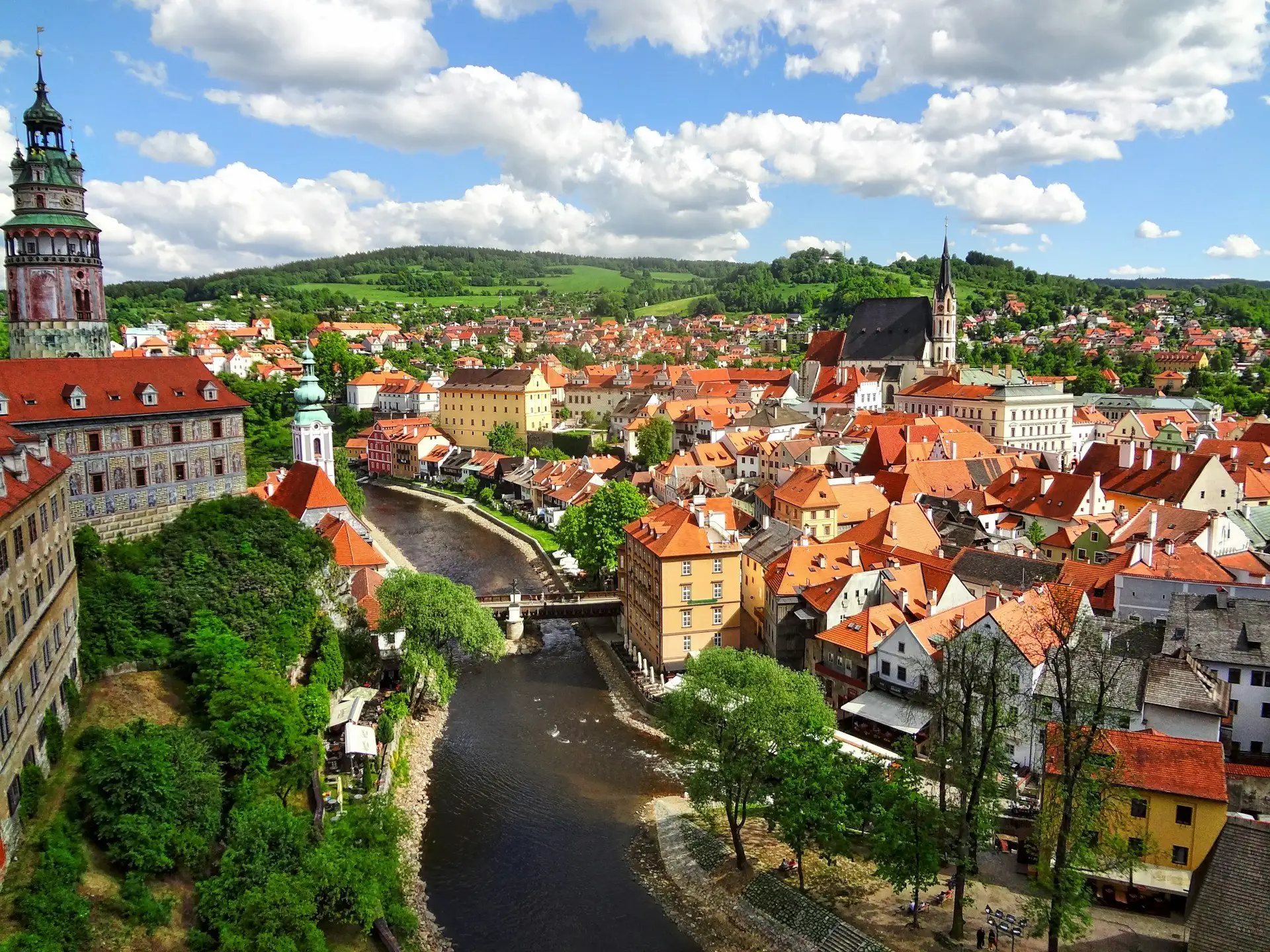
Prague did the marketing work for the whole country decades ago, and it earned it: a medieval core that survived both world wars almost untouched, a skyline of spires and red roofs that looks staged and isn't. What the Prague-only itinerary misses is that Czechia outside the capital is where the country stops performing for tourists. Two UNESCO towns, a spa region built on the same mineral springs Goethe and Beethoven took the waters at, and a beer culture so central to daily life that Czechs drink more of it per person than anyone else on the planet.
It's also an unusually easy country to get right on a first visit. Trains run on time and go almost everywhere worth going, English is standard in any place a visitor is likely to end up, and the whole country is rated Level 1, Exercise Normal Precautions, by the US State Department, one of the lowest-risk ratings issued anywhere. The main friction points are not safety but small, avoidable ones: currency exchange offices that quietly apply a worse rate than advertised, and a instinct to assume everything runs on the euro when it doesn't.
The honest complications
Prague's Old Town Square and the stretch of Karlova Street leading to Charles Bridge are as tourist-saturated as anywhere in Europe in July and August, with the crowds, the inflated menu prices and the currency exchange sharks that come with that kind of traffic. Czechia still uses its own currency, the koruna, not the euro, which trips up visitors who assume otherwise; card payment is widely accepted, but small-town pubs and market stalls are often cash-only. And while the country overall is extremely safe, it is not immune to petty theft: pickpocketing on crowded trams and around major sights is the one thing worth actual vigilance.
A History Worth Knowing
Czechia's history is the story of Bohemia and Moravia passing between Czech, Habsburg and briefly Nazi control, then forty years of Soviet-aligned communism, then one of the most peaceful revolutions and one of the most peaceful national divorces of the 20th century. Prague was, at points, the capital of the entire Holy Roman Empire; it was also, within living memory, a city where speaking out could end a career or a life.
- 1346–1378
Charles IV's golden age. The Holy Roman Emperor makes Prague his imperial seat, founds Charles University (1348), the oldest university in Central Europe, and commissions Charles Bridge and St. Vitus Cathedral.
- 1415–1434
The Hussite Wars. Religious reformer Jan Hus is burned at the stake in 1415; his followers fight a series of wars against Catholic crusaders, a preview of the Reformation a century early.
- 1526–1918
Habsburg rule. Bohemia and Moravia fall under Austrian Habsburg control, later becoming part of the Austro-Hungarian Empire until its collapse at the end of World War I.
- 1918
Czechoslovakia founded. Bohemia, Moravia and Slovakia unite as an independent republic under president Tomáš Garrigue Masaryk.
- 1948–1989
Communist rule. A 1948 coup brings the Communist Party to power; the 1968 Prague Spring reform movement is crushed by a Warsaw Pact invasion in August that year.
- 1989–1993
Velvet Revolution & Velvet Divorce. Mass protests end communist rule without a single death in November-December 1989; playwright Václav Havel becomes president. In 1993, Czechoslovakia splits peacefully into the Czech Republic and Slovakia.
- 1999–2004
NATO & EU. The Czech Republic joins NATO in 1999 and the European Union in 2004, followed by full Schengen membership in 2007.
Read the full history: Hussites, Habsburgs, communism and Havel
The Hussite movement, sparked by Jan Hus's calls for church reform decades before Martin Luther, made Bohemia a center of religious upheaval long before the rest of Europe caught up. The Hussite Wars that followed his execution were among the first conflicts in Europe where a peasant and townsfolk army repeatedly defeated professional crusader knights, using war wagons and early firearms in ways that influenced military tactics for a century.
The Defenestration of Prague in 1618, when Protestant nobles threw two Catholic officials from a castle window, helped ignite the Thirty Years' War that devastated much of Central Europe. Bohemia's subsequent re-Catholicization under Habsburg rule reshaped its religious and cultural identity for the next three centuries, even as Czech nationalism revived strongly in the 19th century.
The communist period (1948-1989) brought nationalized industry, collectivized farms and a secret police apparatus that touched most families in some way. The 1968 Prague Spring, a brief attempt under Alexander Dubček to build "socialism with a human face," ended when roughly 200,000 Warsaw Pact troops and 2,000 tanks crossed the border in a single night. Two decades of harder-line rule followed, ending only when the Velvet Revolution's student-led protests, backed by dissident playwright Václav Havel and the Civic Forum movement, forced the government to resign within weeks. The 1993 split from Slovakia, negotiated by politicians rather than decided by referendum, remains one of the rare examples of a state dividing without violence.
Top Destinations
Czechia rewards a hub-and-spoke trip built around Prague: the country is small enough, and the trains fast and cheap enough, that almost everything worth seeing is a comfortable day trip or a short hop away. Four zones cover it well: the capital, the two UNESCO towns of the south, the spa and beer country of the west, and the sandstone wilderness on the German border.
Prague, the capital that doesn't need the hype
Prague Castle, Charles Bridge, the Astronomical Clock and a UNESCO-listed historic core that runs largely unbroken from the 14th century: Prague's reputation is accurate, which is rarer than it sounds. It rewards three or four full days, ideally with early mornings for the landmarks before the tour groups arrive. The full breakdown, neighborhood by neighborhood, restaurant by restaurant, lives on our dedicated Prague city guide.
Český Krumlov, the town in a river bend
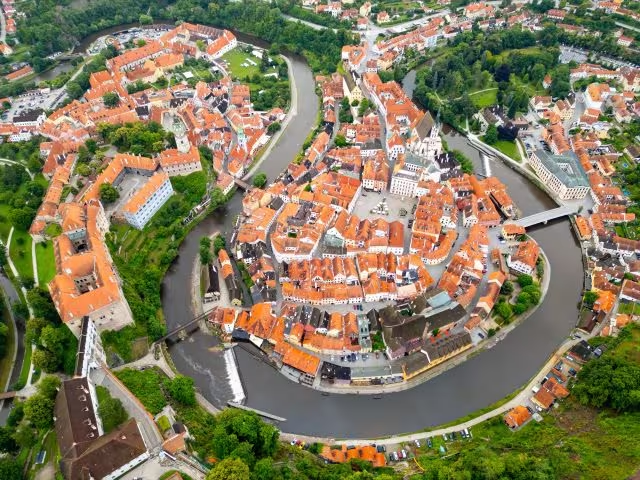
A near-complete medieval and Renaissance old town wrapped almost entirely by a horseshoe bend in the Vltava, with a hilltop castle second in size in Czechia only to Prague's. Český Krumlov Castle's Route 1 interior tour costs 300 CZK, the castle gardens are free, and rafting or canoeing the river that circles the town is a genuine local activity, not a tourist prop. Reachable from Prague by a direct Intercity train in around two and a half hours; it works as a long day trip but rewards an overnight far more.
Kutná Hora, the city of silver and bones
Once one of medieval Europe's wealthiest silver-mining towns, now best known for the Sedlec Ossuary, a chapel decorated with the bones of an estimated 40,000 people, arranged into chandeliers, garlands and a coat of arms by a 19th-century woodcarver. Entry to the ossuary and the adjoining Cathedral of Our Lady runs about 220 CZK. St. Barbara's Cathedral in the historic center, part of the same UNESCO listing, is a Gothic landmark in its own right and far less crowded than the ossuary. About an hour from Prague by direct train, genuinely the easiest day trip on this list.
Karlovy Vary, the spa town
Czechia's most famous spa town, its colonnades and grand 19th-century hotels built around a set of hot mineral springs that visitors have been drinking from small spouted cups for over two centuries. The Karlovy Vary International Film Festival, one of Europe's more prestigious, is held here every summer. Best reached from Prague by bus (around 1 hour 40 minutes), which beats the train's roughly 3-hour routing on this particular route.
Plzeň, where pilsner was born
The birthplace of pale lager itself: Pilsner Urquell has been brewed here since 1842 using a recipe and a triple-decoction process that hasn't fundamentally changed, and the brewery tour ends in the original 19th-century cellars. About an hour from Prague by train, an easy add-on to a beer-focused day.
Bohemian Switzerland National Park
Sandstone gorges, dense forest and the Pravčická brána, the largest natural sandstone arch in Europe, sitting right on the German border where it continues seamlessly into Saxon Switzerland National Park on the other side. This is the one destination on this list that genuinely rewards a car or an organized tour over public transport; it's doable from Prague but sits at the edge of a comfortable day trip, roughly two hours each way.
Beyond the main circuit
The four zones above cover a first trip well. With an extra day or two, these reward the detour.
St. Barbara's Cathedral
A soaring Gothic cathedral funded by medieval silver miners, part of the same UNESCO listing as the Sedlec Ossuary but visited by a fraction of the crowd. Worth the extra hour in Kutná Hora on its own.
Vltava river rafting
Renting an inflatable raft or canoe and floating the river loop that wraps the old town is a genuine local pastime in summer, not a manufactured tourist activity, and the best way to see the castle from below.
The original Pilsner Urquell cellars
The brewery tour's final stop: kilometers of 19th-century sandstone cellars where the beer was traditionally lagered, ending with an unfiltered, unpasteurized pour that tastes noticeably different from the export version.
Culture & Etiquette
Czech culture runs reserved-until-known: strangers on the street are not warm by default, small talk with people you don't know is not really a custom, and this is a matter of social style, not unfriendliness. Czechia is also one of the most secular societies in Europe, a legacy of both the Hussite tradition and four decades of official communist atheism, so religious small talk lands differently here than in most of the rest of the continent. Beer, on the other hand, is a genuine social institution: the neighborhood pub, the hospoda, functions the way a British pub or an Italian piazza does, and turning down a round is a bigger social statement than declining a drink usually is elsewhere.
Do
- Make eye contact and say "na zdraví" (cheers) properly. Clinking glasses while looking away is considered bad luck by some and simply rude by most; a beer round is taken more seriously here than the casual version elsewhere.
- Carry cash for small pubs and markets. Card acceptance is near-universal in Prague hotels and restaurants, but hospody in smaller towns and market stalls are frequently cash-only.
- Learn a few Czech words. Dobrý den (good day), Prosím (please), Děkuji (thank you). The effort is noticed even where English is fluent.
- Tip by rounding up. A 10% round-up for a sit-down meal is standard and appreciated; nothing more elaborate is expected.
- Validate your public transport ticket. Prague's honor system is enforced by plainclothes inspectors, and the on-the-spot fine for an unvalidated ticket is real money.
Don't
- Assume the euro works. Czechia uses the koruna (CZK), not the euro, despite being an EU member. A few tourist-facing businesses near major sights will quote euro prices, usually at a bad rate.
- Mistake reserve for rudeness. Directness and a lack of unsolicited small talk from shopkeepers or strangers is cultural default, not a personal slight.
- Order at the first currency exchange window you see near Old Town Square. Rates there are reliably worse than advertised; more in the Safety chapter below.
- Jaywalk carelessly near trams. Prague's tram network moves faster and more quietly than visitors expect, and pedestrian-tram collisions are the kind of avoidable accident that actually happens here.
- Expect trdelník to be traditional Czech food. The rolled, sugar-and-cinnamon pastry sold everywhere near tourist sites is a real Central European treat, but it's a Prague tourist-economy staple rather than a historic Czech dish, and it's priced accordingly in the most visited squares.
Food & Drink
Czech food is hearty, meat-and-dumpling Central European cooking built for a cold climate: slow-cooked meat, bread or potato dumplings for soaking up sauce, and pickled or braised vegetables on the side. It's rarely the reason people book the trip, but it is consistently satisfying, and beer, brewed here since the 13th century and elevated to a global standard by Pilsner Urquell in 1842, does a lot of the heavy lifting.
Svíčková 180-220 CZK
The dish Czechs consider their national plate: beef sirloin braised and served in a creamy root-vegetable sauce, with bread dumplings, a spoonful of cranberry compote and whipped cream. Order it at any proper Czech restaurant, not a tourist-menu one.
Guláš & Vepřo-Knedlo-Zelo 150-220 CZK
Czech goulash is thicker and less paprika-forward than the Hungarian original, usually served with dumplings rather than rice. Vepřo-knedlo-zelo, roast pork with dumplings and braised cabbage, is the other pub-menu staple.
Czech Beer 40-60 CZK/half-litre
Czechs drink more beer per capita than any nation on earth. Pilsner Urquell, brewed in Plzeň since 1842, is the original pale lager and the ancestor of most lagers made anywhere since; order it "tankové," from the tank, when you see it on tap for the freshest version.
Knedlíky
Bread or potato dumplings, sliced rather than whole, and the default starch under most Czech main courses. Bramborové knedlíky (potato) and houskové knedlíky (bread) are the two standard versions.
Smažený sýr 120-160 CZK
A block of cheese, breaded and deep-fried, served with tartar sauce and fries. Pure pub food, and better than it has any right to be after a few rounds of Pilsner.
Trdelník 80-150 CZK
The rolled pastry dusted in sugar and cinnamon sold from stalls all over central Prague. Genuinely tasty but a modern tourist-economy item, not historic Czech baking; priced well above what locals would pay for what it is.
When to Go & Itineraries
May, June and September are the sweet spot: long daylight, warm but not oppressive temperatures, and crowds noticeably thinner than peak summer. July and August are busiest and hottest, especially in Prague's historic core. Winter is cold but has its own draw, particularly the Christmas markets in December, when Old Town Square genuinely earns the postcard comparison.
All four seasons compared, with temperatures
| Season | Verdict | Temps | Prices & crowds |
|---|---|---|---|
| May-Jun & Sep | Best | 15-24°C | Mid prices, manageable crowds |
| Jul-Aug | Good (busy) | 18-27°C | Peak crowds and prices, especially Prague's core |
| Mar-Apr & Oct | Good | 8-16°C | Lower prices, thinner crowds |
| Nov-Feb | Cold, but Dec has the markets | -2-6°C | Lowest prices outside Christmas markets; short days |
Prague averages: summer highs around 24-27°C, winter lows commonly below freezing overnight. Karlovy Vary and Český Krumlov run a degree or two cooler; Bohemian Switzerland's forest microclimate holds snow later into spring.
Itineraries
Four days covers Prague itself. A week adds one or both UNESCO towns. Ten days allows an unhurried pace with the spa or beer country worked in without feeling rushed.
- Days 1-4
Prague, properly. The full Prague city guide covers this in detail: Castle and Charles Bridge early, Old Town and Josefov, one evening pub crawl through a proper hospoda, one day trip to Kutná Hora.
- Days 1-4
Prague. As above, including the Kutná Hora day trip.
- Days 5-6
Český Krumlov, overnight. Train down in the morning, castle and old town in the afternoon, a raft or canoe on the river the next morning before heading back.
- Day 7
Return via Plzeň. Break the journey back to Prague with the Pilsner Urquell brewery tour and cellar tasting.
- Days 1-4
Prague, at a fuller pace, adding Vyšehrad and a second museum day.
- Day 5
Kutná Hora day trip. Sedlec Ossuary and St. Barbara's Cathedral.
- Days 6-7
Český Krumlov, two nights, with a full day for the river and the castle grounds.
- Day 8
Karlovy Vary. Bus from Prague or en route, an afternoon walking the colonnades and drinking from the spa cups.
- Days 9-10
Plzeň and Bohemian Switzerland, or a slower final stretch back in Prague, depending on whether hiking or beer is the priority.
Getting there & around
Václav Havel Airport Prague (PRG) is the country's main international gateway, with direct connections across Europe and a growing number of long-haul routes. Once in the country, Czech Railways and the private operator RegioJet cover every destination in this guide, are reliably punctual, and cost a fraction of equivalent Western European rail fares. A rental car is genuinely unnecessary for a Prague-plus-day-trips itinerary and becomes a liability in Prague's pedestrianized, expensive-to-park historic core.
All transport options with prices: trains, buses, airport transfers
| Option | Price | Notes |
|---|---|---|
| Prague-Kutná Hora train | ~150-200 CZK | Direct, around 1 hour. |
| Prague-Český Krumlov train | ~250-350 CZK | Direct Intercity, around 2.5 hours. |
| Prague-Karlovy Vary bus | ~150-200 CZK | Around 1h40, faster than the train on this route. |
| Prague-Plzeň train | ~130-180 CZK | Around 1 hour. |
| Airport Express bus (AE) | 100 CZK (~€4) | PRG to central Prague, about 45 minutes. |
SIM & connectivity: Czech mobile coverage is strong nationwide, including in Bohemian Switzerland's forests. An eSIM before landing or a local prepaid SIM at the airport both work well. GetTransfer offers fixed-price airport pickups from PRG for anyone who'd rather not navigate public transport on arrival.
Where to stay
Base in Prague, day-trip the rest
For a Czechia-wide trip, Prague is the practical base: every destination in this guide is a same-day train or bus ride away, so most visitors need only one hotel booking for the whole country. Full neighborhood-by-neighborhood picks, including named hotels at every budget, are in the Prague city guide.
Český Krumlov overnight
Small guesthouses inside the old town, many in restored Renaissance buildings, cost a fraction of equivalent Prague accommodation and put you inside the walls after the day-trip buses leave, when the town is at its quietest and best.
Budget Planning
Czechia is still noticeably cheaper than Austria, Germany or France, though Prague's prices have risen as tourism has grown and no longer qualify as a bargain in the way they did a decade ago. The cost gap opens up fastest once you leave the capital: Brno, Český Krumlov and Kutná Hora all run meaningfully below Prague prices.
- Hostel dorm bed
- Self-service canteen or pub lunch
- Public transport day pass
- Free sights and church interiors
- 3-star hotel or boutique guesthouse
- Sit-down restaurant meals
- A castle or museum entry most days
- Occasional taxi or rideshare
- Best available hotels in Prague
- Fine dining and wine pairings
- Private guides and drivers
- Spa treatments in Karlovy Vary
Quick reference prices: beer, meals, tickets
| Half-litre of draft beer | 40-60 CZK |
| Coffee (espresso) | 50-70 CZK |
| Pub lunch, self-service | 150-250 CZK |
| Sit-down restaurant dinner | 250-450 CZK |
| Prague public transport, single ticket | 40 CZK |
| Prague public transport, 24-hour pass | 120 CZK |
| Prague Castle main circuit | 450 CZK |
| Sedlec Ossuary entry | ~220 CZK |
| Hostel dorm bed | ~€18-25/night |
| 3-star hotel | €68-90/night |
Prices reflect August 2026 research and drift over time. Treat them as a planning baseline, not a quote, and note that Prague runs 10-15% above smaller Czech cities.
Visa & Entry
Czechia has been a full Schengen Area member since 2007, which changes the visa math compared to non-Schengen countries like Albania or Bulgaria: US, EU, UK, Australian, Canadian and New Zealand citizens enter visa-free for up to 90 days in any 180-day period, but that clock is shared across the entire Schengen zone, not reset at each border. Rules do change; the Czech Ministry of the Interior is the authoritative source.
✓ Valid passport
At least 3 months validity beyond your planned departure from the Schengen Area. Keep a photocopy separate from the original.
✓ Full Schengen member
Unlike Albania or Bulgaria, days spent in Czechia count against your overall 90/180-day Schengen allowance across all member states.
✓ ETIAS, expected late 2026
Visa-exempt travelers are expected to need a low-cost ETIAS authorization before entry once the system launches; the exact date has shifted before, so confirm current status closer to travel.
✓ Return/onward travel
May be requested at immigration, particularly for air arrivals without an onward Schengen itinerary already booked.
| Czechia | Austria | |
|---|---|---|
| Daily budget | €40-60 gets you far; noticeably cheaper | Higher across the board, especially Vienna and Salzburg |
| Signature city | Prague: medieval core, beer culture | Vienna: imperial grandeur, coffeehouse culture |
| Currency | Koruna (CZK), not the euro | Euro |
| Crowds | Heavy in central Prague, thin fast outside it | Heavy in central Vienna and Salzburg year-round |
| Schengen | Yes, counts against your 90 days | Yes, same allowance |
Safety, Solo Women & Family
Czechia is genuinely one of the safest countries in the world to visit. The US State Department rates it Level 1, Exercise Normal Precautions, its lowest risk tier, updated January 2026, and the country consistently places in the global top ten of the Global Peace Index. Violent crime against visitors is rare. The things that actually catch travelers out are petty and avoidable: pickpocketing in crowded tourist areas and a specific, well-documented currency exchange scam concentrated around Prague's most visited squares.
Pickpocketing
Concentrated on crowded trams, the metro, and around Prague's most visited sights: Old Town Square, Charles Bridge and the Castle grounds. Keep bags zipped and in front of you in dense crowds.
Currency exchange scams
Exchange offices advertising "0% commission" around Old Town Square and Karlova Street apply a far worse rate than posted, disclosed only in fine print. Check the rate against Google's current CZK figure first, or use bank ATMs or Wise/Revolut instead.
Dating app scams
The State Department specifically flags dating-app scams targeting visitors; treat requests to move off-app quickly or to send money to a new online contact with the same skepticism you would at home.
Solo women travelers
Czechia rates well for solo women (8.7/10 on our scale). Prague and the other major towns are comfortable to walk alone, including in the evening, with standard city awareness. The reserved social style described in the Culture chapter also means solo travelers are generally left alone rather than approached, which most solo women report as a plus rather than a downside. Full detail on our Solo Woman Explorer pages.
Emergency numbers
Embassies in Prague
112 is the EU-standard number and works with English-speaking operators anywhere in the country. Both the US and UK embassies sit in the Malá Strana district near Prague Castle.
- USA
- +420 257 022 000
- UK
- +420 257 402 700
For embassies not listed here, the Czech Ministry of Foreign Affairs maintains an up-to-date directory of all diplomatic missions in the country.
Family travel
Czechia is a strong family destination (8.3/10): compact historic centers are walkable with kids, castles and the Sedlec Ossuary tend to land well with older children fascinated by the macabre, and the low crime rate takes a real category of parental worry off the table. Trams and trains are stroller-friendly, and Czech restaurants are generally relaxed about children even in the evening.
Czechia FAQ
Is Czechia safe to visit?
Yes, one of the safest countries in the world. The US State Department rates it Level 1, Exercise Normal Precautions, and it consistently ranks in the global top ten of the Global Peace Index. The main risks are pickpocketing and currency exchange scams, not violent crime.
Do I need a visa for Czechia?
Citizens of the US, UK, EU, Australia, Canada and New Zealand can enter visa-free for up to 90 days in any 180-day period. Czechia is a full Schengen member, so time spent there counts against your overall 90-day Schengen allowance.
What currency does Czechia use?
The Czech koruna (CZK), not the euro. Czechia is an EU member but has not adopted the euro and has no confirmed timeline to do so, so bring or withdraw koruna rather than assuming euros are accepted.
How many days do you need in Czechia?
Four days covers Prague properly. A week adds Kutná Hora and Český Krumlov as day or overnight trips. Ten days allows an unhurried pace with a spa town or Bohemian Switzerland added in.
When is the best time to visit Czechia?
May, June and September: warm weather, long days and thinner crowds than peak summer. July and August are busier and hotter, and December has an atmosphere of its own thanks to the Christmas markets, despite the cold.
Is Prague expensive?
Cheaper than Vienna, Paris or Amsterdam but no longer the bargain it was a decade ago. Budget travelers manage on roughly €40-60 a day; expect Prague itself to run 10-15% above smaller Czech cities like Brno or Český Krumlov.
Do I need to speak Czech?
No. English is widely spoken in Prague hotels, restaurants and tourist areas. It thins out in small towns and rural regions, where a few Czech phrases go further.
Is Czechia in the Schengen Area?
Yes, Czechia has been a full Schengen member since 2007. Unlike non-Schengen countries such as Albania or Bulgaria, time spent in Czechia does count against a traveler's 90-day Schengen allowance.
Is Český Krumlov worth visiting?
Yes. It's a UNESCO-listed medieval town with one of Europe's best-preserved historic cores, reachable from Prague by direct train in about two and a half hours. It works as a long day trip or, better, an overnight.
Can I drink the tap water in Czechia?
Yes, tap water across Czechia, including Prague, is treated and safe to drink, among the better-regulated supplies in Europe.
Is Czechia cheaper than Austria or Germany?
Noticeably, especially outside Prague. Accommodation, restaurant meals and beer all run well below Vienna, Munich or Berlin prices, though the gap has narrowed as Prague tourism has grown.
What Stays With You
Prague's skyline earns every photo taken of it, and that's true whether you've seen a thousand pictures of it beforehand or none. But the version of Czechia worth remembering is the one that happens once you get past the postcard: the bone chapel at Kutná Hora that a woodcarver spent years arranging, the town wrapped so completely by a river bend it feels designed rather than settled, the pub where nobody hands you an English menu because nobody expected you and it doesn't matter.
Order the beer the way locals do, from the tank, and let the rest of the trip follow the trains. Small country, enormous amount packed into it.