
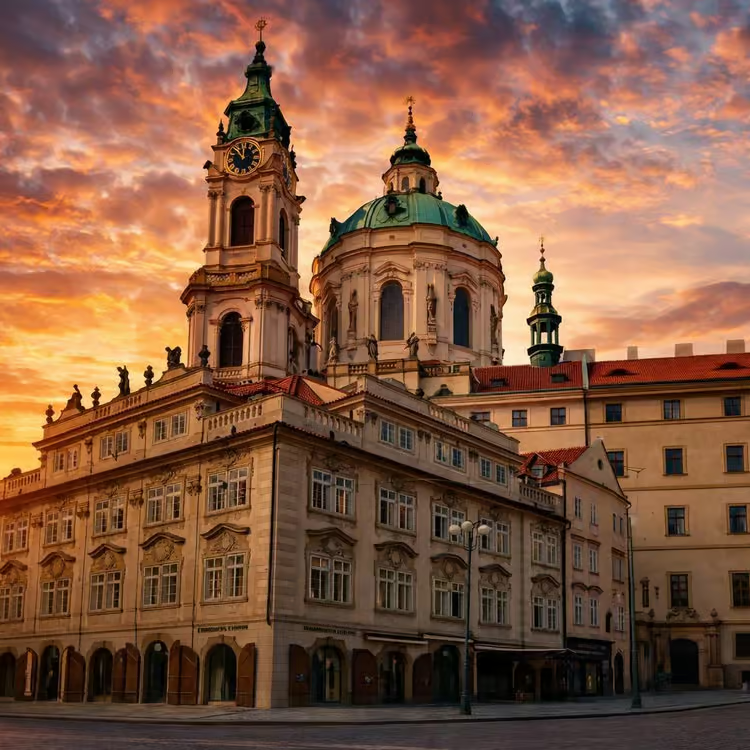
A capital that never got flattened, and looks like it
Prague sits in a bend of the Vltava, its skyline of red roofs, Gothic towers and one enormous hilltop castle largely unbroken since the 14th century. It escaped the heavy WWII bombing that leveled much of Central Europe, which is the practical reason it still looks like a medieval and baroque city rather than a careful postwar reconstruction of one. The result is a historic core dense enough that you can walk from Romanesque rotunda to Gothic cathedral to Cubist apartment block in twenty minutes, and a city that rewards slow wandering as much as any checklist of sights.
What changed over the last two decades is that everyone found out. Prague went from a post-communist secret to one of Europe's most visited cities, and the crowds around the Astronomical Clock and Charles Bridge in peak season are real. But walk fifteen minutes from Old Town Square into Vinohrady or Žižkov and you're in a city that still belongs to residents, where a pub lunch costs 200 CZK and the day's soup is chalked on a board, not printed in six languages.
The honest complications
Old Town Square, Charles Bridge and the stretch of Karlova Street between them are genuinely overwhelmed with tour groups and souvenir stalls in July and August, and the currency exchange offices clustered along that same route are the city's single most effective tourist trap; more on that in the Safety chapter. The cobblestones throughout the historic centre are uneven enough to be a real consideration for footwear. And Prague's prices, while still below Vienna or Paris, are no longer the bargain they were a decade ago, particularly for anything within sight of the Castle or the Clock.
Six neighbourhoods, one river between the postcard and the real city
Prague's center splits naturally along the Vltava: the tourist-facing historic core on one side, the Castle district across the river, and the neighborhoods locals actually live in spreading out from both. Where you base yourself comes down to how much walking distance you want to trade for quiet.
Staré Město (Old Town)
The postcard Prague: the Astronomical Clock, Old Town Square, and the medieval street grid leading to Charles Bridge. Staying here means everything is walkable, and also means navigating the heaviest tourist traffic in the city at the doorstep.
Malá Strana (Lesser Town)
Across Charles Bridge, beneath Prague Castle: baroque palaces, embassy row and cobbled lanes climbing toward Petřín Hill. Quieter after dark than Old Town, and the base of choice for travelers who want the atmosphere without the nightlife noise.
Vinohrady
A grid of Art Nouveau apartment blocks east of the centre, walkable to Old Town but genuinely residential, with Prague's strongest concentration of independent restaurants and cafes and none of the historic-core price premium. The recommended base for a second or third visit, or a first one that wants to eat well.
Žižkov
East of Vinohrady, working-class and famously pub-dense (this is the neighborhood locals cite when they say Prague has more bars per capita than any other European capital), with the futuristic Žižkov Television Tower as its unmistakable landmark. Best for travelers prioritizing nightlife over sightseeing proximity.
Karlín
East of Old Town along the river, a formerly industrial district rebuilt after severe 2002 flood damage into one of Prague's trendiest addresses, with new-build apartments, design cafes and noticeably better value than the historic core.
Hradčany
The district around Prague Castle itself: monasteries, embassies and some of the best panoramic views in the city, but thin on restaurants after the tour buses leave. Better visited than based in.
From riverside palaces to the hostel scene that built Prague's backpacker reputation
Prague's top hotels occupy genuinely historic buildings rather than purpose-built towers, and its hostel scene has been a fixture of the European backpacker circuit for two decades. These picks span the city's main bases and price points.
At the top of the market, the Four Seasons Hotel Prague occupies a row of historic buildings directly on the Old Town riverbank, with rooms looking straight across at Charles Bridge and Prague Castle, from around €450 a night. In Malá Strana, the Mandarin Oriental Prague is set inside a converted 14th-century Dominican monastery a short walk from the Castle, from around €350, while The Golden Wheel on historic Nerudova Street offers just 17 cosy rooms with Castle views and a small Italian coffee shop at street level, from around €150.
For mid-range value, boutique properties in Vinohrady and Staré Město regularly undercut the big riverside names while staying inside easy walking distance of the centre. At the budget end, Sophie's Hostel, spread across two historic buildings in New Town a short walk from Old Town, is consistently ranked among the city's best, with dorm beds from around €18 and private rooms from €45, home-cooked breakfast, and an on-site cafe and bar.
Beer first, dumplings close behind
Prague's food culture runs through its pubs, the hospody, as much as through any restaurant, and the beer is not an accompaniment to the meal so much as the reason for it. The best value is consistently at neighborhood pubs with a handwritten menu rather than anywhere flashing a "Traditional Czech Cuisine" sign in five languages near a major sight.
Svíčková
Beef sirloin braised in a creamy root-vegetable sauce with bread dumplings, cranberry compote and whipped cream: the dish most Czechs would name as their national plate. Restaurace Konvikt in a 12th-century building in Old Town does a properly old-school version.
Pilsner Urquell, from the tank
Lokál on Dlouhá Street in Staré Město serves Pilsner Urquell tankové pivo, unpasteurized tank beer that must be drunk within two weeks of leaving the brewery, visibly stored in glass-fronted tanks at the front and back of the room. For the historic version, U Fleků, a working pub and microbrewery in a building dating to 1499, has served its own dark Flekovský Ležák since long before Pilsner existed.
Guláš & vepřo-knedlo-zelo
Czech goulash, thicker and less paprika-forward than the Hungarian version, and roast pork with dumplings and braised cabbage: the two pub-menu staples found on nearly every hospoda chalkboard in the city. Pod Vyšehradem, a rustic, locals-heavy spot near Vyšehrad, does both without a tourist markup.
Michelin Bib Gourmand pub food
U Kalendů, dating from the Communist era with no English menu and no tourists to speak of, holds a 2026 Michelin Bib Gourmand for exactly the kind of unpretentious, expertly executed Czech pub food this chapter is describing.
The landmarks earn the hype; go early for them
Prague's major sights are genuinely worth the crowds, which is exactly why timing matters more here than in most cities. A few need advance booking, and this chapter walks through the city roughly the way a good three or four days would.
Prague Castle & Malá Strana
Prague Castle, the largest ancient castle complex in the world by some measures and the seat of Czech power since the 9th century, is best entered right at opening before the tour groups arrive. The Main Circuit ticket (450 CZK, valid two consecutive days) covers St. Vitus Cathedral, the Old Royal Palace, St. George's Basilica and Golden Lane; a separate Permanent Exhibitions ticket runs 300 CZK. Walk down through Malá Strana afterward past the Lennon Wall, the ever-repainted graffiti memorial to John Lennon and Cold War-era dissent, free and always changing.
Charles Bridge & Old Town
Walk Charles Bridge at dawn, before the statue-lined span fills with vendors and tour groups; it's free, always open, and a different experience entirely before 8am. The Astronomical Clock on Old Town Hall draws crowds on the hour for its mechanical apostle procession; climbing the Old Town Hall Tower gives a view over the crowd rather than a place in it. Josefov, the Jewish Quarter, holds the Old Jewish Cemetery and synagogues including the Spanish Synagogue and Pinkas Synagogue, whose walls are inscribed with the names of Czech Holocaust victims.
Free viewpoints and modern Prague
Vyšehrad, a hilltop fortress south of the centre dating to the 10th century, gets a fraction of the Castle's crowds for arguably better river views, and it's free to walk the grounds. Petřín Hill, reachable by funicular, has its own 1891 observation tower (a deliberate, smaller echo of the Eiffel Tower) and a mirror maze at the top. Down by the river, Frank Gehry and Vlado Milunić's Dancing House is Prague's best-known piece of modern architecture, its curved glass form deliberately at odds with the baroque skyline around it.
Evenings
A proper pub crawl through Žižkov, which locals will tell you has more bars per capita than anywhere else in Europe, is as legitimate a Prague evening as any concert hall. For something more structured, a guided beer tasting through several tankovna pubs is an efficient way to understand what separates a good pour from a great one.
One, two or three days, planned to beat the crowds
Three to four full days covers Prague properly; even one well-planned day delivers the essentials. These routes front-load the landmarks early in the morning and save the neighborhoods for the afternoon, when the tour groups have thinned out.
- Morning
Charles Bridge at dawn, then the Castle. Walk the bridge before 8am, cross into Malá Strana, and be at Prague Castle's Main Circuit right at opening.
- Midday
Svíčková at Restaurace Konvikt. Down through Malá Strana past the Lennon Wall, back across the bridge for lunch in Old Town.
- Afternoon
Old Town and Josefov. The Astronomical Clock, Old Town Hall Tower, then the Jewish Quarter's synagogues and Old Jewish Cemetery.
- Evening
Tank beer at Lokál. Fresh Pilsner Urquell on Dlouhá Street, or the historic dark lager at U Fleků.
- Day 1
The one-day route: Charles Bridge, Castle, Malá Strana, Old Town, Josefov, tank beer at Lokál.
- Day 2 morning
Vyšehrad. The fortress grounds and river views with a fraction of the Castle's crowds, free to walk.
- Day 2 afternoon
Petřín Hill. The funicular up, the 1891 observation tower and mirror maze, then down through Malá Strana.
- Day 2 evening
Vinohrady for dinner. A neighborhood restaurant with a chalkboard menu, the Prague evening locals actually have.
- Days 1-2
The two-day route above, at a gentler pace, adding the Dancing House and a Žižkov pub crawl.
- Day 3
Kutná Hora day trip. A direct train, about an hour each way, to the Sedlec Ossuary and St. Barbara's Cathedral. Full detail in the Day Trips chapter below.
Compact, flat-ish, and covered by an excellent tram network
Prague's historic centre is dense and largely walkable, with cobblestones the main physical challenge rather than hills. From Václav Havel Airport Prague (PRG), the Airport Express (AE) bus runs to Old Town in about 45 minutes for 100 CZK (~€4); the cheapest route is bus 119 connecting to metro Line A for around 32 CZK total, about 35 minutes. A taxi runs 600-800 CZK (up to around 1,000 CZK at peak traffic), and Uber typically comes in a bit under that; agree a fixed price at the counter or use a licensed rank if taking a taxi.
Within the city, buy the reloadable PID Lítačka app or a paper ticket: a single ticket costs 40 CZK and covers 90 minutes across metro, tram and bus with unlimited transfers, a 24-hour pass is 120 CZK, and a 72-hour pass runs 340-350 CZK. Always validate before boarding; plainclothes inspectors do check, and the on-the-spot fine is 1,000 CZK. The three metro lines and the tram network cover the city fast and reliably; walking covers the historic core faster than any vehicle can.
Best time to visit and the Christmas markets
Prague has a continental climate with warm summers and cold winters. May, June and September are the sweet spots: long daylight, comfortable temperatures, and crowds noticeably thinner than peak summer. July and August are busiest and hottest, particularly around Old Town Square and Charles Bridge.
The Christmas markets, running through December on Old Town Square and Wenceslas Square, are one of Prague's best cold-weather draws: mulled wine, trdelník that finally makes sense in the context it was built for, and a Gothic backdrop that does most of the work for you. Accommodation books up well ahead of the season; plan around it deliberately.
Still one of Western and Central Europe's better-value capitals
Prague is significantly cheaper than Vienna, Paris or Amsterdam, though it costs 10-15% more than smaller Czech cities like Brno or Český Krumlov. The hostel scene is excellent at the budget end, and the main cost trap is eating within sight of Old Town Square, where menus without prices and inflated "tourist" pricing are common.
- Hostel dorm €18-25
- Pub lunches and market food €10-20
- Public transport day pass, ~€5
- Free viewpoints plus one paid sight
- Boutique hotel or guesthouse €70-130
- Restaurant meals with beer €25-45
- Metro plus the occasional taxi
- Castle ticket, a museum, a beer tasting
- Four Seasons or equivalent €350+
- Tasting menus and fine dining
- Private guides and drivers
- Day trips by private car
One of Europe's safest capitals, with two things to actually watch
Prague benefits from Czechia's Level 1, Exercise Normal Precautions rating from the US State Department, one of the lowest-risk classifications given anywhere. Violent crime against tourists is extremely rare, and the city is safe to walk at night, including Malá Strana, Vinohrady and the pub streets of Žižkov, with normal urban awareness.
The two things that actually catch visitors: pickpocketing, concentrated on crowded trams, the metro, and around Old Town Square and Charles Bridge, so keep bags closed and in front of you in dense crowds; and currency exchange scams, specifically kiosks near Old Town Square and along Karlova Street advertising "0% commission" while applying a far worse rate than posted in fine print. Check the rate against Google's current CZK figure before handing over cash, or skip street exchanges entirely and use a bank ATM or a card like Wise or Revolut. Emergency number is the EU-standard 112 from any phone; the state police line is 158.
A bone chapel, a river town and a brewery, all within reach
Prague's position at the centre of a small, well-connected country makes it an excellent base for day trips. Three are worth building a day around, all reachable by train or bus from Prague's main stations.
Kutná Hora
The easiest and most rewarding day trip from the city: a direct train to the Sedlec Ossuary, a chapel decorated with the bones of an estimated 40,000 people arranged into chandeliers and a coat of arms by a 19th-century woodcarver (entry ~220 CZK, including the adjoining Cathedral of Our Lady). St. Barbara's Cathedral in the old town, part of the same UNESCO listing, is a Gothic landmark with a fraction of the ossuary's crowds. A half-day is enough; a full day is comfortable.
Český Krumlov
A near-complete medieval old town wrapped almost entirely by a horseshoe bend in the Vltava, with a hilltop castle whose Route 1 interior tour costs 300 CZK and gardens that are free to walk. It's a long day trip given the travel time, doable with a direct morning Intercity train out and an evening train back, but an overnight makes considerably more sense if the schedule allows it.
Plzeň
The birthplace of pale lager itself: the Pilsner Urquell brewery tour ends in the original 19th-century sandstone cellars with an unfiltered, unpasteurized pour that tastes noticeably different from the export version most visitors already know.
Prague FAQ
Is Prague safe for tourists?
Yes, Prague is one of the safest capital cities in Europe. Violent crime against tourists is extremely rare; the real risks are pickpocketing on crowded trams and around major sights, and currency exchange scams near Old Town Square.
How many days do I need in Prague?
Three to four full days covers the city well: one for the Castle and Malá Strana, one for Old Town and Josefov, one for the free viewpoints and a proper pub crawl, and a fourth for a day trip to Kutná Hora.
How much does Prague cost per day?
Budget travellers manage on €40-60 a day with hostels and pub lunches; mid-range runs €90-150. Prague is noticeably cheaper than Vienna or Paris, though pricier than the rest of Czechia.
When is the best time to visit Prague?
May, June and September: warm weather, long days and thinner crowds than peak summer. July and August are busiest and hottest, and December has its own draw thanks to the Christmas markets on Old Town Square.
What currency is used in Prague?
The Czech koruna (CZK), not the euro, despite Czechia being an EU member. Card payment is widely accepted in the centre, but carry some cash for small pubs.
How do I get from Prague Airport to the centre?
The Airport Express (AE) bus runs to Old Town in about 45 minutes for 100 CZK. The cheapest option is bus 119 plus metro Line A for about 32 CZK. A taxi costs roughly 600-800 CZK.
What is the best area to stay in Prague?
Staré Město (Old Town) or Malá Strana for first-timers who want everything within walking distance. Vinohrady for a quieter, more local base with excellent restaurants. Karlín for good value in a renovated, up-and-coming area.
Do I need to speak Czech in Prague?
No. English is standard in hotels, restaurants and tourist-facing businesses throughout central Prague. A few Czech phrases are appreciated but never required.
Is Prague walkable?
Yes, the historic centre is compact and mostly flat by European standards, though cobblestones are uneven in places. Trams cover longer distances quickly and the metro is fast and cheap for crossing the city.
Is Kutná Hora worth a day trip from Prague?
Yes, and it's the easiest day trip from the city: a direct train takes about an hour, and the Sedlec Ossuary plus St. Barbara's Cathedral fill a satisfying half-day.
What Stays With You
Prague doesn't need to try, and that's the whole appeal. The castle above the river was built to be seen from a distance long before anyone had a phone to photograph it with, the beer arrives at the table because the tapster already knew you'd want one, and the city's habit of surviving intact through wars that flattened its neighbors gives every cobblestone a kind of quiet, unforced weight. None of it was staged for the tour groups, which is exactly why the tour groups keep coming.
Go to Vyšehrad on your last evening instead of the Castle one more time, watch the river bend away under a skyline that's been doing this for six hundred years, and understand why Praguers never felt the need to explain the fuss.