
What You're Actually Dealing With
The Scams That Actually Catch People
Czech Republic scams are almost entirely Prague scams, and Prague scams are almost entirely financial. They're not dangerous and they're not particularly sophisticated. But they're persistent, they're well-practiced, and they reliably catch people who haven't been briefed.
The currency exchange booths clustered around tourist areas in Prague operate on two distinct models. The legitimate ones display the rate clearly, charge no commission beyond the spread, and give you what you'd expect from a quick Google conversion. The predatory ones advertise "0% commission" in large letters and "we buy/we sell" rates in small ones — the rate at which they sell you koruna is 15–25% worse than the interbank rate, which is where the commission actually is. Some booths display a misleading rate prominently and apply a different one at the window. Some give you foreign notes that look like koruna but are worthless currencies from other countries. A variant hits at ATMs: machines in tourist areas offer to convert your withdrawal to your home currency "for convenience" — the DCC (dynamic currency conversion) rate they apply adds 5–10% to every transaction.
- Use bank ATMs — Česká spořitelna, Komerční banka, ČSOB — rather than standalone machines in tourist areas or machines branded with exchange bureau names. Bank ATMs apply the interbank rate with your bank's standard fee.
- When an ATM or card machine asks whether you want to be charged in CZK or your home currency, always choose CZK. Always. The machine's conversion rate is significantly worse than your bank's, every time.
- If you need to use a currency exchange, check the rate against Google's current CZK rate before approaching the window. A legitimate exchange will be within 2–3% of the interbank rate. Anything more than that, walk away.
- Count your notes carefully before leaving the window. Some booths are known to short-change in the handover, banking on the customer not counting until they're down the street.
Prague taxi overcharging has been a documented problem for long enough that it's become self-sustaining — drivers in tourist areas know that visitors expect to be overcharged, so they charge accordingly, and visitors who've been warned still sometimes get caught because the execution is professional. The most common version: a taxi hailed on Wenceslas Square runs a meter that ticks over at twice the regulated rate, or a driver "forgets" to start the meter and names a price at the end. A more aggressive version operates around major hotels, where a driver working with a hotel doorman takes incoming guests on a scenic route with a tampered meter. From central Prague to the airport should cost 500–700 CZK. Drivers in tourist areas frequently charge 1,500–2,000 CZK for the same journey.
- Use Bolt for all Prague taxi journeys. The app shows the price before you confirm, the driver's identity is logged, and the route is tracked. It's typically 30–50% cheaper than a metered taxi even when the meter is honest.
- If you take a street taxi, check the rate card on the door — Prague regulations require it to be posted. The starting fare should be around 60 CZK, with per-kilometre rates of 36 CZK. Anything higher is unregulated or illegal.
- Never take taxis from drivers who approach you inside the airport terminal, near Wenceslas Square, or outside nightclubs. These are the highest-risk scenarios and the most well-practiced overchargers.
- If you're already in a taxi and suspect the meter is rigged, note the driver's number (on the dashboard) and file a complaint with the Prague Transport Authority after arrival. The fine system exists precisely because this is a known problem.
The restaurants immediately surrounding the Old Town Square and lining the approach to the Charles Bridge exist almost entirely to process tourists. The tells are consistent: a host standing outside actively inviting you in, menus with photos but no prices or prices buried in small print, "traditional Czech" dishes at three times what they cost four streets away, and bread and amuse-bouches brought to the table without being ordered that appear on the bill. Some places add a cover charge that's mentioned nowhere on the menu. Some list prices excluding the mandatory service charge. The food is usually mediocre in the way that food made for people who won't be coming back tends to be mediocre. The bill, when it arrives, is the only surprise that shouldn't be one.
- Walk at least two streets back from the Old Town Square in any direction before eating. The prices drop immediately and the quality usually goes up. Dlouhá street and the streets toward Josefov are a reasonable compromise between location and value.
- If a menu doesn't have prices, ask before sitting down. If the host can't tell you or produces a priced menu only after you're seated, leave. You're not obligated to stay once you've sat down if you haven't ordered.
- Refuse anything brought to the table you didn't order, or confirm immediately whether it's complimentary. Bread, olives, and amuse-bouches that appear uninvited are almost never free in tourist-zone restaurants.
- For actual Czech food at honest prices: look for a place where the menu is in Czech first, English second. Locals eat at výčep (pub-restaurants) in residential neighbourhoods, not at places with laminated menus facing the clock.
Prague pickpocketing is real, organised, and concentrated in predictable places. The Charles Bridge at midday in summer is the single highest-risk spot in the city — the combination of crowds, cameras pointing skyward, and slow movement gives working pickpockets ideal conditions. The Old Town Square during the Astronomical Clock chime draws the same crowd-and-distraction dynamic. On the metro, Line A between the airport and the centre is a known working route for pickpocket teams, as are the trams that pass through tourist areas. The standard method is a tight crowd, a small distraction (bump, dropped item, someone asking for directions), and a practiced hand in an exterior jacket pocket or unzipped bag.
- On the Charles Bridge, put your phone away and keep your bag in front of you. This single adjustment eliminates most of the risk. If you want photos, step to the side of the pedestrian flow rather than stopping in the middle.
- Keep wallets in inner jacket pockets or front trouser pockets. Back pockets and the outer pockets of backpacks are the first and second targets respectively. A money belt under your clothing is overkill for most of Prague but entirely reasonable for Charles Bridge at peak tourist hours.
- On metro and tram: be aware of anyone who presses against you unnecessarily in a non-crowded carriage, anyone who creates a distraction near you, or anyone who blocks the door as it opens. These are working patterns.
- If someone bumps into you in a tourist area, your instinct should be to check your pockets, not to apologise. The apologising is part of the distraction.
Two people approach you. One claims to be a plainclothes police officer and shows a badge — quickly, so you can't examine it. They say they're investigating counterfeit currency or drug trafficking and need to check your wallet and passport. While the wallet is being "inspected," cash disappears. A variant: a "police officer" says you've been seen exchanging money illegally (often used near legitimate exchange bureaus) and demands to see your cash and documents. Real Czech police do not stop tourists on the street to inspect their wallets. Plainclothes officers who stop tourists for any reason are required to show full, examinable credentials and take any serious matter to a police station.
- Never hand your wallet or passport to anyone on the street who claims to be police. Politely and firmly say you'll accompany them to the nearest police station (policejní stanice) to sort it out. A real officer will agree. A fake one will find an excuse to leave.
- Ask to see credentials slowly and fully. You're entitled to examine them. If someone flashes a badge too quickly to read, that's deliberate.
- If you feel threatened or the situation escalates, move toward other people — a shop, a café, a crowd — and call 158 (Czech police) or 112 (emergency).
Two tiers here. The mild version, common in tourist-facing bars: drinks are added to your tab that you didn't order, the price per drink is significantly higher than on any visible menu, and the bill at the end is designed to be confusing enough that most people just pay it. The serious version: strip clubs and hostess bars around Wenceslas Square are specifically documented as operating predatory billing practices. A woman is paid to befriend you, orders expensive drinks for herself charged to your tab without consent, and the bill at the end — sometimes presented by large men — is dramatically higher than anything agreed. Several versions of this scam have ended with tourists at ATMs under duress.
- In any bar: ask for a menu with prices, keep a rough running count of what you've ordered, and check the bill line by line before paying. Discrepancies should be challenged calmly and specifically.
- Avoid any establishment where a person on the door is actively trying to invite you in with promises of cheap drinks or female company. This is the entry point for the serious version of this scam.
- If you find yourself with a bill that seems fraudulent and there's any element of intimidation: pay what you can, make note of the venue name and address, and report it to the Czech Police (158) and your embassy afterward. Do not escalate in the venue if the situation feels physically threatening.
The Destinations — Honest Takes
The Czech Republic is much more than Prague, and most of it is entirely free of the financial pressure that concentrates in the Old Town. Here's what to actually expect, city by city.
Prague is legitimately one of Europe's great cities, and the reason it gets four million visitors a year isn't just geography. The Old Town is a medieval streetplan that somehow survived both world wars intact, and at 6am on a Tuesday in April, with mist on the river and nobody else on the Charles Bridge, it is genuinely extraordinary. The problem is that by 10am the same bridge has a thousand people on it and someone's hand in your jacket pocket. The answer isn't to skip the famous things — it's to do them at the right time. Charles Bridge before 8am. Old Town Square for the clock chime once, then leave the square for the side streets. Prague Castle at opening time or late afternoon, when the tour groups have gone. The actual Prague — the one Praguers live in — is in Žižkov's pub culture, in the Saturday farmers' market at Jiřák, in the architecture of Vinohrady, in the jazz clubs on Anenské náměstí. The tourist centre is the appetiser. The rest of the city is the meal.
- Never hail taxis on Wenceslas Square or from tourist hotel fronts — use Bolt exclusively, it's cheaper and honest
- Avoid currency exchange booths near the Old Town Square; use bank ATMs and always decline the machine's offer to convert your withdrawal to your home currency
- Restaurants with photo menus and outdoor hosts on the Old Town Square are tourist traps — walk two streets in any direction for the same food at a third of the price
- Charles Bridge pickpockets are active in peak summer hours — bag in front, phone away, wallet in an inner pocket
- The Astronomical Clock chime is free; anyone trying to charge you to watch it, or to enter a viewing platform to see it better, should be approached with the same scepticism you'd apply to anything else
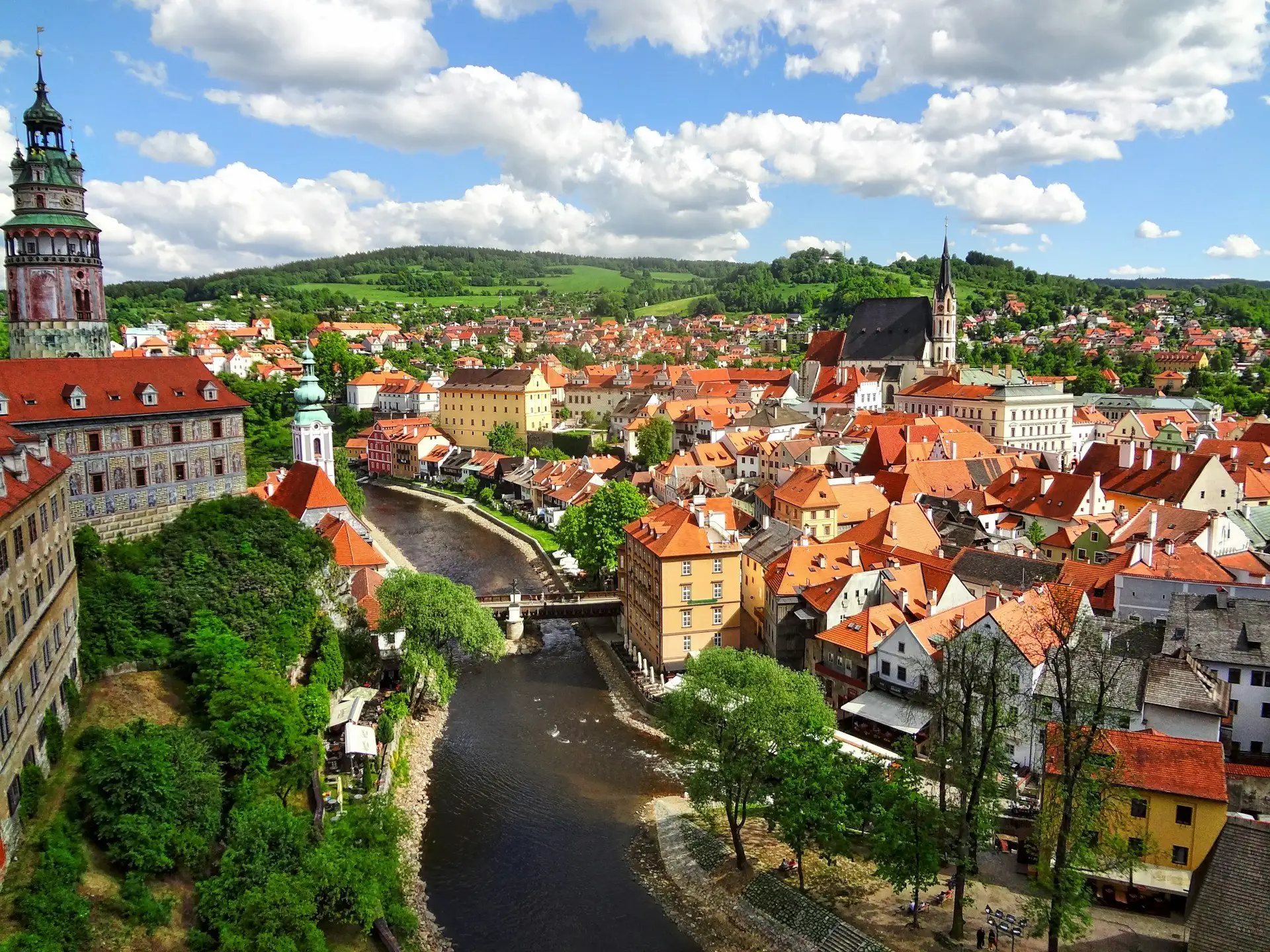
Český Krumlov is what Prague would be if it had stayed small. A UNESCO-listed medieval town curled inside a horseshoe bend of the Vltava, dominated by a castle complex whose Baroque theatre is the best-preserved of its kind in Europe. The town takes two hours to walk and three days to properly appreciate. Rent a canoe and paddle the river loop — the view of the castle from the water, with the hills behind it turning orange in September, is the thing you'll keep describing to people who weren't there. In high summer it's genuinely crowded and accommodation prices spike; May, June, and September are the sweet spots. The restaurant scene has improved significantly in recent years — Krčma v Šatlavské Ulici does medieval-themed Czech cooking with enough genuine warmth that the gimmick becomes beside the point.
- Very low scam pressure — the worst you'll encounter is tourist-priced restaurants on the main square, easily avoided by walking one street back
- Book accommodation well in advance for July and August, when the small number of good options fills months ahead
- The castle interior tours are worth doing — the Baroque theatre tour in particular is remarkable and runs in limited numbers; book online before arriving
Brno is the Czech Republic's second city and the country's best-kept open secret. A university town of 400,000 people with a lively café culture, excellent restaurants at non-Prague prices, and a pride in its own identity that makes it refreshingly free of the tourist self-consciousness that can make Prague feel like a performance. The Špilberk Castle has a Habsburg dungeon that was genuinely terrifying in the 18th century and remains somewhat grim today. The Villa Tugendhat — a Mies van der Rohe masterpiece from 1930, UNESCO-listed — is one of the most important buildings of the 20th century and visited by a fraction of the people who queue for Prague Castle. The ossuary under the Church of St. James contains the bones of 50,000 people in arrangements that are more decorative than they have any right to be. Brno is where you go when you want the Czech Republic without the tourist tax.
- Essentially zero tourist scam infrastructure — Brno's visitor economy is too small and too local for the predatory pricing that characterises Prague's centre
- Book Villa Tugendhat tickets online well in advance — visitor numbers are strictly limited and it regularly sells out weeks ahead
- Brno's nightlife is genuinely good and genuinely cheap; the area around Náměstí Svobody and the streets toward the station have bars where a beer costs what beer should cost
Olomouc is a Baroque university city in Moravia that most Western tourists have never heard of and that Czechs regard as one of their finest cities. Six Baroque fountains anchor the Old Town — the largest group of Baroque fountains outside Rome, which is a claim so specific it has to be true. The Holy Trinity Column in the main square is a UNESCO World Heritage Site that most visitors to the Czech Republic never see. The cheese — Olomoucké tvarůžky, a pungent aged curd cheese with a very specific smell that polarises people hard — is something you should try once at a local restaurant even if you decide you're in the "no" camp. The tram system covers the compact old city, accommodation is cheap, and the student population keeps the restaurant and bar scene alive and affordable year-round.
- No meaningful tourist scam presence — Olomouc simply doesn't have the visitor density to sustain one
- The Astronomical Clock on the Town Hall is worth finding — it's a socialist-realist redesign from 1955 that replaces the saints with workers and scientists, which is either wonderful or unsettling depending on your perspective
Karlovy Vary (Carlsbad) is a spa town in western Bohemia that has been dispensing thermal spring water to European aristocracy since the 14th century. The colonnaded promenades along the Teplá river, the Belle Époque hotels, the ritual of taking the waters from a long-spouted ceramic cup — it's a specific kind of elegance that feels entirely unrelated to the rest of the Czech Republic. Thirteen different springs, each with its own temperature and mineral composition, each supposedly beneficial for something. The water from most of them tastes like hot, slightly sulphurous disappointment. The wafer-thin spa wafers sold everywhere to eat with the waters, however, are genuinely excellent and aggressively addictive. The International Film Festival in July is one of the major European film festivals and transforms the town for ten days.
- Low scam pressure overall, though hotel and spa prices around the main colonnade are at a premium — look slightly further from the centre for the same quality at better rates
- The Russian tourist presence has historically been very high here; the demographics have shifted since 2022 but the town retains its particular character
- Spa treatments at grand hotels are expensive and some are more theatrical than therapeutic — research what you're booking before committing to a treatment package
The Bohemian Switzerland National Park in the northwest — sandstone rock formations, deep gorges, and the Pravčická brána, the largest natural sandstone arch in Europe — is two hours from Prague by train and takes most people completely by surprise. The Elbe passes through it in a canyon that requires a boat to navigate properly; rent one at Hřensko and let the current do the work while the rocks tower above you. The Moravian wine country in the south — around Znojmo and the Pálava hills — is the Czech Republic's answer to Alsace, and largely unknown outside the country. Small family wineries, cycling routes through vineyards, and Moravian white wines made from Welschriesling and Müller-Thurgau that are genuinely lovely and genuinely inexpensive. The Šumava region on the German border is old-growth forest and lake country that Czechs have been going to for summer walks since before there was a Czech Republic to go to.
- Zero tourist scam pressure anywhere in the countryside — the risks described in this guide are Prague-specific and essentially don't exist outside the capital
- For Bohemian Switzerland: the Edmundova souprava gorge boat trip is the highlight and fills up — arrive early or book ahead in summer
- Moravian wine touring works best with a car; the wineries are spread across villages and public transport connections are infrequent
Before You Go — The Checklist
- ✓ Always pay in Czech koruna. When any machine, ATM, or card terminal offers to charge you in your home currency instead, decline. Every time. Dynamic currency conversion adds 5–10% to every transaction and the only person it benefits is the machine's operator.
- ✓ Use Bolt for all taxis in Prague. Open the app, confirm the price, travel. Do not hail street taxis near Wenceslas Square, the Old Town, or hotel fronts in tourist areas. The regulated rate and the actual rate charged to tourists without apps are very different numbers.
- ✓ Use bank ATMs — Česká spořitelna, Komerční banka, ČSOB — not standalone machines in tourist areas. Withdraw in larger amounts to minimise per-transaction fees. Check your bank's foreign ATM fee policy before you leave.
- ✓ On the Charles Bridge: bag in front, phone in your pocket, wallet in an inner jacket pocket. Do this before you step onto the bridge, not after you've been on it for ten minutes. Pickpocket teams work the crowd and work quickly.
- ✓ If anyone on the street claiming to be police wants to inspect your wallet or passport, insist on going to the nearest police station together. Real officers will agree immediately. Fake ones will not.
- ✓ Validate your metro or tram ticket before boarding. Plainclothes inspectors do spot checks and the fine (1,500 CZK) is collected on the spot. The ticket system is cheap and simple — there's no excuse for not having one.
- ✓ For restaurants: if there are no prices on the menu, ask. If you're in a restaurant directly on the Old Town Square and you didn't intend to pay tourist prices, you probably already are. Two streets away in any direction, the same food costs a fraction of the price and is usually better.