

What You're Actually Getting Into
Armenia is the country that became the world's first Christian state in 301 AD, centuries before Rome, and has spent most of the time since surrounded by empires that wanted its land and, at points in the 20th century, its people. What's left is a small, landlocked republic about the size of Albania, with two of its four borders sealed shut and a capital city built almost entirely from pink and orange volcanic tuff that changes color through the day. It is not a country that performs for tourists. It is a country that has survived, and visiting it feels less like a highlight reel and more like being let in on something specific.
Armenia is also still genuinely cheap. A full restaurant meal costs 2,500 to 5,000 dram, about 6 to 12 dollars. A taxi across Yerevan costs 600 to 1,000 dram. And the monasteries, some 9th-century, some carved directly into cliff faces, are usually close to empty even in July, a contrast to the crowds now common at comparable sites in neighboring Georgia.
The honest complications
Two of Armenia's four land borders, with Turkey and with Azerbaijan, have been closed for decades and remain closed to standard travel; you cannot cross overland into either, even after the August 2025 peace framework with Azerbaijan. The eastern and southeastern border strip with Azerbaijan carries an active US State Department caution and is not part of any tourist route, a legacy of the 2020 Nagorno-Karabakh war and the 2023 exodus of the ethnic Armenian population from the region, both still recent and still felt. English is thinner outside Yerevan and the main monastery circuit; Russian remains the more common second language among older Armenians. And road quality in the mountains drops off fast outside the main highways, which matters for a country whose best sites are often at the end of a switchback road.
A History Worth Knowing
Armenians trace their roots to the ancient kingdom of Urartu, which ruled the Armenian highlands from the 9th to 7th centuries BC. In 301 AD, King Tiridates III made Armenia the first state in the world to adopt Christianity as its official religion, a full generation before Emperor Constantine's conversion in Rome. A century later, the monk Mesrop Mashtots created a unique 36-letter alphabet in 405 AD specifically so scripture could be written in Armenian, and that alphabet, still in daily use, is one of the clearest threads connecting the country's ancient and present-day identity.
- 9th-7th c. BC
Urartu. The Iron Age kingdom that gives Armenia its earliest recorded statehood in the highlands around Lake Van and Lake Sevan.
- 301 AD
State religion. King Tiridates III adopts Christianity, making Armenia the first country to do so, under Gregory the Illuminator.
- 405 AD
The alphabet. Mesrop Mashtots creates the Armenian script, still used unchanged in structure sixteen centuries later.
- 1915-1923
The Armenian Genocide. Roughly 1.5 million Armenians killed by the Ottoman government, an event central to modern Armenian identity and still not acknowledged by Turkey, which is part of why the border remains closed.
- 1920-1991
Soviet Armenia. Absorbed into the USSR after a brief 1918-1920 independence; industrialized under Soviet rule, with Yerevan largely rebuilt in the pink tuff style seen today.
- 1991
Independence. Declared 21 September, with 99% of voters in favor, the first non-Baltic Soviet republic to secede.
- 2020-2025
Nagorno-Karabakh. The 2020 war and the 2023 exodus of the ethnic Armenian population from the region reshaped the eastern border; an August 2025 peace framework with Azerbaijan has not yet reopened crossings.
Read the full history: empires, genocide, Soviet rebuilding and the Karabakh question
Between Urartu's fall and the modern era, historic Armenia was repeatedly divided and absorbed by larger powers: the Achaemenid and Parthian empires, a golden age under the Bagratuni and Artsruni dynasties in the medieval period, then centuries split between Ottoman and Persian, later Russian, control. The medieval Kingdom of Cilicia, on the Mediterranean coast far from today's Armenia, was a separate Armenian state that lasted until 1375 and explains why Armenian architecture and manuscripts turn up well outside the country's current borders.
The Armenian Genocide of 1915 to 1923, in which the Ottoman government killed an estimated 1.5 million Armenians and forcibly deported the rest of the empire's Armenian population, is the defining trauma of modern Armenian identity, openly discussed and memorialized but rarely a light conversation topic for locals. It is also the direct reason Turkey and Armenia have no diplomatic relations and a sealed border.
Soviet rule from 1920 to 1991 was harsh in its early decades but also industrialized the country and rebuilt Yerevan almost from scratch, using the pink and black volcanic tuff quarried locally, which is why the city has such a consistent architectural palette today. Independence in 1991 came with an immediate war, the First Nagorno-Karabakh War (1988-1994), over the majority-Armenian enclave inside Azerbaijan's internationally recognized borders, which Armenia won and controlled for three decades.
The 2020 and 2023 turning points. The Second Nagorno-Karabakh War in autumn 2020 reversed most of Armenia's territorial gains, and a lightning Azerbaijani offensive in September 2023 triggered the exodus of nearly the entire ethnic Armenian population, around 100,000 people, from the region within days. Armenia absorbed that population while negotiating a peace framework with Azerbaijan, reaching a joint declaration in Washington in August 2025 that both sides describe as ending the active conflict, though final border demarcation and reopened crossings had not materialized as of this guide's research. For visitors, the practical result is a closed Azerbaijan border and a restricted zone along it, and a Yerevan that now has a noticeably larger population with roots in Karabakh, a recent history that is not ancient and is worth approaching with some sensitivity.
Top Destinations
Armenia divides into five practical zones: the capital, the monastery-and-Ararat-plain circuit that surrounds it, Lake Sevan and the northern forests, the south toward Tatev, and Gyumri in the northwest. The whole country is roughly the size of Albania, so nowhere is more than a long day trip from Yerevan, and a rental car or a hired driver covers the highlights of a first visit inside a week.
Yerevan, the pink city
Yerevan is one of the world's oldest continuously inhabited cities, older than Rome, though almost nothing you see is ancient: most of the current city was rebuilt in the 20th century in a consistent pink and black volcanic tuff that gives it a warm, unified look found nowhere else. Republic Square is the civic heart, its musical fountains running most evenings; the Cascade, a giant tiered stone stairway doubling as an open-air modern art museum, climbs the hillside behind it with a free escalator inside for anyone who doesn't want the stairs. The full city guide covers neighbourhoods, food, hotels and a proper itinerary.
Khor Virap, with Ararat behind it
Khor Virap is a monastery on a low hill on the Ararat plain, its name meaning "deep pit" after the underground dungeon where Gregory the Illuminator was reportedly imprisoned for 13 years before converting King Tiridates III. It is the single most photographed spot in Armenia because Mount Ararat, the biblical peak and national symbol, fills the frame directly behind it despite sitting just across the closed border inside Turkey, close enough to see clearly on a clear morning and permanently out of reach on foot.
Garni & Geghard
Garni Temple is the only Greco-Roman colonnaded temple standing anywhere in the former Soviet Union, a 1st-century pagan structure rebuilt after a 1679 earthquake using the original stones. Ten kilometers on, Geghard Monastery is partly carved directly into the cliff face, its inner chambers cut from solid rock in the 13th century; both sites sit in the same valley and are almost always visited together on a half-day trip from Yerevan.
Lake Sevan
Lake Sevan is one of the largest high-altitude lakes in the world, sitting at nearly 1,900 meters, cold even in summer but ringed by beach clubs on its western shore that fill with Yerevan day-trippers from June to August. Sevanavank, a 9th-century monastery on a peninsula that was once an island, has some of the best lake views in the country and is an easy stop on the way to or from Dilijan. The lake's ishkhan trout, its native "prince" fish, is now critically endangered and mostly farmed rather than wild-caught; ask before ordering it.
Dilijan, "Little Switzerland"
Dilijan sits in a forested valley an hour and a half from Yerevan, its old town of wooden 19th-century houses restored around Sharambeyan Street, with hiking trails through Dilijan National Park and a noticeably cooler climate than the capital in summer. It has become the country's spa-and-retreat town, with several boutique hotels aimed at the weekend crowd from Yerevan.
Noravank
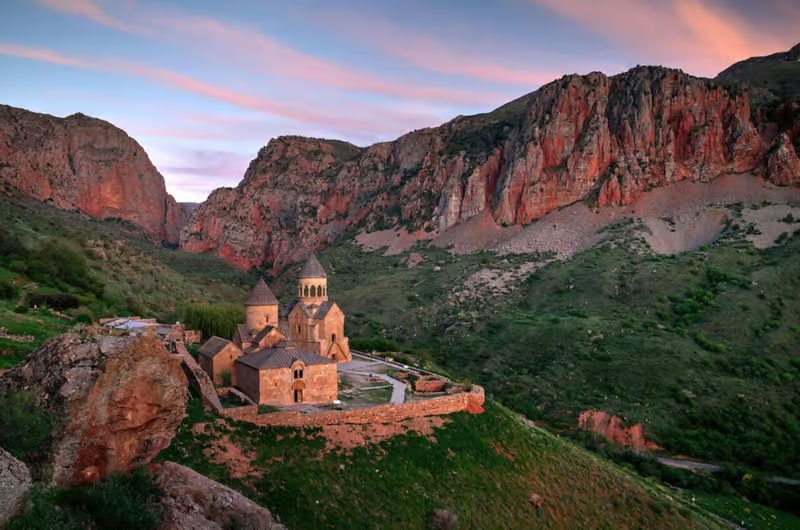
Noravank is a 13th-century monastery set into a narrow canyon of red-orange limestone cliffs, roughly two and a half hours south of Yerevan, with a two-story church reached by a famously narrow external stone staircase. Nearby Areni village has wineries built around the discovery of the world's oldest known winery, dated to around 4100 BC in a nearby cave, and several now offer tastings of the same endemic Areni grape.
Tatev & the Wings of Tatev
Tatev Monastery, founded in the 9th century, sits on the edge of a deep gorge in Syunik province in Armenia's far south, historically one of the most influential monasteries in the country and still one of the most dramatic to visit. The Wings of Tatev, a 5.7-kilometer reversible aerial tramway, carries visitors from Halidzor village across the gorge in about 12 minutes, among the longest cable car lines of its kind anywhere. Goris, the nearest town, is the practical overnight base, with a strange landscape of cave dwellings at nearby Old Khndzoresk as an easy add-on.
Gyumri
Armenia's second city, near the Georgian border in the northwest, has a 19th-century black-and-pink tuff old town that largely survived the devastating 1988 Spitak earthquake, which killed tens of thousands and flattened much of the surrounding region. Gyumri has a drier, more melancholic character than Yerevan and a genuine crafts and ceramics scene around Kumayri, the historic district; it is less visited than the standard circuit and correspondingly quieter.
Hidden gems beyond the main circuit
The zones above cover a first trip well. With extra days, these reward the detour.
Marmashen Monastery
A 10th-century monastery in a river gorge outside Gyumri, almost always empty, with none of the souvenir stalls of the busier southern sites.
Old Khndzoresk
An abandoned cave-dwelling village connected by a wobbly pedestrian suspension bridge across a ravine, inhabited into the mid-20th century.
Amberd Fortress
A 7th-century fortress and church on the slopes of Mount Aragats, Armenia's highest peak, with sweeping views and almost no tour buses.
Culture & Etiquette
Armenian hospitality runs on an old proverb, that a guest is a gift from God, and it shows: declining food or drink from a host can read as genuinely impolite, and toasting at a shared table is a small ceremony in itself, not a formality to rush through. The Armenian Apostolic Church, one of the oldest branches of Christianity, remains central to national identity even for Armenians who rarely attend services, and its khachkars, intricately carved cross-stones found by the tens of thousands across the country, are recognized on UNESCO's list of intangible cultural heritage.
Do
- Join the toast. A dinner with Armenian hosts usually includes several toasts, often to family, peace or the guests; make eye contact as glasses meet and don't leave a toast unanswered.
- Dress modestly for monasteries. Cover shoulders and knees at churches and monastery complexes; scarves for women are common but not always enforced.
- Learn a few words. Barev (hello), shnorhakalutyun or the easier merci (thank you, widely used and understood), and ha/voch (yes/no) go a long way.
- Drink from the pulpulaks. The public fountains are genuinely free, genuinely drinkable, and part of daily life, not a tourist novelty.
- Carry cash (dram). Cards work in Yerevan restaurants and hotels; smaller towns, monasteries and marshrutka rides are still largely cash.
Don't
- Bring up the Genocide or Karabakh casually. Both are recent, personal history for many Armenian families, not abstract historical topics; follow rather than lead if the subject comes up.
- Expect English outside Yerevan and the main sites. Russian is the more reliable second language for older Armenians in smaller towns.
- Assume the Azerbaijan border area is open for a look. The eastern and southeastern border strip is an active caution zone, not a viewpoint.
- Refuse hospitality outright. A polite "just a little" lands better than a flat no.
- Rush the monasteries. Many are still active places of worship; keep voices down and be aware of services in progress.
Deeper culture: the alphabet, khachkars, the Apostolic Church and Armenian coffee
The alphabet. Created by the monk Mesrop Mashtots in 405 AD specifically to translate scripture into Armenian, the 36-letter script (39 after 1920s reforms) is unrelated to Latin, Cyrillic or Greek and remains a point of quiet national pride; a giant stone monument to its letters stands near Aparan, north of Yerevan.
Khachkars. Free-standing cross-stones carved with intricate geometric and botanical patterns, produced from the 9th century onward and still made today; more than 50,000 survive across the country, and UNESCO added the tradition of their creation to its Intangible Cultural Heritage list.
The Armenian Apostolic Church. Independent from both Rome and Constantinople since the 5th century, it is one of the oldest national churches in continuous existence and central to how many Armenians define their identity, religious observance aside.
Armenian coffee. Thick, unfiltered, and brewed in a small copper jazzve, closer to what's often called Turkish coffee elsewhere though Armenians will firmly correct you on the name. Served in small cups at pace-setting cafes across Yerevan; a fortune-telling tradition of reading the grounds afterward still turns up at family gatherings.
Food & Drink
Armenian food centers on grilled meat, fresh herbs, dried fruit and lavash, the thin flatbread recognized by UNESCO as intangible cultural heritage in 2014 for the communal way it's still baked in village tonir ovens. Meals lean savory and herb-heavy rather than spicy, and the best of it, like Albania and much of the Caucasus, is often at family tables rather than restaurants.
Khorovats 2,500-5,000 AMD
Armenian barbecue: pork, lamb or beef skewered and grilled over coals, usually a weekend ritual as much as a dish. Served with fresh herbs, grilled vegetables and thin lavash for wrapping.
Dolma / Tolma
Grape leaves or vegetables stuffed with spiced minced meat and rice, served warm with a garlicky matsun (yogurt) sauce. A staple at family gatherings and one of the dishes locals judge a cook by.
Lavash UNESCO-listed
Thin, tonir-baked flatbread that appears at every meal, used as both plate and utensil. The baking itself, a communal, often multi-generational activity, is what earned the UNESCO recognition, not just the bread.
Harissa
A slow-cooked porridge of wheat and shredded chicken or lamb, traditionally made in huge communal pots at church festivals, still served at Sunday lunches in some Yerevan restaurants.
Gata ~500-1,000 AMD
A sweet, layered pastry with a buttery sugar filling, sold at bakeries across the country and a standard gift to bring to a host's home.
Armenian brandy & wine from ~$3/glass
The Ararat brandy label dates to 1887 and is still the national spirit; the Areni region produces wine from a grape variety tied to what researchers date as the world's oldest known winery, roughly 4100 BC.
When to Go & Itineraries
May, June, September and October are the strongest months: mild temperatures in Yerevan, passable mountain roads, and landscapes either blooming or turning. July and August push past 30°C on the Ararat plain, though the mountains around Dilijan and Tatev stay noticeably cooler. Winter brings snow to the monastery circuit and closes some higher passes, but Yerevan itself stays workable with far fewer visitors.
All four seasons compared, with temperatures
| Season | Verdict | Temps | Prices & crowds |
|---|---|---|---|
| May-Jun & Sep-Oct | Best | 18-26°C Yerevan, cooler in hills | Mid prices, manageable crowds |
| Jul-Aug | Good (hot) | 30-36°C Ararat plain | Peak domestic tourism at Lake Sevan; mountains are the escape |
| Mar-Apr | Good | 10-18°C Yerevan | Low prices, few tourists; higher passes may still hold snow |
| Nov-Feb | Quiet | -2 to 8°C Yerevan, colder in hills | Lowest prices; some mountain roads difficult or closed |
Year-round city averages: Yerevan 12°C, Gyumri 9°C, Dilijan 9°C, Sevan (lakeside) 8°C, Goris 10°C. Yerevan summers regularly hit 35°C in August; Dilijan and Tatev stay 5-8 degrees cooler than the capital.
Itineraries
Five days covers Yerevan and the closest monasteries comfortably. Ten days adds Lake Sevan, Dilijan and the drive south to Tatev without feeling rushed. Armenia rewards a slower pace more than a longer one; the country is small enough that fourteen days means real depth rather than more driving.
- Days 1-2
Yerevan. Republic Square, the Cascade, the History Museum, the Genocide Memorial, dinner in Kentron.
- Day 3
Garni & Geghard. Half-day trip: the Greco-Roman temple, then the cliff-cut monastery, back to Yerevan by evening.
- Day 4
Khor Virap & Areni. Ararat views at Khor Virap, a wine tasting in Areni, on to Noravank for the afternoon light.
- Day 5
Ararat Brandy Factory & Vernissage. A brandy tasting tour, then the weekend market for crafts before flying out.
- Days 1-3
Yerevan, extended. Add the Matenadaran manuscript museum and a full day trip to Garni, Geghard and Khor Virap.
- Days 4-5
Lake Sevan & Dilijan. Sevanavank at sunset, then two nights in Dilijan for the old town and forest trails.
- Days 6-8
South to Tatev. Noravank and Areni en route, overnight in Goris, the Wings of Tatev and the monastery, Old Khndzoresk on the way back.
- Days 9-10
Return via the Ararat plain. A slower final stretch back to Yerevan, the Ararat Brandy Factory, Vernissage on the way out.
- Days 1-3
Yerevan extended. Full city coverage plus a day trip to Amberd Fortress and Mount Aragats.
- Days 4-6
Sevan & Dilijan, unhurried. Longer hikes around Dilijan National Park, a full day at Sevan's beach clubs in summer.
- Days 7-10
The south, properly. Noravank, Areni wineries, two nights in Goris, Tatev and Khndzoresk, plus a detour to Jermuk for its mineral springs.
- Days 11-12
Gyumri. The Kumayri old town, ceramics workshops, a quieter, more melancholic side of the country.
- Days 13-14
Back to Yerevan. A slow final stretch, the Ararat Brandy Factory, and the Vernissage market timed for a weekend.
Getting there & around
Zvartnots International Airport (EVN), 13 kilometers from central Yerevan, is Armenia's main gateway, with connections through Europe, the Gulf and Russia rather than many direct long-haul routes; expect a connection through Vienna, Paris, Dubai or Doha from North America. A rental car (from about $25-35/day) is the most flexible way to see the country, though many travelers use hired drivers or small-group tours for the monastery circuit instead, since roads to remote sites can be rough and signage is inconsistent. Marshrutka shared minibuses connect every town on this guide's route but run on a "leaves when full" schedule that rewards patience over precision. Remember that no route, rented or otherwise, crosses into Turkey or Azerbaijan; Armenia's only open land borders are with Georgia in the north and Iran in the south.
All transport options with prices: marshrutkas, taxis, drivers
| Option | Price | Notes |
|---|---|---|
| Marshrutkas (minibuses) | 1,000-3,000 AMD/route | Leave when full from Yerevan's Kilikia and Sasuntsi David stations. Reliable on main routes, patience required. |
| Taxis & ride apps | 600-1,000 AMD (Yerevan) | Yandex Go and GG apps work well in the capital; agree a price for intercity trips outside them. |
| Hired driver, day trip | $50-90/day | Common for Garni/Geghard, Khor Virap/Noravank or the Sevan/Dilijan loop; splits well between 2-4 people. |
| Zvartnots Express bus | ~300 AMD | Airport to Republic Square and Yeritasardakan metro station, every 30 min, 7am-10pm. |
Practical prep: buy an Armenian SIM at the airport or download offline maps first; signal thins out in the mountains around Tatev and Dilijan's forest trails. Standard travel insurance is sufficient for the monastery circuit; mountain rescue coverage is worth it only for serious hiking around Aragats or the Vayots Dzor canyons.
Where to stay
Yerevan, Kentron district
The central district holds most of the city's hotels and guesthouses, within walking distance of Republic Square, the Cascade and the main restaurant streets. The easiest first-time base by a wide margin.
Dilijan spa hotels
Several boutique and spa-oriented properties have opened around Dilijan's old town in recent years, aimed at the weekend crowd from Yerevan and priced accordingly higher than elsewhere outside the capital.
Goris guesthouses
Family-run guesthouses in Goris are the standard base for Tatev and the Wings of Tatev cable car, often including a home-cooked dinner in the price.
Lake Sevan lakeside
A cluster of resort-style hotels and beach clubs on the western shore fill up on summer weekends with Yerevan day-trippers staying overnight; book ahead for July and August.
Budget Planning
Armenia remains one of the more affordable countries within easy reach of Europe. Budget travelers eat and sleep well on $35 to $50 a day, and the only real cost trap is peak-season Lake Sevan accommodation on summer weekends, when prices climb toward what you'd expect in Yerevan's better hotels.
- Hostel or guesthouse $10-20
- Market meals & khorovats stands $6-10
- Marshrutkas between towns
- Free monasteries and pulpulak water
- Boutique hotel or Dilijan spa stay
- Restaurant dinners $15-25/person
- Rental car or hired driver
- Wings of Tatev, wine tastings
- Best available hotels in Yerevan
- Fine dining with premium Armenian wine
- Private drivers and guides
- Lakefront resort stays in peak season
Quick reference prices: coffee, transport, entry fees
| Armenian coffee (jazzve) | ~500-800 AMD |
| Restaurant meal (mid) | 2,500-5,000 AMD |
| Taxi across Yerevan | 600-1,000 AMD |
| Marshrutka, Yerevan-Dilijan | ~1,500 AMD |
| Wings of Tatev round trip | ~$25 |
| Guesthouse incl. dinner | $20-30/night |
| Yerevan boutique hotel | $50-90/night |
| Garni Temple entry | ~1,500 AMD |
Prices reflect August 2026 research and drift over time, especially Sevan lakeside accommodation in peak summer. Treat them as a planning baseline, not a quote.
Visa & Entry
Armenia has one of the more generous visa regimes in the region: citizens of the US, all EU member states, the UK, Canada and Australia enter visa-free for up to 180 days with just a valid passport, well beyond the standard 90-day window most countries offer. Many other nationalities can apply for an e-visa online in advance. Rules do shift, so the Armenian Ministry of Foreign Affairs is the source to check before booking, not a third-party site charging for something that may be free.
✓ Valid passport
At least 6 months validity is commonly recommended, though entry requirements officially call for a passport valid through the stay. Keep a photocopy separate from the original.
✓ Return/onward ticket
Not routinely checked for visa-free nationalities but worth having on hand for air arrivals.
✓ Accommodation address
Hotels register foreign guests automatically; keep your first night's address handy in case it's asked for at the border.
✓ Not Schengen
Time spent in Armenia does not count toward a Schengen 90-day allowance, useful if it's part of a longer European or Caucasus trip.
| Armenia | Georgia | |
|---|---|---|
| Daily budget | $35-50, marginally cheaper on food & local transport | Close, slightly pricier in tourist hubs like Tbilisi and Batumi |
| Landscape | High, drier plateau; Ararat views; canyon monasteries | Greater Caucasus peaks, subtropical coast, wine valleys |
| Crowds | Notably quieter; monasteries often empty | Busier, more developed tourism infrastructure |
| Borders | Two of four land borders closed (Turkey, Azerbaijan) | Open on most sides; easier regional overland travel |
| Schengen | No, doesn't touch your 90 days | No, same advantage |
Safety, Solo Women & Family
Armenia rates well on everyday safety: violent crime against visitors is rare, Yerevan's central streets are comfortable to walk after dark, and the country ranks among the safer nations in the world for petty and violent crime alike. The US State Department rates Armenia Level 2, Exercise Increased Caution, a rating driven almost entirely by one specific, geographically contained issue rather than general conditions.
The Azerbaijan border strip
The eastern Gegharkunik region east of Vardenis, and the Syunik region east of Goris and south of Kapan, carry an active advisory against travel due to the potential for armed incidents. None of these areas are on a standard tourist route, including the Tatev road.
Mountain roads
Roads to remote monasteries and mountain passes can be narrow, poorly marked and occasionally closed by snow into April or May. Drive defensively and check conditions before heading to Tatev or Aragats in winter.
Petty theft
Uncommon but not unheard of, mostly limited to crowded spots like Vernissage market and the GUM market. Standard city awareness is enough.
One more thing worth knowing: how recent the Karabakh exodus is
The 2023 exodus of roughly 100,000 ethnic Armenians from Nagorno-Karabakh is very recent history, and many people you meet in Yerevan and across the country, including guides, drivers and hospitality staff, may have direct personal experience of it. It is not a safety issue for visitors, but it explains why the subject carries more weight than a standard historical footnote and why some conversations move carefully around it.
The scams to actually know about
Armenia is not a high-scam destination, and most visitors report no issues at all. The two patterns worth knowing going in cover nearly everything that does come up.
Unofficial airport taxis
Drivers approaching arrivals before the official rank sometimes quote inflated fares. Use the Yandex Go or GG apps, or agree a price before getting in; a metered or app-based ride across Yerevan should run 600-1,500 dram.
Vernissage overpricing
Prices at the weekend crafts market are rarely fixed and visitors sometimes pay more than locals for the same carpet or ceramic piece. Light negotiation is normal and expected, not rude.
Street changers
Rare in Yerevan but still around in smaller towns; bank-affiliated exchange counters and ATMs give a fair rate and are widely available.
Solo women travelers
Armenia rates well for solo women, especially in Yerevan and along the main monastery circuit, where street harassment is uncommon and locals tend to be protective of guests generally. The caveat is rural areas, where social norms are more conservative and a woman traveling alone may draw more attention, not typically hostile, but noticeable. Dress modestly at monasteries regardless of gender, keep a charged phone and offline maps for mountain day trips, and use Yandex Go or GG rather than unmarked taxis at night.
Emergency numbers
Embassies in Yerevan
112 also reaches emergency services on many mobile networks as the EU-standard fallback number. Most embassies sit in central Yerevan, within a short taxi ride of Kentron hotels.
- USA
- +374-10-464-700
- UK
- +374-10-264-301
- France
- +374-60-651-950
- Germany
- +374-10-524-581
- Italy
- +374-12-542-335
- Netherlands
- +374-10-713-000
- Canada
- via Honorary Consul in Yerevan, +374-10-300-305
- Australia
- via Moscow embassy, 24h +61-2-6261-3305
Family travel & pets
Armenia is a welcoming family destination: children draw warmth from strangers, restaurants and monasteries alike accommodate them without fuss, and multi-generational Armenian families traveling together are the norm rather than the exception. The Cascade's free escalator makes the city's best viewpoint accessible for strollers, Lake Sevan's beaches give younger kids somewhere to burn energy, and the History Museum on Republic Square has enough scale and mystery to hold older kids' attention.
Kids at the monasteries and bringing pets
Monasteries with children: most are outdoor, uneven-stone environments rather than formal museums; comfortable shoes matter more than any age restriction. Geghard's cave-cut chambers and Khndzoresk's suspension bridge tend to be the two sites that land best with children old enough to appreciate a bit of adventure.
Pets: EU pet passport holders can generally enter with dogs and cats given valid rabies vaccination and a microchip. Non-EU visitors typically need a veterinary health certificate issued shortly before travel and current rabies vaccination; check requirements with an Armenian consulate before booking, as documentation rules can change. Hotels in Yerevan increasingly accept well-behaved dogs; rural guesthouses vary and are worth confirming ahead.
Armenia FAQ
Is Armenia safe to visit?
Yes, for the areas visitors actually go. Yerevan and the monastery circuit are calm and low-crime, and Armenia ranks among the safer countries in the world for everyday crime. The real caution zone is the eastern and southeastern border strip with Azerbaijan, which the US State Department advises against visiting; it is not part of any standard tourist route.
How cheap is Armenia?
Very. Budget travelers manage on $35-50 a day, mid-range on $70-110. A full restaurant meal costs 2,500-5,000 dram (about 6-12 dollars) and a taxi across Yerevan runs around 600-1,000 dram.
Do I need a visa for Armenia?
Most Western passport holders, including the US, EU, UK, Canada and Australia, enter visa-free for up to 180 days with just a valid passport. Many other nationalities can get an e-visa online. Armenia is not in Schengen or the EU.
When is the best time to visit Armenia?
May, June, September and October: mild temperatures, blooming or turning landscapes, and manageable crowds. July and August are hot in Yerevan and the Ararat plain; winter brings snow to the mountains and monasteries.
How many days do you need in Armenia?
Five days covers Yerevan and the closest monasteries well. Ten days adds Lake Sevan, Dilijan and the south to Tatev. The country is small enough that distance is rarely the constraint; road quality and border closures are.
What is Tatev and the Wings of Tatev?
Tatev is a 9th-century monastery perched on a canyon edge in southern Armenia. The Wings of Tatev is the reversible aerial tramway that reaches it, about 5.7 kilometers long and one of the longest cable car lines of its kind in the world.
Can you cross the border from Armenia to Turkey or Azerbaijan?
No. Both borders have been closed for decades and remain closed for standard travel. Armenia's open land borders are with Georgia to the north and Iran to the south; a 2025 peace framework with Azerbaijan has not yet reopened the crossings.
Is Armenia in the European Union?
No. Armenia is not an EU member and not in the Schengen Area, so time spent there doesn't count against a Schengen 90-day allowance.
What language is spoken in Armenia?
Armenian, written in its own alphabet created in 405 AD and unrelated to Cyrillic or Latin scripts. Russian is widely understood as a second language among older Armenians; English is growing in Yerevan and tourist sites but thinner elsewhere.
Is Armenia safe for solo female travelers?
Generally yes. Street harassment is uncommon and Yerevan's central streets are comfortable to walk after dark. Rural areas are more conservative and modest dress at monasteries is expected of everyone.
Is Armenia good for families with kids?
Yes. Armenians are warm toward traveling children, monasteries and markets welcome kids, and sights like the Cascade's escalators and Lake Sevan's beaches work well for a range of ages.
Is Armenia cheaper than Georgia?
Marginally, though the two are close. Armenia edges out Georgia on everyday costs like food and local transport, while Georgia has more developed tourism infrastructure and a wider range of accommodation.
What Stays With You
Armenia does not have the polish that comes with a decade of steady tourism growth, and that is precisely why the monasteries still feel discovered rather than checked off. Mount Ararat sitting permanently across a border you cannot cross. A cable car gliding over a gorge to a monastery that has stood there since the 9th century. A stranger's toast at a family table that runs longer, and means more, than you expected.
Armenia is a small country that has survived a great deal, and it does not perform gratitude for having visitors; it simply extends the same hospitality it always has, to anyone who shows up and pays attention. Go before the rest of the region catches up to what it already knows.