
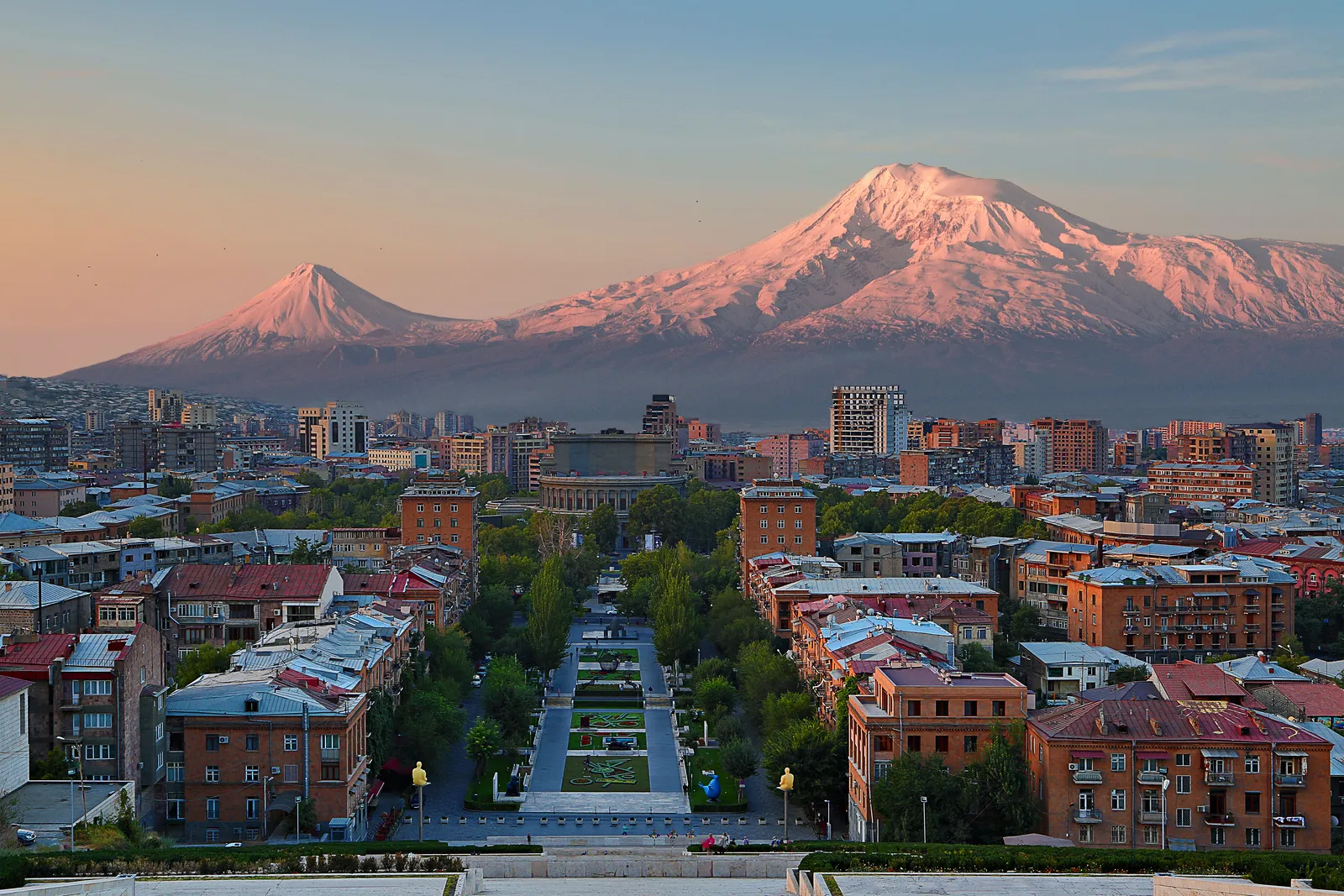
A pink city that rebuilt itself once already
Yerevan is one of the oldest continuously inhabited cities on earth, its origins tracing to the Urartian fortress of Erebuni in 782 BC, yet almost nothing you actually see predates the 20th century. Soviet-era architect Alexander Tamanyan redesigned the city in the 1920s around a radial plan centered on Republic Square, built almost entirely from the pink and black volcanic tuff quarried nearby, and that consistent palette is still the single thing every visitor notices first. The result is a capital that photographs like nowhere else at golden hour and functions, day to day, like a mid-sized city that has not yet been reshaped by mass tourism.
What's changed more recently is who lives here. Yerevan's population grew noticeably after the 2023 exodus of ethnic Armenians from Nagorno-Karabakh, and the city carries that recent history alongside its ancient one. For visitors this shows up mostly as texture rather than disruption: a livelier, slightly more crowded capital than a decade ago, with a restaurant and cafe scene that has expanded to match.
The honest complications
English is genuinely thinner here than in most European capitals; central hotels, restaurants and the main sights manage fine, but a taxi driver or market vendor is more likely to reach for Russian than English if your Armenian runs out. Summer heat on the Ararat plain is real, regularly above 30°C in July and August with limited shade downtown. And Yerevan's museums keep inconsistent hours by Western standards, particularly around public holidays; check ahead rather than assume.
A radial city built around one square
Yerevan's center is compact enough that neighbourhood choice matters less for distance than for atmosphere. Almost everything on a standard visit sits within Kentron, the central district; where you base yourself within it, or just outside it, shapes the trip more than it would in a larger capital.
Kentron
Kentron means "center" and it is exactly that: Republic Square, the Cascade, Opera Square and Northern Avenue's shopping strip all sit inside it, along with the majority of the city's hotels. For a first visit, staying here puts everything within a 20-minute walk and makes the whole trip simpler to plan around.
Around the Cascade
The streets immediately below the Cascade, especially Saryan Street, have become Yerevan's wine-bar and cafe strip, with a concentration of small tasting rooms in a few tightly packed blocks. Staying nearby means an uphill walk home but puts the city's best evening cafe crawl on your doorstep.
Arabkir
North of Kentron, Arabkir is a calmer, more residential district with easy metro access into the center and noticeably lower hotel prices for a similar standard of room. A reasonable choice for a longer stay or for travelers who prefer to walk out of the tourist core each evening.
Northern Avenue & Opera area
The pedestrianized boulevard connecting Republic Square to the Opera House is Yerevan's most polished stretch, lined with international shops and busy cafes; it's a corridor to walk through rather than a place to base yourself, but it anchors the geography of the whole center.
From Soviet grandeur to backpacker basics, all within walking distance
Yerevan's hotel scene runs from international five-star chains near Republic Square to long-running backpacker institutions a few streets over, with prices across the board well below equivalent European capitals. These picks cover the range, and each earns its place for a specific kind of trip.
At the top, The Alexander, a Luxury Collection Hotel offers five-star rooms, multiple dining venues and a spa near the city center, the standard choice for travelers who want an international luxury brand with local design touches. Armenia Marriott Hotel Yerevan, right on Republic Square, is the most centrally located of the major chains and puts the Cascade, the History Museum and Northern Avenue within a five-minute walk of the lobby.
In the boutique bracket, Republica Hotel sits in the middle of the city with a reputation for personal service and a genuinely central location near the main sights, while Messier 53 Hotel, a fifteen-minute walk from Republic Square, is a newly renovated mid-range option with its own small fitness and spa area. Both are strong picks for travelers who want character over brand recognition without stepping down to hostel level.
At the budget end, Envoy Hostel and Tours, open since 2005 in the heart of the city circle, is the long-running backpacker anchor of Yerevan: nine mixed dorms plus private rooms, English- and Russian-speaking staff, and well-organized regional tours to Garni, Geghard and beyond that guests can take or skip with no pressure either way.
Khorovats smoke, Areni wine, and coffee thick enough to read
Yerevan's food scene has grown quickly without losing its center of gravity: grilled meat, fresh herbs, dolma and lavash remain what the city actually eats, while a newer wave of restaurants treats those same dishes with more technique without pricing out the everyday lunch crowd.
Khorovats
Old Erivan is the traditional-ambiance standard-bearer for Armenian barbecue, consistently cited as one of the city's best for classic khorovats. Sherep takes a more composed approach under chef Hamlet Petrosyan, plating grilled meat with pickled wild herbs and a pomegranate reduction rather than serving it straight off the skewer. For a faster, more casual version, Kotayk Kitchen on Mashtots Avenue focuses on wood-fired grilled meats, with its pork neck khorovats among the best in the city at casual prices.
Traditional Armenian cooking
Lavash Restaurant runs the full repertoire: dolma, khorovats, manti, spas soup, harissa and jingalov hats, with herbs sourced daily and lavash baked fresh in-house. Tavern Yerevan pairs the same core dishes, khorovats, salads, pilaf and ghapama stuffed pumpkin, with live music for a livelier evening. For an unpretentious, resolutely local lunch, Poloz Mukuch on Abovyan Street serves manti, Sunday harissa and tolma all week at prices closer to 2,500-5,000 dram for a full meal.
Armenian coffee
Thick, unfiltered coffee brewed in a small copper jazzve is a genuine daily ritual rather than a tourist photo op, and cafes across Kentron and around the Cascade serve it at pace. Order it sladka (sweet) or without sugar, and expect to sip slowly; it's meant to be a pause, not a commute drink.
A small, walkable capital with one unmissable stairway
Yerevan's sights cluster tightly enough that a slow two days covers the essentials on foot, with the Cascade as the one experience nobody skips and the rest filling in around it.
Republic Square and the Cascade
Republic Square, Tamanyan's tuff-stone centerpiece, is worth an evening visit for its musical fountains, which run to Armenian, classical and rock music after dark and draw a genuine mix of locals and visitors rather than a staged tourist show. From there it's a short walk up Northern Avenue and Tumanyan Street to the Cascade, a tiered limestone stairway doubling as an open-air sculpture garden and home to the Cafesjian Center for the Arts inside; climb the outdoor steps for the view over the city toward Ararat, or take the free indoor escalator if the stairs aren't appealing.
Mashtots Avenue: mosque, opera, manuscripts
One avenue connects three of Yerevan's most distinct landmarks. The Blue Mosque, its facade covered in blue-toned mosaic tilework, is the city's last functioning mosque from the Persian era and a striking contrast to the tuff-stone buildings around it. Further along, the Yerevan Opera Theatre anchors Freedom Square and its surrounding park, a popular evening gathering spot. At the top of the avenue, the Matenadaran holds more than 23,000 ancient manuscripts in Armenian and a dozen other languages, a research institute as much as a museum, and the single best stop in the city for understanding how central the written word is to Armenian identity.
Tsitsernakaberd, the Genocide Memorial
On a hilltop overlooking the city, the Armenian Genocide Memorial Complex commemorates the roughly 1.5 million Armenians killed by the Ottoman government from 1915 to 1923. The eternal flame at the center of twelve leaning basalt slabs, the memorial wall, and the museum below combine for a visit that is unavoidably heavy but widely considered essential to understanding modern Armenia rather than a footnote to it.
Markets and the brandy factory
The Vernissage open-air market runs largest on weekends, a sprawl of handwoven carpets, brass, ceramics, wooden chess sets and Soviet-era ephemera where light negotiation is normal. A short taxi away, the Ararat Brandy Factory tour walks through more than a century of Armenian brandy production with a tasting at the end, genuinely informative rather than a straight sales pitch, open daily with tours in several languages.
Evenings on Saryan and Tumanyan
Yerevan's bar-and-pub cluster runs along Parpetsi, Pushkin, Saryan and Tumanyan streets near the Cascade, with Wild West Pub on Tumanyan a long-running fixture and the wine bars on Saryan Street the better call for a quieter night. The area stays busy without feeling like a tourist strip; plenty of the crowd is local.
One, two or three days, planned around the Cascade
Two full days covers Yerevan properly; three adds a monastery day trip that is arguably the best single day of an Armenia visit. These routes are walkable and end each day somewhere worth being at dusk.
- Morning
Republic Square and the History Museum. Coffee on Northern Avenue, then the museum's collection before the day-trip buses arrive.
- Midday
Khorovats lunch. Old Erivan or Poloz Mukuch, then a walk up to the Cascade for the Cafesjian collection and the view.
- Afternoon
Mashtots Avenue. The Blue Mosque, the Opera House and Freedom Square, ending at the Matenadaran before it closes.
- Evening
Republic Square fountains. Dinner in Kentron, then the musical fountains after dark.
- Day 1
The one-day route: Republic Square, the Cascade, Mashtots Avenue, fountains at night.
- Day 2 morning
Tsitsernakaberd. The Genocide Memorial and museum, an unhurried, quiet visit best done early.
- Day 2 afternoon
Vernissage and the brandy factory. The weekend market for crafts, then the Ararat Brandy Factory tour and tasting.
- Day 2 evening
Saryan Street. A wine bar crawl below the Cascade, the evening locals actually have.
- Days 1-2
The two-day route above, at a gentler pace.
- Day 3
Garni and Geghard. A half-day trip: the Greco-Roman temple, then the cliff-cut monastery, back in Yerevan for a late dinner. See the day trips chapter for the full route.
Compact, flat by regional standards, and cheap to move around
Zvartnots International Airport (EVN) sits about 13 kilometers from the center, roughly 25 minutes by road. The Zvartnots Express bus runs to Republic Square and Yeritasardakan metro station every 30 minutes between 7am and 10pm for around 300 dram; a taxi via the Yandex Go or GG app costs more but still only a small multiple of that, and both apps are the standard way locals and visitors alike book rides.
In the city, Yerevan's single-line, ten-station metro is fast for the routes it covers, and route 107 connects the airport to Barekamutyun station on that line. Taxis are cheap enough, around 600-1,000 dram across most of central Yerevan off peak, that many visitors barely use the metro at all. The center itself is flat and compact enough to walk end to end in under half an hour, with the Cascade the only real climb.
Best time to visit and public holidays
Yerevan has a continental climate with real seasonal swings. May-June and September-October bring the most comfortable temperatures for walking the city and combining it with day trips. July and August regularly exceed 30°C with little shade downtown; plan museum and market visits for morning or evening. Winter is cold, sometimes below freezing, but the city stays fully functional and hotel prices drop noticeably.
Independence Day, 21 September, and other national holidays can affect museum hours and transport schedules; check specific opening times if traveling around a holiday date.
One of the more affordable capitals in reach of Europe
Yerevan is significantly cheaper than Western European capitals and holds a slight edge over Tbilisi on everyday costs like food and local transport. The hostel and mid-range hotel scene is strong, and the main cost trap, such as it is, is peak-season pricing at Lake Sevan rather than anything in the city itself.
- Hostel dorm $10-15
- Market meals & khorovats stands $6-10
- Metro and walking, minimal taxi use
- Free fountains plus one paid sight
- Boutique hotel or B&B $50-90
- Restaurant meals with wine $20-35
- Regular taxi use via app
- Brandy factory tour, a museum, a day trip
- The Alexander or equivalent five-star
- Tasting menus and fine dining
- Private driver for day trips
- Premium Areni wine and brandy tastings
A calm, low-crime capital, with one thing that isn't about the city at all
Yerevan itself is genuinely low-crime: violent crime against tourists is rare, the central districts are comfortable to walk at night, and standard city awareness covers almost everything that could go wrong. The country's Level 2 US travel advisory is driven by the eastern border zone with Azerbaijan, hundreds of kilometers from Yerevan and nowhere near any city itinerary.
The short, practical list for the city: pickpocketing, uncommon but not unheard of around Vernissage market on busy weekends, so keep bags closed; unofficial airport taxis, easily avoided with the Yandex Go or GG app instead of drivers approaching arrivals; and uneven pavement in some older streets, worth a moment's attention at night. Emergency number is 911 for general emergencies, with 101 (fire), 102 (police) and 103 (ambulance) as direct lines.
Some of the Caucasus's best monasteries are an hour from your hotel
Yerevan's position on the Ararat plain makes it an outstanding base for Armenia's monastery circuit. Four routes are worth the time, each reachable by hired driver, tour or, for the closer ones, marshrutka.
Garni & Geghard
The region's only standing Greco-Roman temple at Garni, then Geghard Monastery ten kilometers on, its inner chambers carved directly into the cliff face in the 13th century. The most compact and most-booked of Yerevan's day trips, easily combined into a single half-day organised tour with transport included.
Khor Virap, Noravank & Areni
Khor Virap's monastery with Mount Ararat filling the frame behind it, then south to Noravank's canyon-set monastery and a wine tasting in Areni village, near the site of what researchers date as the world's oldest known winery. A long but rewarding full day, also available as an organised tour.
Lake Sevan & Dilijan
Sevanavank Monastery on its lake peninsula, then on to Dilijan's restored 19th-century old town and forest trails. Works as a long day trip or a relaxed overnight, especially in summer when Sevan's beach clubs are in full swing.
Tatev & the Wings of Tatev
The furthest and most dramatic of the four: a long drive south to Halidzor village, the 5.7-kilometer Wings of Tatev cable car across the gorge, and the 9th-century monastery on the other side. Doable as a very long single day from Yerevan but better as an overnight in Goris, which also puts the cave village of Old Khndzoresk within easy reach.
Yerevan FAQ
Is Yerevan safe for tourists?
Yes. Yerevan is calm and low-crime by international standards, comfortable to walk after dark in the central districts, and violent crime against tourists is rare. Standard city awareness around crowded markets covers the rest.
How many days do I need in Yerevan?
Two full days covers the city itself well: one for Republic Square, the Cascade and the museums, one for Tsitsernakaberd, the Blue Mosque and Mashtots Avenue. A third day is best spent on a monastery day trip rather than more city time.
How much does Yerevan cost per day?
Budget travellers manage on $35-50 a day with hostels and market meals; mid-range runs $70-110. Yerevan is significantly cheaper than most European capitals.
When is the best time to visit Yerevan?
May-June and September-October: mild temperatures, comfortable for walking, manageable crowds. July and August push past 30°C on the Ararat plain; winter is cold but quiet and workable.
How do I get from Zvartnots Airport to central Yerevan?
The Zvartnots Express bus runs to Republic Square and Yeritasardakan metro station roughly every 30 minutes for about 300 dram. A taxi via the Yandex Go or GG app costs a small multiple of that and takes about 25 minutes.
What is the best area to stay in Yerevan?
Kentron for first-timers: central, walkable, and within reach of Republic Square, the Cascade and the main restaurant streets. Arabkir for a quieter, more residential pace with good metro access.
Do I need to speak Armenian in Yerevan?
No. English is common in hotels, central restaurants and at the main sights, though thinner than in Western European capitals. Russian remains widely understood as a second language, especially with older residents.
Is Yerevan walkable?
Yes. The historic center is compact and mostly flat by Caucasus standards, and Republic Square, the Cascade, Mashtots Avenue and Northern Avenue are all within a comfortable 20-minute walk of each other.
Can I drink the tap water in Yerevan?
Yes, and Yerevan takes it further: the city has more than 1,500 free public drinking fountains called pulpulaks, fed by cold mountain spring water, scattered across nearly every street and park.
What day trips are possible from Yerevan?
Garni Temple and Geghard Monastery make an easy half-day trip. Khor Virap, Noravank and the Areni wine region fill a full day. Lake Sevan and Dilijan work as a day trip or overnight, and Tatev in the far south is a long full day or better as an overnight in Goris.
What Stays With You
Yerevan does not build itself around visitors, and that is exactly why it works. The city gets on with its evenings, families out late on Northern Avenue, old men playing backgammon in the Cascade's shade, the same khorovats stalls filling with locals on a Sunday, and lets you walk through the middle of it. The fountains at dusk, the first sip of Areni wine on Saryan Street, the moment Ararat appears behind Khor Virap on a clear morning: none of it was staged for you, which is part of why it stays with you.
Drink from a pulpulak on your last evening in the city, the way everyone else does, and understand why Yerevan has never felt the need to dress itself up for visitors.