
Malaysia's capital runs three identities at once
Kuala Lumpur, KL to almost everyone, grew from a 19th-century tin-mining boomtown at the meeting point of the Klang and Gombak rivers (Kuala Lumpur literally means "muddy river confluence") into a capital that never quite settled on one skyline. Colonial-era Moorish-style government buildings sit a few blocks from mirrored glass towers; a century-old Hindu temple faces a mosque across a street lined with Chinese medicine shops. It isn't a curated old-town-meets-new-town narrative, it's simply how the city grew, layered by whichever community and era built there.
What ties it together is the food and the value. Hawker centres and coffee shops (kopitiams) serve Malay, Chinese and Indian dishes side by side at prices that make a full meal cost less than a coffee back home, and the city is cheap enough overall that a genuinely good hotel room, a full day of Grab rides and three meals can still come in under what a single mid-range dinner costs in Singapore, ninety minutes south by plane.
The honest complications
KL's heat and humidity are constant and can wear visitors down faster than the itinerary suggests; pace accordingly and don't schedule back-to-back outdoor attractions at midday. The city was built around cars more than pedestrians, so some walks that look short on a map involve underpasses, elevated walkways or a stretch with no real footpath at all; a Grab ride is often the practical choice even for distances that feel walkable. And KL's skyline, however striking, is largely 1990s-onward: visitors expecting a historic Southeast Asian capital on the order of Hanoi or Yangon will find KL's colonial and pre-colonial layers thinner and more scattered, genuinely worth seeking out around Merdeka Square and Chinatown, but not the city's main event.
Five districts, each a different version of the city
KL's core is the "Golden Triangle," the area bounded by KLCC, Bukit Bintang and Chinatown, walkable in sections but usually stitched together by the MRT, LRT, monorail or Grab. Where to base yourself depends on whether you want the skyline, the nightlife, the heritage streets, or a quieter, more local pace.
KLCC
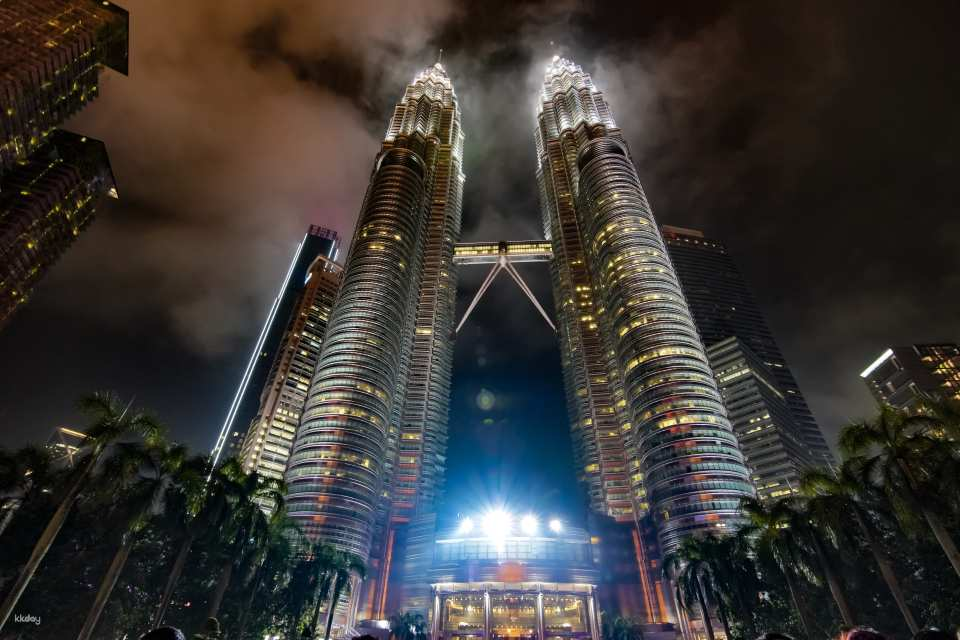
The Kuala Lumpur City Centre district is the glossy, corporate face of the country: the Petronas Twin Towers, KLCC Park at their base, and malls like Suria KLCC connected by air-conditioned walkways. It's the easiest first-time base, everything major feels close, and the KLCC LRT and monorail stations put the rest of the city within reach.
Bukit Bintang
KL's premier nightlife and shopping district, home to Pavilion KL and Berjaya Times Square malls and, after dark, Jalan Alor's hawker stalls. It's louder and busier than KLCC, with hostels and budget hotels alongside five-star towers, and it's the natural base for anyone prioritizing food and going out.
Chinatown (Petaling Street)
Centered on the covered Petaling Street market, this is KL's oldest commercial district, dating to the late 1800s, and still dense with temples, coffee shops and the Madras Lane hawker stalls tucked just behind the main strip. Pasar Seni MRT/LRT station puts Merdeka Square and the river confluence within a five-minute walk.
Bangsar
A leafy, more residential district favored by KL's middle class and expat community, with a café and brunch scene and a livelier, less tourist-oriented night-out strip than Bukit Bintang. A short Grab ride or LRT trip from the centre, better suited to a second visit than a first.
Brickfields
KL's Little India, immediately next to KL Sentral transport hub, dense with South Indian restaurants, sari shops and the Sri Kandaswamy Kovil temple. It lacks the polish of KLCC but rewards a lunch stop, and its proximity to KL Sentral makes it a practical first or last stop around an airport transfer.
From all-butler service to some of Asia's best-value hostels
KL's hotel scene spans genuine five-star luxury at prices well below equivalent cities, alongside a large, well-regarded hostel scene in Bukit Bintang. These picks cover the range, and each one earns its place.
At the top, The Ritz-Carlton, Kuala Lumpur is the city's only all-butler hotel, every room comes with dedicated personal service as standard, from around RM500 a night. In the design-forward boutique bracket, The RuMa Hotel and Residences (from around RM550) has 253 rooms by SCDA Architects, a rooftop infinity pool looking straight at the Petronas Towers, and the ATAS Modern Malaysian Kitchen restaurant downstairs, while the JW Marriott Kuala Lumpur (from around RM400) is a reliable five-star anchor directly on Bukit Bintang's main strip.
For value with genuine comfort, PARKROYAL Serviced Suites Kuala Lumpur in Bukit Bintang has spacious suites with premium bedding, well suited to longer stays or families. And at the budget end, Hexa Backpackers Bukit Bintang and Explorers Guesthouse and Hostel, walking distance to Chinatown, Bukit Bintang and Changkat alike, both offer dorm beds from around RM30-70 with free breakfast and social common areas, the properties that anchor KL's well-regarded backpacker scene.
Malay, Chinese and Indian food, sometimes on the same plate
KL's food scene is the country's in miniature: Malay, Chinese and Indian hawker traditions operating side by side, often in the same coffee shop, and the best meals are routinely at stalls with no sign and a queue of office workers rather than at restaurants with a name you'd remember.
Nasi Lemak
Malaysia's unofficial national dish, coconut rice with sambal, anchovies, peanuts and egg. Village Park Restaurant in Damansara Utama, Petaling Jaya (a short Grab ride from central KL, not walking distance) is the legendary address, its Nasi Lemak Ayam Goreng, rice with deep-fried spiced chicken, runs about RM12.30 and draws queues that have included multiple former prime ministers.
Jalan Alor street food
KL's most famous hawker street comes alive after dark: Wong Ah Wah Restaurant's char-grilled BBQ chicken wings are the signature order, alongside satay, char kway teow, fried oyster omelette and grilled seafood up and down the strip. Arrive hungry and share plates across several stalls rather than committing to one.
Banana leaf rice
South Indian rice and curry served on a washed banana leaf, all-you-can-eat rice and gravy at most stalls. Vishal Food & Catering on Brickfields' "Temple Street" is the best-known address, its banana leaf rice runs about RM6.80 with a rotating choice of curries; Sri Paandi Restaurant nearby is a well-regarded alternative when the queue at Vishal is long.
Petaling Street & Madras Lane
The covered Petaling Street market is worth visiting for the food as much as the (bargain-hard) souvenir stalls: the Madras Lane Hawker Stalls tucked just behind the main strip are known for chee cheong fun (rice noodle rolls), laksa and yong tau foo, and the market itself runs busiest from late morning into the evening.
Towers, temples and a cave system, in roughly that order
KL's sights split cleanly across its layered identities: the modern skyline, the colonial and religious heritage core, and Batu Caves at the city's edge. A few need advance booking or an early start, and this chapter walks through the city roughly the way a good two or three days would.
The Petronas Towers and KLCC
The Petronas Twin Towers observation deck and 41st-floor skybridge (RM98 adult, non-Malaysian passport) are KL's must-do, book online a few days ahead as daily visitor numbers are capped. Skip the ticket entirely and the towers are still worth seeing free, lit up at night from KLCC Park at their base, arguably the better photo anyway. For a second, cheaper high vantage point, KL Tower (Menara Kuala Lumpur)'s observation deck (RM33, non-Malaysian) sits on a hill that puts it at a similar effective height to the Petronas deck for less money and a shorter queue.
Batu Caves
Batu Caves, a limestone cave temple complex guarded by a 42.7-metre golden statue of Lord Murugan, the tallest of its kind in the world, is reached by 272 rainbow-painted steps up to the free Temple Cave. The smaller Cave Villa (RM15, non-Malaysian) and Ramayana Cave (RM5) are optional paid add-ons. KTM Komuter trains run directly from KL Sentral in about 40-45 minutes; go early morning to beat both the heat and the crowds, and expect resident macaques near the steps.
Merdeka Square and Chinatown
Merdeka Square (Dataran Merdeka) is where Malaysia's independence was declared on 31 August 1957, ringed by Moorish-revival colonial buildings including the Sultan Abdul Samad Building. The Central Market, a 1888-built former wet market turned crafts and culture hub, sits a short walk away, and from there it's an easy walk into Petaling Street for the covered Chinatown market and the Sri Mahamariamman Temple. The Islamic Arts Museum Malaysia, one of the region's best museums on the subject, and the modernist National Mosque (Masjid Negara) both sit nearby in the Lake Gardens area and pair well as a half-day.
Lake Gardens and family stops
The Perdana Botanical Garden (Lake Gardens) area holds KL Bird Park, one of the world's largest free-flight walk-in aviaries with more than 3,000 birds across roughly 200 species, a genuinely good stop for families. Aquaria KLCC, beneath the convention centre, is the indoor alternative on a rainy day.
One, two or three days, planned around the heat
Two to three full days covers KL properly; even one well-planned day delivers the essentials. Start early to beat both heat and crowds at outdoor sights, and save air-conditioned malls or museums for the hottest part of the afternoon.
- Morning
Batu Caves. KTM Komuter from KL Sentral, up the 272 steps before the heat and crowds build.
- Midday
Merdeka Square & Chinatown. The colonial core, Central Market, then lunch at the Madras Lane hawker stalls off Petaling Street.
- Afternoon
Petronas Towers. Observation deck and skybridge (book ahead), then KLCC Park.
- Evening
Jalan Alor. BBQ chicken wings at Wong Ah Wah and a share-plate crawl down the street.
- Day 1
The one-day route: Batu Caves, Merdeka Square, Chinatown, Petronas Towers, Jalan Alor.
- Day 2 morning
Lake Gardens. KL Bird Park and the Islamic Arts Museum, then the National Mosque.
- Day 2 afternoon
Brickfields lunch and Bukit Bintang. Banana leaf rice at Vishal Food & Catering, then an afternoon exploring Pavilion KL and Bukit Bintang.
- Day 2 evening
KL Tower at sunset. The second, cheaper high viewpoint, then dinner in Bangsar for a more local night out.
- Days 1-2
The two-day route above, at a gentler pace.
- Day 3, option A
Genting Highlands. Cable car up to the hilltop resort for cooler air and the theme park, back by evening.
- Day 3, option B
Melaka day trip. Bus from Terminal Bersepadu Selatan to the Dutch and Portuguese colonial quarter, back by evening.
Spread out, hot, and built for the MRT and Grab
KL's core sights are spread across a wider area than they first appear, and the tropical heat makes even a "walkable" route feel longer than it looks on a map. From Kuala Lumpur International Airport (KLIA), the KLIA Ekspres train reaches KL Sentral in about 28 minutes for RM55, against RM13 for the slower Skybus (about 75 minutes) or RM80-100 for a Grab. KLIA2, the low-cost terminal used by AirAsia, is a short shuttle from the main terminal and connects via the same Ekspres line.
Inside the city, the MRT, LRT and monorail lines cover the main tourist corridor (KLCC, Bukit Bintang, Chinatown via Pasar Seni, and KL Sentral for Brickfields and onward trains) cheaply and reliably; a single ride typically runs RM1-5. Grab is the default for anything the rail network doesn't cover directly, cheap by Western standards (RM8-20 for most central trips) and far more transparent than flagging a street taxi.
Best time to visit and the monsoon pattern
KL sits inland enough that its climate is more stable than the coastal or island parts of Malaysia, but it is still hot and humid year-round (25-33°C) with rain possible in any month. December to February and May to July are the driest windows; October and November tend to bring the heaviest downpours and occasional flash flooding in low-lying areas. A light rain jacket or umbrella is worth packing regardless of season.
One of Southeast Asia's better-value capitals
KL is significantly cheaper than Singapore and generally on par with or below Bangkok. The hostel scene is excellent at the budget end, and the main cost trap is eating exclusively in mall food courts or hotel restaurants instead of the hawker stalls that are both cheaper and better.
- Hostel dorm RM30-70
- Hawker meals RM6-15
- MRT/LRT and walking RM10-20
- Batu Caves and free viewpoints
- Boutique or serviced-suite hotel
- Restaurant meals RM25-60/person
- Grab rides plus MRT
- Petronas Towers, museums, a day trip
- Ritz-Carlton or The RuMa, RM500+
- Tasting menus and fine dining
- Private driver for day trips
- Genting or Melaka guided tours
One of Southeast Asia's safer capitals, with a short scam list
KL benefits from Malaysia's overall Level 1, Exercise Normal Precautions rating. Violent crime against tourists is rare, and the city is generally fine to walk in the main tourist districts at night with normal urban awareness. KL is also reasonable for solo female travellers: the malls, MRT and main tourist streets see heavy local female use, though the usual advice, use Grab rather than unmarked taxis late at night, applies here as anywhere.
The things that actually catch visitors: bag-snatching, sometimes from passing motorbikes, concentrated in crowded spots like Bukit Bintang and Petaling Street at night, so wear bags cross-body and away from the road; unofficial currency exchangers and overly friendly strangers running romance or investment scams, common enough that the tourist police specifically warn about them; and smash-and-grab theft from parked cars, which affects renters more than walkers. Emergency number is the national 999 (or 112 from any mobile), and the Tourist Police Hotline is 03-2149 6590, with officers stationed in Bukit Bintang, KLCC and Chinatown.
KL's location makes it an easy base for three very different days
KL's central position on the peninsula makes it an efficient base for day trips in three different directions: up into cool hill country, out to the administrative capital, or back into colonial history.
Genting Highlands
A hilltop resort town at around 1,800 metres, reached by road and then the Awana SkyWay cable car over the rainforest canopy. The Genting SkyWorlds theme park and the Genting Highlands Premium Outlets are the main draws, plus simply escaping KL's heat for a few cooler hours.
Putrajaya
A planned government city built from the 1990s onward, with the pink-domed Putra Mosque as its signature building and a lakeside setting that photographs well, especially around sunset.
Melaka (Malacca)
Malaysia's oldest colonial city: Dutch Stadthuys, Portuguese A Famosa fort ruins, and a Peranakan (Baba-Nyonya) heritage quarter, all walkable from Melaka Sentral. Direct buses run every 30 minutes from KL's Terminal Bersepadu Selatan.
Kuala Selangor fireflies
A river boat trip at dusk near Kampung Kuantan watches mangrove trees light up with thousands of synchronized fireflies, a genuinely strange, memorable evening that most first-time visitors skip entirely.
Kuala Lumpur FAQ
Is Kuala Lumpur safe for tourists?
Yes. Malaysia rates Level 1, Exercise Normal Precautions, with KL among the country's safest cities for tourists. The main concerns are pickpocketing and bag-snatching in crowded spots like Bukit Bintang and Petaling Street, not violent crime.
How many days do I need in Kuala Lumpur?
Two to three full days covers the city well: one for KLCC and the Petronas Towers, one for Chinatown, Merdeka Square and Batu Caves, and a third for Bukit Bintang's food scene and a day trip. A fourth day fits Genting Highlands or Melaka comfortably.
How much does Kuala Lumpur cost per day?
Budget travellers manage on RM120-180 a day with hostels and hawker meals; mid-range runs RM300-500. KL is significantly cheaper than Singapore and generally on par with or below Bangkok for food and accommodation.
When is the best time to visit Kuala Lumpur?
December to February and May to July are the driest windows. KL is hot and humid year-round regardless (25-33°C), so timing is more about rain than temperature; sudden downpours are possible in any month.
How do I get from KLIA to the city centre?
KLIA Ekspres runs to KL Sentral in about 28 minutes for RM55. The Skybus coach costs RM13 but takes about 75 minutes, and Grab typically runs RM80-100 off-peak.
What is the best area to stay in Kuala Lumpur?
KLCC for first-timers who want the Petronas Towers on their doorstep and easy walkability to malls and the park. Bukit Bintang for nightlife and Jalan Alor's street food. Bangsar or Brickfields for a quieter, more local pace.
Do I need to speak Malay in Kuala Lumpur?
No. English is genuinely widely spoken in hotels, restaurants, malls and with Grab drivers, a legacy of British rule that functions as a real second language in the capital, not just tourist signage.
Is Kuala Lumpur walkable?
Parts of it. KLCC, Bukit Bintang and Chinatown are each walkable internally, but the tropical heat and humidity, plus gaps between districts, make the MRT, LRT, monorail or Grab the practical way to move between them.
Is Batu Caves worth the trip?
Yes. The Temple Cave itself is free to enter and the 42.7-metre golden Lord Murugan statue and 272 rainbow-painted steps are genuinely striking. It's about 40-45 minutes from central KL by KTM Komuter train.
What Stays With You
Kuala Lumpur doesn't resolve its contradictions for you, and that is exactly why three days here feel like more. The towers lit up over KLCC Park, the golden statue at the top of 272 painted steps, the plate of nasi lemak that costs less than a bottle of water back home, none of it was arranged into one coherent story for visitors. It's simply what happens when Malay, Chinese and Indian communities build a capital together for a century and let each layer stay visible.
Go to Jalan Alor hungry on your last night, order more than you can finish, and understand why nobody who's eaten well in KL describes it as just a stopover city.