
What You're Actually Getting Into
Tunisia is the smallest of the three Maghreb countries and, in area, one of the smallest in Africa, yet it packs a Mediterranean coastline, a working Sahara and Roman ruins that rival anything in Italy into a country you can drive across in a day. It is also the one Arab Spring country whose 2011 uprising produced, for a decade, a functioning democracy: the Jasmine Revolution that began in the town of Sidi Bouzid in December 2010 toppled a dictator within 28 days, led to a new constitution, and won its architects the Nobel Peace Prize in 2015, even as the political system it built has since been unwound by the sitting president.
None of that history is a reason to stay away. Tunis's medina is one of the best-preserved old cities in North Africa, Carthage's ruins sit a 40-minute train ride from downtown, and the Sahara towns of Douz and Tozeur put you on a camel among dunes within a few hours of the capital. Prices are still low by Mediterranean standards: a full dinner with wine at a good restaurant runs 40 to 70 dinars, and Tunisians, particularly outside the resort strips, are some of the most matter-of-fact hospitable people on the Mediterranean.
The honest complications
The security context is worth understanding rather than ignoring. Coordinated attacks on the Bardo Museum in March 2015 and a beach resort near Sousse in June 2015 killed dozens of tourists and devastated the tourism industry for years afterward. Security at museums, airports and resort areas has been rebuilt substantially since, and neither attack has been repeated in a decade, but it explains the visible checkpoints and bag searches at sites like the Bardo. Politically, President Kais Saied's 2021 suspension of parliament and subsequent rewriting of the constitution ended the country's post-revolution democratic experiment, a genuine loss for Tunisians that mostly plays out far from anywhere a tourist would notice. And touts in the Tunis medina and around Sidi Bou Said, offering to "guide" you to a shop or charging for unrequested help, are persistent enough that a polite, firm decline needs to become reflexive.
A History Worth Knowing
Tunisia's history is disproportionate to its size: Carthage, Rome's great rival, stood where Tunis stands today, and the country later became one of the intellectual centers of the early Islamic world. French colonization, a modernizing independence movement and the country's own recent, contested experiment with democracy are the short version of how the country you're visiting got here.
- 9th century BCE
Carthage founded. Phoenician settlers from Tyre establish Carthage, which grows into the dominant power of the western Mediterranean.
- 264-146 BCE
The Punic Wars. Hannibal crosses the Alps with elephants in the second war; Rome razes Carthage in the third, then rebuilds it as a major Roman city.
- 670 CE
Kairouan founded. The Arab general Uqba ibn Nafi establishes Kairouan, the first Islamic city in the Maghreb and one of Islam's holiest.
- 1881-1956
French protectorate. France administers Tunisia for 75 years, leaving a lasting French-language and architectural legacy in Tunis's Ville Nouvelle.
- 1956
Independence. Habib Bourguiba becomes Tunisia's first president and pushes through the Personal Status Code, banning polygamy and expanding women's rights well beyond regional norms of the time.
- Dec 2010-Jan 2011
The Jasmine Revolution. Mohamed Bouazizi's self-immolation in Sidi Bouzid sparks protests that topple President Ben Ali in 28 days and ignite the wider Arab Spring.
- 2021-present
Democratic backslide. President Kais Saied suspends parliament and rewrites the constitution, concentrating power and effectively ending the post-revolution democratic period.
Read the full history: Carthage, the Ottomans, Bourguiba and the revolution
Carthage's rivalry with Rome produced three Punic Wars over more than a century, the second defined by Hannibal Barca's famously improbable crossing of the Alps with war elephants to invade Italy directly. Rome finally destroyed Carthage in 146 BCE, salting the earth in legend if not entirely in fact, then rebuilt it a century later as one of the empire's great African cities, a status reflected today in the scale of Roman ruins scattered across the country at Dougga, El Jem and Carthage itself.
The Arab conquest of the 7th century brought Islam and, with the founding of Kairouan in 670 CE, one of the religion's earliest and most significant centers of scholarship outside Arabia. Ottoman rule followed from the 16th century, administered with real autonomy by local beys, before France established a protectorate in 1881 that lasted until independence in 1956.
Habib Bourguiba, Tunisia's founding president, pursued an explicitly modernizing, secularizing agenda: the 1956 Personal Status Code banned polygamy, established judicial divorce, and gave Tunisian women legal standing unusual anywhere in the Arab world at the time, a legacy still visible in Tunisia's comparatively open social culture. Zine El Abidine Ben Ali ousted Bourguiba in a bloodless 1987 coup and ruled with increasing authoritarianism until Mohamed Bouazizi, a Sidi Bouzid fruit vendor, set himself on fire in protest at police harassment in December 2010. The demonstrations that followed forced Ben Ali from power within weeks, the opening act of what the world came to call the Arab Spring. Tunisia's National Dialogue Quartet, a coalition of civil society groups, won the 2015 Nobel Peace Prize for steering the country to a new constitution and peaceful elections, a genuine, rare success story among the countries the Arab Spring touched. That democratic period has since narrowed considerably under President Kais Saied, who suspended parliament in July 2021 and pushed through a new constitution concentrating power in the presidency, a shift most visitors will not encounter directly but that shapes the country's current political mood.
Top Destinations
Tunisia divides naturally into five travel zones: the capital and the northern coast, the great Roman sites, Kairouan and the interior, the Sahara in the south, and the beach resort coast including Djerba. The country is compact, roughly the size of England and Wales combined, so most of it is reachable on a single well-planned trip.
Tunis, the capital worth two full days
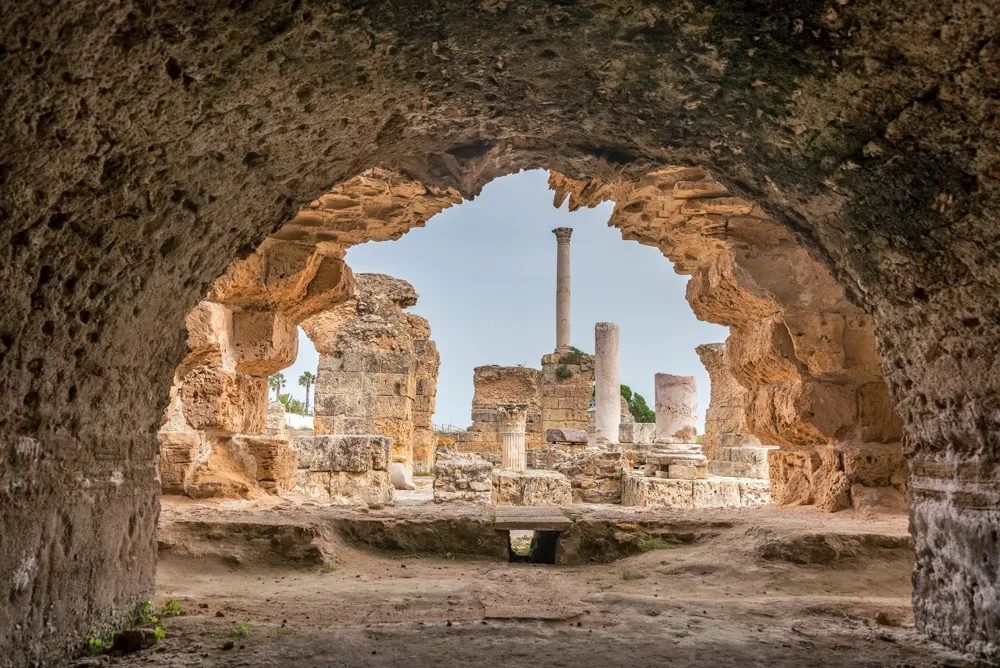
Tunis's medina, a UNESCO World Heritage Site, is one of the best-preserved old cities in North Africa: narrow covered souks selling perfume, spices, textiles and jewelry, centered on the Zitouna Mosque, whose 8th-century core makes it the oldest mosque in the country (non-Muslims can view the courtyard from outside; interior access is restricted). Just outside the medina walls, Avenue Habib Bourguiba is the French-built boulevard that gives Tunis its Ville Nouvelle character, cafes and colonial architecture leading down to the Cathedral of St Vincent de Paul. A short TGM train ride north puts you at Carthage's scattered Roman and Punic ruins and, one stop further, the blue-and-white cliff village of Sidi Bou Said. Budget two full days for the capital and its coastal suburbs.
Dougga, the best-preserved Roman town in North Africa
Dougga sits on a hillside about two hours from Tunis, and it is, by wide consensus, one of the best-preserved Roman towns anywhere, not just in North Africa: a capitol, a theater still used for performances, temples, a forum and residential streets laid out clearly enough that you can read the shape of Roman civic life without a guide. Few crowds, real shade in places, and no reconstruction, this is the genuine ruin rather than a rebuilt approximation.
El Jem, the amphitheater that rivals the Colosseum
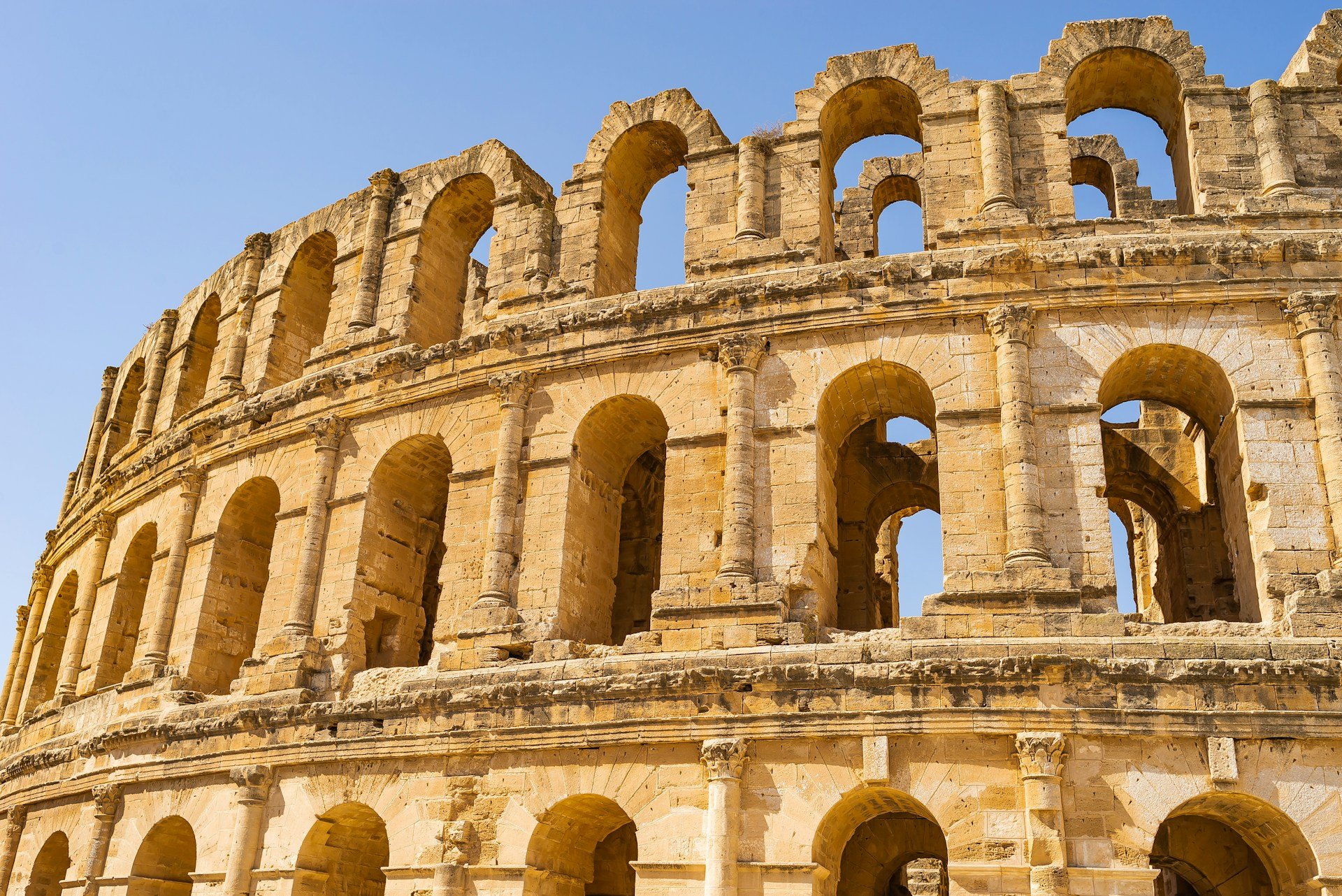
El Jem's Roman amphitheater, a UNESCO World Heritage Site, held an estimated 35,000 spectators and is one of the best-preserved Roman amphitheaters in the world, arguably in better structural condition than Rome's Colosseum. You can walk the underground passages where gladiators and animals waited before entering the arena, a detail most Roman sites don't let you access.
Kairouan, Islam's fourth-holiest city
Kairouan, founded in 670 CE, is traditionally considered the fourth-holiest city in Islam after Mecca, Medina and Jerusalem, and its Great Mosque, one of the oldest in the Islamic world, is a foundational piece of Islamic architecture whose courtyard and forest of column capitals, recycled from Roman and Byzantine buildings, are open to visitors regardless of religion (non-Muslims view the prayer hall from the courtyard rather than entering it). The medina here is quieter and less touristed than Tunis's, and the city is famous across Tunisia for its makroudh pastries, semolina cakes filled with dates and fried or baked, sold throughout the old town.
Douz & Tozeur, the gateway to the Grand Erg Oriental
Douz, "the gateway to the Sahara," and Tozeur, an oasis town of mudbrick architecture and date palm groves, are the two bases for exploring the dunes of the Grand Erg Oriental. Camel treks and overnight desert camps run from Douz into Jebil National Park, while 4WD trips reach deeper into the dune fields for travelers with less time. Tozeur's old town, Ouled el-Hadef, is built almost entirely from a distinctive local brick pattern found nowhere else in Tunisia. Matmata, nearby, is known for its troglodyte cave homes dug into the hillsides, some of which appeared as sets in the original Star Wars films.
Hammamet & Sousse, the resort coast
Hammamet and Sousse are Tunisia's main beach resort towns, both with old medinas attached to modern hotel strips, sandy beaches and all-inclusive infrastructure built for European package tourism. Sousse's medina is itself UNESCO-listed and worth a couple of hours beyond the beach; Hammamet's is smaller but well kept.
Djerba, the island UNESCO recognized in 2023
Djerba, off Tunisia's southeast coast and recognized as a UNESCO World Heritage Site in 2023, combines 133km of coastline with genuinely distinct island culture: the whitewashed town of Houmt Souk, the El Ghriba Synagogue in Er-Riadh, among the oldest in North Africa, and shallow, warm water that lets you wade out a long way from shore. Best swimming season runs May to mid-October.
Culture & Etiquette
Tunisia is a Muslim-majority country with a notably secular public culture relative to much of the region, a legacy of Bourguiba-era reforms, but it remains socially conservative outside resort zones and the more cosmopolitan parts of Tunis. Arabic (in the local Derja dialect) is the everyday language, French is the language of business, education and much daily signage, and English is common only around major tourist sites.
Do
- Dress modestly in medinas, mosques and rural areas. Cover shoulders and knees; women may want to carry a scarf for mosque courtyards. Resort towns and beaches are far more relaxed.
- Bargain in the souks. Prices in medina shops are opening offers, not fixed prices; a friendly back-and-forth is expected and part of the interaction, not an imposition.
- Learn a few words. Shukran (thank you) and salam (hello) in Arabic, or merci and bonjour in French, go a long way, especially outside Tunis.
- Carry cash. Small shops, louages and rural areas are largely cash-based; cards work in hotels, larger restaurants and supermarkets.
- Keep exchange receipts. You can reconvert unspent dinars back to euros or dollars at the airport before departure, but only with proof of the original exchange.
Don't
- Drink alcohol in public. It's legal in licensed hotels, tourist restaurants and some supermarkets, but drinking on the street or on a public beach is illegal and enforced.
- Photograph police, military sites or checkpoints. Enforced strictly and can lead to your phone being confiscated or worse.
- Eat, drink or smoke visibly in public during Ramadan daylight hours. Not illegal for visitors but considered genuinely disrespectful; step into a private space or a tourist-oriented restaurant instead.
- Engage extensively with medina touts. A firm, polite "la, shukran" (no, thank you) and continuing to walk works better than any explanation.
- Assume Tunisia is interchangeable with Morocco or Egypt. The French-Ottoman-Islamic blend, the secular legal legacy and the small scale of the country give it a distinct character worth engaging with on its own terms.
Deeper culture: the Personal Status Code, French bilingualism and Amazigh heritage
The Personal Status Code. Habib Bourguiba's 1956 reform banned polygamy, instituted judicial divorce and gave women legal standing well ahead of regional norms of the era. It remains a genuine source of national identity and is part of why Tunisia's public culture reads as more secular than many of its neighbors.
French bilingualism. Seventy-five years of French administration left French deeply embedded in Tunisian education, business and media. Street signs, menus and official documents frequently appear in both Arabic and French, and French is often a more useful second language for visitors than English.
Amazigh (Berber) heritage. Tunisia's population is predominantly Arab-Amazigh, and Amazigh (Berber) heritage survives most visibly in the south: the troglodyte architecture of Matmata, the fortified granaries (ksour) of the Dahar region near the Libyan border, and place names across the interior.
Food & Drink
Tunisian food is Mediterranean with a distinct North African heat: harissa, the fiery chili paste UNESCO recognized as Intangible Cultural Heritage in 2022, turns up on nearly every table as an unrequested appetizer, and dishes lean spicier than their Moroccan or Algerian counterparts. Street food and market meals are cheap even by regional standards.
Brik 5-6 TND
Paper-thin malsouka pastry, folded into a triangle and deep-fried, classically filled with tuna, a raw egg, capers and preserved lemon that sets as it fries. Order it as a starter; eating it without spilling the yolk is a local rite of passage.
Couscous 10-20 TND
Tunisia's national dish, and typically spicier than couscous elsewhere in the Maghreb thanks to harissa and chili worked into the broth. Fish couscous on the coast, lamb or vegetable inland.
Lablabi 5-7 TND
A chickpea stew ladled over stale bread with cumin, harissa, a soft-poached egg and olive oil, a winter staple and one of the best-value hot meals in the country. Widely available at unpretentious neighborhood spots.
Mechouia salad 6-10 TND
Grilled peppers, tomatoes and garlic blended with olive oil, tuna and a boiled egg on top. A staple starter and, along with brik, one of the dishes most representative of the country's flavor palette.
Dates & pastries
Tozeur's deglet nour dates are considered among the best in the world; Kairouan's makroudh, semolina cakes filled with date paste, are the country's signature sweet.
Mint tea & boukha
Sweet mint tea with pine nuts is the standard hospitality drink. Boukha, a fig-based spirit, is Tunisia's most distinctive alcoholic export, sold in licensed shops and served in tourist-oriented bars and restaurants.
When to Go & Itineraries
April, May, September and October are the best months: warm without being extreme, manageable crowds, and comfortable for both the coast and the Sahara. July and August are scorching, regularly above 40°C in the desert and interior, though the beach resorts still run at full capacity through summer for travelers who don't mind the heat. Winter is genuinely good for sightseeing and culture, with lower prices and the Roman sites and medinas to yourself, though desert nights turn cold.
All four seasons compared, with temperatures
| Season | Verdict | Temps | Prices & crowds |
|---|---|---|---|
| Apr-May & Sep-Oct | Best | 20-28°C coast, cooler inland | Mid prices, manageable crowds |
| Jun-Aug | Good (very hot) | 30-40°C+ interior/Sahara | Peak resort season on the coast; punishing heat inland |
| Mar & Nov | Good | 15-22°C | Low prices, quiet sites, some rain |
| Dec-Feb | Quiet | 8-16°C, cold desert nights | Lowest prices; excellent for sightseeing, poor for swimming |
Approximate averages: Tunis 18°C year-round, coastal resorts (Hammamet, Sousse, Djerba) similar with more summer humidity, the Sahara interior (Douz, Tozeur) swings from near-freezing winter nights to 40°C+ summer days.
Itineraries
Seven days covers Tunisia's essentials adequately. Two weeks adds Kairouan, Djerba and a proper multi-night Sahara trip instead of a rushed detour.
- Days 1-2
Tunis. Medina and the Bardo Museum, TGM train out to Carthage and Sidi Bou Said.
- Days 3-4
Dougga & El Jem. Rental car or organized tour south via the two great Roman sites, overnighting near Sousse or El Jem.
- Days 5-7
The Sahara. Continue to Tozeur or Douz for one night in the desert, camel trek or 4WD dune excursion, before returning to Tunis for departure.
- Days 1-3
Tunis extended. Medina, Bardo Museum, Carthage, Sidi Bou Said, and a day in La Marsa.
- Days 4-5
Dougga & Kairouan. Dougga's ruins, then Kairouan's Great Mosque and medina, an easy pairing on the way south.
- Days 6-7
El Jem & the coast. El Jem's amphitheater, then a night or two in Sousse or Hammamet.
- Days 8-11
The Sahara, properly. Tozeur's old town and oases, Matmata's cave dwellings, and two nights around Douz including an overnight desert camp.
- Days 12-14
Djerba. Houmt Souk, the El Ghriba Synagogue, and beach time before flying home from Djerba-Zarzis or returning to Tunis.
- Days 1-4
Tunis & the north coast. Full capital exploration plus a day trip to the Cap Bon peninsula.
- Days 5-7
Roman heartland. Dougga, Kairouan and El Jem at an unhurried pace, with time for the makroudh bakeries of Kairouan's back streets.
- Days 8-9
Sousse & Hammamet. Beach time and both UNESCO-adjacent medinas.
- Days 10-15
Sahara deep dive. Tozeur, Chebika and Tamerza mountain oases, Matmata, and multiple nights around Douz with a longer camel or 4WD expedition into Jebil National Park.
- Days 16-21
Djerba & the Dahar. The fortified hilltop granaries of the Dahar region near Tataouine, then Djerba for beaches, Houmt Souk and a slow finish.
Getting there & around
Tunis-Carthage Airport (TUN) is the main international gateway, with Enfidha-Hammamet (NBE), Djerba-Zarzis (DJE) and Monastir (MIR) serving the resort coast directly. Ferries connect Tunis with Palermo, Sicily (roughly 9-13 hours depending on the vessel, from about €30, 2-3 sailings a week with Grimaldi Lines and GNV). Car rental from Tunis-Carthage Airport starts around $26-30 a day for an economy car, rising sharply in August.
All transport options with prices: louages, trains, taxis
| Option | Price | Notes |
|---|---|---|
| Louages (shared vans) | 5-25 TND/route | Leave when full from stations near main cities. The fastest way to cover main intercity routes. |
| SNCFT trains | 5-20 TND | Connect Tunis with Sousse, Sfax, and other main-line towns; slower and less frequent than louages but comfortable. |
| TGM light rail (Tunis area) | under 1 TND | Tunis Marine to La Marsa via La Goulette, Carthage and Sidi Bou Said, every 15-20 minutes. |
| Taxis (metered) | 3-10 TND (city) | Insist the meter is switched on; "broken meter" claims are the most common tourist scam. |
| Ferry to Palermo, Sicily | from ~€30 | 9-13 hours, 2-3 sailings weekly, Grimaldi Lines and GNV. |
Practical prep: buy a Tunisian SIM at the airport or download an eSIM before landing. Ride-hailing apps inDrive and Yassir operate in Tunis and are a straightforward way to avoid meter disputes entirely. GetTransfer offers fixed-price airport pickups from TUN.
Where to stay
Medina guesthouses (dar)
Restored traditional courtyard houses inside the old cities of Tunis and Kairouan, the most atmospheric and specifically Tunisian accommodation, typically with a rooftop terrace and a fraction of the price of a comparable hotel.
Sidi Bou Said & La Marsa boutique stays
Small hotels positioned for the cliffside views and the coastal calm, well suited to a first-time visit that wants Tunis's culture without staying inside the busy medina itself.
Resort hotels: Hammamet, Sousse, Djerba
All-inclusive beach resorts built for European package tourism, the most straightforward option for a coastal, family-oriented stay with minimal planning required.
Sahara desert camps & Tozeur hotels
Fixed and semi-permanent tented camps around Douz, or mudbrick-style hotels in Tozeur's oasis, both good bases for camel treks and 4WD excursions into the dunes.
Budget Planning
Tunisia is one of the most affordable countries on the Mediterranean. Budget travelers eat and sleep well on 80 to 140 dinars a day. The dinar is a closed currency, meaning it cannot be bought or exchanged outside the country, so plan to exchange cash or withdraw from an ATM after you land, and keep your exchange receipt if you want to convert leftover dinars back before departure.
- Medina guesthouse or dorm 35-60 TND
- Lablabi and market meals 5-10 TND
- Louages between cities
- Free medina wandering, cheap museum entries
- Boutique dar or 3-4 star hotel
- Restaurant dinners 40-70 TND
- Rental car ~80-150 TND/day
- Guided day trips to Dougga, El Jem
- Best available hotels in Tunis and the coast
- Private guides and drivers
- Multi-night desert camp with full board
- Fine dining in Tunis and Sidi Bou Said
Quick reference prices: brik, taxis, museum entries
| Brik from a market stall | 5-6 TND |
| Coffee | 2-4 TND |
| Restaurant meal (mid) | 25-45 TND |
| Bardo Museum entry | ~15 TND |
| City taxi ride | 3-10 TND |
| TGM train (Tunis-La Marsa) | under 1 TND |
| Medina guesthouse | 35-90 TND/night |
| Economy rental car | ~80-100 TND/day |
| Ferry to Palermo | from ~€30 one way |
Prices reflect August 2026 research and drift over time. Treat them as a planning baseline, not a quote. Approximate exchange rate at research time: $1 ≈ 3.1 TND.
Visa & Entry
Tunisia has a permissive visa regime for most Western travelers: US, UK, Canadian, Australian and almost all EU citizens enter visa-free for up to 90 days with just a valid passport. Cyprus is the notable EU exception and does require a visa. Rules do change; treat third-party paid "e-visa" sites that rank well in search with caution, since Tunisia's standard entry for most Western passports carries no fee at all.
✓ Valid passport
At least six months validity from date of entry is the commonly recommended standard; carry a photocopy separate from the original.
✓ Return/onward ticket
May be requested at immigration, particularly for air arrivals.
✓ Accommodation address
Hotels register foreign guests automatically; have your first night's address ready at the border.
✓ Not EU or Schengen
Tunisia sits outside both, so time here has no effect on a Schengen 90-day allowance for travelers combining trips.
| Tunisia | Morocco | |
|---|---|---|
| Daily budget | $25-45 gets you far; one of the Mediterranean's cheapest | Noticeably pricier, especially Marrakech and the coast |
| Scale | Small, drivable in a day, easy to see most of it in a week | Much larger, requires longer trips to cover comparably |
| Sahara | Grand Erg Oriental via Douz and Tozeur, less crowded | Merzouga and the Erg Chebbi dunes, more developed tourism |
| Roman ruins | Dougga and El Jem, among the best-preserved anywhere | Volubilis is excellent but Morocco's Roman heritage is smaller in scale |
| Crowds | Still under-visited outside peak resort season | Marrakech and Chefchaouen are heavily touristed |
Safety, Solo Women & Family
Tunisia is safe for tourists in the areas travelers actually visit. The US State Department rates the country Level 2, "Exercise Increased Caution," with Tunis, Sousse, Hammamet, Djerba and the other coastal resort areas outside every warning zone. The only Do Not Travel designations cover the area within 16km of the Libyan border, due to terrorism risk, and a southern military zone near Remada that requires special authorization to enter, neither of which is anywhere near the standard tourist circuit.
Petty theft
Pickpocketing and bag-snatching occur in crowded medina lanes and busy markets, at a level comparable to other popular Mediterranean cities. Keep valuables secured and be alert in dense crowds.
Terrorism context
Coordinated attacks on the Bardo Museum and a Sousse beach resort in 2015 killed dozens of tourists. Security at museums, airports and resort areas has been rebuilt substantially since, with no repeat incident in a decade, but visible checkpoints and bag searches remain standard at major sites.
Border & military zones
Avoid the area within 16km of the Libyan border entirely, and don't enter the southern military zone near Remada without official authorization.
The 3 scams to actually know about
Tunisia isn't a high-scam destination for the areas most visitors stick to, but a handful of patterns catch uninformed travelers, mostly around transport and the medina.
The "broken" taxi meter
Drivers claim the meter is broken and quote an inflated fixed price, or use a rigged meter that runs fast. Insist on the meter before the ride starts, or use the inDrive or Yassir apps to avoid the negotiation entirely.
Unsolicited "guides"
Self-appointed guides offer directions or a shop recommendation, then demand payment. A firm decline and continuing to walk resolves it almost every time; engaging or explaining tends to prolong it.
Unofficial airport taxis
Unlicensed drivers approach arrivals before the official taxi rank and quote inflated fares. Use the metered official rank, a pre-booked transfer, or a ride-hailing app instead.
Solo women travelers
Tunisia is considered one of the more comfortable Arab countries for women traveling alone. Serious incidents against tourists are rare, but catcalling and persistent staring happen, especially in busy medina areas and around transport hubs, and tend to ease considerably in resort towns and more cosmopolitan parts of Tunis. Dressing modestly outside beach resorts, avoiding walking alone late at night, and using metered taxis or ride-hailing apps rather than unmarked cars after dark are the practical basics. Full detail on our Solo Woman Explorer pages.
Emergency numbers
Embassies in Tunis and highway assistance
Most Western embassies, including the US and UK, are located in the Les Berges du Lac district of Tunis. The US Embassy is at +216-71-107-000. For breakdown assistance on toll motorways, dial 1200.
- USA
- +216-71-107-000
- France
- Place de l'Indépendance, Tunis
- UK
- Les Berges du Lac, Tunis
- Highway assistance
- 1200
Family travel
Tunisia works well for families, particularly the coastal resort towns. Hammamet and Djerba have shallow, calm beaches and all-inclusive hotel infrastructure specifically built for families, and the Roman sites and Sahara excursions work well for children old enough for some historical or adventure context beforehand. Camel treks in Douz are a reliable hit with kids of most ages.
Tunisia FAQ
Is Tunisia safe to visit?
Yes, for the areas tourists actually visit. The US State Department rates Tunisia Level 2, Exercise Increased Caution, with Tunis, Sousse, Hammamet and Djerba outside every warning zone. The only Do Not Travel areas are within 16km of the Libyan border and the southern military zone, nowhere near the standard tourist circuit.
Do I need a visa for Tunisia?
Most Western passport holders, including the US, UK, Canada, Australia and almost all EU countries, enter visa-free for up to 90 days with just a valid passport. Cyprus is a notable EU exception that does require a visa.
How much does Tunisia cost per day?
Budget travelers manage on 80-140 dinars a day (about $25-45), mid-range on 230-350 dinars ($75-110). Tunisia is one of the most affordable countries on the Mediterranean.
When is the best time to visit Tunisia?
April, May, September and October: warm without being extreme, manageable crowds, and comfortable for both the coast and the Sahara. July and August are scorching, often above 40°C in the desert and interior.
How many days do you need in Tunisia?
Seven days covers Tunis, Carthage, one Roman site and a taste of the Sahara. Two weeks lets you add Kairouan, Djerba and a proper multi-night desert trip without rushing.
Can I drink alcohol in Tunisia?
Yes, it's legal and sold in licensed hotels, tourist restaurants and some supermarkets, but drinking in public, on the street or on a public beach is illegal and taken seriously. During Ramadan, sales are further restricted.
Is Tunisia safe for solo female travelers?
Generally yes, and Tunisia is considered one of the more comfortable Arab countries for women traveling alone. Catcalling and staring happen, especially in busy medina areas, but serious incidents are rare. Avoid walking alone late at night and dress modestly outside resort zones.
What currency does Tunisia use, and can I get dinars before I arrive?
The Tunisian dinar (TND). It's a closed currency that cannot be bought or exchanged outside Tunisia, so bring euros, dollars or a card and exchange or withdraw after you land.
Is Tunisia in the European Union or Schengen area?
No. Tunisia is in North Africa and isn't part of the EU or the Schengen Area, so a Tunisia trip has no effect on a Schengen 90-day allowance.
What language is spoken in Tunisia?
Arabic is the official language, spoken in the Tunisian dialect (Derja) day to day. French is widely used in business, signage and education, and is often more useful than English outside major tourist sites.
Is Tunisia good for families with kids?
Yes, especially coastal resort towns like Hammamet and Djerba, which have shallow, calm beaches and all-inclusive infrastructure built for families. The Sahara and Roman sites work well for older children with some historical context beforehand.
What Stays With You
Tunisia asks you to hold two facts at once: it is a small, affordable, genuinely welcoming country where you can walk a Roman amphitheater in the morning and watch the sun set over the Sahara two days later, and it is a country still working through what its own 2011 revolution meant, and didn't quite deliver. Neither cancels the other out. The medina in Tunis functions as a real market rather than a recreation, the ruins at Dougga sit largely to themselves, and the dunes outside Douz look the way the Sahara is supposed to look in your head before you've actually seen it.
Go for the ruins and the desert. Stay curious about the rest.