
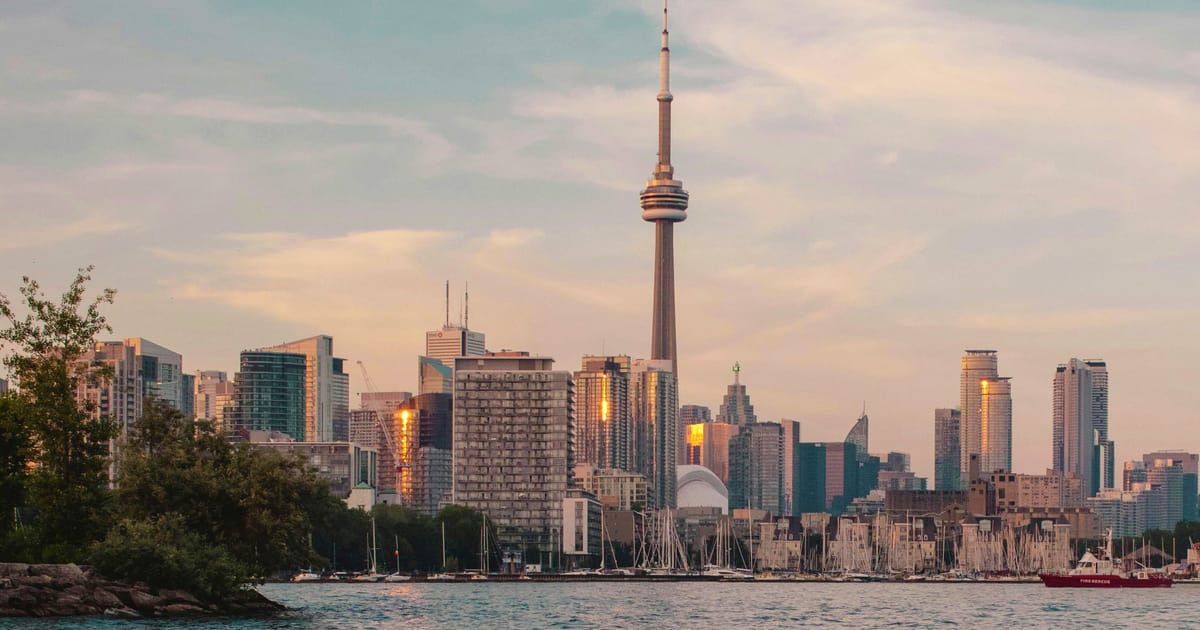
Canada's biggest city, and its easiest first stop
Toronto sits on the shore of Lake Ontario, a flat, grid-planned downtown that makes it one of the more walkable big cities in North America once you get past the initial scale. It is Canada's financial and cultural capital in practice if not in name (that's Ottawa), and it is also, by most measures, one of the most ethnically diverse cities on the planet: over half of Toronto's population was born outside Canada, and it shows in the food, the festivals, and the languages you'll hear on any given subway car.
What changed in the last decade is the skyline and the cost: Toronto's downtown core has densified rapidly, hotel and housing prices have climbed to rival major US cities, and the CN Tower, once the tallest freestanding structure in the world, now shares the skyline with a forest of condo towers built in roughly the same window. The tourist infrastructure is excellent, English is universal, and the city rewards a neighbourhood-by-neighbourhood approach rather than a checklist of single sights.
The honest complications
Toronto is genuinely expensive by Canadian standards, closer to a major US city than to the rest of the country, and the gap between downtown's polish and its rougher edges, particularly around parts of the downtown east side, is real and worth normal urban awareness rather than alarm. Winters are cold and can be grim from late November through March, with the PATH underground walkway existing specifically because of it. And Toronto's traffic is some of the worst in North America; the TTC subway and streetcar network, not a rental car, is how you actually get around.
A flat grid, five neighbourhoods that matter
Toronto's downtown is a manageable grid rather than a maze, and most of what a first-time visitor wants sits within a few subway stops of each other. Where you base yourself comes down to whether you want nightlife, shopping, market life or quiet.
Downtown / King West
The Financial District and King West give you the CN Tower, Union Station, the Entertainment District and the harbourfront all within walking distance, plus the best TTC connectivity in the city. Slightly corporate by day, lively by night around the King Street strip; the practical, no-regrets base for a first visit.
Distillery District & St. Lawrence
The Distillery District's Victorian industrial brick lanes are entirely pedestrian, over 40 boutiques and restaurants with no traffic to dodge, while neighbouring St. Lawrence Market is Toronto's oldest and best food market. Quieter at night than King West, and an easy walk or streetcar ride to downtown proper.
Kensington Market & Chinatown
A National Historic Site of Canada: four blocks of Victorian houses turned vintage shops, Latin American grocers, Caribbean bakeries and unmarked bars, bordering Chinatown's dense strip of dim sum halls and Vietnamese kitchens along Spadina Avenue. The best-value eating in the city and a genuinely different pace from downtown.
Yorkville
Toronto's answer to Rodeo Drive: designer boutiques, five-star hotels and quiet, leafy streets that were a bohemian hippie enclave in the 1960s before becoming the city's most expensive postal code. Close to the Royal Ontario Museum and a short walk from the subway's Bloor-Yonge interchange.
Queen West
Street art, independent design shops, live music venues and the Art Gallery of Ontario at its eastern edge, Queen West is Toronto's creative-culture strip and the best base for a younger, nightlife-focused visit without straying far from downtown.
From a 1929 railway hotel to Queen West hostels
Toronto's hotel scene runs from a genuine architectural landmark downtown to a strong, growing hostel scene in Queen West, with the mid-range increasingly squeezed by rising city-wide prices. These five picks span every budget.
At the top, Fairmont Royal York, opposite Union Station, has anchored the city since 1929: originally the tallest hotel in the British Empire, it later expanded to 1,600 rooms and remains one of Canada's grandest historic stays, well positioned for the CN Tower and the Financial District.
In the boutique bracket, The Hazelton Hotel in Yorkville (from roughly $440) is a five-star, 118 Yorkville Avenue property with 77 rooms and suites, walking distance to the Royal Ontario Museum and Yorkville's boutiques, while the Omni King Edward Hotel downtown is another of the city's grand historic properties, open since 1903.
For value close to the action, the Comfort Hotel near Yonge and Bloor (roughly $130-200) is centrally located with complimentary breakfast, an easy walk to Yorkville and the subway. And at the budget end, Samesun Toronto, in the heart of Queen West, and Check Inn on Elm Grove Avenue are the two properties travellers consistently point to for Toronto's hostel scene, both with private-room options alongside dorms.
A city that eats the whole world, one subway stop at a time
Toronto's food scene is defined by its immigrant communities rather than any single "Toronto cuisine": genuine dim sum on Spadina, Jamaican patties, Vietnamese pho, and a Portuguese-rolled peameal bacon sandwich that is as close as the city gets to a signature dish. The best meals are often the least fussy: a market stall, a hole-in-the-wall on a side street, a bakery counter with a line of regulars.
Peameal bacon sandwich
Toronto's closest thing to a signature dish: back bacon rolled in cornmeal, griddled and stacked on a kaiser bun. Carousel Bakery, on the market's main level for more than 30 years, is the address that put it on the map and still draws a lineup most days.
Dim sum & Chinatown
Chinatown along Spadina and Dundas West runs from $4 dim sum carts to serious sit-down banquets. Rol San and Mother's Dumplings are the two names locals send first-timers to for hand-rolled dumplings and classic dim sum respectively.
Kensington Market grazing
A single afternoon can cover tacos at Hot Beans, a hidden dim sum bar at Cold Tea (unmarked entrance, worth finding), and a butter tart slice from Wanda's Pie in the Sky, all within four blocks.
Italian institutions
Terroni, which opened on Queen Street West in 1992 as an Italian goods shop with four bar stools, is now a beloved multi-location institution across the city and a reliable, no-reservations-needed pasta fix.
The CN Tower is the icon; the neighbourhoods are the trip
Toronto's headline sight is worth doing properly, but the city's real strength is wandering between neighbourhoods that each feel like a different place. A few things benefit from advance booking; this chapter walks through the city roughly the way a good three days would.
The CN Tower & the harbourfront
The CN Tower (adult admission around $43) was the tallest freestanding structure in the world for over three decades; the glass floor and the LookOut level are the standard visit, and the EdgeWalk exterior walk is for those who want more than a view. Book a timed slot and go near opening or sunset to avoid the longest queues. From the tower, it's a short walk to the harbourfront and Ripley's Aquarium of Canada (around $38), whose underwater tunnel and shark exhibit are the draw for families. The Toronto CityPASS bundles the CN Tower, Ripley's and a choice of other major sights at a meaningful discount if you're doing three or more.
The Distillery District & St. Lawrence Market
The Distillery District's 13 car-free acres of restored Victorian industrial buildings hold more than 40 boutiques, galleries and restaurants; it's also one of the most photographed corners of the city, especially around the holiday markets in December. A short streetcar or walk away, St. Lawrence Market has been named one of the world's best food markets by multiple outlets, with more than 120 vendors under one roof.
Museums & Yorkville
The Royal Ontario Museum (adult admission roughly $26-30) is Canada's largest museum of natural history and world cultures, instantly recognizable for its crystalline glass extension jutting over Bloor Street. The Art Gallery of Ontario (around $30, free Wednesday evenings, and free for Ontario residents under 25) holds one of the world's largest Henry Moore sculpture collections alongside a serious contemporary program. Both sit within walking distance of Yorkville's boutiques.
Kensington Market & Casa Loma
Kensington Market rewards slow, aimless wandering more than a checklist: vintage shops, murals, and the multicultural food stops covered in the previous chapter. Uptown, Casa Loma (adult admission around $45-52 with tax), a genuine early-20th-century castle complete with secret passages and manicured gardens, is Toronto's most unusual single building and works especially well for families.
The waterfront & the Toronto Islands
A short, cheap ferry ride from the harbourfront, the Toronto Islands give you a car-free, beach-and-boardwalk afternoon with the skyline as the backdrop, one of the best free-feeling ways to spend a warm-weather afternoon in the city.
One, two or three days, planned neighbourhood by neighbourhood
Three full days covers Toronto properly; even one well-planned day delivers the highlights. These routes stay close to the subway and dodge the worst queues.
- Morning
CN Tower first. Book the first available slot to beat the queues, then walk the harbourfront.
- Midday
St. Lawrence Market. A peameal bacon sandwich at Carousel Bakery, then a short walk or streetcar to the Distillery District.
- Afternoon
Distillery District. Wander the car-free lanes, grab a coffee, browse the boutiques.
- Evening
Dinner in Kensington Market or Chinatown. Dumplings at Mother's Dumplings or a slower Kensington graze.
- Day 1
The one-day route: CN Tower, harbourfront, St. Lawrence Market, Distillery District, dinner in Kensington or Chinatown.
- Day 2 morning
Royal Ontario Museum at opening, then a walk through Yorkville's boutiques.
- Day 2 afternoon
Kensington Market & Queen West. Vintage shops, street art, and the Art Gallery of Ontario at Queen West's eastern edge.
- Day 2 evening
King West or Queen West for dinner and nightlife. The Toronto evening locals actually have.
- Days 1-2
The two-day route above, at a gentler pace, adding the Toronto Islands ferry on a warm afternoon.
- Day 3, option A
Niagara Falls by GO Train. One of the great easy day trips in North America; book ahead for the WEGO bus combo ticket.
- Day 3, option B
Casa Loma & a slower uptown day. The castle in the morning, then a relaxed afternoon back in Yorkville or the Annex.
Flat, gridded, and built around the subway
Toronto's downtown is compact and flat, easy walking once you're oriented to the grid. From Pearson Airport (YYZ), the UP Express train runs to Union Station in the core in 25 minutes for $12.35, or $9.25 with a Presto card, against 30-45 minutes and considerably more by taxi or rideshare depending on traffic. In the city, get a reloadable Presto card (available at subway stations and convenience stores): a single TTC fare is $3.35 and a day pass costs $13.50, covering the subway, streetcars and buses citywide.
The TTC subway and streetcar network is the primary way to get around; traffic and parking make a rental car a net negative for a downtown-focused visit. Uber and Lyft operate citywide and are useful late at night or for reaching neighbourhoods off the subway line. The PATH, an underground pedestrian network connecting much of downtown, is a genuine winter-weather lifeline, not just a novelty.
Best time to visit and Toronto's festival calendar
Toronto has a genuine four-season climate. June through September is the sweet spot: warm days (18-27°C), long daylight hours and every attraction fully open. Winters are cold, averaging around -4°C in January and February with real snow, while spring and fall are shorter transitional seasons worth watching the forecast for.
The Toronto International Film Festival (TIFF) in early September is one of the world's major film festivals and brings a genuine buzz, and elevated hotel prices, to the King West/Entertainment District area. Caribbean Carnival (Caribana) in late July/early August is one of North America's largest Caribbean festivals, with a major parade and citywide events.
Comparable to a major US city, pricier than most of Canada
Toronto is Canada's most expensive city outside a handful of specific niches, running close to major US city prices for hotels in particular. The hostel scene is strong at the budget end, and market and food-court meals keep daily costs manageable even downtown.
- Hostel dorm $35-55
- Market meals and food courts $20-30
- TTC day pass $13.50
- Free harbourfront and neighbourhood walks
- Boutique or chain hotel $180-260
- Restaurant meals $50-90
- TTC plus occasional rideshare
- CN Tower, a museum, one guided extra
- Fairmont Royal York or equivalent $400+
- Fine dining across neighbourhoods
- Private tours and transfers
- Niagara Falls guided day trip
Generally safe, with the usual big-city basics
Toronto is safe for tourists by big-city standards, and the areas a typical visitor actually spends time in, downtown, the Distillery District, Kensington Market, Yorkville, are well within normal urban-awareness territory. Violent crime against visitors is uncommon; the more realistic concerns are pickpocketing in crowded tourist spots and busy transit, and increased reports of incidents on parts of the TTC in recent years, which the system's SafeTTC reporting app and visible staffing are aimed at addressing.
The areas worth avoiding without a specific reason to be there are further from downtown, parts of Scarborough and the Jane and Finch area among them, and are not places a typical sightseeing itinerary would take you regardless. Downtown's east side has visible homelessness and drug use in specific pockets; unpleasant to witness in places but not typically a safety risk to a visitor with normal awareness. Emergency number is the North American standard 911 from any phone.
Niagara Falls alone justifies a fourth day in Toronto
Toronto's position at the western end of Lake Ontario makes it a strong base for southern Ontario day trips. Niagara Falls is the essential one; the others are worth it if you have the extra time.
Niagara Falls
About 130km from downtown, roughly 1.5-2 hours by car or bus and 2-2.5 hours by GO Train. A round-trip GO Train and WEGO shuttle bus combo ticket runs around $34-40 and covers unlimited local bus travel around the Falls for the day; organised day tours from Toronto run roughly $99-150 with hotel pickup included. See the Falls from the Canadian side (the better view of both the American and Horseshoe Falls), take a boat tour close to the base, and if you have a car, extend into Niagara-on-the-Lake for wine country.
Niagara-on-the-Lake
A wine town with more than 20 wineries and one of Ontario's prettiest main streets, an easy half-day extension if you're driving to Niagara Falls rather than taking the train.
Prince Edward County
Ontario's own wine and food region on a peninsula into Lake Ontario, with sandy beaches and dozens of small wineries, and far fewer crowds than Niagara.
Algonquin Provincial Park
Canoe-country lakes and old-growth forest a genuine day trip's reach from the city, best in a rental car and best appreciated as an overnight if you can spare it.
Toronto FAQ
Is Toronto safe for tourists?
Yes, Toronto is generally safe for tourists with standard urban precautions. Violent crime against visitors is uncommon; the main concerns are pickpocketing in crowded spots like the Eaton Centre and on busy transit.
How many days do I need in Toronto?
Three full days covers the city well: one for downtown and the CN Tower, one for the Distillery District, St. Lawrence Market and Kensington Market, one for museums or a slower neighbourhood pace. A fourth day fits the Niagara Falls day trip and is worth adding.
How much does Toronto cost per day?
Budget travellers manage on CAD $70-100 a day with hostels and casual meals; mid-range runs CAD $180-280. Toronto is comparable to a major US city and pricier than most of the rest of Canada.
When is the best time to visit Toronto?
June through September for warm weather and every attraction open. September and October add fall colour with fewer crowds. Winters are cold, averaging around -4°C in January and February.
Is Niagara Falls a good day trip from Toronto?
Yes. It's about 130km away, roughly 2-2.5 hours by GO Train or 1.5-2 hours by car, and the Falls, boat tours and Niagara-on-the-Lake wine country all fit comfortably into a full day.
How do I get from Toronto Pearson Airport to downtown?
The UP Express train runs from Pearson to Union Station in 25 minutes for $12.35, or $9.25 with a Presto card. A taxi or rideshare takes 30-45 minutes depending on traffic and costs considerably more.
What is the best area to stay in Toronto?
Downtown/King West for first-timers: central, walkable and close to the CN Tower and the Financial District. Yorkville for upscale shopping and boutique hotels. Queen West for nightlife, galleries and a younger crowd.
Do I need to rent a car in Toronto?
No. The TTC subway, streetcar and bus network covers downtown and most neighbourhoods well, and traffic and parking make driving in the core more hassle than it's worth for a short visit.
Is Toronto walkable?
The downtown core is very walkable and flat, unlike hillier cities. Winter ice and snow are the main seasonal obstacle; the PATH underground walkway connects much of downtown without going outside.
What is the Presto card and do I need one?
Toronto's reloadable transit card, used across the TTC subway, streetcars, buses and the UP Express airport train. It saves money over cash fares and is available at subway stations and convenience stores citywide.
What Stays With You
Toronto does not have a single postcard moment the way some cities do; what it has instead is scale and range packed into a walkable grid. The CN Tower lit up over the harbourfront at night. A market vendor who has sold the same peameal bacon sandwich for thirty years. A four-block stretch of Kensington Market where you can eat your way through four continents without crossing a single subway line. None of it is trying especially hard to impress you, and that's exactly why it works.
Take the GO Train out to Niagara Falls on your last full day, feel the spray at the railing, and understand why this unglamorous, hard-working, endlessly multicultural city is Canada's easiest first stop rather than its most obvious postcard.