
What You're Actually Getting Into
Canada is the second-largest country in the world by area, roughly the same size as Europe, but 90 percent of its 41-plus million people live within 150 kilometers of the US border, in a handful of cities strung along a single east-west line. That geography shapes every trip here: you are never seeing "Canada" in one visit, you are seeing Toronto, or Vancouver and the Rockies, or Quebec, and each of those regions has its own weather, its own pace, and in Quebec's case, its own primary language.
The country's reputation for politeness and functioning infrastructure is largely earned: public transit runs on time in the major cities, healthcare emergencies for visitors are handled competently even if not free, and the multicultural mix, particularly in Toronto, means excellent food from nearly every culinary tradition on earth within a few subway stops of each other. What it isn't is cheap: Toronto and Vancouver run close to major US city prices, and distances between regions are large enough that a two-week trip realistically covers two regions well, not four.
The honest complications
Winters are genuinely cold across almost the entire country, not a minor inconvenience: Toronto averages around -4°C in January and February, and driving conditions further north and in the Rockies can be serious rather than scenic. Distances are large enough that "seeing Canada" in the way you might see a European country in two weeks is not realistic; flights between Toronto and Vancouver take about five hours, similar to flying across the continental US. Toronto and Vancouver housing and hotel costs have pushed accommodation prices up faster than most other costs, and outside the big cities, English-French bilingualism is inconsistent: expect functional English almost everywhere outside Quebec, and expect Quebec, especially rural Quebec, to genuinely operate in French first.
A History Worth Knowing
Canada's land has been home to hundreds of distinct Indigenous nations for thousands of years before European contact. French settlement began at Quebec City in 1608, Britain took control after the Seven Years' War in 1763, and the country as a political entity was born through Confederation in 1867, a gradual, largely negotiated process rather than a revolutionary break, which still shapes how Canadians talk about their own history today.
- Pre-1600s
Indigenous nations. Hundreds of distinct First Nations, Inuit and later Métis peoples inhabit the land, with complex trade networks, governance systems and oral histories predating any European presence by millennia.
- 1608
Quebec City founded. Samuel de Champlain establishes a French fortress at what is now Quebec City, the beginning of New France and the fur-trade economy built in partnership with, and dependent on, Indigenous nations.
- 1763
Ceded to Britain. The Treaty of Paris ends the Seven Years' War; New France becomes part of the British Empire, but French language, civil law and Catholic institutions are formally preserved in Quebec.
- 1867
Confederation. The British North America Act creates the Dominion of Canada from Nova Scotia, New Brunswick and the Province of Canada on 1 July, a date still celebrated as Canada Day.
- 1971
Official multiculturalism. Canada becomes the first country to adopt multiculturalism as official government policy, a defining, if imperfectly realized, part of national identity since.
- 2015–present
Truth and Reconciliation. Following the Truth and Reconciliation Commission's 2015 report on the residential school system, land acknowledgments, Indigenous-led tourism and public reckoning with this history have become far more visible to visitors than a generation ago.
Read the full history: New France, the two founding peoples, and modern Canada
The fur trade was the economic engine of early Canada, and it depended entirely on partnerships, alliances and intermarriage between French traders and Indigenous nations, particularly around the Great Lakes and the St. Lawrence. This is part of why Canada's founding narrative is usually told as more collaborative than the American frontier story, even though the later history of colonization, forced relocation and the residential school system caused profound, lasting harm to Indigenous communities, harm the country is still actively working through.
After 1763, Britain governed a colony that was majority French-speaking and Catholic, and rather than attempting full assimilation, the Quebec Act of 1774 preserved French civil law and religious freedom, a decision with consequences still visible today in Quebec's distinct legal system and cultural identity. The idea of "two founding peoples," English and French, became central to how Canada understood itself, even as it left Indigenous nations and later waves of immigrants out of that framing for most of the country's history.
Confederation in 1867 was a negotiated federation, not a war of independence, and Canada gained full legislative independence from Britain only gradually, through the Statute of Westminster in 1931 and finally full constitutional independence with the Constitution Act of 1982. The late 20th century brought the multiculturalism policy of 1971, large-scale immigration that made Toronto and Vancouver among the most ethnically diverse cities on earth, and two referendums in Quebec (1980 and 1995) on separating from Canada, both narrowly defeated, that still inform Quebec's relationship with the rest of the country.
Indigenous land acknowledgment. It is now standard at events, in museums and on some tourism signage across Canada to acknowledge the traditional Indigenous territory a place sits on; Toronto, for instance, sits on the traditional territory of the Mississaugas of the Credit, the Anishinaabe, the Chippewa, the Haudenosaunee and the Wendat. Visitors will see this practice regularly and it reflects a genuine, still-unfolding process of reconciliation rather than a purely symbolic gesture.
Top Destinations
Canada divides into a handful of travel regions separated by serious distance: Ontario and Toronto in the east-central corridor, Quebec next door with its own language and character, Western Canada anchored by Vancouver, the Canadian Rockies straddling Alberta and British Columbia, and Atlantic Canada out on the coast. Almost nobody combines more than two regions in a single trip; the flight between Toronto and Vancouver alone takes about five hours.
Toronto, the practical first stop
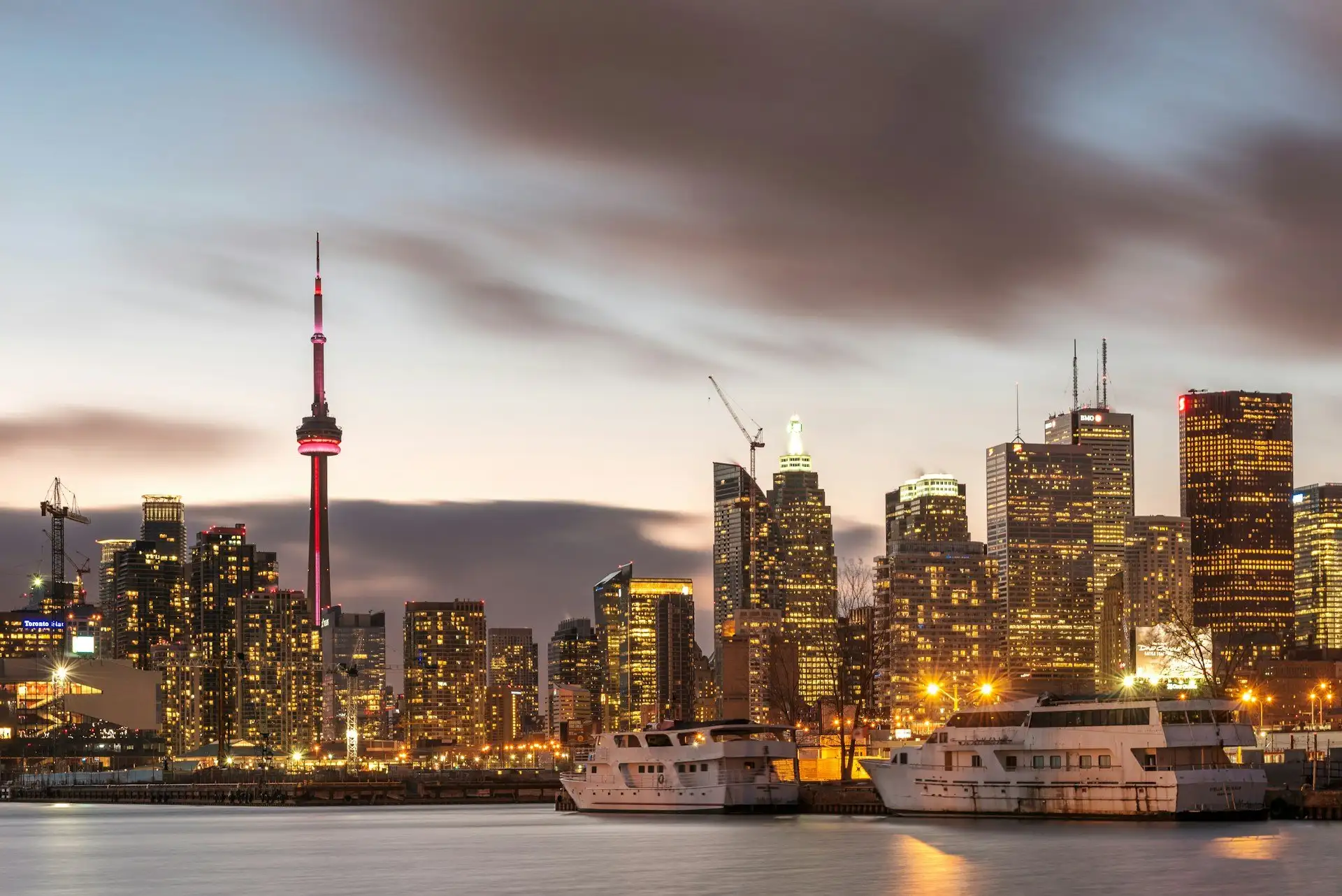
Canada's largest city and its main international gateway is the obvious first-time base: a genuinely multicultural downtown, the CN Tower, the Distillery District's car-free brick lanes, and Niagara Falls a comfortable day trip away by train. See our full Toronto city guide for neighborhoods, hotels, food and a full day-trip breakdown. Budget at least three days for the city itself.
Quebec City, the walled old town
Quebec City's Old Town is the only fortified city wall still standing north of Mexico, a UNESCO World Heritage Site whose stone streets, the Chateau Frontenac hotel dominating the skyline, and French-first atmosphere feel genuinely unlike anywhere else in North America. Poutine, cretons and tourtière are the local specialties; the city is at its best walked slowly over two days.
Montreal, bigger and more layered
Montreal trades Quebec City's postcard prettiness for scale and edge: Old Montreal's cobblestones, the underground city (a genuine necessity in a Montreal winter), a food scene built on smoked meat, bagels and poutine, and a nightlife and arts culture that draws comparisons to European cities. Bilingual in practice, French-first by law and identity.
Vancouver, ocean and mountains together
Vancouver sits between the Pacific and the Coast Mountains in a way few cities can match: Stanley Park's seawall, the Victorian-brick streets of Gastown, Granville Island's public market, and Grouse Mountain a short gondola ride above the skyline. The mildest winters in Canada and one of its most expensive housing markets, both a factor in trip planning.
Whistler, an easy mountain add-on
About two hours north of Vancouver along the Sea-to-Sky Highway, Whistler is one of North America's largest ski resorts in winter and a serious mountain-biking and hiking destination the rest of the year, an easy and popular pairing with a Vancouver city stay.
Banff & Lake Louise
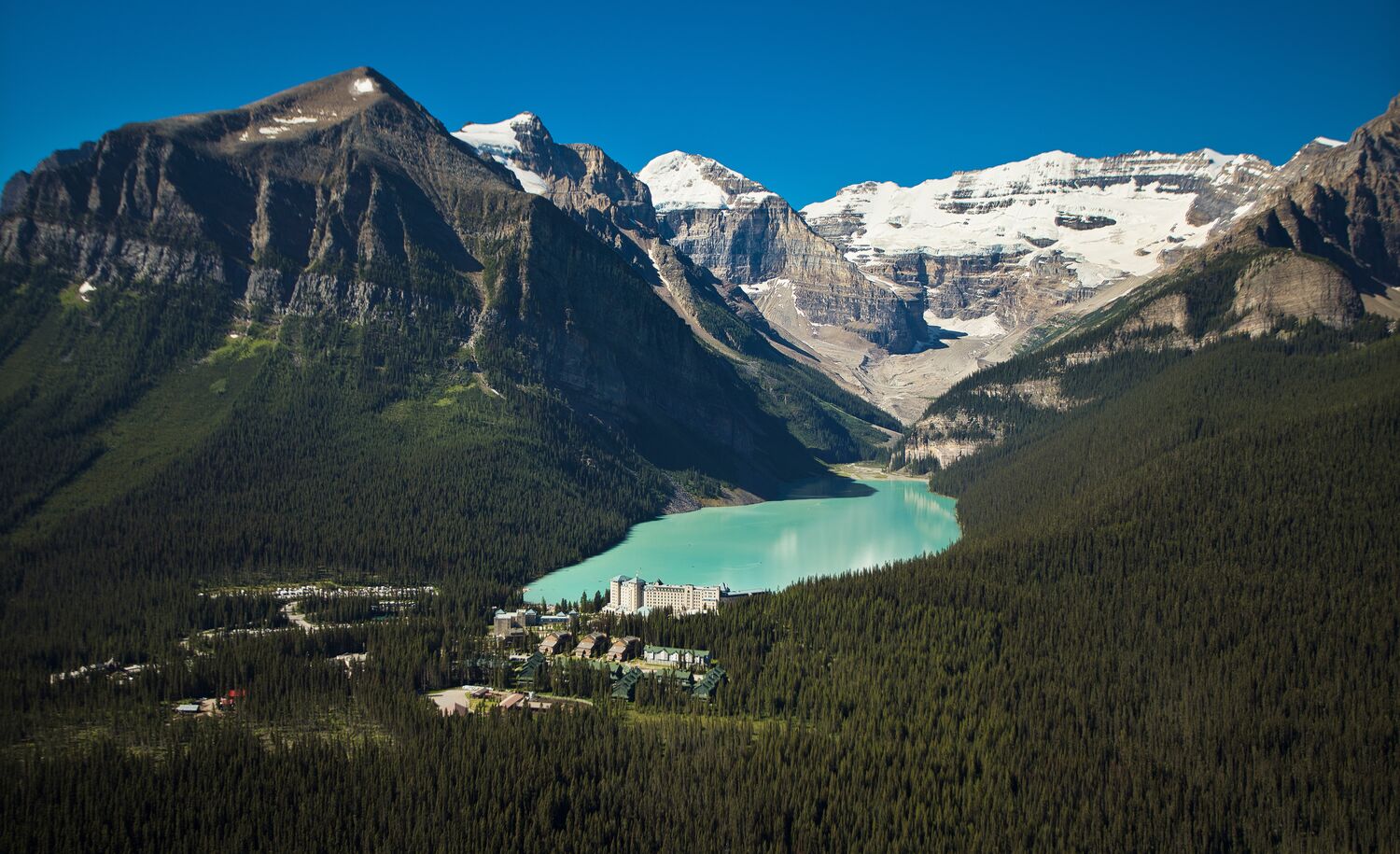
Banff National Park is Canada's oldest national park and its most visited, and the turquoise water of Lake Louise and Moraine Lake, both fed by glacial meltwater, are the images most people associate with Canada without knowing the name. The town of Banff has real tourist infrastructure; distances between sights are short but roads get busy, and in peak summer, some of the most popular lake access points require a shuttle or advance parking reservation.
Jasper, quieter and wilder
North of Banff along the Icefields Parkway, one of the most scenic drives in the world, Jasper National Park is larger, less crowded and has some of the best stargazing in North America under its designated Dark Sky Preserve status. Wildlife sightings, elk, bighorn sheep, sometimes bear, are more common here than in busier Banff.
Halifax & Nova Scotia
Atlantic Canada is the region most first-time visitors skip and most repeat visitors love: Halifax's working waterfront and seafood, the Cabot Trail's coastal cliffs on Cape Breton Island, and a slower, more maritime pace than anywhere else in the country. Lobster suppers and lighthouse-dotted coastline are the draw rather than any single headline sight.
Prince Edward Island
Canada's smallest province, red-sand beaches and rolling farmland, is the real-world setting of "Anne of Green Gables" and a low-key, family-friendly detour reached by the Confederation Bridge from New Brunswick or by ferry.
Hidden gems beyond the main circuit
The regions above cover a first or second trip well. With extra time or a repeat visit, these reward the detour.
Prince Edward County
Ontario's own wine and food region, on a peninsula jutting into Lake Ontario: sandy beaches, dozens of small wineries, and none of the crowds of Niagara.
Tofino & the Pacific Rim
Old-growth rainforest meeting Pacific surf beaches on the wild west coast of Vancouver Island; a genuine surf town in a country not known for surfing.
Churchill, polar bear capital
A remote sub-Arctic town reachable only by plane or train, where polar bears gather each fall waiting for Hudson Bay to freeze; a specialist trip, not an add-on.
Algonquin Provincial Park
Three hours north of Toronto: canoe-country lakes, moose, and the loon calls that Canadians consider the actual sound of summer.
Whitehorse & the Klondike
Gold Rush history, the northern lights from late August through April, and a genuine frontier feel most visitors never associate with Canada.
Grasslands National Park
One of the few places left with undisturbed native prairie, dark-sky stargazing, and black-tailed prairie dog colonies, a completely different Canada than the mountains and coasts.
Culture & Etiquette
Canadian politeness is a genuine cultural norm rather than a stereotype: queueing is taken seriously, "sorry" is used constantly and often means nothing more than "excuse me," and confrontation is generally avoided in favor of indirect, understated communication. Multiculturalism is official government policy and visibly lived, especially in Toronto and Vancouver, and Quebec's French-first identity is a distinct culture within the country, not a regional accent of the rest of Canada.
Do
- Tip 15-20% on restaurant bills, calculated on the pre-tax subtotal, not the total after GST/HST. It is expected, not optional, at sit-down restaurants and bars.
- Say a few French words in Quebec. "Bonjour," "merci" and "parlez-vous anglais?" go a long way in Montreal and especially Quebec City, where French comes first by law and identity.
- Queue and wait your turn. Line-cutting is taken more seriously as a social offense here than in many countries.
- Expect metric units and Celsius. Distances in kilometers, temperatures in Celsius, though older Canadians and some contexts still use feet and pounds informally.
- Carry a passport, not just an ID, for any land crossing to or from the US, even a short day trip.
Don't
- Assume Canada is culturally identical to the US. Universal healthcare, gun culture, multiculturalism policy and French Canada are all genuinely distinct, and Canadians notice the conflation.
- Underestimate winter driving if renting a car outside summer months. Winter tires are standard for a reason; mountain and rural highways can close with little notice.
- Expect Quebec to operate in English the way the rest of Canada does. Rural Quebec in particular runs in French first.
- Skip trip cancellation and health insurance. Canadian healthcare for visitors is not free and hospital bills for the uninsured can be very high.
- Be surprised by the tax added at checkout. Prices are shown before GST/HST/PST almost everywhere; the sticker price is not the final price.
Deeper culture: bilingualism, hockey and reconciliation
Official bilingualism. English and French are both official languages federally, meaning national government services, packaging and signage appear in both. In practice, most of the country operates in English day to day, while Quebec operates in French by provincial law, and New Brunswick is Canada's only officially bilingual province.
Hockey. More than a sport: pond hockey, the NHL, and Tim Hortons coffee culture are genuinely central to how many Canadians understand community and identity, particularly outside the largest cities.
Truth and Reconciliation. Since the 2015 Truth and Reconciliation Commission report, land acknowledgments at public events, Indigenous-led tourism experiences (particularly in British Columbia and the Yukon), and public monuments to residential school history have become far more visible. Visitors will encounter this regularly and it reflects an active, ongoing national process rather than a settled chapter.
Regional identity. A Torontonian, a Quebecer and a Vancouverite will each describe "Canadian culture" somewhat differently; regional identity is strong, and assuming the country is culturally uniform is a common visitor mistake.
Food & Drink
Canadian food is regional rather than singular: Quebec's poutine and smoked meat, Toronto's genuinely global immigrant food scene, Atlantic Canada's lobster and seafood, and maple syrup as close to a unifying national symbol as food gets. Expect to eat differently in each region rather than finding one national cuisine everywhere.
Poutine $8-14
Fries, cheese curds and hot gravy, invented in rural Quebec in the late 1950s and now found nationwide, though Quebec versions with squeaky fresh curds are still the benchmark.
Peameal Bacon Sandwich ~$10
A Toronto specialty: back bacon rolled in cornmeal, griddled and served on a kaiser bun. Carousel Bakery at St. Lawrence Market is the long-running original.
Maple Syrup
Real Canadian maple syrup, graded by color and intensity, is a genuine agricultural product worth buying over the artificial version; Quebec produces roughly 70 percent of the world's supply.
Montreal Smoked Meat $12-18
Spiced, cured brisket piled high on rye with mustard, a Jewish-deli tradition specific to Montreal and distinct from New York pastrami.
Butter Tarts
A small, gooey pastry of butter, sugar and egg filling in a flaky shell, a genuinely Canadian invention with fierce regional debates over raisins versus plain.
Atlantic Lobster & Seafood $25-45
Fresh-caught lobster suppers, PEI mussels and Nova Scotia scallops are the reason to visit Atlantic Canada's coast specifically for the food.
When to Go & Itineraries
June through September is the sweet spot for most of the country: warm weather, long daylight hours, and every attraction and park fully open. December through February suits winter sports specifically, Whistler and Banff both run major ski seasons, but many rural roads and shoulder-season attractions slow down or close outside the big cities. Shoulder months (May, September, October) bring lower prices and thinner crowds at the cost of unpredictable weather.
All four seasons compared, with temperatures
| Season | Verdict | Temps (Toronto) | Prices & crowds |
|---|---|---|---|
| Jun-Sep | Best | 18-27°C | Peak prices and crowds in Banff, Niagara and Vancouver |
| Dec-Feb | Good (winter sports) | -8 to -1°C | Peak in ski towns, quiet and cheap in the big cities |
| Sep-Oct | Very good | 8-19°C | Fall colors, fewer crowds, lower prices |
| Mar-May | Mixed | 2-16°C | Lowest prices; unpredictable weather, "mud season" in the Rockies |
Regional variation is large: Vancouver's winters are the mildest in the country (rarely below freezing), while the Prairies and the Rockies see much harsher cold than Toronto. Banff and Whistler both run genuine year-round tourist seasons, ski in winter, hiking in summer.
Itineraries
A week covers one region properly. Two weeks lets you combine two without the country's scale turning transit time into the whole trip. These sample routes assume flights between regions rather than an attempt to drive the entire country.
- Days 1-4
Toronto. CN Tower, the Distillery District, St. Lawrence Market, Kensington Market and Chinatown, a day at the Royal Ontario Museum or Art Gallery of Ontario.
- Days 5-6
Niagara Falls. GO Train out, the falls from both the Canadian and boat-tour perspective, Niagara-on-the-Lake wine country if time allows.
- Day 7
Return to Toronto for a final day or departure.
- Days 1-4
Toronto & Niagara Falls. The one-week Toronto route above, compressed slightly.
- Days 5-6
Montreal. Fly or take the train (about 5.5 hours by VIA Rail); Old Montreal, smoked meat, the underground city.
- Days 7-9
Quebec City. Short train or drive from Montreal; the walled Old Town, Chateau Frontenac, Montmorency Falls.
- Days 10-14
Fly to Calgary for the Rockies. Banff, Lake Louise and Moraine Lake, the Icefields Parkway to Jasper if time allows.
- Days 1-5
Toronto, Niagara Falls & Prince Edward County. The full Ontario circuit at an unhurried pace.
- Days 6-10
Montreal & Quebec City. Five unhurried days across Quebec's two main cities.
- Days 11-16
The Rockies. Fly to Calgary; Banff, Lake Louise, Moraine Lake and the full Icefields Parkway to Jasper.
- Days 17-21
Vancouver & Whistler. Fly from Calgary; Stanley Park, Granville Island, and two days in Whistler via the Sea-to-Sky Highway.
Getting there & around
Toronto Pearson (YYZ), Vancouver (YVR) and Montreal (YUL) are the main international gateways; Calgary (YYC) is the standard gateway for the Rockies, with no commercial airport in Banff itself. Domestic flights connect the regions; Air Canada and WestJet are the two major carriers. VIA Rail runs the Toronto-Montreal-Quebec City corridor reliably and comfortably, but Canada does not have a fast, comprehensive national rail network the way parts of Europe or Japan do; between distant regions, flying is standard.
All transport options with prices: trains, rental cars, cross-border driving
| Option | Price | Notes |
|---|---|---|
| VIA Rail (Toronto-Montreal) | $50-140 | About 5.5 hours; book ahead for better fares. Comfortable, reliable, not high-speed. |
| Domestic flights | $150-450 | Toronto-Vancouver about 5 hours; Toronto-Calgary about 4.5 hours. |
| Rental car | $50-90/day | Essential for the Rockies and the Maritimes; a valid foreign license is generally sufficient for visitors. |
| Cross-border driving (US) | Free | A passport is required at land crossings even for a short day trip; wait times vary widely by crossing and time of day. |
Practical prep: buy a Canadian SIM or an eSIM before landing; coverage is reliable in cities and along major highways but can be patchy in the Rockies and the far north. Standard travel insurance is close to essential given Canada's healthcare costs for visitors, and winter tires or a 4x4 rental are worth it for any road trip outside summer months.
Where to stay
City hostels & budget hotels
Toronto, Montreal and Vancouver all have strong hostel scenes with private-room options; downtown budget hotel chains fill the gap between hostels and mid-range without sacrificing location.
Mid-range city hotels
Boutique and chain hotels in Toronto's downtown core, Montreal's Old Port and Vancouver's Yaletown or downtown core offer the best location-to-price balance.
Banff & Whistler lodges
Mountain-town accommodation swings hard by season, cheapest in the spring and fall "shoulder" months, most expensive during ski season and peak summer.
Historic grand hotels
The Fairmont chain's railway-era hotels, the Fairmont Royal York in Toronto, Chateau Frontenac in Quebec City, Chateau Lake Louise in Banff, are landmark stays in their own right, not just accommodation.
Budget Planning
Canada is moderately priced, cheaper than most of Western Europe for accommodation but comparable to major US cities in Toronto and Vancouver specifically. The Canadian dollar has typically traded weaker than the US dollar, which helps American visitors, and prices are shown before tax almost everywhere, so budget for GST/HST or PST on top of every sticker price.
- Hostel dorm $35-55
- Food court, market and casual meals $25-35
- Transit passes over rideshares
- Free attractions: parks, waterfronts, miradouros
- Mid-range hotel $180-280
- Restaurant meals $50-90
- Rental car $50-90/day
- Paid attractions and one guided tour
- Historic grand hotels
- Fine dining across regions
- Domestic flights between regions
- Private tours and mountain lodges
Quick reference prices: coffee, transit, attraction tickets
| Coffee (medium, Tim Hortons) | ~$2.50 |
| Toronto TTC single fare | $3.35 |
| Toronto TTC day pass (Presto) | $13.50 |
| CN Tower adult admission | ~$43 |
| GO Train Toronto–Niagara Falls | ~$21 one way |
| VIA Rail Toronto–Montreal | $50-140 |
| Restaurant meal (mid-range) | $25-45 |
| Rental car | $50-90/day |
Prices reflect August 2026 research and drift over time, especially accommodation in Toronto, Vancouver and the Rockies during peak season. Treat them as a planning baseline, not a quote.
Visa & Entry
Entry requirements depend heavily on nationality and how you arrive. US citizens need only a valid passport, no visa or eTA, whether flying, driving or arriving by sea. Citizens of most other visa-exempt countries (UK, EU, Australia, Japan, South Korea and 60-plus others) need an Electronic Travel Authorization to fly to or transit through Canada, though not for land or sea entry. Citizens of countries without visa-exempt status need a Temporary Resident Visa arranged in advance. The Government of Canada's official immigration site (canada.ca) is the only source to trust; third-party sites charging inflated "processing fees" for a $7 government form are common.
✓ Valid passport
Required for all visitors regardless of nationality or method of entry, including short land-border day trips from the US.
✓ eTA (most non-US visa-exempt flyers)
CAD $7, applied for online at canada.ca before flying, usually approved within minutes, valid up to five years.
✓ US citizens: passport only
No eTA and no visa required for US citizens or permanent residents by any method of entry.
✓ Proof of onward travel
May be requested at the border for air arrivals, along with accommodation details for the length of stay.
| Canada | United States | |
|---|---|---|
| Entry for most nationalities | eTA, $7, minutes to get (visa-free for US citizens) | ESTA, $21, minutes to get (visa-free for many nationalities) |
| Cities | Toronto, Vancouver, Montreal: multicultural, walkable cores | Bigger range from coast to coast, generally more car-dependent |
| Mountains | The Rockies: Banff and Jasper, glacier-fed lakes | The Rockies continue south: Glacier, Grand Teton, Yellowstone |
| Healthcare for visitors | Not free; travel insurance strongly recommended | Not free; travel insurance strongly recommended |
| Currency | Canadian dollar, typically weaker than USD | US dollar |
Safety, Solo Women & Family
Canada is safe for tourists. The US State Department rates it Level 1, Exercise Normal Precautions, its lowest advisory tier, and violent crime against visitors is rare across every region a typical trip covers. The real, everyday risks are petty theft in crowded tourist spots and transit, and winter driving conditions outside the warmer months, not crime against visitors.
Petty theft
Pickpocketing occurs in crowded tourist spots and on busy transit, similar to any major North American or European city. Keep bags closed and phones secured in Toronto's Eaton Centre, subway platforms and tourist-heavy waterfront areas.
Winter driving
Outside summer months, mountain and rural highways can close with little notice and winter tires are effectively required. Check road conditions before any Rockies or rural road trip from November through April.
Wildlife (Rockies)
Bears, elk and other wildlife are genuinely present in Banff and Jasper. Keep a safe distance, store food properly at campsites, and follow posted trail closures during active wildlife activity.
Two more things worth knowing: healthcare costs and land border waits
Healthcare is not free for visitors. Canada's universal healthcare covers residents, not tourists; a hospital visit without travel insurance can run into the thousands of dollars. Comprehensive travel medical insurance is close to essential, not a formality.
Land border wait times at popular crossings like Niagara Falls or the Vancouver-Seattle crossings can run well over an hour at peak times (weekends, holidays), while quieter crossings can take minutes. Build in buffer time for any planned US day trip.
The 3 scams to actually know about
Canada is not a high-scam destination overall, but a handful of patterns catch uninformed visitors, mostly concentrated in the busiest tourist zones.
Niagara Falls overpriced tourist traps
The stretch of Clifton Hill near the Falls is full of overpriced attractions and restaurants aimed squarely at day-trippers. Eat and shop a few blocks back from the immediate Falls-view strip for fairer prices.
Inflated eTA "processing" sites
Third-party websites charge $30-80 to file the same $7 eTA form available directly at canada.ca. Apply only on the official government site.
Unlicensed airport pickup touts
Occasional unofficial drivers approach arrivals at major airports. Use the official taxi rank, a licensed rideshare app, or a pre-booked transfer instead.
Solo women travelers
Canada rates well for solo women travelers, especially in Toronto, Vancouver and Montreal's central, well-lit tourist areas. Street harassment is uncommon by international standards, and public transit is generally safe with standard late-night awareness. The main practical advice is the same as any major city: stay aware on transit late at night, keep valuables secured in crowded spots, and use licensed rideshares over unmarked taxis. Full detail on our Solo Woman Explorer pages.
Emergency numbers
Embassies and consular contacts
911 is the nationwide emergency number for police, fire and ambulance, with English and French operators and interpretation available for other languages. Most foreign embassies are based in Ottawa, the capital, with consulates in Toronto, Montreal and Vancouver handling most visitor needs day to day.
- USA (Toronto)
- +1-416-595-1700
- UK (Toronto)
- +1-416-593-1290
- Australia (Toronto)
- +1-416-323-1155
- Germany (Toronto)
- +1-416-925-2813
- France (Toronto)
- +1-416-847-1900
Family travel & pets
Canada is an excellent family destination: safe cities, family-friendly attractions from the CN Tower to Ripley's Aquarium to the Rocky Mountains' short, dramatic hikes, and a tourism infrastructure well set up for kids of every age.
Bringing pets and traveling with kids across regions
Pets: dogs and cats need proof of current rabies vaccination to enter Canada; puppies and kittens under three months are generally exempt. Most major hotel chains have pet-friendly options, though city-specific and provincial leash rules apply in parks.
Kids across regions: Toronto and Niagara Falls suit almost any age with short travel times between sights; the Rockies reward kids old enough for moderate hikes; Quebec's cobblestone Old Towns are stroller-unfriendly in places but walkable overall.
Canada FAQ
Do US citizens need a visa or eTA for Canada?
No. US citizens and permanent residents need only a valid US passport, whether arriving by air, land or sea, and are exempt from the eTA requirement that applies to most other visa-exempt nationalities.
Do UK, EU and Australian citizens need an eTA for Canada?
Yes, if flying to or transiting through Canada. The Electronic Travel Authorization costs CAD $7, is usually approved within minutes, and is valid for up to five years or until your passport expires. It is not required for land or sea entry.
Is Canada safe to visit?
Yes. The US State Department rates Canada Level 1, Exercise Normal Precautions, its lowest advisory tier. Violent crime against visitors is rare; the main annoyances are petty theft in crowded tourist spots and winter driving conditions.
How much does a trip to Canada cost?
Budget travelers manage on CAD $70-100 a day with hostels and casual meals. Mid-range runs CAD $180-280 a day. Toronto, Vancouver and Banff are the priciest bases; smaller cities and towns cost noticeably less.
When is the best time to visit Canada?
June through September for warm weather, hiking and city sightseeing across most of the country. December through February suits winter sports in Banff and Whistler but many rural roads and attractions slow down or close.
How many days do you need in Canada?
A week covers one region well, most commonly Toronto plus Niagara Falls, or Vancouver plus the Rockies. Two weeks lets you combine two regions without the country's huge distances turning into the whole trip.
Is Niagara Falls a day trip from Toronto?
Yes. It is about 130km from downtown Toronto, roughly 1.5-2 hours by car or bus and 2-2.5 hours by GO Train, making it a comfortable, popular day trip.
What language is spoken in Canada?
English and French are both official languages nationally. English dominates in most provinces; Quebec is majority French-speaking, and Montreal and Quebec City are the places a little French goes furthest.
Is Canada expensive?
Moderately, and it varies a lot by city. Toronto and Vancouver run close to major US city prices; smaller cities and the Maritimes are noticeably cheaper. The Canadian dollar is typically weaker than the US dollar, which helps American visitors.
Do I need to rent a car in Canada?
For Toronto, Montreal, Quebec City or Vancouver alone, no: transit and trains cover the essentials. For the Rockies, the Maritimes or combining several regions, a rental car is close to essential given the distances.
Is Canada good for solo female travelers?
Yes, generally very good. Canadian cities rate well for solo women on standard safety indices; normal urban precautions around transit at night and crowded tourist spots are all that is typically needed.
What Stays With You
Canada does not announce itself the way some destinations do. There is no single monument or skyline that sums up the whole country, because the whole country does not fit into one trip. What stays with people instead is the specific: the color of Lake Louise up close, the smell of a Montreal bagel bakery at 2am, the particular quiet of a Toronto neighborhood where four languages are spoken on the same block, Niagara Falls' sheer volume of water making conversation impossible at the railing.
Pick a region, not the whole map. Canada rewards the trip that goes deep into one place over the one that tries to see all six time zones in two weeks.