
What Travellers Should Know About Canada
Canada's risk landscape divides into two categories: conventional scams targeting tourists online and in specific tourist-economy zones, and the natural environment risks that affect wilderness visitors specifically.
Common Scams & Risks in Canada
Canada's tourist scams are few and largely online. The natural environment risks — particularly cold and wildlife — deserve equal billing.
Canada's most prevalent tourist scam is the fake vacation rental — particularly in high-demand ski and mountain destinations where accommodation is expensive and availability is genuinely tight. Fraudulent listings on Kijiji, Facebook Marketplace, Craigslist, and occasionally through lookalike websites cloning legitimate platforms collect deposits or full payments for properties that don't exist, aren't available, or belong to someone else. Whistler condos during ski season, Banff cabins over the summer, and urban apartments during major festivals are the most targeted. Losses can be substantial — CAD 500–3,000 deposits are standard.
- Book accommodation only through established platforms with buyer protection — Booking.com, Airbnb (through the official app/website), and VRBO provide deposit protection and dispute resolution that third-party or direct listings do not.
- Never pay a deposit by wire transfer, cryptocurrency, or gift card — legitimate platforms use credit card payment with reversible transactions. Wire transfer requests are the clearest signal of a scam.
- Verify the listing independently before paying — search the address on Google Street View to confirm the property exists, and cross-check the listing against other platforms.
- Listings priced significantly below comparable properties in the same area during the same dates are almost always fraudulent — the "too good to be true" rule is reliable in Canada's expensive rental markets.
Fraudulent ticket resales target high-demand events — NHL playoff games, major concerts, the Canadian Grand Prix in Montreal, Cirque du Soleil tours, and major festivals. Scammers list tickets on Facebook Marketplace, Kijiji, and through websites designed to look like legitimate resale platforms. Tickets are either entirely fake (digital forgeries), already scanned (used), or purchased with stolen credit cards and subsequently cancelled. The buyer arrives at the venue with an invalid ticket and no recourse.
- Buy tickets only from the official box office or venue website, or from licensed resale platforms — Ticketmaster, StubHub Canada, and Vivid Seats are established with buyer guarantees.
- Never purchase tickets through Facebook Marketplace, Kijiji, or informal social media groups for high-demand events — these are the primary fraud vectors.
- For NHL games, the official team ticketing app (e.g., Leafs app for Toronto, Canadiens app for Montreal) uses mobile ticket transfer that prevents duplication — insist on this transfer method for any secondary market purchase.
- If you must buy from a private seller, meet in person at the venue on the day to scan the ticket before any money changes hands.
Canada's immigration system is genuinely complex, and unlicensed consultants exploit the demand for help. The scam operates at multiple levels: websites charging inflated fees (CAD 50–200) for the eTA that costs CAD 7 at canada.ca/eta; "consultants" charging CAD 500–5,000 for visa applications they submit incorrectly or fraudulently; fake "immigration lawyers" who are not actually called to the bar; and social media influencers or community figures who charge for immigration advice they are not qualified to give. This scam is particularly prevalent in communities where language barriers make the official process daunting.
- Apply for the eTA yourself at the official Government of Canada website — canada.ca/eta — for CAD 7. Any other website charging more for the same application is taking an unjustified fee.
- For complex immigration matters (work permits, permanent residence, spousal sponsorship), use only Regulated Canadian Immigration Consultants (RCICs) — verify their membership at the College of Immigration and Citizenship Consultants (CICC) website: college-ic.ca.
- Immigration lawyers must be members of a provincial law society — verify through the Law Society of Ontario (lso.ca) or equivalent provincial body.
- The Government of Canada's official immigration website (canada.ca/immigration) provides free, accurate information for all visa categories — most applications can be completed without paid assistance.
Niagara Falls is one of North America's most visited tourist destinations and one of its most aggressively tourist-priced. The falls themselves are free — accessible from Queen Victoria Park along the promenade at any time. The surrounding Clifton Hill "entertainment district" is a concentrated strip of overpriced restaurants, carnival attractions, wax museums, haunted houses, and "experience" venues designed to extract maximum spend from day visitors. Parking near the falls during peak season is priced at CAD 25–40/day. Restaurant prices on Clifton Hill are among the highest in Ontario for mediocre food. The Maid of the Mist boat tour (legitimate and genuinely worthwhile) costs CAD 35 per adult — book in advance online to avoid the queue.
- The falls are completely free to view from Queen Victoria Park — the promenade gives excellent views from above. You do not need to pay for any attraction to see the falls.
- The Maid of the Mist boat tour (Canadian side) and the Journey Behind the Falls tunnel are genuinely worthwhile paid experiences — book both online in advance at niagarafallstourism.com to save time and avoid premium same-day pricing.
- Park at the Rapidsview overflow parking lot (free with the Niagara Parks People Mover bus pass, approximately CAD 15/day) rather than the premium lots directly adjacent to the falls.
- Eat in Niagara-on-the-Lake (20 minutes north) or in central Niagara Falls away from Clifton Hill for honest restaurant pricing — the food quality is also dramatically better.
Canada's wilderness is not a backdrop — it is a genuine environment where uninformed decisions can be fatal. The specific risks: grizzly bears throughout British Columbia, Alberta, and the Yukon; black bears across virtually all of Canada's forested areas; moose (responsible for more human injuries annually than bears — large, fast, and highly unpredictable); mountain lions (cougars) in western Canada; cold that is lethal at temperatures visitors from temperate climates underestimate; river crossings that look shallow but run dangerously fast; and navigation challenges in boreal forest where disorientation happens quickly.
- Carry bear spray in grizzly country (Banff, Jasper, Yoho, Kootenay, Glacier, all of BC's interior, and the Yukon) — it is more effective than firearms at close range and available at all outdoor retailers for approximately CAD 40–60. Know how to use it before you need it.
- Make noise on trails to avoid surprising bears — call out "hey bear" at regular intervals, particularly near water (where bears may not hear your approach), in dense brush, and around blind corners.
- Never approach wildlife regardless of how habituated it appears — in Banff and Jasper, elk and deer in townsite areas seem tame but are wild animals. Elk cows with calves are particularly aggressive.
- Store food properly at all backcountry camps — use certified bear canisters or hang food at least 4 metres off the ground and 1 metre from the trunk. Never store food in tents.
- Dress for conditions that are significantly colder than the forecast suggests — wind chill, wet conditions, and altitude change the effective temperature rapidly in mountain environments.
- Register your backcountry itinerary with Parks Canada before any multi-day wilderness trip. If you don't return on schedule, this initiates search and rescue. It is free and potentially life-saving.
Canada has a documented phone scam landscape that sometimes affects tourists. The "CRA scam" (Canada Revenue Agency impersonation) targets people with calls claiming to be from the CRA demanding immediate payment for back taxes or arrest will follow — tourists are occasionally targeted when scammers assume a foreign phone number belongs to a vulnerable local resident. The "grandparent scam" involves a caller claiming to be a grandchild in trouble abroad, needing emergency money sent via wire or gift card. Both rely on urgency and fear; neither involves any legitimate government agency or family emergency.
- The CRA never demands immediate payment by phone, never requests gift cards as payment, and never threatens immediate arrest. Hang up on any such call immediately.
- If a caller claims to be a family member in trouble, hang up and call that family member directly on a number you already have — never use a number provided by the caller.
- Never purchase gift cards at a cashier's request made by phone — this is the payment method of choice for virtually all phone scams in Canada and serves no legitimate purpose.
Canada's major ski resorts are among the most expensive in North America when all costs are totalled — and the full cost is not always transparent at the point of initial booking. Whistler Blackcomb's lift ticket prices (CAD 250–350/day at peak season without an Epic or Ithaca pass) are among the world's highest. Rental equipment, ski school lessons, resort parking, accommodation at ski-in/ski-out prices, and resort restaurants create a total trip cost that can surprise budget-conscious visitors. This is not fraud — but the gap between advertised and total cost is significant.
- Buy multi-day lift passes in advance online — all major Canadian resorts offer significant discounts (20–40%) for advance purchase versus day-of window prices.
- Epic Pass and Ithaca Pass (formerly Indy Pass) provide access to multiple Canadian resorts at substantial discounts — worth calculating against single-resort day ticket costs for any trip of 4+ days.
- Rent ski equipment in town rather than at the resort — Banff town and Whistler village both have rental shops that charge 20–40% less than the resort rental desk for equivalent equipment.
- Eat lunch at the base lodge (less expensive than mid-mountain restaurants) or pack food from town — mid-mountain resort restaurant pricing in Canada is among the world's most expensive.
Canada's Key Destinations
Canada's ten provinces and three territories cover nearly 10 million square kilometres — the world's second-largest country. These are the destinations most visited by international tourists.
Vancouver is Canada's most temperate major city and one of North America's most beautiful — mountains behind, Pacific Ocean in front, Stanley Park's 405-hectare rainforest seawall walkable from downtown. British Columbia beyond Vancouver is extraordinary: the Sea-to-Sky Highway to Whistler passes Howe Sound and Brandywine Falls; Vancouver Island holds Tofino's surfing beaches and Pacific Rim National Park; the Okanagan Valley produces excellent wine; the Interior's Thompson-Okanagan highlands are dramatic. The Great Bear Rainforest on the northern coast contains spirit bears (Kermode bears, white-coated black bears).
- Vancouver Downtown Eastside: Canada's most concentrated open drug use scene — avoid this area at night and be aware of the context during the day
- Fake vacation rental listings peak in Whistler during ski season and summer — book through established platforms only
- Vancouver airport to downtown: Canada Line SkyTrain takes 25 minutes for CAD 10.25 — significantly cheaper and faster than taxis at peak hours
- Stanley Park: free to enter and walk; the horse-drawn carriage tour and miniature railway are legitimate optional paid experiences
- Wildlife in BC: bear spray essential for any backcountry hiking; cougar awareness required on Vancouver Island trails
The Canadian Rockies are among the world's great mountain landscapes — Banff National Park (Canada's oldest, established 1885), Jasper (the largest national park in the Rockies), Yoho, and Kootenay form a connected UNESCO World Heritage Site. Moraine Lake and Lake Louise are the iconic images of Canadian tourism — both genuinely extraordinary, both requiring advance planning for parking and access due to overcrowding since private vehicles have been restricted. The Icefields Parkway (Highway 93) between Banff and Jasper (232km) is regularly listed among the world's great drives.
- Parks Canada entry fees: CAD 11.70 per adult per day or CAD 72.25 for an annual Discovery Pass covering all national parks — excellent value for a multi-day visit
- Moraine Lake and Lake Louise: private vehicles prohibited in peak season (May–October) — use the Parks Canada shuttle system booked at reservation.pc.gc.ca
- Grizzly and black bears throughout both parks: bear spray mandatory for backcountry, essential for frontcountry hikes
- Banff town accommodation books out months in advance for summer — book early through established platforms only
- Elk in Banff townsite: appear habituated but are wild animals — elk cows with calves in spring are particularly dangerous and responsible for multiple injuries annually
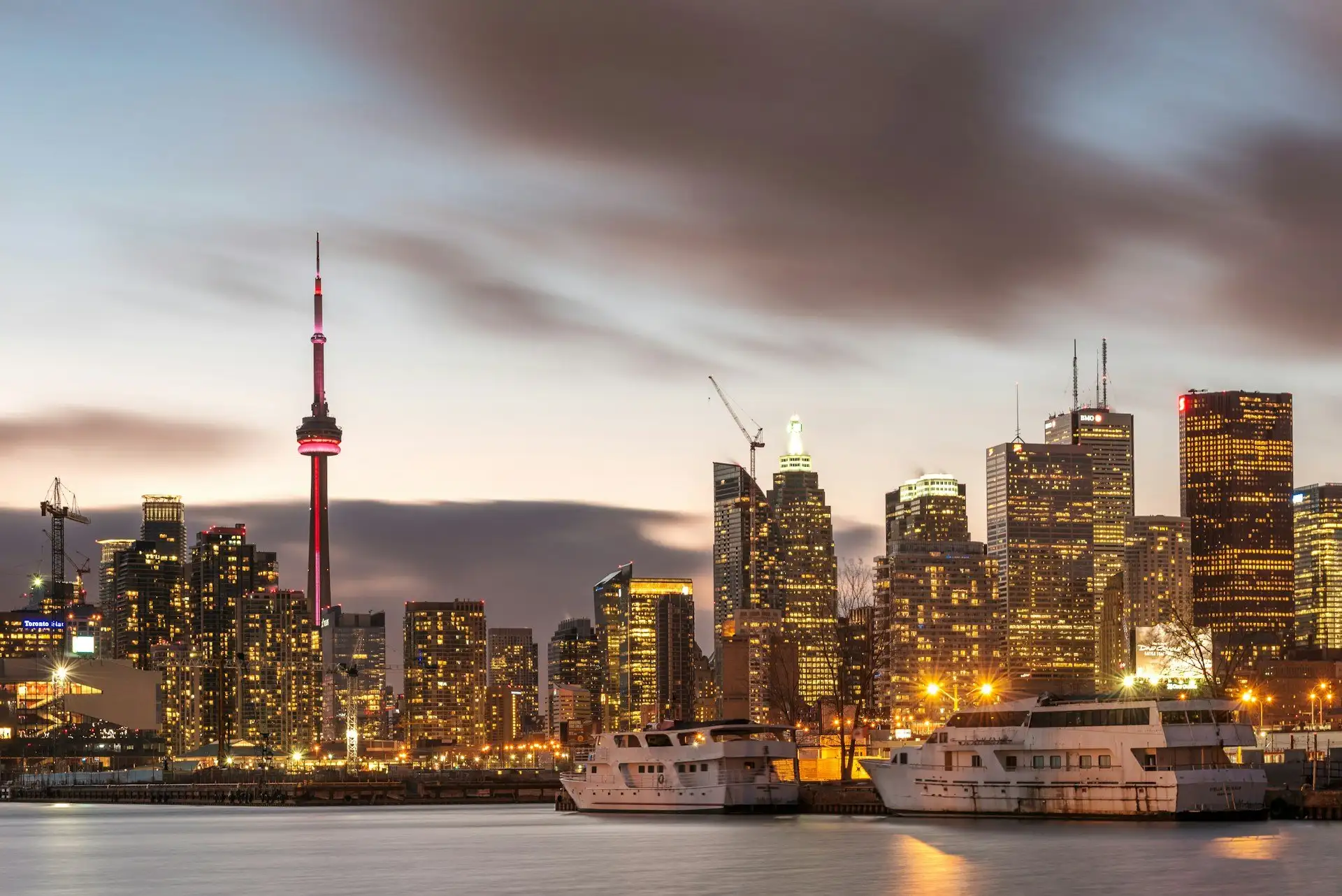
Toronto is Canada's largest city — a genuinely multicultural metropolis where over 200 languages are spoken and neighbourhoods reflect communities from every part of the world. The CN Tower (553m, the world's tallest free-standing structure from 1976–2007), the Royal Ontario Museum, the Art Gallery of Ontario (designed by Frank Gehry), Kensington Market, and the St. Lawrence Market are among the main attractions. The Greater Toronto Area sprawls extensively — getting to Niagara Falls from downtown takes 1.5 hours by car or 2.5 hours by GO train and coach.
- Ticket resale fraud for NHL (Leafs), concerts, and major events — buy only through official channels or licensed resellers
- Union Station and major transit hubs: standard urban pickpocket awareness in crowds
- Toronto Pearson Airport: ride-hailing (Uber/Lyft) and licensed taxi services are legitimate; avoid unmarked vehicles soliciting inside the terminal
- CN Tower: legitimate attraction, book tickets online in advance to avoid queues — the glass floor and EdgeWalk are genuine experiences worth the premium
- Niagara Falls day trip: see detailed Niagara section — the falls are free, the surrounding tourist economy is not
Québec is culturally and linguistically distinct from the rest of Canada — French-speaking, fiercely proud of its identity, and home to some of North America's best food and architecture. Montréal is the cultural capital: the underground city (RÉSO), the Plateau-Mont-Royal neighbourhood, the jazz festival (Jazz Fest in July, one of the world's largest), the Old Port, St. Joseph's Oratory, and Schwartz's deli (the definitive Montreal smoked meat, queues since 1928). Québec City's fortified Old Town — the only walled city north of Mexico — is a UNESCO World Heritage Site and genuinely beautiful.
- Very low tourist scam risk — Montréal and Québec City are among North America's safest major urban destinations for tourists
- Jazz Fest and Grand Prix weekends: accommodation prices triple and fake ticket listings proliferate — book accommodation and tickets well in advance through official channels
- French language: most Montréalers and Québec City residents speak English, but making an effort to use basic French is genuinely appreciated and will improve the experience
- Winter in Québec: genuinely cold (January averages −15°C in Montréal, −18°C in Québec City) — dress in proper layered winter clothing for any outdoor activity; the Carnaval de Québec (February) requires serious cold-weather preparation
The Maritime provinces are among Canada's most authentic and welcoming destinations — fishing villages, dramatic coastlines, lobster shacks, and a pace of life entirely unlike urban Canada. Nova Scotia's Cape Breton Island and the Cabot Trail coastal highway is one of North America's finest scenic drives. Prince Edward Island's red soil, Anne of Green Gables heritage, and exceptional seafood make it a summer destination of extraordinary gentleness. New Brunswick's Bay of Fundy has the world's highest tidal range — up to 17 metres — with tidal bore watching and unique intertidal zone exploration.
- Virtually no tourist scam infrastructure — the Maritimes are among Canada's most honest tourism economies
- Lobster shacks and fish markets: prices are high by international standards (a full lobster dinner CAD 40–80) but honestly represented — this is genuine cost of living, not tourist pricing
- Bay of Fundy tidal times: check the tide schedule before any low-tide walking — the incoming tide at some locations moves faster than walking pace and has trapped visitors. Parks staff provide tide schedules at all access points.
- Cape Breton Highlands: moose are common roadside hazards, particularly at dawn and dusk — slow down significantly on the Cabot Trail at these times
The Yukon, Northwest Territories, and Nunavut cover nearly 40% of Canada's land area and are home to some of the most extraordinary wilderness on earth. Kluane National Park (Yukon) contains the largest non-polar icefield in the world. The Nahanni River (Northwest Territories, UNESCO World Heritage) is one of the world's premier wilderness canoe routes. Nunavut's Baffin Island offers polar bear watching, narwhals, and access to the Arctic. The northern lights (aurora borealis) are visible from September to March throughout the territories. Whitehorse and Yellowknife are the main gateway cities.
- No significant tourist scam infrastructure in the northern territories
- Wilderness travel in the north requires expedition-level planning and experience — this is not accessible wilderness hiking; satellite communicators (SPOT, inReach) are essential
- Grizzly bears throughout the Yukon and Northwest Territories: bear spray mandatory, electric fence for camps, very serious wildlife protocols required
- Northern lights tours: legitimate operators in Whitehorse and Yellowknife charge CAD 100–250 for guided tours with warm vehicles — book through established operators rather than informal social media arrangements
- Extreme cold: winter temperatures in the territories regularly reach −40°C — this temperature is genuinely dangerous without proper insulated clothing, and exposed skin freezes in minutes
Safety Tips for Canada
- ✓ Book accommodation through established platforms with buyer protection — Booking.com, official Airbnb, VRBO. Never pay a deposit by wire transfer, cryptocurrency, or gift card for any rental property. Listings priced well below comparable properties in high-demand areas are almost always fraudulent.
- ✓ Apply for the eTA at the official Government of Canada website — canada.ca/eta — for CAD 7. Any third-party website charging more is taking an unjustified fee. For complex immigration matters, verify any consultant's RCIC status at college-ic.ca before paying any fees.
- ✓ Buy event tickets through official box offices or established resale platforms (Ticketmaster, StubHub Canada). Never buy tickets for high-demand events through Facebook Marketplace, Kijiji, or informal social media groups.
- ✓ At Niagara Falls, view the falls for free from Queen Victoria Park. The Maid of the Mist boat tour and Journey Behind the Falls are worth paying for — book online in advance at niagarafallstourism.com. Clifton Hill's carnival attractions are optional and expensive.
- ✓ Carry bear spray in grizzly country — all of BC, Alberta, and the Yukon. Carry it accessible (hip holster, not buried in a pack) and practise the deployment motion before entering bear habitat. It works. Know how to use it.
- ✓ Make noise on wilderness trails — call "hey bear" regularly near water, in dense vegetation, and around blind corners. Never run from a bear. For black bears, make yourself large and fight back if attacked. For grizzlies, deploy bear spray at 30–60 feet and, if contact occurs, play dead (face down, hands clasped behind neck, legs spread to resist rolling).
- ✓ Register your backcountry itinerary with Parks Canada or the relevant provincial park authority before any multi-day wilderness trip — this is free and initiates search and rescue if you don't return on schedule.
- ✓ For the Canadian Rockies in peak season (June–September): book the Parks Canada shuttle for Moraine Lake and Lake Louise at reservation.pc.gc.ca months in advance — private vehicles are restricted and the shuttle is the only option without an extremely early start.
- ✓ Never pay anything by gift card in response to a phone call. The CRA does not demand immediate payment by phone and does not accept gift cards. Any call claiming immediate arrest unless you pay is a scam regardless of how official the caller sounds.
- ✓ Winter travel requires proper preparation — Canadian winters are colder than most visitors from temperate climates expect. Layered merino wool or synthetic base layers, an insulating mid-layer, and a waterproof outer shell are the minimum for any outdoor winter activity. Cotton kills in wet cold conditions.
Book Right for the World's Second-Largest Country
Canada's scale rewards planning — booking accommodation and key experiences well in advance is the most important preparation for a Rockies, Maritimes, or Québec visit.
Emergency Numbers & Contacts
Canada has excellent emergency services throughout its urban areas. In remote wilderness, satellite communicators and pre-registered itineraries are the primary safety infrastructure.