
What You're Actually Getting Into
Luxembourg is 2,586 square kilometers, smaller than Rhode Island, about the size of greater London. It borders Belgium, France and Germany, and its population of 680,000 includes roughly 47 percent non-Luxembourgish residents, the highest proportion in Europe. More than 200,000 workers commute in daily from the three neighboring countries, one of the largest cross-border workforces in the world, and the GDP per capita is, depending on the year, the first or second highest on earth. This wealth is visible in the infrastructure, the absence of visible poverty, and the price of dinner.
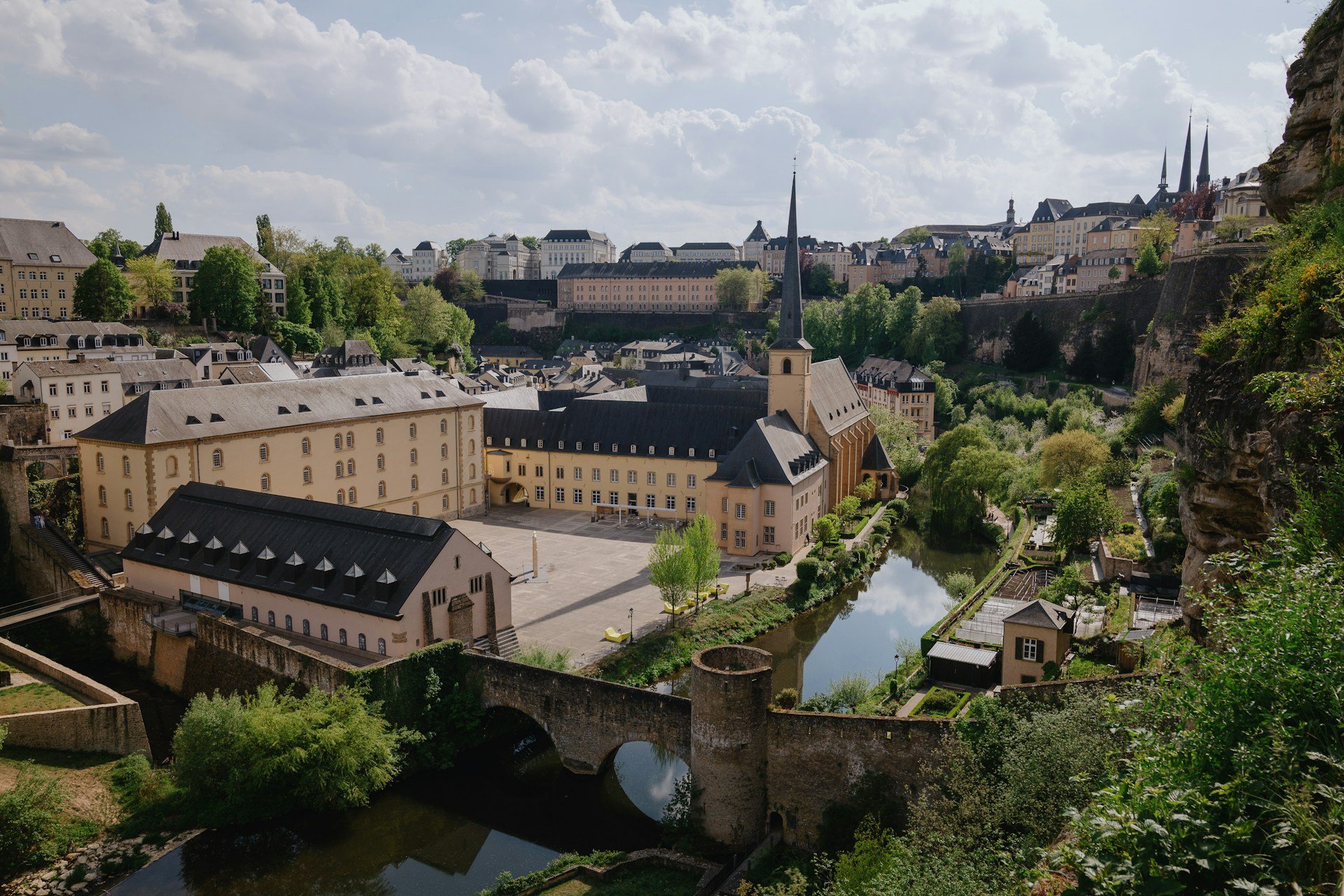
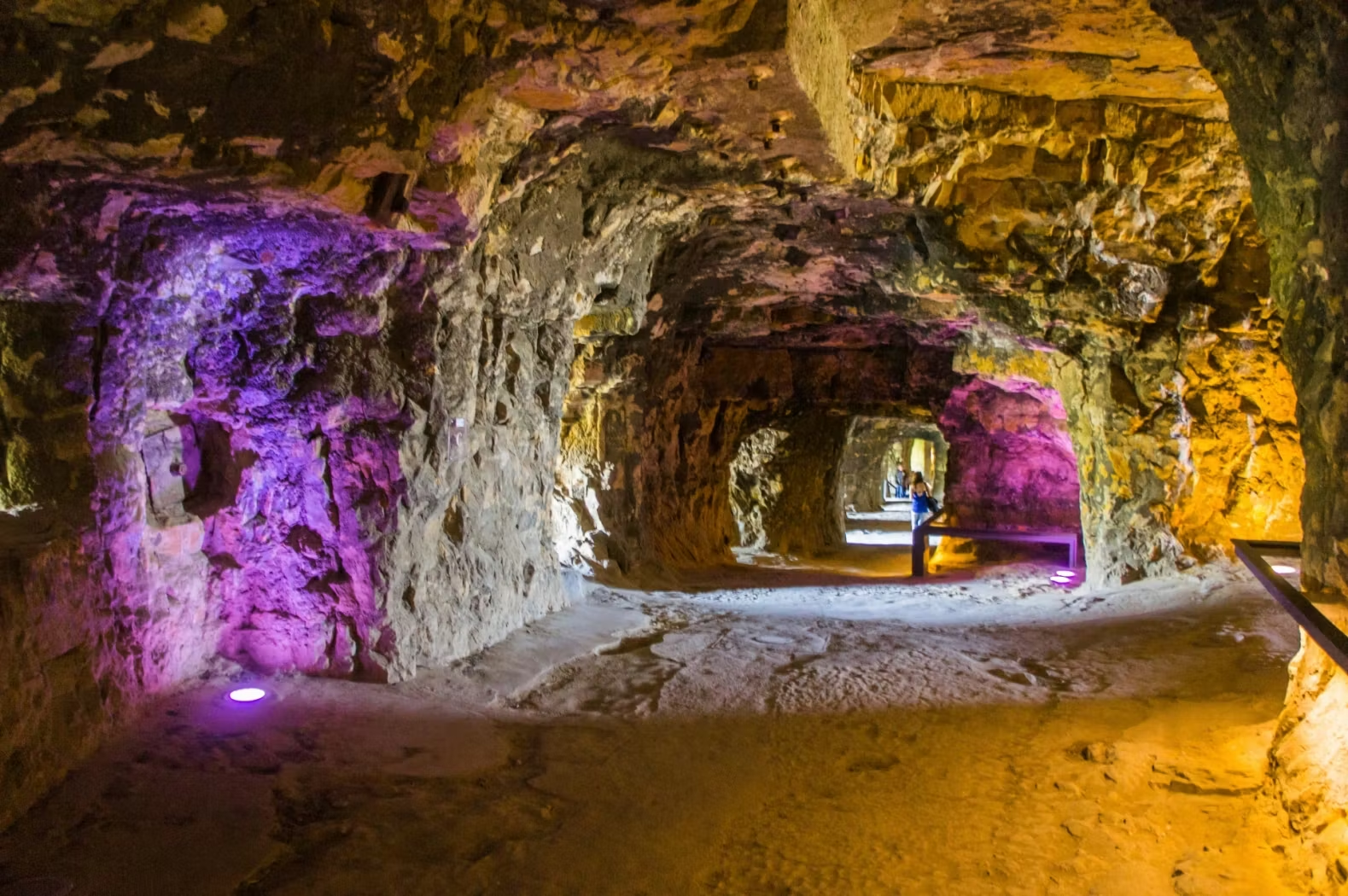
Most travelers treat Luxembourg as a transit stop or a day trip from Brussels, which leaves them having seen the main square and the medieval walls without descending into what makes the country actually interesting: the gorge. Luxembourg City is built on a dramatic sandstone plateau carved by two river gorges, the Alzette and the Pétrusse, and the medieval fortress that exploited this natural defensibility was once considered the most impregnable in Europe, known as "the Gibraltar of the North." An 1867 neutrality treaty required the fortress dismantled, but 23 kilometers of underground casemates carved through the sandstone couldn't practically be removed and remain today as the most extraordinary urban underground in Western Europe.
The honest complications
Luxembourg City's accommodation market skews expensive, a business travel destination shaped by international institutions and a financial sector, and prices reflect this even away from the tourist center. The Chemin de la Corniche, the cliff-edge promenade above the Alzette gorge, becomes genuinely slippery in frost or ice through the winter months, worth knowing if visiting December through February. And the country's financial sector attracts legitimate international scrutiny (the 2014 LuxLeaks scandal is real and worth knowing about), a dimension worth acknowledging without letting it flatten a country with a genuine thousand-year history into a caricature.
A History Worth Knowing
Luxembourg's history is inseparable from its geography. The narrow sandstone plateau at the confluence of the Alzette and Pétrusse rivers, easily defended on three sides by natural cliffs, made the location strategic from the moment anyone with military ambitions noticed it. Siegfried, Count of the Ardennes, acquired a Roman-era fortification on this rock in 963 CE and began building what would become the County of Luxembourg, the founding moment of the Luxembourg state.
- 963 CE
County of Luxembourg founded. Siegfried of the Ardennes acquires the rock fortress on the Alzette, Luxembourg's founding date.
- 1354
Elevated to Duchy. Emperor Charles IV creates the Duchy of Luxembourg as the fortress continues expanding underground.
- 1815
Grand Duchy created. The Congress of Vienna creates the Grand Duchy, simultaneously Dutch crown property and part of the German Confederation.
- 1867
Treaty of London. Perpetual neutrality declared; the fortress dismantled except 23km of casemates too embedded in rock to remove.
- 1940-1944
Nazi occupation. Absorbed into the Third Reich, the Luxembourg language banned, 10,000 killed; liberation by Patton's forces in September 1944.
- 1951
European integration begins. Founding member of the European Coal and Steel Community, the EU's direct predecessor; three EU institutions remain headquartered here.
- 2020
Free public transport. March 1: Luxembourg becomes the first country in the world to make all national public transport completely fare-free.
Read the full history: the fortress, the occupation, and the linguistic tradition
By the time the Spanish Habsburgs completed their version of the defenses in the 17th century, the fortress had roughly 40,000 soldiers, 35,000 civilians, and the capacity to withstand extended siege; the French military engineer Vauban worked on Luxembourg's defenses and reportedly said he'd never seen a more naturally strong position. The 1867 Treaty of London resolved a dispute between Prussia and France over control of the fortress by declaring Luxembourg perpetually neutral. Luxembourg lost its military significance and found a different kind of importance: the founding meeting of the European Coal and Steel Community was held here in 1951, and the Court of Justice, the General Court and the Court of Auditors remain headquartered in the country today.
The Nazi occupation from 1940 to 1944 was brutal by the standards of a country that hadn't been occupied since Napoleon: the Luxembourg language was banned, French names replaced with German ones, and Luxembourgers conscripted into the Wehrmacht, with around 10,000 killed. Liberation by American forces under General Patton in September 1944 was followed immediately by the Battle of the Bulge, launched through Luxembourg's Ardennes in December 1944; the American Cemetery at Hamm contains 5,076 graves including Patton's own. Post-war, the steel industry that had once made Luxembourg the fifth-largest steel producer in the world contracted from the 1970s and was replaced by financial services, producing the wealth behind today's GDP figures. Luxembourgish, a Moselle Franconian dialect, wasn't officially recognized as a national language until 1984, and school lessons still begin in Luxembourgish before transitioning to German, then French.
Top Destinations
Luxembourg's smallness is an advantage: the entire country can be seen in four to five days with a car, and all of it is accessible by the free public transport from Luxembourg City. The country divides naturally into the capital and its gorge, the Moselle wine region to the east, the Mullerthal rock formations in the center-east, and the Ardennes hills and castles in the north.
Luxembourg City: plateau & gorge
The city has three distinct levels: the upper plateau (Ville Haute) with the Grand Ducal Palace and Cathedral, the gorge district (Grund and Clausen) at the bottom of the Alzette valley, and the Kirchberg plateau where EU institutions and banking cluster. The Bock Casemates, 23km of tunnels cut through the rock, are entered from Montée de Clausen and descend through multiple gallery levels, allow two hours. The Chemin de la Corniche gives the view from above; the walk down to Grund gives the view from below, and most day-trippers skip the second, missing the better half.
Vianden
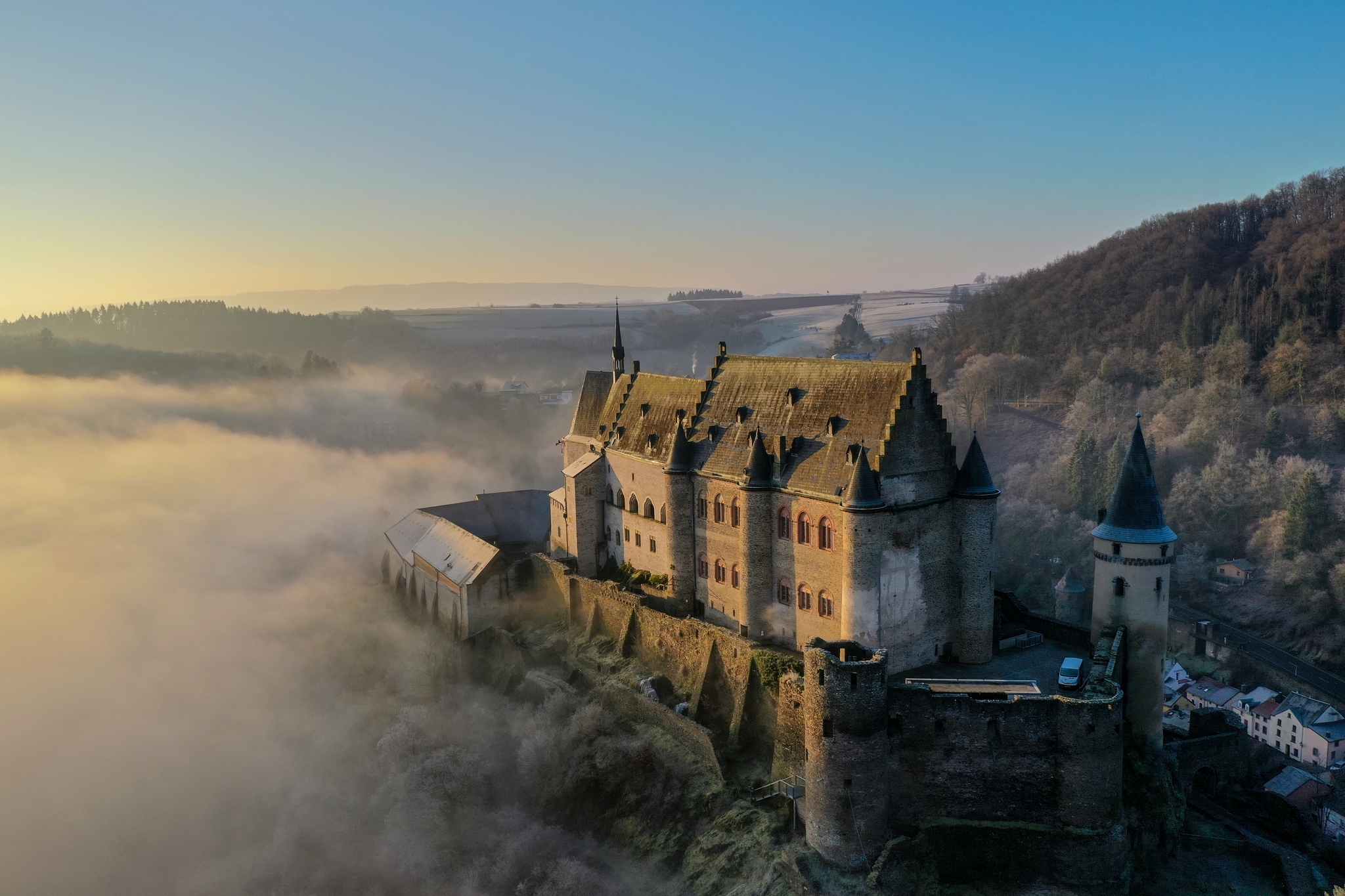
The most impressive castle in Luxembourg and one of the most beautifully situated in the Benelux region, perching on a rocky outcrop above the Our River valley in the northern Ardennes. Largely Romanesque and Gothic construction from the 10th-14th centuries, heavily but authentically restored. Victor Hugo lived here for several summers in exile; the small Victor Hugo House museum is genuine. The chairlift above the town gives the best elevated view of castle and river.
Bourscheid & Esch-sur-Sûre
The northern Ardennes has castle ruins considerably less visited than Vianden but equally dramatic. Bourscheid Castle, on a 150m rocky spur above the Sûre river, is the largest castle ruin in Luxembourg with walkable ramparts. Esch-sur-Sûre sits inside a near-complete loop of the Sûre river, feeling like a natural fortress even without medieval walls.
The Moselle wine route
The Luxembourg Moselle runs 42km along the German border, its south-facing slopes producing Riesling, Pinot Gris, Auxerrois and Crémant de Luxembourg systematically underrated compared to Alsace or the German Mosel across the river. The route from Schengen (where the Schengen Agreement was signed on a boat in 1985) north through Remich, Stadtbredimus, Grevenmacher and Wormeldange has estate wineries welcoming walk-in visitors at modest prices. Caves Bernard-Massard in Grevenmacher runs Crémant production tours, and Caves Viticoles de Greiveldange produces what many consider the country's finest Riesling.
Mullerthal, Little Switzerland
Sandstone rock formations worn into fantastical shapes by millions of years of erosion: narrow gorges, balanced boulders, mossy overhangs and forest trails that genuinely resemble the Swiss Jura. The Mullerthal Trail is a 112km marked route divided into three main loops, with shorter day sections accessible without committing to the full route. Echternach, Luxembourg's oldest town with a 7th-century Benedictine abbey, is the trail's main base, and the Schiessentümpel waterfall, 20 minutes' walk from the car park, is the most photographed feature.
Culture & Etiquette
Luxembourg's social character reflects its position at the intersection of Germanic and Latin cultures and its extraordinary degree of internationalization. A country where 47 percent of residents are non-Luxembourgish and three languages are official produces a social environment that's genuinely cosmopolitan without making a performance of it. A conversation may switch from Luxembourgish to French for a technical point, German for a reference, and English when a visitor appears, and nobody apologizes for this or announces it.
Do
- Try Luxembourgish greetings. "Moien" is hello, used throughout the day; "Äddi" is goodbye. The effort is received with disproportionate warmth from a population used to visitors assuming they're in Belgium.
- Take the free transport seriously. Simply board any bus or train without buying a ticket or validating anything, this applies equally to tourists and residents.
- Descend into the gorge. The single most common mistake is admiring the Corniche view and returning to the main square without walking down to Grund, which looks completely different from the valley floor.
- Visit the American Cemetery. One of the most well-kept and emotionally significant WWII memorial sites in Europe, worth making the connection between the physical Ardennes landscape and the graves at Hamm.
- Drink the local wine. Luxembourg Crémant and Moselle Riesling are genuinely excellent and genuinely unknown outside the country, lighter and more mineral than their German Mosel counterparts.
Don't
- Say "it's basically Belgium." Luxembourg is linguistically German-inflected, historically a Grand Duchy, economically finance-and-steel based, and culturally its own thing; the comparison irritates Luxembourgers in equal measure to how understandable it is.
- Assume French is the primary language. It's one of three official languages, but Luxembourgish is the mother tongue of most citizens, and English is often the most efficient language for visitors.
- Dismiss the country as just a tax haven. The 2014 LuxLeaks scandal is real and worth knowing about, but it's one dimension of a country with a genuine thousand-year history predating the financial sector.
- Rush through as a day trip. Luxembourg City deserves at least two nights; the Bock Casemates alone take two hours, and the gorge walk takes most of a morning.
Deeper culture: the Echternach dancing procession, the Grand Ducal family, and cycling
The Hopping Procession of Echternach. A Catholic pilgrimage held on Whit Tuesday in which participants dance through the town in a two-steps-forward-one-step-back pattern for several kilometers, honoring Saint Willibrord, the Northumbrian missionary who founded Echternach's abbey. Performed since the Middle Ages and UNESCO-inscribed as Intangible Cultural Heritage in 2010, drawing tens of thousands of participants annually.
The Grand Ducal family. Luxembourg is a constitutional monarchy currently ruled by Grand Duke Henri, who ascended in 2000. The family is relatively accessible by royal standards, Henri is known to walk in the city without extensive security, and National Day on June 23rd includes a military parade and the Grand Duke's balcony appearance.
Cycling & the Vëlosummer. Luxembourg punches above its weight in cycling, Andy Schleck won the 2010 Tour de France and Charly Gaul won in 1958, an extraordinary record for a country of 680,000. The Vëlosummer festival in July highlights the country's cycling infrastructure, and bikes travel free on the trains alongside the free public transport.
Food & Drink
Luxembourg's food tradition sits at the intersection of French cooking technique and Germanic ingredients, a hearty, satisfying cuisine of freshwater fish, game, pork preparations and produce from the Moselle and Ardennes that's better than its reputation among food-focused travelers suggests. The restaurant scene in Luxembourg City has a sophistication reflecting the purchasing power of its financial sector workforce, with more Michelin stars per capita than most European cities.
Judd mat Gaardebounen €15-20
Luxembourg's national dish: smoked collar of pork slow-braised until tender, served with broad beans in a cream sauce and boiled potatoes. The pork is cured and smoked in a specifically Luxembourgish way, more delicate smoke, more balanced salt, than German or French equivalents.
Friture de la Moselle
Small fried fish, gudgeon, smelt or small perch, pulled from the Moselle and fried in batter until crispy, served with tartar sauce and a glass of local Riesling. The canonical Moselle meal, available at every riverside restaurant from Schengen to Grevenmacher.
Crémant de Luxembourg €10-15/bottle
Made by the méthode champenoise from Pinot Blanc, Riesling, Auxerrois and Pinot Noir grapes, lighter and more delicate than most Champagnes with a mineral quality from the Moselle's clay and limestone soils. Served at the Grand Ducal Palace for state occasions.
Bouneschlupp & Soups
The Luxembourgish green bean soup, green beans, onions, potatoes and smoked bacon in a clear broth, the comfort food of the Ardennes. Gromperenzopp (potato soup) and Kniddelen (potato dumplings in broth) appear in the same register.
Kachkéis
Spreadable processed cheese made from quark, butter, egg yolk and caraway seeds, stronger and more complex than it sounds. Spread on dark bread with a glass of local white wine, it's the most specifically Luxembourgish food available.
Bofferding & Local Beer
Luxembourg's two main domestic breweries, Bofferding and Diekirch, produce clean pilsner-style lagers that drink well with Judd and friture. Liquid Bar on Rue du Saint-Esprit has the most comprehensive craft beer selection in the country.
When to Go & Itineraries
May through October is the main travel window, with June and September the most comfortable months for walking, cycling, wine tasting and outdoor dining. The Moselle wine route is at its most beautiful during harvest (late September through October) when vineyards turn gold and press houses run. December brings one of the best Christmas markets in the Benelux region to Luxembourg City's old town squares.
All four seasons compared, with temperatures
| Season | Verdict | Temps | Prices & crowds |
|---|---|---|---|
| May-Jun | Best | 14-22°C | Moderate prices, building crowds; Echternach's dancing procession |
| Sep-Oct | Best | 8-18°C | Moderate prices, comfortable crowds; Moselle harvest season |
| Late Nov-Dec | Good, atmospheric | 0-8°C | Christmas premium; book ahead for market weekends |
| Jul-Aug | Be aware | 18-28°C | Peak prices, busiest; Corniche and Casemates queues |
Luxembourg City averages. The Moselle is marginally warmer; the Ardennes north can be 2-3°C colder year-round. Rain is spread evenly through the year, pack a light waterproof regardless of season.
Itineraries
The free public transport changes the planning equation significantly: Luxembourg City to Vianden by free train and bus takes about 1.5 hours each way, a realistic day trip without a car. A car is faster and more flexible for the northern Ardennes and the full castle circuit but isn't essential for a city-plus-one-or-two-regions visit.
- Day 1
Plateau & gorge. Corniche walk, Bock Casemates (90 min minimum), lunch at the Saturday market or in Grund, descend via the Pfaffenthal lift, Grand Ducal Palace, dinner in Bonnevoie.
- Day 2
American Cemetery & Moselle. Bus 19 to Hamm cemetery, free train to Remich, riverside lunch, a wine tasting at an estate, return by train, Crémant at a wine bar in the evening.
- Days 1-2
Luxembourg City fully. Bock Casemates, Corniche, Grund and Clausen gorge floor, the Pétrusse valley, MUDAM on Kirchberg, National Museum of History and Art.
- Day 3
Vianden & the north. Free train to Ettelbruck then bus to Vianden, castle and Victor Hugo house, chairlift, Diekirch's Military History Museum in the afternoon.
- Days 4-5
Moselle & Mullerthal. Cycle Remich to Grevenmacher with wine stops; bus to Echternach for the Gorge du Loup section and Schiessentümpel waterfall.
- Days 1-3
Luxembourg City deeply. The full WWII circuit (American Cemetery, National Memorial of the Military Deportation, Diekirch day trip), Kirchberg architecture, Clausen breweries, a rented bike for the Pétrusse greenway.
- Days 4-5
Northern Ardennes castle circuit. Rent a car: Vianden, Bourscheid Castle, Esch-sur-Sûre, then the Upper Sûre lake circuit and Clervaux's Family of Man photography exhibition.
- Days 6-7
Moselle fully & Schengen. The full 42km cycling route from Schengen to Wasserbillig with estate stops, then the Mullerthal Trail's Berdorf loop, 22km full day hiking.
Getting there & around
Every CFL train (second class), bus and tram in the country has been completely free since March 1, 2020, no ticket, no app, no validation, simply board. The network covers every town and village. Luxembourg Findel Airport is 6km from the center, connected by a free tram (Line T1) in about 20 minutes.
All transport options with prices: free CFL trains, buses, car rental
| Option | Price | Notes |
|---|---|---|
| CFL train & regional bus | Free (2nd class) | Luxembourg City-Ettelbruck (for Vianden): 45 min. To Wasserbillig (Moselle): 30 min. Every 30-60 minutes. |
| Luxembourg City tram | Free | Cloche d'Or through the center to the airport and Kirchberg; 20 min from airport to city. |
| Car rental | €35-70/day | Unlocks the Ardennes castle circuit and the full Moselle route at your own pace. City center parking is expensive; use park-and-ride facilities instead. |
| Cycling (Veloh!) | €15-25/day rental | The Moselle cycle path is flat and paved; bikes travel free on CFL trains. |
Luxembourg City Card: €18 for 48 hours or €23 for 72 hours, free entry to over 50 museums and attractions including the Bock Casemates and MUDAM. Worth it for a two-to-three day city stay with multiple museums, since the transport is already free either way. Trip.com offers fixed-price airport transfers for arrivals after the tram stops running.
Where to stay
Old Town boutique
Hotel Le Place d'Armes on the main square is the most characterful luxury option; Simmons Hotel and the Sofitel Le Grand Ducal offer comparable quality, five minutes from the Corniche and ten from the Casemates entrance.
Grund guesthouse
Staying at the bottom of the gorge gives the most atmospheric Luxembourg City experience, waking with the cliff walls above and the Alzette outside. Auberge du Coin de la Terre and several smaller B&Bs offer this.
Ardennes country hotel
Family-run country hotels in stone buildings with forested views; the Hôtel de la Sûre in Esch-sur-Sûre sits inside the river loop with the castle tower above, noticeably cheaper than the capital.
Hostel
Luxembourg City Youth Hostel on Rue du Fort Olisy, in the Pfaffenthal area near the gorge, accessible by the free lift from the Old Town, book ahead in summer.
Budget Planning
Luxembourg is expensive but not Swiss-level. The free transport dramatically reduces one of the usual major travel expenses, but accommodation, restaurants and museum entries are priced at high Western European rates. The Luxembourg City Card is worth buying if you plan more than three paid attractions in 48 hours, the Bock Casemates alone cost €8 entry, so the card pays for itself quickly.
- Youth hostel dorm
- Saturday market breakfast, supermarket lunch
- One restaurant dinner
- All transport free, zero transport cost
- Boutique hotel or comfortable guesthouse
- Restaurant lunch and dinner
- Luxembourg City Card for museums
- Moselle wine tasting, €8-15 per session
- Hotel Le Place d'Armes or Sofitel
- Michelin-starred or fine dining
- Rental car for the Ardennes and Moselle
- Private wine estate tasting with food pairing
Quick reference prices: coffee, Casemates, wine tasting
| Espresso | €2.50-3.50 |
| Bock Casemates entry | €8 (free with City Card) |
| Luxembourg City Card, 48hr | €18 |
| Lunch, brasserie | €15-25 |
| Restaurant dinner | €25-45 |
| Glass of Crémant | €6-9 |
| All public transport | Free |
| Hostel dorm | €25-38 |
Prices reflect July 2026 research and drift over time. Treat them as a planning baseline, not a quote.
Visa & Entry
Luxembourg is a full EU and Schengen member. EU citizens can enter and stay indefinitely. Citizens of the US, UK, Canada, Australia, New Zealand, Japan and most Western nations get 90 days visa-free within any 180-day Schengen period. ETIAS pre-registration, a €7 online authorization valid three years, is required for these nationalities and takes minutes to complete; the Schengen clock runs across all member states, so time spent elsewhere in Schengen before Luxembourg counts against the same allowance.
✓ Valid passport
Valid at least 3 months beyond your planned Schengen departure date.
✓ ETIAS registration
Apply at travel.ec.europa.eu/etias before departure, €7, valid 3 years, required for UK, US, Canadian, Australian, New Zealand and other non-EU passport holders.
✓ EU EHIC or travel insurance
EHIC covers emergency treatment for EU citizens; non-EU visitors need travel insurance. CHL hospital in the city handles emergency treatment.
✓ No land border checks
Luxembourg borders Belgium, France and Germany, all Schengen members, with no formal passport checks at these land borders; movement between them is seamless.
| Luxembourg | Belgium | |
|---|---|---|
| Daily budget | €70-100, helped by free transport nationwide | Comparable or slightly less, but transport costs money |
| Signature feature | A gorge-split capital and 23km of underground casemates | Bruges' canals and Brussels' Grand Place |
| Wine & drink | Underrated Moselle Riesling and Crémant | World-famous beer culture, less known for wine |
| Size | 2,586 km², seen fully in 4-5 days | Larger, needs 7-10 days for a full circuit |
| Transport | 100% free since 2020 | Standard paid public transport |
Safety, Solo Women & Family
Luxembourg is one of the safest countries in Europe by all available metrics. Violent crime against tourists is essentially absent, and the main practical concern is pickpocketing in the Old Town during peak tourist season, a modest risk by major European city standards. The country's wealth, small size and efficient policing produce a genuinely low-crime environment.
Corniche in icy conditions
The Chemin de la Corniche is paved stone that becomes extremely slippery in frost or ice, a genuine hazard December through February, with the cliff edge immediately adjacent. Wear shoes with grip or avoid it until it clears.
Casemates safety
Some sections have low ceilings, uneven surfaces and genuine drops visible through openings in the rock. Paths are marked and dangerous edges indicated; wear sensible shoes with grip and supervise children near the open gallery views.
Ardennes trail weather
Rapidly changing weather, particularly autumn and winter; Mullerthal sandstone is slippery when wet. Check forecasts before long hikes and carry a waterproof layer regardless of morning sunshine.
Solo women and healthcare
Solo women: exceptional safety for solo female travelers. Street harassment is very uncommon, the city is well-lit and well-policed, and the gorge neighborhoods (Grund, Clausen) are pleasant evening destinations at any hour.
Healthcare: the Centre Hospitalier de Luxembourg (CHL) is the main hospital in the capital. EU EHIC is accepted; non-EU visitors should have travel insurance. Pharmacies on every major street handle minor concerns and pharmacists typically speak French, German, Luxembourgish and usually English.
Emergency numbers
Embassies in Luxembourg City
Most Western embassies are located in Luxembourg City's residential districts; some smaller nations are represented via their Brussels missions.
- USA
- +352-46-01-23
- UK
- +352-22-98-64
- Australia (Brussels)
- +32-2-286-0500
- Canada
- +352-26-39-36-20
- Germany
- +352-45-34-45
- France
- +352-45-72-71
- Belgium
- +352-44-27-46
- New Zealand (Brussels)
- +32-2-512-1040
Medical: the Centre Hospitalier de Luxembourg (CHL) at 4 Rue Nicolas Ernest Barblé is the main hospital and emergency department. For non-life-threatening issues, the Dokter.lu platform connects visitors to English-speaking GPs, and pharmacies operate a night duty rota posted on every pharmacy door.
Family travel & pets
Luxembourg is an excellent family destination, safe, clean, accessible by free public transport, and with activities engaging children of different ages without extensive preparation. The Bock Casemates are the universal family highlight, and the free transport deserves special mention: traveling with children that would normally generate significant transport costs travels entirely free, making Luxembourg's relative expense more manageable than the headline hotel prices suggest.
Vianden's chairlift with kids, the Moselle cycle path, and bringing pets
Vianden Castle & chairlift: the most accessible grand medieval fortress in Luxembourg, with a comprehensive interior museum and a chairlift giving the best aerial view of castle and valley, worth the trip for children on its own. The free train and bus from Luxembourg City make the day trip possible without a car.
Pets: Luxembourg follows EU Pet Travel Scheme rules; dogs and cats from EU countries need a microchip, valid rabies vaccination and an EU pet passport, non-EU pets (including post-Brexit UK) need a health certificate from an accredited vet. Dogs travel free on CFL trains and buses on a lead, and moderate pet-friendliness extends to the Moselle riverside paths and many outdoor restaurant terraces; verify with urban hotels before booking, as acceptance varies more in the city than in rural guesthouses.
Luxembourg FAQ
Is public transport really free in Luxembourg?
Yes. Since March 1, 2020, every bus, train (second class) and tram in the country has been completely fare-free, for tourists and residents alike, the first country in the world to do this. Simply board, no ticket, no app, no validation.
How many days do you need in Luxembourg?
Four to five days covers Luxembourg City properly plus Vianden and the Moselle valley. The entire country can be seen in that time using the free public transport network from the capital, though a car adds flexibility for the northern Ardennes.
Is Luxembourg expensive?
Yes, though not Swiss-level. Budget travelers manage on €70-100 a day, helped considerably by the free transport, which eliminates a cost that represents 10-20% of a typical European trip budget. Restaurants and hotels are priced at high Western European rates.
Do I need a visa for Luxembourg?
Citizens of the US, UK, Canada, Australia, New Zealand and most Western nations get 90 days visa-free within any 180-day Schengen period. ETIAS pre-registration, a €7 online authorization valid three years, is required for these nationalities.
What are the Bock Casemates?
23 kilometers of underground fortified tunnels carved through the sandstone beneath Luxembourg City, the remains of a fortress once called the Gibraltar of the North, too extensive to demolish under an 1867 neutrality treaty. Open to the public and worth two hours of exploration.
What is Luxembourg's national dish?
Judd mat Gaardebounen: smoked collar of pork slow-braised until tender, served with broad beans in a cream sauce and boiled potatoes. Best at traditional Luxembourgish restaurants in the Grund neighborhood.
Is Luxembourg part of Germany or Belgium?
No. Luxembourg is a fully independent Grand Duchy bordering Belgium, France and Germany, with its own language (Luxembourgish), history, monarchy and constitutional tradition distinct from all three neighbors, despite sharing linguistic and cultural influences with each.
What languages are spoken in Luxembourg?
Luxembourgish, French and German are all official. Most residents speak four or five languages, and conversations commonly switch between them mid-sentence. English is widely spoken in the capital.
What is the Moselle wine region like?
A 42-kilometer stretch along the German border producing Riesling, Pinot Gris, Auxerrois and Crémant de Luxembourg from south-facing slopes, systematically underrated compared to Alsace or the German Mosel, with estate wineries welcoming walk-in visitors.
Is Luxembourg good for families with kids?
Yes. The Bock Casemates, Vianden Castle's chairlift, and the flat Moselle cycle path all work well for children, and the free public transport makes family travel between sights meaningfully cheaper than the headline hotel prices suggest.
The Country That Quietly Gets Everything Right
Luxembourg teaches something quiet: what happens when a small country, with no particular drama in its recent history, simply gets on with the business of being very good at being a place. The free public transport is the most visible expression of this. The world's wealthiest country per capita chose to make getting around completely free for everyone, visitor and resident alike, not as a political statement but as a practical decision that the money was there and the benefit was obvious.
The care taken with the UNESCO old city, the American Cemetery maintained to a standard that exceeds most national war memorials, the Moselle estates producing excellent wine that nobody outside the country knows about, the 23 kilometers of medieval tunnel beneath the capital that could have been sealed and forgotten but were instead opened and lit and made accessible. Mir wëlle bleiwen wat mir sin, we want to remain what we are, is the country's unofficial motto, a line from its national anthem. From a place this small, that's been occupied this many times, the statement is both modest and quietly extraordinary.