
What You're Actually Getting Into
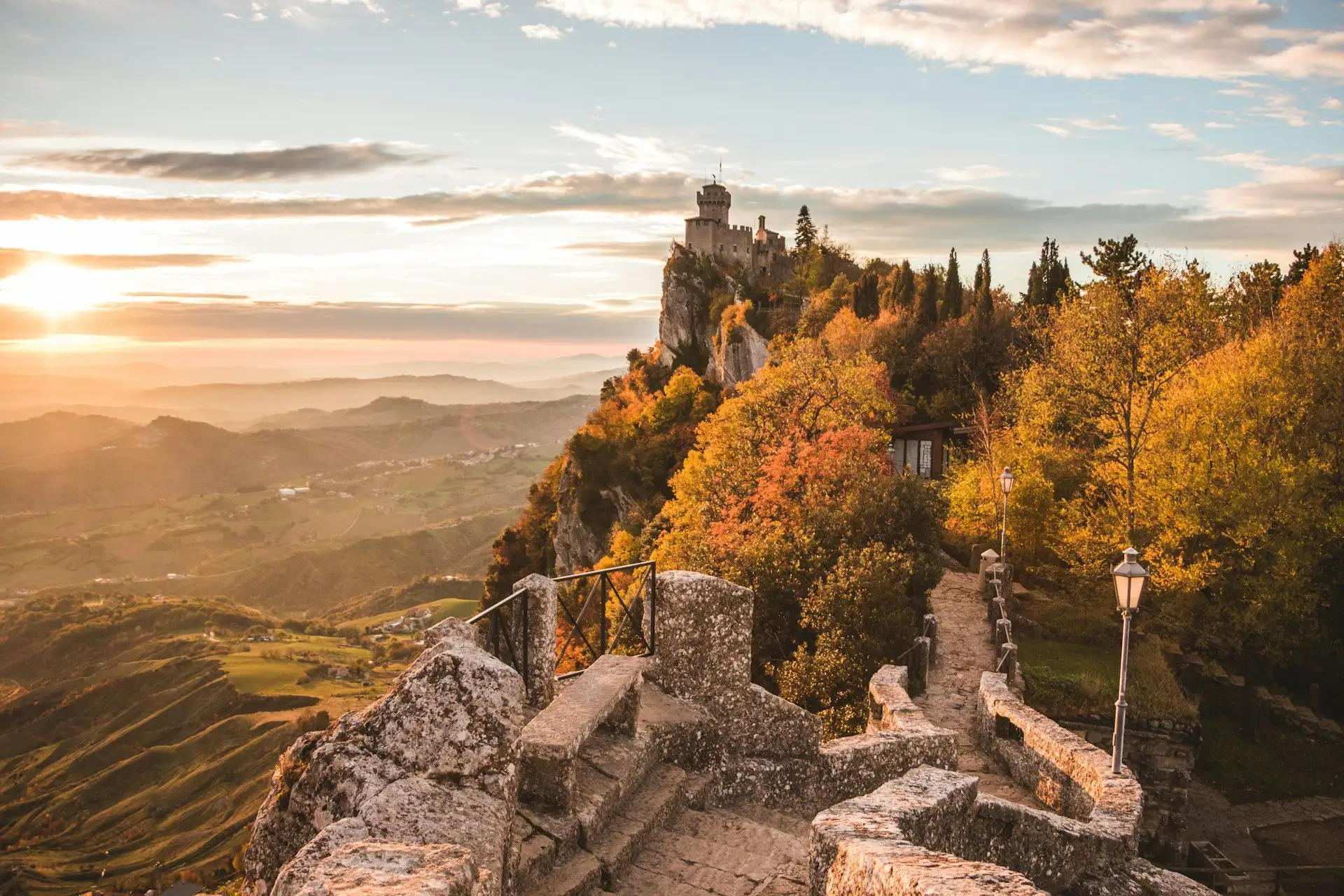
San Marino is the third-smallest country in Europe, an enclave entirely surrounded by Italy, and the kind of place that rewards a specific mindset. It is not a place for a week. It is a place for an afternoon, an evening, or a careful overnight, and within those constraints it is genuinely extraordinary: a medieval fortified town on the crest of Mount Titano with views across the Adriatic plain to the sea on a clear day, three towers that have been watching over the same ridge since the Middle Ages, and the specific atmosphere of a place that has been its own thing since 301 CE without anyone successfully convincing it otherwise.
The tourist infrastructure here is built almost entirely around day-trippers from Rimini, 25 kilometers away on the Adriatic coast. This has a practical consequence: the main street of the historic center, leading up to the towers, is lined almost entirely with souvenir shops, arms and armor dealers (San Marino legally produces and sells medieval weaponry as a traditional craft), and duty-free liquor stores. This is real and unavoidable. It is also a thin veneer over something older and more genuine that reveals itself when you walk two streets off the main tourist line or arrive before 9am, before the coaches begin.
The honest complications
Do not treat San Marino as a box to check. Treat it as the world's oldest republic, which is what it is, and engage with it accordingly. The Palazzo Pubblico, where the Captains Regent have governed since the 14th century, still governs. The crossbowmen's corps has been active since 1295. The constitution in use today dates to 1600 and is the oldest written national constitution still in force. These are not tourism props. They are a functioning micro-civilization that has been at it, quietly and persistently, for over 1,700 years, and the main tourist street's souvenir-shop veneer obscures rather than represents this.
A History Worth Knowing
In 301 CE, a Christian stonemason named Marinus, from the island of Rab in modern Croatia, fled religious persecution under Emperor Diocletian and established a small community on the summit of Mount Titano, a limestone ridge rising to 749 meters above the Adriatic plain. The community he founded on what he considered a place of refuge became, over the following centuries, a town, then a commune, then a republic, and has never since been successfully absorbed by any of the larger powers surrounding it. This is not a historical accident; it's the product of a consistent, deliberate, 1,700-year policy of neutrality and strategic use of a mountain fortress position that made conquest more trouble than it was worth.
- 301 CE
Foundation. Marinus the stonemason establishes a Christian community on Mount Titano, the beginning of an unbroken run.
- 1243
First Captains Regent. The dual-head-of-state system begins, still operating identically today, elected every six months.
- 1295
Crossbowmen Corps founded. The Compagnia dei Balestrieri established, still active and competitive at international tournaments.
- 1600
The Constitution. The Statutes of San Marino codified, the world's oldest national constitution still in force, 187 years before the US Constitution.
- 1797
Napoleon declines to conquer. Napoleon offers to expand San Marino's territory; San Marino politely refuses, preferring to remain small and free.
- 1861
Italian unification. Italy unifies. San Marino alone remains independent, partly out of Garibaldi's personal gratitude for past refuge.
- 1944
Accidental bombing. British aircraft accidentally bomb San Marino; Britain apologizes and pays reparations, and San Marino continues.
Read the full history: the government structure and WWII neutrality
San Marino is a parliamentary republic headed by two Captains Regent (Capitani Reggenti) who serve six-month terms and cannot be re-elected for three years after their term ends. They are elected by the Grand and General Council, the 60-seat parliament, an arrangement functioning in essentially its current form since 1243. The Palazzo Pubblico where they sit is the oldest parliament building in continuous use in the world. The constitution of 1600 predates the US Constitution by 187 years, and Thomas Jefferson, while US Minister to France, reportedly wrote to San Marino requesting a copy of their governing documents as reference material during the drafting process; whether it directly influenced the American document is debated, but that Jefferson considered it worth studying is not.
In WWII, San Marino declared neutrality and refused passage to either Axis or Allied forces. It accepted over 100,000 refugees, a number exceeding its own population at the time. It was briefly and accidentally bombed by the British in 1944, who subsequently apologized and paid reparations. San Marino came out of the war with its independence intact, as it had come out of every previous conflict, including the Papal States' centuries-long proximity and Mussolini-era Italy.
Top Destinations
San Marino is 61 square kilometers. The historic capital, Città di San Marino, sits on the crest of Mount Titano and is where virtually all tourism concentrates. The country also has eight other municipalities in the flatlands below, Serravalle, Borgo Maggiore, Domagnano and others, which are ordinary Italian-style towns with almost no tourist infrastructure. The mountain city is the destination.
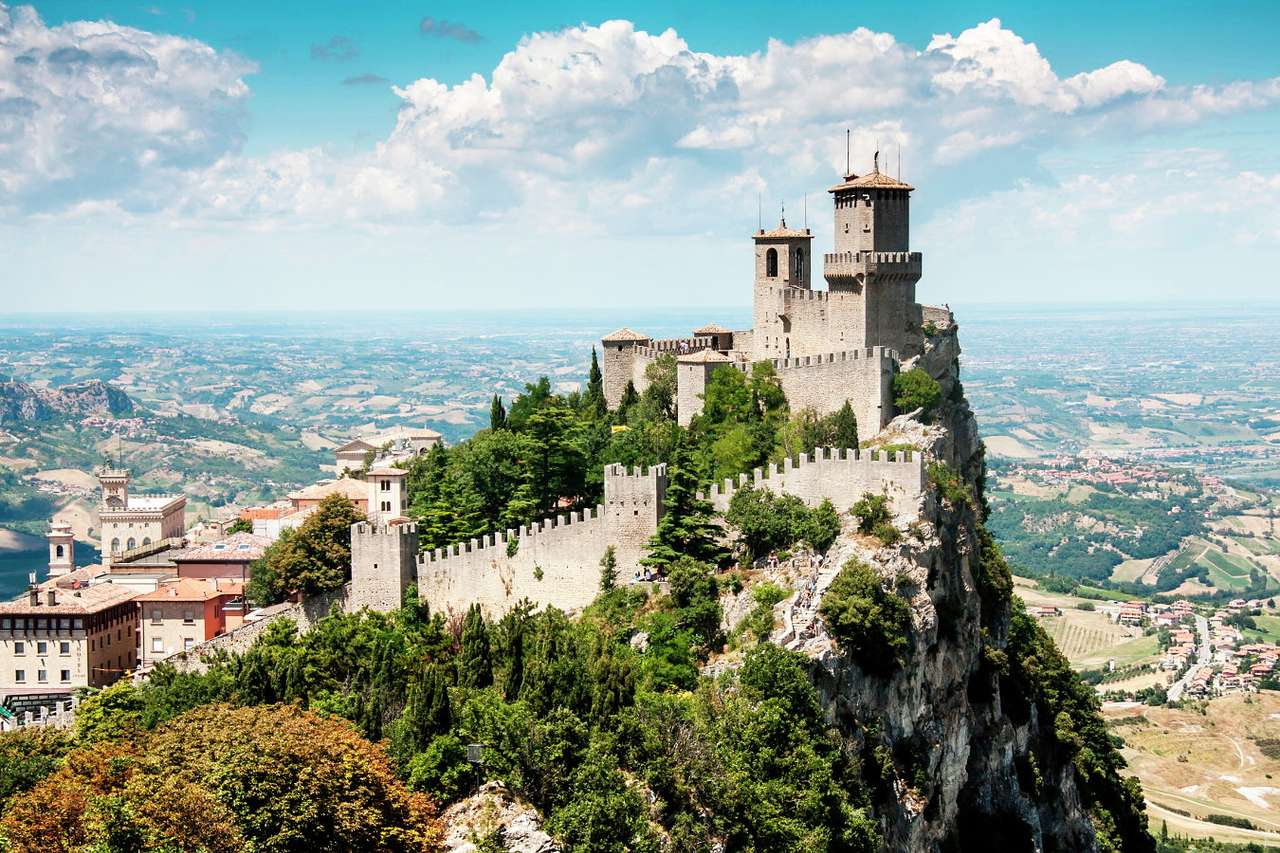
Guaita (Prima Torre)
The oldest and most iconic of the three towers, dating to the 11th century, perched on the highest peak of Mount Titano at 739 meters. Guaita served as a prison until 1970, and the graffiti carved into the stones of the lower dungeon by prisoners over the centuries is still visible and oddly moving. Combined entry with Cesta costs €5.
Cesta (Seconda Torre)
The highest of the three towers at 756 meters, housing the Museum of Ancient Weapons, one of the better-curated collections of medieval arms and armor in Italy. The 20-minute wall walk from Guaita to Cesta offers the best panoramic sequence in San Marino.
Montale (Terza Torre)
The smallest tower, on the southernmost peak, not open to the public but viewable from the path. Completing the ridge walk to it is worth doing for the defensive logic of three observation posts covering every approach, and for the best photograph of all three towers together.
Palazzo Pubblico
The seat of San Marino's government, rebuilt in the 19th century in neo-Gothic style but on foundations dating to the 13th century, in the Piazza della Libertà. The changing of the guard ceremony takes place here on the hour during summer months. Guided tours are available when parliament isn't in active session.
Museo di Stato & Treasury
The Museo di Stato covers San Marino's history from prehistoric finds through Roman-era artifacts and medieval documents, small and well-curated. The Treasury and Museum of the Captains Regent holds the historical objects of state. Neither is world-class, but both give context that makes the towers and Palazzo Pubblico more meaningful; entry €3-5 each.
The City After 6pm
By 6pm in high summer, the last coaches have left and Città di San Marino becomes something entirely different. The medieval streets empty of day-trippers, souvenir shops close, and the permanent residents of 4,000 people appear: walking the walls in the evening light, eating at the handful of restaurants actually cooking for locals, watching the valley fill with shadow while the towers catch the last sun. This is the San Marino worth experiencing, and it requires staying the night or arriving very early and staying very late.
Passport Stamp
The Tourist Information Office on Contrada Omagnano offers a voluntary souvenir stamp: €5 per stamp, no official status, but one of the most sought-after microstate passport stamps in Europe. Do this before 5pm when the office closes.
Culture & Etiquette
San Marino speaks Italian and functions culturally as an Italian-adjacent society, but with a distinct national pride proportionally outsized relative to the country's scale. Sammarinesi are genuinely proud of their republic's longevity and independence, and they're accustomed to visitors who treat the country as a quirky stop on the way somewhere else. The difference between a visitor who engages with the history and one who buys a plastic crossbow and leaves is visible to locals and changes the quality of the interaction.
Do
- Treat it as a real country. San Marino has its own government, constitution, military, currency coins and stamps, and 1,700 years of independent existence. Engage with this rather than treating it as a theme park.
- Get the passport stamp. The €5 Tourist Office stamp is the right souvenir from the world's oldest republic. Bring your passport even though nobody will check it at any border.
- Walk all three tower paths. The walk between Guaita and Cesta is the best physical experience in San Marino; most day visitors also skip the Montale path, which is the better half.
- Buy San Marinese stamps for post. Sending a postcard with a San Marinese stamp is a small, legitimate pleasure that arrives carrying the specific fact of where it was posted.
- Check the event calendar. Medieval Days in July and September, and the Captains Regent inauguration on April 1 and October 1, show the country at its most itself.
Don't
- Only walk the main tourist street. Contrada del Pianello is lined with souvenir shops and isn't representative. Two streets uphill or down reveals an ordinary, pleasant Italian hill town with extraordinary foundations.
- Rush through in an hour. The main sites take three to four hours to see properly; rushing to say you've "been to San Marino" produces underwhelmed visitors.
- Assume the duty-free shopping is worth it. The alcohol and tobacco is marginally cheaper than Italy. Whether that constitutes a reason to visit is genuinely your call.
- Dismiss the souvenir shops entirely. Behind the mass-produced trinkets, several San Marinese craftspeople produce genuinely good ceramics, leather goods and hand-finished medieval replica weapons, a real traditional craft industry maintained for centuries, not cheap imitations.
Deeper culture: euro coins, the military, and postal tradition
San Marinese euro coins. San Marino mints its own euro coins depicting the three towers, the Palazzo Pubblico and historical figures, legal tender throughout the eurozone in small minting quantities. Numismatists specifically seek them; complete annual sets cost €30-50 from the State Philatelic and Numismatic Office.
The military. San Marino has the world's smallest military: the Grand and General Corps (guard for the Palazzo Pubblico), the Fortress Guard in medieval ceremonial costume, and the Crossbow Corps. Its ceremonial helmet hasn't changed significantly since the 16th century, and it exists primarily as a constitutional tradition rather than a fighting force.
Postal culture. San Marino has operated its own postal service since 1607, and its stamps are collected internationally, particularly the commemorative issues. A postmark reading "Repubblica di San Marino" is a small, satisfying pleasure that costs almost nothing.
Food & Drink
San Marino's food culture is essentially the Italian food of Emilia-Romagna, the region surrounding it, with a handful of specific local dishes that have been part of the mountain community's cooking for centuries. The main tourist street has the recognizable volume-based Italian-for-tourists menu; three streets off it, you find something different.
Piadina €3.50-5
The flatbread of Emilia-Romagna, made on a hot stone and filled with prosciutto, squacquerone cheese and rocket, or local cured meats. San Marino sits in piadina country, and the version here, thin and slightly charred, is the real thing.
Strozzapreti €10-14
A twisted pasta shape, "priest strangler," appearing most often with a wild boar ragù or a simple tomato and sausage sauce at a good restaurant away from the main tourist corridor.
Brugneto & Tessano €8-15/bottle
San Marino's own wines from vineyards on Mount Titano's slopes: Brugneto (red, from Sangiovese) and Tessano (white). Honest mountain wines that pair correctly with the local food.
Fagioli con le Cotiche
Beans braised with pork rind, a traditional winter dish of the Apennine foothills appearing on menus in cooler months and at festivals; unglamorous food that sustained the mountain community through five hundred winters.
Formaggio di Fossa
Pit cheese aged in tufa-stone pits for three months, producing a pungent, crumbly, intensely flavored result unlike standard Italian cheese; available from the better provisions shops in the historic center.
Titano Bitters & Mirto
San Marino's own digestivi: a bitter herbal liqueur and a local myrtle-berry mirto. Available in duty-free shops at prices marginally lower than Italy.
When to Go & Itineraries
San Marino is accessible year-round and pleasant in almost any season. The honest consideration is crowds: July and August bring the heaviest day-trip traffic from Rimini and the Adriatic coast, filling the main streets from mid-morning to early evening. September and October are the best compromise: warm, clear, and with dramatically fewer people.
All four seasons compared, with temperatures
| Season | Verdict | Temps | Prices & crowds |
|---|---|---|---|
| Sep-Oct | Best | 15-24°C | Mid prices, manageable crowds; Medieval Days in September |
| Apr-Jun | Good | 14-24°C | Mid prices, light to moderate crowds; April 1 inauguration |
| Jul-Aug | Think twice | 24-32°C | Peak prices, very crowded daytime; Medieval Days in July |
| Nov-Feb | Atmospheric, quiet | 3-10°C | Lowest prices, almost empty; occasional fog on the mountain |
Mount Titano averages; the mountain can be 2-4°C cooler than the surrounding plain, and cloud is possible year-round at altitude, worth checking before a trip made specifically for the views.
Itineraries
San Marino requires no special planning beyond what you'd need for a day trip in northern Italy. The main decision is how long to stay and whether to base yourself in Rimini or San Marino itself.
- Morning
Arrive early from Rimini. Bus at 9am, straight up the main street to Piazza della Libertà, Palazzo Pubblico, then Guaita tower and the dungeon graffiti, continuing along the wall path to Cesta and the weapons museum. Total: 2 to 2.5 hours.
- Midday
Stamp, piadina, bus. Tourist Office for the €5 passport stamp, a piadina from a piadineria, then back down to catch the bus or funivia. Total visit: 3 to 4 hours, adequate but not optimal.
- Morning
Towers & walls. Arrive by 9am, Palazzo Pubblico, then Guaita, the wall path, Cesta, continuing to the Montale path for the combined view of all three towers. 2 to 2.5 hours, the physical and visual peak of the visit.
- Midday
Museum & lunch. Museo di Stato (45 min), passport stamp, lunch at a piadineria or trattoria two streets off the main tourist axis.
- Afternoon
Slower walking. The lower sections of the historic city most visitors miss, stamps from the post office, return to Rimini late afternoon. Total: 7 to 8 hours, the correct day-trip length.
- Day 1, afternoon
Arrive after the crowds. Arrive by 3pm as morning coach traffic reduces, check into a hotel inside the historic walls. Walk the Cesta-to-Montale path late afternoon for the best light.
- Day 1, evening
The empty city. Dinner at a local restaurant at 8pm, then walk the walls after the city returns to its 4,000 permanent residents. The Guaita battlements by night, with the Adriatic plain lit below, is worth every extra euro.
- Day 2, morning
Dawn, towers, departure. Wake before 7am, walk to Guaita for sunrise over the Adriatic plain before any tourist or shop has opened. Leave by 10am before the coaches arrive.
Getting there & around
San Marino has no airport, no railway, and no international bus connections; it's reached from Italy by road, either bus from Rimini or driving. Within the country, the funivia (cable car) connects Borgo Maggiore at the foot of the mountain to the historic center in 90 seconds, the best arrival experience available.
All transport options with prices: bus, funivia, driving, taxi
| Option | Price | Notes |
|---|---|---|
| Bus from Rimini | €5 single / €9 return | Bonelli Bus from Rimini railway station and seafront, roughly 50 minutes, every 30-60 minutes depending on season. |
| Funivia (cable car) | €3 single / €5 return | Borgo Maggiore to the historic center in 90 seconds, excellent views of the towers on the ascent. Open 7:30am-8:15pm, varies by season. |
| Car (self-drive) | Parking ~€3-5/hr | 25km from Rimini via the SP258, about 35 minutes. Parking below the city wall, then funivia or escalators up; no border documentation required. |
| Taxi from Rimini | €40-60 one way | Worth it for late arrivals or returning after the last bus. No general taxi service within San Marino itself. |
Don't skip the funivia: most visitors arrive by bus directly to the historic center or drive to the upper car parks, missing the cable car entirely. Taking it up in the morning before the tourist buses fill the top is a significantly better arrival than stepping off a coach at a car park. GetTransfer offers fixed-price pickups from Rimini, Bologna and Ancona airports for groups or late arrivals.
Where to stay
Historic center hotel
A handful of small hotels and B&Bs inside the historic walls, from converted medieval buildings to more modern guesthouses. Staying inside the walls means having the city after the coaches leave; book early for summer weekends.
Lower town hotel
Borgo Maggiore and Serravalle have more conventional Italian hotels at lower prices, losing the overnight atmosphere of the walls but gaining a practical base with funivia access.
Base in Rimini
For beach travelers combining the Adriatic coast with a San Marino day trip; extensive accommodation across all budgets, 50 minutes away by bus.
Agriturismo
Several farm stays operate in San Marino's lower municipalities, good for families or a rural base with local food, typically excellent value, less convenient for the historic center without a car.
Budget Planning
San Marino is priced broadly in line with northern Italian tourist towns, with some inflation from the captive day-trip audience. The tourist restaurants charge tourist prices; the tower entry and passport stamp are very affordable. If you eat away from the main tourist strip and visit the towers, a comfortable day costs €30-50 per person all-in excluding transport from Rimini.
- Bus from Rimini (€9 return)
- Towers combined ticket (€5)
- Passport stamp (€5)
- Piadina lunch, coffee and gelato
- Bus or taxi from Rimini
- Towers + State Museum entry
- Sit-down restaurant lunch
- Afternoon coffee and digestivo
- Historic center hotel (€100-160)
- Dinner at a local restaurant
- Towers and museums next morning
- Breakfast, return transport
Quick reference prices: bus, funivia, food
| Bus Rimini return | €9 |
| Funivia single | €3 |
| Towers combined entry | €5 |
| Passport stamp | €5 |
| Piadina | €3.50-5 |
| Restaurant lunch (pp) | €15-25 |
| Coffee (espresso) | €1.20-1.80 |
| Historic center hotel | €80-160/night |
Prices reflect July 2026 research and drift over time. Treat them as a planning baseline, not a quote.
Entry & Formalities
San Marino has no border controls and no immigration infrastructure. Entry is simply driving or taking the bus through unmarked road signs on Italian roads. If you can legally enter Italy, you can enter San Marino: no passport check, no entry stamp, no visa requirement specific to the country. The only formality is that San Marino follows Italian and Schengen norms by convention.
✓ No border controls, no visa
Entry through Italy with no passport checks. Schengen and Italian entry rules apply. The Tourist Office stamp is a €5 souvenir, not an official entry document.
✓ Legal in Italy, legal in San Marino
A valid Schengen visa or visa-exempt nationality that can enter Italy covers San Marino too, no additional documentation needed.
✓ Bring your passport anyway
Not for border control, for the €5 souvenir passport stamp at the Tourist Office, the specific reason most people want to come here.
✓ Schengen day count still matters
San Marino isn't Schengen, but time spent there is conventionally counted against your Schengen 90-day allowance by agreement, though never checked at a San Marino-specific border since there isn't one. EU citizens can enter with just a national ID card.
| San Marino | Liechtenstein | |
|---|---|---|
| Access | 50 min bus from Rimini, no border check | Reached via Switzerland or Austria, no border check either |
| Age & founding | Founded 301 CE, world's oldest republic | Founded 1719, a principality rather than a republic |
| Character | Medieval towers, day-trip crowds, souvenir shops on the main street | Alpine scenery, quieter, oriented toward hiking and banking |
| Currency | Euro, with its own minted coins | Swiss Franc, not the Euro |
| Budget | €30-50/day comfortable | Noticeably pricier, closer to Swiss price levels |
Safety in San Marino
San Marino is one of the safest places in Europe. Crime against tourists is essentially non-existent, and the country has a police force of about 150 officers for a population of 34,000, in a historic center small enough that strangers are noticeable. The practical safety considerations are not about crime but the physical environment: cobblestones on steep inclines, tower staircases without full guardrails in some sections, and winter mountain driving.
Cobblestones
The historic center is extensively cobbled on steep gradients, and wet cobblestones are genuinely slippery. The single most common tourist injury here is a twisted ankle or a fall on the main pedestrian street. Proper footwear is not optional.
Tower access
The tower staircases are steep, and some sections lack full-height guardrails. Children should be supervised closely on the upper tower sections, particularly Guaita's open outer-wall walkway in windy conditions.
Winter driving
The mountain road can be icy or foggy December to March. Check road conditions before driving in this window; snow chains may be required on the upper approach roads in heavy snow, and the funivia stops operating in severe weather.
Healthcare and general safety
Healthcare: San Marino has a hospital, Ospedale di Stato in Cailungo, with emergency care available. EU citizens' EHIC cards are honored. Given the country's size and proximity to the Italian health system, care is adequate for ordinary emergencies; serious cases may be transferred to Rimini or Forlì.
General safety: essentially no tourist-targeted crime. The historic center is small, well-surveilled by permanent residents, and policed by a force large relative to the population. Violent crime is negligible, and the country is comfortable for solo travelers of any gender at any hour.
Emergency numbers
Consular assistance, via Rome
San Marino has no resident foreign embassies. Most countries handle San Marino consular matters through their Rome embassy in Italy.
- USA (Rome)
- +39-06-46741
- UK (Rome)
- +39-06-4220-0001
- Australia (Rome)
- +39-06-852-721
- Canada (Rome)
- +39-06-854-442-911
- Germany (Rome)
- +39-06-492-131
- France (Rome)
- +39-06-686-011
- Netherlands (Rome)
- +39-06-3228-6001
Medical note: the hospital in Cailungo handles standard emergencies; serious trauma or specialist care goes to Rimini or Cesena. EU citizens' EHIC cards are accepted; travel insurance is recommended for non-EU visitors. In practice, the most common reason tourists need medical assistance is a cobblestone-related fall.
San Marino FAQ
What is the capital of San Marino?
Città di San Marino, sitting on the crest of Mount Titano at 749 meters, is both the capital and the historic city where nearly all tourism concentrates. It shares the country's name, which sometimes confuses first-time visitors.
Is San Marino worth visiting?
Yes, especially as a day trip or overnight from Rimini. The three medieval towers, the working 700-year-old government, and views across the Adriatic plain make it one of Europe's most rewarding small detours, provided you get past the souvenir-shop main street.
Do I need a visa or passport for San Marino?
No visa is required, and no passport check happens at the border since San Marino has no immigration infrastructure of its own. If you can legally enter Italy, you can enter San Marino. Bring your passport anyway for the voluntary €5 souvenir stamp at the Tourist Office.
How do you get to San Marino from Rimini?
Bonelli Bus runs regular services from Rimini railway station and seafront, taking about 50 minutes for €5 single or €9 return. Driving takes about 35 minutes via the SP258 road, with parking below the historic center and a cable car up to the walls.
Is San Marino part of Italy?
No. San Marino is a fully independent sovereign state, the world's oldest republic, founded in 301 CE, though it's entirely surrounded by Italy and shares no border controls, currency (the euro) or Schengen-area conventions with it.
How many days do you need in San Marino?
A full day covers the three towers, the Palazzo Pubblico, and the historic center properly, around 7 to 8 hours including lunch. An overnight stay is strongly recommended for anyone who wants to see the city after the day-trip coaches leave.
What is the passport stamp in San Marino?
A voluntary souvenir stamp available at the Tourist Information Office for €5, placed directly in your passport. It carries no official immigration status but is one of the most sought-after microstate stamps in Europe.
Is San Marino expensive?
Moderately, in line with northern Italian tourist towns, with some inflation from the captive day-trip audience on the main tourist street. A comfortable day trip costs €30-50 per person excluding transport from Rimini.
What language is spoken in San Marino?
Italian is the official and everyday language, and San Marino functions culturally as an Italian-adjacent society with a distinct national identity built around its independence and longevity.
Is San Marino safe for solo female travelers?
Yes, exceptionally so. San Marino has essentially no tourist-targeted crime, a small, well-surveilled historic center, and is comfortable for solo women at any hour, including the quiet evening hours after the day-trip crowds leave.
The Thing That Stays With You
What most people carry away from San Marino is not the towers, which are genuinely beautiful, or the passport stamp, which is genuinely satisfying, but the specific feeling of standing somewhere that has been stubbornly, quietly, and continuously itself for 1,700 years. Empires rose and fell around it. The Papal States, the Austro-Hungarian Empire, Napoleonic France, Mussolini's Italy, all of them had reasons to absorb a 61 km² mountain republic, and none of them did. The reasons vary: the mountain too defensible, the territory too small to matter, the republic too cooperative to be worth the trouble. But the cumulative result is a medieval city on a limestone ridge where the same two-person government, elected for six months at a time, has been meeting in the same building for eight centuries.
What there is, is the view from the Guaita battlements at dawn, before anyone else is there, when the Adriatic plain is still in shadow and the towers are in the first light. The oldest republic in the world, doing what it has always done, which is simply continuing. That's worth the bus fare from Rimini on its own.