
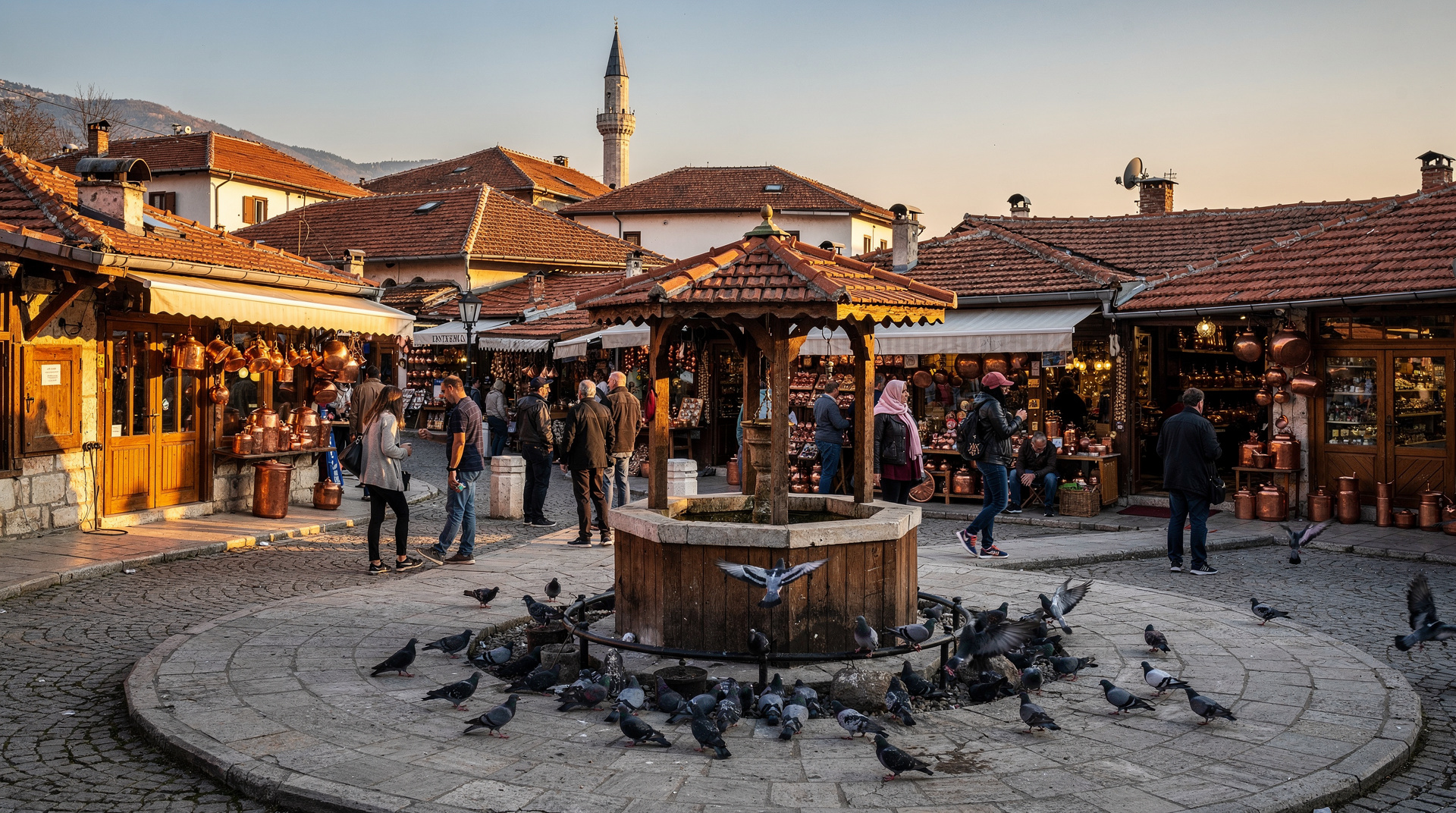
A capital that wears its history without hiding any of it
Sarajevo has been called "Europe's Jerusalem" for a good reason: it's one of the only cities on the continent where a mosque, a Catholic cathedral, an Orthodox church and a synagogue all sit within easy walking distance, a legacy of centuries under Ottoman and then Austro-Hungarian rule. A line embedded in the Ferhadija pavement literally marks where the Ottoman old town, Baščaršija, gives way to the Austro-Hungarian grid of the center, and the transition happens over the space of about ten meters, mosque domes on one side and grand European facades on the other.
The city also carries the 1990s openly rather than papering over it. Bullet and shrapnel scarring is still visible on some buildings, the Tunnel of Hope that kept the besieged city alive is open to walk through, and taxi drivers and hotel owners in their fifties and sixties often lived through the siege themselves. None of this makes Sarajevo grim: it is, day to day, a lively, cheap, coffee-obsessed capital where a good ćevapi lunch costs about five euros and the old-town lanes are genuinely enjoyable to just wander.
The honest complications
Sarajevo sits in a valley, which traps winter smog from wood and coal heating badly enough that the city periodically ranks among the world's most polluted for short stretches in December and January; if you're sensitive to air quality, avoid deep winter or check daily readings. Summer afternoons can be uncomfortably hot with limited shade in Baščaršija's narrow lanes. And while the city itself is safe to walk, the countryside around it is not uniformly so: land mines remain in unmarked rural and forested areas from the 1992-1995 war, which is why this guide is specific about staying on paved paths and marked trails, including on Trebević.
A small capital, three areas that matter
Sarajevo's tourist core is compact and walkable, stretched along the Miljacka river valley. Almost everything a first-time visitor wants sits within twenty minutes of Baščaršija on foot, or a short tram ride along one of Europe's oldest tram lines, running since 1885.
Baščaršija
The historic bazaar quarter founded around Isa-beg Isaković's 15th-century mosque and public baths, Baščaršija is Sarajevo's most visited neighbourhood and also its most atmospheric: copper workshops, the Sebilj fountain, and the Gazi Husrev-beg Mosque all sit within its cobbled lanes. It's genuinely touristy in the main square by midday, but the crowds thin out fast once the day-tour coaches leave in late afternoon, and the side lanes stay quiet and local even at peak season.
Ferhadija & the Austro-Hungarian center
Ferhadija Street is where Baščaršija physically ends and the 19th-century Austro-Hungarian center begins, marked by a line in the pavement and a genuine shift in architecture within a few steps. Grand facades, the Sacred Heart Cathedral and a denser concentration of modern shops and cafes make this a good base for travellers who want a slightly quieter, more contemporary feel than Baščaršija's bazaar energy.
Marijin Dvor
Sarajevo's modern administrative and business district, home to the National Museum of Bosnia and Herzegovina (with the Sarajevo Haggadah), the Bosnian Parliament, and most of the city's international-brand hotels including the Swissotel. A ten-minute tram ride from Baščaršija, better suited to travellers prioritising modern comfort over old-town atmosphere.
From an 1882 grand hotel to a themed hostel room named for an archduke
Sarajevo's hotel scene spans genuine 19th-century history to contemporary international brands, and prices stay low by European capital standards across every bracket.
At the top of the market, Hotel Europe has stood in Baščaršija since 1882, built by the merchant Ješua Salom over the remains of a 15th-century Ottoman caravanserai, and remains the city's most historic address with a spa and five conference halls, from around €150 a night. In Marijin Dvor, Swissotel Sarajevo is the contemporary alternative, 218 rooms with a full wellness and spa centre a ten-minute stroll from the National Museum, from roughly €130.
In the mid-range, Hotel Old Town sits directly inside the Baščaršija pedestrian zone, air-conditioned rooms with a minibar and safe from around €70, genuinely hard to beat on location for first-timers.
At the budget end, Hostel Franz Ferdinand, rebuilt inside an Austro-Hungarian-era Baščaršija house and themed room by room around the 1914 assassination story, is Sarajevo's best-reviewed hostel: dorm beds from around €12, private rooms from €30, breakfast included.
Ćevapi for five euros, coffee that takes thirty minutes
Sarajevo eats extremely well for the price, and the city's food culture is as much about the ritual, particularly coffee, as the dish itself. A full traditional lunch rarely tops 15 KM (about seven euros) per person.
Ćevapi
Ćevabdžinica Željo on Kundurdžiluk is the long-standing local benchmark, small grilled minced-meat sausages served in warm somun bread with raw onion, a portion of ten for 9-12 KM. Arrive before 11:30am or after 2pm to skip the lunch-rush queue.
Traditional Bosnian
Barhana, in a converted courtyard just off the old town, does slow-cooked sarma, dolma and grilled meats in an atmospheric stone-walled room. Aščinica Inat Kuća, right across from Vijećnica on the riverbank, is the classic spot for home-style Bosnian cooking, the kind of stews and baked dishes that rarely make it onto tourist menus elsewhere.
Bosnian coffee & an evening in Baščaršija
Bosnian coffee, brewed unfiltered in a copper džezva and poured into a small fildžan cup with a cube of rahat lokum, is meant to last thirty minutes of conversation, not five minutes of scrolling. Any of the small coffeehouses tucked into Baščaršija's side lanes away from the main square serve a proper version; sit down, and don't rush it.
A mosque, a bridge, a tunnel and an abandoned Olympic track
Sarajevo's sights are compact enough to cover in two focused days, and the war-history sites do more to explain the country than anything else you'll see in Bosnia.
Baščaršija and the Gazi Husrev-beg Mosque
The Gazi Husrev-beg Mosque, completed in 1531 and the largest historical mosque in the country, anchors Baščaršija's old bazaar; its courtyard and interior are free to visit outside prayer times, with modest dress required and shoes removed. The Sebilj, an ornate wooden fountain in the main square, is the old town's most photographed landmark, and the surrounding copper-working lanes (Kazandžiluk) still have artisans hammering metal in workshops passed down through families.
The Latin Bridge and Vijećnica
The Latin Bridge, a 16th-century Ottoman stone bridge over the Miljacka, is where Gavrilo Princip assassinated Archduke Franz Ferdinand and his wife Sophie on 28 June 1914, the spark that ignited the First World War; the corner is unassuming enough that it's easy to walk past without realising. A few minutes upriver, Vijećnica, the pseudo-Moorish former city hall and National Library, was gutted by shelling and fire on the night of 25-26 August 1992, destroying roughly 80 percent of the library's two million books, and reopened after painstaking reconstruction in 2014; its interior alone justifies the entry fee.
The Sarajevo Tunnel Museum
The Tunnel of Hope, an 800-meter tunnel dug under the airport runway during the siege, was the besieged city's main lifeline for food, weapons, mail and people between 1993 and 1996. The museum, built onto the house that concealed the original entrance on the city's outskirts, includes a preserved 20-meter section you can walk through, an 18-minute documentary, and wartime photographs and equipment (entry around 10-12 KM). Reachable by taxi, a combined cable car and tunnel tour, or city bus; pair it with a walk at Vrelo Bosne nearby for a gentler close to an emotionally heavy visit.
Trebević cable car and the Olympic bobsled track
The Trebević cable car, destroyed during the war and rebuilt, climbs from near the old town to the summit of Mount Trebević in about ten minutes, opening up the best skyline view of Sarajevo. At the top, a walkable trail leads to the abandoned 1984 Winter Olympics bobsled and luge track, its concrete curves now covered in vivid, constantly changing graffiti, one of the strangest and most photographed sights in the Balkans. Stay on the paved track and marked path; do not wander into the surrounding forest.
One, two or three days, planned street by street
Two full days cover Sarajevo properly; even one focused day hits the essentials. A third day is really the Mostar day trip, worth adding if your schedule allows it.
- Morning
Baščaršija and the mosque. The Gazi Husrev-beg Mosque, the Sebilj fountain, and a burek breakfast from a bakery.
- Midday
The Latin Bridge and Vijećnica, then lunch at Ćevabdžinica Željo.
- Afternoon
Trebević cable car up to the abandoned bobsled track for the skyline view.
- Evening
Bosnian coffee in a Baščaršija side lane, dinner at Barhana or Inat Kuća.
- Day 1
The one-day route: Baščaršija, the Latin Bridge, Vijećnica, Trebević, dinner and coffee.
- Day 2 morning
The Tunnel of Hope. Taxi or combined tour out to the Tunnel Museum, then a walk at Vrelo Bosne.
- Day 2 afternoon
National Museum and War Childhood Museum. The Sarajevo Haggadah, then the more intimate war-history stop.
- Day 2 evening
Ferhadija. A slow walk along the Ottoman-to-Austro-Hungarian line, then a last dinner in Baščaršija.
- Days 1-2
The two-day route above, at a gentler pace.
- Day 3
Mostar. A full-day trip or guided tour to see the Old Bridge, back in Sarajevo by evening or continuing on toward the Croatian coast.
Compact, walkable, and running one of Europe's oldest trams
Sarajevo International Airport (SJJ) sits about 10km southwest of the centre. A taxi to Baščaršija takes 15-20 minutes and costs roughly 15-20 KM; agree the fare or confirm the meter is running. City bus line 32 also connects the airport to the centre for a fraction of the cost.
The old town and center are walkable, and that's the best way to see them: Baščaršija, Ferhadija and the riverside museums are all within twenty minutes of each other on foot. Sarajevo's tram network, running since 1885 and one of the oldest in Europe, covers the east-west spine from Baščaršija out to Ilidža and is useful for reaching Marijin Dvor or Vrelo Bosne without a taxi, tickets bought on board or from kiosks for a few KM. Neither Uber nor Bolt is consistently reliable in Sarajevo; metered taxis are the standard and generally trustworthy in the city center.
Best time to visit
Sarajevo works as a city break most of the year, but May, June, September and October are most comfortable: warm without July-August's heat, and free of the valley smog that can settle over the city in deep winter. December to February suits a ski-focused trip, with Bjelašnica and Jahorina both under an hour away, though check air quality readings if visiting the city center itself in this window.
One of Europe's cheapest capital cities
Sarajevo is noticeably cheaper than any Western European capital and cheaper than most Balkan ones too. The main cost trap is the same as everywhere: eating at the handful of tourist-facing restaurants right on the main Baščaršija square instead of walking two minutes into a side lane.
- Hostel dorm bed €12-18
- Ćevapi and bakery meals €3-6
- Walking plus the occasional tram fare
- Free sights: mosque courtyard, old town, Latin Bridge
- Old-town hotel or guesthouse €60-90
- Restaurant dinners €8-18/person
- Taxis for the Tunnel/Trebević loop
- Cable car and museum entries
- Hotel Europe or Swissotel €130-190+
- Private guided war-history tour
- Private Mostar day tour with driver
- Airport taxis over the bus
Safe by capital-city standards, with one rule that matters more here
Sarajevo is safe for tourists. Violent crime against visitors is rare, the central areas, Baščaršija and Marijin Dvor are fine to walk at night with normal urban awareness, and the city's hospitality culture generally extends warmly to visitors. The practical risks are pickpocketing in crowds, not violent crime, with one specific exception worth taking seriously.
The rule that matters more in Sarajevo than in almost any other European capital: never leave paved roads, marked trails or paths other people are visibly using, including on Trebević above the city. Land mines from the 1992-1995 war remain in unmarked rural, forested and hillside areas; the cable car and the marked path to the bobsled track are fine, wandering off them into the surrounding forest is not. Within the city itself, the everyday risks are ordinary: pickpocketing in crowded Baščaršija lanes during peak season, and unlicensed taxis at the airport quoting inflated fares, avoidable with a metered taxi or the airport bus.
Emergency numbers: 112 general emergency, 124 ambulance, 123 fire, 122 police. Sarajevo is a reasonable choice for solo female travellers, broadly in line with the country's 7.2/10 rating: harassment is uncommon in the center, and the cafe culture makes it easy to spend an evening out alone.
Mostar and the Old Bridge
Sarajevo's central position makes it a workable base for one strong day trip; the national parks and deeper Herzegovina villages are better tackled as their own stops rather than rushed from the capital.
Mostar
Mostar's Stari Most, the rebuilt 16th-century Ottoman bridge over the Neretva, is the obvious draw, along with the Old Town's copper-working lanes and the tradition of local divers leaping 24 meters into the river for tips. A full-day guided tour typically bundles in Blagaj's Dervish monastery, Počitelj's fortified village, and Kravice Falls for a proper Herzegovina overview in a single trip; independent travellers can do the same loop by rental car with more time at each stop, or take the bus to Mostar alone for a more focused visit to the bridge itself.
Sarajevo FAQ
Is Sarajevo safe for tourists?
Yes. Violent crime against visitors is rare and central Sarajevo, Baščaršija and Marijin Dvor are fine to walk at night with normal urban awareness. The one rule that matters more here than in most cities: never leave paved paths on Trebević or in green space at the city's edge, since land mines from the 1992-1995 war remain in unmarked rural and hillside areas.
How many days do I need in Sarajevo?
Two full days covers the city well: one for Baščaršija, the mosque and the Latin Bridge, one for the Tunnel Museum and the Trebević cable car. A third day fits a Mostar day trip and is worth adding if you have it.
How much does Sarajevo cost per day?
Budget travellers manage on €30-45 a day with hostel beds and ćevapi meals; mid-range runs €60-100. Sarajevo is one of the cheapest capital cities in Europe.
When is the best time to visit Sarajevo?
May, June, September and October: warm without being scorching, and quieter than peak summer. December to February suits skiing on nearby Bjelašnica and Jahorina, both under an hour from the city.
What is the Tunnel of Hope?
An 800-meter tunnel dug under the airport runway during the 1992-1996 siege, the main lifeline for food, supplies and people in and out of besieged Sarajevo. The museum, built onto the house that hid the original entrance, lets visitors walk a short preserved section.
Is Baščaršija worth staying in, or too touristy?
Worth staying in. It's the most visited part of the city, but it's also where the mosque, the bazaar and the best ćevapi grills actually are, and it empties out noticeably once the day-tour buses leave in the late afternoon.
How do I get from Sarajevo airport to the city centre?
A taxi from Sarajevo International Airport (SJJ) to Baščaršija takes about 15-20 minutes and costs roughly 15-20 KM; agree the fare or use a metered taxi. City bus line 32 also connects the airport to the centre for a fraction of the price.
What is the best area to stay in Sarajevo?
Baščaršija for first-timers: central, walkable, and steps from the best ćevapi and the mosque. Marijin Dvor is a quieter, more modern alternative a short tram ride from the old town, better suited to business travellers or those wanting more contemporary hotels.
Can I do a day trip to Mostar from Sarajevo?
Yes. Mostar is about 2.5 hours from Sarajevo by road, doable as a long day trip by bus, guided tour or rental car, though one overnight lets you see the Old Bridge without the coach-tour crowds.
What Stays With You
Sarajevo does not have Vienna's polish or Istanbul's scale, and it doesn't need either. What it has is a city that was besieged for nearly four years, dug an 800-meter tunnel under an airport runway to survive, and is now, a generation later, a place where you can drink a slow coffee in the exact old-town square that history keeps returning to. The line in the Ferhadija pavement where two empires meet, the bullet scars left visible on some facades on purpose, the graffiti-covered Olympic track above the city: none of it is staged, and all of it adds up to somewhere that asks to be understood, not just photographed.
Sit in a Baščaršija side lane on your last evening with a fildžan of coffee you're not allowed to rush, and understand why so many visitors who came for a weekend leave planning when they can come back.