
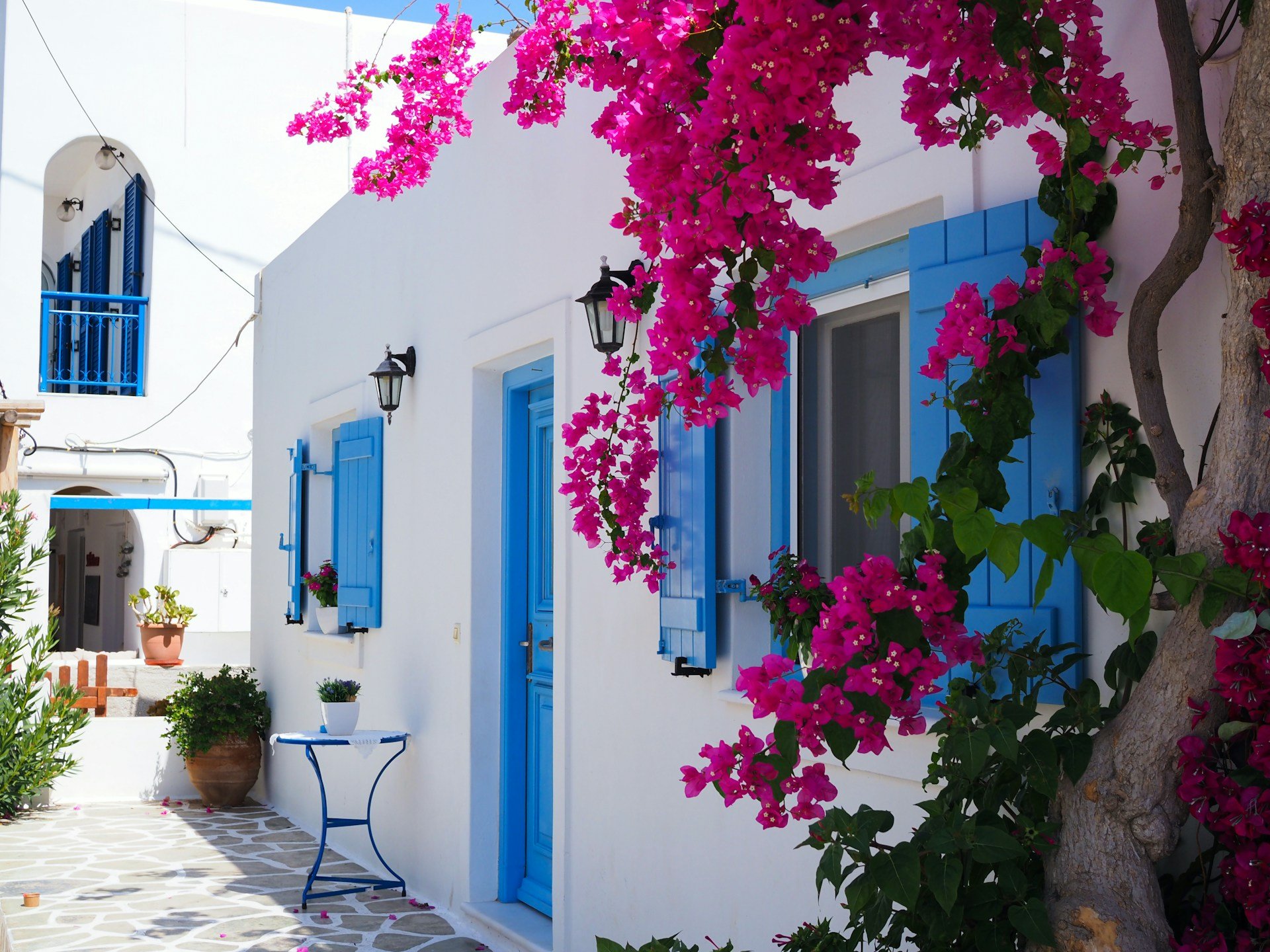

Greece vs Turkey at a glance
Nine rounds, scored from our two country guides. Turkey takes cost clearly and getting around narrowly, Greece takes the famous islands, safety and entry narrowly, and ancient sites, landscapes, food and weather are close to a tie. Select a category to jump to the full comparison.
| Category | GreeceTurkey |
|---|---|
| The nine rounds | |
| Beaches & islandsFamous islands against a quieter coast | Greece, narrowly |
| Cost & valueLower budget, food and tea prices in Turkey | Turkey, clearly |
| Ancient sites & historyClassical Greece against layered empires | A genuine tie |
| Landscapes & sceneryCaldera and Meteora against Cappadocia and Pamukkale | Split decision |
| FoodBoth score 9.3 for food in our guides | Draw |
| Weather & best timeShoulder seasons win in both | A genuine tie |
| Getting aroundFerries and meltemi against cheap domestic flights | Turkey, narrowly |
| SafetyLevel 1 and higher solo-women score in Greece | Greece, narrowly |
| Visas & entryCanada and Australia need an e-Visa for Turkey | Greece, narrowly |
| Best for | |
| Budget & value tripsLower daily budgets, meals and tea | Turkey |
| Island hoppingSix thousand islands and islets, about 230 inhabited | Greece |
| Cappadocia balloons & IstanbulSunrise flights over fairy chimneys | Turkey |
| OverallNo outright winner; it comes down to priorities | Depends on your priorities |
Island classics vs a continent-sized country
Greece and Turkey share the Aegean, the Mediterranean table and thousands of years of overlapping history, but they make different trips. Neither is "better" outright; they suit different priorities.
The islands that live up to the postcards
Greece is one of the most photographed countries on earth, and the photographs undersell it. The caldera view from Oia really does look like that, the Acropolis sits in the middle of a working modern city, and the country holds roughly six thousand islands and islets, only around 230 of them inhabited. The catch is that Santorini and Mykonos are overwhelmed in July and August, and the meltemi wind regularly grounds ferries.
A crossroads at a lower price
Turkey earns the word crossroads: Istanbul was Byzantium, then Constantinople, and straddles Europe and Asia, while Cappadocia, the Aegean and the Turquoise Coast each feel like a different country. The sharply weaker lira has made it one of the best-value trips available to anyone earning in a stronger currency. The catch is size: it is a big country, and trying to cover too much means spending the trip in airports and bus terminals.
Key facts side by side
| Fact | 🇬🇷 Greece | 🇹🇷 Turkey |
|---|---|---|
| Capital | Athens | Ankara |
| Currency | Euro (€) | Turkish lira (TRY) |
| Language | Greek | Turkish |
| Population | About 9.9 million | About 85 million |
| Area | About 128,900 km² | 783,562 km² |
| Budget day | €50–80 | $40–60 |
| Mid-range day | €100–150 | $90–150 |
| Best months | May, June, September, October | April to June, mid-September to November |
| Main gateways | Athens (ATH) | Istanbul (IST), Sabiha Gökçen (SAW) |
| EU and Schengen | Yes, both (EU 1981, Schengen 2000) | No, an EU candidate since 1999 |
| Visa, US, UK and EU passports | None, 90 days in any 180 (Schengen) | None, 90 days in any 180 |
| Power | 230V, Type C/F | 230V, Type C/F |
Figures from the Atlas Guide Greece and Turkey country guides (August 2026 research). Turkey's prices are given in US dollars because the lira moves fast; treat all figures as a planning baseline.
Round 1 of 9
Which has better beaches and islands, Greece or Turkey?
Greece wins, narrowly
Greece for fame and variety, Turkey for space and price. Greece has the world-famous island beaches and a country of about 230 inhabited islands. Turkey's Turquoise Coast has a comparable coastline with noticeably fewer crowds.
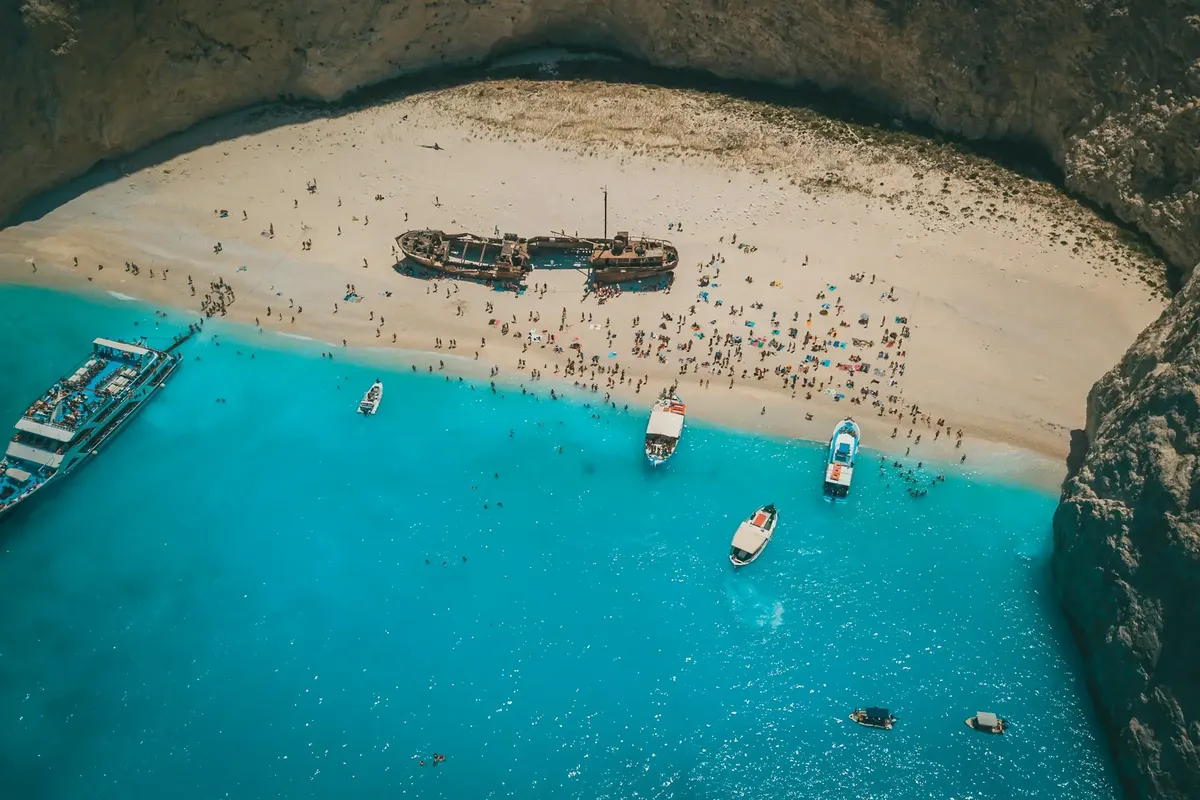 🇬🇷 Greece
Greece: the island classics
Greece's beaches range from the long sandy stretches of Naxos, rated the best all-round value in the Cyclades, to Crete's pink sand at Elafonissi and the lagoon at Balos. Water off Naxos or Crete really is that transparent. The trade-off is crowds: Santorini and Mykonos are overwhelmed in July and August, and the meltemi wind can ground ferries for a day or more.
- Best value
- Naxos, with long sandy beaches
- Best on Crete
- Elafonissi and Balos
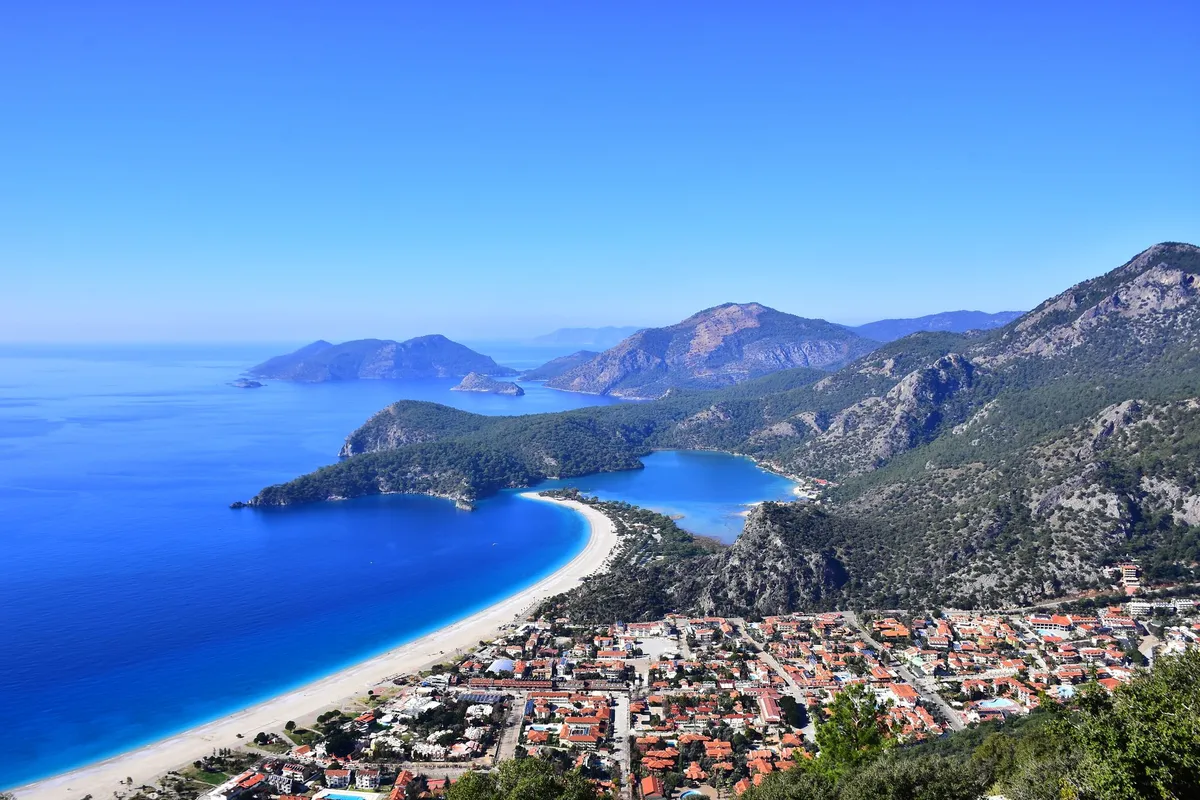 🇹🇷 Turkey
Turkey: the Turquoise Coast
Turkey's Mediterranean coast, which Turks call the Turquoise Coast, runs from Antalya west toward Fethiye and Ölüdeniz: pine-backed cliffs dropping into turquoise water, ancient ruins on the shoreline and a beach-resort infrastructure that undercuts the equivalent Greek or Italian coast on price. A Blue Voyage gulet cruise is a well-established way to see it from the water, and the sea stays swimmable from roughly May through October.
- Best resort area
- Ölüdeniz and Fethiye
- Best from the water
- Gulet Blue Voyage cruise
Want famous icons? Choose Greece. Want a similar sea with fewer people and lower prices? Turkey's coast is the better bet.
Round 2 of 9
Which is cheaper, Greece or Turkey?
Turkey wins, clearly
Turkey, in almost every category. A budget day runs $40–60 in Turkey against €50–80 in Greece, and street food and tea cost less. Greece is not uniformly expensive, though: the premium sits on Santorini and Mykonos.
Greece: mid-priced, island-dependent
Greece is mid-priced by Western European standards, and the biggest lever on your budget is which islands you pick. Santorini and Mykonos run 40–60% above equivalent quality on Naxos, Paros, Crete or the mainland, while food, ferries and archaeological sites cost roughly the same wherever you are.
Turkey: one of the best-value countries
Turkey is one of the best-value countries covered on Atlas Guide right now, a direct consequence of the lira's sustained weakness against the dollar and euro. Five-star hotels cost a fraction of Western prices, and prices at museums and tours drift faster than elsewhere, so check current pricing before booking time-sensitive items such as a balloon flight.
| Typical cost | 🇬🇷 Greece | 🇹🇷 Turkey |
|---|---|---|
| Budget day | €50–80 | $40–60 |
| Mid-range day | €100–150 | $90–150 |
| Comfortable day | €200+ | $200+ |
| Street food | Souvlaki or gyros wrap €3.50–5 | Döner from a stall $2–4 |
| Mid-range restaurant meal | Taverna meal €12–20 | $8–18 |
| Coffee or tea | Freddo or frappé €2.50–4 | Çay at a tea house about $0.50–1 |
| Headline site | Acropolis €20 summer, €10 winter | Hagia Sophia upper gallery about $25–30 |
| Long-hop transport | Piraeus to Santorini high-speed ferry €40–70 | Istanbul to Cappadocia flight $40–100 |
| Cave or caldera stay | Santorini cave hotels €150–400+/night | Cappadocia cave hotels $40–150/night |
| Budget day, summary | €50–80 | $40–60 |
Prices from the Atlas Guide country guides (August 2026). Greece in euros, Turkey in US dollars as the lira moves too fast for a reliable lira figure; the two columns are not converted.
How the guides compare them: our Greece guide puts Turkey at roughly 30–60% cheaper across food and lodging. Greece narrows the gap if you skip Santorini and Mykonos for Naxos, Paros, Crete or the mainland.
Round 3 of 9
Ancient sites and history: Greece or Turkey?
A genuine tie
Different strengths rather than a winner. Greece is classical Greece at its source. Turkey layers Greco-Roman, Byzantine and Ottoman history in one country, from Ephesus to Hagia Sophia.
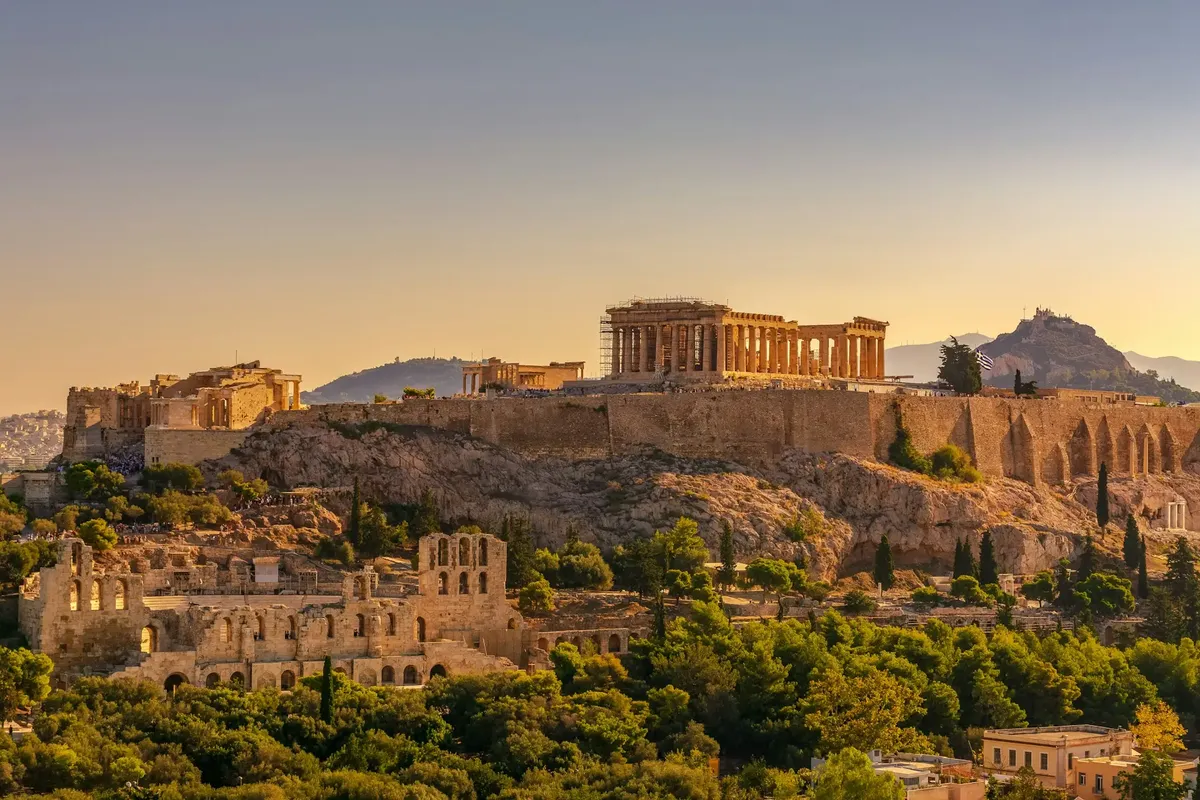 🇬🇷 Greece
Greece: the classical heartland
The Acropolis and Parthenon (€20 summer, €10 winter) are visible from most of Athens and impressive up close, and the Acropolis Museum and the Ancient Agora, where Socrates taught, are a short walk away. Beyond Athens, Mycenae's Lion Gate marks Agamemnon's Bronze Age kingdom, the theatre at Epidaurus carries a dropped coin's sound to the top row 60 metres up, Delphi was the ancient world's most important oracle, and Knossos on Crete is the restored Minoan palace.
- Must-see
- Acropolis and Parthenon, Athens
- Day trip
- Mycenae, Epidaurus and Nafplio (2 to 2.5 hours)
 🇹🇷 Turkey
Turkey: layers of empires
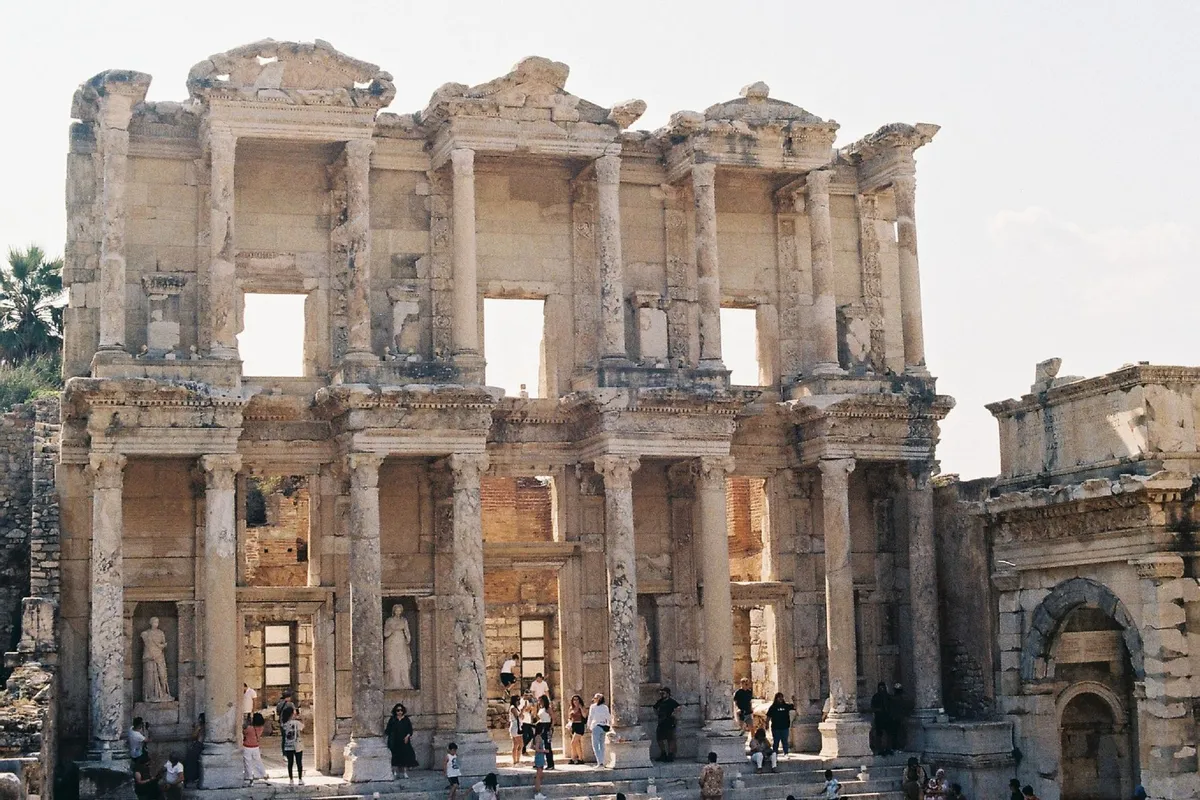
Ephesus, near Selçuk, is one of the best-preserved Greco-Roman cities anywhere: its marble Curetes Way leads to the facade of the Library of Celsus and a restored amphitheatre that once seated 25,000. Pamukkale's travertines sit below the ruins of the Roman-Byzantine spa city of Hierapolis, near Çanakkale lies the UNESCO site of Troy, and Istanbul adds Hagia Sophia, the Blue Mosque and Topkapı Palace within walking distance of each other.
- Must-see
- Ephesus and the Library of Celsus
- Istanbul core
- Hagia Sophia, Blue Mosque, Topkapı Palace
For a Greek-history trip, pick Greece. For Roman, Byzantine and Ottoman layers together, Turkey packs more empires into one itinerary.
Round 4 of 9
Landscapes and scenery: Greece or Turkey?
A split decision
Greece for the island view, Turkey for landscapes found nowhere else. Santorini's caldera and Meteora's rock-top monasteries against Cappadocia's fairy chimneys and Pamukkale's white terraces.
 🇬🇷 Greece
Greece: caldera, cliffs and gorges
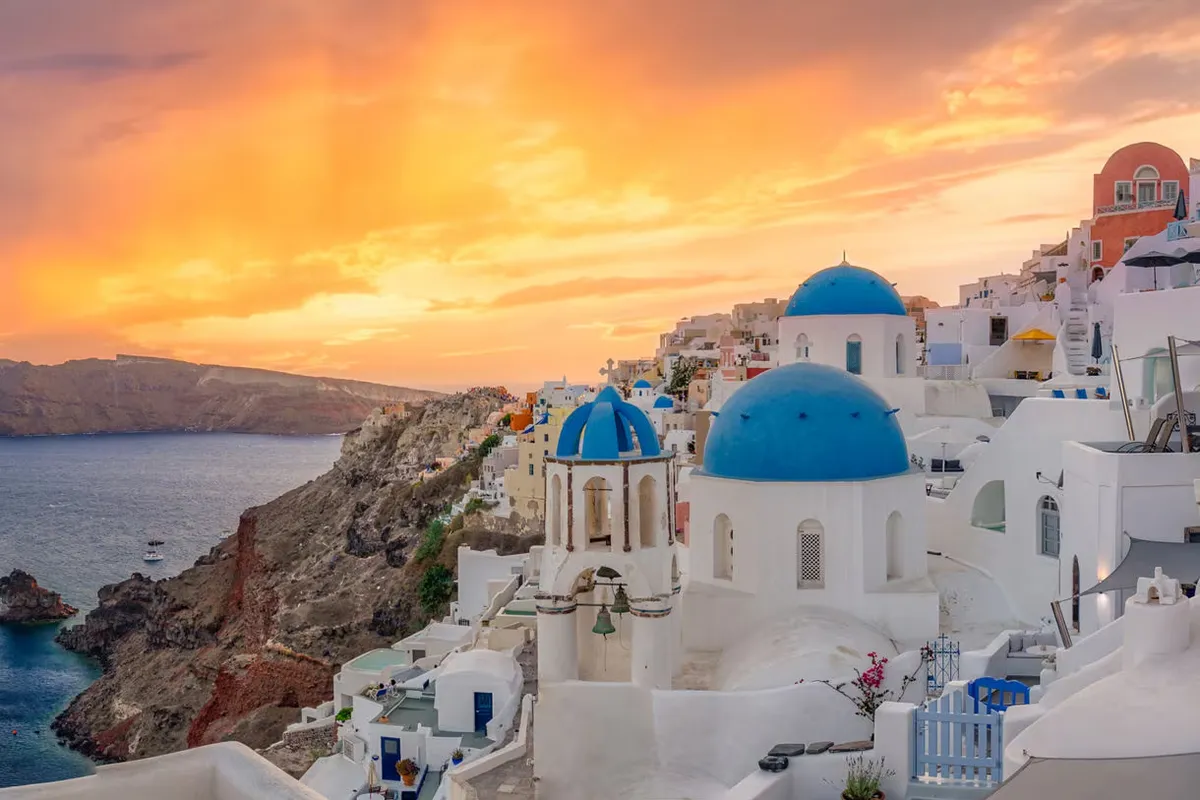
Santorini has the single most dramatic view in Greece, the caldera left by a Bronze Age volcanic eruption, best seen from Oia at sunrise before the cruise-ship crowds. Meteora has six active Greek Orthodox monasteries built onto sandstone pillars, best as an overnight in Kalambaka. For walkers, the Samaria Gorge on Crete is one of Europe's longest, and the Vikos Gorge in Epirus is among the deepest relative to its width.
- Classic view
- Oia caldera, Santorini
- Strangest sight
- Meteora monasteries
 🇹🇷 Turkey
Turkey: balloons and travertine
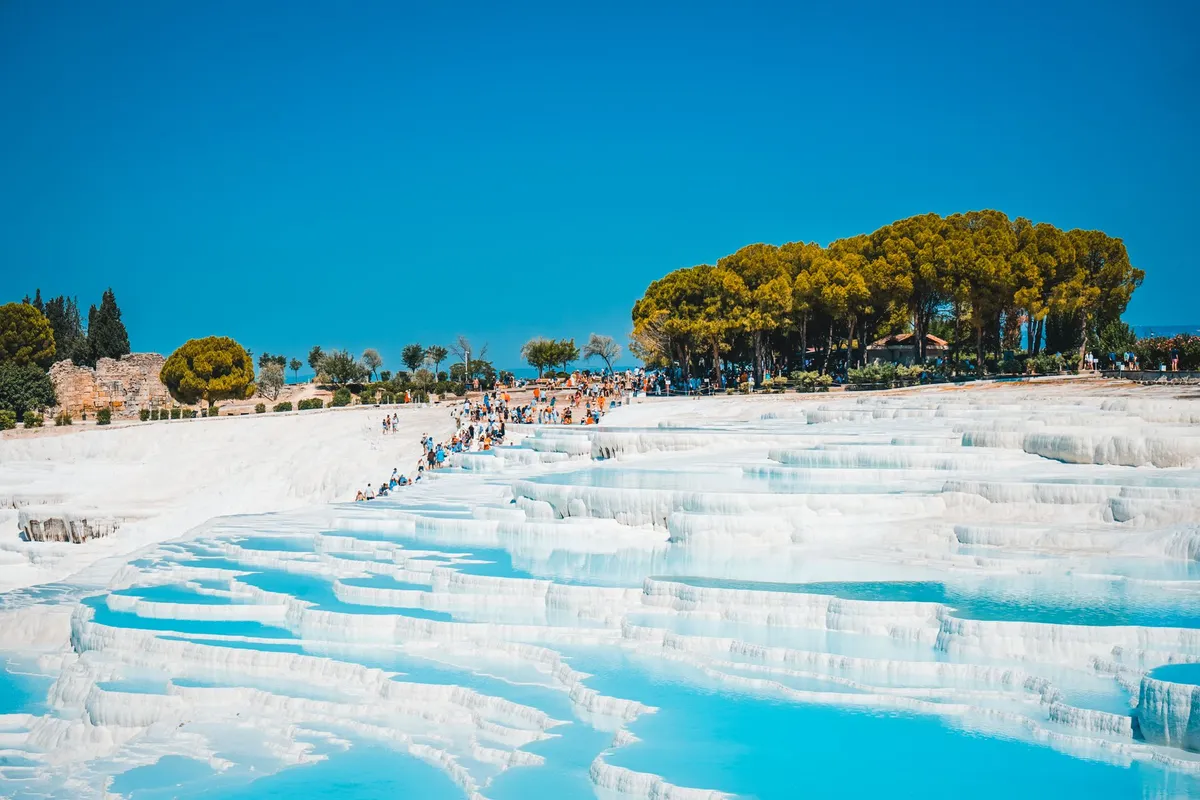
Cappadocia's landscape of wind-eroded fairy chimneys, some hollowed into churches, homes and entire underground cities, is unlike anywhere else in the world, and sunrise hot air balloon flights over Göreme fly most mornings. Pamukkale is a hillside of white calcium travertine terraces filled with mineral-rich pools. Book balloons ahead and allow a spare morning, as flights are cancelled on windy days.
- Signature sight
- Cappadocia sunrise balloons
- Natural wonder
- Pamukkale travertine terraces
A practical note: Cappadocia is a flight of about an hour from Istanbul, and Meteora is roughly 350km and 3.5 to 5 hours from Athens, so both reward an overnight rather than a rushed day trip.
Round 5 of 9
Which has better food, Greece or Turkey?
A draw
Our guides score both 9.3 out of 10 for food. Greek cooking leans on olive oil, grilled fish and shared taverna plates; Turkish cooking on meze, kebabs, breakfast spreads and pastry.
 🇬🇷 Greece
Greece: taverna plates and seafood
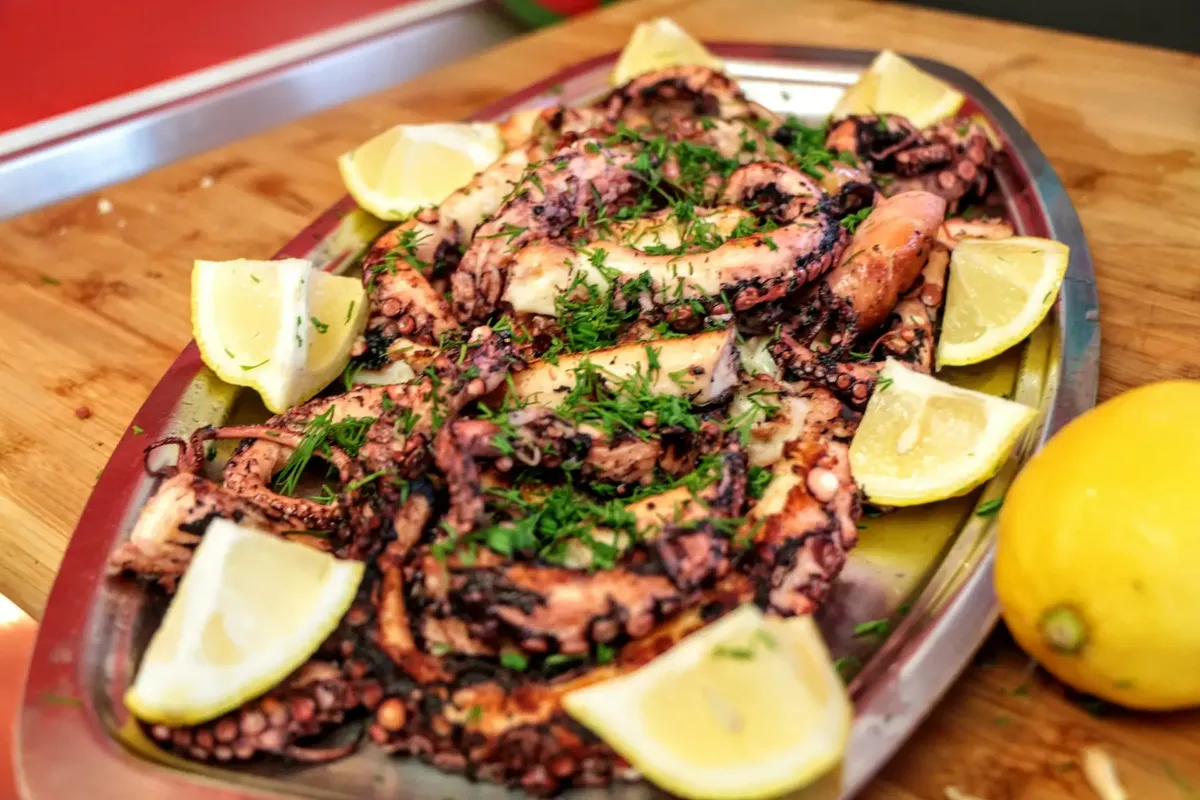
Greek food outside tourist-menu restaurants is built on olive oil, fresh vegetables, grilled meat and fish and simple preparation. Souvlaki and gyros cost €3.50–5, horiatiki is the real Greek salad with no lettuce, and fish at seaside tavernas is sold by the kilo, so confirm the price per kilo and the weight before it is cooked. Ouzo, tsipouro and Santorini's Assyrtiko wine round it out.
- Street food
- Souvlaki and gyros, €3.50–5
- Sweet
- Baklava and loukoumades
 🇹🇷 Turkey
Turkey: meze, kebabs and breakfast
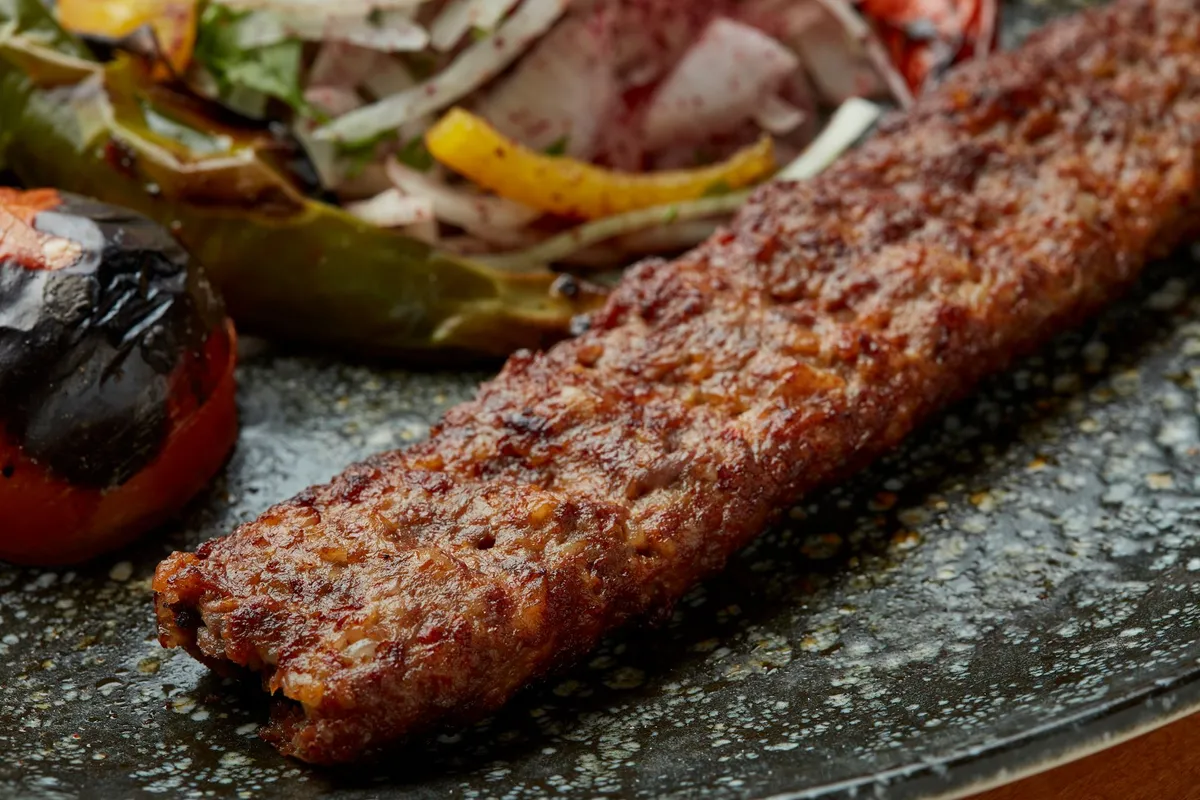
Turkish food varies by region, but fresh bread with every meal, a serious meze culture, grilled meat and superb pastries hold everywhere. A Turkish breakfast of cheeses, olives, tomatoes, honey, eggs and flatbread is widely considered one of the best in the world, döner from a busy stall costs $2–4, and Gaziantep is the acknowledged baklava capital. Eat where the queue is local, in a busy lokanta rather than a restaurant with photo menus.
- Street food
- Döner $2–4, simit from carts
- Slow meal
- Kahvaltı breakfast, meze and raki
The same rule applies in both: skip restaurants with laminated photo menus and staff pulling in passers-by, and pick the place with a local crowd even two streets back from the view.
Round 6 of 9
Weather: the best time to visit Greece or Turkey
A genuine tie
Both are best in the shoulder seasons. The sweet spot is May, June, September and October in Greece and April to June and mid-September to November in Turkey. Summers are hot in both.
| Season | 🇬🇷 Greece | 🇹🇷 Turkey |
|---|---|---|
| Spring, May and June | Best22–29°C, everything open | BestApril to June, 18–27°C in Istanbul |
| July and August | Good, hot and crowded30–38°C, heatwaves common | Good, hot28–35°C in Istanbul and inland |
| Autumn, September and October | Best22–29°C, mid prices | BestMid-September to November |
| March and April | Good15–21°C, some islands still closed | Good, coolMarch 12–18°C in Istanbul |
| November to February | Quiet8–15°C, most small islands shut | Quiet4–10°C in Istanbul, colder Cappadocia |
The practical difference: in Greece, many island hotels, restaurants and even ferry routes shut from November to March. In Turkey, Cappadocia can see snow, which grounds balloon flights more often, but the Mediterranean coast stays swimmable from roughly May through October.
Round 7 of 9
Getting there and getting around
Turkey wins, narrowly
Turkey is easier to cover, Greece asks for more slack. Our guides score transport 8.0 for Turkey and 7.0 for Greece: Turkey has cheap domestic flights and buses, while Greece depends on ferries that the meltemi can cancel.
Ferries, metro and a rental car on the mainland
Athens International (ATH) is the main gateway, and several islands also get direct seasonal flights from Europe. Ferries from Piraeus reach virtually every inhabited island: Piraeus to Aegina from about €9.50, Paros, Naxos or Mykonos about €33, and Santorini €40–70, with high-speed catamarans cutting hours off. The meltemi in July and August regularly grounds catamarans, so never book a tight ferry connection to a flight home. A rental car is useful on the mainland, the Peloponnese and Crete.
Domestic flights and long-distance buses
Istanbul Airport (IST) is the main gateway, with Sabiha Gökçen (SAW) on the Asian side for budget carriers. Turkey is roughly the size of France and Germany combined, so domestic flights are the practical way to cover it: Istanbul to Cappadocia or İzmir takes about an hour and costs $40–100 one way. Intercity buses run $10–30, and a rental car at $25–45 a day suits the coasts but is a liability in Istanbul.
Don't over-plan Turkey: our guide advises three regions in ten to fourteen days rather than four, since each deserves two to four unhurried days.
Round 8 of 9
Is Greece or Turkey safer for tourists?
Greece wins, narrowly
Both are safe on the tourist circuit, and Greece has the simpler picture. It carries the lowest US risk level and scores higher for solo women, while Turkey has a clearly marked no-go border region far from where visitors travel.
🇬🇷 Greece: what to watch
- Heat and sun: heatwaves above 40°C are increasingly common and send more tourists to Greek hospitals each year than crime does. Carry water and avoid midday sun at archaeological sites.
- Ferries and roads: meltemi cancellations and accidents on rented scooters and ATVs are the two most common disruptions. Wear a helmet.
- Petty theft: pickpockets work Athens's Monastiraki flea market, crowded metro lines and busy ferry terminals.
- Wildfires and protests: wildfire risk is elevated most summers, and protests around Syntagma Square can disrupt transport for hours. Emergency number: 112.
🇹🇷 Turkey: what to watch
- The southeast border: do not travel within 10km of the Syria or Iraq border, and avoid the wider southeastern provinces. This is nowhere near Istanbul, Cappadocia or the coasts.
- Sultanahmet scams: the carpet-shop invitation, taxi meter tricks and the shoe-shine drop target first-time visitors. Use the BiTaksi app for taxis.
- Petty theft and traffic: pickpockets work the Grand Bazaar and rush-hour transit, and Istanbul drivers are assertive.
- Earthquakes and protests: Turkey sits on active fault lines, and protests occur periodically around Taksim Square. Emergency number: 112.
| Safety measure | 🇬🇷 Greece | 🇹🇷 Turkey |
|---|---|---|
| Solo women | 8.7 out of 10 | 7.0 out of 10 |
| Families | 8.4 out of 10 | 8.3 out of 10 |
| Official advisory | US State Department Level 1, Exercise Normal Precautions | No elevated advisory on the standard tourist circuit; do-not-travel areas near the Syria and Iraq borders |
In both countries the standard circuit is visited by millions of tourists a year without incident beyond petty crime and the scams above. Use licensed taxis or ride apps at night and keep bags zipped and in front of you.
Round 9 of 9
Visas and entry: Greece or Turkey?
Greece wins, narrowly
Greece is slightly simpler for more passports, Turkey is easier on your Schengen days. US, UK and EU travellers are visa-free in both. Canadians and Australians need an e-Visa for Turkey but not for Greece.
| Entry rule | 🇬🇷 Greece | 🇹🇷 Turkey |
|---|---|---|
| US, UK and EU passports | Visa-free, up to 90 days in any 180 (Schengen) | Visa-free, up to 90 days in any 180 |
| Canadian and Australian passports | Visa-free, up to 90 days in any 180 (Schengen) | e-Visa needed from evisa.gov.tr, typically $50–60, arranged before departure |
| Pre-travel authorisation | ETIAS (€20) expected from late 2026, not required as of August 2026 | None for visa-free nationalities |
| Schengen clock | Time counts against the shared 90 days | Time in Turkey does not count |
| Passport validity | At least 3 months beyond departure from Schengen | Most nationalities: at least 6 months from date of entry |
Island-hopping across: short ferries link Rhodes, Kos, Lesbos and Samos with Turkish ports, and because Turkey sits outside Schengen, time there does not touch your Schengen 90-day clock. Apply for any e-Visa only at the official site, as paid third-party visa sites often charge extra.
Which is better for couples, families and solo travellers?
Greece for island hoppers, families, solo women and classical history. Turkey for budgets, balloon flights and Istanbul. Couples are well served by either.
Couples & honeymoons
Either
Greece has Santorini's caldera suites and Naxos sunsets; Turkey has Cappadocia cave hotels and a sunrise balloon flight. Both deliver a memorable romantic trip.
Families with young children
Greece
Shallow, calm beaches on Naxos and Crete and kid-friendly sites like Knossos suit young children. Greece scores 8.4 for families against 8.3 for Turkey, and island ferries need slack with toddlers.
Budget & backpacker travel
Turkey
A budget day runs $40–60, with döner at $2–4, çay at about $0.50–1 and intercity buses at $10–30.
Island hoppers
Greece
Six thousand islands and islets, about 230 inhabited, linked by ferries from Piraeus, with Naxos and Paros as the value picks.
Balloon and landscape chasers
Turkey
Cappadocia's sunrise balloon flights, cave hotels and underground cities, plus Pamukkale's travertine terraces.
Solo women
Greece
Greece scores 8.7 for solo women against 7.0 for Turkey, where street harassment is more common than in Western Europe.
City and bazaar lovers
Turkey
Istanbul puts Hagia Sophia, the Blue Mosque, Topkapı Palace and the Grand Bazaar within walking distance, with Bosphorus ferries between two continents.
Classical history fans
Greece
The Acropolis, Delphi, Mycenae, Epidaurus and Knossos are the source material for classical Greece.
Can you combine Greece and Turkey in one trip?
Yes. Short ferries link Rhodes, Kos, Lesbos and Samos with the Turkish coast, and time in Turkey does not count against your Schengen days. Allow 12 to 14 days so neither country feels rushed.
Greece: days 1 to 7
- Days 1–2
Athens. The Acropolis and Acropolis Museum, the Ancient Agora and Plaka, plus an evening at Cape Sounion for sunset.
- Days 3–4
Naxos or Paros. High-speed catamaran from Piraeus (3.5 to 5 hours), then beach time and a sunset in the old town.
- Days 5–6
Santorini. Oia at sunrise before the crowds, the caldera villages and an Assyrtiko wine tasting.
- Day 7
Travel day. Leave a buffer day for ferries before any flight, then travel on to Turkey by air, or by ferry from Rhodes, Kos or Samos if you route that way.
Turkey: days 8 to 14
- Days 8–11
Istanbul. Sultanahmet's core sights, a Bosphorus ferry, Beyoğlu and Karaköy, and a day on the Asian side at Kadıköy.
- Days 12–14
Cappadocia. Fly in (about an hour), two nights in a cave hotel, a sunrise balloon flight, the Göreme Open-Air Museum and an underground city.
When to go: May, June, September and October suit Greece, and April to June and mid-September to November suit Turkey, so May, June, September and October cover both. Book balloon flights and Santorini stays well ahead.
Verdict: Greece or Turkey?
There's no single overall winner. Greece is the right choice for island hopping, classical history and the simplest safety and entry picture. Turkey is the right choice when value, Cappadocia and Istanbul matter more than the famous islands.
Choose Greece if…
Greece, for islands and classical sites
The right choice when the Aegean islands and the sites of classical Greece are the point of the trip, and you want the lowest advisory level and the easiest entry.
- Island hopping from Piraeus is the plan, with Naxos and Paros for value
- The Acropolis, Delphi, Mycenae and Epidaurus are on your list
- You want Santorini's caldera at sunrise or sunset
- You are travelling solo as a woman or with young children
- You hold a Canadian or Australian passport and want no e-Visa step
- You will travel in May, June, September or October
Choose Turkey if…
Turkey, for value and big sights
The right choice when your budget matters, or when Cappadocia, Istanbul and the layered ruins of the Aegean coast are the draw.
- You want a $40–60 budget day, or a comfortable trip for less
- A sunrise balloon flight over Cappadocia is a priority
- Istanbul, with two continents and the Grand Bazaar, appeals
- You want Ephesus, Hierapolis and Troy rather than classical Athens
- You want a similar coast with fewer crowds on the Turquoise Coast
- You need time away from your Schengen 90-day clock
Weigh it for your own trip
Select everything that matters to you.
Pick what matters on this trip and the needle will move.
Greece vs Turkey: frequently asked questions
Which is better, Greece or Turkey?
Neither wins outright. Choose Greece for the famous islands such as Santorini, Naxos and Crete, for classical sites like the Acropolis and Delphi, and for the slightly easier entry and safety picture. Choose Turkey for value, with a budget day of $40–60 against €50–80 in Greece, for Cappadocia's balloons and for Istanbul. Food, ancient sites and the weather are close to a tie, and ferries link several Greek islands with the Turkish coast, so some travellers visit both.
Is Turkey cheaper than Greece?
Yes, in most categories. Our guides put a budget day at $40–60 in Turkey and €50–80 in Greece, and a döner from a stall at $2–4 against €3.50–5 for a souvlaki or gyros wrap. A çay at a tea house is about $0.50–1 in Turkey. Greece's costs are driven by Santorini and Mykonos, which run 40–60% above Naxos, Paros, Crete or the mainland, so Greece can be good value if you skip the famous islands.
Are the beaches better in Greece or Turkey?
It depends what you want. Greece has the world-famous island beaches, from the Cyclades to Crete's pink sand at Elafonissi and the lagoon at Balos. Turkey's Turquoise Coast, from Antalya towards Fethiye and Ölüdeniz, has fewer icons but a comparable coastline with noticeably fewer crowds and lower resort prices. Greece wins narrowly on variety and fame; Turkey wins on space and price.
Is Greece or Turkey better for ancient history?
Both are outstanding and different. Greece offers classical Greece: the Acropolis, Delphi, Mycenae, the theatre at Epidaurus and Knossos on Crete. Turkey offers a layered Greco-Roman, Byzantine and Ottoman story: Ephesus with the Library of Celsus, Hierapolis above Pamukkale, Troy, and Istanbul's Hagia Sophia and Topkapı Palace. Classical-Greece fans should pick Greece; those who like several empires in one trip should pick Turkey.
When is the best time to visit Greece and Turkey?
Both are best in the shoulder seasons. For Greece that is May, June, September and October; for Turkey it is April to June and mid-September to November. July and August are hot in both, with Greece at 30–38°C and heatwaves common, and Turkey at 28–35°C in Istanbul and inland. Many smaller Greek islands largely shut down from November to March, while Cappadocia can see snow that grounds balloon flights.
Do I need a visa for Greece or Turkey?
US, UK and EU citizens enter both visa-free for up to 90 days in any 180-day period. Greece is in the Schengen Area, so its 90 days are shared with other Schengen countries, and ETIAS (€20) is expected from late 2026. Turkey is outside Schengen, so time there does not count against your Schengen clock. Canadian and Australian passport holders need an e-Visa for Turkey from evisa.gov.tr, typically $50–60, and must arrange it before departure.
Is Turkey safe compared with Greece?
Both are safe on the standard tourist circuit. Greece carries a Level 1 US State Department rating, with heat, ferry delays, road accidents on rented scooters and petty theft as the real risks. In Turkey, Istanbul, Cappadocia and the Aegean and Mediterranean coasts carry no elevated advisory, but governments advise against travel within 10km of the Syria and Iraq borders. Our guides score solo women at 8.7 for Greece and 7.0 for Turkey.
Can you combine Greece and Turkey in one trip?
Yes. Short ferries link Greek islands such as Rhodes, Kos, Lesbos and Samos with Turkish ports such as Bodrum, Marmaris and Kuşadası, in a matter of hours. A common plan is Athens and the Cyclades first, then Istanbul and Cappadocia. Allow 12 to 14 days so neither country feels rushed. Build a buffer day around Greek ferries, which can be cancelled in strong meltemi wind in July and August.
There's no wrong answer here
Greece and Turkey are compared so often because both are genuinely excellent. Pick on what you want from this trip: the famous islands, classical sites and the simplest entry, or value, Cappadocia and Istanbul. Better still, do both, with a short ferry hop across the Aegean.