
What You're Actually Getting Into
Turkey is the rare country that genuinely earns the word crossroads. Istanbul was Byzantium, then Constantinople, then Istanbul, capital to two empires that between them ran for over sixteen centuries, and the city still wears every layer of that at once: a Byzantine cathedral turned mosque turned museum turned mosque again, standing across a square from an Ottoman sultan's palace, both a short walk from bars playing the same music as Berlin or London. Outside the city, the country holds landscapes that look unrelated to each other and to Istanbul entirely, Cappadocia's eroded volcanic valleys dotted with cave churches and hotels, the white calcium terraces of Pamukkale, the marble streets of Ephesus, one of the best-preserved Greco-Roman cities anywhere, and a Mediterranean coastline of pine-covered cliffs and turquoise coves that Turks call the Turquoise Coast without much exaggeration.
The other headline fact is price. The Turkish lira has fallen sharply against the dollar and euro over the past several years, and while that's genuinely hard on Turkish households, it has made the country one of the best-value trips available to anyone earning in a stronger currency: five-star hotels at three-star prices, meze feasts for the cost of a sandwich at home, and a Bosphorus ferry ticket that costs less than a bus fare in most of Europe.
The honest complications
Turkey is a large country, and travelers who try to combine too much in too little time end up spending their trip in airports and otogars (bus terminals) rather than the places themselves. Sultanahmet, Istanbul's historic core, is genuinely touristed: carpet-shop touts and inflated-menu restaurants cluster around Hagia Sophia and the Blue Mosque, and a few common scams (covered fully in the Safety chapter) specifically target first-time visitors there. Inflation has made prices less predictable than in most countries this guide covers; what something costs in lira today may look different in six months, so treat the figures here as a baseline, not a quote. And Turkey's political situation, while irrelevant to the standard tourist circuit, is genuinely serious in its far southeast, near the Syria and Iraq borders, a region with an active do-not-travel warning that this guide addresses honestly rather than glossing over, in the Safety chapter.
A History Worth Knowing
Anatolia has been continuously inhabited and fought over since before recorded history: Hittites, Greeks, Persians, Romans, Byzantines, Seljuks and Ottomans each ruled some or all of it in turn. The short version that actually helps on the ground: Constantinople fell to the Ottomans in 1453, the empire ruled from Vienna's gates to the Persian Gulf at its height, collapsed after the First World War, and Mustafa Kemal Atatürk built the secular Republic of Turkey out of the wreckage in 1923, reshaping the alphabet, the legal code and the role of religion in public life within a decade.
- 330 CE
Constantinople founded. Roman emperor Constantine refounds Byzantium as his new capital, later the seat of the Byzantine Empire for over a thousand years.
- 1453
The Ottoman conquest. Sultan Mehmed II takes Constantinople after a 53-day siege, ending the Byzantine Empire and beginning nearly five centuries of Ottoman rule.
- 16th century
Ottoman peak. Under Suleiman the Magnificent the empire stretches from Hungary to the Persian Gulf to North Africa, one of the largest empires in history.
- 1918–1922
Collapse and War of Independence. Defeat in World War I dismantles the empire; Mustafa Kemal (later Atatürk) leads the Turkish War of Independence against occupying and partitioning powers.
- 1923
The Republic. Atatürk declares the Republic of Turkey, abolishes the sultanate and caliphate, and drives rapid secularizing and modernizing reforms through the following decade.
- 2000s–present
Modern Turkey. Rapid economic growth, EU candidacy from 1999 that stalls, and a more assertive regional role, alongside currency volatility that has reshaped the cost of visiting.
Read the full history: Byzantium, the Ottomans and Atatürk's reforms
Before the Ottomans, Anatolia was already one of the ancient world's great crossroads: the Hittite Empire ruled from Hattusa near modern Ankara, Greek city-states colonized the Aegean coast and built Ephesus into one of the Mediterranean's largest cities, and the Byzantine Empire, the Greek-speaking Christian continuation of Rome, ruled from Constantinople for over a thousand years, leaving Hagia Sophia as its greatest surviving monument.
The Ottoman conquest of 1453 is one of the pivotal dates in world history, closing the medieval period for many historians and opening an empire that would rule three continents at its height. Sultan Suleiman the Magnificent's 16th-century reign is generally considered the peak: legal reform, architectural patronage (much of it by the great architect Mimar Sinan), and military reach from Vienna's walls to the Persian Gulf.
Ottoman decline was slow and complicated, but the empire's choice to join Germany in World War I proved fatal; defeat brought occupation and a partition plan that would have left little of Anatolia to Turkish control. Mustafa Kemal, a war hero from the Gallipoli campaign, organized resistance from Ankara, defeated the occupying and partitioning forces in the Turkish War of Independence, and in 1923 declared the Republic of Turkey with Ankara, not Istanbul, as its capital, a deliberate break from the imperial past.
Atatürk's reforms. Over the following decade Atatürk abolished the caliphate, replaced the Arabic script with a Latin alphabet, granted women the vote before several Western European countries, and enshrined secularism into the constitution, reforms so foundational that "Atatürk," meaning father of the Turks, is a name the parliament granted him and forbade anyone else from using. His mausoleum, Anıtkabir in Ankara, remains a site of genuine national reverence.
Top Destinations
Turkey divides naturally into Istanbul, Cappadocia, the Aegean coast and the Mediterranean coast, with each requiring its own travel day to reach from the others. The classic first-time route links three of the four; trying to add all four in under two weeks usually means spending the trip in transit rather than in any one place properly.
Istanbul, where two continents meet
Istanbul is Turkey's essential stop and, for most first-time visitors, the whole trip if time is short. Hagia Sophia, the Blue Mosque, Topkapı Palace and the Grand Bazaar sit within walking distance of each other in Sultanahmet, the Bosphorus splits the city between Europe and Asia with ferries crossing constantly, and neighborhoods from Beyoğlu's nightlife to Kadıköy's food scene on the Asian side each feel like a different city. It rewards three or four full days and deserves its own guide, which this site has: read the complete Istanbul city guide for neighborhoods, hotels, restaurants and a street-by-street itinerary.
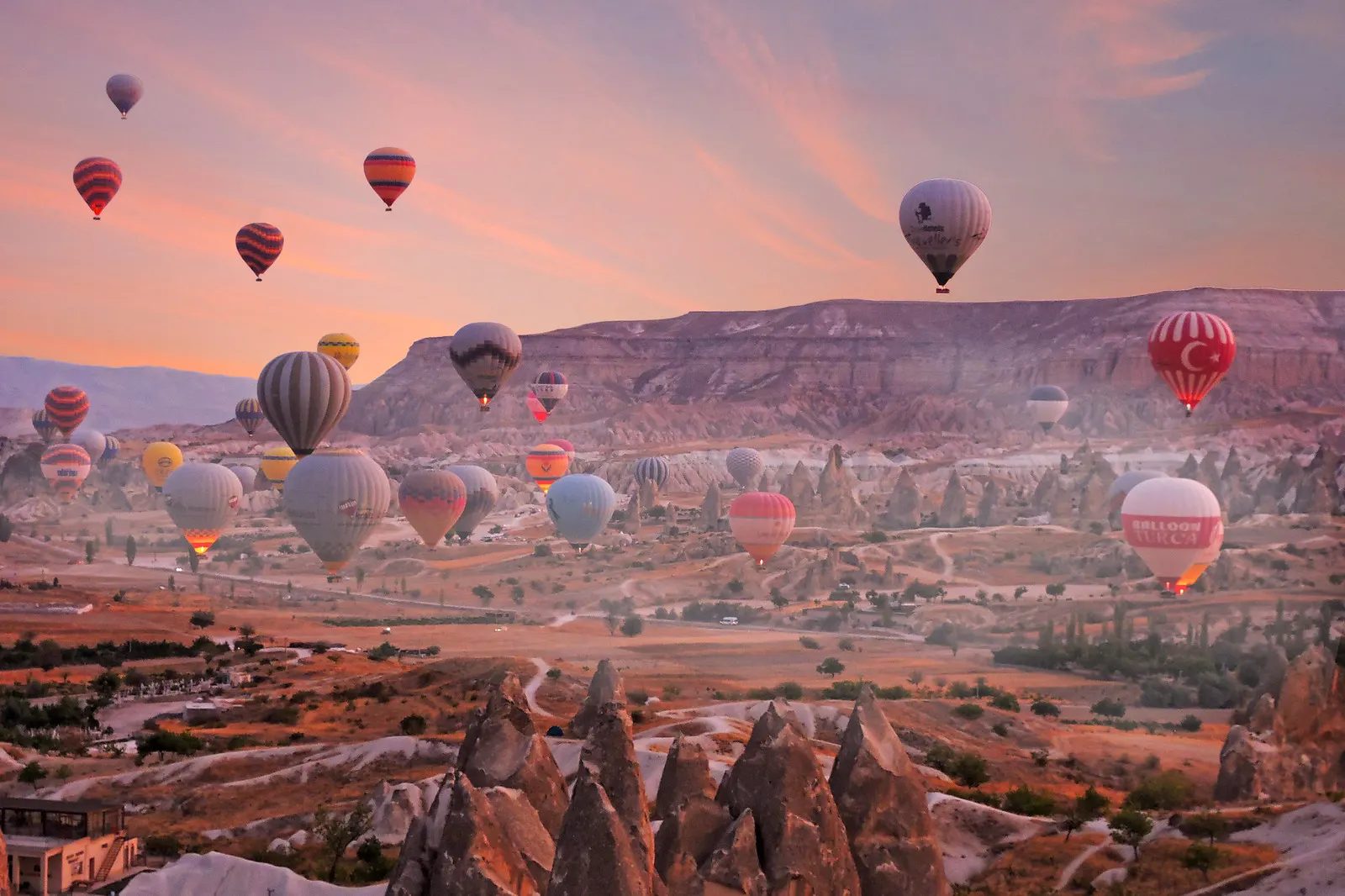
Cappadocia, balloons over fairy chimneys
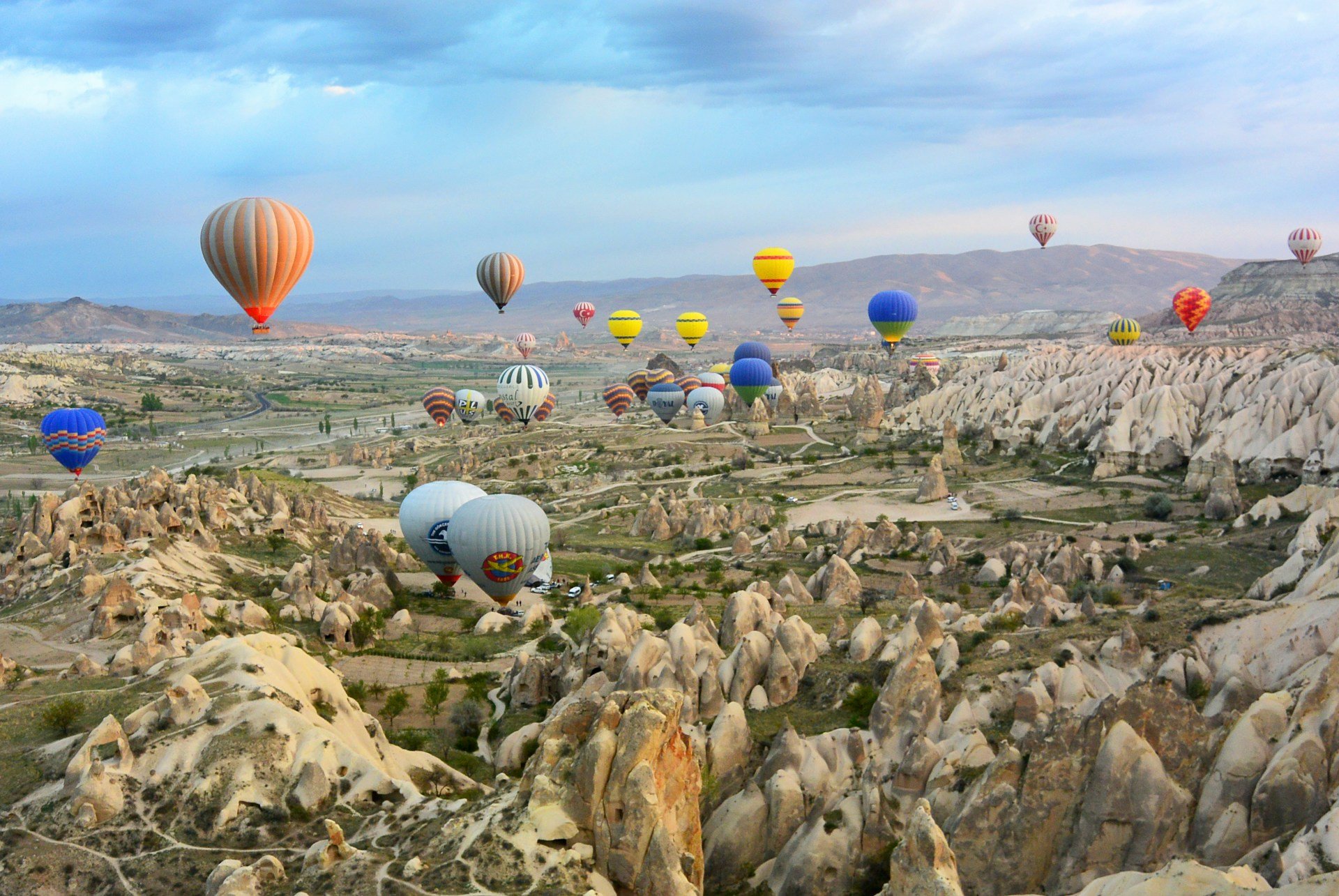
Cappadocia's volcanic landscape of wind-eroded rock towers, "fairy chimneys," some hollowed into churches, homes and entire underground cities by Byzantine-era Christians hiding from raiders, is unlike anywhere else in the world. The sunrise hot air balloon flights over Göreme's valleys, weather permitting most mornings, are the reason most people come, but the underground cities at Derinkuyu and Kaymaklı, the open-air museum at Göreme with its painted rock churches, and simply staying a night in a cave hotel carved into the rock are worth the trip on their own. Reach it by a roughly 1-hour domestic flight from Istanbul to Kayseri or Nevşehir airport rather than the 10-plus-hour drive or overnight bus.
Ephesus & Pamukkale
The Aegean side pairs two very different sites well in a day or two: Ephesus, near the town of Selçuk, is one of the best-preserved ancient Greco-Roman cities anywhere, its marble Curetes Way leading to the two-story facade of the Library of Celsus and a restored amphitheater that once seated 25,000. Pamukkale, a few hours inland, is a hillside of white calcium travertine terraces filled with mineral-rich pools, with the ruins of the Roman-Byzantine spa city of Hierapolis sitting directly above them. Both are day-trippable from the coastal city of İzmir or as a stop between Cappadocia and Istanbul on a longer route.
Antalya & the Turquoise Coast
Turkey's Mediterranean coast, which Turks call the Turquoise Coast, runs from Antalya west toward Fethiye and Ölüdeniz: pine-backed cliffs dropping into genuinely turquoise water, ancient ruins scattered along the shoreline, and a beach-resort infrastructure that undercuts the equivalent stretch of Greek or Italian coast on price. Antalya's old town, Kaleiçi, with its Ottoman-era houses and Roman harbor, is worth a full day before heading to the beach towns; a "Blue Voyage" gulet (traditional wooden yacht) cruise along the coast is a well-established way to see it from the water.
Bursa, the first Ottoman capital
Bursa, an easy ferry-and-bus or fast-ferry trip across the Sea of Marmara from Istanbul, was the Ottoman Empire's first capital before Constantinople fell, and its Grand Mosque and silk-trading Koza Han caravanserai are worth a day trip if you have extra time around Istanbul rather than heading further afield.
Troy & the Dardanelles
Near Çanakkale, the excavated site of ancient Troy (a UNESCO World Heritage Site) and the World War I Gallipoli battlefields sit on either side of the Dardanelles strait, a meaningful stop for history-focused travelers en route between Istanbul and the Aegean coast.
Culture & Etiquette
Turkish hospitality (misafirperverlik) is a genuine cultural value: guests are honored, tea (çay) is offered constantly and rarely declined gracefully, and shopkeepers in tourist areas will often invite you to sit for tea before any conversation about buying anything begins. Turkey is a secular republic with a majority-Muslim population, and the balance between the two is visible everywhere, from headscarved and uncovered women shopping side by side to çay houses next to cocktail bars in the same street.
Do
- Dress modestly for mosques. Cover shoulders and knees; women need a headscarf, usually available to borrow at the entrance of major mosques like the Blue Mosque.
- Accept tea when offered. Declining repeatedly can read as rude; a polite "no, thank you" once is fine, but accepting one small glass costs you nothing and often improves the interaction.
- Learn a few Turkish words. Merhaba (hello), teşekkürler (thank you), lütfen (please). Turkish uses a Latin alphabet, so signage is readable even without the language.
- Remove shoes when entering a mosque or a Turkish home. Shoe racks or bags are provided at mosque entrances.
- Carry cash in lira for markets and small vendors, though cards are widely accepted in cities; ATMs are everywhere in tourist areas.
Don't
- Photograph military or government buildings, checkpoints, or people in uniform without permission; this is taken seriously.
- Wander into a carpet shop's "just for tea" invitation near Sultanahmet expecting no sales pressure; it's a well-known, choreographed pattern covered in the Safety chapter.
- Discuss Atatürk, the Kurdish issue or the Syria/Iraq border situation casually with strangers. Turks generally hold strong views on all three; these aren't small talk.
- Assume all of Turkey is like Istanbul or the resort coast. Rural and southeastern Turkey are considerably more conservative; dress and behavior expectations shift accordingly.
- Give or accept items with your left hand in traditional settings, considered impolite by some older Turks, though rarely an issue in cities.
Deeper culture: the hammam, Sufi whirling and Turkish tea culture
The hammam. The Turkish bath, a steam-and-scrub ritual dating to Ottoman and earlier Roman bathing traditions, remains a genuine local institution as well as a tourist experience. Historic hammams in Istanbul, some centuries old, offer both.
Sufi whirling (Sema). The whirling dervish ceremony, performed by followers of the 13th-century mystic poet Rumi (Mevlana), is a genuine religious meditation, not a folk dance, though tourist-oriented performances are widely available in Istanbul and Cappadocia; Konya, Rumi's home city, is the spiritual center.
Tea culture. Çay, brewed strong and served in small tulip-shaped glasses, is closer to a national ritual than a beverage: offered on arrival, after meals, during business negotiations, and by shopkeepers to browsing customers. Turkish coffee, thick, unfiltered and traditionally read for fortunes in the grounds, is a separate and more occasional drink.
Food & Drink
Turkish food varies significantly by region, but a few things hold everywhere: fresh bread with every meal, a serious meze culture of small shared plates, grilled meat done exceptionally well, and a sweet tooth that produces some of the world's best pastries. Restaurant meals are still cheap by Western standards even after recent inflation, and street food, particularly a good döner or simit, is some of the best low-cost eating anywhere.
Turkish breakfast (kahvaltı)
A spread of cheeses, olives, tomatoes, cucumber, honey, jam, eggs and flatbread, meant to be lingered over with endless refills of tea. Widely considered one of the best breakfast traditions in the world, and worth building a slow morning around at least once.
Kebabs & döner
Not one dish but a whole category: Adana kebab (spiced minced meat), şiş kebab (skewered), and döner, thin-sliced roasted meat in bread, Turkey's most famous export and, done well from a busy stall, one of the great cheap eats anywhere.
Baklava & Turkish delight
Layered filo pastry with nuts and syrup, at its best from a dedicated baklava shop rather than a general bakery. Gaziantep is the acknowledged baklava capital, though excellent versions are sold throughout Istanbul.
Meze & raki
Small cold and hot shared plates, hummus, patlıcan salatası (smoked eggplant), dolma and more, traditionally eaten slowly alongside raki, the anise spirit that turns cloudy with water, Turkey's answer to ouzo or pastis.
Simit
A circular sesame-crusted bread ring sold from carts on every corner, Istanbul's answer to the bagel and one of the cheapest, most reliable breakfasts in the city.
Turkish tea & coffee
Çay, strong black tea in small glasses, is drunk constantly and cheaply; Turkish coffee, thick and unfiltered, is a slower, more occasional ritual usually taken after a meal.
When to Go & Itineraries
April through June and mid-September through November are Turkey's best months: warm days, cool nights, manageable rainfall, and Cappadocia's balloons flying most mornings. July and August are hot, especially inland and in Istanbul, but the Mediterranean and Aegean coasts are still excellent for swimming. Winter is genuinely cold in Cappadocia and Istanbul, though also the quietest and cheapest time to see both.
All four seasons compared, with temperatures
| Season | Verdict | Temps | Prices & crowds |
|---|---|---|---|
| Apr-Jun & mid-Sep-Nov | Best | 18-27°C Istanbul, cooler Cappadocia nights | Mid prices, manageable crowds |
| Jul-Aug | Good (hot) | 28-35°C Istanbul/inland, hot coast | Peak coast season and prices; inland heat is significant |
| Mar | Good, cool | 12-18°C Istanbul | Low prices, few tourists, coolish for the coast |
| Dec-Feb | Quiet | 4-10°C Istanbul, colder Cappadocia | Lowest prices; some balloon flights cancelled by wind and cold |
Cappadocia can see snow in winter, which is beautiful but grounds balloon flights more often. The Mediterranean coast stays swimmable from roughly May through October.
Itineraries
Ten days is the sweet spot for a first trip: Istanbul, Cappadocia and one more region without feeling rushed. A week works if you accept covering only Istanbul and one other stop well. Two weeks adds the Mediterranean or Aegean coast in full rather than as a rushed add-on.
- Days 1–4
Istanbul. Sultanahmet's core sights, a Bosphorus ferry, Beyoğlu and Karaköy, a day trip to the Princes' Islands or across to Kadıköy.
- Days 5–7
Cappadocia. Fly from Istanbul, two nights in a cave hotel, sunrise balloon flight, the Göreme Open-Air Museum and an underground city.
- Days 1–3
Istanbul. Sultanahmet's core sights, the Bosphorus, Beyoğlu and Karaköy.
- Days 4–5
Cappadocia. Fly in, balloon flight, underground city and valley hikes.
- Days 6–8
Aegean coast. Fly to İzmir, Ephesus and Şirince, then Pamukkale's travertines and Hierapolis.
- Days 9–10
Return to Istanbul. Grand Bazaar, a hammam, and the sights or neighborhoods missed on day one.
- Days 1–4
Istanbul, unhurried. Both sides of the Bosphorus, a Princes' Islands day trip, and time to sit in a çay garden rather than rush between sights.
- Days 5–7
Cappadocia. Balloon flight, valley hikes, an underground city, and a full free day to simply wander Göreme and Uçhisar.
- Days 8–10
Aegean coast. Ephesus, Pamukkale and Hierapolis, with time in coastal Selçuk or Kuşadası.
- Days 11–14
Mediterranean coast. Fly or bus to Antalya, Kaleiçi old town, and three unhurried days on the Turquoise Coast around Fethiye or Ölüdeniz.
Getting there & around
Istanbul Airport (IST) is Turkey's main international gateway, with Turkish Airlines and most major European and Middle Eastern carriers connecting from global hubs; Sabiha Gökçen (SAW) on the Asian side handles many budget carriers. Domestic flights are the practical way to cover Turkey's distances: Istanbul to Cappadocia (Kayseri or Nevşehir) or to İzmir for the Aegean coast both run about an hour and regularly cost less than the long-distance bus once booked a few weeks ahead. Turkey's intercity bus network is extensive, comfortable and cheap for shorter hops, and a rental car makes sense specifically for the Mediterranean and Aegean coasts, where public transport between small towns is limited.
Domestic flights, buses and practical prep
| Option | Typical cost | Notes |
|---|---|---|
| Domestic flight (Istanbul–Cappadocia) | $40-100 one way | Turkish Airlines, Pegasus and AJet all fly it; book ahead for the lower fares. |
| Intercity bus (otobüs) | $10-30 | Extensive network via companies like Metro Turizm and Kamil Koç; comfortable, with attendants and snack service on longer routes. |
| Rental car | $25-45/day | Most useful on the Aegean and Mediterranean coasts; Istanbul traffic and parking make a car a liability in the city itself. |
Practical prep: buy a Turkish SIM at the airport or an eSIM before landing to have data from arrival; most Western nationalities can enter visa-free or via e-Visa (see the Visa chapter). Standard travel insurance works for the standard circuit; check any policy's specific exclusions if your plans go anywhere near the southeastern provinces, which most policies exclude given the active advisory there.
Where to stay
Istanbul neighborhoods
Sultanahmet for first-time convenience, Beyoğlu and Karaköy for nightlife and design hotels, Kadıköy for a local, less touristy base. The full breakdown with named hotels across every budget is in the Istanbul city guide.
Cappadocia cave hotels
Staying in a genuine cave room carved into the rock, common throughout Göreme and Uçhisar, is one of the most distinctive lodging experiences in Turkey and costs far less than the equivalent novelty would elsewhere. Book ahead in the April-June and September-October high season.
Aegean & Mediterranean coast
Boutique guesthouses in Selçuk near Ephesus, and beach resorts around Antalya, Fethiye and Ölüdeniz ranging from simple pensions to all-inclusive resorts. Prices roughly double in July-August compared with shoulder season.
Cappadocia logistics
Most cave hotels can arrange balloon flight bookings directly and reliably; going through your accommodation is usually as good as or better than a street tout in Göreme, and lets you coordinate an early pickup without confusion.
Budget Planning
Turkey is one of the best-value countries covered on this site right now, a direct consequence of the lira's sustained weakness against the dollar and euro. Prices below are given in US dollars since the lira itself moves too fast against foreign currencies to make a lira figure reliable for long; check a current exchange rate before you go.
- Hostel dorm or budget guesthouse
- Lokanta meals & street food
- Public transit & intercity buses
- Free mosques, one or two paid sites
- Boutique hotel or cave room
- Restaurant meals with a glass of wine or raki
- Domestic flights and the occasional taxi
- Balloon flight, a museum pass, a Bosphorus cruise
- Five-star hotels at a fraction of Western prices
- Fine dining and private guides
- Gulet charter or private Cappadocia tours
- Business-class domestic flights
Quick reference prices: tea, museums, transit
| Çay (tea) at a çay house | ~$0.50-1 |
| Döner from a stall | $2-4 |
| Restaurant meal (mid) | $8-18 |
| Istanbulkart transit card | ~165 TRY (~$3.50) plus credit |
| Hagia Sophia upper gallery | ~$25-30 |
| Cappadocia balloon flight | roughly $100-250, confirm current price |
| Domestic flight Istanbul–Cappadocia | $40-100 one way |
| Bosphorus cruise + Spice Bazaar tour | ~$50-60 |
Prices reflect August 2026 research; the lira's volatility means dollar and euro prices at museums and tours drift faster than in most countries this guide covers. Treat every figure here as a planning baseline, not a quote, and check current pricing before booking anything time-sensitive like the balloon flight.
Visa & Entry
US, UK and EU citizens enter Turkey visa-free for tourism, for stays of up to 90 days within a 180-day period, with no advance paperwork required. Many other nationalities, including Canadian and Australian passport holders, need an e-Visa arranged in advance at the official site, evisa.gov.tr, typically costing $50-60 and issued within minutes to 24 hours. Walk-up visa windows at Turkish airports and land borders have been permanently closed, so anyone who needs an e-Visa must have it arranged before departure; third-party "visa service" sites that rank well in search results often charge extra for something the official site handles directly.
✓ Valid passport
Most nationalities need at least 6 months validity remaining from date of entry; check the official e-Visa site or your nearest Turkish consulate for your specific nationality's requirement.
✓ e-Visa if required
Apply only at evisa.gov.tr, at least 48 hours before travel as a buffer, and print or save the approval email; some airlines check it before boarding.
✓ Return or onward ticket
May be requested at immigration, particularly for e-Visa holders.
✓ Not Schengen or EU
Time spent in Turkey doesn't count toward a Schengen 90-day allowance, useful for combining it with a longer European trip.
| Turkey | Morocco | |
|---|---|---|
| The bazaar city | Istanbul: Grand & Spice Bazaars, domes and minarets over the Bosphorus | Marrakech: the souks and Jemaa el-Fna, riads behind unmarked doors |
| Signature landscape | Cappadocia's balloon-lit fairy chimneys | The Sahara's dunes and the High Atlas mountains |
| Ancient history | Ephesus, one of the best-preserved Greco-Roman cities anywhere | Volubilis' Roman ruins, smaller in scale |
| Daily budget | $40-60 gets you far, weak lira favors visitors | Comparable, $35-55 for budget travel |
| Coast | The Aegean and turquoise Mediterranean coast | The Atlantic coast at Essaouira, cooler and windier |
Safety, Solo Women & Family
This needs to be direct rather than reassuring: Turkey has two genuinely different safety pictures depending on where you are. Istanbul, Cappadocia, the Aegean coast and the Mediterranean coast, meaning the entire standard tourist circuit this guide covers, carry no elevated advisory and see millions of foreign visitors a year without incident beyond ordinary petty crime and the scams below. The far southeastern provinces along the Syria and Iraq border are a different situation entirely: multiple governments advise against all travel within 10km of those borders and against all but essential travel to the wider southeastern region, citing terrorism, armed conflict and, since renewed hostilities began in February 2026, cross-border spillover including artillery and small-arms fire reaching some border towns. There is no reason a standard tourist itinerary would take you anywhere near this region, and this guide doesn't cover it as a destination.
The southeastern border
Do not travel within 10km of the Syria or Iraq border, and avoid the wider southeastern provinces, including Gaziantep, Diyarbakır, Hatay and Adana, given the active advisory. This is nowhere near Istanbul, Cappadocia or the coasts.
Petty theft & pickpocketing
Occurs at the level of any major tourist city, concentrated in Istanbul's crowded sights, the Grand Bazaar, and public transit at rush hour. Keep bags zipped and in front of you.
Traffic
Istanbul traffic is heavy and driving culture assertive; as a pedestrian, cross at marked crossings and don't assume a stopped car will stay stopped.
Two more things worth knowing: political demonstrations and earthquake risk
Demonstrations. Political protests occur periodically in major cities, most visibly around Taksim Square in Istanbul. They are usually announced in advance and avoidable; steer clear of any gathering crowd regardless of the cause.
Earthquakes. Turkey sits on active fault lines, and the devastating February 2023 earthquake in the southeast (a region already covered by the border advisory above) was a stark reminder. Istanbul itself faces meaningful long-term seismic risk that seismologists have flagged for years; this is a background fact of living in or visiting the region rather than a reason to avoid it, but it's worth knowing basic earthquake safety (drop, cover, hold on) if you're staying any length of time.
The 3 scams to actually know about
Turkey is not a high-crime destination for tourists, but Istanbul's Sultanahmet district in particular has a small set of well-established scams aimed specifically at first-time visitors. Knowing them in advance defuses nearly all of it.
The carpet shop invitation
A friendly local, often near the Blue Mosque, strikes up conversation, offers unsolicited directions or advice, and steers you toward a "family" carpet shop for free tea and a long, choreographed sales pitch. The carpets are often genuine but heavily marked up; politely decline the initial invitation rather than getting seated.
Taxi meter tricks
Some taxis switch to the higher night-rate tariff during the day or take a longer route than necessary, especially from the airports. Use the BiTaksi app, which shows the fare upfront, or the Havaist bus and M11 metro from Istanbul Airport instead.
The shoe-shine drop
A shoe-shiner "accidentally" drops a brush ahead of you; when you point it out or help pick it up, he offers a free shine as thanks, then demands an inflated payment. Simply don't engage if a brush drops near you unprompted.
Solo women travelers
Solo women travel Istanbul, Cappadocia and the coasts in large numbers without major incident, though street harassment (unwanted attention, occasional catcalling) is more common than in Western Europe, particularly in busy tourist areas. Dress modestly around mosques and in more conservative neighborhoods, use registered taxis or ride-hailing apps rather than hailing on the street at night, and expect more direct social attention than at home, most of it harmless but persistent. Rural and southeastern Turkey are considerably more conservative than Istanbul or the resort coast; this guide's standard circuit doesn't go there anyway given the border advisory above. Full detail on our Solo Woman Explorer pages.
Emergency numbers
Embassies and the tourist police in Istanbul
112 is the single number for police, fire and ambulance nationwide, free from any phone, and operators generally reach English speakers for tourist calls in major cities. Istanbul's dedicated Tourist Police keep offices in Sultanahmet, Sirkeci and Taksim with English-speaking officers in black-and-orange vests, for non-emergency issues like reports and language help; call +90 212 527 4503 or the 24-hour mobile line +90 505 187 6614. Most foreign embassies are in the capital, Ankara, not Istanbul, though several maintain consulates in Istanbul for travelers.
Family travel & pets
Turkey is a warmly welcoming family destination: children are doted on in restaurants and by strangers generally, the Mediterranean coast's resort towns are built around family beach holidays, and Cappadocia's cave hotels and balloon-watching (even without flying) are memorable for kids. Istanbul's ferries double as an easy, cheap sightseeing activity that keeps younger children entertained.
Kids at the mosques, balloon flight age limits, and bringing pets
Mosques with children: major mosques welcome families; bring a scarf for girls and simply keep children quiet and off carpets with shoes on. Balloon flights in Cappadocia typically have a minimum age (commonly around 6, sometimes higher), confirm with the operator when booking, since standing in the basket for up to an hour isn't suited to very young children.
Pets: EU pet passport holders can enter with dogs, cats and ferrets given valid rabies vaccination and microchipping; other nationalities need a veterinary health certificate and current rabies vaccination arranged before travel. Requirements shift, so check Turkey's Ministry of Agriculture guidance close to your travel date rather than relying on older information.
Turkey FAQ
Is Turkey safe to visit?
Yes, across the entire standard tourist circuit. Istanbul, Cappadocia, the Aegean coast and the Mediterranean coast see no elevated advisory. The far southeastern provinces along the Syria and Iraq border carry an active do-not-travel warning, but they are hundreds of kilometers from anywhere visitors actually go.
Do I need a visa for Turkey?
US, UK and EU citizens enter visa-free for up to 90 days within a 180-day period. Many other nationalities, including Canada and Australia, need an e-Visa from the official site evisa.gov.tr before arrival; walk-up visas at the airport no longer exist.
What is the best time to visit Turkey?
April through June and mid-September through November: warm days, cool nights, low rainfall, and Cappadocia balloon flights fly most mornings. July and August are hot inland and in Istanbul but still good for the coast.
How many days do you need in Turkey?
Seven days covers Istanbul and one other region well. Ten days is the sweet spot for the classic route: Istanbul, Cappadocia and the Aegean coast. Two weeks adds the Mediterranean coast without rushing.
Is Istanbul in Europe or Asia?
Both. The Bosphorus strait splits the city, with about two-thirds of the population living on the European side. It's the only city in the world that straddles two continents, and ferries cross between them constantly.
Does the weak Turkish lira matter for budgeting?
It matters in your favor. The lira has weakened sharply against the dollar and euro in recent years, which is part of why Turkey has become one of the best-value countries in the region for visitors paying in foreign currency.
Should I worry about the border areas near Syria and Iraq?
Avoid them; there's no reason for a tourist itinerary to go near them. Governments advise against travel within 10km of the Syrian and Iraqi borders and against all but essential travel to the wider southeastern provinces. Istanbul, Cappadocia and the coasts are unaffected.
Is Turkey part of the European Union?
No. Turkey has been a candidate country since 1999 with accession talks largely stalled, and it isn't in the Schengen Area, so time spent there doesn't count against a Schengen 90-day allowance.
What language is spoken in Turkey?
Turkish. English is common in Istanbul, Cappadocia and coastal resort towns, less so inland and in smaller towns, where a few Turkish phrases go a long way.
Is Turkey good for solo female travelers?
Generally yes in the main tourist areas, with the usual precautions of any large country: dress modestly around mosques, expect more attention and occasional catcalling in touristy zones, and use registered taxis or ride apps at night.
Is Turkey good for families with kids?
Yes. Turkish culture is warmly welcoming to children, the Mediterranean coast has easy beach resorts, Cappadocia's cave hotels and balloon-watching are memorable for kids, and Istanbul's ferries double as sightseeing.
What Stays With You
Turkey doesn't fit the story most visitors arrive with. It isn't just Istanbul, and Istanbul isn't just the postcard skyline: it's a call to prayer overlapping a ferry horn overlapping someone's phone conversation in three languages at once, on a boat crossing between two continents that most cities on earth don't touch even one of. Cappadocia's silence at 5am before the first balloon lifts off has nothing in common with that, and Ephesus' marble street underfoot has nothing in common with either. That's the country: not one thing dressed up as several, but genuinely several things that happen to share a passport stamp.
Go now while the exchange rate still makes it one of the best-value trips on this site, and go honestly, to the places that are actually safe and actually worth it, not the ones that make a better story to have avoided.