
Turkmenistan
A burning hole in the desert that hasn't stopped burning since the 1970s. A white marble capital built for a dictator's ego. An ancient Silk Road that nobody visits. Getting here is the hardest part — and it's absolutely worth doing.
What You're Actually Getting Into
Turkmenistan is one of the most isolated and tightly controlled countries on earth. It is also, for a certain kind of traveler, one of the most extraordinary. The government restricts who can come, where they can go, and who they can talk to. You will have a state-assigned guide at all times. You will not be able to wander freely. You will not be able to strike up candid conversations with local people without your guide present. These are not inconveniences to work around. They are the structure of the visit.
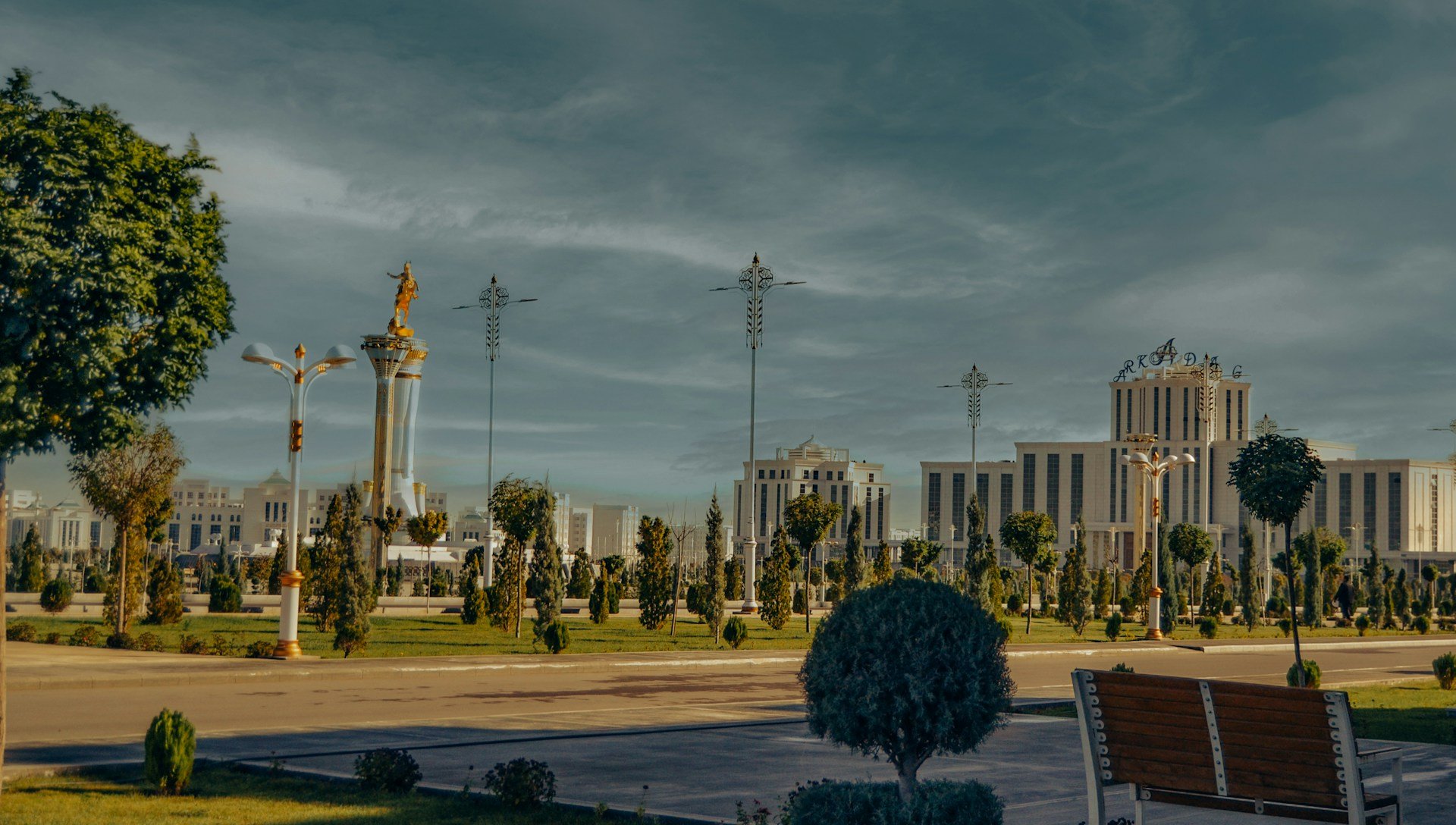
Within those constraints, what you get is unlike anywhere else. The Darvaza gas crater — an enormous flaming hole in the Karakum Desert that has burned continuously since Soviet drillers accidentally punctured a natural gas pocket in the 1970s — is one of the most alien sights you will see on this planet. Ashgabat, the capital, holds the Guinness World Record for the highest density of white marble-clad buildings on earth. It was rebuilt almost from scratch after a 1948 earthquake and then rebuilt again by Saparmurat Niyazov, the country's first post-Soviet dictator, who covered it in marble, gold statues of himself, and rotating monuments dedicated to his own writings. The city looks like a theme park designed by a particularly grandiose authoritarian — because that's exactly what it is.
Then there is the ancient Silk Road: Merv, a UNESCO World Heritage Site that was once one of the largest cities in the world and now sits largely unexcavated and unvisited in the desert east of Mary. The Parthian fortress of Nisa, just outside Ashgabat. The ancient city of Konye-Urgench in the north. These are world-class archaeological sites that receive a fraction of the visitors that Petra or Angkor Wat get. You walk through them largely alone.
The trip requires significant planning, an accepted tour operator, money, patience, and a willingness to surrender control. It is not a casual holiday. For those who do it, almost nobody regrets it.
Turkmenistan at a Glance
A History Worth Knowing
The land that is now Turkmenistan has been inhabited for at least 8,000 years. The Karakum Desert covers 80% of the country, but the river valleys and oases along the Murghab and Amu Darya rivers sustained some of the ancient world's most significant cities. Merv — known in antiquity as Antiochia Margiana, then Marv, then Sultan Sanjar's Merv — sat at the intersection of Silk Road trade routes connecting China, India, Persia, and Rome. At its medieval peak in the 12th century, Merv had a population of somewhere between 200,000 and 500,000 people and was credibly one of the largest cities in the world.
In 1221, the Mongol army under Tolui, son of Genghis Khan, arrived at Merv. The sources disagree on the exact numbers but agree on the outcome: the city's population was massacred and the city destroyed. One Arab historian put the dead at 1.3 million, a figure modern historians consider exaggerated, but the archaeological reality is clear — Merv never recovered. The ruins spread across 60 square kilometers of desert today and remain one of the least excavated major ancient sites on earth.
The Turkmen people themselves, a Turkic-speaking nomadic and semi-nomadic culture, emerged across the region during the medieval period. They were never unified into a single political state before the modern era. The Russian Empire absorbed the region in the 1880s after a series of military campaigns, the most decisive of which was the Battle of Geok Tepe in 1881, where Russian forces defeated the Tekke Turkmens after a prolonged siege. The Transcaspian Railway followed, and with it the first real infrastructure connecting the desert towns.
Soviet rule from 1924 created the Turkmen Soviet Socialist Republic, carved borders that had never existed, and began the systematic destruction of traditional nomadic life. The collectivization of herds, the sedentarization of nomads, and the suppression of Islam transformed Turkmen society within a generation. The Karakum Canal, dug from the 1950s onwards across the desert to irrigate cotton fields, is one of the largest irrigation channels on earth and one of the main contributors to the drying of the Aral Sea — an environmental catastrophe still unfolding.
Independence came with the Soviet collapse in 1991. Saparmurat Niyazov, the Communist Party First Secretary, simply declared himself president and then, over the following decade, constructed one of the most elaborate personality cults the world had seen since Stalin. He renamed himself Turkmenbashi ("Father of all Turkmens"). He renamed the months of the year — January became Turkmenbashi, April was renamed after his mother. He wrote a spiritual-philosophical text called the Ruhnama (Book of the Soul) and made it mandatory reading in schools, universities, and even driving tests. Golden statues of himself rotated to face the sun in Ashgabat's main square. He banned opera, ballet, and the circus as "un-Turkmen." He banned beards on men. He banned gold teeth.
Niyazov died in 2006. His successor, Gurbanguly Berdimuhamedov, dismantled some of the more extreme elements of the cult while maintaining the authoritarian structure. He developed his own personality cult, with a focus on horses, Turkmen sports heroes, and medical health (he wrote books on traditional medicine and herbal tea). In 2022 his son, Serdar Berdimuhamedov, became president in an election that produced 73% of the vote with no credible opposition. Gurbanguly retained significant power as chairman of the upper house of parliament. The family business of running Turkmenistan continues.
Neolithic farming communities in the Kopet Dag foothills. Among the oldest continuously settled regions in Central Asia.
Nisa, near modern Ashgabat, becomes the first capital of the Parthian Empire. The ruins are a UNESCO site today.
One of the largest cities in the world. Silk Road commerce, scholars, and Islamic architecture at its zenith.
Tolui's forces destroy Merv. The city never recovers. The ruins sit largely unexcavated today.
Battle of Geok Tepe. Russia absorbs the region. The Transcaspian Railway follows.
Soviet collapse. Niyazov declares himself president and begins constructing his personality cult.
Niyazov dies. His successor and then son maintain authoritarian control. The marble city expands.
Top Destinations
Turkmenistan is large — about the size of Spain — and getting between its attractions involves long drives across the Karakum Desert. Most tours follow one of two main circuits: the southern route (Ashgabat, Nisa, Merv, and sometimes the Afghan border at Turkmenabad), and the northern route (adding Konye-Urgench and the Darvaza crater). The crater is technically between routes and requires a dedicated overnight desert excursion. Do not skip it.
Darvaza Gas Crater
In the middle of the Karakum Desert, a 69-meter-wide, 30-meter-deep crater has been burning since the early 1970s when a Soviet drilling rig broke through the roof of a natural gas cavern and collapsed. The exact origin story is debated — some sources say 1971, some say earlier, and the decision to set it alight to burn off the gas may have been deliberate or accidental. None of that matters when you are standing at the rim at 2am with no other light in any direction and the heat reaching your face from twenty meters away. Camping here overnight is the singular experience of Turkmenistan. Your guide arranges it. Do not bring up the government's periodic threats to extinguish it — just come while it's still burning.
Ashgabat
Ashgabat is a city that exists primarily to demonstrate the power and grandeur of whoever is currently running Turkmenistan. Rebuilt in white marble after the 1948 earthquake — which killed between 10,000 and 170,000 people, the Soviet state suppressed the true figure — and then relentlessly expanded by Niyazov and his successors. The Neutrality Arch (formerly topped by a rotating gold statue of Niyazov facing the sun, now topped by a Berdimuhamedov-era triumphal arch), the Monument of the Constitution, the Earthquake Monument, the Eight-Legged Horse Monument — these are all best understood as political objects, not architectural ones. The Russian Bazaar, one of the few places where Ashgabat feels like a real city, is the human relief valve. Go there.
Merv (Mary)
Near the modern city of Mary, the ruins of ancient Merv spread across 60 square kilometers of desert. The site was continuously occupied for 4,000 years and at its 12th-century peak was credibly one of the largest cities on earth. What remains: mud-brick walls, the Sultan Sanjar mausoleum (the best-preserved structure), the Erk Kala citadel from the 6th century BCE, and the remains of caravanserais and palaces that have barely been excavated. You walk through it almost alone. The scale becomes apparent only once you are inside it — the walls on the horizon are the walls of the old city, and you are very small.
Nisa (Parthian Nisa)
Twelve kilometers west of Ashgabat, the ruins of Old Nisa served as the first capital and royal necropolis of the Parthian Empire from the 3rd century BCE. The site is UNESCO-listed and contains the remains of throne rooms, wine cellars, and treasury buildings excavated by Soviet and Italian archaeologists. The rhytons (ivory drinking vessels) found here, now in the National Museum of Turkmenistan, are among the finest Parthian artefacts anywhere. The site itself is peaceful, wind-swept, and largely unvisited.
Konye-Urgench
In the far north near the Uzbek border, the ruins of Konye-Urgench (ancient Urgench, capital of the Khwarezmian Empire) contain some of the most impressive medieval Islamic architecture in Central Asia. The 60-meter Kutlug-Timur minaret is the tallest surviving medieval minaret in Central Asia. The Il-Arslan and Tekesh mausoleums have extraordinary tilework. The city was also destroyed by the Mongols in 1221, and like Merv it never recovered. Getting here requires either a northern loop from Ashgabat or a border crossing from Uzbekistan — confirm current border status with your tour operator.
Kopet Dag & Nokhur
The Kopet Dag mountains form the border with Iran along the south and contain the most dramatic scenery in the country. The village of Nokhur, accessible from Ashgabat in about two hours, is inhabited by a community with distinctive traditions including unusual cemeteries where graves are marked with ibex horns. The villages in this range have been relatively isolated from the rapid modernization of the capital. A night in a homestay here, facilitated through your tour operator, is one of the few genuine windows into daily Turkmen life that the trip provides.
Akhal-Teke Stud Farm
The Akhal-Teke horse is the national animal of Turkmenistan and one of the oldest horse breeds on earth, prized for its metallic sheen, endurance, and extraordinary speed. The stud farms around Ashgabat breed horses that hold world records for long-distance racing. President Berdimuhamedov (the elder) reportedly owns hundreds. Visiting a stud farm is possible through tour operators and is one of the more genuine cultural experiences available — the Turkmens' relationship with their horses predates the personality cults by several millennia.
Avaza (Turkmenbashi City)
On the Caspian Sea, the government built Avaza: a state-mandated tourist resort with gleaming hotels, a waterpark, and a beach — all largely empty. It functions as a domestic resort for Turkmen citizens and the occasional official delegation. Turkmenbashi city (named for Niyazov, formerly Krasnovodsk) is the western gateway to the country and has an airport with connections to some CIS countries. The Caspian here is genuinely pretty. The resort itself is a textbook example of what happens when a government builds tourism infrastructure for political reasons rather than demand.
Culture & Etiquette
Turkmen culture is layered: a nomadic Turkic base, shaped by centuries of Silk Road contact with Persian, Arab, and Chinese civilization, transformed by Soviet rule into something that suppressed much of its Islamic and tribal character, and then reorganized again by the Niyazov cult into a heavily state-managed national identity. What you encounter as a tourist is a curated version of all of this, mediated through your guide.
The most important cultural fact for visitors: Turkmen people are genuinely hospitable by tradition, but they are also aware that talking freely to foreign tourists carries risk. Your guide knows this. Locals know this. Conversations will often feel constrained in ways that have nothing to do with personal warmth and everything to do with the political context. This is not a reason to avoid interaction. It's a reason to be gracious, unhurried, and read signals carefully.
Some buildings, military infrastructure, and government sites are prohibited for photography. Your guide will tell you what's off-limits. This is not paranoia on their part. There have been cases of tourists being detained for photographing the wrong building. Listen the first time.
Tea, bread, and food offered in a home or yurt is a genuine cultural gesture. Accept it, eat something, express appreciation. "Sag boluň" (thank you in Turkmen) lands well even from a tourist. The hospitality tradition is real and predates the current government by centuries.
Covered shoulders and knees for women in rural areas and bazaars. Men in shorts in the city are tolerated but look out of place outside hotel zones. In the heat of the Karakum Desert, loose long clothing is also practically superior.
Expressing genuine interest in and admiration for Turkmen horses, carpets, and the traditional arts is the fastest way to establish genuine human connection with people. These are things Turkmens are proud of for legitimate reasons that predate any government.
Checkpoints, registration requirements, and administrative delays are part of travel in Turkmenistan. None of it is personal. Your guide handles it. Your job is to not make their job harder by being difficult or impatient at a checkpoint.
Not in public, not at a checkpoint, not in earshot of anyone you don't trust completely. This applies to both current and former leadership. The political situation is not a safe topic for casual conversation. Your observations about the personality cult are fascinating and belong in your journal, not in a conversation with a stranger.
Your visa specifies where you are permitted to be. Wandering away from your guide and approved locations is not a grey area. Your guide is legally responsible for your whereabouts. Going off-script puts them at risk, not just you.
Internet access is filtered and VPN use is technically illegal. Many travelers use VPNs without issue, but doing so visibly or discussing it with people you've just met is unwise. Use common sense with your devices throughout the trip.
The official exchange rate is significantly worse than black market rates. The black market exists and is used. For tourists, getting caught using it means at minimum being expelled from the country and potentially more serious consequences. The risk-reward calculation is not worth it for a short trip.
One personal copy of a Bible, Quran, or other religious text is permitted. Multiple copies imply distribution and will cause serious problems at customs. Leave them at home.
Turkmen Carpets
Turkmen hand-knotted carpets are among the finest in the world and the largest carpet in the world (made for a Niyazov-era government building) is Turkmen. The national carpet museum in Ashgabat is genuinely worth visiting — the collection spans centuries and the craft knowledge displayed is extraordinary. Buying a carpet through the state carpet shop is the approved route. Exporting antique carpets (over 50 years old) requires permits that are not easily obtained. Know this before you buy.
Horse Culture
The Akhal-Teke horse has been bred in the Kopet Dag foothills for at least 3,000 years. It is the source of the Turkmen national identity in a way that goes deeper than any government's marketing. The breed is known for its metallic gold coat, unusual speed, and the ability to cover enormous distances with minimal water — essential qualities for a nomadic people crossing deserts. If you have any connection to horses, this is the dimension of Turkmenistan that will affect you most.
The Ruhnama
The Book of the Soul, written by Niyazov and made mandatory reading for all citizens, school children, driving test candidates, and university students, is both deeply strange and oddly readable in parts. It is a mixture of history (heavily revised), philosophy, spiritual guidance, and personal autobiography, all presented as divine wisdom. Understanding it — even a chapter — makes Ashgabat's monuments comprehensible. The golden Ruhnama book that opened mechanically every Thursday evening in Ashgabat's main square has been removed. The book's influence hasn't.
State Celebrations
If your visit coincides with a national holiday — Independence Day (27 October), Neutrality Day (12 December), or the Nawruz spring festival (21 March) — the state puts on large public celebrations in Ashgabat that are worth attending. They involve choreographed performances, traditional music, horse parades, and the kind of organized spectacle that authoritarian states excel at. They are also genuinely impressive and one of the few times the empty streets of Ashgabat fill with actual people.
Food & Drink
Turkmen food is Central Asian in character — substantial, meat-focused, built for nomadic life in a harsh climate — and will not be the reason you visit. That's honest. But it is genuinely good in its category, and some of it is distinctly Turkmen in a way worth seeking out. The quality of what you eat depends largely on whether your tour operator puts you in state hotels (mediocre) or sources meals from local families and small restaurants (significantly better). When booking your tour, ask specifically about meal arrangements.
Plov
The Central Asian pilaf, eaten across the region from Afghanistan to Kazakhstan, is the staple dish of Turkmenistan. Rice cooked with lamb fat, carrots, onions, and chunks of lamb or beef, sometimes with raisins and chickpeas. A good plov requires a heavy cast-iron kazan (cauldron) and someone who knows what they're doing with the oil temperature. In a good restaurant or at a family table, it's deeply satisfying. In a state hotel, it's stodgy. The version you eat at a desert campsite beside the Darvaza crater, cooked over a fire by your guide, is the one you'll remember.
Manty & Çibörek
Manty are large steamed dumplings filled with lamb and onion, eaten with yoghurt and butter. Çibörek are half-moon deep-fried pastries filled with spiced lamb mince, crispy and oily and good. Both are street and market food that the state hotel menu rarely captures well. At the Tolkuchka Bazaar, çibörek vendors operate from small stalls and the product is worth the food safety risk calculation that is part of all serious travel.
Bread
Çörek is the traditional Turkmen bread: a thick, round, slightly sweet flatbread baked in a tamdyr (clay oven). Freshly made, it is excellent. It is eaten at every meal, in the morning with tea, and as a snack between meals. In rural areas, particularly in the Kopet Dag villages, the bread-making is done by women over an open fire and watching the process is one of the more grounding experiences the trip offers.
Shashlik
Lamb skewers grilled over charcoal. Technically a dish shared across the entire former Soviet Central Asia, but Turkmen shashlik has a particular quality when the lamb is from animals grazing on the steppe herbs of the Karakum edge. Eaten standing at a market stall with bread and raw onion and a glass of ayran, it costs almost nothing and is better than most things you will eat at the state hotel restaurants.
Tea Culture
Green tea (gök çay) is drunk throughout the day from ceramic bowls without handles. It is always the first thing offered to a guest and always the correct thing to accept. The social ritual of tea-pouring — pouring a small amount, pouring it back into the pot, pouring again, as a warming gesture — is worth learning from your guide. Black tea is also available, particularly in Russian-influenced establishments in Ashgabat. The tea is excellent throughout.
Camel Milk & Çal
Camel's milk (süýt) is a staple of nomadic Turkmen diet and available fresh in market areas. Çal is fermented camel milk, slightly sour and fizzy, acquired taste but genuinely interesting. It has been drunk across the Karakum for centuries and was documented by travellers in the 19th century as the primary sustenance of camel herders crossing the desert. It's not for everyone. Try a small cup. Form an opinion. It's at least one of the more singular taste experiences of the trip.
When to Go
The climate is continental and extreme. Summer temperatures in the Karakum Desert exceed 50°C. Winter drops below freezing in the mountains and can be bitterly cold in the desert at night. The workable windows are April to June and September to November. Spring is slightly preferable — the desert has wildflowers in April and the light is extraordinary. Autumn is equally good and slightly less crowded with what few tourists there are.
Spring
Apr – JunThe Karakum Desert blooms briefly in April. Temperatures are bearable (20-30°C). The Darvaza crater is extraordinary at night when spring air is still cool. Nawruz (21 March) celebrations are worth timing your trip around if you can.
Autumn
Sep – NovSummer heat breaks in September. October is arguably the best month — cool enough for comfortable desert travel, warm enough for the Caspian coast. The ruins of Merv and Konye-Urgench in autumn light are striking.
Summer
Jul – AugTemperatures in the Karakum regularly exceed 45-50°C. The desert is genuinely dangerous to humans at these temperatures without serious preparation. Long drives between sites become endurance tests. Even the crater is best seen in cooler weather.
Winter
Dec – FebCold in Ashgabat (0-10°C), freezing at altitude. The Darvaza crater in winter, with snow occasionally dusting the desert around a flaming pit, is genuinely spectacular. Not comfortable, but memorable. Book a tour operator experienced with cold-weather desert camping.
Trip Planning
The standard tourist visit runs 5-10 days. Five days covers Ashgabat, the Darvaza crater overnight, and a day trip to Nisa. Eight to ten days adds Merv and Mary, and potentially Konye-Urgench or the Kopet Dag villages. The northern loop including Konye-Urgench adds at least two more days and involves long drives on roads of variable quality.
Reputable tour operators for Turkmenistan include Advantour, Owadan Tourism, and Stan Tours (which covers multiple Central Asian countries and has strong Turkmenistan expertise). Compare prices, read recent traveler reviews on forums like TripAdvisor and Lonely Planet Thorntree, and ask specifically about guide quality — your guide makes or breaks this trip more than in almost any other country.
Ashgabat
Day one: arrive, recover, walk the marble boulevards with your guide. Neutrality Arch, the Earthquake Monument, the Wedding Palace. The Russian Bazaar in the afternoon for actual human life. Day two: National Museum of Turkmenistan for context and the Akhal-Teke carpets, Tolkuchka Bazaar if it's a Thursday or Sunday — request this specifically.
Nisa & Drive North
Morning: Parthian Nisa, 20 minutes from Ashgabat. Two hours among ruins that almost nobody visits. Afternoon: begin the 5-6 hour drive north into the Karakum Desert toward Darvaza. Arrive at the crater complex by late evening.
Darvaza & Return
Evening and overnight at the crater. The experience runs from roughly 10pm to 4am when the fire is most dramatic against the dark sky. Sleep late. Also visit the nearby water and mud craters during daylight (smaller, less dramatic, worth seeing). Drive back to Ashgabat.
Merv & Departure
Fly or drive to Mary (1 hour flight). Full day at the ruins of ancient Merv: Sultan Sanjar mausoleum, Erk Kala, the Great Kyz Kala. These are world-class ruins with no queue and no gift shop. Return to Ashgabat for departure flight.
Ashgabat Extended
Three days gives you the full Ashgabat circuit including Tolkuchka Bazaar (request Sunday), the Carpet Museum, Nisa ruins, a half-day in the Kopet Dag foothills, and the Akhal-Teke stud farm. Ask your guide to arrange a traditional meal at a local home rather than the hotel.
Karakum Desert & Darvaza
Drive north with a longer desert route, stopping at Yerbent, the desert settlement that appeared spontaneously in the 1980s when oil workers established families there. Overnight at Darvaza. Continue north toward Konye-Urgench on day six.
Konye-Urgench & Dashoguz
The northern ruins: Kutlug-Timur minaret, Il-Arslan and Tekesh mausoleums, Turabek Khanum mausoleum. Two nights in Dashoguz or in basic accommodation near the site. The ruins in early morning light before tour buses (which don't actually come here) would arrive are extraordinary.
Merv, Mary & Kopet Dag
Fly or drive east to Mary and Merv. Two full days at the ruins. Return west and spend the last two days in the Kopet Dag mountains with a night in Nokhur village. Final day back in Ashgabat before departure.
Tour Operator (Step 1)
Everything starts here. Advantour, Owadan Tourism, and Stan Tours are established operators with English-speaking staff. Compare packages, ask about guide experience, and confirm exactly what is included. Get everything in writing.
Letter of Invitation
Your tour operator obtains the LOI from the Turkmen Ministry of Foreign Affairs. This takes 2-4 weeks and is the basis for your visa application. You then apply for the tourist visa at a Turkmenistan embassy using the LOI reference number. Start this process minimum 6-8 weeks out.
Vaccine requirements →Vaccinations
No mandatory vaccinations for most travelers. Recommended: Hepatitis A, Hepatitis B, Typhoid, Rabies if traveling in rural areas, and routine vaccines. Malaria risk is low in most areas but check current advice for specific regions with your travel health clinic.
Cash in USD
Bring enough USD for the entire trip. Credit cards are not accepted in most places. ATMs exist in Ashgabat but are unreliable for foreign cards. Your tour operator bill may be payable in USD or EUR. Budget generously and bring more than you calculate needing.
Desert Camping Gear
For the Darvaza overnight, your operator provides the tent and basic equipment. Bring a sleeping bag rated to 5°C (nights drop sharply), a headlamp, and warm layers regardless of the season. The desert temperature range between day and night is extreme.
Travel Insurance
Medical facilities in Turkmenistan are limited and not accessible to foreigners without significant payments. Medical evacuation to Dubai or Istanbul is the realistic outcome for anything serious. Comprehensive travel insurance with medical evacuation cover is essential.
Transport in Turkmenistan
Transport in Turkmenistan is entirely arranged by your tour operator. You do not independently book trains, buses, or taxis. Your guide handles all of this. What you should understand is the logistics, because the distances are large and the infrastructure is limited in specific ways.
The country is roughly the size of Spain. Ashgabat to Mary (for Merv) is 360 kilometers south-east. Ashgabat to Darvaza is 270 kilometers north. Ashgabat to Konye-Urgench is 500 kilometers north. These distances mean significant time in vehicles. The roads between major cities are generally paved and in reasonable condition. The roads to more remote sites are not.
Domestic Flights
Arranged by operatorTurkmenistan Airlines flies between Ashgabat, Mary, Dashoguz, Turkmenbashi, and Turkmenabad. Domestic flights are the sensible option for covering the country's distances quickly. Your operator books these as part of the tour package.
4WD with Driver
Included in tourThe standard transport for all overland movement, including the Darvaza crater drive. Your guide's vehicle is typically a Soviet-era UAZ jeep or a more modern 4WD. Both will make the journey. The UAZ is more atmospheric and slightly less comfortable.
Train
Rarely used by touristsA railway network connects Ashgabat, Mary, and Turkmenbashi. Trains are cheap and slow and occasionally part of a tour itinerary for the experience. The Ashgabat station building is an architectural spectacle worth seeing regardless of whether you board anything.
Fuel Prices
Government subsidizedTurkmenistan has some of the cheapest fuel on earth due to state subsidies from natural gas revenues. This is mostly irrelevant to tourists but explains why your operator's vehicle costs per kilometer are low and why the drives are logistically easy to include.
Ashgabat Taxis
Fixed by guideWhite-colored vehicles dominate Ashgabat — at various points the government mandated white cars for the aesthetic of the white marble city. Taxis exist but tourists do not hail them independently. Your guide manages local movement.
Checkpoints
N/AInternal checkpoints exist on major roads, particularly when approaching sensitive areas. Your guide handles all documentation at these. Your job is to sit quietly with your passport accessible and not photograph anything near the checkpoint. This is standard and delays are rarely more than 10-15 minutes.
Accommodation in Turkmenistan
Accommodation in Turkmenistan runs from state-owned hotels (large, marble-clad, expensive, sterile, staffed by people who look uncomfortable about the whole situation) to basic guesthouses and homestays in rural areas that are genuinely warm and culturally interesting. Your tour operator selects and books your accommodation as part of the tour package. When comparing operators, ask specifically about accommodation quality — it varies significantly.
State Hotels (Ashgabat)
$80–200/nightThe Oguzkent and Ak Altyn hotels are the standard tourist accommodation in Ashgabat. Both are large, marble-clad, and maintained for international visitors. The architecture is grandiose. The wifi is unreliable. The breakfast is substantial. They are expensive for what they deliver.
Guesthouses
$30–60/nightIn Mary, Turkmenbashi, and Dashoguz, smaller guesthouses are available through your operator. Basic but clean. Often better food than the state hotels because the owners cook for you. In Nokhur village, a homestay with a local family is the best accommodation in the country and costs almost nothing.
Desert Camping (Darvaza)
Included in tourYour operator provides the tent and basic camping equipment at the crater site. The experience justifies the entire trip. No electricity, no running water, no signal. The fire provides more than enough light. Sleep when you can. Wake up at 4am and look at the crater one more time before the sun rises.
Yurt Stays
$40–80/nightSome operators arrange yurt accommodation in the Karakum Desert or Kopet Dag foothills. A round felt tent on the steppe, with a wood fire in the center and the sound of horses outside, is the closest you'll get to experiencing pre-Soviet Turkmen nomadic life. Worth requesting specifically if available.
Budget Planning
Turkmenistan is not cheap. The state-controlled economy, the requirement for organized tours, and the mandatory guide all push costs above what you'd pay in neighbouring Uzbekistan or Kazakhstan for a similar number of days. A solo traveler on a private tour pays the most. Joining a group tour cuts the daily rate considerably. Budget at least $150-200 per day all-in (excluding international flights) for a decent solo tour experience. Group tours run $80-120 per day.
- Join existing group departure (4-12 people)
- Guide, transport, accommodation included
- State hotel accommodation
- Standard itinerary
- Visa support from operator
- Private or small group (2-4 people)
- More flexibility on itinerary
- Better accommodation options
- Dedicated guide throughout
- Homestay options available
- Fully private itinerary and guide
- Best available accommodation
- Custom scheduling around your interests
- Yurt stays and homestays bookable
- Maximum flexibility within constraints
Quick Reference Prices
Visa & Entry
Getting a tourist visa for Turkmenistan is a multi-step process that cannot be rushed and cannot be done independently. There are no visa on arrival, no e-Visa portals, and no self-service options for tourist visas. The process works as follows: your registered tour operator applies for a Letter of Invitation (LOI) from the Turkmenistan Ministry of Foreign Affairs on your behalf, providing your passport details and intended itinerary. Once the LOI is approved and issued (2-4 weeks), you take it to a Turkmenistan embassy in your country to apply for the tourist visa. The visa is then stamped into your passport.
There is one partial exception: the transit visa. Travelers transiting by road from Uzbekistan to Iran (or vice versa) can apply for a 5-day transit visa, which technically allows independent travel on the approved transit route only. In practice, most transit travelers hire a guide anyway, as checkpoints can be difficult without one.
No independent visa on arrival. Must use a registered tour operator to obtain a Letter of Invitation first. Apply at a Turkmenistan embassy using the LOI. Allow 6-8 weeks minimum from start to finish.
Family Travel & Pets
Turkmenistan is not a natural family travel destination and the infrastructure does not cater to it. The mandatory tour structure, the long drives across the desert, the basic accommodation outside Ashgabat, and the limited activities that would engage young children make it unsuitable for families with children under about 14. For teenagers who are interested in history, archaeology, or genuinely unusual travel experiences, it can be extraordinary. The Darvaza crater overnight is one of those experiences that stays with a person for decades.
For families considering it: plan a shorter itinerary focused on Ashgabat and Darvaza. Skip the very long drives to Konye-Urgench. Choose a tour operator with experience handling mixed-age groups. The heat in summer is genuinely dangerous for young children.
Darvaza for Teenagers
The Gates of Hell is one of those experiences that requires no explanation to a 14-year-old. A flaming pit the size of a football field in the middle of a dark desert is inherently compelling. The camping element, the fire-lit landscape, and the distance from everything else is the kind of trip that defines a person's understanding of what travel can be.
Akhal-Teke Horses
For children who like horses, a visit to an Akhal-Teke stud farm is a genuine highlight. The horses are physically striking — the metallic coat has to be seen in direct sunlight to be believed — and the Turkmen relationship with them is ancient and genuine. Arrange through your operator in advance.
Ancient Ruins
Older children who have been briefed on the history will find Merv and Nisa compelling. The absence of crowds and barriers means you can actually explore, touch walls, and get a physical sense of the scale. There is no equivalent experience of being alone in a major ancient city anywhere else on the normal tourist circuit.
Heat Warning
Summer temperatures in the Karakum can reach 50°C and are genuinely life-threatening for young children without proper hydration and sun protection. Spring (April-May) and autumn (September-October) are the only sensible family travel windows. Even then, midday sun in the desert is serious. Plan all outdoor activities for early morning and late afternoon.
Traveling with Pets
Traveling with pets to Turkmenistan is not practically feasible for tourists. The visa process requires specific documentation for pet entry, the tour structure does not accommodate animals, accommodation is not pet-friendly, and the extreme heat makes the desert portions of any standard itinerary dangerous for animals. Leave pets at home. There is no workaround for this that is sensible.
Safety in Turkmenistan
The physical safety situation for tourists in Turkmenistan is generally fine. Violent crime against visitors is essentially unheard of. Petty crime is low. The main risks are bureaucratic and environmental. Understanding the difference is important: a mugging is not a realistic fear. Being questioned by officials for photographing the wrong building, or having your guide get in trouble because you wandered somewhere unauthorized, is a realistic risk that your behavior can directly affect.
Physical Safety
Very safe from crime. The combination of a heavily monitored society and genuine Turkmen hospitality traditions means tourists are not targeted for theft or violence. This is one of the genuinely safe countries in Central Asia from a personal safety standpoint.
Photography Rules
The most common cause of tourist problems. Government buildings, military infrastructure, checkpoints, and some monuments are prohibited. Your guide will tell you what's off-limits. When in doubt, ask before photographing, not after. Officials here are not flexible about this.
Going Off-Itinerary
Your visa specifies your authorized locations. Your guide is legally responsible for your adherence to the itinerary. Going somewhere not on your approved list puts your guide in a difficult position and can result in questioning for both of you at the next checkpoint.
Environmental Risks
The Karakum Desert is a serious environment. Summer heat is genuinely dangerous. Dehydration and heat stroke are real risks in the desert. The Darvaza crater rim has no barriers and the ground around it can be unstable. Stay back from the edge. This is not theatrical caution.
Internet & Communications
Social media is filtered. WhatsApp and some messaging apps are restricted. VPNs are technically illegal. Email and basic internet work in hotels. Tell people at home how to reach you and establish check-in schedules before departure. Don't rely on being able to contact anyone quickly in an emergency from a remote site.
Medical Facilities
Hospitals in Ashgabat are functional but not equipped for complex medical emergencies by Western standards. Outside the capital, facilities are very limited. Medical evacuation to Istanbul or Dubai is the realistic option for serious emergencies. Travel insurance with medevac cover is not optional.
Emergency Information
Embassies & Consulates in Ashgabat
Diplomatic representation in Ashgabat is limited. Several countries are represented through their embassies in neighboring countries.
Book Your Turkmenistan Trip
The booking process here is different. Start with a tour operator. Everything else follows from that.
What Stays With You
The strangest thing about Turkmenistan is not the burning crater or the marble city or the rotating golden statues. It's the people you meet within a system that makes genuine human contact difficult. Your guide, who has to balance official responsibilities with the reality of spending ten days with a curious foreigner asking awkward questions. The family in Nokhur who offer you bread and tea and cannot say what they actually think about anything, but offer you more bread anyway. The bazaar vendor at Tolkuchka who has been selling the same embroidered textiles for thirty years and whose craft contains more of the real Turkmenistan than any monument.
There is a Turkmen proverb: "Bir gezek görmegiň müň gezek eşitmekden gowudyr." One time seeing is better than a thousand times hearing. This is also a defense of the trip itself. No account of the Darvaza crater, including this one, substitutes for standing at its rim. You have to go.