
What You're Actually Getting Into
Zambia built its reputation on two things: a waterfall it shares with Zimbabwe, and a style of safari it invented and never stopped doing well. Mosi-oa-Tunya, "the smoke that thunders," is the local name for what British explorer David Livingstone renamed Victoria Falls in 1855, and the Zambian side gets you closer to the edge, including the seasonal swim to Devil's Pool that no other vantage point on the falls offers. Inland, South Luangwa National Park is where the walking safari was pioneered in the 1950s, and it, the Lower Zambezi and the vast Kafue ecosystem still deliver some of the least crowded, most guide-led wildlife viewing in Southern Africa.
What Zambia doesn't have is Kenya's or Tanzania's tourism infrastructure, or Botswana's prices to match. Roads outside the main routes are rough, flights between parks are the practical way to move, and safari lodges here run genuinely expensive relative to a backpacker's Livingstone budget. The upside of the gap: parks that feel like you found them, guides who trained in a tradition that treats walking with a rifle-carrying scout as normal rather than a gimmick, and a country that has been politically stable since independence in a region where that's not something to take for granted.
The honest complications
Zambia is landlocked and large, roughly the combined size of France and Germany, and its national parks sit hours or a flight apart. Self-driving is possible on the main routes but slow and occasionally dangerous outside them: armed robbery targeting vehicles has increased on the Great East Road toward Malawi, and rural roads flood in the wet season. Safari accommodation is priced for a different budget than backpacker Livingstone, so a Zambia trip that includes both ends up split between two very different price tiers rather than one smooth budget. And while crime against tourists is low, Lusaka itself is a working capital with the petty theft and traffic problems of any large African city, not a place built for sightseeing.
A History Worth Knowing
Zambia's borders trace the old British protectorate of Northern Rhodesia, named for Cecil Rhodes and administered for its copper. Independence came on 24 October 1964 under Kenneth Kaunda, who led the country for 27 years through the copper boom, the copper crash, and a one-party socialist period before stepping aside peacefully after losing multiparty elections in 1991, a rarer act in the region than it should be. The short version of how the country you're visiting got here: British Central Africa, colonial copper wealth, independence without a war of liberation, decades of Kaunda, and a democratic transition that stuck.
- 1855
Livingstone at the falls. David Livingstone becomes the first European to see Mosi-oa-Tunya and renames it Victoria Falls after the British monarch. The town and the falls' Zambian gateway later take his name.
- 1911
Northern Rhodesia. The British South Africa Company's territories merge into a single protectorate, administered for its Copperbelt mineral wealth rather than settlement.
- 1964
Independence. Declared on 24 October under Kenneth Kaunda, the country's first president, who governs until 1991.
- 1970s-80s
Copper boom and bust. Zambia becomes briefly one of Africa's wealthiest nations on copper exports, then suffers when prices collapse; the Copperbelt economy still shapes national politics today.
- 1991
Peaceful transition. Kaunda loses multiparty elections to Frederick Chiluba and steps down without incident, a defining moment for Zambia's reputation for political stability.
- 2000s-present
Tourism and conservation growth. South Luangwa, the Lower Zambezi and the Kafue ecosystem develop as serious safari destinations while Victoria Falls tourism on the Zambian side expands around Livingstone.
Read the full history: Northern Rhodesia, Kaunda and the walking safari tradition
Before European contact, the area was home to Bantu-speaking peoples including the Bemba, Lozi, Tonga, Ngoni and Chewa, several of whom formed kingdoms of real regional power, the Barotse (Lozi) kingdom on the upper Zambezi among the most significant. The British South Africa Company, Cecil Rhodes's chartered vehicle for extending colonial rule north from South Africa, administered the territory from the 1890s, formalized as Northern Rhodesia in 1911 and transferred to direct British colonial rule in 1924 once the Copperbelt's mineral value was established.
Kenneth Kaunda, a schoolteacher's son and independence movement leader, became prime minister in January 1964 and president that October, and remained in power for 27 years through a one-party state period beginning in 1972 that he justified as national unity in a country with over 70 ethnic groups and languages. Zambia's economy rode and then fell with global copper prices: extraordinary wealth through the late 1960s, a crushing debt crisis after the mid-1970s crash, and IMF structural adjustment through the 1980s and 90s that remains a contested part of national memory. Kaunda's decision to accept defeat in the 1991 multiparty election, rather than cling to power, is the single fact Zambians and outside observers most often cite when explaining the country's unusually stable trajectory since independence, unbroken by coup or civil war in a region where both have been common.
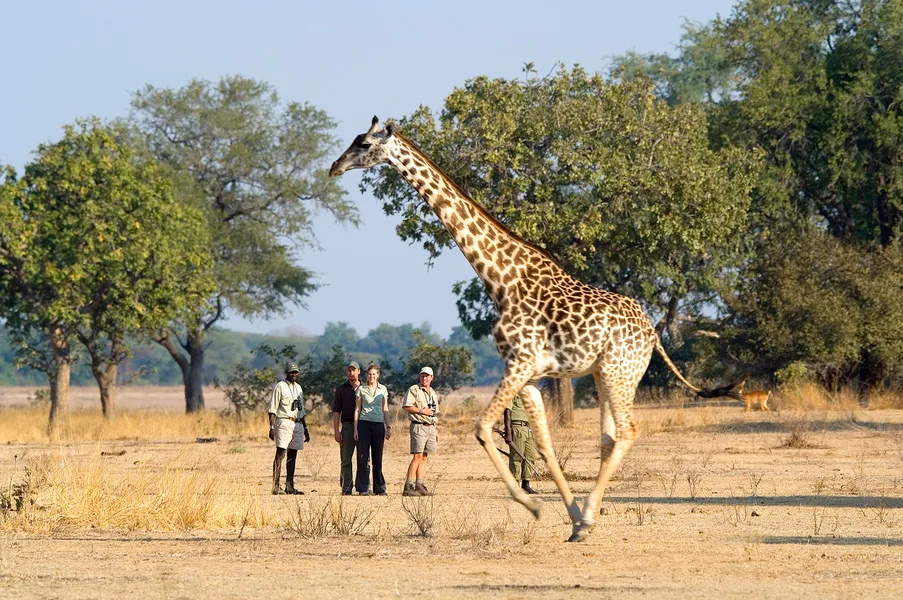
The walking safari. Norman Carr, a British-born conservationist who had served as a game ranger in colonial Northern Rhodesia, pioneered guided walking safaris in what became South Luangwa National Park in the 1950s, partly as an economic alternative to trophy hunting that could fund conservation and benefit local communities. The model, small groups, an armed scout, genuine proximity to wildlife on foot rather than from a vehicle, spread from Zambia across Southern and East Africa and remains most strongly associated with the park where it began.
Top Destinations
Zambia divides into Victoria Falls and Livingstone in the south, and three major safari ecosystems spread across the rest of the country: South Luangwa in the east, the Lower Zambezi south of Lusaka, and Kafue in the west-center. They don't sit close together, so most trips fly between them rather than drive. A week covers Livingstone plus one safari area well; two weeks lets you add a second park.
Victoria Falls, from the quieter side
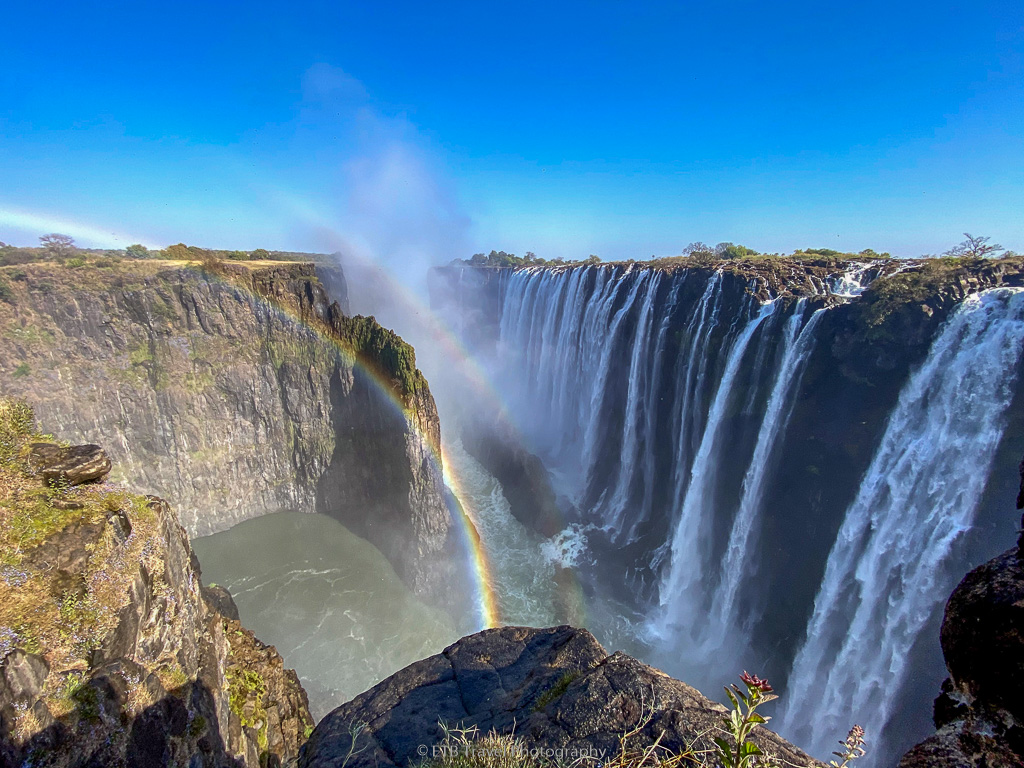
Mosi-oa-Tunya National Park on the Zambian bank puts you closer to the water than the Zimbabwe viewpoints do, across the Knife-Edge Bridge into a permanent cloud of spray, with roughly a third of the falls' total frontage against Zimbabwe's wider two-thirds. What Zambia has that Zimbabwe doesn't is Devil's Pool: a natural rock pool right at the lip of the falls, swimmable from mid-August to mid-January when water levels drop enough, reached by a short boat trip to Livingstone Island. The full guide to the town, Livingstone, its neighborhoods, hotels, restaurants and activity prices, lives on our dedicated Livingstone city guide.
South Luangwa, where the walking safari began
South Luangwa National Park, in Zambia's Eastern Province along the Luangwa River, is where Norman Carr pioneered the guided walking safari in the 1950s, and it remains one of the best parks in Africa for it: small groups, an armed scout, and genuine proximity to wildlife rather than viewing from a vehicle. The park has exceptional leopard density, alongside elephant, buffalo, hippo concentrations that make the riverbanks loud at dawn, and over 400 recorded bird species. Access is by air to Mfuwe Airport, roughly an hour from Lusaka, since the road route takes most of a day. Camps range from simple bush camps to high-end lodges, nearly all full-board with game activities included in the nightly rate.
Lower Zambezi, the river-focused park
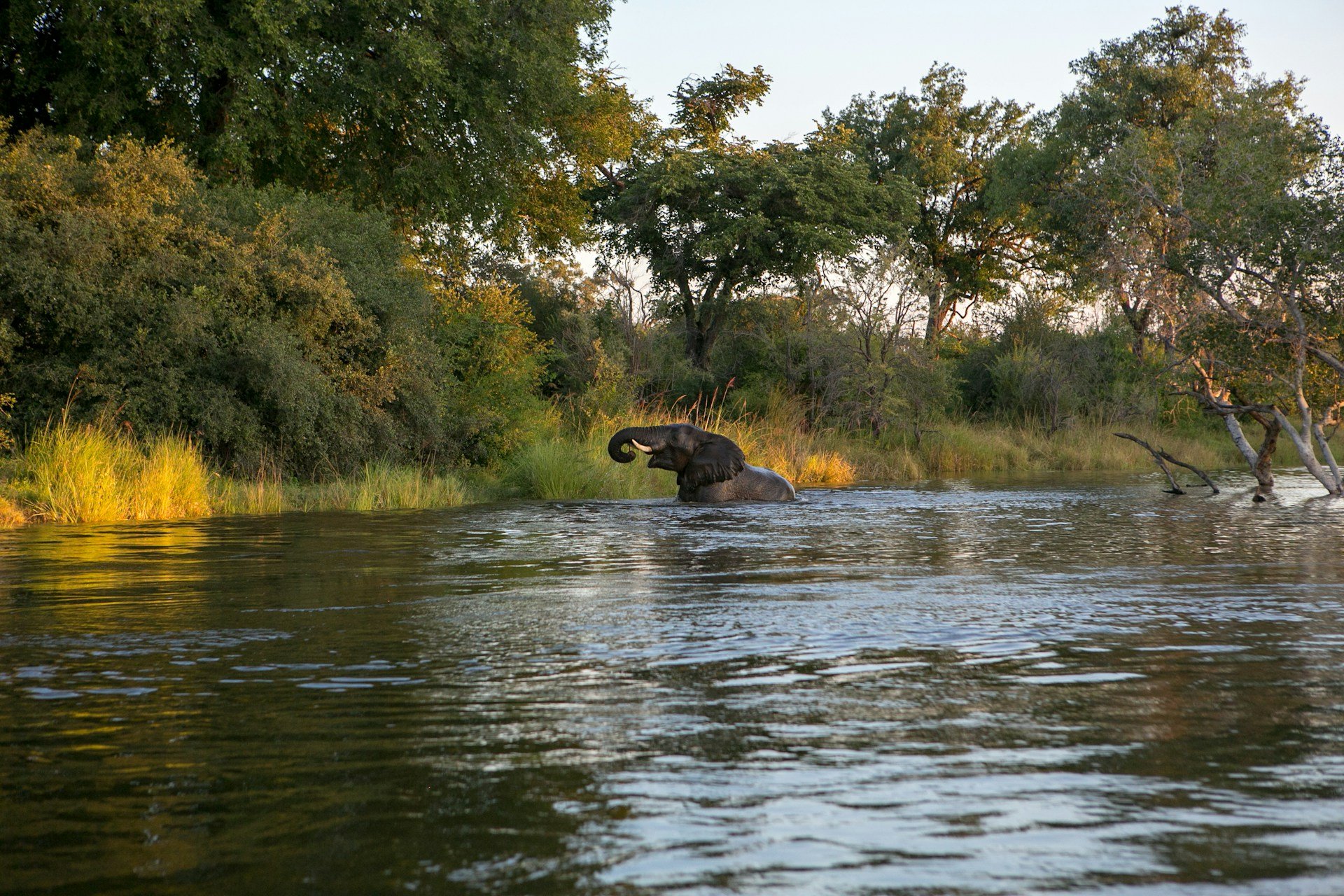
Lower Zambezi National Park sits across the river from Zimbabwe's Mana Pools, both UNESCO-listed on the opposite bank, and its defining activities are on the water rather than on foot: canoe safaris weaving between islands and pods of hippo, sunset river cruises, and some of Southern Africa's best tigerfish fishing. Game drives and walking safaris run too, with good elephant and occasional wild dog sightings, but the river is the reason to come. It's a shorter flight from Lusaka than South Luangwa, roughly 30 to 45 minutes, making it easier to combine with a short trip.
Kafue, the wilderness option
Kafue National Park is one of Africa's largest, roughly the size of Wales, and correspondingly the least developed of Zambia's big three: fewer camps, longer drives between sightings, and a genuine sense of having the wilderness to yourself. The Busanga Plains in the north flood seasonally into a Serengeti-like grassland with lion prides, cheetah and huge red lechwe herds, best reached and boated around earlier in the dry season (June-July) before the water recedes too far. Kafue rewards travelers who've already done a more classic safari and want the remote version.
Lusaka, the necessary stopover
Zambia's capital is primarily a transit hub, the connecting point for domestic flights to Livingstone, Mfuwe and the other park airstrips, rather than a sightseeing destination. If a layover leaves you with a few hours, the Lusaka National Museum covers Zambian history and contemporary art, and the Kabwata Cultural Village sells crafts directly from the artisans who make them. Most visitors treat Lusaka as one night at most, arriving or departing, and spend their actual trip elsewhere.
Culture & Etiquette
Zambia is home to more than 70 ethnic groups and languages, and the country's post-independence motto, "One Zambia, One Nation," reflects a genuine and largely successful effort to build a shared national identity across that diversity rather than around it. Greeting rituals matter more here than in much of Southern Africa: a rushed or skipped greeting before getting to business, even a simple market transaction, reads as brusque. Respect for elders is a real social structure, not a platitude, and shapes everything from how meetings are run to who speaks first in a group.
Do
- Greet before you ask. "How are you" and a handshake, even a brief one, before any request or transaction. Skipping straight to business is considered rude.
- Use your right hand, or both hands together, for giving and receiving anything, money, food, a handshake. The left hand alone is considered impolite in traditional contexts.
- Dress modestly outside safari lodges and Livingstone's tourist strip, especially in rural areas and at any religious site; shoulders and knees covered is the safe default.
- Ask before photographing people, and expect that some will ask for a small tip in return in tourist areas; it's a normal negotiation, not a scam.
- Learn a greeting in the local language of wherever you are. "Muli bwanji" (Nyanja, Lusaka area) or "Mulishani" (Bemba, Copperbelt/Luangwa) land well even attempted imperfectly.
Don't
- Rush a greeting or interrupt an elder. Age carries real deference in Zambian social structure, in meetings, in villages, and in ordinary conversation.
- Assume Zambia is interchangeable with its neighbors. A stable, never-coup, largely peaceful post-independence history is a source of real national pride, not incidental trivia.
- Wander off marked paths in national parks, even briefly and even at a lodge. This is unfenced wildlife country; guides set the rules for a reason.
- Photograph government buildings, bridges or military installations without checking first; sensitivities exist even where enforcement is inconsistent.
- Expect fast pace outside Lusaka and Livingstone. Rural Zambia runs on its own clock, and visible impatience reads poorly.
Deeper culture: the Barotse kingdom, Kuomboka, and Zambian music
The Barotse (Lozi) Kingdom. Centered on the Zambezi floodplain in Zambia's Western Province, the Lozi kingdom retained a degree of traditional authority through the colonial period that few other Zambian polities did, and its monarchy, the Litunga, still holds real cultural standing today.
Kuomboka. The Lozi royal ceremony marking the Litunga's seasonal move from the flooding Zambezi plain to higher ground, typically around March or April, features an enormous royal barge, the Nalikwanda, paddled by dozens of ceremonially dressed paddlers, drums and dancing along the route. One of Southern Africa's great cultural spectacles when the flood timing allows it to happen.
Music. Zamrock, a fuzzed-out psychedelic rock movement from the 1970s (WITCH being the best-known band internationally), has seen a genuine international revival in reissues and documentaries. Contemporary Zambian popular music leans toward Zed Beats and Afrobeat-influenced sounds, heard in Lusaka bars and increasingly on the international festival circuit.
Food & Drink
Zambian food centers on nshima, a thick maize-meal porridge that plays the role rice or bread does elsewhere: the base of nearly every everyday meal, eaten by hand, paired with a relish of meat, fish or vegetables. It's simple, filling and genuinely worth trying outside the tourist-facing lodge buffets, at a market stall or a family-run kantemba (small eatery) where a full plate costs a couple of dollars.
Nshima $1-3
Maize-meal porridge, stiff enough to roll into a ball by hand and dip into a relish. The Zambian staple, eaten at nearly every meal, and the thing to order at any local kantemba for an authentic, cheap meal.
Kapenta & Ifisashi
Kapenta, small dried or fried sardine-like fish from Lake Kariba and Lake Tanganyika, is a protein staple served with nshima. Ifisashi layers leafy greens, pumpkin or sweet potato leaves, in a creamy sauce made from pounded groundnuts.
Mosi Lager & Local Spirits $1-3
Mosi, named for Mosi-oa-Tunya, is Zambia's dominant lager and the easy default at any bar. Munkoyo, a fermented, mildly alcoholic maize and root drink, and Kachasu, a strong home-distilled spirit, are the traditional counterparts, best tried with a local host rather than sought out solo.
Village Chicken & Grilled Bream $5-10
Free-range "village chicken" has more flavor and less tenderness than commercial poultry, usually stewed. Bream and other river fish, grilled or fried whole, appear anywhere near the Zambezi or Kariba.
Ifinkubala Seasonal
Fried mopane caterpillars, a protein-rich seasonal delicacy across Southern Africa, sold dried in markets and served fried with onion and tomato. Genuinely eaten by Zambians, not staged for tourists.
Safari Lodge Dining
Most safari camps run full-board with set multi-course menus, often surprisingly ambitious given the bush setting, included in the nightly rate alongside game activities and most drinks.
When to Go & Itineraries
June to October, the dry season, is peak Zambia: game viewing improves as vegetation thins and animals cluster around remaining water, and from mid-August the falls drop low enough for Devil's Pool to open. November to April is the wet season, green, dramatic and much cheaper, but many remote bush camps close and some park roads become impassable. April-May and November are the shoulder months, with lower prices and most camps still open.
All seasons compared, with what's open
| Season | Verdict | What's happening |
|---|---|---|
| Jun-Oct (dry) | Best | Peak game viewing; Devil's Pool open from mid-Aug; all camps open; peak prices |
| Apr-May & Nov | Good value | Shoulder season; lush landscape, lower prices, most camps still open |
| Dec-Mar (wet) | Cheapest, limited | Green season birding and dramatic skies; many bush camps close; some roads flood; falls at peak flow, not swimmable |
Livingstone and Lusaka stay warm and dry roughly May-Sep (highs 22-28°C, cool nights); Oct-Nov builds toward the hot pre-rain peak (up to 35°C+); Dec-Apr is warm and humid with regular rain.
Itineraries
A week covers Victoria Falls and Livingstone plus one safari park well. Two weeks lets the trip breathe: Livingstone, one river-and-canoe park and one classic walking-safari park, without feeling rushed by flights.
- Days 1-3
Livingstone & Victoria Falls. Mosi-oa-Tunya park and the falls, Devil's Pool if the season allows, a sunset cruise, and time to cross into Zimbabwe on the KAZA visa for the panoramic view.
- Days 4-7
South Luangwa. Fly Livingstone-Lusaka-Mfuwe (or direct where available), three nights at a walking-safari camp with morning walks and afternoon game drives.
- Days 1-3
Livingstone & Victoria Falls. The falls, Devil's Pool, white water rafting or a Zambezi sunset cruise, and a day trip into Zimbabwe or across to Botswana's Chobe.
- Days 4-7
Lower Zambezi. Fly from Livingstone via Lusaka. Canoe safaris between the islands, a game drive, and tigerfishing if the season fits.
- Days 8-14
South Luangwa. The full walking-safari experience across a week: morning walks, night drives where permitted, and time to let leopard and elephant sightings compound rather than rush.
- Days 1-4
Livingstone extended. The falls, Devil's Pool, rafting, a Zimbabwe day trip, and a day across the border to Chobe National Park in Botswana for elephant herds along the river.
- Days 5-9
Lower Zambezi. Canoe safaris, fishing, walking and game drives across four nights, unhurried.
- Days 10-16
South Luangwa. A full week at one or two camps, mixing walking safaris with night drives for the nocturnal species the walks don't cover.
- Days 17-21
Kafue. The remote finale: the Busanga Plains if timed for June-July, or the central Kafue River area for a quieter, lower-density wilderness close.
Getting there & around
Most international flights route through Kenneth Kaunda International Airport (LUN) in Lusaka, with connections from Johannesburg, Addis Ababa, Nairobi, Dubai and a growing number of direct European routes. Livingstone's Harry Mwanga Nkumbula International Airport (LVI) also takes some direct regional flights and is the arrival point for most Victoria Falls-first itineraries. Between Lusaka and Livingstone, Proflight Zambia and Zambia Airways fly the 55-minute route roughly two dozen times a week; the equivalent drive is 6 to 7 hours on a paved but sometimes rough road.
Domestic flights, driving and border crossings
| Option | Notes |
|---|---|
| Proflight Zambia | The main domestic carrier: Lusaka to Livingstone, Mfuwe (South Luangwa) and other strips, all under 90 minutes. |
| Self-drive | Left-hand traffic. Feasible on main paved routes; national park roads and the wet season demand a 4x4 and local knowledge. |
| Great East Road caution | Vehicle-targeted armed robbery has increased on the Lusaka-Malawi route; check current advisories before self-driving this corridor. |
| Victoria Falls Bridge crossing | Walk between Zambia and Zimbabwe at the falls on the KAZA univisa; no separate visa needed for either country. |
| Kazungula border | The land and ferry/bridge crossing into Botswana near Livingstone, used for Chobe National Park day trips. |
Practical prep: a Zambian SIM (Airtel or MTN, $2-5 plus data) is cheap at either airport; safari camps in the parks generally have no signal, so download offline maps and tell someone your itinerary. Yellow fever certification is required only if arriving from, or transiting more than 12 hours through, a country with yellow fever risk. Antimalarials are worth discussing with a travel doctor for anywhere outside Livingstone and Lusaka's built-up centers.
Where to stay
Livingstone backpackers
Jollyboys Backpackers and Fawlty Towers are Livingstone's two long-running hostels, both with pools, free airport pickup and free daily shuttles to the falls, dorms from around $15-20. The full range of Livingstone hotels, from these to the riverfront resorts, is in our Livingstone city guide.
Safari camps
South Luangwa, Lower Zambezi and Kafue camps run full-board with game activities and most drinks included; prices reflect a genuinely different product from a hotel room, with guiding, exclusivity and remote logistics baked in. Book through a specialist safari operator rather than direct where possible for itinerary support.
Victoria Falls riverfront hotels
The Royal Livingstone and the Avani Victoria Falls Resort sit inside or beside Mosi-oa-Tunya park on the Zambezi's edge, both walkable to the falls entrance; David Livingstone Safari Lodge and Tongabezi (now under Green Safaris) offer a quieter upstream alternative.
Lusaka stopover hotels
Chain and business hotels cluster near Kenneth Kaunda International Airport and the city center; treat Lusaka as a one-night connection rather than a base, since the domestic flight network is built to route through it.
Budget Planning
Zambia splits into two very different budgets. Livingstone and independent travel run cheap by international standards; safari lodges in the national parks run genuinely expensive, priced closer to Botswana than to backpacker Africa, because the nightly rate bundles guiding, meals, park fees and remote logistics rather than just a bed.
- Hostel dorm $15-20
- Market meals and nshima $2-5
- Mosi-oa-Tunya park entry $20
- Self-booked single activities
- Riverfront or boutique hotel
- Restaurant meals $10-25
- Multiple Livingstone activities
- Entry-level safari camp nights
- South Luangwa, Lower Zambezi or Kafue lodge
- Full board, guiding and activities included
- Domestic flights typically extra
- Premium camps run well above this range
Quick reference prices: activities, entry fees, transport
| Mosi-oa-Tunya National Park entry | ~$20 |
| Nshima plate at a market kantemba | $2-3 |
| Mosi lager at a local bar | $1-3 |
| Hostel dorm, Livingstone | $15-20/night |
| Full-day white water rafting | ~$140 |
| Devil's Pool / Livingstone Island tour | $120-210, by meal package |
| Victoria Falls Bridge bungee jump | $194 |
| Lusaka-Livingstone flight (Proflight) | ~55 min, from ~$100-150 |
| KAZA univisa (Zambia + Zimbabwe) | $50 |
Prices reflect August 2026 research and drift over time, especially safari lodge rates, which vary heavily by season and operator. Treat them as a planning baseline, not a quote.
Visa & Entry
Zambia's visa regime is straightforward for most nationalities: many countries enter visa-free for up to 90 days, and most of the rest qualify for a visa on arrival at Kenneth Kaunda International (Lusaka) or Harry Mwanga Nkumbula International (Livingstone). As of 1 January 2026, a single-entry visa on arrival costs $50, double-entry $80, multiple-entry $80, and a day-tripper visa (for crossing to see the falls or Livingstone Island without staying overnight) costs $10. The Zambia Department of Immigration is the authoritative source; third-party "e-visa" sites that rank well in search often charge a markup for something available directly at the border.
✓ Valid passport
At least 6 months validity from date of entry, with at least 3 full blank pages.
✓ Accommodation address
Have your first night's address and host details ready for the immigration desk.
✓ Return or onward ticket
May be requested on arrival by air, especially on a single-entry visa.
✓ Card payment accepted
Single and double-entry visa fees can be paid by credit card at the Lusaka and Livingstone airport immigration desks as of 2026.
| Zambia | Zimbabwe | |
|---|---|---|
| The falls | Closer to the water, Devil's Pool swim (mid-Aug to mid-Jan) | Wider panoramic views, roughly two-thirds of the total frontage |
| Crowds | Noticeably quieter viewpoints | Busier, more developed tourist infrastructure |
| Base town | Livingstone: hostels to five-star, relaxed pace | Victoria Falls town: more restaurants and nightlife options |
| Onward safari | South Luangwa, Lower Zambezi, Kafue | Hwange National Park, Mana Pools |
| Visa | KAZA univisa covers both, $50 | KAZA univisa covers both, $50 |
Safety, Solo Women & Family
Zambia is a genuinely low-risk destination: the US State Department rates it Level 1, exercise normal precautions, its lowest advisory tier, and Zambia has never experienced a coup or civil war since independence, a real point of distinction in the region. Violent crime against tourists is rare, and safari camps supervise guests closely by design. The main risks are petty theft and scams around money, not violence, plus road safety on the routes between destinations.
Petty theft & ATM scams
Opportunistic theft in busy areas of Lusaka and Livingstone, plus informal currency exchange and ATM scams, are the most common issues. Use bank ATMs, keep valuables secured, and avoid street money-changers.
Road safety
The primary practical risk for most visitors. Roads outside main routes are variable, and armed robbery targeting vehicles has increased on the Great East Road toward Malawi. Avoid night driving outside cities.
Wildlife awareness
Unfenced parks and some lodges mean animals move through camp areas after dark. Always follow staff escort rules at night and never approach wildlife independently, on foot or by vehicle.
Malaria, yellow fever and health prep
Malaria is present across most of Zambia outside central Lusaka and Livingstone's built-up center; discuss antimalarial prophylaxis with a travel clinic before any safari itinerary, and use repellent and long sleeves at dawn and dusk.
Yellow fever certification is required only for travelers arriving from, or who have transited more than 12 hours through, a country with risk of yellow fever transmission; it is not required for direct arrivals from Europe, North America or most of Asia.
Tap water is treated and generally safe in Lusaka and Livingstone's main areas; stick to bottled or filtered water in rural areas and remote camps as a precaution.
Emergency numbers
Embassies in Lusaka and safari medical evacuation
Most embassies cluster in Lusaka's diplomatic areas around Nangwenya Road and Kabulonga. Safari lodges in South Luangwa, the Lower Zambezi and Kafue typically carry medical evacuation insurance requirements or arrangements as standard; confirm your own travel insurance covers medical evacuation from a remote bush location before booking.
- USA
- +260-211-357-000
- UK
- +260-211-423-200
- Germany
- +260-211-250-644
- France
- +260-211-251-322
- Netherlands
- +260-211-250-373
- Australia
- via Harare, +263-24-233-6053
- Canada
- via Harare, +263-24-225-1152
Solo women travelers
Zambia rates reasonably well for solo women on the main tourist circuit: safari camps supervise guests closely by design, and Livingstone's tourist strip is well used to independent travelers of all kinds. Street harassment is not a major reported issue in Livingstone or at lodges, though normal city caution applies in Lusaka after dark. Use licensed transport rather than unmarked taxis, book camps and transfers through reputable operators, and the backpacker hostels in Livingstone are well set up for solo travelers to pair up for activities. Full detail on our Solo Woman Explorer pages.
Family travel & pets
Zambia works for families with some planning around age limits. Many safari camps set minimum ages, commonly 8 to 12, for walking safaris and night drives, since these activities require the ability to stay quiet and follow instructions closely; check specific camp policies before booking with young children. Victoria Falls itself is an easy, low-risk family day out, and family-friendly lodges around Livingstone and some Lower Zambezi camps welcome younger kids with dedicated activities.
Malaria precautions for kids and bringing pets
Malaria prophylaxis for children is a standard travel-clinic conversation for any Zambia itinerary outside central Lusaka and Livingstone; plan this well ahead of departure, and pack child-appropriate repellent and mosquito nets are provided by most camps.
Pets: Zambia requires an import permit, a veterinary health certificate, and current rabies vaccination for cats and dogs; the process needs to be arranged well in advance through the Ministry of Fisheries and Livestock, and is impractical for most short trips.
Zambia FAQ
Is Zambia safe to visit?
Yes. Zambia is rated a low-risk destination with the US State Department at Level 1, exercise normal precautions. Violent crime against tourists is rare; the main risks are petty theft, ATM and currency scams, and road safety, not crime.
Do I need a visa for Zambia?
Many nationalities enter visa-free for up to 90 days. Others get a visa on arrival: single entry $50, double entry $80, day-tripper $10 (2026 rates). If you're combining Zambia with Zimbabwe, the KAZA univisa covers both for $50.
How much does Zambia cost per day?
Budget travelers on hostels and self-guided activities manage on $35-55 a day. Mid-range travelers combining Livingstone with a mid-tier safari camp spend $150-300 a day; safari lodges in South Luangwa or the Lower Zambezi run $400 and up per person per night, all-inclusive.
When is the best time to visit Zambia?
June to October, the dry season, is best for game viewing in South Luangwa, Lower Zambezi and Kafue, and for the Victoria Falls water levels that allow Devil's Pool swimming from mid-August. November to April is the wet season: lush, dramatic and much cheaper, but many bush camps close and the falls are at their most powerful rather than swimmable.
Is Victoria Falls better from Zambia or Zimbabwe?
Zambia gets you closer to the water and Devil's Pool, with about a third of the total falls frontage and thinner crowds; Zimbabwe has the wider panoramic views of roughly two-thirds of the falls. Many travelers cross the bridge and see both in a day using the KAZA univisa.
What is South Luangwa National Park known for?
South Luangwa is where the walking safari was invented in the 1950s by conservationist Norman Carr, and it remains one of the best parks in Africa for walking safaris and leopard sightings, alongside high densities of elephant, buffalo and hippo.
Is it better to fly or drive around Zambia?
Fly. Zambia is roughly the size of France and Germany combined, road quality varies widely, and the national parks are hours apart on rough tracks. Proflight Zambia connects Lusaka, Livingstone, South Luangwa (Mfuwe) and other airstrips in under 90 minutes each.
What language is spoken in Zambia?
English is the official language and works throughout the tourist industry. Bemba, Nyanja, Tonga and Lozi are the largest of over 70 indigenous languages, and a few words go a long way outside Lusaka and Livingstone.
Is Zambia safe for solo female travelers?
Generally yes in the main tourist circuit of Livingstone and the safari lodges, where guests are supervised by guides and staff throughout. Use licensed transport in Lusaka, avoid walking alone at night in any city, and book camps and transfers through reputable operators.
Is Zambia good for families with kids?
Yes, with planning. Many safari camps set minimum ages of 8 to 12 for walking safaris and night drives, but family-friendly lodges around Livingstone and self-drive-style camps in Lower Zambezi welcome younger children, and Victoria Falls itself is an easy family day out.
Do I need a yellow fever certificate for Zambia?
Only if you're arriving from, or have transited more than 12 hours through, a country with risk of yellow fever transmission. Zambia itself doesn't require it for direct arrivals from Europe, the US or most of Asia, but carry proof if your itinerary includes at-risk countries.
Is Zambia in the KAZA visa zone?
Yes. The KAZA univisa, $50 for up to 30 days, covers Zambia and Zimbabwe on multiple entries, including day trips across the Victoria Falls border and into Botswana's Kazungula/Chobe area on a separate day pass.
What Stays With You
Most travelers arrive in Zambia for the falls and leave talking about the walking safari instead. There's a specific quiet that settles in when you're on foot in South Luangwa, an armed scout a few paces ahead, a herd of elephant genuinely not caring that you're there, that a vehicle never quite replicates. The falls are still the falls, close enough on the Zambian side to feel the spray on your face and swim to the edge of the drop from mid-August. But it's the walk that people describe first when they get home.
Zambia has spent sixty years being the stable, unshowy country next to more famous neighbors. That's exactly the reason the parks still feel undiscovered and the guides still have time for you. Go while that's still true.