
What You're Actually Getting Into
Tanzania is where most people's mental picture of "African safari" actually comes from: the open grass of the Serengeti, a million wildebeest moving in a column toward the horizon, an extinct volcanic caldera so complete it holds its own self-sufficient ecosystem inside a wall of forest. None of that is exaggerated for marketing. It is also, by design, an expensive country to see properly: park fees are high, most travel is by organized vehicle or guide rather than independent backpacking, and the safari industry runs on a different budget logic than the rest of East Africa.
Away from the safari circuit, Tanzania is Zanzibar's Stone Town and its ring of beaches, Kilimanjaro rising to 5,895 meters with no neighboring peak to share the skyline, and a mainland culture built on more than 120 ethnic groups who, unusually for the region, have never fought a civil war along ethnic lines, something Tanzanians are quietly proud of. Swahili, spoken as a first or second language almost everywhere, ties the country together more than any other single institution.
The honest complications
Tanzania is not a cheap or spontaneous safari destination: park entry fees, vehicle fees and the Ngorongoro Crater's separate descent fee add up fast, and the parks are structured for pre-booked guided vehicles rather than self-drive, unlike South Africa's Kruger. Roads outside the tarmac highways are frequently rough dirt, which is part of the safari experience but tiring on long transfer days. And travelers need to read the current safety chapter before booking: a violent crackdown followed the disputed October 2025 general election, concentrated in Dar es Salaam and other mainland cities, and it materially changed the country's official risk rating. It has not, as of this writing, disrupted safari or Zanzibar tourism operations, but the situation has moved quickly before and official guidance should be checked close to departure.
A History Worth Knowing
Tanzania's Olduvai Gorge, on the edge of the Serengeti, is one of the most important paleoanthropological sites on earth, part of why the region is sometimes called the Cradle of Mankind. Millennia later, the Swahili Coast grew into one of the Indian Ocean's great trading civilizations, and the 20th century brought German colonization, British rule, and a peaceful independence movement under Julius Nyerere that, unusually for the era, avoided the ethnic civil wars that scarred several neighboring states. The short version of how the country got here, and to its current political moment.
- 1.8+ million years ago
Olduvai Gorge. Fossil finds including Zinjanthropus (Paranthropus boisei), discovered by Mary and Louis Leakey in 1959, made this rift valley gorge central to understanding early human evolution.
- c. 8th-19th centuries
The Swahili Coast. Arab, Persian and Indian traders blended with Bantu-speaking Africans along the coast, producing the Swahili language and culture, and city-states like Kilwa Kisiwani grew wealthy on the Indian Ocean gold and ivory trade.
- 1890-1919
German East Africa. Germany colonized the mainland; a brutal suppression of the 1905-07 Maji Maji Rebellion killed an estimated 200,000-300,000 people before Germany lost the territory after World War I.
- 1919-1961
British Tanganyika. Administered first as a League of Nations mandate, then a UN trust territory, until independence on 9 December 1961 under Julius Nyerere.
- 1963-1964
Zanzibar's revolution and the union. Zanzibar gained independence on 19 December 1963; a revolution in January 1964 overthrew the Sultan, and on 26 April 1964 Tanganyika and Zanzibar merged to form Tanzania.
- 2025
Contested election and crackdown. The October 2025 general election triggered nationwide protests and a violent security response, prompting the US State Department to raise its advisory to Level 3.
Read the full history: Ujamaa, one-party rule, and the return to multiparty politics
Julius Nyerere, Tanzania's founding president, pursued Ujamaa, a program of African socialism built around collectivized "ujamaa villages," from the mid-1960s onward. Economically the program struggled: forced villagization was disruptive and agricultural output suffered. Politically, however, Nyerere's deliberate policy of promoting Swahili as a unifying national language over tribal identities, and his one-party state's relative restraint compared to contemporaries elsewhere in the region, left Tanzania with a rare legacy in Africa: no major civil war or genocide along ethnic lines since independence, something that still shapes how Tanzanians talk about their own national identity.
Nyerere stepped down voluntarily in 1985, itself unusual for the era, and his successor Ali Hassan Mwinyi began liberalizing the economy. Tanzania formally returned to multiparty politics in 1992, and the ruling Chama Cha Mapinduzi (CCM) party, in continuous power in some form since independence, has won every election since, with opposition parties alleging increasing restriction of political space in recent cycles.
The 2025 election and its aftermath. The October 2025 general election, held amid the arrest of a prominent opposition leader and the exclusion of major opposition candidates from the ballot, triggered street protests in Dar es Salaam and other mainland cities beginning 29 October. Security forces responded with a curfew, a nationwide internet shutdown lasting until roughly 3 November, and the use of lethal force; human rights organizations including Amnesty International and Human Rights Watch documented widespread killings, with opposition figures alleging casualty figures running into the hundreds or higher, and reports of ongoing incidents into 2026. This is an active, evolving situation rather than closed history, and it is covered in more detail in the safety chapter below.
Top Destinations
Tanzania divides into three practical zones for most visitors: the northern safari circuit (Serengeti, Ngorongoro, Tarangire, Lake Manyara), the Zanzibar archipelago, and Kilimanjaro as a standalone trekking objective. A fourth, the southern circuit around Ruaha and Nyerere National Park (formerly the Selous), is quieter, cheaper per day in some cases, and much further from the tourist trail. Most first-time visitors combine the northern circuit with Zanzibar; Kilimanjaro is usually a separate, dedicated trip.
Serengeti National Park
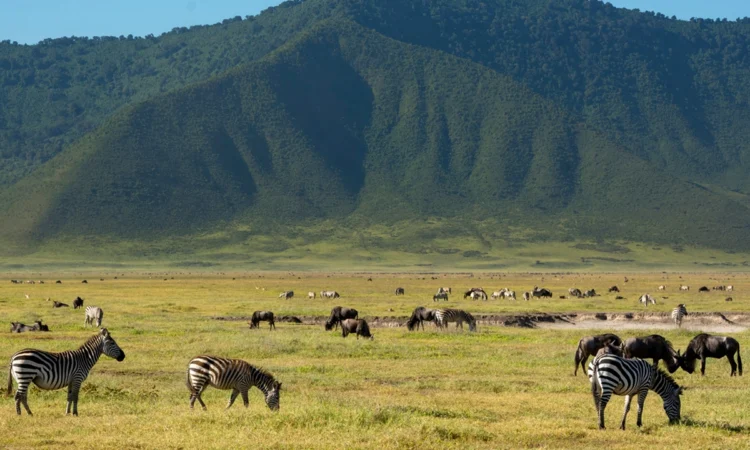
The Serengeti's endless grass plains host the Great Migration: roughly two million wildebeest and zebra moving in an annual clockwise circuit chasing the rains. The dramatic Mara River crossings, with crocodiles and predators waiting, happen roughly July through October in the northern Serengeti; the calving season, when the herds concentrate in the southern plains and predator action peaks, runs December to March. Even outside migration months the Serengeti holds a resident population of lions, leopards, cheetahs and elephants year-round.
Ngorongoro Conservation Area
The Ngorongoro Crater is the collapsed caldera of an extinct volcano, its floor a 260-square-kilometer self-contained ecosystem holding one of Africa's densest populations of lions and one of its best chances of spotting black rhino. The crater rim sits at over 2,200 meters, cold enough at night for a fleece, and the descent to the floor requires a separate vehicle fee on top of standard park entry.
Tarangire & Lake Manyara
Tarangire has Tanzania's highest elephant density and iconic baobab-studded landscapes, excellent in the dry season (June-October) when animals concentrate around the Tarangire River. Lake Manyara, smaller and often visited as a single day, is known for tree-climbing lions and dense flamingo flocks along the alkaline lakeshore.
Stone Town
Zanzibar's UNESCO-listed old town is a maze of narrow lanes, carved wooden doors, and a distinct Swahili-Arab-Indian architectural mix built on centuries of Indian Ocean trade, including the island's dark history as a major slave-trading hub, documented at the former slave market site. The Forodhani Night Market along the waterfront is the best introduction to Zanzibari street food, and Prison Island (Changuu), a 20-minute boat ride out, holds giant tortoises over a century old.
The beaches
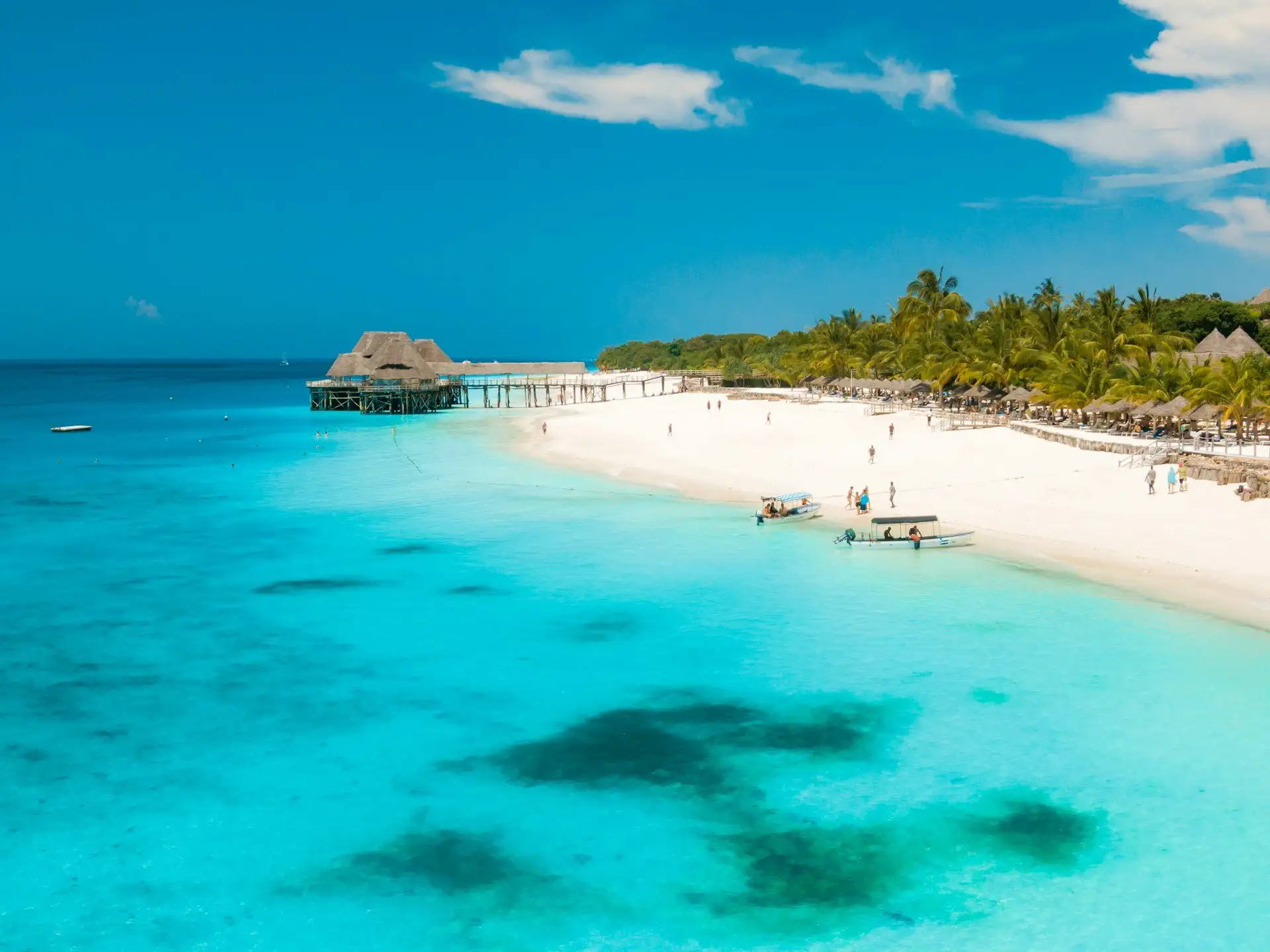
Zanzibar's ring of beaches each have a different character: Nungwi and Kendwa in the north have the most reliable swimming tides and nightlife; Paje and the east coast are the kitesurfing and quieter-resort belt; the south around Kizimkazi has dolphin encounters and a slower pace. Jozani Forest, inland, is the only place to see Zanzibar red colobus monkeys, found nowhere else on earth.
Mount Kilimanjaro
At 5,895 meters, Kilimanjaro is the highest peak in Africa and the highest free-standing mountain in the world, meaning it rises from surrounding plains rather than a connected mountain range. No technical climbing skill is required, only fitness, proper acclimatization and the willingness to walk for 6-9 days: the Machame and Lemosho routes are the most popular for their scenery and better summit success rates than the faster Marangu route.
Nyerere National Park & Ruaha
Nyerere National Park (the northern part of the former Selous Game Reserve) and Ruaha National Park make up Tanzania's southern circuit: vast, far less visited than the north, with boat safaris on the Rufiji River in Nyerere and one of East Africa's largest elephant and lion populations in Ruaha. Both require charter flights from Dar es Salaam and suit travelers who have already done a northern circuit safari and want somewhere with almost no other vehicles.
Culture & Etiquette
Tanzania's mainland is home to over 120 ethnic groups, including the semi-nomadic Maasai of the northern rift valley, but Swahili language and culture, plus a shared post-independence national identity, bind the country together more than any single tribal affiliation. The coast and Zanzibar are majority Muslim and notably conservative in dress and public behavior; the interior mixes Christianity, Islam and traditional beliefs with more relaxed norms.
Do
- Learn basic Swahili greetings. Jambo or Habari (hello), Asante (thank you), Karibu (welcome). Swahili is a source of national pride and a few words open doors.
- Dress conservatively on Zanzibar and the coast. Cover shoulders and knees away from resort pools and beaches; swimwear is fine at your hotel, not walking through Stone Town.
- Ask before photographing Maasai people or villages. A fee is often expected for photos at cultural bomas (villages); this is standard practice, not an imposition.
- Tip your safari guide and camp staff. Tipping is a significant part of guide and porter income; $15-25 per day per guide and similar for camp staff is typical on a mid-range safari.
- Carry small shilling notes. Since March 2025, everyday cash purchases must be paid in Tanzanian shillings; USD is only accepted by tour operators and hotels for invoiced services.
Don't
- Discuss the 2025 election or politics casually with strangers. The aftermath is a sensitive, live subject; let locals raise it if they wish to.
- Assume public displays of affection are neutral. Same-sex acts are illegal in Tanzania; laws are rarely enforced against tourists but discretion in public is the norm for all couples on the conservative coast.
- Feed or approach wildlife on safari, or ask your driver to leave the marked tracks. Off-track driving damages fragile grassland and is restricted in most parks.
- Expect self-drive safari flexibility. Unlike South Africa's Kruger, Tanzania's parks are built around guided vehicles and pre-arranged logistics, not independent exploration.
- Rely on old US dollar bills. Notes older than 2013 or with tears and marks are widely rejected or given worse exchange rates.
Deeper culture: the Maasai, Swahili identity, and religion
The Maasai. A semi-nomadic pastoralist people found across northern Tanzania and southern Kenya, recognizable by their red shuka cloth and elaborate beadwork. Many Maasai communities around Ngorongoro and the Serengeti maintain traditional cattle-herding life alongside tourism-related cultural visits; treat a boma visit as a paid cultural exchange, not a free photo opportunity.
Swahili identity. Kiswahili developed from Bantu languages with heavy Arabic loanwords along the coast, and Nyerere's post-independence government deliberately promoted it as a unifying national language over English or any single tribal language, a policy widely credited with Tanzania's relative ethnic cohesion since independence.
Religion. Tanzania is roughly split between Christianity (concentrated inland and in the north) and Islam (dominant on the coast and in Zanzibar, where the population is over 95% Muslim), with smaller communities practicing traditional and indigenous beliefs. Religious tolerance is generally strong and interfaith relations are calm, though Zanzibar's Muslim identity shapes dress norms and the rhythm of daily life more visibly than on the mainland.
Food & Drink
Mainland Tanzanian food centers on ugali (a stiff cornmeal dough) or wali (rice) as the base, with grilled meat, stews and beans alongside. The coast and Zanzibar tell a different culinary story: centuries of Arab, Persian and Indian trade layered cardamom, clove, cinnamon and chili into a spice-driven cuisine balanced with coconut milk, distinct from anything found inland.
Nyama Choma $4-10
Grilled meat, usually goat or beef, cooked in large cuts over charcoal and served sliced from the bone for sharing, almost always with ugali and kachumbari (tomato-onion salad). The single most common "let's eat" answer across the mainland.
Pilau & Mishkaki
Pilau is spiced rice, cinnamon, cardamom and cloves cooked with meat or potatoes, served at celebrations and in ordinary restaurants alike. Mishkaki are smaller marinated meat skewers grilled street-side, the mainland's answer to Zanzibar's seafood skewers.
Zanzibar Mix & Zanzibar Pizza $1-3
Zanzibar Mix is a cassava, potato and bhajia stew finished with tamarind, mango and lemon; Zanzibar pizza is a thin, folded dough parcel stuffed with minced meat or egg and vegetables, fried on a griddle. Both are Forodhani Night Market staples.
Coconut Fish Curries $5-12
Coastal and Zanzibari curries lean on coconut milk to balance the clove, cardamom and chili that arrived with Arab, Persian and Indian traders; fresh-caught reef fish and octopus are the usual base.
Chapati & Mandazi
Chapati (flatbread) accompanies stews across the country, while mandazi, a lightly sweet fried dough, is the standard breakfast pairing with spiced chai (tea brewed with cardamom, cinnamon and ginger).
Spice Tours $15-25
Zanzibar's inland spice farms, legacy of the island's clove-plantation economy, run walking tours through cardamom, nutmeg, vanilla and clove plantings, usually ending with a tasting and a home-cooked coastal lunch.
When to Go & Itineraries
The dry season, June through October, is the classic safari window: thinner vegetation concentrates wildlife around remaining water sources, and the dramatic Mara River crossings happen within this window, usually July to October. December through March is calving season in the southern Serengeti, with huge herds and correspondingly high predator activity, plus warm weather for Zanzibar's beaches. April and May are the long rains, when some camps close and travel gets harder, but prices drop and the landscape is at its greenest.
All seasons compared, with what to expect
| Season | Verdict | Notes |
|---|---|---|
| Jun-Oct | Best for safari | Dry season, river crossings Jul-Oct, peak prices and crowds at popular camps |
| Dec-Mar | Best for calving & beach | Southern Serengeti calving, predator action, warm and dry on Zanzibar |
| Nov | Good value | Short rains, brief and localized, herds still moving south |
| Apr-May | Lowest prices | Long rains; some camps close, roads difficult, lush green landscape |
Ngorongoro Crater's altitude keeps it good year-round regardless of season; pack a fleece for early morning game drives on the rim.
Itineraries
Seven days covers a solid northern circuit. Two weeks adds Zanzibar. Climbing Kilimanjaro is best planned as its own trip component, either before or after a safari, since the physical toll of the mountain doesn't mix well with early-morning game drives.
- Day 1
Arrive Kilimanjaro Airport, transfer to Arusha. Rest day to adjust, or a half-day Arusha National Park excursion if energy allows.
- Days 2-3
Tarangire & Lake Manyara. Elephant herds and baobabs, then tree-climbing lions and flamingos.
- Day 4
Ngorongoro Crater. Full day on the crater floor, overnight on the rim.
- Days 5-7
Serengeti. Two to three nights depending on the migration's position, then fly back to Arusha or Kilimanjaro.
- Days 1-7
The 7-day northern circuit above.
- Day 8
Fly Arusha to Zanzibar. Short domestic flight, most operators can arrange it directly from the Serengeti airstrip.
- Days 9-10
Stone Town. Old town, Forodhani Night Market, a spice tour and Prison Island.
- Days 11-14
Zanzibar beaches. North coast (Nungwi/Kendwa) or east coast (Paje) depending on whether swimming tides or kitesurfing matter more to you.
- Days 1-9
Kilimanjaro climb first. A 7-9 day Lemosho or Machame route, then two rest days in Arusha before safari.
- Days 10-16
Full northern circuit. Tarangire, Lake Manyara, Ngorongoro and an extended Serengeti stay.
- Days 17-21
Zanzibar. Stone Town plus a full beach week to recover from the mountain and the dust.
Getting there & around
Kilimanjaro International Airport (JRO), roughly 50 kilometers from Arusha, is the main international gateway for safari travelers; Julius Nyerere International Airport (DAR) in Dar es Salaam is the larger hub and the main entry point for Zanzibar and the southern circuit. Zanzibar has its own airport (ZNZ) with direct international connections from Europe as well as short domestic hops from Arusha and Dar. Within the safari circuit, travel is almost entirely by pre-arranged 4x4 safari vehicle or light aircraft between airstrips; self-drive is rare and not recommended for first-time visitors given road conditions and park logistics.
Domestic flights, buses and practical prep
| Option | Price | Notes |
|---|---|---|
| Arusha to Serengeti (light aircraft) | $150-300 one way | Coastal Aviation and Auric Air run scheduled routes to multiple Serengeti airstrips |
| Arusha/Dar to Zanzibar (flight) | $80-180 one way | Precision Air, Air Tanzania and others run multiple daily flights |
| Dar to Zanzibar (ferry) | $35-50 one way | Azam Marine, roughly 2 hours; buy tickets from an official counter, not street touts |
| JRO to Arusha (transfer) | ~$55 | Pre-booked shuttle or private transfer; roughly 50 minutes |
Practical prep: bring crisp US dollar bills dated 2013 or newer for visa fees and park-related payments where dollars are accepted; a Tanzanian SIM (Vodacom or Airtel, $5-10 for a generous data bundle) is easy to buy at either international airport. Yellow fever vaccination is required if arriving from or transiting a country with risk of yellow fever transmission, and malaria prophylaxis is strongly recommended for the safari circuit and Zanzibar. An eSIM before landing covers data from the moment you touch down.
Where to stay
Mid-range safari camps
Permanent tented camps with en-suite bathrooms and generator power, positioned inside or just outside the parks. The standard base for a first safari, usually full-board with game drives included in the overall package price.
Luxury lodges & crater-rim stays
Ngorongoro's crater-rim lodges and the Serengeti's premium mobile camps that follow the migration command the highest prices in the country, justified by location, service and, on the rim, views straight down into the caldera.
Zanzibar beach guesthouses
Family-run guesthouses and small hotels along Paje, Nungwi and Kendwa offer sea-view rooms at a fraction of mainland safari prices, the main reason Zanzibar works so well as a decompression stop after a safari.
Arusha & Moshi bases
Coffee-plantation lodges and city hotels around Arusha serve as the logistics base before and after both safaris and Kilimanjaro climbs; covered in full on our Arusha city guide.
Budget Planning
Tanzania is not a budget safari destination the way parts of Kenya or Uganda can be: park fees are high and the industry is built around fully guided vehicles and set-menu packages rather than independent low-cost travel. Zanzibar and the mainland cities, by contrast, can be done cheaply. Expect your total trip cost to be dominated by however many safari days you book.
- Shared group vehicle, basic camps
- Fewer parks, shorter circuit
- Park fees still apply in full
- Zanzibar add-on stays cheap
- Private vehicle and guide
- Full-board tented camps
- Northern circuit: Tarangire, Ngorongoro, Serengeti
- Domestic flights between parks
- Premium mobile camps following the migration
- Crater-rim lodges
- Light-aircraft transfers between camps
- Private guiding throughout
Quick reference prices: park fees, transport, Zanzibar costs
| Serengeti park entry (per person/day) | $70-80 |
| Ngorongoro entry + crater descent fee | ~$71 + $295/vehicle |
| Kilimanjaro climb, 6-9 days | $1,700-4,000+ |
| Zanzibar guesthouse (beach) | $20-40/night |
| Dala dala local minibus | ~$0.20-1 |
| Dar-Zanzibar ferry | $35-50 one way |
| Nyama choma plate | $4-10 |
| Tanzanian SIM with data | $5-10 |
Prices reflect August 2026 research and drift over time, especially park fees, which are set annually. Treat them as a planning baseline, not a quote.
Visa & Entry
Most Western passport holders need a visa for Tanzania. UK citizens pay $50 for a single-entry tourist visa valid 90 days; US citizens must apply for the $100 multiple-entry visa regardless of trip length. Apply for an eVisa online in advance (processing typically 5-10 business days) or pay cash on arrival at Kilimanjaro International Airport or Julius Nyerere International Airport in Dar es Salaam. Zanzibar is part of the same union visa, so no separate entry is needed if you already hold a valid Tanzania visa, though your passport is stamped again on arrival there.
✓ Valid passport
At least 6 months validity from your entry date, with blank pages for stamps.
✓ Crisp USD cash (if paying on arrival)
Bills dated 2013 or newer, no tears or marks; visa-on-arrival is cash-only in USD.
✓ Yellow fever certificate (conditional)
Required only if arriving from or transiting a country with risk of yellow fever transmission.
✓ Proof of onward travel
May be requested at immigration; keep a printed or digital return ticket accessible.
| Tanzania | Kenya | |
|---|---|---|
| Safari cost | Higher; park fees $70-80/day, few budget options | Wider range, more budget and mid-range camps around the Mara |
| Signature parks | Serengeti, Ngorongoro Crater, Tarangire | Maasai Mara, Amboseli, Tsavo |
| Migration access | Best Jul-Oct river crossings and Dec-Mar calving | Best Aug-Sep river crossings in the Mara |
| Beach add-on | Zanzibar, short flight from the circuit | Mombasa/Diani, further from Nairobi safaris |
| Current safety rating | US Level 3, Reconsider Travel (since Oct 2025) | US Level 2, Exercise Increased Caution |
Safety, Solo Women & Family
Tanzania's safety picture changed materially in late 2025 and deserves a direct answer rather than a brochure one. A contested general election on 29 October 2025 triggered street protests, mostly in Dar es Salaam and other mainland cities, and the government responded with a curfew, a nationwide internet shutdown lasting roughly a week, and lethal force against demonstrators. Human rights organizations including Amnesty International, Human Rights Watch and UN experts documented widespread killings and arrests, with opposition figures alleging casualty counts running into the hundreds or higher, and reports of further incidents into 2026. The US State Department raised its Tanzania advisory to Level 3, Reconsider Travel, on 31 October 2025, citing unrest, crime, terrorism and the targeting of gay and lesbian individuals.
For the safari circuit and Zanzibar specifically: these areas sit hundreds of kilometers from where the political unrest concentrated, and tour operators report the Serengeti, Ngorongoro and Zanzibar tourism circuits continuing to operate through the crisis. That is meaningfully different from saying the country is unaffected. Check your government's current travel advisory close to your departure date and again during your trip, since the situation moved quickly once before and could again.
Political unrest
Concentrated in Dar es Salaam and mainland cities around the October 2025 election. Avoid demonstrations, political gatherings and discussions of the election with strangers; monitor local news and your embassy's alerts if traveling on the mainland outside the safari circuit.
Crime
Violent crime including assault, robbery and carjacking occurs, mostly in Dar es Salaam and other urban centers; petty theft is common in crowded markets and on beaches. The controlled environment of an organized safari carries very low crime risk.
Terrorism
The Mtwara region on the far southern coast near the Mozambique border is the area flagged for terrorism risk; it sits far from the standard northern safari circuit, Kilimanjaro and Zanzibar's main tourist areas.
Two more things worth knowing: LGBT travelers and Zanzibar's conservative norms
LGBT travelers: same-sex acts are illegal in Tanzania and the advisory specifically cites targeting of gay and lesbian individuals. Laws are rarely enforced against tourists directly, but public displays of affection, activism or discussion of LGBT rights should be avoided; keep couple behavior private.
Zanzibar and the coast: a conservative, majority-Muslim culture where modest dress away from resorts matters more than on safari or in Arusha. Avoid walking alone after dark in Stone Town's quieter lanes or on unlit beach paths.
The 3 scams to actually know about
Tanzania is not a high-scam destination for organized safaris, since a pre-booked itinerary with a licensed operator removes most opportunities for overcharging. Independent travelers on Zanzibar and around Dar es Salaam should know these three patterns.
Unlicensed safari operators
Cut-rate safaris booked through unverified street agents in Arusha or online sometimes fail to deliver the promised vehicle, guide quality or park entries. Book through a TATO-registered operator (Tanzania Association of Tour Operators) or a well-reviewed company with a physical Arusha office.
Unofficial "beach boy" guides
Persistent unofficial guides on Zanzibar's beaches offer tours, taxis or spice-farm visits at inflated prices. Book activities through your hotel or a licensed tour desk instead; prices are clearer and quality is more consistent.
Ferry ticket touts
Touts outside the Dar es Salaam ferry terminal sell Zanzibar ferry tickets at a markup or steer travelers to slower, less reputable operators. Buy directly from the Azam Marine counter or your hotel.
Solo women travelers
Solo women travel Tanzania's safari circuit regularly without incident, since it's a controlled, guided environment; Zanzibar and mainland cities require more standard precautions. Expect more direct attention, including marriage proposals, on the coast and in Zanzibar than inland; a firm "Hapana, asante" (no, thank you) handles most of it. Avoid walking alone after dark in Stone Town's back lanes or unlit beach paths, dress modestly away from resort grounds, and use hotel-arranged transport rather than hailing unmarked vehicles at night. Full detail on our Solo Woman Explorer pages.
Emergency numbers
Embassies in Dar es Salaam and mountain/bush emergency protocol
Emergency numbers work best in Dar es Salaam and other major towns; response times in remote safari areas and on Kilimanjaro are slower, which is exactly why licensed operators carry their own satellite communication and evacuation insurance. Confirm your safari operator's emergency protocol and evacuation coverage before departure, and consider dedicated evacuation insurance (such as through Flying Doctors/AMREF) for Kilimanjaro climbs.
- USA
- +255-22-229-4000
- UK
- +255-22-229-0000
- Germany
- +255-22-211-7409
- France
- +255-22-219-8800
- Netherlands
- +255-22-211-0000
- Canada
- +255-22-216-3300
- Australia
- via Nairobi, +254-20-427-7100
Family travel & health
Tanzania's safari camps are generally family-friendly from around age 6-8 depending on the operator, with private vehicles the easiest way to manage younger children's schedules and safety around wildlife. Zanzibar's calmer north and east coast beaches suit families well after a safari. Malaria prophylaxis is strongly recommended for both the safari circuit and Zanzibar; discuss options with a travel health clinic 4-6 weeks before departure, and check current yellow fever certificate requirements if arriving from a risk country.
Tanzania FAQ
Is Tanzania safe to visit right now?
The safari circuit and Zanzibar's tourist beaches have continued to operate normally. But the US State Department raised its advisory to Level 3, Reconsider Travel, after a violent crackdown followed the October 2025 general election, mostly in Dar es Salaam and other mainland cities. Check your government's current advisory before booking and while traveling.
How much does a Tanzania safari cost?
A mid-range all-inclusive safari runs roughly $350-500 per person per day covering accommodation, meals, a private vehicle, guide and park fees. Park entry alone is $70-80 per person per day in the Serengeti, plus a separate $295 per-vehicle fee to descend into the Ngorongoro Crater.
Do I need a visa for Tanzania?
Yes, most Western passport holders need a visa. UK citizens pay $50 for a single-entry tourist visa; US citizens must apply for the $100 multiple-entry visa. Apply online for an eVisa in advance or pay cash on arrival at Kilimanjaro or Dar es Salaam airports.
When is the best time to see the wildebeest migration?
The dramatic Mara River crossings happen roughly July to October in the northern Serengeti. December to March is calving season in the southern Serengeti and Ngorongoro area, with huge herds and high predator action. Ngorongoro Crater itself has strong wildlife viewing year-round.
How many days do you need in Tanzania?
Seven days covers a solid northern circuit safari (Tarangire, Ngorongoro, Serengeti). Two weeks adds several days on Zanzibar's beaches. Climbing Kilimanjaro adds 6-9 days on its own and is usually planned as a separate trip component.
How much does it cost to climb Kilimanjaro?
Guided climbs range from about $1,700-2,300 for budget 5-6 day routes to $2,500-4,000+ for better-acclimatized 7-9 day routes like Machame or Lemosho, plus $250-350 in tips for guides, porters and cooks.
What currency does Tanzania use?
The Tanzanian shilling (TZS). Since March 2025, cash purchases within Tanzania must be paid in shillings; only tour operators and hotels may invoice international visitors in US dollars for safaris and accommodation.
Is Zanzibar part of Tanzania?
Yes. Zanzibar is a semi-autonomous archipelago that joined mainland Tanganyika in 1964 to form Tanzania, and it keeps its own president, legislature and immigration stamp within the union.
Is Tanzania good for a beach and safari combination?
Yes, and it's one of the easiest combinations in Africa: a short flight connects the northern safari circuit to Zanzibar, so a week of Serengeti and Ngorongoro pairs naturally with 4-5 days unwinding on Zanzibar's beaches afterward.
What language is spoken in Tanzania?
Swahili (Kiswahili) is the national and official language, spoken alongside English, which is widely used in tourism, business and higher education. Learning basic Swahili greetings is easy and well received.
Is Tanzania cheaper than Kenya for safari?
Not generally. Tanzania's parks charge similar or slightly higher per-day fees than Kenya's, and its safari circuit skews toward exclusive, less crowded parks. Kenya has more budget and mid-range options concentrated around the Maasai Mara.
What Stays With You
Tanzania holds an unfair share of Africa's iconic landscape in one country: a migration a million animals strong, a crater that behaves like its own private world, a mountain that stands entirely alone against the sky, and an island where the spice trade never really left the air. None of it is quiet or cheap, and none of it needs exaggeration to sell itself.
It also asks something more of the traveler right now than it used to: read the current safety picture honestly, plan around it rather than ignore it, and go in with clear eyes about a country in the middle of a real political moment. That doesn't cancel the Serengeti. It just means arriving informed.