
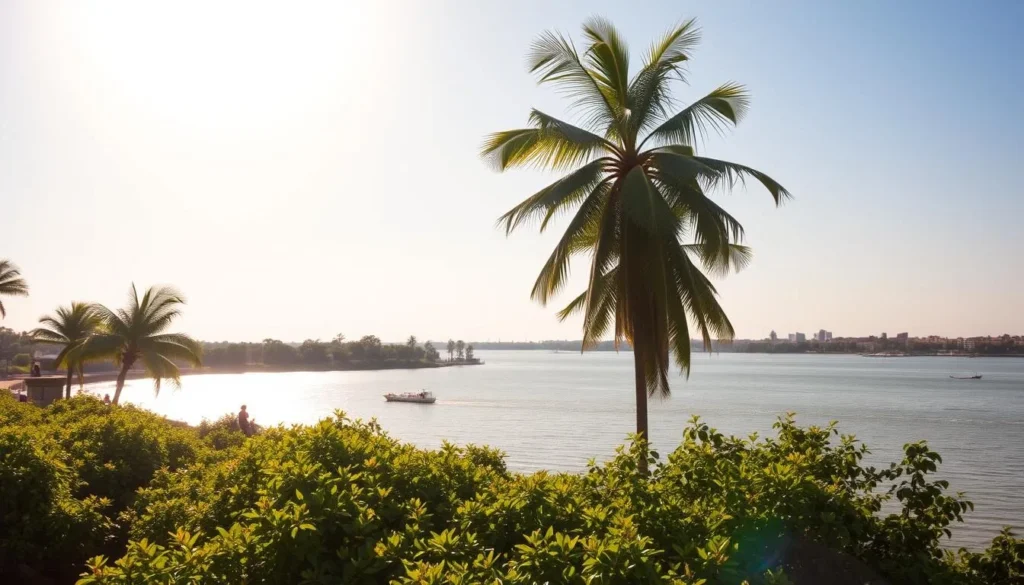
The capital across the river from a much bigger story
Brazzaville sits on the north bank of the Congo River directly opposite Kinshasa, and the two cities are close enough that on a clear evening you can watch Kinshasa's lights come on from Brazzaville's own riverfront. Founded in 1880 through a negotiated treaty rather than conquest, and briefly the capital of Free France during the Second World War, Brazzaville today is a modest, walkable city of roughly 2.5 million people: colonial-era facades mixed with newer towers, a genuinely interesting art scene, and a fashion subculture that turns ordinary Sunday afternoons into something worth witnessing.
What Brazzaville isn't is a city built for tourists. There's no historic old town circuit, no cluster of must-see museums, and English gets you nowhere outside a couple of international hotels. What it does have is real: the Poto-Poto School of Painting, still working in the same figurative style that reached MoMA in the 1950s, the Sapeurs of Bacongo turning dandyism into a form of dignity, and a river view that puts you eye to eye with a metropolis thirty times the size of the city you're standing in.
The honest complications
Getting here requires a visa arranged well in advance and a yellow fever certificate you'll need to produce more than once. English is close to nonexistent outside the Radisson and Hilton, ATMs and card acceptance are unreliable outside a handful of hotels, and there's no confirmed ride-hailing app to fall back on, so every taxi fare gets negotiated on the spot. None of this makes Brazzaville hard exactly, but it does mean this isn't a city you improvise your way through without some French and some patience.
Four neighbourhoods, one river view
Brazzaville's arrondissements sprawl inland, but almost everything a visitor wants sits within four areas close to the river.
Le Plateau (Centre-ville)
The administrative and business heart of the city, home to ministries, embassies, the best international-standard hotels, and the stretch of La Corniche closest to downtown. Central and the most practical base for a first visit, though quieter and less atmospheric after dark than you might expect from a capital.
Poto-Poto
Named for the neighbourhood that gave the famous painting school its name, Poto-Poto mixes flaking colonial facades with fresh murals, the green-roofed Basilique Sainte-Anne, and the sprawling Marché Total. It's the most walkable introduction to everyday Brazzaville life and a short taxi ride from Le Plateau.
Bacongo
A more residential, more traditional quarter south of the centre, and the neighbourhood most consistently recommended for spotting the Sapeurs, especially at local pubs on Sunday afternoons when the week's dressing-up ritual is at its most visible. Fewer sights in the conventional sense, more genuine daily life.
Mpila & the Riverfront
The port and riverside strip where La Corniche runs its full length, lined with restaurants and cafés looking straight across at Kinshasa. This is where Brazzavillois themselves come for an evening out, and it's the single best place in the city to watch the sun go down over the water.
A short list, and each name on it earns its place
Brazzaville's hotel stock is thin compared to almost any other capital this guide covers, which makes the handful of genuinely good options easy to name directly rather than sort into a long list.
At the top, Radisson Blu M'Bamou Palace sits directly on the Congo River in Le Plateau, with rooms looking out toward Kinshasa, reliable international-standard service, and rates around $170-190 a night, making it the most consistently recommended base in the city. Hilton Brazzaville Les Tours Jumelles, the city's newer twin-tower high-rise, runs from around $276 a night and is the pick for travelers who want the most modern rooms in the capital.
For a more central, walkable location near the Basilique and the Plaine Market, Mikhael's Hotel is a smaller, comfortable mid-range option within walking distance of Poto-Poto's sights, while Hotel La Roche, close to both the Basilique and the Cathédrale du Sacré-Cœur, is a reasonable value alternative in the same area. Book any of these directly or through a major platform well ahead of travel, since Brazzaville's total room count is small relative to demand from the oil and diplomatic sectors.
Palm nut sauce, cassava bread, and a river-view terrace
Brazzaville eats the same cassava-and-palm-nut foundation as the rest of the country, with the added advantage of the city's best rendition of nearly everything, plus a genuine river-view dining scene along the Corniche that most of the Republic of Congo simply doesn't have.
Poulet Moambe
Chicken braised in a thick, rust-colored sauce made from pounded palm nut pulp, tomato, onion and pili-pili chili, usually spooned over rice or plantain. You'll find a version of it at nearly every sit-down restaurant in the city.
Saka-Saka & Chikwangue
Pounded cassava leaves cooked with peanut paste and spices, served alongside dense, fermented chikwangue bread steamed in banana leaves. Le Jardin de la Paix is a well-regarded local spot specifically known for doing saka-saka properly.
Maboke
Fish or meat seasoned and wrapped in koko leaves before steaming or grilling, a strong contender for the country's other national dish and common at market stalls and casual restaurants alike.
Mami Wata
Mami Wata, named for the mermaid spirit of West and Central African folklore, sits directly on La Corniche with a terrace jutting out over the water and a clear view of Kinshasa across the river. The menu runs through pondu (saka-saka), grilled fish and fried plantain, and it's the single best combination of food and setting in the city.
A modest capital with three genuinely memorable stops
Brazzaville doesn't have a long attractions list, and that's fine: two unhurried days lets you see everything worth seeing without rushing, and leaves room for the river to do most of the work.
The river and its landmarks
La Corniche, the riverside promenade running along Mpila and Le Plateau, is Brazzaville's single best free experience: walk it in the late afternoon as the light softens over the water and Kinshasa's skyline comes into view across the Congo River, the world's two closest capitals facing each other in real time. A short distance inland, the Basilique Sainte-Anne du Congo, completed in 1943 to a modernist design by the architect Roger Erell and topped with a distinctive green-tiled roof, is the city's architectural landmark; its older, plainer counterpart, the Cathédrale du Sacré-Cœur, built in 1892, holds the title of the oldest cathedral in Central Africa. On the water's edge, the Pierre Savorgnan de Brazza Memorial, a marble mausoleum completed in 2006 to hold the remains of the city's founder, his wife and their children, includes a 15-metre fresco by Poto-Poto school artists tracing Brazza's journey through the Congo; it's an striking building whose contested colonial legacy is worth reading up on before you go, not just admiring from outside.
Art and everyday Brazzaville
The Poto-Poto School of Painting, founded in 1951 by Pierre Lods, gave African artists a studio and total creative freedom decades before that was a common idea in colonial Africa; the school still works and sells from the same neighbourhood today, and browsing the studio is one of the few genuinely essential stops in the city. The Nabemba Tower, at 106 metres the tallest building in the country, houses government ministries and can't be visited inside, but it's a useful landmark for orienting yourself along the riverfront. Marché Total, Poto-Poto's main market, is the best place to see the ordinary rhythm of the city: produce, cloth, and the general commerce that the oil economy's headlines skip over.
Sundays in Bacongo
If your dates allow it, spend a Sunday afternoon in Bacongo, where the Sapeurs, Brazzaville's dandy fashion subculture, gather at neighbourhood pubs in sharply tailored, brightly colored suits. Ask before photographing anyone directly; most are glad to pose once asked, and the gesture of asking is itself part of showing the culture the respect it's due.
Les Rapides du Djoué
On the western edge of the city, where the Djoué River meets the Congo, the water turns to genuine white-water turbulence as it drops toward the sea, a scene the explorer Henry Morton Stanley described in 1877 as having a rarely equaled, impressive beauty. A bar overlooking the rapids is the easiest viewpoint; the better view is a short walk further down a sandy track past the bridge.
One, two or three days in the capital
Two full days covers Brazzaville properly. A third day is worth adding only if it lines up with a Sunday in Bacongo or if you're using the extra time to arrange onward logistics to Odzala-Kokoua or Pointe-Noire.
- Morning
Poto-Poto. The Basilique Sainte-Anne, a browse through the Poto-Poto School of Painting, and Marché Total.
- Midday
Lunch at Le Jardin de la Paix or a market stall for saka-saka and chikwangue.
- Afternoon
Le Plateau and the Brazza Memorial. The mausoleum's fresco and grounds, then a walk along La Corniche.
- Sunset
Dinner at Mami Wata, watching Kinshasa's lights come on across the river.
- Day 1
The one-day route: Poto-Poto, the Basilique, the Brazza Memorial, La Corniche, dinner at Mami Wata.
- Day 2 morning
Les Rapides du Djoué. A short taxi ride to the western edge of the city for the Congo River's white water.
- Day 2 afternoon
Cathédrale du Sacré-Cœur and Nabemba Tower as a walking loop through Le Plateau.
- Day 2 evening
Grilled fish on Rue de la Marine, the local alternative to the Corniche's restaurant prices.
- Days 1-2
The two-day route above, at a gentler pace.
- Day 3, option A
A Sunday in Bacongo. If your dates line up, spend the afternoon watching the Sapeurs gather at neighbourhood pubs.
- Day 3, option B
Mbamou Island by pirogue, a half-day boat trip to a quiet river island for a picnic and time with local fishermen.
Small, walkable in parts, and entirely negotiated by taxi
Maya-Maya International Airport (BZV) sits about 20-30 minutes from Le Plateau depending on traffic. Air France runs the only nonstop flight to Europe, landing from and departing to Paris CDG; most other international routings connect through a regional hub. Arrange an airport transfer through your hotel if you can, since there's no confirmed ride-hailing app operating reliably in the city and unofficial drivers sometimes approach arriving passengers before the official taxi rank.
Within the city, shared taxis running loose routes cost 500-1,000 XAF and are how most residents get around; private taxis for a short ride in the centre run 1,000-3,000 XAF, always negotiated before you get in since none are metered. French is close to essential for giving directions or negotiating fares; a phrasebook or offline translation app closes most of the gap English can't.
Getting to Odzala-Kokoua, Pointe-Noire and Kinshasa from here
Odzala-Kokoua: no scheduled commercial flights serve the park. Charter flights from Maya-Maya are arranged directly through your lodge operator (Kamba, for Ngaga, Lango and Mboko) as part of the overall package.
Pointe-Noire: a domestic flight covers the route in under an hour and is the practical choice for most visitors. The weekly CFCO passenger train, "La Gazelle," takes roughly 14-16 hours overnight with air-conditioned sleeper cars for around 15,000 XAF, a genuinely scenic if slow alternative.
Kinshasa: the passenger ferry from Beach Ngobila crosses the Congo River in under an hour. You'll need a separate DR Congo visa arranged before you travel; budget patience and small XAF or USD notes for the crossing itself, which has a well-known reputation for informal fees on both sides.
Moderate by day, expensive only if gorillas are on the list
Day-to-day life in Brazzaville is reasonably priced; the cost curve only spikes once Odzala-Kokoua enters the plan, and that's worth budgeting as a separate package rather than folding into your daily average.
- Guesthouse room $25-40
- Market meals and street food $3-8
- Shared taxis around town
- Free sights: La Corniche, markets
- Radisson-tier hotel $170-190
- Restaurant meals $10-25
- Private taxi for the day
- A guided visit to the Poto-Poto studio
- Hilton-tier hotel $276+
- Dinner at Mami Wata
- Private driver and guide throughout
- Odzala-Kokoua trip booked as a separate add-on
Level 2, and mostly about common sense after dark
Brazzaville carries the same Level 2, exercise increased caution, rating the US State Department applies to the whole country. Violent crime like armed robbery occurs but isn't common, and daytime movement around Le Plateau, Poto-Poto and the Corniche is generally straightforward with normal city awareness. The real risks concentrate after dark: keep valuables out of sight, use a hotel-arranged or pre-agreed driver rather than hailing a taxi off the street at night, and avoid walking alone once the sun is down outside the main hotel areas.
Petty theft is the most common issue tourists actually encounter, concentrated around crowded markets like Marché Total and the port area. Photography of government buildings, bridges, the airport, or anyone in uniform is taken seriously here and best avoided entirely; ordinary street photography and the Sapeurs (with permission) are fine. Emergency numbers are 117 for police and 118 for fire, though there's no unified 112-style dispatch system; in a genuine emergency, your hotel front desk will usually connect you faster than the numbers alone.
Gorillas, waterfalls, a river island and another country entirely
Brazzaville's location makes it a genuinely useful base for four very different day and multi-day trips, from a genuine wildlife encounter to an afternoon in a foreign capital.
Lesio-Louna Gorilla Sanctuary
Part of the Lefini Reserve north of Brazzaville, Lesio-Louna rehabilitates orphaned western lowland gorillas and lets you observe habituated groups without the flight and cost of a full Odzala-Kokoua trip. Arrange a 4x4 with driver in Brazzaville in advance; the paved road covers most of the distance, with a final rough stretch to the reserve entrance.
Loufoulakari Falls
A 40-metre waterfall where the Loufoulakari River meets the Congo, southwest of the city. The drive is short in distance but slow in practice, 2-3 hours each way on a rough, partly unpaved road, so treat this as a full-day commitment rather than a quick detour.
Mbamou Island
A river island in the middle of the Congo, reached by a motorized pirogue crossing of 30 minutes to just over an hour depending on current. It's unpolished on purpose: no resort infrastructure, just quiet beaches, small coves, and a fishing village where you can pick up fresh fish and spend an afternoon away from the city.
Kinshasa (DR Congo)
The ferry from Beach Ngobila puts you in a city of roughly 17 million people, thirty times Brazzaville's size, in under an hour. You'll need a DR Congo visa arranged before you travel and should check the current US State Department advisory for DR Congo, rated considerably higher risk than the Republic of Congo, before planning anything beyond a short, well-organized day visit.
Brazzaville FAQ
Is Brazzaville safe for tourists?
Brazzaville carries the same Level 2, exercise increased caution, rating as the rest of the Republic of Congo. Violent crime happens but isn't common; the practical risks are petty theft and walking alone after dark, both manageable with normal city awareness.
How many days do I need in Brazzaville?
Two days covers the city itself: the Basilique, La Corniche, the Poto-Poto School of Painting, and a Sunday in Bacongo if your dates allow. Most visitors then continue on to Odzala-Kokoua or Pointe-Noire rather than lingering longer in the capital alone.
How much does Brazzaville cost per day?
Budget travelers manage on $50-70 a day with guesthouses and market meals; mid-range runs $120-200. This excludes gorilla trekking at Odzala-Kokoua, which is priced as its own multi-day package rather than a daily cost.
Can I really see Kinshasa from Brazzaville?
Yes. Brazzaville and Kinshasa are the world's closest pair of capital cities, roughly 3km apart across the Congo River. La Corniche, Brazzaville's riverside promenade, has a clear view of Kinshasa's skyline, especially striking at golden hour.
How do I get from Brazzaville to Kinshasa?
A passenger ferry from Beach Ngobila crosses in well under an hour. You need a separate DR Congo visa arranged before you travel, and the crossing has a reputation for informal fees on both sides, so carry small notes and stay patient.
What is the best area to stay in Brazzaville?
Le Plateau (centre-ville) for the most reliable hotels and proximity to the Corniche and embassies. Poto-Poto for walkable access to the Basilique and the painting school. Bacongo is more residential but worth an afternoon visit for the Sapeurs.
What are the Sapeurs and where do I see them?
The Sapeurs are Brazzaville's dandy fashion subculture, ordinary workers who dress in sharp, colorful tailoring once the workday ends. Bacongo is the most consistently recommended neighbourhood for Sunday sightings, especially around neighbourhood pubs in the afternoon.
Do I need a visa to visit Brazzaville?
Yes, almost every nationality needs a Republic of Congo visa arranged in advance through an embassy, plus a mandatory yellow fever certificate. There is no visa on arrival, unlike some other African capitals.
Is Brazzaville a good base for gorilla trekking?
Yes, it's the only realistic gateway: charter flights to Odzala-Kokoua's lodges depart from Brazzaville's Maya-Maya Airport, arranged through the lodge operator rather than booked as a scheduled commercial flight.
What Stays With You
Brazzaville doesn't announce itself the way capitals usually do. There's no single monument that sums it up, no old town circuit that tells you where to look next. What sticks is quieter: the green roof of the Basilica against the afternoon light, a taxi driver folding himself into a sharply tailored suit before a Sunday walk through Bacongo, and the strange, specific fact of standing on a riverbank and watching another country's capital light up across the water, close enough to feel and far enough to remind you how much the river still decides.
Go for the gorillas if that's what got you here. Stay the extra day for the river.