

What You're Actually Getting Into
The Republic of Congo is the smaller of the two countries carved out of the Congo River basin, and it spends most of its life in the shadow of the other one. Where Kinshasa across the water holds around 17 million people and a war in its east, Brazzaville holds roughly 2.5 million and a genuinely workable Level 2 safety rating. French colonization arrived here through diplomacy rather than the forced-labor brutality that defined Belgian rule on the opposite bank, an early divergence that still shapes how each country feels on the ground today. What's left is an oil-dependent economy, a capital of crumbling colonial facades and fresh murals, and a rainforest interior most of its own citizens will never see.
The country's real draw for travelers willing to do the paperwork is Odzala-Kokoua National Park, where habituated western lowland gorilla families can be trekked for $350-450 a permit, well under half of what Rwanda or Uganda charge for mountain gorillas. Layer in the Sangha Trinational rainforest in the far north, a genuine UNESCO World Heritage forest that has never been logged, and the Sapeurs of Bacongo turning poverty into a Sunday fashion statement, and you have a country with real substance and almost no tourist infrastructure built around any of it.
The honest complications
There is no visa on arrival and no reliable e-visa system, unlike DR Congo next door: you apply through an embassy weeks ahead, with a yellow fever certificate as a hard requirement rather than a suggestion. Information about the country online is thin and frequently gets confused with its much larger, much more dangerous neighbor of nearly the same name, so double-check anything you read, including some of what's on this page, against a current source before you travel. Roads outside Brazzaville and Pointe-Noire are rough, English is close to nonexistent outside a few hotels, and the contrast between the oil wealth visible in parts of the capital and the poverty visible everywhere else is not something a short visit resolves or should try to.
A History Worth Knowing
The Teke and Kongo kingdoms controlled the Malebo Pool region for centuries before the French explorer Pierre Savorgnan de Brazza negotiated a treaty with the Teke King Makoko in 1880, founding the city that carries his name on the river's north bank. That handshake diplomacy, contrasted deliberately by Brazza himself against Belgian Congo's brutality on the opposite shore, became the founding myth of French Congo, even as forced labor was used just as ruthlessly to build the colony's infrastructure a few decades later. Independence came in 1960, followed by one of Africa's few self-declared Marxist-Leninist states, a civil war in the 1990s, and an oil-fueled economy run for most of the last three decades by one man.
- 1880
Brazza's treaty. Pierre Savorgnan de Brazza signs an agreement with Teke King Makoko, founding Brazzaville and giving France its foothold on the river's north bank.
- 1910-1944
Federal capital. Brazzaville becomes the seat of French Equatorial Africa, then the capital of Free France after de Gaulle's 1944 Brazzaville Conference, held while Paris was under German occupation.
- 1960
Independence. The Republic of Congo becomes independent from France on 15 August, one of fourteen former French African colonies to do so that year.
- 1969-1991
People's Republic of Congo. A one-party Marxist-Leninist state under the Congolese Labour Party (PCT), one of the few in Africa to formally adopt the label.
- 1993-1999
Civil wars. Multiparty democracy from 1992 collapses into ethnic-militia conflict; Denis Sassou Nguesso, president 1979-1992, returns to power in 1997 with Angolan military backing.
- 2003-present
Peace and oil. A 2003 accord ends the fighting. Sassou Nguesso has since been re-elected repeatedly, most recently in March 2026, and oil revenue remains the backbone of the economy.
Read the full history: Brazza's treaty, the Congo-Ocean Railway, and the civil wars
Brazza's 1880 treaty with Makoko is still taught as a point of national pride precisely because of the contrast with what happened across the river: Leopold II's Congo Free State became a byword for colonial atrocity, while French Congo's founding is remembered as a negotiated one. The distinction mattered less in practice than in propaganda. When the French government needed to build the Congo-Ocean Railway linking Pointe-Noire's new deepwater port to Brazzaville between 1921 and 1934, it relied on forced conscripted labor from across French Equatorial Africa, and estimates of the death toll from disease, exhaustion and accidents on the line commonly run from 17,000 to 20,000 workers. The railway remains in use today; the human cost of building it is not something you'll find on a plaque at either station.
Brazzaville's role as capital of Free France from 1944, hosting the conference at which de Gaulle promised eventual self-government to France's African colonies, gave the city an outsized diplomatic profile for its size that briefly made it one of the most important cities in the French-speaking world. Independence in 1960 was followed by increasing radicalization: the Congolese Labour Party took power in 1969 and ran a one-party Marxist-Leninist state, unusually explicit for Africa, allied with the Soviet Union and Cuba, until the wave of democratization that swept the continent in 1990 and 1991 forced a national conference and multiparty elections.
The 1990s were rougher than the transition promised. Pascal Lissouba won the 1992 election, but ethnic-militia politics, with rival factions organized around Sassou Nguesso, Lissouba and Bernard Kolélas, escalated into open civil war in 1993-94 and again more seriously in 1997, when Sassou Nguesso, backed by Angolan troops and his own Cobra militia, retook Brazzaville by force. A further round of fighting in 1998-99 in the Pool region south of the capital preceded a 2003 peace accord. Sassou Nguesso has governed continuously since 1997, on top of his earlier term from 1979 to 1992, and was re-elected to a fifth consecutive term in March 2026.
Top Destinations
The Republic of Congo splits into four practical zones: the capital and the Pool region around it, the coastal strip anchored by Pointe-Noire, the gorilla-trekking heartland of Odzala-Kokoua, and the deep, roadless rainforest of the far north. Distances are large and infrastructure is thin, so most itineraries pick two zones rather than attempting all four; getting between them usually means a domestic or charter flight rather than a road trip.
Brazzaville, the capital facing Kinshasa
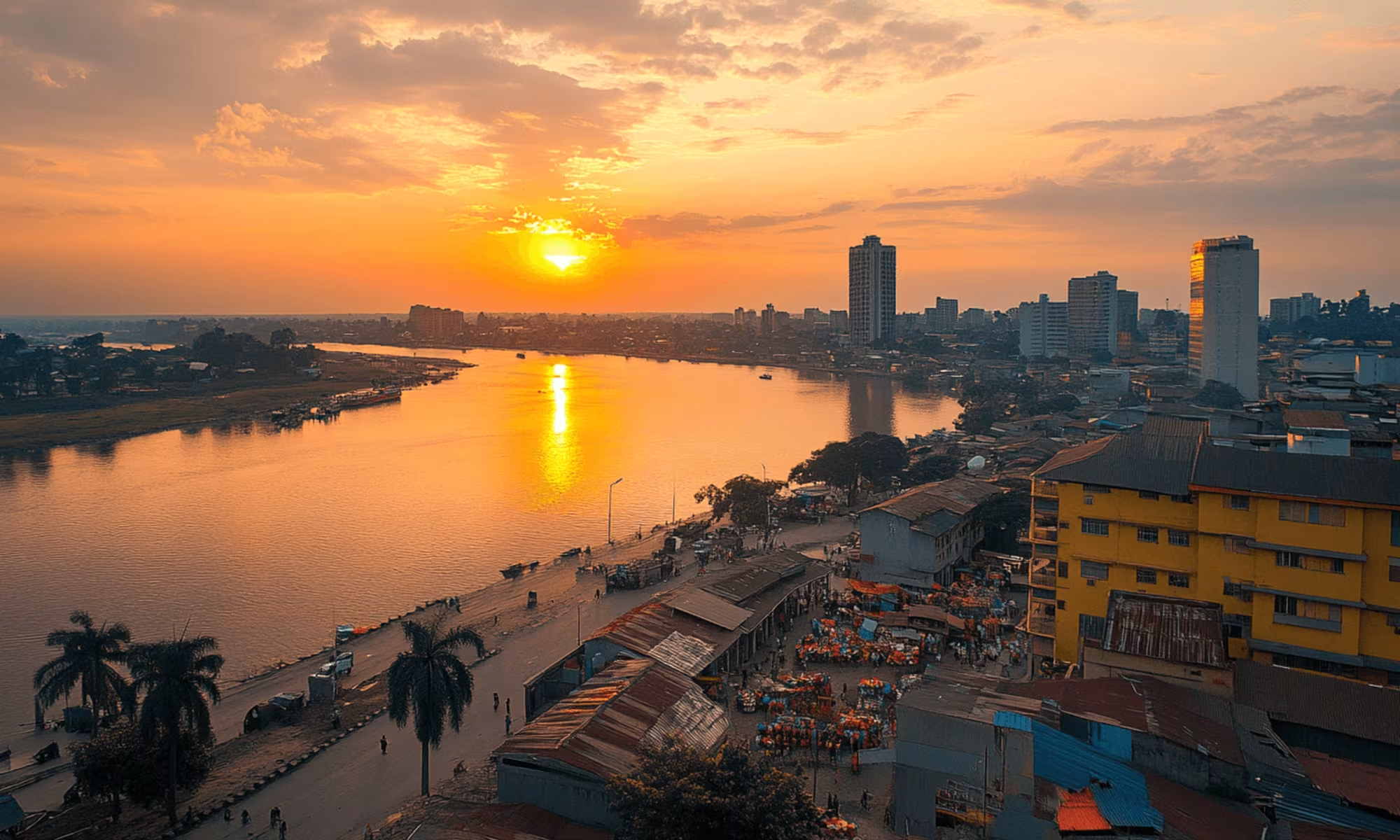
Brazzaville sits on the north bank of the Congo River, close enough to see Kinshasa's high-rises across the water and, on a clear evening, hear its traffic. The city itself is a modest two-day stop: the green-roofed Basilique Sainte-Anne, the riverside promenade of La Corniche, and the Poto-Poto School of Painting, founded here in 1951 and still producing work in the same vivid, figurative style that once hung in New York's MoMA. On Sundays the Bacongo neighborhood fills with Sapeurs, dandies in sharp designer suits turning ordinary streets into a runway. A full city guide, with neighborhoods, hotels, restaurants and a day-by-day plan, covers Brazzaville separately: see our Brazzaville city guide.
Pointe-Noire, the economic capital
Pointe-Noire is Congo's oil and shipping hub on the Atlantic coast, with a more developed, more expatriate feel than Brazzaville and better tourist accommodation. On its own it's a functional port city rather than a destination, but it's the gateway to two genuinely worthwhile sites nearby. Diosso Gorges, a short drive north, is a canyon of eroded red earth locals and guides both call the Grand Canyon of the Congo, its cliffs cutting through green forest in a way that looks imported from another continent. Fifty kilometers further on, the Tchimpounga Chimpanzee Rehabilitation Center, run by the Jane Goodall Institute, is the largest chimpanzee sanctuary in Africa and rescues orphaned chimps from the illegal pet trade.
Conkouati-Douli National Park
South of Pointe-Noire toward the Gabon border, Conkouati-Douli combines Atlantic beach with rainforest and coastal lagoons in a single park, home to forest elephants, hippos, and nesting sea turtles on its beaches in season. It's far less developed for tourism than Odzala, which is exactly the appeal for travelers who want genuine wilderness without a marquee gorilla-trekking price tag.
Western lowland gorilla trekking
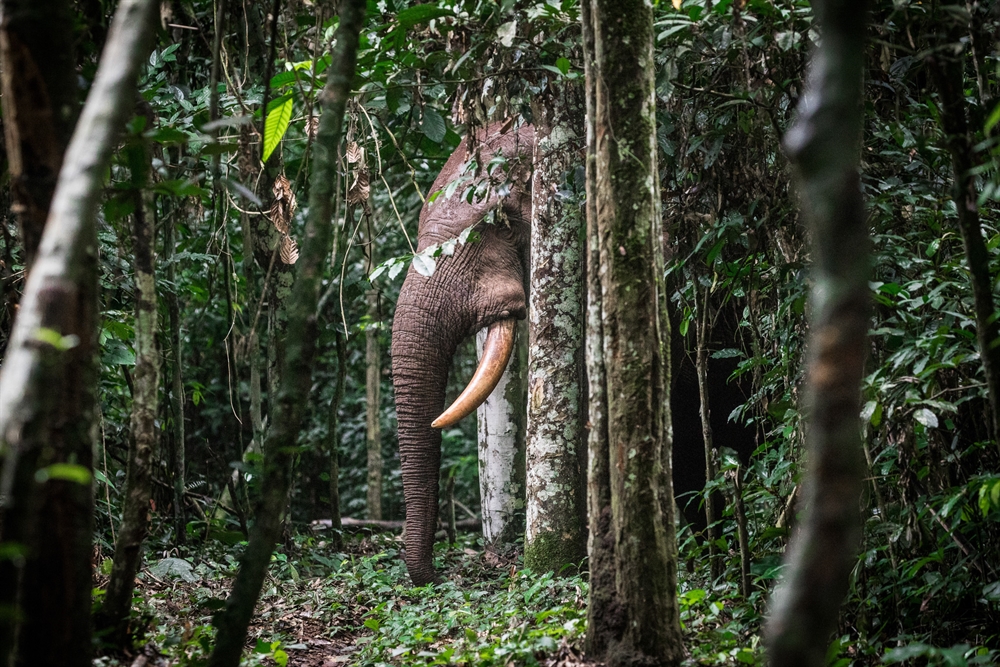
Odzala-Kokoua National Park, managed by the nonprofit African Parks alongside Congo's Ministry of Forest Economy since 2010, is the country's headline wildlife destination: dense equatorial forest holding habituated groups of western lowland gorillas, along with forest elephants and forest buffalo. Three lodges, Ngaga, Lango and Mboko, operated by Kamba, put you within reach of daily treks; expect $500-1,200 a night for the lodges on top of a $350-450 trekking permit, still considerably less than mountain gorilla permits in Rwanda or Uganda. Access is by charter flight from Brazzaville, arranged through the lodge operator, since there's no scheduled commercial service.
Nouabalé-Ndoki National Park
Created in 1993 and never logged, Nouabalé-Ndoki protects one of the most intact forest ecosystems left in the Congo Basin, with no roads inside its borders and wildlife that has had minimal contact with people. It anchors the Sangha Trinational, a single UNESCO World Heritage Site since 2012 spanning three contiguous national parks across Congo, Cameroon and the Central African Republic. Mbeli Bai, a marshy forest clearing, is the park's signature sight: forest elephants and sometimes gorillas gather at the mineral-rich soil in full view of a raised observation platform.
This is the most logistically demanding part of the country to reach, typically a flight to Ouesso followed by boat and road transfers, and it's built for travelers already committed to a serious, multi-day wildlife trip rather than an add-on.
Beyond the main circuit
These two are for travelers with time, a real interest in the country's less-visited corners, and no illusions about how hard they are to reach.
Lake Télé
A near-perfectly circular lake deep in roadless swamp forest, reachable only by a multi-day trek or canoe, famous locally for the legend of Mokele-mbembe, a dinosaur-like creature local communities describe living in its waters. Nobody credible expects to find a dinosaur; the genuine remoteness and the story's place in Congolese folklore are the real draw.
Mayombe Forest
A coastal rainforest belt running from southern Congo into Gabon and Angola's Cabinda exclave, holding chimpanzees, western lowland gorillas and forest elephants alongside an exceptionally rich bird community. Under real pressure from logging, and correspondingly short on any tourism infrastructure at all.
Culture & Etiquette
French is the language of government, business and every road sign, but Lingala and Kituba are what most Brazzavillois actually speak to each other, alongside Kikongo, Teke and dozens of other languages. Congolese rumba, the guitar-and-vocal dance music that grew up on both banks of the river through the 20th century, was jointly inscribed on UNESCO's Intangible Cultural Heritage list by both Congos in 2021, a rare piece of shared culture the two countries formally agree on. Music and fashion, more than religion or ritual, are where Congolese identity performs itself most visibly to a visitor.
Do
- Carry your yellow fever certificate everywhere, not just at the border. It gets checked more often than you'd expect, including sometimes at domestic flight check-in.
- Learn basic French greetings. Bonjour, merci, ça va: French carries you much further here than English will, and the effort is noticed.
- Ask before photographing people, including Sapeurs, who are often glad to pose but appreciate being asked rather than shot from across the street.
- Carry small XAF notes. Shared taxis, market stalls and tips all run on small cash; large bills are hard for vendors to break.
- Get the country right in conversation. Assuming Congo-Brazzaville and DR Congo are the same place is a common outsider mistake and a mildly awkward one to make out loud.
Don't
- Photograph government buildings, bridges, airports or military personnel. This is taken seriously and can lead to a genuinely unpleasant conversation with authorities.
- Drink tap water untreated. Stick to bottled or properly filtered water, including for brushing teeth.
- Walk around with visible valuables after dark, particularly outside the main hotel districts of Brazzaville and Pointe-Noire.
- Discuss national politics casually with strangers. Sassou Nguesso's long rule is a sensitive topic; let locals raise it if they want to, rather than the other way around.
- Expect the DR Congo e-visa system to apply here. The two countries' visa processes are entirely separate, and conflating them is a common and costly mistake.
Deeper culture: the Sapeurs, the Poto-Poto School, and Congolese rumba
La Sape. The Société des Ambianceurs et des Personnes Élégantes, better known as the Sapeurs, is a fashion subculture centered on precise, colorful, often designer-label tailoring worn by ordinary working Brazzavillois, taxi drivers and tailors among them, who transform into dandies once the workday ends. Every neighborhood has its own Sapeur circle, but Bacongo is the most consistently recommended for Sunday sightings at neighborhood pubs, where dressing well is treated as a form of dignity and defiance rather than vanity. The photographer Daniele Tamagni's book "Gentlemen of Bacongo" remains the standard visual document of the movement.
The Poto-Poto School of Painting. Founded in 1951 by the Frenchman Pierre Lods after he encountered the vivid, figurative style of a young Congolese painter named Félix Ossali, the school gave African artists studio space and total creative freedom, with Lods offering only technical, never stylistic, feedback. It reached New York's MoMA by 1955 and the Brussels World's Fair by 1958, and flourished further after independence under former students Nicolas Ondongo and Guy Léon Fylla. It remains the first formal school of painting in sub-Saharan Africa and is still producing and selling work in Brazzaville today.
Congolese rumba. A guitar-driven dance music descended from an older dance called nkumba, meaning "waist" in Kikongo, rumba grew up simultaneously in Brazzaville and Kinshasa through the mid-20th century and became the shared soundtrack of both Congos and much of Francophone Africa. Its joint 2021 UNESCO inscription, filed by both countries together, is one of the only formal acknowledgments of how thoroughly entangled the two nations' cultures remain despite decades of separate, often difficult, national histories.
Food & Drink
Congolese cooking is built around cassava, palm nut sauce and river fish, with cassava appearing in more forms than most visitors expect: boiled, pounded into leaves, or fermented and steamed into dense, sour bread. It's a cuisine best eaten at family-run spots and market stalls rather than hotel restaurants, and portions tend to be generous and unhurried, meant to be shared.
Poulet Moambe
Widely considered the national dish: chicken braised in a rich sauce made from pounded palm nut pulp (moambe, or sauce graine), tomato, onion and pili-pili chili, usually served over rice or plantain.
Saka-Saka & Chikwangue
Saka-saka is pounded cassava leaves cooked down with peanut paste and spices, usually alongside fish or meat. Chikwangue is fermented cassava root steamed in banana or koko leaves into a dense, tangy bread, the standard starch at nearly every meal.
Maboke
Fish or meat seasoned and wrapped in koko (Marantaceae) leaves, then steamed or grilled over coals so the parcel locks in the marinade. Widely regarded as a strong contender for the country's other national dish.
When to Go & Itineraries
The long dry season from June to September is the best window for wildlife viewing and for reaching Odzala-Kokoua and Nouabalé-Ndoki, when forest trails are firmer and rivers more navigable. A shorter dry spell runs December into January. The rainy seasons, October-November and March-May, turn rural roads to mud, complicate charter flights into remote camps, and see some lodges reduce operations or close entirely.
Seasons compared, with what actually changes
| Season | Verdict | Temps | What it means for your trip |
|---|---|---|---|
| Jun-Sep | Best | 22-30°C | Firmer trails, best gorilla and elephant viewing, easiest charter access to the north |
| Dec-Jan | Good | 23-31°C | Shorter dry spell, lighter crowds at Odzala, still reliable for trekking |
| Oct-Nov | Difficult | 23-30°C, humid | Rains build, rural roads deteriorate, some lodges scale back |
| Mar-May | Difficult | 23-30°C, humid | Heaviest rains, hardest month to reach Nouabalé-Ndoki, mosquito pressure peaks |
Brazzaville and Pointe-Noire stay warm and humid year-round with little temperature swing; the difference between seasons is almost entirely rainfall and road passability, not heat.
Itineraries
Five days covers the essentials for a gorilla-focused trip. Ten days adds the coast. Two weeks is really only worthwhile if the remote north genuinely interests you, since the logistics and cost step up considerably to get there.
- Days 1-2
Brazzaville. Basilique Sainte-Anne, La Corniche, the Poto-Poto School of Painting, and a Sunday afternoon in Bacongo if your dates allow it.
- Days 3-5
Odzala-Kokoua. Charter flight from Brazzaville, two nights at a lodge with daily gorilla treks, return via Brazzaville.
- Days 1-2
Brazzaville. The capital's sights, plus the Lesio-Louna Gorilla Sanctuary as a long day trip.
- Days 3-5
Pointe-Noire & the coast. Diosso Gorges, the Tchimpounga chimpanzee sanctuary, a day at Conkouati-Douli.
- Days 6-10
Odzala-Kokoua. Charter flight in, four nights split between lodges for repeat gorilla treks and forest walks, charter back to Brazzaville.
- Days 1-2
Brazzaville extended. Capital sights plus the Lesio-Louna day trip.
- Days 3-5
Pointe-Noire & the coast. Diosso Gorges, Tchimpounga, Conkouati-Douli.
- Days 6-9
Odzala-Kokoua. Four nights, multiple gorilla treks and forest walks across two lodges.
- Days 10-14
Nouabalé-Ndoki & the Sangha Trinational. Fly to Ouesso, transfer by boat and road, several days at Mbeli Bai and the surrounding forest before the long trip back to Brazzaville.
Getting there & around
Maya-Maya International Airport (BZV) in Brazzaville has one intercontinental link: Air France flies nonstop to Paris CDG year-round, and it's currently the only carrier flying nonstop to Europe from Brazzaville. Most other international arrivals connect through a regional hub. Between Brazzaville and Pointe-Noire, the weekly CFCO passenger train, nicknamed "La Gazelle," takes roughly 14-16 hours overnight with air-conditioned sleeper cars; a domestic flight covers the same route in under an hour and is the more practical choice for most visitors. Neither Odzala-Kokoua nor Nouabalé-Ndoki has scheduled commercial air service: access is by charter flight arranged through your lodge or tour operator.
City transport, the river ferry, and practical prep
| Option | Price | Notes |
|---|---|---|
| Shared taxi (Brazzaville/Pointe-Noire) | 500-1,000 XAF | Loosely fixed routes, pick up multiple passengers; the standard local way to get around. |
| Private taxi, short ride | 1,000-3,000 XAF | Not metered; agree the fare before you get in. No confirmed ride-hailing app in wide local use. |
| CFCO sleeper, Brazzaville-Pointe-Noire | ~15,000 XAF | Weekly departures each direction; prices drift, confirm current fare before booking. |
| Ferry to Kinshasa, Beach Ngobila | ~16,000-28,000 XAF | Under an hour crossing; requires a separate DR Congo visa and patience for informal fees at both sides. |
Practical prep: a local SIM from MTN Congo or Airtel Congo is available in Brazzaville and Pointe-Noire; signal drops out fast once you're in the forest zones. French is close to essential; a phrasebook or offline translation app closes most gaps. Standard travel insurance with medical evacuation coverage is worth having specifically because serious medical cases are typically flown to Europe or South Africa rather than treated locally.
Where to stay
Odzala-Kokoua lodges
Ngaga, Lango and Mboko, all operated by Kamba, are the only realistic base for gorilla trekking, with rates that bundle guiding, meals and usually the charter flight. Book directly through the operator well ahead of your trip.
City hotels
Brazzaville has the country's most reliable hotel stock, from international chains to family-run guesthouses; see our Brazzaville city guide for specific, vetted picks. Pointe-Noire's options skew toward business travelers tied to the oil industry.
Budget Planning
Day-to-day costs in Brazzaville and Pointe-Noire are moderate by regional standards. The number that changes everything is gorilla trekking: a few days at Odzala-Kokoua can cost more than two weeks everywhere else in the country combined, so it's worth budgeting for as its own line item rather than folding it into a daily average.
- Guesthouse room $25-40
- Market meals & street food $3-8
- Shared taxis around town
- Free sights: La Corniche, markets
- Mid-range hotel $80-150
- Restaurant meals $10-25
- Private car and driver for day trips
- Domestic flight, Brazzaville-Pointe-Noire
- Trekking permit $350-450
- Lodge $500-1,200/night, several nights
- Charter flight to/from Odzala
- Best treated as a standalone package cost
Quick reference prices
| Ngok or Primus beer | ~1,000-1,500 XAF |
| Market meal (saka-saka, fish) | 2,000-4,000 XAF |
| Shared taxi ride | 500-1,000 XAF |
| Radisson-tier hotel, Brazzaville | $170-190/night |
| CFCO sleeper ticket | ~15,000 XAF |
| Odzala-Kokoua trekking permit | $350-450 |
| Kinshasa ferry crossing | ~16,000-28,000 XAF |
Prices reflect August 2026 research and drift over time, especially lodge and permit rates. Treat them as a planning baseline, not a quote, and confirm directly with operators before booking.
Visa & Entry
Nearly every nationality needs a visa arranged in advance through a Congolese embassy or consulate; there is no visa on arrival. Applications typically require an invitation letter or hotel booking, a passport valid at least three months beyond entry with two blank visa pages, and a yellow fever vaccination certificate, which is checked at the border regardless of what your visa says. Processing commonly takes one to three weeks through an embassy or visa agency, with express options available at some missions for a higher fee.
✓ Valid passport
At least 3 months validity beyond entry, with two adjacent blank visa pages. Keep a photocopy separate from the original.
✓ Yellow fever certificate
Mandatory for every traveler over 9 months old, checked at the border and sometimes again for domestic flights. No certificate, no entry.
✓ Invitation letter or hotel booking
Most embassies require one or the other as part of the application; a confirmed hotel reservation is usually the simpler route for independent travelers.
✓ Visa fee & timing
Commonly $160-200 through a visa agency, less if applied for directly at an embassy consular window. Budget one to three weeks unless express processing is offered.
| Republic of Congo (Brazzaville) | DR Congo (Kinshasa) | |
|---|---|---|
| US advisory | Level 2, Exercise Increased Caution, generally | Level 4, Do Not Travel, countrywide |
| Distance apart | The world's closest pair of capital cities: roughly 3km apart across the Congo River, with a ferry connecting them | |
| Current conflict | No comparable active conflict as of 2026 | Active M23/Rwanda-linked conflict in the east |
| Scale | ~6.4 million people, considerably smaller | ~112-116 million people, 2nd-largest African country by area |
| Shared draw | Both sit on the Congo River and share deep cultural and linguistic ties, including Lingala and Congolese rumba | |
Safety, Solo Travelers & Family
The US State Department rates the Republic of Congo Level 2, exercise increased caution, primarily for crime rather than conflict or terrorism. Violent crime such as armed robbery and assault happens but isn't common; the practical risks for most visitors are petty theft, poor road conditions outside the two main cities, and limited medical care rather than anything more dramatic. Tellingly, the US government requires its own personnel to travel in two-vehicle convoys for any overland travel outside Brazzaville, and restricts them to hotel-adjacent beaches in Pointe-Noire, a useful data point even if your own trip carries less institutional caution.
Crime & night safety
Keep valuables out of sight, avoid walking alone after dark outside main hotel districts, and use a hotel-arranged or pre-agreed driver rather than hailing a taxi off the street at night.
Road travel outside the cities
Roads deteriorate fast once you leave Brazzaville or Pointe-Noire, especially in the rainy seasons. Avoid night driving between towns, and travel with a local driver who knows current conditions.
Health & medical care
Yellow fever vaccination is mandatory; malaria prophylaxis is strongly advised countrywide. Medical facilities are limited even in Brazzaville, and serious cases are typically evacuated to Europe or South Africa, which is the real argument for good travel insurance here.
Demonstrations, the border crossing, and remote-area logistics
Demonstrations. Political gatherings can turn unpredictable quickly and are best avoided entirely as a visitor, regardless of how orderly they look. This is standard advice across most of the region and applies here without exception.
The Kinshasa ferry crossing. Beach Ngobila has a well-earned reputation for informal "fees" requested by officials and fixers on both sides. Keep small XAF and USD notes handy, stay patient and polite, and consider arranging a fixer or guide for your first crossing if you're not confident navigating it solo.
Remote wildlife areas. Odzala-Kokoua and especially Nouabalé-Ndoki are hours from the nearest real medical facility by any means of transport. Lodge operators plan around this, but it's worth understanding before you go: a twisted ankle on a gorilla trek is a bigger logistical problem here than almost anywhere else you might have trekked before.
Solo travelers & families
Reliable, Congo-specific data on solo female travel here is thin, because most visitors arrive on organized wildlife trips with a guide and driver rather than traveling independently, which is itself the honest advice: this isn't a country with an established backpacker or solo-travel scene to plug into. General precautions apply, dress modestly, avoid walking alone at night, and keep a low profile with valuables, but treat any specific numeric safety score for solo women here with real skepticism, including ones you might see elsewhere online. Family travel follows a similar pattern: workable for families experienced with less-developed destinations and comfortable with an organized-tour structure, but not an easy first trip abroad with young kids given the vaccination requirements, limited medical infrastructure, and near-total absence of child-specific tourist facilities.
Emergency numbers
The honest state of emergency services
There is no unified 112-style emergency number here. Police (117) and fire (118) have dedicated lines, but ambulance response runs through individual private clinics rather than a national dispatch system, and most operators speak French only. In practice, your hotel or lodge staff, or your tour operator's local contact, will usually get help to you faster than calling a number cold, especially outside Brazzaville. Save your embassy's emergency contact number before you arrive, and enroll in your government's traveler registration program if one is available.
Republic of Congo FAQ
Is the Republic of Congo (Congo-Brazzaville) safe to visit?
The US State Department rates it Level 2, exercise increased caution, mainly for crime. Violent crime such as armed robbery happens but isn't common, and Brazzaville is generally manageable with normal city awareness plus caution at night.
Is the Republic of Congo the same as DR Congo?
No, they are two different countries that share a name and a border along the Congo River. The Republic of Congo (capital Brazzaville) is smaller, calmer and rated Level 2 by the US State Department. DR Congo (capital Kinshasa) is far larger and currently rated Level 4, do not travel, due to active conflict in its east.
Do I need a visa for the Republic of Congo?
Yes, almost every nationality needs a visa arranged in advance through a Congolese embassy or consulate. There is no visa on arrival and no reliable government e-visa portal, unlike neighboring DR Congo. Budget one to three weeks for processing and always carry a yellow fever certificate.
How much does gorilla trekking cost in Odzala-Kokoua?
Trekking permits run roughly $350-450 per person, well below the $700+ charged in Rwanda and Uganda. Lodge accommodation at Ngaga, Lango or Mboko adds $500-1,200 a night, so a full trip typically runs several thousand dollars all-in including the charter flight from Brazzaville.
When is the best time to visit the Republic of Congo?
The long dry season from June to September is best for wildlife viewing and reaching Odzala-Kokoua and Nouabalé-Ndoki. A shorter dry spell in December and January also works. The rainy seasons, October-November and March-May, make rural roads difficult and some camps close.
How many days do you need in the Republic of Congo?
Five days covers Brazzaville plus a gorilla-trekking trip to Odzala-Kokoua. Ten days adds Pointe-Noire's coast and Diosso Gorges. Two weeks is realistic only for travelers adding the remote Nouabalé-Ndoki forest in the far north.
What language is spoken in the Republic of Congo?
French is the official language of government, business and signage. Lingala and Kituba are the widely spoken national languages on the street, alongside dozens of local languages. English is rare outside a handful of upscale hotels.
Do I need a yellow fever vaccine for the Republic of Congo?
Yes, a yellow fever vaccination certificate is mandatory for every traveler over nine months old and is checked at the border. Malaria prophylaxis, hepatitis A and typhoid vaccination are also strongly recommended.
Can I cross the river to Kinshasa from Brazzaville?
Yes, a passenger ferry from Beach Ngobila crosses the Congo River in well under an hour, connecting the world's two closest capital cities. You'll need a separate DR Congo visa in advance; the crossing has a reputation for informal fees, so keep small notes handy and stay patient.
Is the Republic of Congo cheaper than Rwanda or Uganda for gorilla trekking?
The trekking permit itself is cheaper, $350-450 versus $700 or more in Rwanda and Uganda. But Odzala-Kokoua's lodges run $500-1,200 a night and access requires a charter flight, so total trip cost is comparable once logistics are factored in.
What currency is used in the Republic of Congo?
The Central African CFA franc (XAF), fixed to the euro at 655.957 XAF per euro. It's a cash economy outside a few Brazzaville and Pointe-Noire hotels, so carry USD or EUR as backup and use bank ATMs rather than street exchangers.
Is Brazzaville worth visiting on its own, without the national parks?
Yes for travelers interested in the Sapeurs' dandy fashion culture, the Poto-Poto School of Painting, and the strange experience of standing on La Corniche looking across the river at Kinshasa, a city 30 times its size. It's a modest two-day capital, not a headline destination by itself.
What Stays With You
Most people who can name the Republic of Congo at all know it only as the smaller, safer country next to the one making headlines. That's an accurate description and also, once you're actually standing on La Corniche watching Kinshasa's lights come on across the water, a strange one to hold in your head: two capitals within sight of each other, two national histories that split hard and then quietly agreed to share their music anyway.
Go for the gorillas if that's what gets you on the plane, but the country's real argument for itself is smaller and stranger: a Sunday afternoon in Bacongo watching a taxi driver turn into a dandy, in a city that the rest of the world has simply forgotten to visit.