
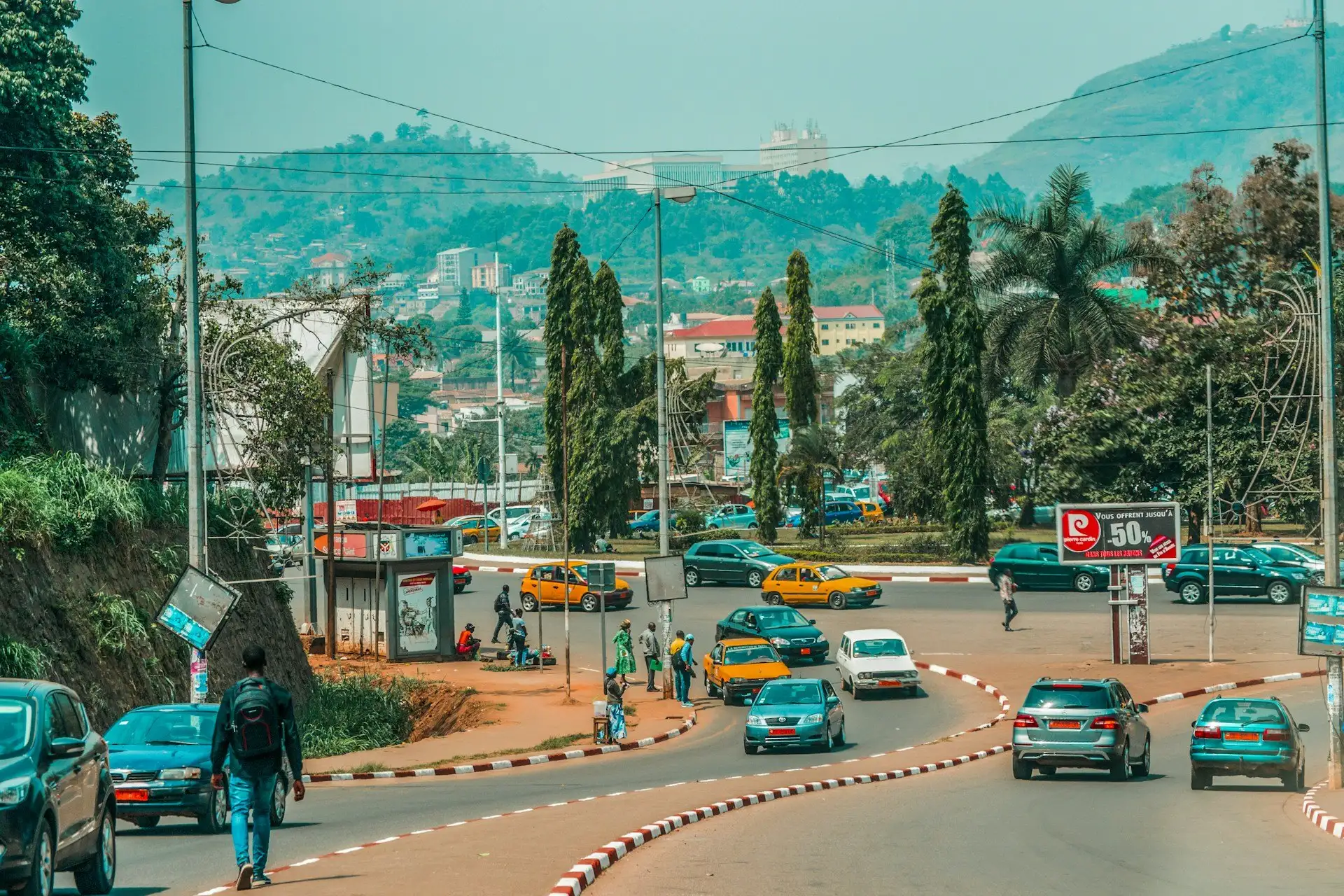
Cameroon
They call it Africa in miniature, and the description earns its name: rainforest, savanna, desert, active volcano, Atlantic coast, and 280 languages within one country's borders. The Anglophone crisis has closed parts of it to visitors. The rest is some of the most extraordinary travel available in Central Africa.
What You're Actually Getting Into
Cameroon is simultaneously one of Central Africa's most rewarding travel destinations and one of its most complex to navigate. The country genuinely earns the Africa in miniature nickname: within its borders you can travel from equatorial rainforest in the south to savanna in the center to semi-arid Sahel in the north, with an Atlantic coast, an active volcano, and West African highland kingdoms layered through the middle. The biodiversity is extraordinary: chimpanzees, western lowland gorillas, forest elephants, and some of the continent's highest species counts of birds and plants all within a country the size of California.
The complication: Cameroon has been governed by Paul Biya since 1982, making him one of the world's longest-serving heads of state, under a system that has progressively consolidated power while maintaining the appearance of multiparty democracy. More urgently for visitors, the country's two Anglophone regions — Northwest and Southwest — have been in active armed conflict since 2016, with separatist forces (Ambazonia) and government security forces fighting across a landscape that was, before the crisis, home to some of Cameroon's most extraordinary destinations including Mount Cameroon and Korup National Park. This conflict has killed thousands, displaced hundreds of thousands, and made these regions genuinely dangerous and inaccessible for tourists.
The accessible Cameroon — Yaoundé, Douala, Kribi, the western highlands outside the conflict zone, the Dja Reserve, the north — is still remarkable and still visitable with preparation. This guide maps both clearly, names what's accessible and what isn't, and gives you what you need to visit the parts of Cameroon that are currently safe while being honest about the parts that are not.
Cameroon at a Glance
⚠️ Ratings apply to accessible safe regions only. Northwest and Southwest regions are not rated here due to active conflict.
The Security Situation by Region
Cameroon's security situation is not uniform and must be understood region by region. The critical mistake that visitors make — and that some travel resources encourage — is treating the country as uniformly risky or uniformly safe. Neither is accurate. The southwest and northwest are in active conflict. The far north has Boko Haram activity near the Chad border. The rest of the country — which contains the majority of tourist attractions — is generally accessible with standard precautions. Understanding the map of where the risk actually lies allows you to plan a meaningful Cameroon visit while avoiding genuinely dangerous areas.
Northwest Region
Active armed conflict between Ambazonia separatist forces and government security forces. Multiple armed groups operating. Ambushes, kidnappings, and armed attacks on civilians and security forces documented. Bamenda (the regional capital) and surrounding areas. Do not travel here. Most Western governments advise against all travel to this region.
Southwest Region
Active conflict same as Northwest. Includes Buea (base for Mount Cameroon), Limbe, and Korup National Park. All of these destinations, which were previously among Cameroon's finest, are inaccessible under current conditions. Mount Cameroon treks and Korup gorilla trekking should not be planned until this situation changes. Check most current advisories.
Extreme-Nord Region
Boko Haram/ISWAP activity in areas near the Lake Chad border and the Mandara Mountains. Border areas with Nigeria and Chad carry genuine risk. Waza National Park (previously a major attraction) has had security incidents and requires current assessment before any visit. Most governments advise against travel to border areas in this region.
Adamawa & Nord Regions
More stable than the far north but some risk remains from Boko Haram in northern Adamawa. The city of Ngaoundéré (train terminus from Yaoundé) is generally safe. Travel north of Ngaoundéré toward the Extreme-Nord requires specific current intelligence before proceeding.
Centre, Littoral, South Regions
Yaoundé, Douala, Kribi, Ebolowa, and the southern rainforest are generally safe for visitors with standard urban precautions. These regions contain the capital, the main international entry point (Douala), and several major attractions including Kribi and Dja Reserve access.
West Region (Bafoussam, Bamoun)
The highland kingdoms area including Bafoussam, Bamoun/Foumban, and Bafia is adjacent to the Northwest conflict zone but has been largely stable. The Ring Road historically passes through both Northwest (conflict) and West (safer) regions. Currently the Northwest section of the Ring Road is not traversable. Check current conditions for specific West Region destinations.
A History Worth Knowing
Cameroon's shape on a map looks like a finger pointing north into the African interior, and the country's history has been shaped by that position: a junction between West and Central Africa, the Atlantic coast, and the Sahel, attracting and absorbing influences, trade routes, and colonial ambitions from multiple directions simultaneously.
The grassland kingdoms of the west — Bamoun, Bafut, Bamiléké, and others — developed sophisticated political and artistic cultures over centuries, producing the elaborate bronze and bead regalia, carved masks, and architectural traditions that fill the region's royal palaces today. The Bamoun sultan Njoya, who ruled from around 1886 to 1933, created an entirely original script for the Bamoun language (one of only a handful of indigenous African writing systems ever developed), a palace that remains one of the most interesting buildings in Central Africa, and a system of governance that the German colonial administration eventually found troublesome enough to dismantle.
The German colonial period began in 1884 when Germany signed treaties with coastal chiefs, creating Kamerun. The Germans built the rail lines from Douala and cleared large tracts of rainforest for plantations under conditions that were brutal even by colonial standards. Germany lost Kamerun after World War I; the League of Nations split the territory between France (80 percent) and Britain (20 percent). The French ran their portion as part of French Equatorial Africa; the British ran their portion as two strips of territory administered from Nigeria — a Northern Cameroons and a Southern Cameroons, both appended to a neighboring colony rather than treated as distinct entities.
This arrangement is the root of the current Anglophone crisis. When French Cameroon became independent in 1960, the two British-administered territories held a plebiscite: Northern Cameroons voted to join Nigeria; Southern Cameroons voted to join the new Cameroon republic in a federation. The 1961 federation gave the Anglophone population a degree of autonomy. Then, in 1972, President Ahmadou Ahidjo abolished the federation and replaced it with a unitary state under which the Francophone majority dominated almost every institution. English-speaking Cameroonians describe the subsequent decades as a gradual marginalization: French-speaking lawyers in English-speaking courts, French-speaking teachers in English-speaking classrooms, exclusion from senior civil service positions, economic neglect of the northwest and southwest.
Protests began in 2016 when lawyers and teachers in the Anglophone regions struck against the imposition of French-trained judges and teachers. The government responded with arrests and force. By 2017 the protests had evolved into an armed separatist movement declaring the Republic of Ambazonia. By 2018 it was a full conflict. As of 2026, the conflict continues with no political resolution in sight, a pattern of atrocities documented on both sides, and a humanitarian situation of serious concern. Paul Biya, who has governed since 1982, maintains power. The international community's response has been muted.
Bamoun, Bafut, Bamiléké, and other kingdoms develop in the western highlands. Rich traditions of art, governance, and trade.
Bamoun Sultan Njoya invents the Shu Mom script for the Bamoun language. One of the few original African writing systems ever created.
Germany establishes the colony of Kamerun. Plantation economy built on forced labor. Rail lines pushed into the interior.
After WWI, Kamerun divided between France (80%) and Britain (20%). The British portion administered as appendage to Nigeria.
French Cameroon independent January 1960. Southern Cameroons votes to join in federation (1961). Northern Cameroons joins Nigeria.
President Ahidjo abolishes the federation. The Anglophone population loses formal autonomy. Marginalization begins systematically.
Biya succeeds Ahidjo. Continues to govern in 2026 — over 40 years in power. One of the world's longest-serving heads of state.
Protests escalate to armed conflict. Thousands dead. Hundreds of thousands displaced. Northwest and Southwest effectively outside government control in many areas.
Accessible Destinations
The destinations below are in regions that are currently accessible to visitors. Each entry notes the current security context where relevant. Destinations in the Northwest and Southwest conflict zones are documented separately at the end of this section, for reference and for when conditions improve.
Douala
Douala is the largest city, the main port, the entry point for most international flights, and a genuinely interesting city that most travelers treat as a transit stop and shouldn't. The Bonanjo district has the colonial-era buildings that survive from the German and French periods. The Marché Central is one of Central Africa's great urban markets: noise, color, and the full commercial range of a port city that touches every economic zone in the country. The Douala Art Museum in the Akwa neighborhood documents the region's contemporary art scene, which has been unusually strong. The city's restaurant culture reflects its cosmopolitan economy: Cameroonian, French, Chinese, and Lebanese cuisines all represented at a standard that the capital Yaoundé doesn't quite match. Allow two full days minimum; most visitors who rush through miss a city that repays slow attention.
Kribi
Three hours south of Douala on the Atlantic coast, Kribi is the best beach in Central Africa and not a close contest. The white sand and warm water of the main beach, the Chutes de la Lobé where the Lobé River falls directly into the sea (one of the world's few Atlantic waterfalls), the Bassa fishing village immediately north of town where the catch comes in at dawn and goes directly onto charcoal grills — Kribi is what Douala residents do on long weekends and what visitors who discover it tend to extend their stay for. The Pygmy community of Bagyeli outside Kribi can be visited with appropriate cultural protocols through organizations that work with community consent: ask at your hotel for the current recommended approach. The road from Douala is paved and well-maintained. Allow three days minimum to actually stop rushing.
Dja Faunal Reserve
One of the largest and best-preserved tropical rainforests in Africa, a UNESCO World Heritage Site, and the best accessible location for western lowland gorilla tracking in Cameroon. The reserve covers 5,260 square kilometers in the south of the country and is accessible from Yaoundé (about 3 hours to the nearest entry point at Somalomo or Lomié). Western lowland gorillas, chimpanzees, forest elephants, bongo, sitatunga, and mandrill are all present. Gorilla tracking requires advance booking with park authorities or a registered operator: the groups are semi-habituated and sightings are not guaranteed but rates are reasonable. Budget two to three nights in the forest minimum; half-day visits miss the depth of what's here. The forest itself — cathedral-height trees, the particular quality of equatorial light filtered through 60 meters of canopy — is extraordinary regardless of what you see.
Foumban (Bamoun Kingdom)
The Bamoun sultan's palace in Foumban is the most extraordinary royal complex in Central Africa. The current palace, built in the early 20th century with European architectural elements adapted to Bamoun aesthetics, houses the Museum of Bamoun Art: throne rooms, royal weapons, masks, regalia, and the original manuscripts of Sultan Njoya's Shu Mom script. The bronze work and woven textiles in the palace museum are among the finest examples of West African applied arts anywhere. The Thursday market outside the palace draws traders from across the highland region. Foumban is in the West Region, generally accessible. Allow a full day minimum; the artisans' quarter around the palace where metalwork and weaving are still practiced is a half-day on its own.
Bafoussam & West Region
Bafoussam is the capital of the West Region and the practical base for exploring the highland kingdoms, markets, and volcanic lakes of this area. The Chefferies (traditional chieftaincy compounds) around Bafoussam and Bangangté are among the most accessible examples of the Bamiléké architectural tradition: multistorey bamboo buildings with ornate carved posts and thatched roofs. Lake Barombi Mbo near Kumba (south, not in conflict zone) is an ancient crater lake. The volcanic twin lakes of Lake Manengouba are an hour's drive and have crater lake walks and spectacular mist-wrapped views. This region, accessed from Bafoussam rather than from the Northwest via the Ring Road, is accessible under current conditions.
Yaoundé
The political capital sits at 750 meters in the highland center, with a cooler climate and more spacious layout than coastal Douala. The National Museum is a good introduction to Cameroon's ecological and cultural diversity before heading into the field. The Mvog-Betsi Zoo, for all the obvious reservations about zoos, has rescued great apes and is run in partnership with conservation organizations — it's the easiest way to see a chimpanzee without going to the forest. The cathedral of Notre-Dame des Victoires and the mosque on the Avenue Kennedy are visible symbols of the cultural pluralism the city represents on its better days. Yaoundé is safer and calmer than Douala and works well as a planning base for southern itineraries.
Ngaoundéré
The terminus of the Yaoundé-to-north railway, Ngaoundéré sits on the Adamawa plateau at 1,100 meters and has a relaxed highland atmosphere and a significant Muslim cultural presence from the Fulani traditions of the north. The overnight train from Yaoundé is one of the better rail journeys in Central Africa — 16 hours through changing landscapes, the overnight departure, the dawn arrival into the highland air. The Lamido palace compound in the city is an active chieftaincy with a ceremonial life that's worth timing a visit around. From Ngaoundéré, the road north toward Garoua and Waza requires careful current security assessment before proceeding.
Waza National Park
Once the best wildlife park in Central Africa, Waza in the Extreme-Nord region has lion, elephant, giraffe, and large herbivore populations in an open savanna environment that's accessible March through May when the park is fully open. The park has had security incidents related to Boko Haram activity in the broader region, and the Extreme-Nord's border areas carry genuine risk. Waza town itself has been relatively stable, but the access roads pass through areas of varying security. Check the most current government advisories and contact a local operator in Maroua who knows the current situation before planning any visit to this area.
Culture & Etiquette
Cameroon is one of Africa's most culturally complex countries. Over 280 languages spoken by more than 250 ethnic groups within a single national territory creates a texture of cultural difference that's unusual even by African standards. The country is also bilingual in a politically loaded way: French and English are both official languages, but the Anglophone minority's status and the current conflict have given the language divide an emotional charge that visitors from English-speaking countries will encounter directly.
In the Francophone majority — which includes Yaoundé, Douala, Kribi, and most of the south — French is the working language and English is welcomed but not expected. In the West Region, local languages (Medumba, Bamoun, Fe'efe'e) are common alongside French. Being aware of the political dimensions of the French/English divide, and not making casual comments about it to people you've just met, is appropriate sensitivity rather than excessive caution.
"Bonjour, comment allez-vous?" before anything else. In the north among Muslim communities, "As-salamu alaykum" is appropriate. In the highlands, a local language greeting produces disproportionate warmth. The greeting is the meeting; rushing past it marks you immediately as someone not worth full hospitality.
When offered at a gathering or a chief's compound, accept what is given. Palm wine in Cameroon — particularly the version from the west — is genuinely excellent and a mark of hospitality. Refusing without explanation is a social slight.
Visits to traditional chieftaincy compounds (chefferies) in the west require modest dress and sometimes the removal of shoes. At Muslim chieftaincy events in the north, covered shoulders and ankles are appropriate for women. Ask before entering any compound what is expected.
Prices for taxis, markets, and informal services are negotiated. The opening price and the final price are different by convention. Negotiate firmly, pleasantly, and without aggression. The person you're negotiating with is trying to make a living; a reasonable final price that suits both of you is the correct outcome.
The Anglophone crisis is a painful, live, politically sensitive subject. Cameroonians have strong and varied views about it. As a visitor, listen to what people share; don't probe, and don't make casual political comments about a conflict that has cost people their families, homes, and livelihoods.
This is taken seriously and enforcement can be unpredictable. Do not photograph checkpoints (common on all main roads), military vehicles, government ministries, or the presidential compound. The consequences range from confiscated equipment to prolonged detention.
Intercity road travel after dark is not advisable anywhere in Cameroon, both from road safety (unmarked obstacles, animal crossings) and security (checkpoints become more difficult to navigate at night). Plan your movements to be at your destination before dark.
Police and gendarmerie checkpoints are frequent on all main roads. Have your passport and visa accessible at all times. Be polite and cooperative. Having a local driver who can navigate these interactions in French and local languages removes friction that can be significant without their help.
Mask Traditions
The Bamiléké, Bafut, and Bamoun masquerade traditions of the western highlands are among the most important in Central Africa. The Kuosi society masks — enormous feathered constructions worn at royal funerals and enthronements — have been collected by every major museum in Europe and are among the most recognized symbols of Cameroonian art internationally. Seeing them in their original context, at a chieftaincy ceremony, requires patience and local connections. The palace museums in Foumban and Bafut have excellent examples in situ.
Makossa Music
Makossa is Cameroon's defining popular music export: an urban dance form developed in Douala that blends traditional Bassa rhythms with jazz, soul, and Afrobeat influences. Manu Dibango, whose 1972 track "Soul Makossa" was sampled by Michael Jackson and Rihanna (with litigation attached), remains the global reference point. The live music scene in Douala — particularly in the Akwa and Bali neighborhoods — still pulses with this tradition on weekend evenings. Finding it requires local knowledge and showing up late.
Baka and Bagyeli Forest Peoples
The Baka and Bagyeli (collectively called Pygmy peoples, a term some communities use and others prefer not to) are the original hunter-gatherer inhabitants of Cameroon's southern forests, living in and around the Dja Reserve and the Kribi area respectively. They face significant pressure from logging, agricultural encroachment, and displacement. Visits to their communities are sensitive and should only be arranged through organizations working with their specific consent — ask your operator or guesthouse specifically about this. Informal "Pygmy village visits" that treat communities as tourist attractions without consent or compensation are not appropriate.
Football
The Indomitable Lions are among Africa's most celebrated football teams, having reached the World Cup quarter-finals in 1990 and won the Africa Cup of Nations five times. Football is the one subject on which Cameroonians of every background, language, and political opinion find unified enthusiasm. Asking about the Lions' most recent match is the easiest social opener in the country. Samuel Eto'o, who played for Barcelona and Inter Milan and remains active in Cameroonian football administration, is a figure of almost mythological status at home.
Food & Drink
Cameroonian cuisine is one of Central Africa's finest: varied, technically accomplished, and built around a remarkable range of local ingredients that reflect the country's ecological diversity. The south uses plantain, cassava, egusi (melon seeds), and forest vegetables. The highlands add yam, corn, and highland beans. The north brings millet, sorghum, and the spicing traditions of the Sahel. The coast provides exceptional seafood. What ties it together is a tradition of slow cooking, of extracting deep flavor from simple ingredients, that produces some of the most satisfying eating on the continent.
Ndolé
The national dish: bitter leaf (ndolé leaf) stewed with peanut paste, dried shrimp or smoked fish, and either meat or plantain. The bitterness of the leaf is tempered by the cooking but not eliminated — it is the point, not a flaw. Served with plantain, rice, or miondo (cassava paste wrapped in banana leaves). Every Cameroonian cook has a family ndolé recipe considered correct and all others approximate. Eat it at a local restaurant in Douala for CFA 1,000 to 2,000 and you will understand something about the city.
Poisson Braisé (Grilled Fish)
Tilapia, barracuda, and capitaine (Nile perch) grilled over charcoal at roadside and beach grills across the country. In Kribi the fish comes directly from the boats to the fire. In Douala the beach grills in Bali neighborhood serve it with attiéké (fermented cassava couscous), hot pepper, and onion sauce. This is the meal that defines coastal Cameroon and is reliably better at an unpretentious outdoor grill than at any restaurant.
Eru (Waterleaf and Okok)
A specialty of the Southwest and Anglophone west: eru (a wild forest vine leaf, also called okok or Gnetum africanum) shredded finely and cooked with waterleaf, palm oil, crayfish, and meat or fish. The result is intensely green, richly savory, and unlike anything in West or East African cuisine. Eaten with fufu corn or water fufu (cassava dough). Finding eru in Douala is possible in restaurants that serve Anglophone Cameroonian food; in the west it appears at any gathering.
Mbongo Tchobi
A Bassa specialty from the Littoral region: a black, intensely spiced stew built around mbongo spice — charred tree bark from the calabash nutmeg tree — that gives it a dark color and a smoky, earthy depth unlike any other African stew. Made with fish (preferred) or chicken. The color looks alarming; the flavor is not. One of Cameroon's most distinctive and least internationally known dishes. Found in Douala restaurants specializing in traditional cuisine.
33 Export and Palm Wine
33 Export (Trente-Trois) is Cameroon's national lager, brewed since 1948 and the beer of virtually every celebration and informal gathering in the country. Cold, at CFA 500 to 700 in a local bar, it is a Cameroonian institution. Palm wine — white, naturally fermented, mildly alcoholic, and drunk fresh from the tree — is the highlands' social drink and genuinely excellent when tapped that morning, increasingly sour and potent as the day progresses. The best palm wine in Cameroon comes from the west, and the Bamiléké know it.
Koki and Corn Chaff
Koki is a steamed pudding of black-eyed peas, palm oil, and aromatics wrapped in banana leaves — a highland specialty that travels well as a street food. Corn chaff (corn and black-eyed peas cooked together with palm oil and Scotch bonnet) is the Anglophone west's comfort food, eaten at every funeral and naming ceremony and available at street food spots in Douala's Anglophone community restaurants. Both are simple, filling, and represent the best of what can be done with minimal ingredients and maximum knowledge.
When to Go
Cameroon's climate varies as dramatically as its ecosystems. The south has two rainy seasons (March–June and September–November) and two dry seasons. The highlands have a long rainy season (April–October) and a dry season (November–March). The north is dry and hot most of the year with a single rainy season (July–September). The general principle: dry season travel is more comfortable and makes rural roads and forest trails more accessible. But the rainy season turns the highlands green in a way that photographs poorly and looks spectacular in person.
Main Dry Season
Nov – FebThe ideal window for most of Cameroon. Roads are passable, forest trails manageable, the north is accessible, and temperatures in the highlands are at their most pleasant. Gorilla tracking in Dja is good year-round but dry season access roads are easier. Waza National Park (if visiting) best in March–May at the end of dry season.
Short Dry Season (South)
Jul – AugA brief drier window in the south between the two rainy seasons. Good for Kribi beach and the southern rainforest. Highlands receive rain year-round but July–August is manageable. Acceptable for Dja Reserve. The north is hot but technically in rainy season — the Sahel receives its minimal rainfall in July–September.
Long Rainy Season
Sep – NovThe main rainy season across the south. Forest trails muddy and sometimes flooded. Rural roads difficult. Kribi beach is rough. Douala and Yaoundé are fine — cities work rain or shine. The highland landscape is spectacularly green. If your itinerary is city-focused this window is fine; for forest and road travel it requires more tolerance.
Late Dry (North)
Mar – MayThe north in March–May is extremely hot (38–42°C in the Extreme-Nord) but this is when Waza National Park is fully open and wildlife is most visible at water sources. Not pleasant weather but optimal for northern wildlife. For the south and highlands, March–May is the start of the rainy season and manageable with adjusted expectations.
Trip Planning
Cameroon requires more planning than most West African destinations, primarily around the security context and the gorilla trekking logistics. The e-visa process has improved and is now manageable online. A local guide or operator is strongly recommended for anything beyond Douala and Yaoundé: the road checkpoint culture, the regional nuances, and the permit requirements for national parks and forest reserves all benefit from local expertise. French is the working language for all logistics outside tourist operations.
Ten days is the minimum for a meaningful visit. Two weeks allows the coast (Douala, Kribi), the south (Dja gorilla trekking), and the west (Yaoundé, Bafoussam, Foumban). Three weeks adds the north if current security allows.
Douala
Arrive. Recover. Day two: Bonanjo colonial quarter, Marché Central in the morning, Douala Art Museum in the afternoon, beach grills in Bali in the evening. Let the city find its pace before you try to impose yours on it.
Kribi
Three days on the Atlantic coast. Chutes de la Lobé on day three. Beach day on day four. Day five: arrange a pirogue trip up the Lobé River into the forest, or visit the Bagyeli community through a responsible operator. Return to Douala in the evening.
Dja Faunal Reserve
Drive or take transport to Lomié or Somalomo. Two nights in the rainforest. Gorilla tracking on day seven with a pre-booked guide (arrange before leaving Douala or Yaoundé). Forest walks on day eight. Return to Yaoundé.
Yaoundé
National Museum for context. Mvog-Betsi zoo for the rescued apes. Day ten: explore the Elig-Essono neighborhood for the restaurant and bar culture that defines Yaoundé's urban middle class. Fly home from Yaoundé or return to Douala.
Douala + Kribi
Two days in Douala. Fly or drive to Kribi on day three. Allow yourself to actually stop moving for the first time. Three nights on the Atlantic is the foundation that makes everything else more pleasurable.
Dja Reserve Gorilla Trekking
Three nights in the Dja forest. Pre-booked gorilla tracking permit. Two tracking attempts over three days. The second day in the forest is consistently better than the first: you've calibrated your expectations, the guides know what you're looking for, and the forest has accepted that you're there.
West Region Highlands
Drive or take transport to Yaoundé, then continue to Bafoussam. Full day in Foumban for the Bamoun palace and Thursday market. Two days exploring Bamiléké chefferies around Bafoussam. Lake Manengouba on day ten — the volcanic twin lakes at 2,400 meters, often in cloud, with cattle grazing the crater rim.
Return via Yaoundé
Drive back to Yaoundé via Bafia. Spend remaining days in the capital exploring properly. The Mfoundi market, the Yaoundé–Nsimalen route through the forest, the evening restaurant culture of Elig-Essono. Fly home from Yaoundé or Douala.
Douala + Kribi + South Coast
Four days between the port city and the coast. Include the Campo Ma'an National Park south of Kribi if conditions allow — the Atlantic humpback dolphin watching and gorilla presence in the coastal forest makes it worth the extra day.
Dja Reserve
Four nights in the forest. Multiple gorilla tracking attempts. Night forest walks (arranged with guides for birding and nocturnal species). The forest at night is a completely different sensory experience from the forest by day and worth staying for.
West Region and Foumban
Five days in the highlands. Foumban palace and market. Bafut kingdom (traditionally accessible from Northwest, check current conditions for Bafut specifically given its proximity to conflict zone). Bafoussam chefferies. Lake Barombi Mbo. Palm wine at a highland roadside bar.
North: Ngaoundéré and Beyond
Overnight train from Yaoundé to Ngaoundéré (depart evening, arrive dawn). Three to four days in the north if current security allows progression beyond Ngaoundéré. Lamido palace. The Adamawa plateau landscape. Garoua if road security is confirmed. Waza only with current local security confirmation.
Yaoundé Decompression
Return by train to Yaoundé. Three days to slow down, revisit what you want more of, and leave properly. The National Museum visit that you rushed the first time. The ndolé at the restaurant where the local judge eats lunch. The market you meant to explore. Fly home.
Vaccinations
Yellow Fever vaccination is mandatory for entry and the certificate will be checked. Typhoid, Hepatitis A and B, Rabies, and Meningococcal meningitis strongly recommended. Malaria prophylaxis essential throughout the country — Cameroon has high malaria transmission year-round. Consult a travel health clinic at least six weeks before departure with your specific itinerary.
Full vaccine info →Malaria
One of the highest malaria transmission rates in Africa. Year-round risk in all regions, higher in the rainforest south and lower in the dry north. Take prophylaxis for the full duration, use DEET consistently, sleep under a net in the forest and any basic guesthouses. Any fever during or within two months after your trip needs medical evaluation immediately.
Connectivity
MTN Cameroon and Orange are the main operators. SIMs available at Douala airport. Coverage good in cities and along main roads. Forest reserves have very limited or no signal. Download offline maps before leaving cities. An Airalo eSIM for Central Africa covers the main populated areas.
Get Cameroon eSIM →Gorilla Trekking Permits
Gorilla tracking in Dja requires advance permits arranged through the Ministry of Forests and Wildlife (MINFOF) or through a registered operator. Do not book without confirmed permits — unregistered guides and informal arrangements around the reserve have created problems for visitors. Book through established operators in Yaoundé or Douala at least three weeks ahead.
Travel Insurance
Essential, with medical evacuation cover. Verify explicitly that your policy covers Cameroon given current security advisories — some policies exclude regions. Best private hospitals are in Douala (Clinique de l'Aéroport, Polyclinique de l'Essos) and Yaoundé (Hôpital Central). Medical evacuation to Paris or South Africa is the plan for anything requiring specialist care. Ensure evacuation is explicitly covered.
Cash Strategy
The XAF CFA franc is the currency, shared with five other Central African countries and pegged to the euro. ATMs in Douala and Yaoundé work with international cards. Outside major cities, cash is the only option. Carry sufficient CFA for your full itinerary beyond the capitals before leaving. Exchanging euros or dollars in Douala gets better rates than the airport.
Transport in Cameroon
Cameroon's transport infrastructure is adequate between major cities and deteriorates significantly on secondary routes. The main paved routes — Douala to Yaoundé (4 hours), Yaoundé to Bafoussam (3.5 hours), and the rail line Yaoundé to Ngaoundéré — are functional and regularly used. Forest and highland routes require more time and tolerance. Police and gendarmerie checkpoints on all intercity roads are the constant of any overland journey in Cameroon: factor them into your journey times and have your documentation accessible at all times.
Domestic Flights
$60–150/routeCamair-Co connects Douala and Yaoundé with Garoua, Maroua, Bertoua, and Ngaoundéré. Reliability is variable — Camair-Co has a mixed record. For long routes (Douala to Maroua) they save a day's driving in difficult conditions. Book in advance and confirm the day before. Keep the train as a backup for the Yaoundé–Ngaoundéré route.
Yaoundé–Ngaoundéré Train
CFA 15,000–30,000One of Central Africa's better rail experiences. Overnight departure from Yaoundé's Gare Centrale around 6pm, arriving Ngaoundéré the following morning. First class has sleeper compartments; second class has couchettes. The landscape changes dramatically through the night. Book at the station or through an operator. Not always on schedule but usually within a few hours.
Agency Buses (Intercity)
CFA 3,000–12,000Express buses between Douala, Yaoundé, Bafoussam, and other cities. Touristique Express and Garanti Express run air-conditioned coaches on the Douala–Yaoundé route regularly. More comfortable than bush taxis, fixed price, and depart from dedicated terminals rather than gare routières. Book a day ahead for weekend travel.
Taxis and Motorcycle Taxis
CFA 200–2,000/tripYellow shared taxis run fixed routes in Douala and Yaoundé for CFA 200 to 300. Motorcycle taxis (benskins in Yaoundé, ototoman in Douala) cover shorter distances quickly. Negotiate charter taxi fares before getting in. The Douala taxi system is efficient once you know the color-coded routes; ask locals for the correct one to your destination.
Hired 4x4 with Driver
$80–150/dayFor anything beyond the Douala–Yaoundé corridor and for forest reserve access, a 4x4 with a local driver is the practical choice. Drivers who know the checkpoints, the road conditions, and the local protocols remove friction that can turn a day's journey into a day's ordeal. Arrange in Douala or Yaoundé through your guesthouse or a local operator.
Bush Taxis (Rural)
CFA 2,000–8,000Shared minibuses and Peugeot 504 bush taxis cover rural routes from gare routières in every town. Leave when full, stop on request. The practical (and sometimes only) option for reaching villages near Dja Reserve access points and highland market towns. Slow, often crowded, and genuinely the way most Cameroonians travel.
Accommodation in Cameroon
Cameroon's accommodation runs from international business hotels in Douala and Yaoundé that serve the oil and development sector, through mid-range guesthouses with genuine character, to forest ecolodges and simple gîtes in rural areas. The mid-range tier is well-developed by Central African standards. The forest lodges near Dja Reserve are simple but adequate for the experience they're delivering; nobody goes to the Dja forest for the mattress.
International Hotels
$80–200/nightHilton Yaoundé, Akwa Palace in Douala, and Onomo Hotels serve the business travel and development sector. Reliable power, good security, English-speaking staff. More expensive than comparable properties in West Africa but useful as bases for logistics. Akwa Palace's rooftop restaurant in Douala has a view of the port that's worth at least one dinner.
Guesthouses and Auberges
$25–60/nightThe working traveler's option in Douala, Yaoundé, Bafoussam, and Kribi. Clean rooms, A/C that works most of the time, in-house restaurants serving Cameroonian food that's better than most hotel restaurants. The auberge in Kribi with a view of the beach is the correct way to spend three nights on the coast.
Forest Ecolodges
$30–80/night (often full-board)Simple lodges near Dja Reserve at Somalomo and Lomié provide necessary accommodation for gorilla tracking. Basic facilities but the forest is outside your door. Some are community-run and the income is direct to local families. Book ahead through your operator — there are few beds and gorilla tracking permits are coordinated through the same channels.
Kribi Beach Hotels
$40–100/nightSeveral beach hotels and bungalow complexes directly on the Kribi waterfront range from functional to genuinely comfortable. Ilomba Beach Resort and several smaller family-run places give you the correct combination of Atlantic ocean sounds, warm water, and ndolé for dinner. Weekends in peak season (November–January) book out — reserve ahead.
Budget Planning
Cameroon is moderately priced by Central African standards — more expensive than Mali or Senegal, less than Gabon or Equatorial Guinea. The main cost variables are accommodation choice (international hotels versus guesthouses), transport (hired 4x4 versus bush taxi), and gorilla tracking permits. Day-to-day food, local transport, and market purchases are affordable. The CFA franc's euro peg makes budgeting straightforward for European travelers.
- Guesthouse or basic auberge
- Local restaurants and street food
- Agency buses and shared taxis
- Markets and free attractions
- Excludes gorilla permit costs
- Comfortable auberge or beach hotel
- Mix of local and mid-range restaurants
- Hired transport for regional travel
- Gorilla trekking permit ($100–150)
- Guided Dja forest experience
- International hotel or boutique lodge
- Good restaurants in Douala and Yaoundé
- Private 4x4 with driver throughout
- Full-service gorilla trekking package
- Domestic flights where available
Quick Reference Prices
Visa & Entry
Virtually all nationalities require a visa to enter Cameroon. An e-visa system launched in recent years allows most nationalities to apply online through the official portal with approval typically within five to ten business days. Apply at least four weeks before travel. The Yellow Fever vaccination certificate is mandatory and will be checked at immigration — this has been consistently enforced. Without it, you will be refused entry or vaccinated at the airport clinic at your expense and significant inconvenience.
Apply online through the official Cameroon e-visa portal. Allow 4 weeks minimum. Tourist visa: typically 30 days single entry. Yellow Fever certificate mandatory — original yellow booklet required, not a phone photo. Carry passport and visa accessible at all road checkpoints throughout your stay.
Family Travel & Pets
Cameroon with children requires careful consideration. The country is genuinely warm toward families — Cameroonian culture is deeply family-centered and children receive the particular welcome that many African cultures extend. The practical challenges are significant: malaria is a serious risk requiring full prophylaxis protocols for children, medical facilities outside Douala and Yaoundé are limited, the security context requires more situational awareness than typical family destinations, and the travel logistics (long road journeys, checkpoints, variable infrastructure) are demanding. Families with older children who have some travel experience can handle the accessible regions well. Young children are better served by starting with Cameroon's more straightforward neighbors for a first Central Africa family trip.
Kribi for Families
The beach at Kribi is the most family-friendly destination in Cameroon. The Atlantic water is warm, the main beach is calm enough for swimming on most days, and the surrounding area has the Chutes de la Lobé waterfalls and riverboat trips that work for most ages. The beach hotels are small and service-oriented. Three days here builds the family goodwill needed for more demanding parts of the itinerary.
Gorilla Trekking Age Limits
Dja Reserve gorilla trekking has a minimum age of 15 for safety and health reasons (proximity to great apes requires that participants can reliably follow health protocols). The Limbe Wildlife Centre (Southwest region — currently inaccessible) had the most child-friendly great ape experience. Mvog-Betsi zoo in Yaoundé, though not a wild encounter, has rescued chimpanzees that are accessible to all ages.
Foumban Palace for Kids
The Bamoun palace museum in Foumban is visually extraordinary enough that children who can't read the labels will still be engaged. Royal thrones, bronze weapons, ceremonial regalia, and the mystery of a writing system invented by a king are things that work across age groups. Combine with the Thursday market for a full and manageable day.
Malaria — Critical for Children
Cameroon has among Africa's highest malaria transmission rates. Pediatric prophylaxis dosing requires specialist consultation at least eight weeks before travel. DEET for children (age-appropriate concentrations), long sleeves at dusk, and nets are all non-negotiable. Any fever during or within two months after the trip is potentially malaria and requires immediate medical evaluation in a child. Do not wait and see.
Food for Children
Grilled chicken (poulet braisé) is universally available and universally acceptable. Rice and plantain cover starch requirements. Fresh Atlantic fish in Kribi is generally well-received. The main caution is water — consistently bottled only — and raw vegetables outside the better hotels and restaurants in Douala and Yaoundé. The stews and sauces that define Cameroonian cuisine can be spicy; ask for mild (sans piment) when ordering for children.
Medical Preparedness
Comprehensive pediatric medical kit essential. Best private facilities: Clinique de l'Aéroport and Polyclinique de l'Essos in Douala, Hôpital Central in Yaoundé. Outside these cities, medical facilities are limited. Medical evacuation cover for children to Paris or Johannesburg is the insurance requirement — verify this explicitly, as some policies limit coverage for family members.
Traveling with Pets
Bringing pets to Cameroon is administratively possible but practically challenging. Requirements include a microchip, valid rabies vaccination, a health certificate from an official veterinarian issued within ten days of travel, and documentation in French or with certified translation. The Cameroonian Veterinary Authority (MINEPIA) must be notified in advance for import authorization.
The practical reality: veterinary care outside Douala is very limited; endemic diseases including rabies, canine distemper, and tick-borne illnesses are present at higher levels than in most pet-owning travelers' home countries; the heat and humidity of the rainforest regions create genuine welfare concerns for animals from temperate climates; and the road logistics involve long journeys and checkpoints that create significant stress for animals. Leave pets at home.
Safety in Cameroon
Safety in Cameroon is fundamentally a regional question. The accessible regions (Centre, Littoral, South, West, most of North) are manageable with standard precautions. The Northwest, Southwest, and far north near the Chad border carry serious risk. The detailed regional breakdown is in the Security section above; what follows covers day-to-day safety in the accessible areas.
Urban Crime (Douala)
Douala has a higher crime rate than Yaoundé. Bag snatching, phone theft, and pickpocketing occur particularly in the Marché Central and around the Douala Gare Routière. Use a money belt, don't carry expensive equipment visibly, use taxis at night rather than walking. The Akwa and Bonanjo neighborhoods have reasonable security.
Northwest and Southwest Regions
Active armed conflict. Ambushes, kidnappings, and attacks on civilians from both armed groups and security forces. Do not travel to Bamenda, Buea, Limbe, Korup, or any Northwest or Southwest destination. This is not a precautionary warning — it describes an active conflict that has killed thousands of civilians.
Extreme-Nord Border Areas
Boko Haram/ISWAP activity near the Lake Chad and Nigerian borders. Risk is concentrated in border areas rather than across the entire region, but the uncertainty is sufficient to treat the far north with real caution. Waza National Park specifically requires current local intelligence before any visit.
Road Travel and Checkpoints
Night driving on intercity roads is not advisable anywhere in Cameroon. Road accidents are common. Police checkpoints carry low but real risk of arbitrary detention for perceived disrespect or failure to produce documentation. Have your passport accessible; let drivers handle interactions; never photograph a checkpoint.
Yaoundé
The capital is generally safe and significantly calmer than Douala. The Bastos and Nlongkak neighborhoods are safe and well-served by restaurants and transport. Standard urban precautions apply. The political environment means you should avoid any proximity to government demonstrations or political gatherings, which can escalate unpredictably.
Health: Malaria + Water
The two most consistent health risks. Malaria has caused more harm to visitors in Cameroon than crime and security combined. Prophylaxis, DEET, and nets are non-optional. Tap water is not safe anywhere in the country. Bottled water throughout, including for brushing teeth outside the best international hotels.
Emergency Information
Your Embassy in Yaoundé
Most embassies are in the Bastos and Nlongkak districts of Yaoundé. Some also have consular presences in Douala.
Book Your Cameroon Trip
Everything in one place. Verify current security conditions before booking. These are services worth actually using.
The Country That Contains All the Others
Africa in miniature is a description that sounds like marketing until you're actually in Cameroon and have stood in the Dja rainforest in the morning, driven north through the savanna in the afternoon, and eaten ndolé in a Douala restaurant in the evening while Makossa played from somewhere behind the kitchen. The biodiversity is real, the cultural range is real, and the particular experience of moving through such different landscapes and peoples within a single country produces a kind of compressed understanding of the continent that slower, more specialist travel cannot replicate.
The Bamiléké people of the western highlands have a concept called ndem — the animating spirit that connects living people to their ancestors and to the natural world they inhabit. It is present in the masks, in the compounds, in the palm wine poured at gatherings, in the way a chief's authority is understood to derive not from political power but from proximity to that animating connection. You encounter it in the palace at Foumban, in the chefferies above Bafoussam, in the Thursday market where the highland kingdoms still converge. Whatever Cameroon is and becomes — whatever the political situation resolves into, whenever the Anglophone crisis finds the political solution it has been denied — that spirit of continuity between the living, the dead, and the land is already there and waiting.