
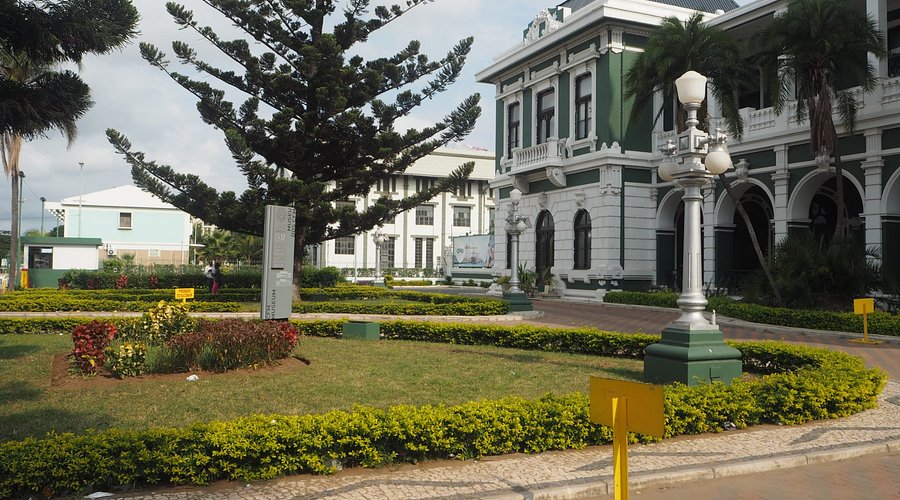
Mozambique's capital is a city first, a gateway second
Maputo sits on a bay at the far southern tip of Mozambique, its downtown a layer cake of Portuguese colonial buildings, 1960s modernist blocks by architects like Pancho Guedes, and the newer high-rises going up along the Marginal. Most visitors arrive treating it as a one-night stopover before the coast, and most leave wishing they'd given it a second night: the live music scene, the restaurants, and a downtown genuinely worth walking with your head up rather than down at a map are easy to underrate from outside.
What Maputo does not do is pretend the last fifty years didn't happen. Independence in 1975 and the sixteen-year civil war that followed left the city's infrastructure and economy badly damaged; the recovery since has been real but uneven, visible in everything from the gleaming new Maputo-Katembe suspension bridge across the bay to the potholed side streets two blocks from the smartest hotels. That tension, colonial elegance, socialist-era ambition, and a very current rebuild, is part of what makes the city interesting rather than a flaw to route around.
The honest complications
Petty crime, phone snatching and pickpocketing in particular, is a real and ongoing issue in crowded markets and on certain stretches of the Marginal waterfront, and walking alone after dark anywhere in the city is not advisable. Pavements are uneven and sometimes simply absent. Tap water isn't safe to drink. And English is genuinely limited outside international hotels and tour operators; this is a Portuguese-speaking city and traveling without at least a few phrases makes everything from taxis to markets noticeably harder.
Four areas that cover the city well
Maputo's tourist-relevant footprint is compact: a downtown grid on the bay, a leafy hillside district above it, and a couple of quieter residential areas further out. Where you base yourself comes down to how much street noise you can sleep through and how far you want to be from the water.
Baixa
The commercial and historic heart of the city, holding the Central Railway Station, the Mercado Central market, the Fortaleza and most of the budget-to-mid-range hotels. Bars line Avenida Araújo and the area has genuine energy after dark, but it's also the most crowded and least polished part of town, with uneven pavements and pickpocketing risk in the markets.
Polana
Maputo's most exclusive residential district, built on a hillside above downtown, home to the Polana Serena Hotel, several embassies, and a walkable cluster of restaurants and the FEIMA craft market. Quieter at night than Baixa, with better security and shade, at a slightly higher price point.
Sommerschield
Adjoining Polana, a leafy residential neighbourhood with more embassies, guesthouses and a handful of well-regarded restaurants. A good pick for travellers who want Polana's calm at a gentler price, at the cost of being a short taxi ride from most sights.
Costa do Sol & Katembe
Costa do Sol, north of the centre along the coast road, holds the long-running seafood restaurant of the same name and a stretch of beach popular with locals on weekends. Katembe, across Maputo Bay via the new suspension bridge, is quieter and less developed, with undeveloped beaches and long-term plans for resort growth that haven't fully arrived yet.
From a 1919 clifftop hotel to a backpacker institution
Maputo's hotel scene is smaller and more top-heavy than a comparable Southern African capital: a handful of genuinely historic properties at the top, a thin mid-range, and one long-running hostel that most backpackers passing through the country end up at some point.
At the top, Polana Serena Hotel has stood on its hillside above the city since 1922, with sweeping views across to the Indian Ocean, three on-site restaurants and a classic pool terrace; it remains the address most visitors picture when they think of colonial-era Maputo. Nearly as historic, Hotel Cardoso, open since 1919, sits on a cliff top over the bay with lush gardens, a rooftop gym with harbour views and a recently renovated restaurant, and generally runs a little cheaper than the Polana for a comparable sense of place.
For beachfront, Southern Sun Maputo is the city's only hotel directly on the water, with mosaic floors and vaulted wooden ceilings echoing Maputo's architectural past, an infinity pool and sundeck facing the ocean, and a restaurant menu built around Mozambican classics like piri-piri prawns and pastéis de nata. And at the budget end, Fatima's Place on Avenida Mao Tse Tung is the closest thing Maputo has to a backpacker institution: dorms and private rooms, an outdoor kitchen, a well-stocked bar, and a shuttle connection to its sister hostel in Tofo that makes it a natural first or last stop on a coastal trip.
Piri-piri prawns, a Sunday fish market, and a genuine bakery culture
Maputo eats well and cheaply relative to most Southern African capitals, with Portuguese, Goan and coastal Mozambican influences layered together. The single best food experience in the city isn't a restaurant at all, it's buying your own seafood off the ice and having it grilled to order.
Mercado de Peixe (Fish Market)
The Maputo fish market, in the Bairro Triunfo area right on the waterfront, is where you choose fresh prawns, crab, lobster or fish from the market stalls, then carry it to one of the adjacent grill stands to have it cooked, usually simply grilled or done piri-piri style, for a small fee starting around 160 MZN a kilo. Eat at outdoor tables under rows of red umbrellas facing Maputo Bay. Go early for the best selection, and go on a Sunday for the full local scene: it's the day Maputo families treat the market as much as a social outing as a meal.
Piri-piri chicken
Mundos has a strong local reputation for what regulars call the best peri-peri chicken in the city, while Costa do Sol, an institution on Avenida Marginal serving Mozambican and Portuguese food for decades, pairs its piri-piri chicken and grilled prawns with garlic butter and a bay view that's been part of the draw as long as the food.
FEIMA
The Feira de Artesanato, Flores e Gastronomia, a market of craft stalls, flower sellers and casual food vendors near the Polana district, is as much a place to eat cheaply and well as it is to shop. Weekends bring live music and the busiest, most sociable version of the market.
Matapa $6-10
Cassava leaves in coconut and peanut sauce, usually with shrimp, served over rice or xima. Available at most Mozambican-focused restaurants across the city.
2M & Laurentina beer $1-2
Mozambique's two national lagers, cold and cheap, at bars along Avenida Araújo in Baixa and at every restaurant in the city.
Pastéis & Portuguese bakeries
A genuine bakery culture left over from the colonial era: fresh bread, custard tarts and strong espresso are easy to find in Baixa and Polana.
A downtown that rewards an unhurried walk
Maputo's sights cluster tightly enough in Baixa and Polana to cover on foot by day, with a couple of standout buildings that justify the trip on their own.
Baixa's landmarks
The Maputo Central Railway Station, inaugurated in 1910, is the city's single most photographed building: a green dome long, and wrongly, credited to Gustave Eiffel (the actual designers were José Ferreira da Costa and the Johannesburg firm Evans & Plows, with Eiffel's only real Mozambican contribution being the unrelated Casa de Ferro iron house nearby). It's a working station, so wander the platforms as well as the grand entrance hall. A short walk away, the Mercado Central covers the classic market circuit of tropical fruit, spices and flowers, and the Fortaleza de Maputo, the old colonial fortress overlooking the bay, gives a quieter, more historical counterpoint to the market's noise.
Art & gardens
The Museu Nacional de Arte on Avenida Ho Chi Minh, a modern white three-story building, holds the country's best collection of Mozambican art, including work by Malangatana and Alberto Chissano, with the sculptor Samussone Macamo's "United People" statue greeting visitors at the entrance. Núcleo de Arte, a long-running artists' cooperative with a pottery workshop and garden, is a good place to see working artists rather than a finished gallery. Tunduru Gardens, laid out in 1885 and one of the oldest public gardens in Southern Africa, offer three hectares of shade in the middle of downtown, a genuinely pleasant break between sights.
The Katembe Bridge
The Maputo-Katembe Bridge, Africa's longest suspension bridge at over 3 kilometers with a 680-meter main span, opened in 2018 and connects downtown to the still-developing Katembe district across the bay. Crossing it, whether by car or organized tour, gives the best skyline view of the city, and Katembe's quieter beaches are a reasonable half-day out if you have extra time.
Evenings
Maputo has a genuine live music scene rooted in marrabenta, the city's homegrown guitar-and-dance style, with venues around Baixa and Polana hosting live sets on weekends; ask your hotel for the current lineup, since venues rotate. The bars along Avenida Araújo in Baixa stay busy into the evening, best reached and left by taxi rather than on foot.
One, two or three days, planned block by block
Two to three days covers Maputo properly for most travelers using it as a gateway to the coast; a single well-planned day still delivers the essentials if you're tight on time.
- Morning
Baixa on foot. The Central Railway Station, Mercado Central for fruit and spices, and the Fortaleza overlooking the bay.
- Midday
Lunch in Baixa. A casual Mozambican or Portuguese lunch near the market before the afternoon heat builds.
- Afternoon
Polana. The Museu Nacional de Arte, then FEIMA if it's a weekend, or a walk through Tunduru Gardens if not.
- Evening
Fish market or Costa do Sol. Grilled prawns at the Mercado de Peixe, or a sit-down seafood dinner at Costa do Sol overlooking the bay.
- Day 1
The one-day route: Baixa's landmarks, the art museum, FEIMA or Tunduru Gardens, dinner at the fish market.
- Day 2 morning
Núcleo de Arte. Watch working artists at the cooperative, then coffee and pastries at a Baixa or Polana bakery.
- Day 2 afternoon
The Katembe Bridge. Cross by car for the skyline view, with time on Katembe's quieter beach if the weather holds.
- Day 2 evening
Live marrabenta music. Ask your hotel for the current weekend lineup around Baixa or Polana.
- Days 1-2
The two-day route above, at a gentler pace, with more time at Tunduru Gardens and the markets.
- Day 3, option A
Ponta do Ouro. A 2.5-3 hour 4x4 transfer south for a day of diving or dolphin-watching near the South African border.
- Day 3, option B
Maputo Special Reserve. An easier half-day-to-full-day trip for coastal wetlands and a recovering elephant population, closer to the city than Ponta do Ouro.
Compact enough to walk by day, taxis after dark
Maputo International Airport (MPM) sits about 15-20 minutes from downtown. Use the official taxi queue at arrivals or a pre-booked hotel transfer, which runs roughly $10-20; ride apps including Bolt, Yango and inDriver can be booked once you're through arrivals and connected to local data, though international Uber does not operate here. In the city, chapas, shared minibuses that run fixed routes without fixed stops, are the cheapest way to move around at 5-15 MZN a ride, but they're crowded and not the easiest system for a first-time visitor to navigate; taxis and ride apps are the more practical choice for most travelers.
Baixa and Polana are both walkable by day, with the usual caveats about uneven pavements and heat. For anything further, the fish market, Katembe across the bridge, or an evening out, book a taxi or rideshare rather than walking, and avoid walking on foot anywhere after dark, including on Avenida Marginal.
Best time to visit and seasonal notes
Maputo has a warm subtropical climate. May to October is the dry season and the most comfortable stretch: lower humidity, little rain, daytime temperatures generally in the low-to-high 20s Celsius. November through April is hot and increasingly humid, with the heaviest rain from December to March; the city itself is south of the Bazaruto cyclone risk zone but can still see heavy downpours in this window.
Cheap to eat, pricier to sleep well
Maputo's food and local transport are genuinely affordable; its better hotels price closer to a European capital than to the rest of Mozambique. The fish market and casual Mozambican restaurants keep food costs low even for travelers staying at mid-range or upscale hotels.
- Hostel dorm or budget guesthouse $10-25
- Market and fish-market meals $5-10
- Chapas and walking
- Free gardens plus one paid museum
- Boutique or business hotel $60-120
- Restaurant meals with drinks $20-35
- Taxis and ride apps
- A day trip to Ponta do Ouro or the reserve
- Polana Serena or Hotel Cardoso $150+
- Fine dining and hotel restaurants
- Private transfers and guided tours
- Live music evenings out
Fine by day, taxis after dark, no exceptions
Maputo is manageable for tourists who take ordinary city precautions, but it isn't a place to switch off the way a small European capital might let you. Petty crime, phone snatching, purse grabs and pickpocketing, is the main concern, concentrated in crowded markets, bus and taxi ranks and busy public spaces. A specific stretch of Avenida Marginal between the Southern Sun hotel and the Waterfront Restaurant has seen increased violent crime and pedestrian activity there is discouraged; use a vehicle for that section rather than walking it.
The clearest rule that covers most of the risk: don't walk alone after dark anywhere in the city, even in central or tourist-frequented areas. Use a hotel-arranged driver or a rideshare app instead, keep phones and valuables out of sight in markets and on public transport, and carry a passport photocopy, since police checkpoints occasionally ask to see identification.
Phone & bag snatching
The most common issue for visitors, concentrated in markets, at transport hubs and in crowds. Keep phones in a zipped bag, not a hand or back pocket.
Night walking
Not recommended anywhere in the city after dark, including areas that feel busy and well-lit. Book transport before you need it, not after.
Uneven pavements
Baixa's pavements are frequently broken or simply absent. Wear closed, supportive shoes and watch your footing, especially at dusk.
Emergency number for police is 119, ambulance 117, fire 198. Maputo has the country's best private medical facilities; comprehensive travel insurance is still worth having, since serious cases are sometimes evacuated to South Africa.
Two easy escapes from the capital
Maputo's position at the far south of the country makes it a practical base for two contrasting day or overnight trips, one for diving, one for wildlife, before flying onward to the Inhambane coast or Bazaruto.
Ponta do Ouro
A surf and dive town close to the South African border with some of the region's best land-based diving, resident dolphins year-round, and seasonal whale sharks and manta rays. A 4x4 is recommended for the sandy final stretch of road; several operators run guided day trips from Maputo if you'd rather not self-drive.
Maputo Special Reserve
Coastal wetlands, dune forest and a recovering elephant population make this an easier, closer wildlife add-on than a full Gorongosa trip, and it pairs naturally with a Ponta do Ouro visit since the reserve sits on the same road south.
Maputo FAQ
Is Maputo safe for tourists?
Maputo is generally safe by day with normal city caution. Petty theft, phone and bag snatching are the main risks in markets and crowded areas; walking alone after dark, including on parts of Avenida Marginal, is not recommended. Use hotel-arranged transport or a rideshare app at night.
How many days do I need in Maputo?
Two to three days covers the city well: one for Baixa's landmarks and markets, one for Polana and the museums, and a third for a day trip to Ponta do Ouro or the Maputo Special Reserve before flying onward to the coast.
How much does Maputo cost per day?
Budget travellers manage on $30-50 a day with guesthouses and market meals; mid-range runs $80-140. Maputo is more affordable than most Southern African capitals for food, less so for hotels at the top end.
When is the best time to visit Maputo?
May to October, the dry season, is most comfortable: warm days, little rain, lower humidity. December to April is hot and rainy with a coastal cyclone risk in January and February further along the coast.
How do I get from Maputo airport to the centre?
Maputo International Airport (MPM) is about 15-20 minutes from downtown. An official airport taxi or a pre-booked hotel transfer costs roughly $10-20; ride apps like Bolt can be booked once you clear arrivals.
What is the best area to stay in Maputo?
Polana for a leafy, upscale base near the Polana Serena Hotel and FEIMA market. Baixa for walkable access to the railway station, Central Market and the fortress, with more street noise. Sommerschield for a quieter, more residential stay near embassies and restaurants.
Do I need to speak Portuguese in Maputo?
It helps a lot. English is spoken at international hotels, upscale restaurants and some tour operators, but is limited at markets, with taxi drivers and in most everyday interactions. A handful of Portuguese phrases go a long way.
Is Maputo walkable?
The Baixa and Polana districts are walkable by day with uneven pavements in places. Longer distances, the trip to the fish market, and any travel after dark are better done by taxi or rideshare rather than on foot.
What is Maputo's fish market and is it worth visiting?
The Mercado de Peixe on Avenida Marginal is where you buy fresh prawns, crab or fish from market stalls, then pay an adjoining grill stand to cook it to order. It is one of the best and most authentic meals in the city, especially on a Sunday when locals fill the tables.
What Stays With You
Maputo doesn't dress itself up for visitors passing through on the way to the beach, and most people only find that out once they've stayed long enough to notice. The railway station dome nobody actually built the way the postcards claim, the plate of prawns you picked out yourself twenty minutes earlier, jacaranda petals collecting in the cracks of a pavement that's seen fifty years of history since the last time anyone repaved it: none of it is polished, and all of it is real.
Give the city two nights before you fly on to Tofo or Bazaruto. It earns them.