
What You're Actually Getting Into
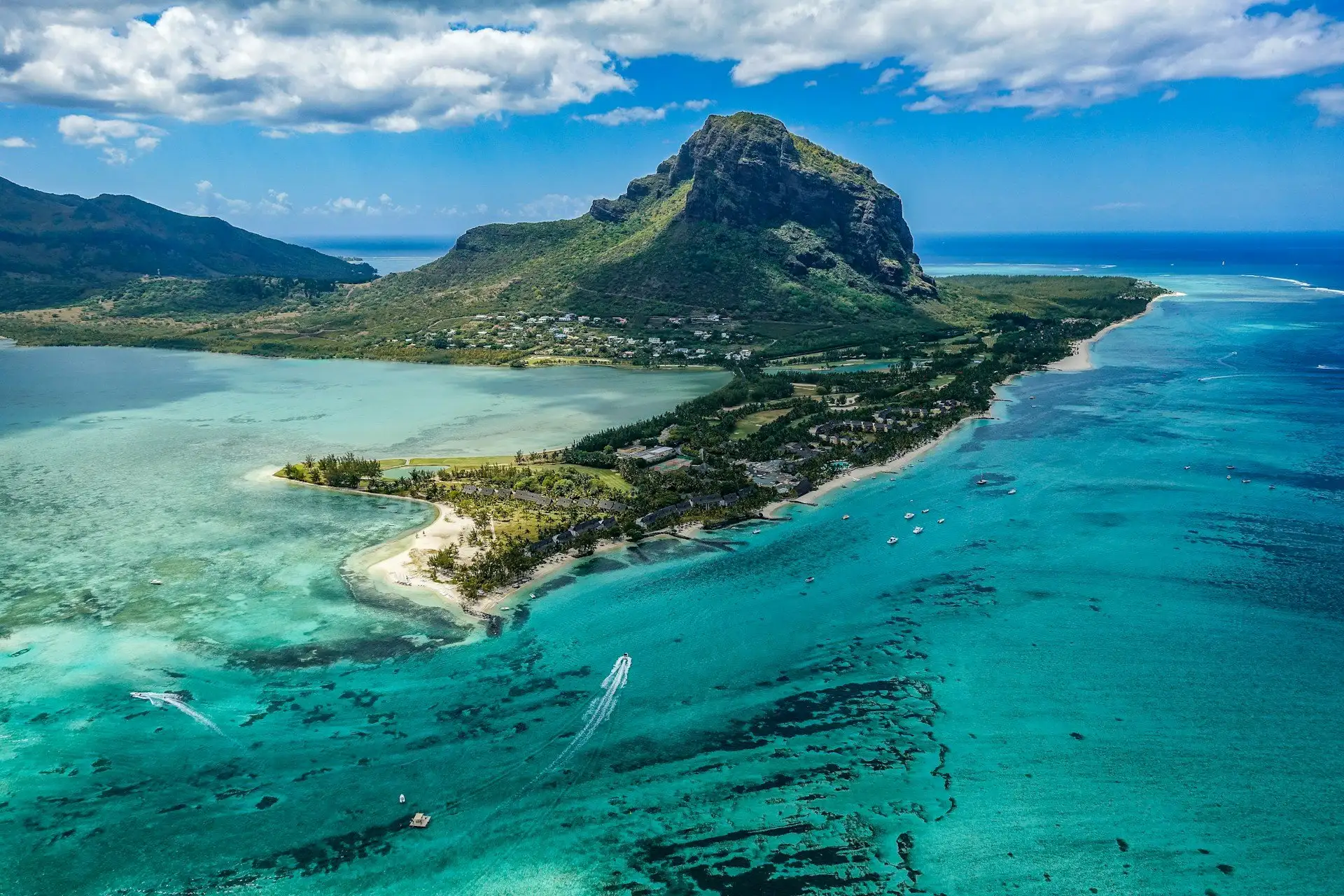
Mauritius is 2,040 square kilometres of volcanic island roughly 2,000 kilometres off the east coast of Madagascar, ringed almost entirely by coral reef that turns the coastal water into the flat, saturated turquoise the marketing photos never actually exaggerate. Nobody lived here before the 16th century: no indigenous population, no precolonial history to reckon with, just an uninhabited island the Dutch, French and British colonized in sequence, each importing the labour, and eventually the people, who would come to define what Mauritius is today. The result is a population that is roughly 48% Hindu, with large Muslim, Christian and Sino-Mauritian communities, speaking a Creole language built from French, English, Hindi, Chinese and Tamil in different measures depending on the street.
The tourism industry, which now anchors the economy alongside textiles, sugar and offshore finance, is built almost entirely around the coastline: five-star resorts, lagoon water sports, and the kind of all-inclusive infrastructure that can make it entirely possible to see nothing of the country except a beach chair and a buffet. That would be a genuine waste. The interior has a dormant volcano crater, a national park with some of the last stands of native ebony forest, a mountain with a slave-resistance history significant enough to earn UNESCO status, and a capital city that, unlike the resorts, actually looks and feels like the multicultural Indian Ocean crossroads Mauritius really is.
The honest complications
Mauritius is not cheap the way its neighbors on the African mainland can be: resort pricing is closer to the Maldives or the Seychelles than to East Africa, and stepping outside the resort gate takes some deliberate effort and a rental car or a genuine willingness to use the local bus network. Late in 2025 the crime picture also shifted enough that the US State Department raised its advisory a full level, citing a rise in pickpocketing, purse snatching, break-ins, and harassment of women traveling alone, alongside a smaller amount of serious violent crime; this guide takes that seriously rather than smoothing it into the usual "paradise" copy. And the coral reef and lagoon ecosystem the whole tourism model depends on is under real pressure from bleaching and, in the southeast, from the lingering effects of the 2020 Wakashio oil spill near Blue Bay, worth knowing if you plan to snorkel that stretch of coast.
A History Worth Knowing
Mauritius has no precolonial history because it had no people: Arab and Portuguese sailors likely knew of the island by the 10th and 16th centuries, but nobody settled it until the Dutch arrived in 1598. What followed is a compressed, four-century story of three empires and the people each one brought here, none of whom left, which is why Mauritius today looks less like anywhere in Africa and more like a small, self-contained fragment of the Indian Ocean world: Indian, Chinese, African, French and British threads still visibly present and still visibly separate.
- 1598
The Dutch arrive. Named for Prince Maurice of Nassau. Two attempted settlements (1638-58, 1664-1710) introduce sugarcane and, within a century, drive the flightless dodo to extinction.
- 1715-1810
Isle de France. The French take over, build Port Louis as a naval base, and establish the sugar plantation economy worked by enslaved labour from Madagascar and East Africa that still shapes the island's demographics today.
- 1810
British conquest. Britain takes the island during the Napoleonic Wars; French language, law and the Franco-Mauritian planter class remain influential even under British rule.
- 1835
Abolition of slavery, followed almost immediately by mass indentured labour migration from India: roughly half a million Indian workers arrive between 1834 and 1910, permanently remaking the island's population.
- 1968
Independence. Mauritius becomes independent within the Commonwealth on 12 March; it becomes a republic in 1992 while remaining a Commonwealth member.
- 1970s-present
Economic diversification. Sugar gives way to textiles, then tourism and offshore financial services; Mauritius becomes one of Africa's highest-income and most politically stable states.
Read the full history: the dodo, indenture, and Aapravasi Ghat
Mauritius is the dodo's only known habitat and the reason the bird went extinct within about a century of human contact is now the textbook case for island-species vulnerability: no natural predators, ground-nesting, and no fear of the sailors, pigs and rats that arrived with Dutch ships. There is no surviving complete dodo skeleton anywhere in the world; what you'll see in Mauritius museums are reconstructions.
The demographic core of modern Mauritius was set by the indentured labour system that followed the 1835 abolition of slavery across the British Empire. Planters needed a replacement workforce, and roughly half a million indentured labourers, overwhelmingly from India, arrived between 1834 and 1910 under contracts that were nominally voluntary but often exploitative in practice. Aapravasi Ghat, the immigration depot in Port Louis where most of them first set foot on the island, is now a UNESCO World Heritage Site and the single clearest physical link to how the country's population came to look the way it does. The descendants of these labourers make up the Indo-Mauritian majority, roughly two-thirds of the population today, split between Hindu and Muslim communities.
Alongside them: the Franco-Mauritian descendants of the original French planter families, who still hold outsized influence in agriculture and business; the Sino-Mauritian community descended from 19th and early 20th-century Chinese traders and shopkeepers, concentrated historically in Port Louis's Chinatown; and the Creole community, descended primarily from enslaved Malagasy and East African people, historically the most economically marginalized of the island's groups, and the community most associated with the séga music and dance tradition that is now Mauritius's most visible cultural export.
Top Destinations
Mauritius divides cleanly into a north coast (the tourist hub), a capital in the west, a wild volcanic south, and a calmer east. The island is small enough, at roughly 65 km at its longest, that no destination is more than a two-hour drive from any other, which is exactly what makes a single coastal base with day trips the practical way to see it, rather than constantly changing hotels.
Grand Baie, the tourist hub
Grand Baie, on a sheltered horseshoe bay on the north coast, has the island's densest concentration of hotels, restaurants and nightlife, and is the near-universal first-time base; it gets its own dedicated Grand Baie city guide with hotels, restaurants and a full day-trip plan. Nearby, Pereybère and Mont Choisy add quieter beach alternatives a short drive or walk away.
Pamplemousses Botanical Garden
Roughly 15 minutes south of Grand Baie, the Sir Seewoosagur Ramgoolam Botanical Garden is one of the oldest botanical gardens in the Southern Hemisphere, planted from 1770, and famous for its giant Victoria amazonica water lily pond, giant tortoises, and a palm collection with specimens from across the tropical world. An easy, unhurried half-day.
Port Louis
Mauritius's capital and only real city sits on the west coast about 25-30 minutes' drive from Grand Baie, a working port town rather than a resort destination, and the place that shows you the country's actual multicultural texture rather than a curated version of it. Aapravasi Ghat, the UNESCO-listed immigration depot where most of the island's indentured Indian labourers first arrived, sits a short walk from the harbour and is the single most important historical site in the country. The Port Louis Central Market, a chaotic two-storey building of spices, tropical fruit and street food, is where locals actually shop, not a tourist recreation of one. On the waterfront, Caudan Waterfront combines shopping, casual dining and the small Blue Penny Museum in a row of restored colonial warehouses next to a working marina, with the green wall of the Moka Range rising behind the city. Budget half a day; more if you want to add the Champ de Mars racecourse or the Chinatown streets behind the market.
Chamarel & Black River Gorges
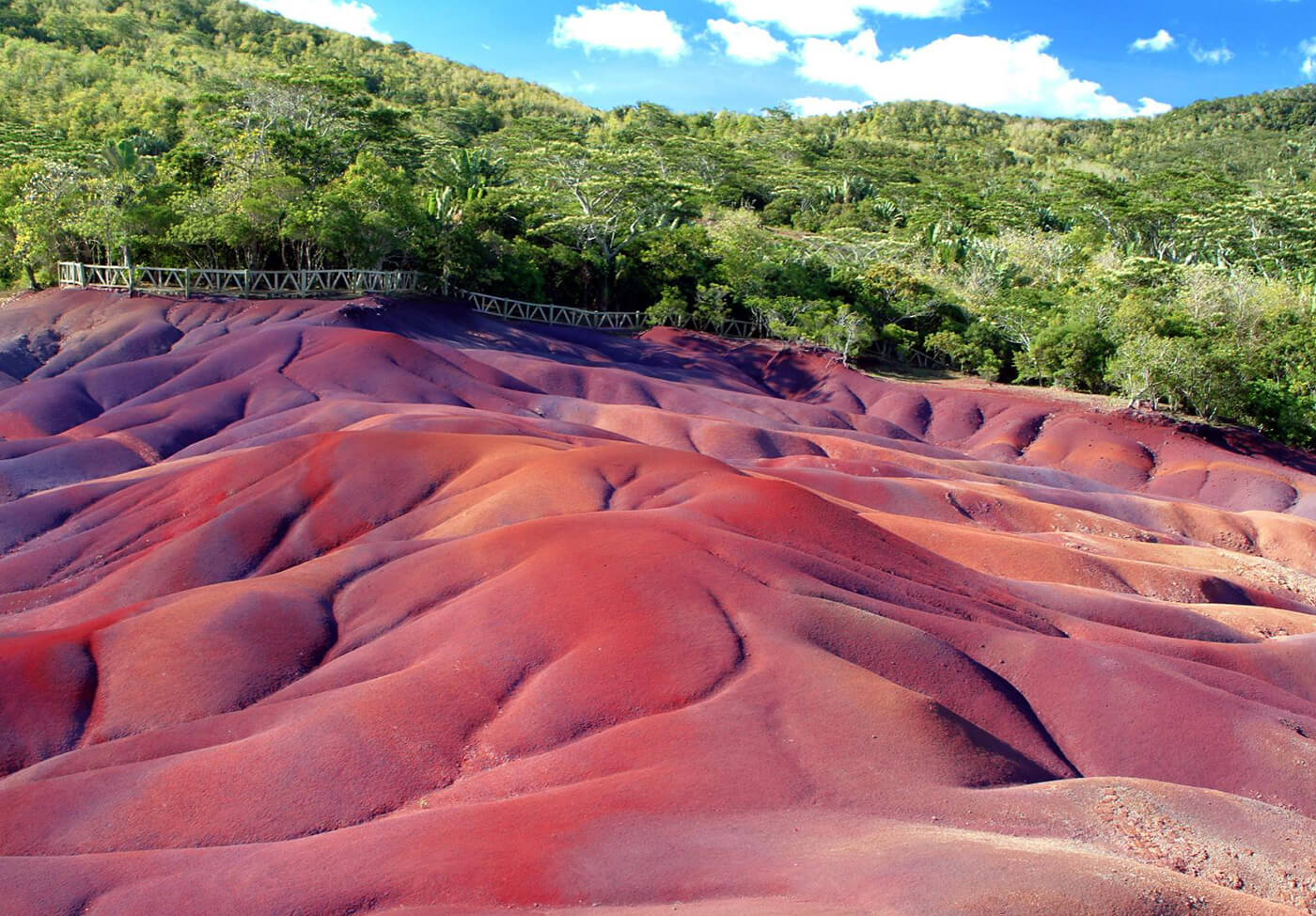
The southwest holds Mauritius's most dramatic scenery. Chamarel Seven Coloured Earth is a small dune field of cooled volcanic ash that has settled into distinct, striped bands of red, brown, violet, green, blue, purple and yellow, a genuine geological oddity rather than a tourist-brochure exaggeration; the same geopark includes Chamarel Waterfall, a single 100-metre drop visible from a roadside viewpoint. A few minutes away, Black River Gorges National Park, the island's largest at 6,754 hectares, protects most of what remains of Mauritius's native forest and is the best place to see endemic birds like the pink pigeon and Mauritius kestrel, both brought back from the edge of extinction by conservation programs. The whole southwest circuit, Chamarel, the gorges, and Trou aux Cerfs, a dormant volcanic crater with a walkable rim just outside Curepipe, covers a little over 70 kilometres and works well as a single self-drive day.
Le Morne Brabant
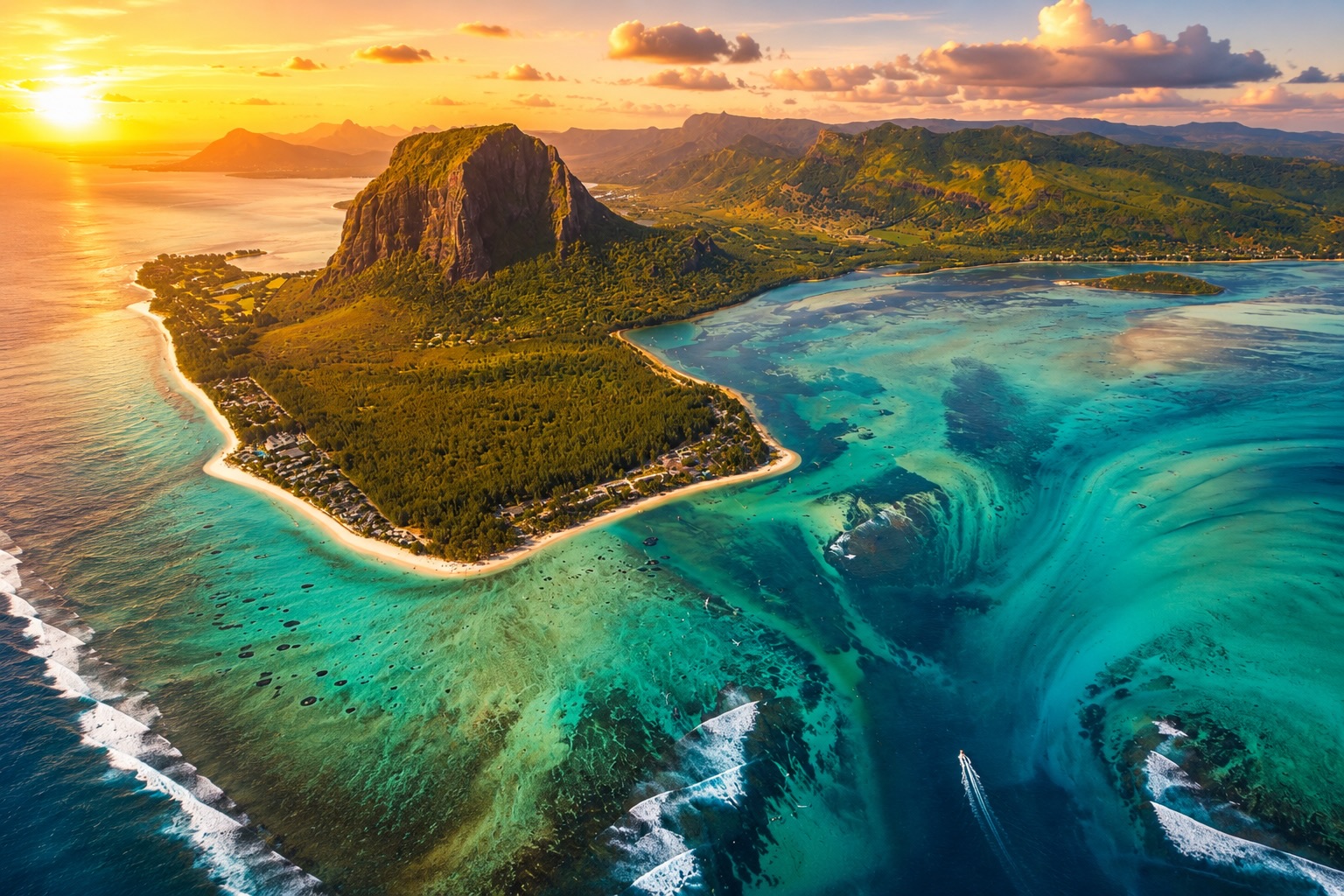
At the island's southwestern tip, Le Morne Brabant, a dramatic 556-metre basalt monolith, has been a UNESCO World Heritage Site since 2008 for its role as a natural fortress where escaped slaves, maroons, hid for years in the 18th and early 19th centuries; local tradition holds that some jumped to their deaths on seeing an approaching search party in 1835, misreading it as a recapture attempt when it was actually bringing news of abolition. The public beach at its base is one of the most photographed stretches of coast in Mauritius, and the surrounding lagoon is one of the world's best kitesurfing spots. The summit trail, about 1.5 km one way, takes roughly three hours round trip and the upper section is exposed scrambling best done with a local guide.
Ile aux Cerfs & the east coast
Île aux Cerfs, a small islet off Trou d'Eau Douce on the east coast, is reachable by a short 10 to 20-minute boat crossing and is the classic Mauritius day-trip beach: powder sand, warm shallow lagoon, and enough water-sports and lunch infrastructure that most visitors book it as an organised day rather than arranging boats independently. Trou d'Eau Douce itself, the departure village, is roughly 30 minutes' drive from Grand Baie via the coastal road. Further down the coast, Belle Mare and Trou d'Eau Douce hold some of the island's most established resort properties, and the east coast in general catches the strongest trade winds, which makes it the livelier option for windsurfing and kitesurfing but also the coast to avoid for calm swimming in July and August.
Hidden gems beyond the main circuit
The zones above cover a first trip well. With extra days, these reward the detour.
Grand Bassin (Ganga Talao)
A crater lake considered one of Hinduism's most sacred sites outside India, ringed with temples and a towering statue of Shiva. Extraordinary during the Maha Shivaratri festival, when hundreds of thousands of pilgrims walk here on foot; quiet and contemplative the rest of the year.
Casela Nature Parks
A wildlife and adventure park on the west side of the island with zip lines, a safari-style big-cat enclosure and walking with lions, and quad biking through sugarcane country. Popular with families and a genuine change of pace from the beach.
Blue Bay Marine Park
A protected lagoon near Mahébourg with some of the island's best snorkeling and a glass-bottom boat trade built around it. Check current conditions before booking: this stretch of coast was affected by the 2020 Wakashio oil spill, and while it has substantially recovered, it's worth a quick look at recent visitor reports.
Culture & Etiquette
Mauritius runs on four cultures at once, Indo-Mauritian (Hindu and Muslim), Franco-Mauritian, Sino-Mauritian and Creole, each with its own temples, mosques, churches and pagodas often standing within sight of one another. There is no single "Mauritian" religious or culinary identity to learn; there's a working coexistence between several, and the most consistently impressive thing about the country, more than any beach, is how well that coexistence has held for two centuries.
Do
- Dress modestly at temples and mosques. Cover shoulders and knees, remove shoes before entering, and ask before photographing worshippers, especially during active ceremonies.
- Keep beachwear on the beach. Bikinis and swim trunks are for the resort and the sand; cover up for towns, markets and restaurants away from the coast.
- Try a few Creole phrases. "Bonzour" (hello) and "Mersi" (thank you) go a long way and are genuinely appreciated outside the resort bubble.
- Carry small rupee notes. Local buses, market stalls and roadside food stands are cash-only; hotels and larger restaurants take cards.
- Ask before photographing people, particularly in markets and at religious sites, the same courtesy expected anywhere.
Don't
- Assume "African island" tells you what to expect. Mauritius's culture, food and demographics are overwhelmingly Indian Ocean Creole and South Asian in character, not sub-Saharan African.
- Walk alone after dark outside busy tourist strips, particularly as a woman traveling solo. See the Safety chapter: this is not boilerplate advice here, it's a direct response to the current advisory.
- Leave valuables visible in a parked rental car. Break-ins are one of the specific crime patterns named in the December 2025 advisory.
- Expect the bus network to run on a fixed schedule. There is no reliable published timetable; buses leave when reasonably full on main routes and locals navigate it by habit, not an app.
- Bargain aggressively in fixed-price shops. Haggling is normal in markets and with independent taxi drivers, but not in malls or branded stores.
Deeper culture: séga, festivals, and the languages you'll actually hear
Séga. The traditional music and dance of the Creole community, born from the rhythms enslaved Malagasy and East African people brought to the sugar plantations: a swaying hip movement, ravanne drums, and call-and-response singing, usually in Creole. Most resorts stage a version for guests; the more authentic performances happen at community events and smaller, family-run restaurants rather than the beachside dinner shows.
Festivals worth knowing. Maha Shivaratri (February or March, dates shift with the lunar calendar) brings hundreds of thousands of Hindu pilgrims on foot to Grand Bassin, the largest religious gathering in the country. Chinese Spring Festival is celebrated visibly in Port Louis's Chinatown. Divali, Eid, and Christmas are all public or widely observed holidays, a reflection of the same power-sharing coexistence that defines the culture more broadly.
Languages. English is the official language of parliament and schooling but is rarely anyone's first spoken language. French dominates the media, newspapers and much of business. Mauritian Creole (Kreol Morisien), a French-lexified creole with Malagasy, English, Hindi and other influences, is what the majority of the population actually speaks at home. Bhojpuri survives among older generations in some Indo-Mauritian communities. In tourist areas, functional English is close to universal.
Food & Drink
Mauritian food is a genuine fusion in the literal sense: Indian curry technique, Chinese stir-fry and noodle dishes, French sauce work and Creole seafood and spice, often within the same meal. The best of it is street food and small family-run tables, not resort buffets, and a full satisfying local meal costs a fraction of what the same calories cost inside a hotel.
Dholl Puri ~$0.50-1
The unofficial national street food: a thin flatbread stuffed with ground yellow split peas, folded around bean curry, tomato chutney and pickled vegetables. Sold from roadside stands island-wide, best found by following the local queue rather than the English signage.
Rougaille & Cari
Rougaille is a tomato, garlic and onion base used for fish, chicken or sausage, distinctly Creole in origin. Cari (curry) shows the island's Indian influence directly, made with fish, chicken, venison or octopus and eaten with rice and lentils. Both are the backbone of a genuine home-cooked Mauritian meal.
Rum $4-10/glass
Sugarcane made the island's fortune for two centuries, and the rum distilleries that grew alongside it, several open for tours and tastings near Chamarel and Grand Port, now produce genuinely serious spiced and aged rums worth seeking out beyond the resort cocktail list.
Fish Vindaye $6-12
Fried fish marinated in a mustard, turmeric and vinegar sauce with onions and chili, served cold or at room temperature; a Creole dish with clear roots in the Indian pickling tradition.
Chinese-Mauritian Noodles
Mine frite (fried noodles) and boulettes (dumpling soup) reflect the island's Sino-Mauritian community and are as common on menus as curry, a legacy of 19th and early 20th-century Chinese immigration through Port Louis.
Alouda ~$1-2
A cold, sweet drink of basil seeds, milk, and flavoured syrup, sold from street carts and an excellent, cheap way to cool down between sights on a hot afternoon.
When to Go & Itineraries
Mauritius runs opposite the Northern Hemisphere calendar: winter (dry season) runs roughly May to October, summer (hot, humid, cyclone-prone) runs November to April. May-June and September-November are the sweet spots, warm enough for the beach, low humidity, and outside the cyclone risk window. Avoid January to March if you can, the peak of cyclone season, and expect the strongest wind on the east coast specifically in July and August, when the west and north coasts are the more sheltered choice.
All seasons compared, with temperatures
| Season | Verdict | Temps | Notes |
|---|---|---|---|
| May-Jun & Sep-Nov | Best | 20-27°C | Dry, warm, outside cyclone risk, manageable crowds |
| Jul-Aug | Good (windy east) | 18-24°C | Coolest months; strong trade winds hit the east coast hardest |
| Dec-Apr | Hot & humid | 25-33°C | Cyclone season (peak Jan-Mar); still visitable, watch forecasts |
Direct cyclone hits are infrequent, roughly once every several years, but heavy rain and rough seas are common through the whole November-April window even without a named storm making landfall.
Itineraries
A week covers a solid first trip based mainly out of Grand Baie or another coastal hub. Ten to fourteen days lets you slow down and add the east coast without feeling rushed.
- Days 1-3
Grand Baie base. Settle in, Mont Choisy and Pereybère beaches, a catamaran or dolphin cruise, dinner along the bay road.
- Day 4
The wild south. Self-drive or organised tour: Chamarel Seven Coloured Earth and waterfall, Black River Gorges, Trou aux Cerfs on the way back.
- Day 5
Port Louis. Aapravasi Ghat, the Central Market, Caudan Waterfront, back to Grand Baie by evening.
- Days 6-7
Île aux Cerfs or Le Morne. A lagoon day at Île aux Cerfs off Trou d'Eau Douce, or the Le Morne summit hike and beach; unwind on the north coast for the last evening.
- Days 1-3
Grand Baie base, as above, with an extra day for Pamplemousses Botanical Garden.
- Days 4-5
The south, unhurried. Chamarel, Black River Gorges, and an overnight near Le Morne for the summit hike at cooler morning temperatures.
- Day 6
Port Louis and, if timing allows, Grand Bassin on the way back north.
- Days 7-8
East coast switch. Relocate to Belle Mare or Trou d'Eau Douce for Île aux Cerfs and calmer east-coast time (outside Jul-Aug wind).
- Days 9-10
Back to the north for a final unhurried stretch, or add Casela's wildlife park with kids.
- Days 1-4
Grand Baie extended, including a full water-sports day and Pamplemousses.
- Days 5-7
Southwest slow. Chamarel, Black River Gorges hiking trails properly (not just the roadside viewpoints), Le Morne summit and beach, a rum distillery tour.
- Days 8-9
Port Louis & Grand Bassin, with time for Chinatown and the Champ de Mars if racing is on.
- Days 10-12
East coast. Belle Mare or Trou d'Eau Douce, Île aux Cerfs, Blue Bay Marine Park near Mahébourg.
- Days 13-14
Back to Grand Baie for a final relaxed stretch and any activities missed the first time.
Getting there & around
Sir Seewoosagur Ramgoolam International Airport (MRU), in the southeast near Plaine Magnien, is the only international gateway, with direct flights from major European, African, Middle Eastern and Asian hubs. A pre-booked taxi transfer to Grand Baie on the north coast takes about 75 minutes for roughly €160-200; a rental car is the most practical way to see the country if your budget allows it (from about $23/day for a small car, more for an SUV), since the island's genuine highlights are spread across four coasts. A functioning but tourist-unfriendly public bus network covers the whole island at MUR 20-40 (about $0.50-1) a fare, running roughly 5:30am to 8pm, without a reliable published timetable or app-based route planner.
All transport options with prices: taxis, buses, car rental
| Option | Price | Notes |
|---|---|---|
| Airport taxi to Grand Baie | €160-200 | ~75 minutes; agree the fare or pre-book before getting in. |
| Public bus, airport to Grand Baie | ~MUR 45 (~$1) | Bus 198 to Port Louis, then Bus 215 Express to Grand Baie; slow (~95 min) but genuinely cheap. |
| Rental car, economy | $23-50/day | SUVs from ~$63/day; fuel roughly MUR 50 (~$1.25) per litre. International driving permit recommended. |
| Local bus, island-wide | MUR 20-40 (~$0.50-1) | Extensive network, but no reliable published timetable; ask locally or your hotel for current routes. |
| Taxi within Grand Baie / short hops | MUR 200-500 | Agree the fare before you get in; metered taxis are uncommon outside the airport rank. |
Practical prep: Mauritius drives on the left, British-colonial legacy, and most rental cars are manual unless you specifically request automatic. An eSIM before landing covers navigation and ride-hailing without hunting for a local SIM at arrivals. Standard travel insurance covers most activities; check specifically for water-sports and hiking cover if you plan the Le Morne summit trail or diving.
Where to stay
Grand Baie, the north coast
The island's densest concentration of hotels, restaurants and nightlife, and the most central point for day trips in every direction. See the full Grand Baie city guide for specific hotels and restaurants.
Flic-en-Flac
A long, calm west-coast beach with a more single-resort, lower-key feel than Grand Baie, popular for sunset views and diving, with fewer restaurants and less nightlife within walking distance.
Belle Mare & Trou d'Eau Douce
Home to some of the island's most established five-star properties and the launch point for Île aux Cerfs; best outside July-August when the east-coast wind is strongest.
Le Morne & the southwest coast
The best base for kitesurfing and for an early, cooler-morning Le Morne summit hike, with Chamarel and Black River Gorges both a short drive away.
Budget Planning
Mauritius can be genuinely expensive if you never leave a five-star resort, but it doesn't have to be: local food and transport are affordable, and the real cost driver is which style of accommodation you choose. Budget travelers manage comfortably outside the resorts; the jump to mid-range and comfortable tiers is mostly about the hotel, not the food.
- Small guesthouse, $30-50/night
- Dholl puri & local curry meals, $3-6
- Public buses
- Free beaches, one paid excursion every few days
- 3-4 star hotel or B&B
- Restaurant meals, $15-25/person
- Rental car, $30-60/day
- Catamaran cruise or diving trip every couple of days
- Five-star beach resort
- Fine dining, private excursions
- Private transfers and guided tours
- Spa treatments, water-sports packages
Quick reference prices: street food, transport, entry fees
| Dholl puri from a roadside stand | ~$0.50-1 |
| Local curry lunch | $3-5.50 |
| Mid-range restaurant dinner | ~$25/person |
| Local Phoenix beer, restaurant | ~$4 |
| Public bus fare | $0.50-1 |
| Rental car, economy | $23-50/day |
| Catamaran/dolphin cruise | $57-87/person |
| Chamarel Seven Coloured Earth entry | ~$7-8 |
Prices reflect August 2026 research and drift over time, especially resort accommodation in peak season. Treat them as a planning baseline, not a quote.
Visa & Entry
Mauritius is genuinely easy to enter: US, UK, EU, Canadian, Australian and most other passports get visa-free entry for up to 60 days for tourism, with a stamp on arrival rather than any advance application. The one step that actually is mandatory is digital: every visitor must complete the Mauritius All-in-One Travel Digital Form online within 72 hours of arrival, a free government form, not the paid third-party "visa" services that rank well in search but charge for something that costs nothing officially.
✓ Valid passport
Well beyond your stay; check the current requirement before you fly, as validity rules can shift.
✓ Return/onward ticket
Requested at immigration; airlines may also check before boarding.
✓ Proof of accommodation
A hotel booking or host address; have it ready alongside your digital form confirmation.
✓ Proof of funds
Officers sometimes look for roughly $100/day of your stay; a bank statement or card is usually sufficient.
| Mauritius | Seychelles | |
|---|---|---|
| Daily budget | $50-80 gets you a real trip outside resorts | Consistently pricier; far less budget infrastructure |
| Culture | Layered Indian, Creole, Chinese and French mix, a real capital to explore | Smaller, quieter Creole culture, fewer inland attractions |
| Landscape | Volcanic interior, coloured earth, national park, a UNESCO mountain | Granite boulder beaches, more purely coastal |
| Getting around | Rental car and a real bus network make independent travel practical | Inter-island travel by ferry or plane adds cost and time |
| Safety picture | Level 2 advisory since Dec 2025 (petty crime, some violent crime) | Generally lower reported crime, but always confirm current advisories |
Safety, Solo Women & Family
Be straightforward about this one: the US State Department raised Mauritius from Level 1 to Level 2, Exercise Increased Caution, on 8 December 2025, citing a rise in reported crime. That's not a Do Not Travel or even a Reconsider Travel rating, and trips to Mauritius remain entirely normal and well-traveled. But it is a real change from the island's reputation a few years ago, and this guide treats it honestly rather than smoothing it into brochure copy. Most crime against visitors is opportunistic: pickpocketing, purse snatching and petty theft in crowded markets, beaches and near ATMs. The advisory also specifically names break-ins, a smaller amount of serious violent crime (assault, and rarer, murder and rape), and verbal harassment and other crimes directed at women traveling alone.
Petty theft
The most common issue by far. Keep phones and wallets secured in crowded markets, beaches and around ATMs, and don't leave valuables visible in a parked car.
Break-ins
Named specifically in the December 2025 advisory. Use hotel safes, lock rental accommodation properly, and avoid leaving ground-floor windows open overnight.
Robbery response
The State Department's specific guidance: do not physically resist a robbery attempt. Hand over what's asked for and report it afterward.
Two more things worth knowing: night driving and lagoon safety
Driving at night. The advisory specifically flags increased caution walking or driving after dark. Roads outside main towns are unevenly lit, and pedestrians and cyclists without reflective gear are a real hazard on coastal roads at night.
Lagoon and ocean safety. The inner lagoon is generally calm and safe for swimming, but currents pick up sharply near reef passes and channels; heed posted flags and lifeguard advice, and don't swim or snorkel alone in unfamiliar breaks, especially outside resort-patrolled beaches.
Solo women travelers
Mauritius is broadly manageable for solo women in tourist areas and resorts, but the December 2025 advisory is specific and current: it names harassment of women traveling alone as an active pattern, not a historical footnote. Take normal precautions seriously here: use registered taxis or ride-hailing rather than hailing unmarked cars, avoid walking alone after dark outside busy, well-lit tourist strips like the Grand Baie bay road, and trust your hotel's advice on which local areas are fine to explore solo versus better done with company or a guide. None of this should stop a trip; it should shape how you plan the after-dark hours specifically. Full detail on our Solo Woman Explorer pages.
Emergency numbers
Embassies and consular contacts
112 works from any mobile phone and reaches emergency services generally; 999 is the dedicated police line. Most foreign embassies and consulates that maintain a presence in Mauritius are based in or near Port Louis. If you're a US citizen, the nearest US Embassy is in Port Louis; check mu.usembassy.gov for current contact details and any updated guidance before you travel, since advisory details are revised periodically.
Family travel & pets
Mauritius is an easy, well-suited family destination outside cyclone season: calm lagoon beaches, resorts built around kids' clubs and shallow swimming areas, and low-intensity attractions like Pamplemousses Botanical Garden's giant tortoises and water lilies, or Casela's animal encounters, that work well for a range of ages. Booking outside November-April sidesteps both the heat and any cyclone-season disruption to flights or excursions.
Kids on the water, and bringing pets
Water activities with kids: the inner lagoon at most resort beaches is calm and shallow enough for young children, but currents near reef passes can be strong; stick to flagged, lifeguard-patrolled sections and skip unsupervised snorkeling in open channels with young kids. Île aux Cerfs and Blue Bay both have gentle, family-friendly shallows.
Pets: Mauritius has strict import requirements including advance permits, quarantine considerations and specific vaccination and microchip documentation depending on origin country; this is a more involved process than many destinations, so start with Mauritius's Ministry of Agro-Industry well ahead of travel if you're considering bringing a pet, rather than assuming standard EU pet-passport rules apply.
Mauritius FAQ
Is Mauritius safe to visit?
Mostly yes, but go in with current information. The US State Department raised Mauritius to Level 2, Exercise Increased Caution, in December 2025 after a rise in reported crime: pickpocketing, purse snatching, break-ins, some violent crime, and harassment of women traveling alone. Violent crime against tourists is still uncommon, but this is not the same island it was rated a few years ago and normal city-level caution is now genuinely warranted, not just boilerplate.
Do I need a visa for Mauritius?
Most nationalities, including the US, UK, EU, Canada and Australia, can enter visa-free for up to 60 days for tourism. You still need a passport valid well beyond your stay, proof of onward travel and accommodation, and you must submit the Mauritius All-in-One Travel Digital Form online within 72 hours of arrival.
What is the best time to visit Mauritius?
May to early December, the dry, cooler winter season, with May-June and September-November the sweet spots for warm, mostly dry weather without cyclone risk. Avoid January to March, the peak of cyclone season, and expect the strongest wind on the east coast in July and August.
How many days do you need in Mauritius?
A week covers a good first trip: a few days based in Grand Baie or another coastal hub, a day for the south (Chamarel and Black River Gorges), and a day for Port Louis. Ten to fourteen days lets you add the east coast and a slower pace.
What language do people speak in Mauritius?
English is the official language of government and schooling, French is widely spoken and dominates the media, and Mauritian Creole (Kreol Morisien) is what most people actually speak at home. Nearly everyone in tourist areas speaks functional English.
Is Mauritius expensive?
It can be, if you stay only inside resort walls, but it doesn't have to be. Budget travelers manage on $50-80 a day using guesthouses, local restaurants and buses; mid-range with a rental car and restaurant meals runs $150-260 a day; five-star resorts push it to $300 or more.
When is cyclone season in Mauritius?
November through April, with the highest chance of an actual storm between January and March. Direct hits are infrequent, averaging roughly once every few years, but heavy rain and rough seas are common in this window even without a named cyclone.
Is Mauritius safe for solo female travelers?
Generally yes in tourist areas and resorts, but the December 2025 US advisory specifically flags harassment of women traveling alone as a real, current pattern, alongside petty theft. Take it seriously: use registered taxis, avoid walking alone after dark outside busy tourist strips, and keep the same street awareness you'd use in any unfamiliar city.
Is Mauritius good for families with kids?
Yes. Calm lagoon beaches, all-inclusive resorts built around kids' clubs, and low-key attractions like Pamplemousses Botanical Garden and Casela make it an easy family destination, especially outside cyclone season.
What currency does Mauritius use?
The Mauritian rupee (MUR). Cards are widely accepted at hotels, resorts and larger restaurants, but small vendors, local buses and market stalls are cash-only, so carry some rupees withdrawn from a bank ATM.
Where should I stay in Mauritius as a first-time visitor?
Grand Baie on the north coast is the practical first-time base: the island's densest concentration of hotels, restaurants and nightlife, and the most central point for day trips in every direction. Flic-en-Flac and Belle Mare are strong single-resort alternatives if you want a quieter base.
Is Mauritius part of Africa?
Geographically and politically yes, it's an island nation of the African Union roughly 2,000 km off Madagascar's east coast, though culturally it feels distinct: a majority Hindu, Indian Ocean Creole society with almost no visible link to mainland African culture.
What Stays With You
Most visitors come to Mauritius for the lagoon, and the lagoon delivers: water clear enough that the resort photos aren't lying, sand that stays cool underfoot at midday, a reef that keeps the swell out and the color impossibly saturated. But what actually stays with you, if you let it, is the rest of the island behind the beach: a market in Port Louis where four cultures have been trading past each other for two centuries, a mountain that hid people fighting for their freedom, and volcanic earth that genuinely comes in seven colours without a filter.
Go for the water. Stay curious enough to leave the resort at least twice, and you'll come home with a country, not just a photo of one.