
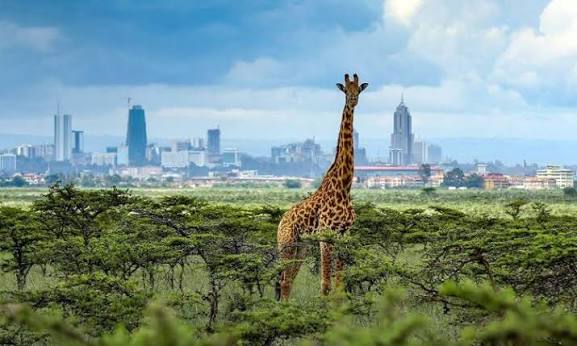
The only capital with a national park inside it
Nairobi National Park sits a 20-minute drive from downtown skyscrapers, and it is a real park with real lion, rhino, giraffe and buffalo, not a fenced novelty. That single fact tells you most of what you need to know about Nairobi's relationship to the rest of Kenya's tourism industry: this is a working capital of five million people that also happens to be the logistics hub, the flight departure point, and increasingly a destination in its own right for everything the safari itineraries rush past.
What most visitors actually do is treat Nairobi as a one-night pit stop between long-haul arrival and the bush. That's a mistake the food scene alone argues against: nyama choma grilled over charcoal and shared by the kilo, a genuinely excellent restaurant scene in Westlands and Kilimani, and an elephant orphanage that will change how you watch the adults on safari a few days later. Give the city one full day before your flight out to the Mara, and a second one on the way back if you can.
The honest complications
Nairobi's traffic is a genuine planning constraint, not a cliché: a drive that looks like 15 minutes on a map can take an hour at rush hour, so build slack into any airport transfer or dinner reservation. The city is also spread out and not consistently walkable between neighborhoods, so budget for ride-hailing rather than assuming you'll stroll between sights. And Nairobi does carry real crime risk in specific areas and after dark, covered honestly in the safety chapter below; it is not a reason to avoid the city, but it is a reason to plan your evenings with a bit more structure than you might in a smaller, calmer capital.
Four areas that matter, and one to skip after dark
Nairobi's useful neighborhoods for visitors sit west and south of the historic center, each with a distinct character. Where you base yourself comes down to how close you want to be to wildlife versus nightlife.
Westlands
Nairobi's highest concentration of restaurants, bars and shopping, and the default pick for business travelers. Central enough for most sights, lively enough at night that you won't need to venture far for dinner, and home to some of the city's best independent restaurants, About Thyme and Cultiva among them.
Kilimani
Ten to twenty percent cheaper than Westlands with a similar modern, cosmopolitan feel, plus the city's best apartment and boutique-hotel supply. For most first-time visitors without a specific reason to be in Westlands, Kilimani is the more practical base.
Karen
Named for Out of Africa author Karen Blixen, whose farmhouse is now a museum here, Karen is Nairobi's leafiest suburb and sits closest to the Giraffe Centre, David Sheldrick Wildlife Trust and Nairobi National Park's main gate. More isolated from the city's dining core, but the obvious choice if wildlife-adjacent calm matters more to you than nightlife.
CBD (Central Business District)
Nairobi's downtown holds the Sarova Stanley, the Railway Museum and most of the city's colonial-era architecture, and it's genuinely fine to visit by day. It becomes considerably less secure after dark, with specific streets, River Road, Archives and Kirinyaga Road among them, best avoided entirely once the sun goes down. Stay in Westlands, Kilimani or Karen instead and visit the CBD as a daytime outing.
From colonial-era grandeur to $10 hostel beds
Nairobi's hotel scene spans genuine five-star luxury to some of the cheapest reliable hostel beds in East Africa, with a strong boutique mid-range in Kilimani that most visitors never hear about before they arrive.
At the top, Villa Rosa Kempinski in Westlands blends European five-star polish with African warmth: a heated outdoor pool, three restaurants, a rooftop bar and a full spa, popular with both business executives and leisure travelers. In the historic CBD, the Sarova Stanley has been Nairobi's grand dame hotel for over a century, with a rooftop pool and a location that puts you steps from the Railway Museum.
In Karen, Hemingways Nairobi is the boutique pick: spacious suites with Ngong Hills views, butler service and a genuinely tranquil setting a short drive from the Giraffe Centre and Karen Blixen Museum, worth the premium if wildlife-adjacent calm is what you're after.
For value, Hadassah Hotel Nairobi in Kilimani, opposite Nairobi Hospital, is a solid 3-star with en-suite rooms, satellite TV and fridges from around $19-40 a night. At the budget end, Spotless Hostel Westlands has dorm beds from roughly $10, with free WiFi, a shared kitchen and a garden lounge, one of several hostels that make Nairobi genuinely workable on a backpacker budget between safari legs.
Nyama choma first, then a food scene most itineraries skip entirely
Nairobi's food scene runs from smoky nyama choma joints to a genuinely serious fine-dining circuit in Westlands, and it's one of the most underrated reasons to build in an extra day. Meat, grilled over charcoal and ordered by the kilo, remains the center of gravity, but the range around it has grown fast.
Nyama Choma
Grilled goat or beef, ordered by weight and shared at the table, is the closest thing Nairobi has to a signature meal. The Carnivore Restaurant on Langata Road near Wilson Airport is the famous, tourist-oriented version, an all-you-can-eat carving spectacle that some longtime residents now consider overpriced for what it is. For a more local, better-value experience, Ashaki Grill in Kilimani (Kindaruma Road) and Roadhouse Grill in Kilimani and Hurlingham (Dennis Pritt Road) are the spots locals actually recommend.
Westlands fine dining
About Thyme, on Eldama Ravine Road, has been a Westlands fixture since 2005, with an eclectic globally inspired menu and a strong vegetarian selection in a garden setting. Nearby, Cultiva runs a serious tasting menu (around KES 5,500) that puts Nairobi's fine-dining ambitions on the record for anyone who assumed the city was all grilled meat.
Everyday Kenyan food
Ugali and sukuma wiki at a local kibanda (small eatery), chapati with a bean or meat stew, and mandazi with chai for breakfast: this is how most of Nairobi actually eats day to day, and it's worth seeking out at least once alongside the restaurant circuit.
A city that front-loads its wildlife so you don't have to wait for the bush
Nairobi's best attractions cluster around Karen and the southern edge of the city, close enough together that a well-planned day covers most of them without excessive driving.
The Karen wildlife circuit
David Sheldrick Wildlife Trust, in Nairobi National Park, hand-raises orphaned elephant and rhino calves and opens a public viewing hour daily (typically late morning) where you watch the young elephants take their milk bottles and play in the mud, a genuinely moving experience that reframes how you'll watch adult elephants on safari days later. A short drive away, the Giraffe Centre is a sanctuary for the endangered Rothschild's giraffe, where you can hand-feed the animals at eye level from a raised platform. The Karen Blixen Museum, the preserved farmhouse of the Out of Africa author, rounds out a half-day that covers wildlife, history and one of Nairobi's most attractive suburbs in a single loop.
Nairobi National Park
The improbable fact that gives this guide its opening line: a full game park, with lion, rhino, giraffe, zebra and buffalo, a 20-minute drive from downtown, with the city skyline visible on the horizon in some of the more striking wildlife photographs you'll take on the whole trip. Not the density or drama of the Maasai Mara, but a genuinely worthwhile half-day, especially if your itinerary doesn't include a full safari.
Museums & markets
The Nairobi National Museum covers the country's archaeology, paleontology (including material connected to the Leakey family's Rift Valley fossil finds) and ethnography in one well-curated stop. The Nairobi Railway Museum, near the CBD, traces the East African Railways history, including the "Lunatic Express" line that shaped the city's founding. For crafts and souvenirs, the Maasai Market is Nairobi's best-known open-air market, a rotating pop-up that sets up in a different location depending on the day of the week, so confirm the current schedule before you go.
Bomas of Kenya
A cultural center recreating traditional homesteads from across Kenya's ethnic groups, with scheduled traditional dance and music performances. A more curated, packaged experience than an organic cultural encounter, but a genuinely useful primer on Kenya's ethnic diversity if your itinerary doesn't otherwise take you outside Nairobi and the safari circuit.
One, two or three days, built around a safari departure
Most Nairobi stays are bookended by a safari, so these itineraries assume you're fitting the city in before or after the bush rather than as a standalone trip.
- Morning
David Sheldrick Wildlife Trust. Arrive for the public elephant-feeding hour, then the Giraffe Centre a short drive away.
- Midday
Karen Blixen Museum. The farmhouse and grounds, then lunch nearby in Karen or back toward Westlands.
- Afternoon
Nairobi National Park. A short game drive if time and light allow; skip if you're heading straight to a full safari.
- Evening
Nyama choma in Kilimani. Ashaki Grill or Roadhouse Grill for the meal locals actually recommend.
- Day 1
The one-day route: Sheldrick, Giraffe Centre, Karen Blixen Museum, dinner in Kilimani.
- Day 2 morning
Nairobi National Museum. The archaeology and paleontology collections, unhurried.
- Day 2 afternoon
Maasai Market. Confirm the day's location first, then an afternoon browsing crafts and beadwork.
- Day 2 evening
Westlands for dinner. About Thyme or Cultiva for the fine-dining side of the city.
- Days 1-2
The two-day route above, at a gentler pace, adding the Nairobi Railway Museum in the CBD by day.
- Day 3
Hell's Gate & Lake Naivasha. The one genuine day trip from Nairobi: walk or cycle among zebra and giraffe with no vehicle required, since the park has no resident lion.
Spread out, traffic-heavy, and built for ride-hailing apps
Jomo Kenyatta International Airport (JKIA) is Nairobi's main gateway and East Africa's busiest airport, currently mid-expansion after outgrowing its original design capacity. The Nairobi Expressway, a toll road connecting the airport corridor to the CBD and Westlands, has meaningfully cut journey times outside peak rush hour; Uber, Bolt or a hotel-arranged transfer are the standard ways to make the trip, and it's worth agreeing or confirming the fare before you get in rather than negotiating with unmarked taxi touts inside the terminal.
Within the city, Uber, Bolt and Little Cab are the practical default: cashless, GPS-tracked, and the safest way to move around after dark. Fares rose roughly 50% in late 2025 under new government-mandated pricing, so budget accordingly; a typical CBD-to-Westlands ride runs KES 300-500. Matatus, the privately run minibuses that form Nairobi's backbone transit system, are extensive and cheap (KES 50-200 for a typical urban fare) but not really built for visitors without local guidance on routes; fine for a short, well-understood hop, less fine as your primary transport. Self-driving is possible but not recommended for first-time visitors given the traffic density and road-rule differences; save the rental car for a self-drive trip to Lake Naivasha or Hell's Gate outside the city if you want that flexibility.
Onward travel: the SGR train and domestic flights
If your Kenya trip continues to the coast, the Madaraka Express SGR train to Mombasa departs from Nairobi's Syokimau station (outside the city center, plan for a taxi or matatu to reach it) and takes just over five hours for KES 1,000 economy or KES 3,000 first class, a comfortable alternative to the road route.
For the safari circuit or Diani and Lamu on the coast, nearly all connections depart Wilson Airport, a separate, smaller airfield from JKIA on the south side of the city, on small-aircraft operators like Safarilink and AirKenya. Most travelers book these flights through their safari or tour operator rather than independently, and it's worth confirming which airport, JKIA or Wilson, your onward flight uses, since they are a genuine drive apart from each other.
Genuinely affordable, separate from the safari budget entirely
Nairobi itself is one of the more affordable capitals in this guide's range; the expense of a Kenya trip comes almost entirely from the safari days once you leave the city. Treat the two as separate budget lines.
- Hostel dorm $10-25
- Local kibanda meals, matatu transport
- Free or low-cost city sights
- Giraffe Centre & Sheldrick entry fees
- Boutique hotel in Kilimani or Westlands
- Restaurant meals, Uber/Bolt throughout
- Karen wildlife circuit, guided
- One evening at a Westlands fine-dining spot
- Villa Rosa Kempinski or Hemingways
- Private guide for the day
- Tasting menu at Cultiva
- Airport transfers arranged directly
Fine by day in the right areas, deliberate after dark
Nairobi is safe for tourists who stick to the areas covered in this guide and plan their evenings rather than wandering freely after dark. The neighborhoods of Eastleigh and Kibera carry a specific Level 3, Reconsider Travel, US State Department designation for crime and kidnapping risk; neither is on any standard tourist route, and if you have a specific reason to visit either, go with a knowledgeable local guide rather than independently.
The three things that actually catch visitors: the CBD after dark, safe enough by day but genuinely riskier at night, with streets like River Road, Archives and Kirinyaga Road best avoided entirely once the sun goes down; carjacking and armed robbery, rare but real enough that Kenya's overall Level 2 advisory specifically names them, best mitigated by avoiding night driving and using reputable ride-hailing apps rather than unmarked taxis; and pickpocketing in crowded markets and matatu stages, standard big-city risk manageable with normal awareness. That's the realistic list for the areas visitors actually use. Emergency numbers are 999 or 112 from any phone, Kenya Red Cross ambulance is free at 1199, and the gender violence hotline at 1195 operates in Swahili, English and local languages.
One real day trip, and two safaris worth the extra nights instead
Nairobi's position means most of Kenya's headline destinations are a flight or a multi-hour drive away, not a day trip. Hell's Gate is the honest exception; the Maasai Mara and Amboseli deserve the extra nights rather than a rushed there-and-back.
Hell's Gate & Lake Naivasha
Hell's Gate National Park is one of the only parks in Kenya where you can walk or cycle freely among zebra, giraffe and buffalo, since there are no resident lion, with a dramatic gorge and the Fischer's Tower rock formation that reportedly helped inspire scenery for The Lion King. Pair it with a boat trip on nearby Lake Naivasha to Crescent Island for a second walking-safari stop in the same day. Self-drive or a day tour both work well; this is the one Nairobi day trip that doesn't require compromising on the experience to fit the clock.
Ngong Hills
A ridge of hills southwest of the city with hiking trails and views associated with Karen Blixen's writing about the area. A shorter, less structured outing than Hell's Gate, best combined with the Karen wildlife circuit rather than treated as a standalone trip.
Maasai Mara & Amboseli
Both are genuinely reachable from Nairobi by short domestic flight, 45 minutes to the Mara, roughly an hour to Amboseli, but neither works as a day trip: flight schedules, park entry logistics and the whole point of a safari (dawn and dusk game drives, time for the wildlife to actually show up) argue strongly for at least two to three nights. Full detail on both is in our Kenya country guide.
Nairobi FAQ
Is Nairobi safe for tourists?
The areas visitors actually use, Westlands, Kilimani, Karen and the CBD by day, are safe with normal city awareness. Avoid Eastleigh and Kibera, avoid walking after dark, and use Uber, Bolt or Little Cab rather than hailing taxis or matatus at night.
How many days do I need in Nairobi?
One full day covers the essentials: David Sheldrick, the Giraffe Centre and Nairobi National Park. Two days adds the National Museum and a proper dinner circuit; a third day fits the Hell's Gate day trip and is worth adding if your schedule allows.
How much does Nairobi cost per day?
Budget travelers manage on $40-70 a day with hostels and local food; mid-range runs $90-160. This is separate from safari costs, which run $220 a day and up per person once you leave the city.
When is the best time to visit Nairobi?
Nairobi's altitude keeps it mild year-round, 12-25°C, so the city itself has no bad season. Time your visit around the safari calendar instead: June-October and January-February for the wider Kenya trip.
Is Nairobi a good base for a Kenya safari?
Yes, it's the standard one. Nearly every safari to the Maasai Mara, Amboseli or the coast departs from Nairobi's Wilson Airport or JKIA, and most travelers spend a night or two in the city before and after the bush.
How do I get from JKIA airport to the city centre?
Uber, Bolt or a hotel transfer are the standard options; the Nairobi Expressway toll road has cut typical journey times to Westlands or the CBD outside rush hour. Agree or confirm the fare before you ride, and avoid unmarked taxi touts inside the terminal.
What is the best area to stay in Nairobi?
Westlands and Kilimani for most first-timers: central, walkable amenities, good dining. Karen for wildlife proximity and a quieter, greener pace near the Giraffe Centre and Karen Blixen Museum. Avoid the CBD for overnight stays.
Do I need a car in Nairobi?
No. Uber, Bolt and Little Cab cover the city well and remove the stress of Nairobi traffic and unfamiliar road rules. Save a rental car for outside the city if you're self-driving to Lake Naivasha or Hell's Gate.
Is Nairobi walkable?
Within neighborhoods like Westlands, Kilimani and Karen, yes, for daytime errands and short hops. Between neighborhoods, no: distances are long, pavements are inconsistent, and ride-hailing apps are the practical way to get around.
What Stays With You
Most people who fly through Nairobi remember the airport, the hotel, and not much else, because the bush was the whole point of the trip. That's a shame, because the city has its own case to make: an elephant orphan learning to be wild again a few minutes from downtown, a plate of nyama choma shared with strangers at a plastic table, the specific vertigo of watching a giraffe eat out of your hand at eye level.
Give Nairobi its one full day. The safari will still be extraordinary. You'll just arrive at it having already met the country instead of just its wildlife.