

What You're Actually Getting Into
Djibouti is a small country with an outsized geological and geopolitical identity. At 23,200 square kilometers it's one of Africa's smallest nations, wedged between Ethiopia, Eritrea and Somalia at the mouth of the Red Sea, where the Gulf of Aden meets the Bab-el-Mandeb Strait, one of the world's most strategically important waterways. The country hosts more foreign military bases per capita than anywhere else on earth: France, the United States, China, Japan, Italy and Germany all maintain facilities here, and the port handles roughly 95 percent of Ethiopia's international trade.
None of that is the reason to come. The reason is the geology and the marine life. Djibouti sits directly on the Afar Triangle, the point where the African, Arabian and Somali tectonic plates are pulling apart, slowly creating what will eventually be a new ocean basin. The landscape this produces is unlike anything in the region: Lake Assal, the lowest point in Africa and the saltiest lake outside Antarctica; the Lac Abbé plain, where hundreds of limestone chimneys steam at dawn in a setting with no terrestrial analogue. And then the sea: the Gulf of Tadjoura concentrates whale sharks from November to January in some of the most reliable encounters available anywhere in the Indian Ocean.
The honest complications
Djibouti is expensive, hot, and French-speaking in a way that strongly favors French-speaking visitors. It's not primarily a beach holiday destination, the beaches themselves aren't particularly attractive, and the heat from May through September is dangerous for prolonged outdoor activity. Tourist infrastructure is thin despite the country's overall stability. But the specific experiences on offer, the chimneys at dawn, the whale shark encounter, the floating sensation of Lake Assal, have no equivalent elsewhere on the continent.
A History Worth Knowing
The territory of what is now Djibouti has been inhabited for at least 3,500 years, with the Afar and Somali (Issa) peoples establishing pastoralist and trading communities around the Gulf of Tadjoura long before any external power arrived. The Afar Triangle, the interior territory of the Afar people, is also where some of the earliest hominid fossils have been found, including Australopithecus afarensis, the species that includes the fossil known as Lucy, found just across the border in Ethiopia.
- ~3,000+ yrs
Afar and Issa settlement. Afar and Issa Somali peoples establish communities around the Gulf of Tadjoura; trade networks with Arabia predate Islam.
- 1862
French treaty. France signs a treaty with the Sultan of Tadjoura, driven by strategic interest in the Bab-el-Mandeb passage.
- 1917
Djibouti-Addis Ababa Railway. The railway connecting the port to the Ethiopian capital opens, remaining the foundation of the country's economic role.
- 1977
Independence. June 27; Hassan Gouled Aptidon becomes first president, the last mainland African territory to gain independence from France.
- 1991-2001
Afar civil war. Afar insurgency against the Issa-dominated government; peace agreement reached in 2001.
- 1999
Guelleh takes power. Ismail Omar Guelleh, nephew of the first president, elected; has held power since, re-elected in 2005, 2011, 2016 and 2021.
- 2017
China opens military base. Djibouti now hosts more foreign military installations per square kilometer than anywhere on earth.
Read the full history: the ethnic balance, the monetized sovereignty model, and the railway
French interest began in the 1860s, driven by the same strategic logic that operates today: control of the Bab-el-Mandeb Strait means influence over the passage between the Mediterranean, via the Suez Canal opened in 1869, and the Indian Ocean. The territory was known as French Somaliland and then the French Territory of the Afars and Issas before 1977 independence. The independence movement was complicated by ethnic division: the Afar feared Somali-majority rule and had some preference for continued French administration, while the Issa Somali wanted independence and saw it as a step toward pan-Somali unification. This tension has structured Djiboutian politics since; the political system has moved toward one-party dominance, opposition parties exist on paper, and Guelleh wins with extremely large majorities.
The geopolitical situation gives Djibouti a specific economic model: sovereignty is monetized. Base-hosting fees, port revenues and Ethiopian trade transit fees generate government income disproportionate to the country's size, producing infrastructure better than most similarly sized African nations, but creating a dependent relationship with foreign powers that shapes everything from political alignments to the physical presence of Chinese construction companies alongside French military barracks alongside American drones.
Djibouti's Destinations
Djibouti is small enough that the entire country is accessible as day trips from Djibouti City. Most visitors base themselves in the capital and radiate outward. The standard tourist circuit covers Lake Assal, Lac Abbé, whale shark snorkeling in the Tadjoura Gulf, and Day Forest, and doing all four gives a remarkably complete picture of what makes this country distinctive.
Lake Assal
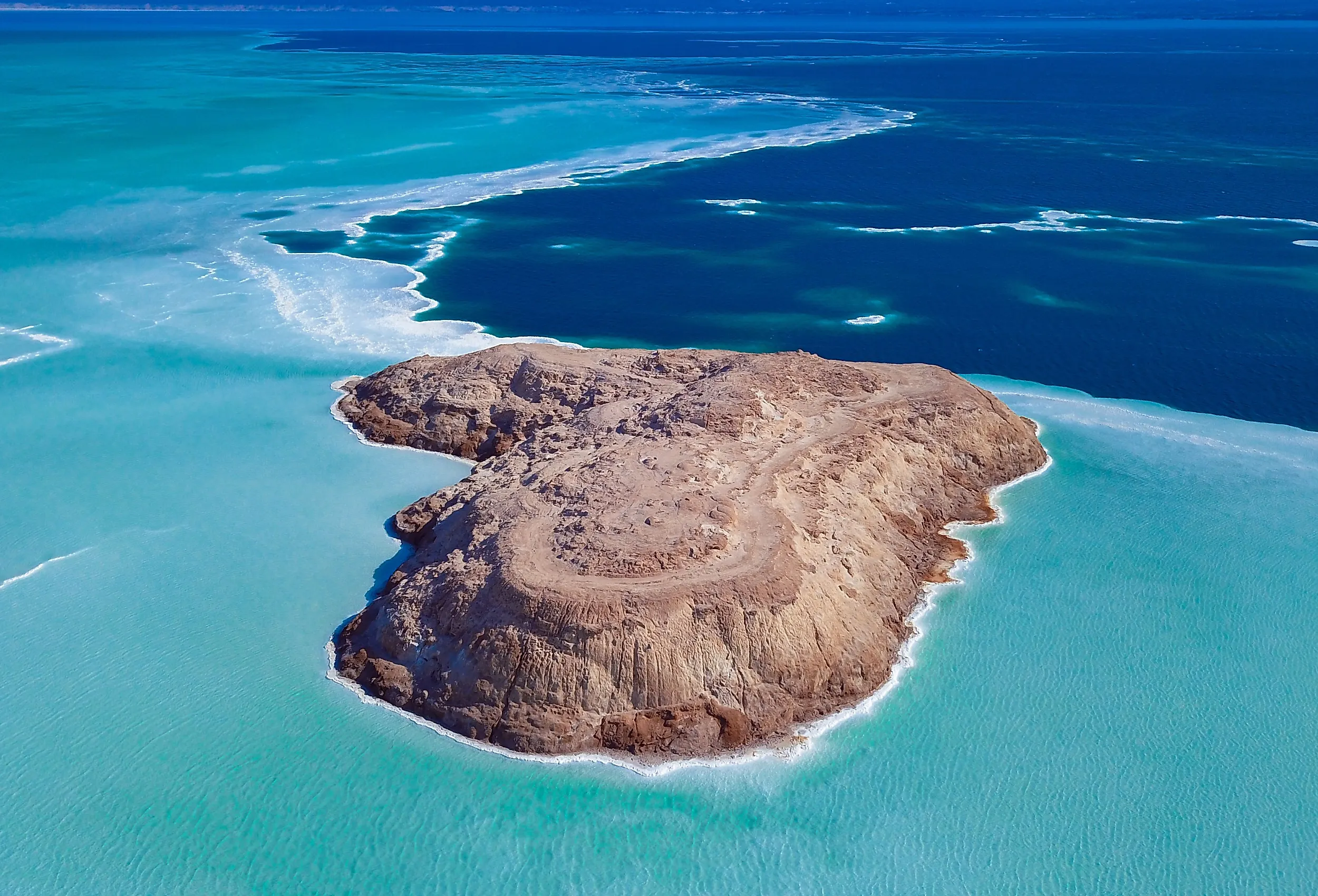
155 meters below sea level, the lowest point in Africa and the third-lowest place on earth's surface, with a salinity of 34.8 percent, ten times that of seawater. The lake occupies a volcanic caldera surrounded by black basalt lava fields and white halite crystal formations. You don't swim so much as float; at this salinity, staying under the surface requires genuine effort, and any cut produces a memorable burning sensation. The drive from Djibouti City is about 120km, crossing dramatic volcanic landscape. Allow a full day, and go in the morning before midday heat makes the salt flat unpleasant.
Lac Abbé
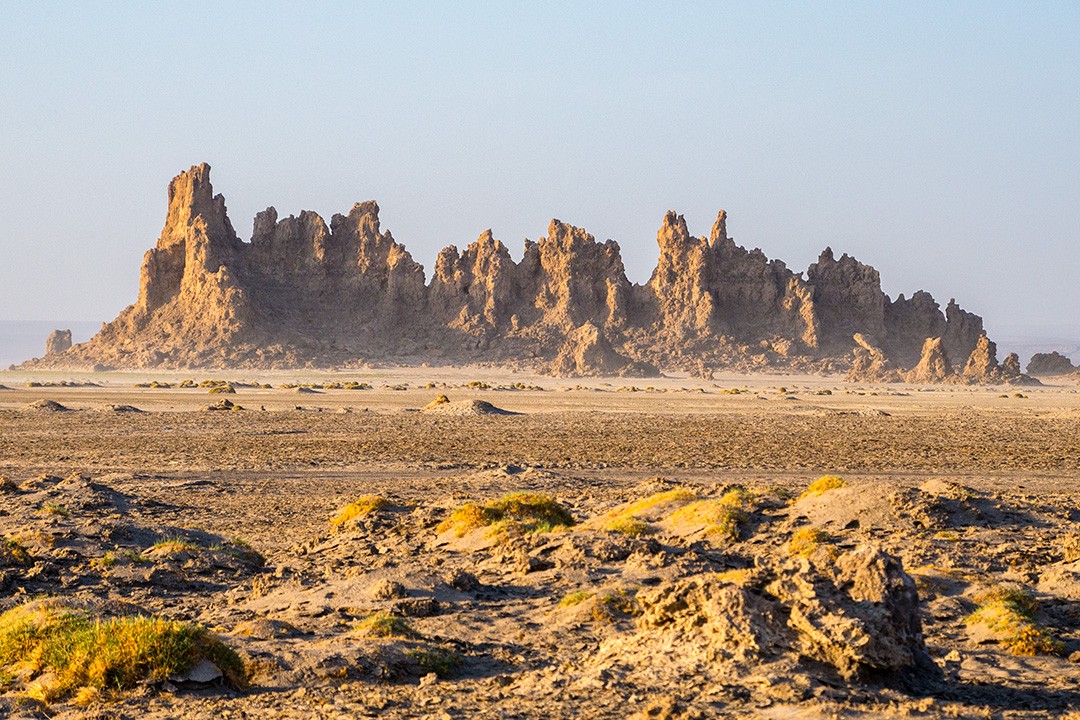
The most visually spectacular destination in Djibouti. The lake itself is a shrinking saline depression, and as it retreats it leaves behind limestone and gypsum chimneys, some reaching 50 meters, rising from cracked white mud flats with steam emerging from their tips in the morning cool. At dawn, with the light pink and flat and steam rising from dozens of vents simultaneously, the landscape is entirely unlike anywhere else easily described. Flamingoes feed in the shallower sections; hyena, warthog and gazelle move through at dusk. The drive takes about 3 hours on paved road, then roughly an hour on a track. Overnight camping among the chimneys is entirely recommended, the dawn light is the point.
Gulf of Tadjoura
Nutrient upwelling that accompanies the seasonal wind shift in November attracts whale sharks in reliable numbers each year, present November through January in a relatively concentrated area. Multiple operators run half-day and full-day excursions; snorkeling is standard since the animals feed at or near the surface. Moucha and Maskali islands, 45 minutes to an hour by boat, offer reef diving of exceptional quality, in better condition than most heavily dived Red Sea sites, with hammerhead sharks in season (October to January) and resident bottlenose dolphins.
Djibouti City
A port town defined by its function as a transit point. The European Quarter has French colonial architecture that feels distinctly anachronistic in the Horn of Africa heat; the African Quarter and the old medina around the central mosque are more interesting for street life, the Somali market where khat is sold alongside electronics, the fish market at the port, Lebanese restaurants and Yemeni tea houses. The Place du 27 Juin at dusk, when the temperature drops and the city relaxes, is the most pleasurable time to be there. Worth a day and an evening, not a reason to visit on its own.
Culture & Etiquette
Djibouti's culture reflects its position as a meeting point between East Africa, the Arabian Peninsula and the wider Islamic world. The Afar and Issa Somali communities maintain distinct traditions while sharing the Islamic faith and a trading culture oriented toward the sea, overlaid with French colonial language influence and a cosmopolitan military-base economy.
Do
- Greet in French or basic Arabic/Somali. "Bonjour" works everywhere; "Assalam aleykum" is the Islamic greeting throughout the country. Attempting any local language is noticed and appreciated.
- Schedule activities in the morning. After midday, especially 1-4pm during khat session, the pace of the city shifts dramatically.
- Dress modestly throughout. Covered shoulders and knees appropriate everywhere outside beach and resort environments.
- Hydrate aggressively. At least 3 liters of water per day, more on excursion days, genuinely affects your capacity to engage with the country.
Don't
- Photograph military installations. With multiple foreign bases, the definition of a sensitive installation is applied broadly; avoid photographing anything resembling port, military or communications infrastructure.
- Underestimate the heat. Genuinely dangerous rather than theoretical in summer; outdoor excursions must be timed for early morning with return to shade by 9am.
- Approach the Eritrea or Somalia borders. The Ras Doumeira territorial dispute with Eritrea remains unresolved; neither border area is a tourist zone under any circumstances.
- Discuss domestic politics openly. The government monitors dissent; observe and listen rather than editorialize.
Deeper culture: khat, Afar pastoralism, and the multiple military presence
Khat culture. Every afternoon between roughly 1pm and 4pm, male social life largely suspends as men chew khat, a mild stimulant leaf flown in daily from Ethiopia, in social groups. An estimated 90 percent of male adults chew regularly; the session is where business is discussed and community decisions effectively made. Visitors are sometimes offered khat; declining politely is acceptable.
Afar pastoralism. The Afar people of the interior are among the Horn of Africa's most ancient pastoral communities, moving with camels, goats and cattle through some of the most extreme terrain on earth. Afar communities have harvested and transported salt from Lake Assal to Ethiopia for centuries, some traders still using camel caravans today.
The multiple military presence. French Foreign Legion, American personnel from Camp Lemonnier, and Chinese military personnel are all visibly present in Djibouti City, creating a specific atmosphere in the European Quarter's bars and restaurants where off-duty soldiers from multiple national forces coexist with diplomatic staff.
Food & Drink
Djiboutian food reflects the country's cultural geography: a synthesis of Afar and Somali pastoral cooking, enriched by Yemeni and Lebanese influences from the Red Sea trade, overlaid with French culinary technique. The fish, in particular, is extraordinary, fresh from the Red Sea and Gulf of Aden each morning.
Grilled Red Sea Fish
Charcoal-grilled barracuda, emperor, grouper or trevally with a cumin-tomato sauce, flatbread and lime. The best fish isn't at European Quarter restaurants but at small places near the African Quarter port market, a fraction of the tourist strip price.
Fah-fah Braised goat soup
The Djiboutian national soup: bone-in goat braised slowly with cumin, cardamom and onion until the broth is deeply flavored, meat falling from the bone, served with flatbread. The standard restorative meal after a long day in the heat.
Skoudekharis
Aromatic long-grain rice with cardamom, cinnamon, cloves and black pepper, served with braised goat or lamb. The celebratory rice dish of the Issa Somali community, best on a Friday lunchtime at an African Quarter restaurant.
Lahoh
A large, spongy fermented pancake from sorghum or wheat flour, similar to Ethiopian injera but thicker. Eaten at breakfast with honey and butter, with shaax spiced tea, between 6am and 10am while the city is still cool.
Shaax & Yemeni Coffee
Cardamom-spiced black tea served at every gathering from breakfast through khat session. Yemeni coffee houses around the port serve qishr, a coffee husk drink spiced with ginger, alongside strong cardamom qahwa.
Lebanese & Yemeni Restaurants
The Lebanese community runs some of the city's best restaurants, mezze, grilled meats, fresh salads. Yemeni restaurants serve saltah and mandhi, whole goat slow-roasted in a pit oven.
When to Go & Itineraries
Djibouti's climate is extreme in summer and pleasant in winter, making the timing question nearly simple: visit between November and March. The whale shark season runs November to January, making this the peak window; outside this corridor, the heat, particularly June through September when temperatures regularly exceed 40°C, makes outdoor activity dangerous rather than merely uncomfortable.
All seasons compared, with temperatures
| Season | Verdict | Temps | Notes |
|---|---|---|---|
| Nov-Jan | Best, peak | 25-32°C | Whale sharks present; water visibility best; book accommodation and boats well ahead |
| Feb-Mar | Good | 28-36°C | Whale sharks departing by Feb; diving remains excellent; quieter than peak |
| Apr-May | Hot, transition | 33-40°C | Temperatures rising rapidly; possible for very early morning excursions only |
| Jun-Sep | Dangerous heat | 40-45°C+ | One of the hottest inhabited places on earth; not recommended for leisure travel at all |
Djibouti City averages. Lake Assal and the Afar plain run 5-8°C hotter; Day Forest at 1,500m runs 8-12°C cooler.
Itineraries
Djibouti's small size means the full tourist circuit is achievable in five to seven days. Book whale shark trips in advance during peak season, and build enough time for the dawn arrival at Lac Abbé that makes the overnight camping worthwhile.
- Day 1
Djibouti City arrival. Transfer to hotel, slow walk through the African Quarter market, dinner at a Yemeni restaurant near the port.
- Day 2
Whale sharks. Pre-booked private trip departing 7am, two to three hours on the water, return by noon; rest or explore in the afternoon.
- Day 3
Lake Assal. 4x4 departure at 6am, spend the morning on the salt flat before midday heat, return by early afternoon.
- Days 4-5
Lac Abbé overnight. Depart 7am, arrive midday, explore the chimneys in late afternoon light, wake at 5am for the dawn experience, return by midday.
- Days 1-2
City and whale sharks. Full city day, then a morning whale shark trip and afternoon Moucha Island snorkeling.
- Days 3-4
Lake Assal and Day Forest. Full day for Lake Assal and the Ardoukoba rift, returning via a different road; day four to Day Forest for birds and cooler highland air.
- Days 5-6
Lac Abbé overnight and Tadjoura. The dawn chimney experience, then an afternoon ferry to Tadjoura for an overnight in the old town.
- Day 7
Return and departure. Morning in Tadjoura, ferry back, afternoon flight home.
Getting there & around
Djibouti's small size makes transport simpler than most countries in this region. Main roads are paved; interior tracks to Lac Abbé and the geological sites require 4x4 but are rough rather than technically demanding. Everything requires hired vehicles or organized tours since public transport to tourist sites doesn't exist.
All transport options with prices: 4x4, ferry, whale shark boats
| Option | Price | Notes |
|---|---|---|
| Hired 4x4 with driver | $80-150/day | Standard for Lake Assal, Lac Abbé and Day Forest; drivers manage camp setup and know current track conditions. |
| Tadjoura ferry | DJF 1,000-2,000 | 90 minutes across the gulf; a passenger service used by locals, not a tourist boat, so check the schedule the day before. |
| Whale shark/dive boats | $60-150/person/trip | Pre-book November and December; private boats for groups of 4-6 produce better encounters than crowded group trips. |
| Taxis, Djibouti City | DJF 500-2,000/trip | Fine for city movement; cannot reach the geological excursion sites on their own. |
Tour operators: ask your hotel for individual driver and boat captain recommendations rather than booking through international aggregator platforms; the price difference is minimal and the experience difference substantial. GetTransfer offers pre-arranged airport pickups.
Where to stay
International hotels
Kempinski Palace Djibouti and Sheraton Djibouti serve the diplomatic and military market; functional rather than characterful, but reliable air conditioning and pools matter here.
Mid-range hotels
Hôtel de la République and Hôtel Djibouti Palace in the European Quarter offer reasonable comfort at lower prices, breakfast included at the better ones.
Moucha Island bungalows
Basic accommodation for divers wanting extended reef time without the daily city commute; facilities are minimal but the setting isn't.
Lac Abbé desert camp
Basic tented camping among the chimneys, set up by your 4x4 driver as part of the overnight package, positioned for the dawn light. Not luxury, but necessary; no alternative provides the dawn experience without sleeping there.
Budget Planning
Djibouti is expensive by African standards, driven by the military base economy that inflates prices across the city. Hotels are priced for diplomats and soldiers; restaurants in the European Quarter charge European prices. The excursions, whale sharks, Lake Assal, Lac Abbé, add up as a total trip cost, though day-to-day market food and local transport are cheap.
- Mid-range hotel or guesthouse
- Mix of local and mid-range restaurants
- Shared whale shark group trips
- Shared 4x4 for day excursions
- Comfortable hotel with pool
- Private whale shark boat, small group
- Private 4x4 for all excursions
- Lac Abbé overnight included
- Kempinski or Sheraton
- Full restaurant dining throughout
- Private exclusive boat for whale sharks
- Moucha Island overnight for diving
Quick reference prices: excursions, hotels, food
| Whale shark trip, shared | $60-80/person |
| Whale shark trip, private | $150-300/boat |
| Lake Assal day trip, 4x4 | $100-130/vehicle |
| Lac Abbé overnight, 4x4+camp | $150-200/vehicle |
| Hotel, mid-range | $80-120/night |
| Grilled fish, local restaurant | DJF 1,500-3,000 |
| Restaurant, European Quarter | $20-40/person |
| Dive, Moucha Island | $50-80/dive |
Prices reflect July 2026 research and drift over time. Treat them as a planning baseline, not a quote.
Visa & Entry
Djibouti offers visa on arrival at Djibouti-Ambouli International Airport for most nationalities, one of the more straightforward entry processes in the Horn of Africa. An e-visa system is also available online. Visa on arrival allows up to 31 days, and the process at the airport is generally efficient.
✓ Valid passport
At least 6 months validity beyond your stay, two blank pages minimum.
✓ Visa fee, ~$35 USD cash
Have it ready at the immigration desk; e-visa is available online for advance processing.
✓ Return or onward ticket
Evidence of departure from Djibouti, plus hotel confirmation for your first night.
⚠ Yellow fever, if applicable
Required only if arriving from a yellow fever endemic country; not needed for most European or North American direct travelers.
| Djibouti | Eritrea | |
|---|---|---|
| Entry | Visa on arrival or e-visa, straightforward | Requires advance visa approval, more restrictive |
| Tourist infrastructure | Thin but functional, whale shark operators established | Very limited, tightly controlled itineraries |
| Signature draw | Whale sharks, Lake Assal, Lac Abbé chimneys | Asmara's Italian colonial architecture, Red Sea coast |
| Political openness | Restrictive but stable, functioning tourism sector | Among the most closed and controlled states in the world |
This is context for travelers curious about the Horn of Africa's Red Sea coast, not a straightforward vacation-choice comparison given the very different access realities.
Safety, Solo Women & Family
Djibouti is one of the more stable countries in the Horn of Africa. It hasn't experienced the civil conflicts of Somalia, the border wars of Eritrea, or the internal instability of Ethiopia, and the concentration of foreign militaries produces a relatively low violent crime rate compared to regional peers.
Petty theft
Pickpocketing and bag snatching occur in the African Quarter market and around the port during busy periods. Keep valuables secured; phone theft specifically has increased.
Summer heat
The primary safety risk outside November-January. Heat stroke can occur within 30 minutes of unprotected sun exposure in peak summer; do not visit June through September for outdoor activity.
Lake Assal salt edge
Some salt formations have hollow interiors and can collapse. Walk only on ground confirmed by your guide; don't walk onto formations at the water's edge without guidance.
Border areas and military presence
Border areas: the Eritrea border, particularly the Ras Doumeira territory, remains unresolved and tense; the Somalia border, including Somaliland, carries elevated risk. Neither has any legitimate tourist excursion nearby, and neither should be approached or photographed.
Military presence: multiple foreign bases create restricted zones in and around Djibouti City and the airport area. Don't photograph anything resembling military infrastructure, port facilities or communication equipment; American, French, Chinese and Japanese perimeter zones are all actively policed.
Emergency numbers
Embassy contacts and medical evacuation
Several countries maintain resident embassies given Djibouti's strategic importance; others handle it from Nairobi or Addis Ababa.
- France
- +253-21-35-25-03
- USA
- +253-21-45-30-00
- UK (via Addis Ababa)
- Ethiopia consular services
- Canada (via Nairobi)
- Kenya consular services
- Italy
- +253-21-35-44-56
Medical: Peltier Hospital is the main public facility; Bouffard Hospital, the French military hospital, may assist civilian foreigners in serious emergencies. Specialist care requires evacuation to Addis Ababa (1.5 hrs), Nairobi (2.5 hrs), or Dubai (3 hrs); ensure your insurance explicitly covers this.
Family travel & pets
Djibouti is a reasonable family destination in the November to January window, when the whale shark season provides genuinely excellent family-friendly wildlife encounters. The heat outside this window makes it unsuitable for families with young children.
Whale sharks for kids, Lake Assal, and bringing pets
Whale sharks: one of the best family wildlife experiences available in Africa; whale sharks are gentle filter feeders with no interest in humans beyond mild curiosity. Age 8 and above is the practical minimum for confident snorkelers.
Lake Assal: the floating sensation is universally delightful for children of any age; the one caution is that any cut or broken skin produces significant pain from the salt concentration.
Pets: not recommended. No established pet import framework, extremely limited veterinary services, and the heat, even in the cool season, creates genuine welfare concerns for temperate-climate animals. Leave pets at home.
Djibouti FAQ
Is Djibouti safe to visit?
Yes, generally, and one of the more stable countries in the Horn of Africa. Violent crime targeting tourists is uncommon; the main visitor-relevant risks are petty theft, extreme heat, and unstable salt formations at Lake Assal's water edge, rather than anything political or criminal.
When can you see whale sharks in Djibouti?
November through January, when nutrient upwelling in the Gulf of Tadjoura attracts whale sharks in reliable numbers. Snorkeling is the standard approach since the animals feed at or near the surface; no scuba certification is required.
What is Lake Assal?
The lowest point in Africa at 155 meters below sea level, and the saltiest lake outside Antarctica at 34.8 percent salinity, ten times that of seawater. Visitors float rather than swim, surrounded by black basalt lava fields and white halite crystal formations.
Do I need a visa for Djibouti?
Most nationalities can get a visa on arrival at Djibouti-Ambouli International Airport for up to 31 days, for approximately $35 USD cash, or apply for an e-visa online in advance. A yellow fever certificate is required only if arriving from an endemic country.
What are the Lac Abbé chimneys?
Limestone and gypsum formations built up by mineral-rich hot springs over millennia, some reaching 50 meters tall, rising from a cracked white mud flat with steam emerging from their tips at dawn. Overnight camping among them is the standard way to catch the sunrise light.
How many days do you need in Djibouti?
Five to seven days covers the standard circuit: whale sharks, Lake Assal, and an overnight at Lac Abbé. Ten days allows a slower pace with Day Forest, Tadjoura, and island diving added.
Is Djibouti expensive?
Yes, by African standards, driven by the military base economy that inflates prices across Djibouti City. Hotels and restaurants are priced for diplomats and soldiers; daily market food and local transport are cheap but form a small share of most visitors' total cost.
When is the best time to visit Djibouti?
November to March, and ideally November to January for whale shark season specifically. Summer, June through September, brings temperatures of 40-45°C that make outdoor activity genuinely dangerous rather than merely uncomfortable.
What language is spoken in Djibouti?
French and Arabic are official languages, with Afar and Somali also widely spoken depending on ethnicity and region. French covers most logistics for visitors, particularly in Djibouti City.
Why does Djibouti have so many foreign military bases?
Its position at the mouth of the Red Sea, controlling access to the Bab-el-Mandeb Strait, makes it strategically valuable, and the government monetizes this through base-hosting fees from France, the United States, China, Japan, Italy and Germany, an economic model that has funded infrastructure disproportionate to the country's size.
The Country That Is Pulling Itself Apart
Geologists use the Afar Triangle to study how new ocean basins form, how a continent tears itself apart over millions of years, the rift widening by a few millimeters each year, until eventually the sea floods in and what was land becomes ocean floor. It's happening now, in geological time, under your feet at Lake Assal. The black lava and the white salt and the halite crystals building at the shoreline are the immediate products of a process that will, in twenty million years or so, make this a seafloor where fish might eventually swim through what was today's tourist parking area.
The Afar word for this place, for the triangle of geological instability their ancestors have inhabited for longer than any human civilization has existed, is simply their land. Not a geological phenomenon, not an object of scientific interest. Their land. The Afar people's adaptation to this landscape over millennia is the other geological story: what organisms do when their environment is extreme and changing, which is adapt continuously or fail. The visitor, arriving for five days with an insulated water bottle and a sense of wonder, is the most recent and least consequential participant in the story. That humility is not a reason to stay home. It's the correct posture for arriving.