
The Current Situation
Do not travel to mainland Yemen for tourism. The ongoing armed conflict, involving the Houthi movement, the internationally recognized government, a Saudi-led coalition and various armed factions since 2015, has produced one of the world's worst humanitarian crises, an estimated 150,000-plus conflict-related deaths with the true toll significantly higher once famine and disease are included. Virtually every Western government advises against all travel, and this advice is current and should be followed.
The exception this guide covers separately is Socotra Island, in the Arabian Sea roughly 240 kilometers east of the Horn of Africa. Socotra has been largely removed from the direct conflict, sitting under UAE-backed administration and periodically receiving tourists via charter flights from Abu Dhabi. But this isn't a clean exception: as of 2026 the US State Department has also specifically warned that companies outside Yemen have misrepresented Socotra's safety and sold tourists invalid, unofficial visas, and whether Socotra travel is advisable depends on current political conditions that genuinely change. Check specifically and recently before any booking.
Why this guide exists at all
This guide covers Yemen fully for several reasons. Humanitarian workers, journalists, diplomatic staff and researchers do travel to Yemen, under institutional frameworks entirely different from tourism, and this guide provides context for them. It also documents what Yemen was, what it contains, and what has been lost or damaged, because that record matters regardless of current accessibility. And it provides planning information for when a lasting peace eventually makes tourism possible again. Yemen deserves to be known, and what the war has done to it, and what remains despite the war, is documented here honestly.
⚠️ Mainland: do not visit
Every Western government advises against all travel. This isn't excessive caution: active combat, airstrikes, kidnapping risk and landmines are current realities.
🏝️ Socotra: verify current status
Accessible in some periods via UAE-based operators, but political control is contested and the safety picture is genuinely uncertain. Verify with a specialist operator before booking.
🏢 Aid workers & journalists
Travel with institutional support, security clearances and vetted local fixers. The planning chapter below covers what that involves.
📖 Planning for peace
Yemen's heritage, culture and landscapes are extraordinary. This guide documents them so the world knows what exists and what's worth protecting.
Yemen at a Glance
- Capital
- Sana'a (contested)
- Currency
- YER (Rial)
- Language
- Arabic
- Time zone
- AST (UTC+3)
- Power
- 220V, Type A/D/G
- Dialing code
- +967
- Population
- ~34 million
- Area
- 527,968 km²
Safety Assessment
This section is brief because the honest assessment is simple: mainland Yemen is not safe for tourists, and attempting to visit as a tourist creates risk for you and for Yemenis who would be obligated to help you. What follows is context, not a framework for "managed risk" tourism.
Active armed conflict
Multiple armed factions control different territories, front lines shift, and air strikes have occurred with limited warning. Ground combat, artillery and small arms fire continue in contested areas.
Kidnapping
Foreign nationals have been kidnapped, including humanitarian workers, by AQAP and various armed groups. The tribal protection system that historically made Yemen remarkably safe for travelers has been severely disrupted by the war.
Landmines & UXO
Widespread contamination, particularly in former front-line areas of Taiz, Sa'da, Hodeidah and Marib governorates. The scale hasn't been fully mapped, and this hazard will remain for years after any peace agreement.
Collapsed infrastructure, Socotra's conditional status, and remote research
Collapsed infrastructure: health facilities have been destroyed or severely degraded, water and sanitation systems have collapsed in many cities, contributing to the world's largest cholera outbreak in modern history, and power is intermittent or nonexistent in most areas. Medical evacuation for any emergency would be extremely difficult.
Socotra, conditional: its security situation is distinct from the mainland but not simple. Military presence, contested governance between the internationally recognized government and the UAE-backed Southern Transitional Council, and intermittent access all require current-specific verification. Do not treat previous access as an indicator of current access, and be aware that scam operators selling invalid, unofficial visas for Socotra have been specifically flagged by the US State Department.
Diaspora and cross-border research: academic and journalistic research on Yemen can be conducted through Yemen's large diaspora community without traveling to the country. Remote interviewing, working with local researchers through secure digital platforms, and open-source data analysis are all viable approaches the conflict has made standard practice in Yemen studies.
Emergency contacts
The following are relevant for humanitarian workers, journalists and others with institutional reasons to be in Yemen, not a framework for tourist travel.
Embassies, most suspended since 2015
The majority of foreign embassies suspended Yemen operations in 2015 and have not reopened. Contact the nearest embassy to the country in a neighboring state instead.
- USA
- via Riyadh, +966-11-488-3800
- UK
- FCO desk, +44-20-7008-5000
- Australia
- DFAT, +61-2-6261-3305
- Canada
- GAC, +1-613-996-8885
- Germany
- via Riyadh
- France
- via Riyadh
If in Yemen without institutional support: contact your foreign ministry's emergency line immediately, contact the ICRC, do not move without local guidance, and inform someone outside Yemen of your precise location. Consular capacity to assist is severely limited; prevention is the only effective strategy.
A History Worth Knowing
The Romans called it Arabia Felix, Happy Arabia, to distinguish it from the desert Arabia Deserta to the north. Yemen's southwestern highlands receive monsoon rains the rest of the Arabian Peninsula doesn't, producing an agricultural surplus that sustained complex civilization for at least 3,000 years before Islam. The ancient kingdoms of Saba, Himyar, Qataban and Ma'in, whose names appear in the Bible, in Herodotus and in the Quran, all existed here, and the frankincense and myrrh routes that supplied the ancient world's temples ran through this land.
- ~700 BCE
Great Dam of Ma'rib. The Sabaean Kingdom at its height; ancient frankincense trade routes established, and Arabia Felix earns its name.
- 630 CE
Islam arrives. Ali ibn Abi Talib sent by the Prophet Muhammad; Yemen becomes Islamic within a year.
- 897 CE
Zaidi Imamate founded. The Zaidi Shia tradition takes root in the northern highlands, the religious-political tradition underpinning the Houthi movement today.
- 1918
Ottoman withdrawal. North Yemen becomes independent; South Yemen remains under British control until 1967.
- 1990
Unification. North and South Yemen merge; Ali Abdullah Saleh governs for over two decades.
- 2014-2015
War begins. Houthi forces take Sana'a; a Saudi-led coalition intervenes, and Yemen's civil war becomes an international proxy conflict.
- 2026
Ongoing conflict. No lasting peace agreement; fragmented territorial control and a humanitarian crisis among the world's worst.
Read the full history: the Queen of Sheba, Sana'a's origins, and the road to war
The Queen of Sheba story, whatever its historical basis, is Yemeni. Ma'rib, capital of the Sabaean Kingdom, had a dam that was one of the ancient world's greatest engineering achievements, built around 700 BCE, irrigating 25,000 acres and supporting a city of 20,000 people; when it finally collapsed around 570 CE after centuries of repairs, the event was significant enough to be recorded in the Quran as a sign of divine judgment. Sana'a itself is one of the oldest continuously inhabited cities on earth, with local tradition holding it was founded by Shem, son of Noah; the old city's distinctive tower houses grew largely to their current form between the 10th and 17th centuries, and UNESCO inscribed it in 1988.
The modern political history is complicated and contested. North Yemen gained independence from the Ottoman Empire in 1918 and was ruled by Zaidi imams until a 1962 republican revolution. South Yemen was a British protectorate that became independent in 1967 and briefly had the only officially Marxist government in the Arab world. The two Yemens unified in 1990; Ali Abdullah Saleh governed for over three decades, survived the 2011-2012 Arab Spring uprisings only to be removed under a UN-brokered transition, and was ultimately killed in 2017 by Houthi forces he had allied with. The war that began in 2014-2015, when Houthi forces swept south from their highland strongholds and took Sana'a, is still ongoing.
Yemen's Heritage & Socotra
Yemen contains four UNESCO World Heritage Sites, among the most extraordinary in the Arabian world, all in various states of damage, contested territory, or uncertain access. Documenting them is a form of record-keeping: these places exist and matter, regardless of whether visiting them is currently possible.
Socotra Archipelago
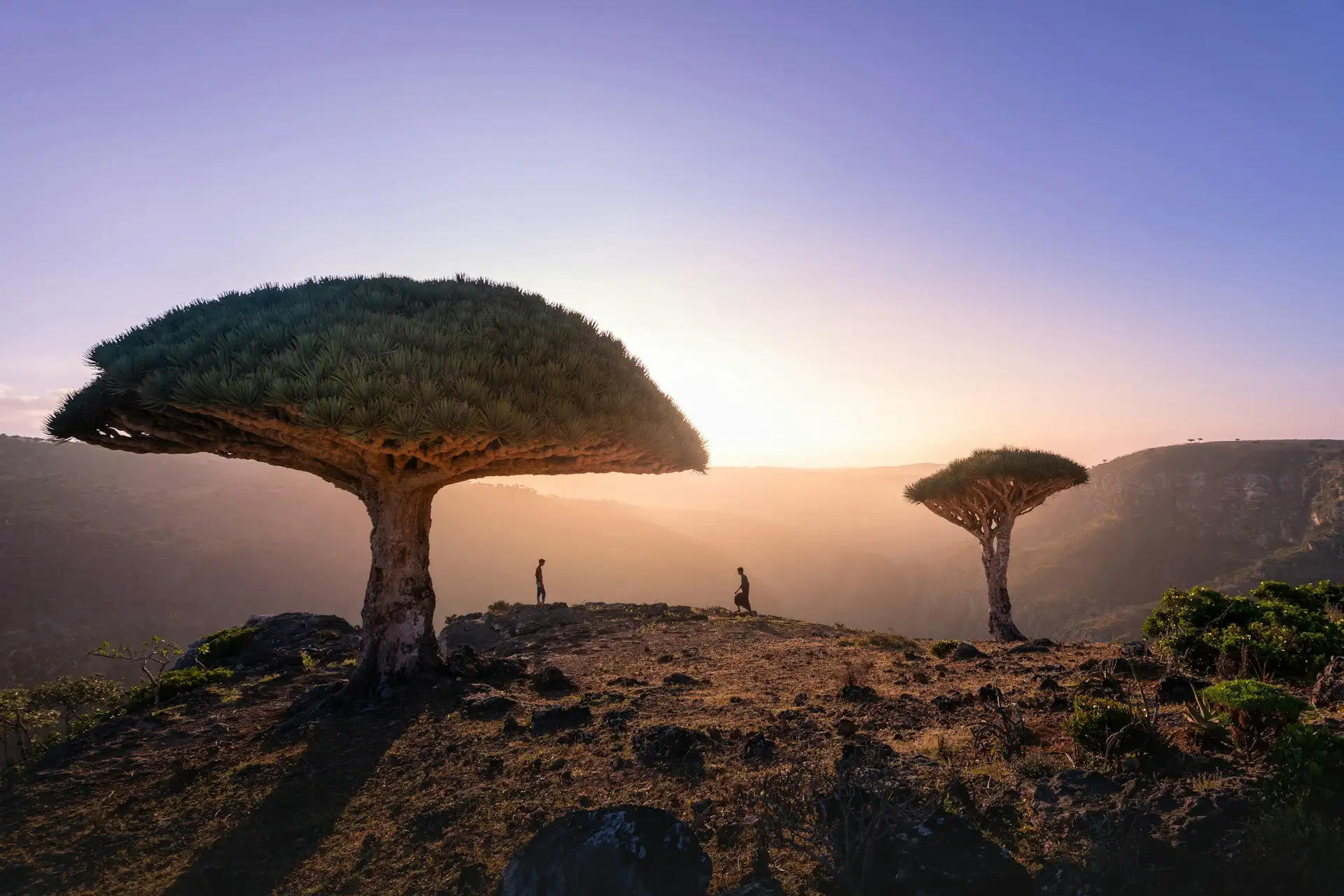
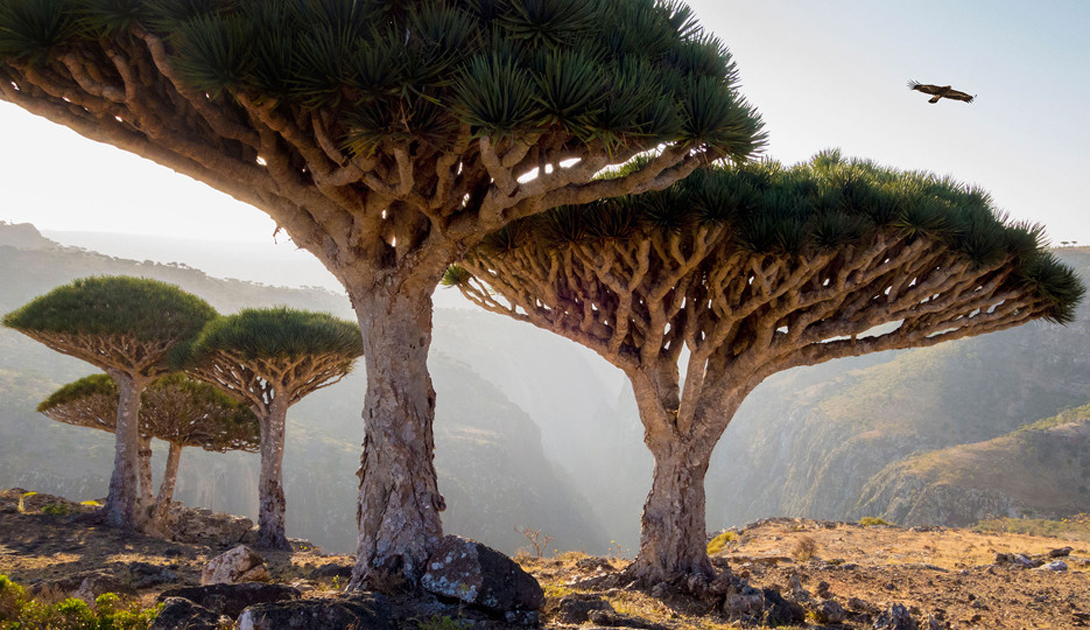
Socotra separated from the African and Arabian continental masses about 6 million years ago, producing a flora unlike anywhere else on earth. 37 percent of its plant species exist nowhere else. The dragon blood tree, its umbrella canopy catching fog and channeling moisture to the roots, is the island's symbol; the bottle tree and the giant succulents of the Diksam plateau look designed by someone who'd never seen the rest of the planet's plants. Socotra also has its own UNESCO listing for endemic biodiversity, and its own language, Socotri, unrelated to Arabic and spoken by around 70,000 people.
Old City of Sana'a
One of the most visually distinctive urban environments on earth: tower houses standing six or seven stories high, facades decorated with geometric fired-brick patterns, upper rooms lit by alabaster fanlights. The city has been inhabited continuously for at least 2,500 years. Air strikes hit the historic core in 2015, damaging parts of it including the Al-Qasimi Palace; heritage organizations continue documenting the damage.
Old Walled City of Shibam
The "Manhattan of the desert": roughly 500 mud-brick tower houses in the Hadhramaut valley, built between the 16th and 19th centuries, rising 5 to 11 stories from the desert floor within a fortified wall, one of the earliest examples of urban planning based on vertical construction. It was on UNESCO's List of World Heritage in Danger before the war; the mud bricks require constant maintenance that conflict has disrupted, compounding the damage.
Ma'rib & the Sabaean Kingdom
East of Sana'a, Ma'rib was the capital of the ancient Sabaean Kingdom. The ruins include the Great Dam, the Temple of Awwam, associated with the Queen of Sheba, and the Temple of the Moon God. Ma'rib has been at the center of some of the war's most intense fighting, with the Houthi siege of Ma'rib city involving months of combat for the surrounding governorate.
Haraz Mountains
West of Sana'a, rising over 3,000 meters, with some of the most dramatic terraced agriculture in the world. The cliff-edge village of Al-Hajjarah is among the most dramatically situated villages in Arabia, and coffee cultivation, Yemen being the birthplace of coffee as a beverage, continues in the Haraz and Bani Matar regions despite the conflict.
Yemeni Culture
Yemeni culture is among the most layered in the Arab world: an ancient civilizational history, mountainous geography that preserved regional distinctiveness, a tribal social structure predating Islam, and a deeply rooted Islamic tradition in multiple strands. Yemenis, pre-war travelers consistently reported, were among the most hospitable people in the Middle East, in a region where hospitality standards are already high.
Do
- Understand the tribal structure. The Hashid and Bakil confederations in the north, with distinct confederations in the south and Hadhramaut, still shape social and political life. Tribal law regulating hospitality and protection of guests, jiwar, has historically been taken seriously enough to override political conflicts.
- Approach qat culture with understanding. The afternoon qat chew is the primary social institution of Yemeni life, where business is conducted, disputes resolved and poetry recited.
- Appreciate the poetry tradition. The humayni style associated with Sana'a and the tribal highland styles are living traditions performed at weddings and gatherings, and some of the most significant documentation of the war has come in poetic form.
- Support Yemeni coffee and honey. Both trades have continued through the war and directly support farming families still working the land.
Don't
- Reduce Vodou-style stereotypes onto qat. Qat is central, legitimate social infrastructure in Yemen, not a curiosity, even though its water use is a genuine economic and environmental issue worth understanding honestly.
- Assume the jambiya is decorative. The curved dagger worn at the belt is the defining symbol of male identity in the northern highlands and indicates real social status through its handle material.
- Treat the current crisis as timeless or inevitable. Yemen's instability has specific causes tied to the 2014-2015 war and its aftermath, not an inherent condition of the country or its people.
Deeper culture: coffee's Yemeni origins, the jambiya, and poetry under conflict
Yemen and coffee. Coffee as a beverage was developed in Yemen, in the Sufi monasteries of the mountains where monks used it to stay awake for night prayers. The port of Mocha (Al-Mukha) on the Red Sea gave its name to the coffee that 16th-century Ottoman and European traders shipped worldwide, and Yemeni varieties from the Haraz, Bani Matar and Rayma regions are now among the most sought-after in specialty coffee.
The jambiya. A curved dagger worn at the front of the belt, the defining symbol of male Yemeni identity in the northern highlands; the handle material, rhinoceros horn traditionally, now banned and replaced with animal horn, wood or plastic, indicates social status. The silversmithing traditions around it, historically produced by Yemen's Jewish craftsmen before the community's emigration to Israel, were among the finest in Arabia.
Poetry under conflict. Yemen has one of the richest oral poetry traditions in the Arab world, and it continues even in displacement and refugee camps. Poet Ibrahim al-Hadhrami described the relationship between poetry and Yemeni identity in terms that apply directly to the war: the tradition continues regardless of circumstance.
Yemeni Food
Yemeni cuisine is one of the great underrecognized food cultures of the Arab world, with centuries of regional specificity in ways the Gulf states' more recently developed traditions don't share. It has traveled widely with the Yemeni diaspora and can now be found in Yemeni restaurants in London, Detroit, New York, Djibouti and Kuala Lumpur, cities where significant communities settled during the oil-boom migration years of the 1970s and 1980s.
Saltah
The national dish: a meat stew served in a stone bowl, topped with a fenugreek foam called hulba and a spiced tomato-chili paste, eaten with flatbread. The bitter, pungent fenugreek foam is the defining element, nothing else in the region's cuisine is quite like it.
Bint al-Sahn
Literally "daughter of the plate": a multi-layered pastry baked in clarified butter, soaked in honey at the table. The best Yemeni honey, sidr honey from the Hadhramaut and Wadi Dawan, is among the most prized in the Arab world.
Mandi & Fahsa
Mandi, lamb or chicken slow-cooked in a sealed underground oven with rice and spices, originated in the Hadhramaut and spread across the Gulf. Fahsa is a Sana'ani specialty of fenugreek-cooked lamb served in a clay dish that stays hot at the table.
Lahoh & Breads
A spongy, fermented pancake bread similar in texture to Ethiopian injera, reflecting Yemen's ancient connections across the Bab el-Mandeb Strait. Khubz tawa, khubz sa'a and malawah complete the bread repertoire present at every meal.
Coffee & Qishr
Qishr, steeped coffee husks with ginger, is the amber-colored home morning drink. Coffee beans roasted and ground with cardamom influenced both the Ethiopian coffee ceremony and the Turkish coffee tradition.
Yemeni Honey $150-300/kg
Sidr honey, from bees foraging on the jujube tree in the Hadhramaut and Marib regions, is among the most expensive honeys in the world, and one of the few Yemeni economic activities that has continued through the war.
Working in Yemen, and Planning for Peace
Thousands of humanitarian workers, journalists, diplomats and researchers operate in Yemen despite the conflict, and this section is for them, not a framework for "going anyway for adventure," a framing that's dangerous both for the person attempting it and for Yemenis obligated to assist or protect them.
Institutional support is non-negotiable
Nobody goes to Yemen responsibly without an established organization's backing: UN agencies, major INGOs like MSF, IRC, CARE and Oxfam, recognized news organizations, or diplomatic missions, who provide security protocols, local contacts and evacuation procedures. Freelancers without this support should not attempt entry regardless of experience.
Security training
HEAT (Hostile Environment and First Aid Training) is mandatory for any professional operating in Yemen. INSO provides regular Yemen-specific security briefings for registered organizations, and UNDSS provides clearances and incident reporting.
Access points
Aden International Airport has periodically operated commercial flights, mainly to Amman and Djibouti; Seiyun Airport serves the Hadhramaut. Access points change with the conflict, so verify current operational status with your organization before planning travel.
Communications
Satellite phones (Thuraya, Iridium) are essential outside Aden and other functioning centers. The mobile network is fragmented along conflict lines; establish regular check-in schedules with a security focal point before any movement.
When peace comes
This exists because peace will come eventually, and Yemen will need tourism when it does. Pre-war, Yemen received around 1 million tourists annually; that baseline will take years to rebuild, but the rebuilding is worth planning for now: landmine clearance across formerly contested areas, infrastructure repair, security sector reform, heritage restoration particularly at Sana'a's old city and Shibam, and re-establishing a tourism sector that was overwhelmingly dependent on local family-run guesthouses.
Sana'a, the Haraz & Ma'rib
The old city's tower houses and qamariyya windows, the qat market at noon, the cliff village of Al-Hajjarah in the Haraz mountains, and the Sabaean ruins at Ma'rib, the Temple of Awwam and the Great Dam, in a desert setting at the edge of the Empty Quarter.
Hadhramaut & Socotra
Shibam's skyscrapers from the approach road, a night in a traditional Hadhramaut house, then Socotra's Diksam plateau at sunrise and the Qalansiya lagoon, when both regions are safely and fully accessible again.
Costs, Then and When Peace Returns
Pre-war Yemen was an extremely inexpensive destination, and Socotra tours today reflect specialist, low-volume logistics rather than backpacker pricing. What follows is context, not a current-day tourist budget breakdown, since mainland tourism doesn't currently exist to budget for.
| Item | Approximate cost | Context |
|---|---|---|
| Socotra guided tour package | $150-300/day | Charter flight, guide, camping or guesthouse, via a UAE-based specialist operator |
| Sidr honey, premium | $150-300/kg | Purchasable now through diaspora importers without travel |
| Yemeni specialty coffee | Varies by roaster | Available through direct-trade importers supporting farming families |
| Pre-war Sana'a guesthouse | $10-25/night (historical) | Reflects the pre-2015 baseline, not current mainland conditions |
Visa & Entry
Entry to mainland Yemen is not a tourism question in 2026; visas exist on paper but the security situation, not the visa regime, is the barrier. For Socotra, entry is arranged through the specialist operator handling the trip, and only the Republic of Yemen government can issue genuinely valid Yemeni visas, a distinction that matters because unofficial companies have sold tourists invalid documents for Socotra specifically.
✓ Valid passport
Standard 6-month beyond-entry validity recommended for any Yemen-related documentation, including Socotra bookings.
✓ Verified operator for Socotra
Only book Socotra access through an operator that can confirm your visa or entry documentation is issued by the recognized Republic of Yemen government, not a third-party reseller.
✓ Institutional documentation for mainland work
Journalists, aid workers and researchers need their organization's own access arrangements and security clearances; individual visa applications outside these channels aren't a realistic path.
⚠ Register with your embassy
Most embassies have suspended Yemen operations since 2015 and operate remotely from neighboring countries; register there and confirm emergency contact procedures before any travel.
Yemen FAQ
Is Yemen safe to visit?
Mainland Yemen is not safe for tourism; every Western government advises against all travel, citing active armed conflict, kidnapping risk, and severe landmine contamination. This is current guidance, not excessive caution.
Is Socotra safe to visit?
Socotra's situation is genuinely uncertain rather than clearly safe. It has been largely removed from the mainland conflict and has periodically received tourists via charter flights, but as of 2026 the US State Department has also specifically warned about companies selling invalid tourist visas for Socotra, and access depends on shifting political control. Verify current conditions with a specialist operator before booking.
What caused the war in Yemen?
Houthi forces swept south from their highland strongholds and took the capital Sana'a in 2014-2015, prompting a Saudi-led coalition intervention. The conflict has since fragmented into multiple armed factions with no functioning national government.
What is the Old City of Sana'a?
One of the oldest continuously inhabited urban environments on earth, known for tower houses up to seven stories tall decorated with alabaster fanlights and geometric brickwork, UNESCO-listed since 1988. Air strikes damaged parts of the historic core in 2015.
What is Shibam, the Manhattan of the desert?
A walled city of roughly 500 mud-brick tower houses in the Hadhramaut valley, built between the 16th and 19th centuries and rising 5 to 11 stories from the desert floor, one of the earliest examples of vertical urban planning anywhere in the world.
Can journalists and aid workers travel to Yemen?
Yes, thousands do, but only under institutional backing from UN agencies, major INGOs, or recognized news organizations that provide security protocols, local contacts, and evacuation procedures. Freelancing into Yemen without this support isn't a survivable approach.
What is the dragon blood tree?
Dracaena cinnabari, a tree found only on Socotra and a few nearby islands, with an upturned umbrella canopy that catches fog moisture and channels it to the roots. When cut it produces a dark red resin, dragon's blood, used in traditional medicine and as a dye for centuries.
Why is Yemen called Arabia Felix?
The Romans used the name, meaning Happy Arabia, to distinguish Yemen's monsoon-fed southwestern highlands from the desert Arabia Deserta to the north, since the rainfall supported an agricultural surplus and complex civilization for at least 3,000 years before Islam.
What language is spoken in Yemen?
Arabic is the official language nationwide. Socotra has its own distinct language, Socotri, a South Semitic language unrelated to Arabic with no traditional written form, spoken by around 70,000 people and classified as endangered.
How can I support Yemen without traveling there?
Buying Yemeni specialty coffee from importers who source directly from Yemeni farmers, supporting humanitarian organizations including UNICEF, WFP, MSF and CARE operating in Yemen, and supporting heritage protection work through ALIPH and similar organizations are all direct ways to help.
What Endures
Tim Mackintosh-Smith, who lived in Sana'a's old city for decades, described pre-war Yemen as a palimpsest of time, layer upon layer of civilization written on top of each other, visible simultaneously in a way newer countries can't replicate. The Sabaean inscription and the Ottoman lintel on the same building. The ancient irrigation channel running beside a mobile phone shop. The poet reciting in a language descended from the people who built the Temple of Awwam.
In Arabic, the word for hospitality, karam, derives from the word for generosity and also from the word for nobility, the two meanings inseparable in the tradition: to be generous with a guest is an expression of who you are, not just what you do. Yemen has been fighting for its survival for a decade. The karam has survived. When the fighting ends, it will still be there, in the same tower houses, over the same coffee, with the same insistence that you eat more than you thought you could.