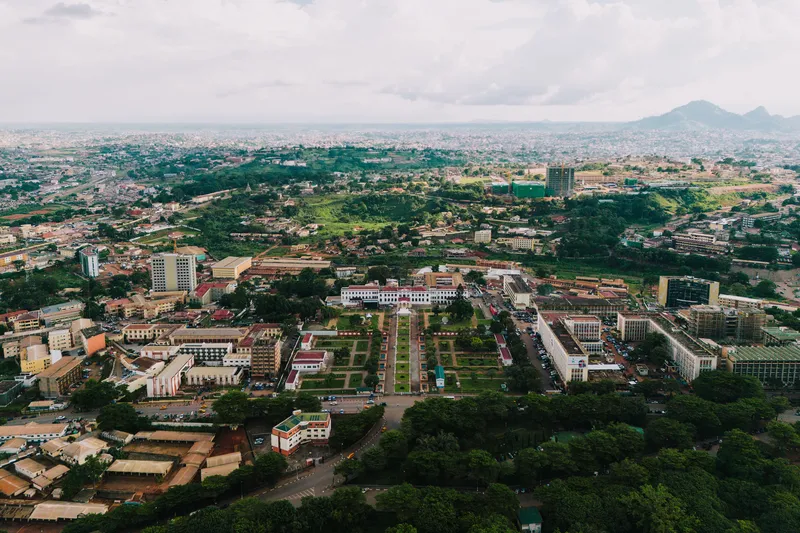
Former presidential palace
National Museum
Ethnographic and historical collections from across Cameroon, in the former presidential palace.

Updated November 2026 · Fact-checked
A capital spread over green hills, where the national museum sits in a former presidential palace, a spiral monument marks the reunification of the two Cameroons, and a Benedictine monastery looks down on the rooftops from Mont Fébé. Yaoundé does not put on a show for visitors, and a day or two here is the clearest way to understand how Cameroon sees itself.
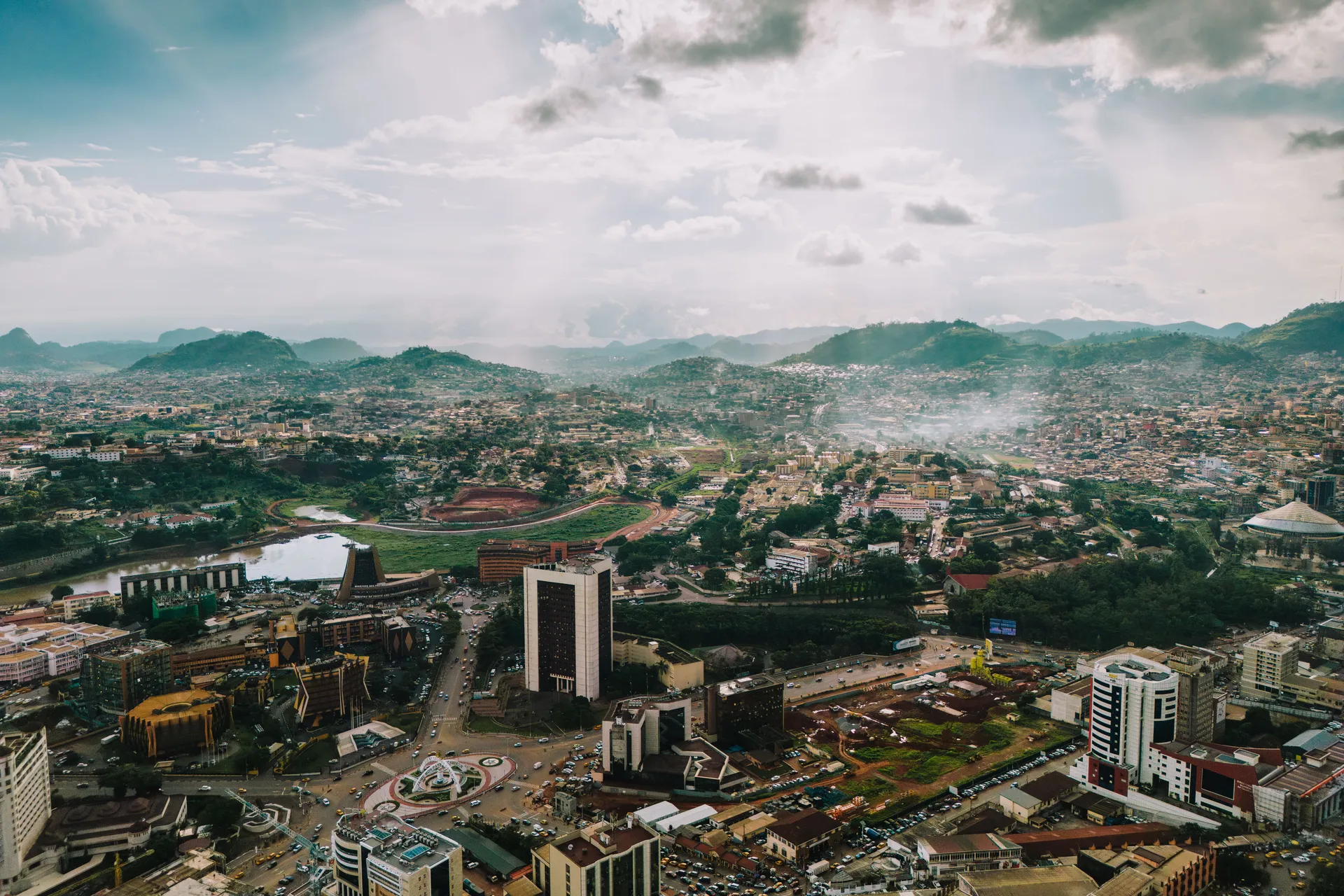 YAOUNDÉ · 3.8°N 11.5°E
Yaoundé is Cameroon's political capital and its second-largest city after Douala, set among hills at roughly 700 to 750 metres above sea level and nicknamed the City of Seven Hills. It is greener and cooler than the coast, and it holds most of the country's national monuments and several of its museums. It is a government and diplomatic city first and a tourist destination a distant second, which is exactly why it feels more like everyday Cameroon than the coast does.
For visitors, the case for Yaoundé is concrete: the National Museum, the Reunification Monument, the Blackitude Museum and the monastery on Mont Fébé can all be seen in two unhurried days, and the Camrail express train reaches Douala in a little under five hours. Most streets outside the centre have no signs, and locals navigate by landmarks and neighbourhood names, so a hotel-arranged driver who knows the hills is worth having.
The UK FCDO says terrorists are very likely to try to carry out attacks in Cameroon, mainly in the Far North but with attacks possible anywhere, including Yaoundé and Douala, and notes that improvised explosive devices have been seen in the capital. It also warns of armed robbery and mugging in Yaoundé. Canada advises a high degree of caution for the country as a whole. The practical consequence is a city you can visit, but not casually.
Photography is a real legal risk here. The FCDO says it is illegal to photograph military sites, government buildings, airports and ports in Cameroon, and officials may ask for money. In a capital full of ministries, that covers more than you would expect. Always carry ID or a certified copy of your passport with your visa, because police can detain you without it, and never wear camouflage clothing, which is illegal for civilians.
French is the working language of most of the city, with some English, so a little French goes a long way.
Yaoundé has no single old town. Its sights are spread across separate hills and districts, so where you stay matters less than how you move between them: plan each day around one or two areas and take a hotel-arranged taxi between them.
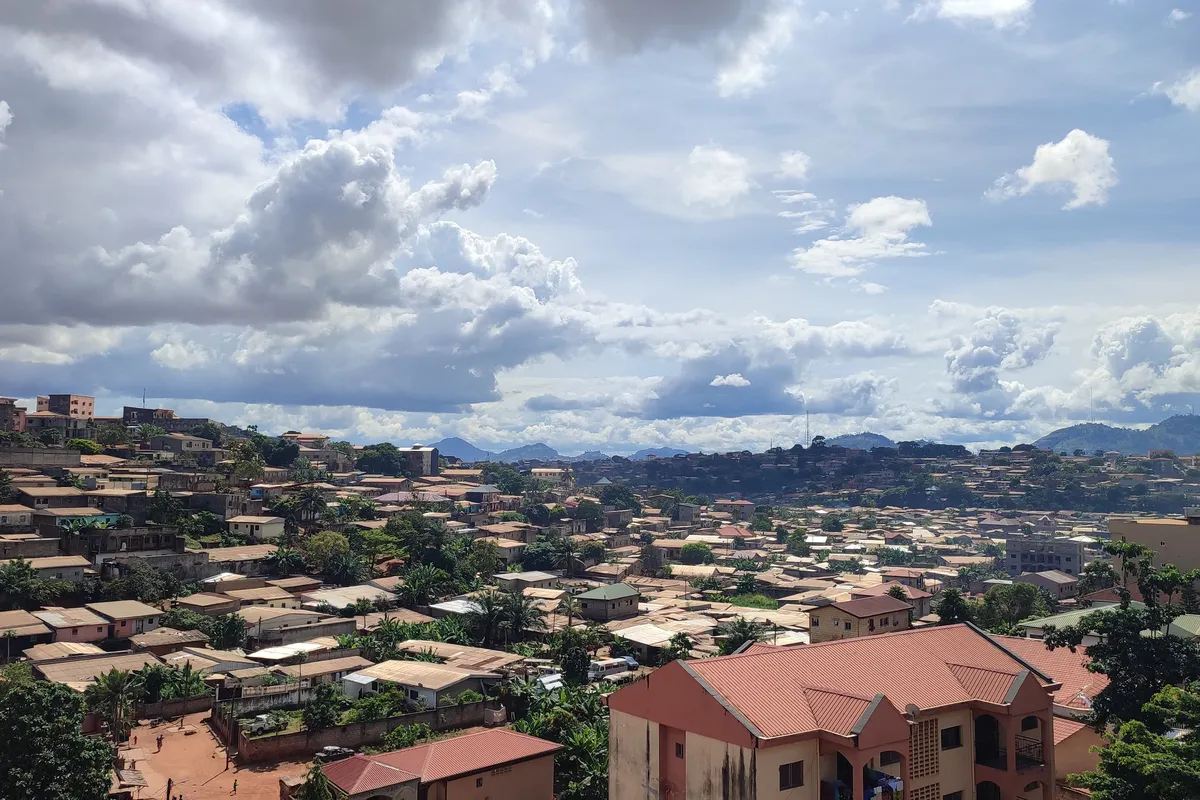
The broad Boulevard du 20 Mai is the capital's ceremonial axis: it is traditionally used for the national-day military parade on 20 May. The Hilton Yaoundé stands on it, and the Blackitude Museum sits behind the Presidential Tribune on the same boulevard. This is the most practical area for a first stay.
The National Museum occupies the former presidential palace in central Yaoundé, and it is the single most useful stop for understanding the country's history and the variety of its peoples. It is best paired with the Reunification Monument and a morning in the centre.
Yaoundé's main upscale and diplomatic district, with embassies, international organisations and higher-end hotels, calmer and greener than the centre. It is a comfortable base if quiet matters, but not where the sights are.
A hill just outside the centre with a Benedictine monastery and its small museum of Cameroonian art, a hotel and a golf course at its foot, and the best views over the city. Allow a half day.
The Mary Queen of the Apostles Basilica stands on Mvolyé hill, built on the site of the first church of the Holy Spirit Missionaries in Cameroon and consecrated as a minor basilica in 2006.
Mokolo is a market district and La Briqueterie is a central quarter. Both are named by the UK FCDO as places to avoid being isolated in, and Canada lists Mokolo market, Briqueterie and several other districts for increased caution against pickpocketing and theft. Go only in daylight, with a local, and carry very little.
We name only hotels we could confirm from several independent listings, and we do not quote nightly rates, because the published prices vary too widely between sources to repeat. Check current rates on the booking page before you decide.
Hilton Yaoundé is an international-brand hotel on Boulevard du 20 Mai in the central business district, near government offices, and listings describe restaurants and bars, an outdoor pool and a conference centre. Listings also mention an airport shuttle at extra cost, and the hotel can book taxis for you.
Hotel Mont Fébé stands on Mont Fébé beside the convention centre, with listings describing pools and several restaurants. It suits you if you want the quiet and the views of the hill, and it is further from the centre, so plan on taxis.
Whichever you choose, carry cash as well as a card: the FCDO notes that ATMs are not often available outside large towns and that shops usually need small notes. Book accommodation with adequate security, and keep doors and windows locked, as both the UK and Canada advise.
Yaoundé eats the same national dishes as the rest of southern Cameroon, and the best meals are often simple ones. We name no individual restaurants here: the scene changes quickly and we could not confirm any current venue from more than one source.
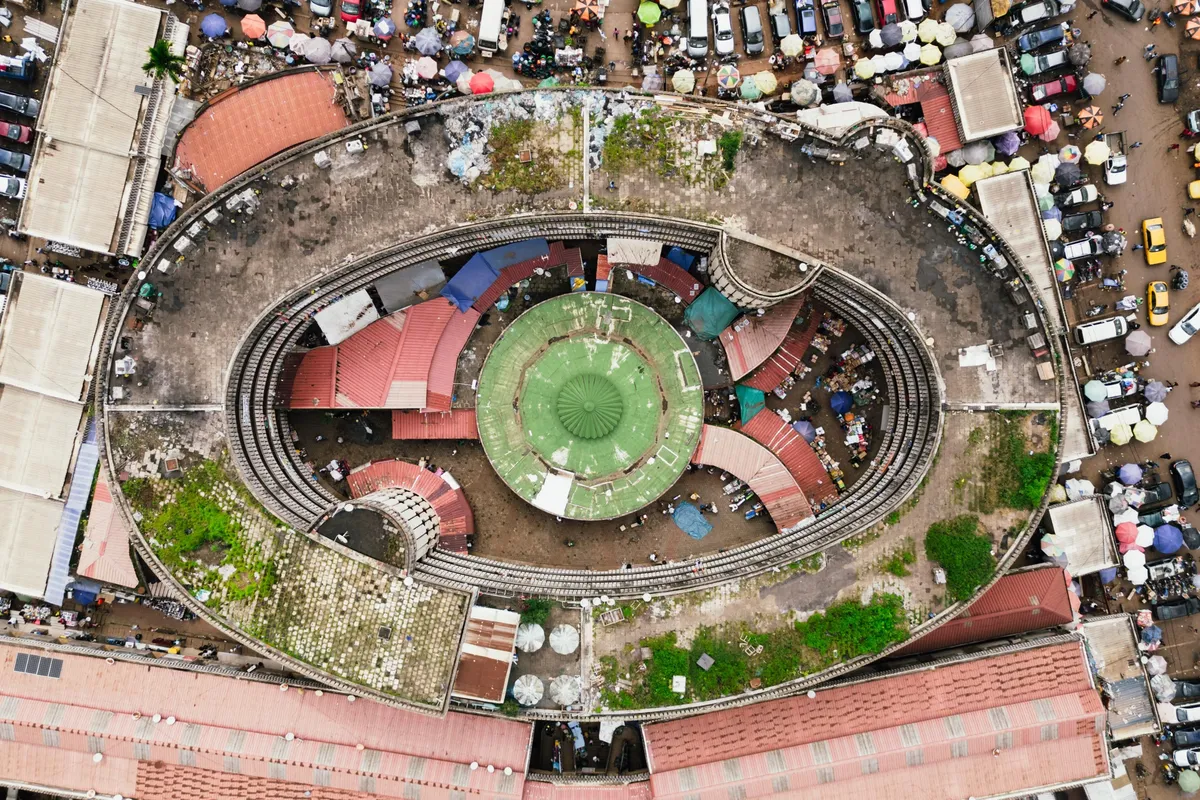
A stew of bitterleaf greens, ground peanuts, crayfish and palm oil, usually with fish or beef. It originated in Douala and is the national dish.
Puff-puff (sweet fried dough balls), suya (spiced grilled beef skewers) and soya (grilled fish or meat) are the everyday street standards, sold from stalls and grills after dark.
The sprawling Mfoundi Market is the place for fabric, spices and produce; go on a weekday morning before 10am. Markets are also where pickpockets work, so carry little and keep your phone out of sight.
Yaoundé is a sightseeing city of a few strong stops rather than a checklist. Opening hours and entry fees for several of them are published inconsistently, so we give none: confirm them locally before you go.
Ethnographic and historical collections from across Cameroon, in the former presidential palace.
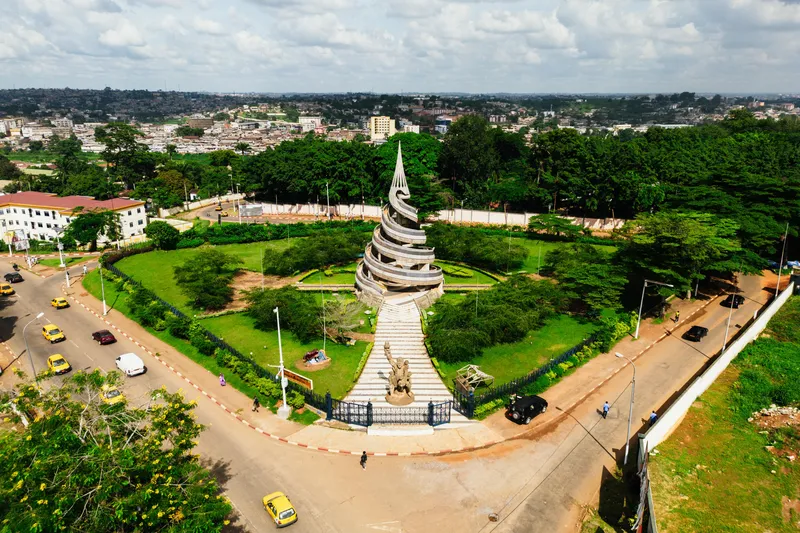
A spiral tower and a statue of an elder with children, marking the reunification of the two Cameroons.
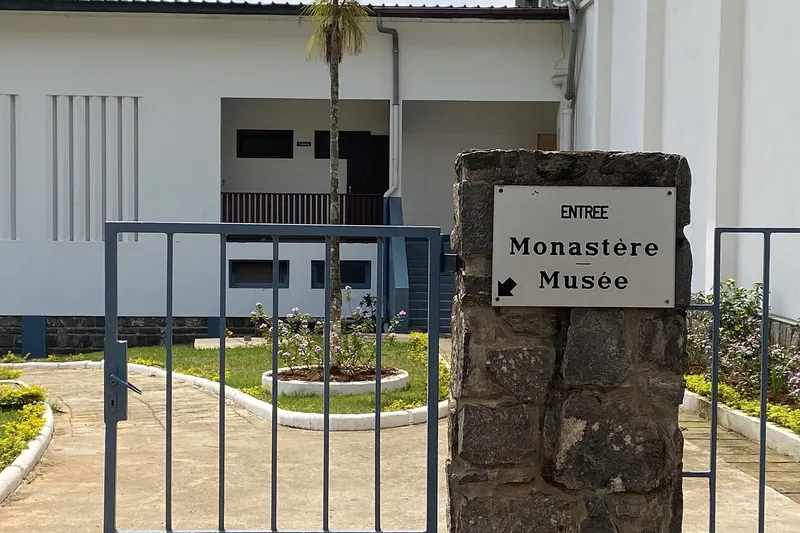
A Benedictine monastery founded in 1964, with a small museum of Cameroonian art and the best city views.
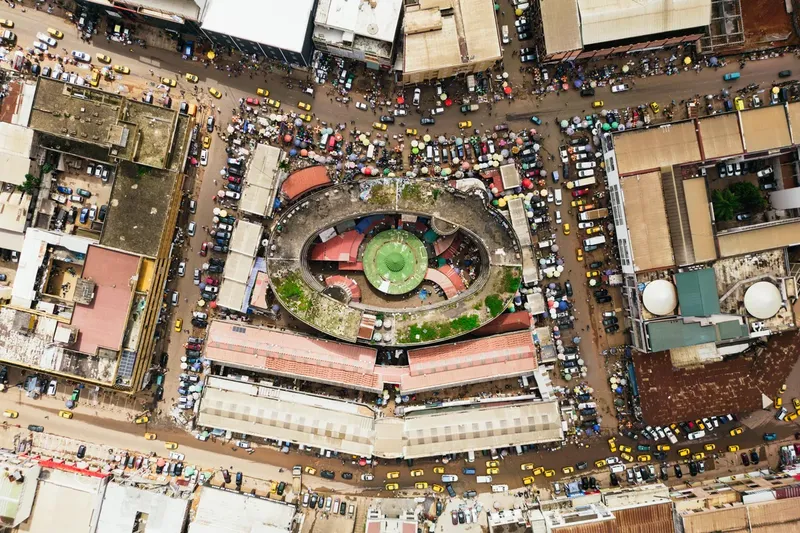
Busy, crowded and pickpocket-prone; fabric, spices and produce.
The National Museum is housed in a former presidential palace, which began as the residence of the French colonial governors and was later extended under President Ahidjo. Its collections cover traditional art, archaeology, ceremonial masks, musical instruments and everyday objects from across Cameroon's more than 250 ethnic groups, plus material from the independence era. Published opening hours conflict, so confirm locally before going.
The Reunification Monument commemorates the reunification of the Francophone and Anglophone parts of Cameroon. It combines a tall spiral tower with a statue of an elder and children reaching toward a flame, about seven metres high, and it was designed by several artists after a national and international competition launched under President Ahidjo. It is worth visiting with that history in mind, and it is a public monument, so photograph it from the roadside rather than pointing your camera at nearby official buildings.
The Blackitude Museum is a private ethnographic museum behind the Presidential Tribune on Boulevard du 20 Mai, opened in 2008 and founded by Her Majesty Ngo Nab Fô I Nana Agnès Sunjio. Its collection is commonly cited as more than 2,070 objects, largely from the Fang Beti and Grassfields peoples, of which about 360 are on permanent display: statues, masks, musical instruments and royal furniture.
The Monastery of Our Lady of Mont Fébé was founded in 1964 by monks from Engelberg in Switzerland and is home to a community of about 21 monks. It houses the Musée d'Art Camerounais, which displays masks, sculptures and ritual objects, and the hill gives the best view over the city. A hotel and a golf course sit at its foot. Go by taxi arranged through your hotel, and treat it as a quiet, respectful place.
The Mary Queen of the Apostles Basilica on Mvolyé hill was conceived by Mgr Jean Zoa, completed under his successor and consecrated as a minor basilica in 2006. The Mvog-Betsi Zoo is a zoological and botanical park with a range of species, including several monkeys; some visitors feel the animals are not well kept, so check recent reports before deciding to go.
Group the sights by area and move between them by hotel-booked taxi. Two days covers the capital properly; a third is best spent on the train to Douala.
National Museum. The country's history and peoples in one building; confirm opening hours first.
Reunification Monument. A short taxi ride, then lunch near your hotel.
Mont Fébé. The monastery museum and the views over the city.
Dinner at your hotel or a place it recommends, and a booked taxi home.
The one-day route: National Museum, Reunification Monument and Mont Fébé.
Blackitude Museum. About 360 objects on display, behind the Presidential Tribune on Boulevard du 20 Mai.
Mvolyé basilica and the Mvog-Betsi Zoo. Check zoo conditions and opening before you go.
A market visit only in daylight, with a local guide, if you want to see Mfoundi; otherwise rest.
The two-day route above, at a gentler pace.
Express train to Douala. Camrail's express takes 4 hours 40 minutes; see the Douala guide.
Yaoundé Nsimalen International Airport (NSI) is about 27 km south of the city and is operated by Aéroports du Cameroun. There is no visa on arrival at Yaoundé or Douala airport: you must apply through Cameroon's e-visa system in advance, and a valid yellow fever vaccination certificate is required. Airport taxis have no meters and there is no published tariff, so agree the fare before you get in, or ask your hotel to send a driver.
In the city, yellow taxis run like shared buses, picking up passengers while there is room, and the UK FCDO warns that many do not meet basic safety requirements and that passengers have been assaulted and robbed. Its advice is to use only trusted, pre-arranged taxis, ideally booked through your hotel or restaurant. Ride-hailing apps such as Yango are reported to operate in Yaoundé. Because most streets are unnamed, give a landmark rather than a street address. Police and gendarmerie roadblocks are common; the FCDO advises against paying bribes and asking for a ticket for any alleged offence instead.
By train from Douala. Camrail's express trains 185 and 186 link Douala and Yaoundé in 4 hours 40 minutes, according to Camrail. Seat61, whose timetable was last updated on 1 January 2026, lists a daily express leaving Douala at 06:30 and arriving at Yaoundé at 11:15, and a daily express leaving Yaoundé at 17:00 for Douala at 21:45. Buy at the station or on mycamrail.cm. The road is the alternative, but the FCDO says accidents are common on the Yaoundé-Douala road and advises against travelling at night.
November to February is the dry season and the best window, with temperatures of roughly 18-27°C in Yaoundé and the best road conditions. The wet season runs roughly March to November, with a dip in rainfall around July, and the heaviest rain falls from June to September.
Practical prep: buy a local SIM (MTN or Orange) on arrival, or get an eSIM before landing. Malaria prophylaxis is strongly recommended, and the eVisa and yellow fever certificate should be sorted well before departure.
Yaoundé has no published taxi tariff, and hotel and restaurant prices vary widely between sources, so we give only figures that a source states. Our Cameroon guide uses a baseline of $35-50 a day for the country as a whole; treat it as a starting point, not a quote.
| Item | Price | Source and note |
|---|---|---|
| Express train Douala-Yaoundé, premium class, one way | 6,000 XAF | Seat61 (fares undated); check mycamrail.cm |
| Express train, first class, one way | 10,000 XAF | Seat61 (fares undated); check mycamrail.cm |
| Ordinary train, second class, one way | 3,000 XAF | Seat61 (fares undated); slower, not air-conditioned |
| Airport and city taxis | No official tariff | No meters; agree the fare first, or use a hotel-booked driver |
| eVisa, ordinary short stay | 100,000 XAF | From our Cameroon guide; confirm on the e-visa site |
The UK FCDO (current at 1 November 2026) advises against all travel to the Far-North Region (with limited exceptions), the North-West and South-West Regions (with exceptions for Limbé), the Bakassi Peninsula and the border zones, and Yaoundé is not on that list. Canada (updated 14 October 2026) advises a high degree of caution for Cameroon overall and avoiding all travel to the North-West, South-West and Far North regions and the border zones. The US renewed its Level 2 advisory for Cameroon in May 2026, with Level 4, Do Not Travel, for the Southwest, Northwest and Far North Regions. New Zealand advises exercising increased caution.
In Yaoundé itself, the FCDO names armed robbery and mugging as the main risk and tells visitors to avoid isolated or less developed areas such as the Briqueterie and Mokolo market and to avoid walking at night. Canada adds pickpocketing and bag snatching, with increased caution around Mokolo market, Kennedy Avenue, Mvog-Ada Pakita, Briqueterie, Mini-Ferme Melen and Nkololun, and warns that violent crime is frequent at night. Keep valuables out of sight, do not resist an attack, and avoid crowds and demonstrations, which can turn violent or lead to curfews without notice; follow local authorities. Same-sex sexual acts are illegal in Cameroon. The emergency number is 112 and the police number is 117, but Canada says police and emergency services assistance is limited, so travel with insurance that covers medical evacuation.
For scams specific to Cameroon, including advance-fee and adoption scams, see our Cameroon scam guide.
Yaoundé works best as one stop in a southern Cameroon trip. The one onward journey we can source properly is the train to Douala; several tempting destinations are covered by advisories.
Cameroon's largest city and main gateway is 264 km away by Camrail's route. The express train takes 4 hours 40 minutes, according to Camrail. See our Douala city guide for neighbourhoods, hotels and what to do.
Our Cameroon country guide covers Kribi and the western highlands, which it treats as the parts of the country where routine travel happens. We do not give transfer times here because we could not confirm them from an operator.
The UK FCDO advises against all travel to the North-West Region and to the South-West Region including Buea, and Canada advises avoiding all travel to both. Canada also advises avoiding non-essential travel to the North and Adamaoua regions, so check the current advisories before planning anything north of Yaoundé.
Yaoundé is not in any of the areas that the UK, Canada or the US advise against, but it is not a low-risk city. The UK FCDO says terrorist attacks could occur in major cities including Yaoundé, warns of armed robbery and mugging there, and names the Briqueterie and Mokolo market as areas to avoid. Canada advises a high degree of caution for Cameroon overall. Use hotel-booked taxis, avoid walking after dark and keep valuables out of sight.
Two days covers the main sights: the National Museum, the Reunification Monument and Mont Fébé on one day, the Blackitude Museum, the basilica at Mvolyé and the zoo on the other. A third day works well for the train to Douala.
Yes, if you are interested in Cameroonian history and art. The capital holds most of the country's national monuments and several museums. It is not a beach or resort city, and it works best combined with Douala and Kribi.
Yes. You cannot get a visa on arrival at Yaoundé or Douala airport; you must apply and pay through Cameroon's e-visa system before you travel, and a valid yellow fever vaccination certificate is required to enter. Check the Cameroon country guide for the current fee.
November to February, the dry season, is the best window. The wet season runs roughly March to November, with a dip in rainfall around July, and heavy rain makes roads and getting around harder.
Nsimalen International Airport (NSI) is about 27 km south of Yaoundé. Taxis at the airport have no meters and there is no published official tariff, so agree the fare before getting in, or ask your hotel to arrange a pick-up. Ride-hailing apps such as Yango are reported to operate in the city.
Yes. Camrail runs express trains 185 and 186 between Douala and Yaoundé with a journey time of 4 hours 40 minutes, according to Camrail. Tickets can be bought at the station or on mycamrail.cm. Slower ordinary and omnibus trains also run.
Be careful. The UK FCDO says it is illegal to photograph military sites, government buildings, airports and ports in Cameroon. As the capital, Yaoundé has many of these, so ask before taking photos near ministries, the presidential palace or any official building.
French is the main language, and many younger people speak some English. A few words of French, such as bonjour and merci, make everyday dealings easier.
We do not recommend it. The UK advises against all travel to the North-West and South-West Regions, including Buea, Canada advises avoiding all travel to both regions, and the US rates them Level 4, Do Not Travel.
Yaoundé is not built to impress a visitor in an afternoon. It is a working capital of hills, ministries and markets, with a palace turned into a museum and a monument that tries to hold two histories in one spiral. Given a little care and a good driver, it repays the effort.
Climb Mont Fébé late in the day, look back over the rooftops, and you will see why this was never a coastal city: it is Cameroon's interior, seen from above.