
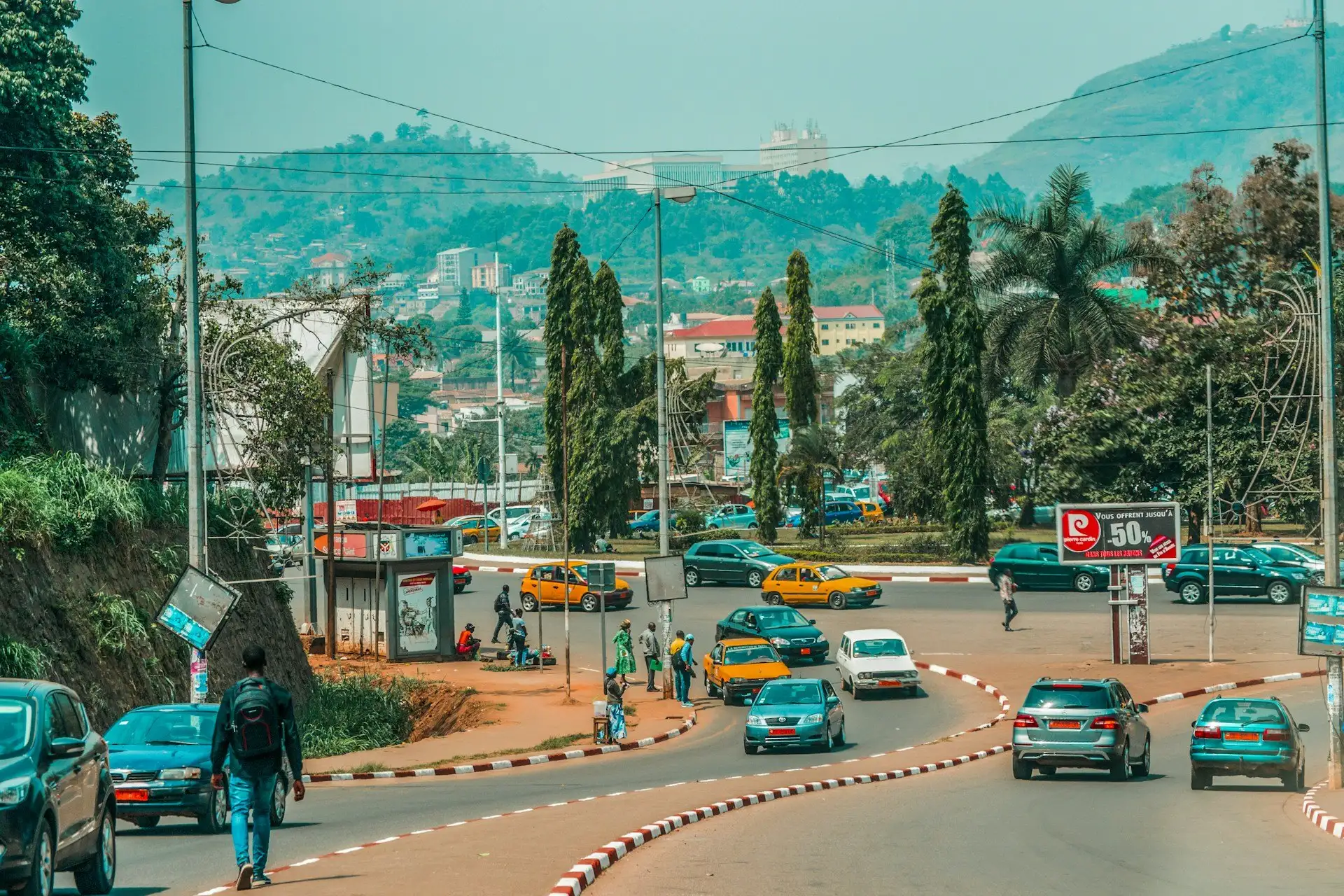
What Travellers Must Know About Cameroon
Cameroon's safety picture divides sharply by region. The tourist scam landscape for the accessible parts of the country — Yaoundé, Douala, the West region, and the south — is a secondary concern compared to understanding which regions to avoid entirely.
Common Scams & Risks in Cameroon
Cameroon's tourist traps divide into institutional risks (police checkpoints), conventional financial scams (taxi overcharging, fake guides), and the regional security threats that require geographical awareness above all else.
Cameroon's road checkpoints are among the most persistently documented in Central Africa. Officers from the police, gendarmerie, and military stop vehicles at numbered barriers across all road types. For foreign travellers, the demand is usually for "document verification" that morphs into a request for a "fee" — for a visa not being stamped correctly, for a passport page not being in order, or simply as an unstated expectation. Amounts range from XAF 500–5,000 (approximately €0.75–7.60). Some officers are straightforward; others are persistent. The cumulative effect on a long road journey — 10–20 checkpoints is not unusual — makes this a significant practical issue.
- Carry original documents — passport, visa, and yellow fever certificate — at all checkpoints. Cameroon requires original documents, not copies, at official checkpoints.
- When a fee is requested, ask politely for an official receipt (un reçu officiel). This question alone ends most informal payment requests since genuine fines have paperwork and shakedowns do not.
- Remain calm, polite, and patient throughout — visible frustration or confrontation prolongs the stop. A Cameroonian travelling companion or driver who speaks with officers in French or the local language shortens checkpoint interactions significantly.
- Travelling by reputable organised transport with a driver who knows the roads reduces checkpoint friction — experienced local drivers navigate these routinely and efficiently.
Douala's airport has one of West and Central Africa's most aggressive tout presences at arrivals — drivers, fixers, and unofficial "helpers" converge on new arrivals immediately. Taxi fares from Douala airport to the city centre (approximately 10km) should be XAF 5,000–8,000; prices quoted to tourists without research can reach XAF 20,000–30,000. Yaoundé's Nsimalen Airport is 20km from the city centre; XAF 8,000–12,000 is the correct range for a private taxi. Both cities use shared taxis (taxi brousse) for local travel — the system is cheap but requires knowing destinations and fare ranges.
- Pre-arrange hotel airport pickup before arrival — this is the most reliable approach and hotels quote honest fixed rates.
- If taking a taxi independently at Douala Airport, walk to the official taxi rank outside the terminal rather than accepting approaches inside the arrivals hall.
- Agree the fare in XAF explicitly before getting into any vehicle. For Douala city centre: XAF 5,000–8,000. For Yaoundé city centre from Nsimalen: XAF 8,000–12,000.
- In both cities, the shared taxi brousse system costs XAF 200–500 per trip within the urban area — ask your hotel staff or a trusted local contact how to use it for the specific route you need.
Cameroon has a documented culture of advance fee fraud — locally called "feymen," those who live by deception. The online variant is familiar globally: emails claiming inheritance transfers, business deals, or investment opportunities requiring upfront fees. The in-person variant operates in Douala and Yaoundé's business districts — a well-dressed, apparently prosperous person establishes acquaintance over days or weeks before introducing an "exclusive business opportunity" that requires an initial investment. The sophistication of the approach scales with the amount being targeted: small targets get simple approaches; large targets get elaborate staging with fake offices, accomplices posing as lawyers, and forged documents.
- Any unsolicited business opportunity encountered in Cameroon — by email, online, or in person — should be treated as a scam until rigorously verified through independent channels.
- The pattern of establishing warm personal rapport before introducing a profitable but time-sensitive opportunity is the universal setup — recognise it regardless of how genuine the person appears.
- Never transfer money, pay fees, or make investments based on relationships formed with strangers, regardless of the documentation or apparent legitimacy of the opportunity presented.
- If you believe you are being targeted, disengage immediately and discuss with your embassy — they have specific advisories on these scams and can assist in verifying any claimed business entity.
Unofficial guides approach tourists at Cameroon's main attractions — the Bamoun Sultan's Palace in Foumban, the Lobe Falls near Kribi, and national park entrances — offering services that range from genuinely useful to actively harmful. At Foumban, unofficial guides offer palace tours that overlap confusingly with the official guided tour system; tourists sometimes pay for both without realising. At Kribi, beach guides claim to provide "safety" services that are not necessary. At national parks, unofficial guides sometimes provide genuinely useful access to areas not covered by park rangers but are operating without oversight or training standards.
- At the Bamoun Sultan's Palace in Foumban, use only guides arranged through the official palace entrance — unofficial guides outside the gate provide inferior information at higher prices.
- Decline all unsolicited guide approaches before entering a site — say you already have a guide or do not need one, then do not engage further.
- For national parks (Waza, Dja, Korup), book through official park management or licensed tour operators in advance — official park fees are clearly posted and guides are certified.
- Agree all fees in advance and in full before any service begins — "we can discuss payment after" always produces a higher final demand than agreed upfront prices.
Photography restrictions in Cameroon are broad and inconsistently enforced. Photographing military installations, police posts, government buildings, checkpoints, the Presidential Palace, airports, ports, and bridges is prohibited and can result in equipment confiscation and detention. Beyond official restrictions, some market traders and individuals are hostile to being photographed without permission — confrontations have escalated when tourists photograph without asking. In the current political climate, photography near any official structure in the Anglophone regions carries heightened risk of a serious response.
- Keep cameras and phones out of sight at all road checkpoints — photographing officers or checkpoint infrastructure is a serious offence that will extend the stop dramatically.
- Ask permission before photographing individuals, market scenes, or any location that is not clearly a civilian tourist site.
- Do not photograph any structure that could plausibly be government-owned or military — if uncertain, do not photograph it.
- In the event of equipment confiscation, remain calm, do not resist, and request assistance from your embassy as soon as possible.
Cameroon's rainforest south — including the Dja Faunal Reserve and the areas inhabited by Baka forest peoples — has attracted tour operators of wildly varying quality and ethics. Some operators claiming to offer "authentic Baka cultural experiences" are exploitative — presenting communities for tourist consumption without genuine community consent or benefit sharing. Others claim access to gorilla and chimpanzee tracking in areas where great ape tourism is either not operating or poses genuine conservation risks. The gap between marketing claims and on-the-ground reality is significant for some operators in this space.
- Use only tour operators who can demonstrate verified partnerships with community organisations and clear benefit-sharing arrangements for any Baka cultural tourism.
- Gorilla and chimpanzee tracking in Cameroon requires MINFOF (Ministry of Forestry and Wildlife) permits — verify any operator's permit status before booking.
- The Dja Faunal Reserve is a UNESCO World Heritage Site — entry without a licensed guide and official permits is both illegal and potentially dangerous due to large wildlife including forest elephants and buffalo.
- Reputable operators include those affiliated with the Wildlife Conservation Society (WCS) Cameroon programme and WWF's Congo Basin programmes — ask specifically about their institutional affiliations.
Cameroon's Key Destinations
Understanding Cameroon's regional geography — and which areas are currently inaccessible — is the most important safety knowledge for any visitor.
Yaoundé, the political capital, sits on seven hills in the Centre region — a greener, less chaotic city than Douala with a more manageable scale. The National Museum, the Benedictine Monastery of Mont Fébé, and the Central Market are the main visitor attractions. The city has good accommodation options and is the starting point for trips south to the Dja Reserve and east toward the Congo border. Yaoundé's airport (Nsimalen, 20km from the centre) is the secondary international entry point after Douala.
- Airport taxis: Nsimalen to city centre XAF 8,000–12,000 — pre-arrange hotel pickup to avoid airport tout pressure
- Shared taxis in the city (taxi brousse): XAF 200–500 per trip, destinations called out by drivers — ask hotel staff to explain the system for your specific routes
- Advance fee / feymen approaches: in business districts particularly — maintain standard vigilance with unsolicited propositions
- Photography near the Presidential Palace, National Assembly, and government ministry buildings is prohibited
- Mvog-Mbi market and Mokolo market: standard urban pickpocket awareness — keep valuables out of sight in crowded market areas
Douala is Cameroon's largest city and main port — West and Central Africa's busiest commercial hub, chaotic, energetic, and not primarily a tourist destination. Most international flights arrive here. The Akwa and Bonanjo neighbourhoods are the commercial centres; the Deido district has good restaurants. The Musée des Arts et Traditions Populaires and the Doual'art contemporary art organisation are worth time. Douala is a transit point for most visitors rather than a destination — but those who spend time here find genuine urban African energy.
- Airport arrivals: most aggressive tout presence in Cameroon — pre-arrange hotel pickup, walk to official taxi rank for independent taxis
- Airport to city centre (10km): XAF 5,000–8,000 correct range — any quote above XAF 15,000 is overcharging
- Bag snatching from motorbikes (bend-skin): carry bags on the building side of the pavement, phones out of sight while walking
- Feymen/advance fee approaches: concentrated in Douala's business districts — disengage immediately from unsolicited business opportunities
- Nightlife areas require standard drink safety vigilance — never leave drinks unattended
The Northwest region (capital Bamenda) and Southwest region (capital Buea, base for Mount Cameroon) have been in active armed conflict since the Anglophone crisis escalated in 2017. Both regions are English-speaking, formerly part of British Southern Cameroons before joining the Francophone Cameroon Republic in 1961. The unresolved political grievances and brutal conflict between separatist armed groups and Cameroonian security forces have made both regions extremely dangerous for civilians and entirely off-limits for tourists. Note that Mount Cameroon is accessed via Buea in the Southwest region — its accessibility requires current security checks before any visit.
- All travel to the Northwest and Southwest regions is advised against by the US, UK, France, Australia, and Germany
- Kidnappings of foreigners including NGO workers and missionaries are documented
- "Ghost towns" (villes mortes) are enforced by armed groups — movement on certain days is physically prevented
- Mount Cameroon access via Buea requires current security assessment — check embassy advisories specifically before planning this trip
- The security situation changes — verify current conditions with your embassy immediately before any planned visit to either region
The West region — centred on Bafoussam and the road to Foumban — is one of Cameroon's most rewarding accessible destinations. Foumban is the capital of the Bamoun sultanate, one of Africa's most sophisticated pre-colonial kingdoms, and the Sultan's Palace is a genuine marvel — a multi-storey mud-brick building containing the Bamoun Museum with the dynasty's artefacts, royal regalia, and carved thrones. The palace has been continuously occupied by the Bamoun sultans since the 14th century. The surrounding Grass Fields (Hauts Plateaux) have volcanic crater lakes, Fulani cattle herders, and the remains of traditional chieftaincy architecture.
- Foumban palace: use official guides arranged at the palace entrance only — unofficial guides outside the gate should be declined
- Palace entry fee is modest and legitimate — the museum collection is genuinely extraordinary
- Road checkpoints between Bafoussam and Foumban: standard checkpoint procedures apply — have documents ready, ask for receipts if fees are demanded
- The road northwest from Bafoussam toward Bamenda enters the Northwest conflict zone — do not continue past the last major checkpoint without current security information
- Ring Road circuit: the classic Grass Fields loop passes through areas adjacent to the Northwest conflict zone — requires current security assessment before undertaking
Kribi, 200km south of Yaoundé on the Atlantic coast, is Cameroon's most accessible beach destination — long golden beaches, clear water, excellent grilled fish at the beachfront restaurants, and the extraordinary Lobe Falls where the Lobe River cascades directly into the sea over a low cliff. It is a primarily domestic tourism destination — Yaoundé and Douala residents come for weekends — which means the tourist trap infrastructure is limited. The nearby Campo Ma'an National Park protects forest including significant chimpanzee populations.
- Very low tourist scam risk — the domestic tourism character of Kribi means limited exploitation infrastructure
- Lobe Falls: unofficial guides offer pirogue (dugout canoe) trips to view the falls from the water — agree price before boarding, XAF 2,000–3,000 per person is reasonable
- Beachfront restaurants: food is excellent and honestly priced for a Cameroonian context — barracuda, red snapper, and lobster grilled on beachside fires at very reasonable prices
- Road from Yaoundé to Kribi (3 hours): numerous checkpoints — have all documents accessible, expect stops
The Extreme Nord region contains Waza National Park — one of the best wildlife destinations in Central Africa for elephant, giraffe, lion, and migratory birds — and the ancient walled city of Maroua, a centre of Saharan trade routes. The region is also the area most affected by Boko Haram / ISWAP activity along the Lake Chad border. The security situation fluctuates — Waza and Maroua have been accessible during quieter periods with organised tour arrangements and security escorts, but the situation requires specific, current assessment before any visit. Most governments advise against travel to the Extreme Nord or advise against travel to areas near the Nigerian and Chadian borders specifically.
- Check current embassy advisories specifically for the Extreme Nord before planning any visit — the situation changes
- Waza National Park visits should be organised only through licensed operators with current security arrangements — do not visit independently
- Security escorts are recommended and sometimes mandatory for tourist visits in this region
- Do not travel within 50km of the Nigerian border in Extreme Nord under any circumstances
- The Mandara Mountains area (near Mokolo) has been more stable than the Lake Chad plain — check current situation specifically
Safety Tips for Cameroon
- ✓ Do not travel to the Northwest or Southwest (Anglophone) regions under any circumstances. The armed conflict there is active and foreigners have been kidnapped. Check your government's current advisory before any trip to confirm which additional areas require caution.
- ✓ Check current advisories for the Extreme Nord region before any planned visit — Waza National Park and Maroua may be accessible with organised arrangements during calmer periods, but require specific, up-to-date security assessment.
- ✓ At police and gendarmerie checkpoints, carry original documents (passport, visa, yellow fever certificate) and ask politely for an official receipt if a fee is demanded. This request alone ends most informal payment demands.
- ✓ Pre-arrange airport pickup with your hotel before arriving in Douala or Yaoundé. This eliminates the most aggressive tout pressure in Cameroon at its most concentrated point — airport arrivals.
- ✓ Any business opportunity introduced by a new acquaintance in Cameroon — however plausible, however well-documented — should be treated as a feymen advance fee approach until verified through fully independent channels.
- ✓ Do not photograph checkpoints, uniformed officers, government buildings, military installations, the Presidential Palace, airports, ports, or bridges. Keep cameras out of sight when passing through checkpoints.
- ✓ Register with your embassy immediately upon arrival in Cameroon. The US STEP programme, UK FCDO registration, and equivalents allow your embassy to contact you if the security situation changes rapidly.
- ✓ Travel with a local guide or through a reputable organised operator for any trips outside Yaoundé and Douala — particularly for the West region, Kribi, the Dja Reserve, and any Extreme Nord visit. Local knowledge of checkpoint procedures and current security conditions is invaluable.
- ✓ Yellow fever vaccination is required for entry — your certificate will be checked at the border. Malaria prophylaxis is essential throughout Cameroon. Typhoid and hepatitis A vaccinations are strongly recommended.
Book Right — Pre-arranged Transport Changes Everything
In Cameroon, pre-arranged hotel transfers and verified tour operators eliminate the airport tout pressure and checkpoint risks that most affect new arrivals.
Emergency Numbers & Contacts
Emergency services in Cameroon are limited outside the major cities. For serious incidents, your hotel, your tour operator, and your embassy are the most reliable first contacts.