
Turkmenistan Travel Scams
A tour operator outside Turkmenistan charges you USD 300 for a "visa invitation letter" that a licensed Turkmen operator issues for USD 30. A guide inflates his daily rate because he knows you have no alternative and cannot complain to anyone who will listen. A friendly man on Ashgabat's marble streets offers to exchange your dollars at twice the official rate, and the legal consequences of accepting dwarf any financial benefit. Turkmenistan is one of the world's most closed, most surreal, and most genuinely extraordinary countries to visit. It is also one where the normal tourist scam dynamics are twisted by a political system that makes fraud harder to report and official overcharging impossible to challenge. This page tells you what to expect, what things cost, and how to navigate a destination unlike any other on earth.
Turkmenistan Scam Overview 2026
Turkmenistan receives fewer than 10,000 foreign tourists per year, making it one of the least-visited countries on earth. It is governed by one of the most repressive regimes in the world, ranking consistently at the bottom of press freedom, human rights, and civil liberties indices. The capital Ashgabat is a city of white marble megaprojects, golden statues of former presidents, and empty boulevards that must be experienced to be believed. The Darvaza Gas Crater burns in the middle of the Karakum Desert 260 kilometres away, a Soviet-era drilling accident that has been on fire since 1971. Merv, near the city of Mary, contains some of the most important Silk Road archaeological ruins in Central Asia.
All of this is accessible to foreign visitors, but only within a tightly controlled framework that concentrates most tourist spending through state-connected operators. The "scams" in Turkmenistan are less about criminal fraud and more about: understanding which costs are genuine and unavoidable, which are inflated by the captive-visitor dynamic, and which carry legal risks that no financial consideration justifies accepting. The sections below document each pressure point in full.
Theft, mugging, and street crime against tourists are extremely rare. The authoritarian surveillance state and the small tourist footprint mean visible crime against visitors is almost nonexistent.
Guide fees, visa costs, and tour packages are priced for a captive market with no alternative. Knowing what is reasonable vs inflated is the primary financial skill needed in Turkmenistan.
Photography of prohibited facilities, straying off approved routes, and currency violations can result in detention, equipment confiscation, and deportation. Not common but the consequences are severe.
Third-party visa agents outside Turkmenistan regularly collect fees for services they cannot reliably deliver. Pre-trip financial fraud is more likely than in-country fraud.
Turkmenistan at a Glance
Essential Context: Visiting Turkmenistan
Visiting Turkmenistan requires understanding the political and administrative environment that shapes every aspect of the visitor experience. The country has been governed since independence from the Soviet Union by a succession of authoritarian leaders, currently President Serdar Berdimuhamedow (son of longtime ruler Gurbanguly Berdimuhamedow, who retains substantial power). Freedom House consistently rates Turkmenistan as "Not Free" with near-bottom scores on political rights and civil liberties. It is one of only a handful of countries in the world where the state exercises close to total control over the economy, media, movement of citizens, and treatment of foreigners.
For tourists, this context produces a specific set of travel dynamics. The tourism industry is largely state-connected: licensed tour operators exist within a system that benefits from and partially depends on government relationships. The guide requirement is both a genuine safety function (your guide knows which areas are restricted and will steer you away from situations that could lead to detention) and a revenue mechanism that channels tourist spending into the approved economy. The photography rules are extensive and enforced unpredictably. The currency rules have serious legal consequences for violations.
None of this should discourage a prepared visitor. Turkmenistan is genuinely extraordinary in ways that have no equivalent anywhere else on earth. The Ashgabat of white marble and gold statues is not a theme park; it is an inhabited capital city with a surreal grandeur that experienced travelers describe as one of the most mind-altering destinations they have ever visited. The Darvaza crater is exactly as dramatic as every photograph suggests. The Merv ruins at Mary are among the finest archaeological sites in Central Asia, visited by almost no one. Go prepared, go with a good guide, and go with clear eyes about the environment you are entering.
📷 Photography Rules: What Can Get You Detained
The list of prohibited photography subjects in Turkmenistan is extensive and not always clearly marked. Hard prohibitions include: all government ministries and official buildings, military facilities and personnel, police officers and checkpoints, airports (interior and exterior), border crossings, bridges, power stations and infrastructure, industrial facilities, and the presidential palace compound. Some monuments and public squares are in grey areas where enforcement is inconsistent.
In practice, a police officer or security official may demand you delete any photo they consider sensitive, regardless of whether the subject is officially prohibited. Refusing or arguing is not advisable. Your guide will steer you away from genuinely prohibited subjects: follow their guidance without question. The consequence of photographing a sensitive facility is not a fine; it is confiscation of your camera or phone, potential detention at a police station for questioning, and possible deportation with your visa cancelled.
Before photographing anything in Turkmenistan, ask your guide. Not "can I photograph this?" as a formality, but as a genuine consultation. Your guide's income depends on managing your visit without incident, which means their advice on photography is reliable and conservative. When in any doubt, put the camera away. The marble streetscapes of Ashgabat, the bazaars of Mary, the crater at night, and the desert landscapes are all photographable and extraordinary. The prohibited subjects are specific. Your guide knows the difference and will tell you clearly.
📍 Movement Restrictions and Approved Itineraries
Your tourist visa specifies the areas you are approved to visit. Travelling outside your approved itinerary or to unapproved regions is a legal violation. The border areas with Afghanistan are entirely closed to tourists and carry genuinely serious security risks. Some regions require additional permits even for guided visitors: the Caspian coast area around Turkmenbashi, certain archaeological sites, and regions near the Afghan and Iranian borders all have additional approval requirements that your tour operator must arrange in advance. Attempting to visit restricted areas independently, even in transit, can result in detention at checkpoints.
Before your trip, review your approved itinerary with your tour operator and understand which cities and sites are on it. Do not deviate. If you want to visit a site not on your standard itinerary (the ancient city of Konye-Urgench in the north, the Caspian coast at Turkmenbashi, or the Yangykala Canyon), arrange the additional permits through your operator before arrival, not spontaneously once you are in the country. Your guide is your most important asset in Turkmenistan: they know where you can and cannot go and will keep you from situations that could escalate.
Visa & Entry Fraud
The Turkmenistan visa process is where more foreign visitors lose money before they even arrive than at any other point in their trip. The process is genuinely complex, and a small but active industry of fraudulent and unreliable third-party agents has grown up around it.
📄 Fraudulent Visa Agent and LOI Services
A tourist visa for Turkmenistan requires a Letter of Invitation (LOI) issued by a licensed Turkmen tour operator, which is submitted to the State Migration Service for approval. The process takes 2-4 weeks and is not guaranteed. A web of third-party "visa agents" based outside Turkmenistan advertises LOI services at USD 150-350, claiming to obtain visas faster, more cheaply, or for nationalities that the standard process cannot accommodate. Many of these agents simply take your money and either disappear, produce an LOI of dubious authenticity, or forward your application to a legitimate operator and pocket the margin. The legitimate operator's LOI fee is USD 25-50. You are paying USD 200-300 extra for a middleman who adds no value and, in some cases, produces a fraudulent document.
The more serious version: some agents produce convincing fake LOIs that are rejected at the Turkmen border, leaving the visitor stranded with no recourse and significant onward travel costs already committed.
Use only a tour operator registered with the State Committee for Tourism of Turkmenistan. The Caravanistan website (caravanistan.com) maintains an updated list of verified operators with community reviews. Established operators including LENA Tour, Ayan Travel, and MIR Corporation are verifiable and have long track records. The LOI fee from a legitimate operator is USD 25-50. The visa fee itself is paid separately at the Turkmen embassy in your country or at the airport on arrival for eligible nationalities. If an agent cannot give you the name and registration number of the specific licensed Turkmen operator handling your LOI, walk away.
📄 Transit Visa Misinformation
Turkmenistan offers transit visas (maximum 5 days) at certain land border crossings, which are used by overland travellers crossing between Uzbekistan or Kazakhstan and Iran. The rules around transit visa issuance, which crossings offer them, and what movement is permitted under a transit visa change with little public notice and are inconsistently applied at the border level. Travellers who plan an overland transit based on information that was accurate 12 months ago sometimes find the rules have changed at the specific crossing they use. Transit visa "guides" who offer their services at land borders sometimes provide inaccurate information about the rules to extract fees for unnecessary services.
Check the current status of transit visa issuance at your specific intended crossing within 2-3 weeks of travel on the Caravanistan forum, which has the most current user-reported information on Turkmenistan land border conditions. Do not plan a transit visa crossing based on blog posts or travel guides more than 3 months old. The rules change. At the border, do not pay any individual for guidance services before confirming what service is actually being provided and at what official price.
Guide Fees: What's Fair, What's Not
The mandatory guide requirement for most tourist visas is not a scam; it is Turkmenistan's legal framework for tourism. What can be a scam is the pricing of that guide service, particularly when visitors are booked through intermediaries who layer their own margin on top of the operator's rate, and when guides themselves inflate ancillary costs during the trip.
👥 Tour Package Margin Stacking
A visitor books a Turkmenistan tour through a Western-based travel agency or aggregator, which books through a Central Asia specialist tour company, which books through a licensed Turkmen operator. Each layer adds a margin. The visitor pays USD 2,500 for a 7-day Ashgabat and Darvaza tour that the Turkmen operator provides at USD 1,200-1,500 direct. This is not criminal, but the layering is significant and entirely avoidable by booking with a licensed Turkmen operator directly. The Caravanistan list and the operators' own websites allow direct contact without intermediaries.
A second version: some Western travel agencies present themselves as Turkmenistan specialists while actually having no direct relationship with a Turkmen operator at all, booking ad hoc through whoever accepts the job. This produces inconsistent quality and eliminates any accountability when things go wrong.
Book directly with a licensed Turkmen operator. Ask them: "Are you a licensed Turkmenistan tour operator based in Ashgabat?" Ask for their State Committee for Tourism registration number. The price difference between booking directly and booking through a Western intermediary is significant on a trip of this cost. Verified direct operators include LENA Tour (lena-tour.com), Ayan Travel, and several others listed and reviewed on caravanistan.com. Email them directly, get an itemised quote, and compare it against any aggregator price you have been given.
🚫 In-Country Guide Ancillary Fee Inflation
A minority of Turkmen guides inflate ancillary costs during the trip: site "entrance fees" that are above the official rate, restaurant bills where the guide takes a commission from the establishment, transport surcharges that appear on the day, and "special access" fees to sites that have no official access charge. This is not universal: many Turkmen guides are honest, knowledgeable, and provide excellent value. But visitors who have no price reference and no ability to independently verify costs are vulnerable. The captive nature of the guided visit, where you cannot simply leave and find another guide, removes the normal market checks on this behaviour.
Before arriving, ask your tour operator to provide a full itemised breakdown of what is included in your package: all site fees, all meals, all transport. Request this in writing. If a new charge appears during the trip that was not on the itemised list, ask your guide specifically what it is for and request a receipt. Most guides will not fabricate fees if they know you are tracking costs against a pre-agreed itemisation. For site fees specifically, the UNESCOlisted Merv archaeological site near Mary and the Nisa ruins near Ashgabat both have official published entry fees; ask your operator what these are before you arrive so you can verify what is charged on the day.
👥 Solo Traveler Guide Rate Inflation
Solo travelers in Turkmenistan pay a significant premium over per-person group rates because guide, driver, and vehicle costs are fixed regardless of how many people share them. A solo traveler pays USD 120-150 per day for guide and transport costs that, split across a group of four, would be USD 40-60 per person. This is not fraud; it is arithmetic. What can tip into overcharging is when an operator quotes a solo traveler the same per-person rate as a group but does not disclose that the group rate is conditional on minimum numbers that the solo booking does not meet.
When requesting a quote as a solo traveler, ask specifically: "Is this a solo price or a per-person group price?" A legitimate operator will give you a solo price that reflects the full fixed cost of guide and vehicle divided by one. Ask whether the operator can match you with other solo travelers for the same dates to share costs. Many Turkmenistan operators actively match solo travelers into small groups, which significantly reduces the per-person cost without compromising the experience.
Currency: The Most Dangerous Tourist Trap
Currency in Turkmenistan is the area where the consequences of the wrong decision are most severe. The black market currency dynamic that exists in many developing countries takes on an entirely different character here, where the legal and administrative consequences of involvement far outweigh any financial benefit.
💵 Black Market Currency Exchange
Turkmenistan has historically maintained a gap between its official exchange rate and the rate available through informal channels. Individuals approach tourists in Ashgabat, at the Tolkuchka Bazaar, and occasionally through hotel intermediaries, offering significantly better rates than official exchange desks. The financial temptation can be real. The legal risk is categorically not worth it.
Exchanging currency outside official channels is a criminal offence in Turkmenistan. Foreigners caught in an unofficial exchange transaction face: confiscation of all currency involved, detention for questioning, potential criminal charges under Turkmen law (which offers foreigners minimal legal protection), and almost certain deportation. The individual offering the exchange may be an operative whose purpose is to create a pretext for detaining a foreigner and accessing their cash and documents. Even if no entrapment is intended, a visitor's vulnerability during any police interaction in Turkmenistan is high and their ability to dispute charges is near zero.
Exchange all currency at official bank branches or hotel exchange desks. The official rate may be less favourable than informal rates. This is irrelevant. The financial difference between official and unofficial rates on a typical tourist cash requirement is USD 20-80 over a week-long trip. The consequence of being caught in an unofficial exchange is detention, confiscation of all your cash, and deportation. There is no calculation where the unofficial rate is worth the risk. Decline any currency exchange offer that does not take place at a bank counter or official hotel desk. Do this firmly and without engaging in negotiation.
💳 No International Cards. Bring All Cash.
International Visa and Mastercard do not work in Turkmenistan. ATMs exist in Ashgabat but do not process foreign-issued cards reliably. Some higher-end hotels and the national airline TMAVIA have limited card acceptance, but cash is the universal payment method for all tourist expenses. Plan your entire trip in USD cash. Bring 10-15% more than your estimated budget as a buffer for unexpected costs, delays, or additional site fees.
USD bills must be clean, unfolded, and post-2009 series. Older series USD notes, bills with any pen marks, tears, or significant creasing are refused at many exchange desks and by some vendors. EUR notes are accepted at some exchange points but less universally than USD. Bring your cash in a mix of denominations: USD 50 and USD 100 for hotel bills and tour payments, USD 10 and USD 20 for daily expenses and tips.
Obtain clean, post-2009 USD bills from your bank before departure. Exchange what you need for Manat at the Ashgabat airport exchange desk on arrival or at your hotel desk. Keep a record of all official exchange transactions: you will need these receipts to reconvert any unspent Manat at departure. Unused Manat cannot be exported and cannot be reconverted without receipts proving official exchange.
Ashgabat: What to Know
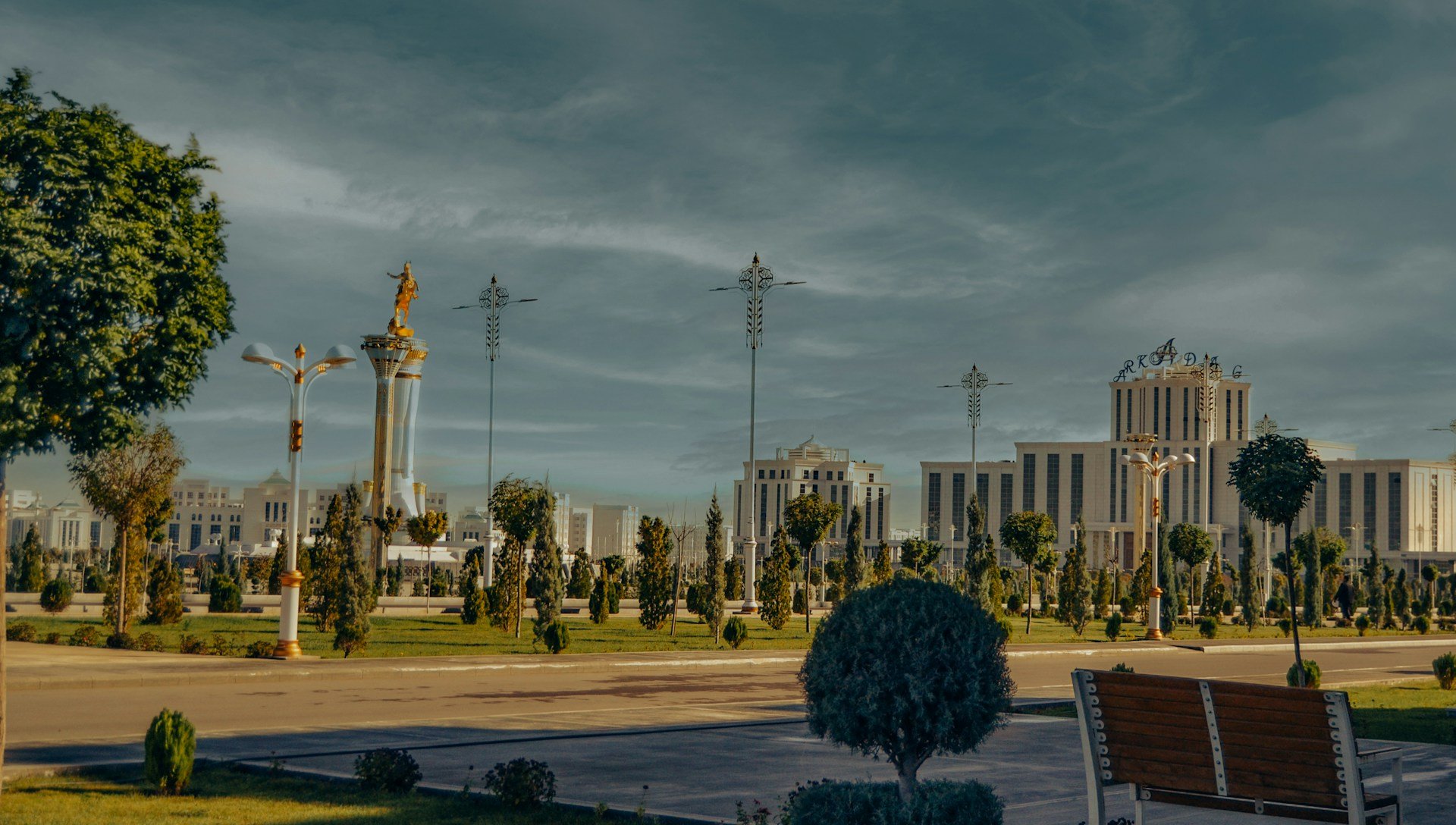
Ashgabat is one of the most genuinely surreal cities on earth. The capital was rebuilt almost entirely in white marble after a devastating earthquake in 1948 and then rebuilt again at enormous expense by successive presidents into a showcase of authoritarian megaprojects: the world's largest indoor Ferris wheel for a time, the world's highest flagpole briefly, golden statues that rotate to face the sun, and kilometres of identical marble apartment blocks with gold-trimmed windows that no one appears to live in. The population of roughly 800,000 moves through this marble landscape, and the contrast between the grandiose architecture and ordinary Ashgabat life is one of the most remarkable things a traveler can witness anywhere.
🚗 Taxi Overcharging
Ashgabat has a functioning if informal taxi system. Visitors without a guide meeting them at the airport (which should not happen if you have booked a legitimate tour, as guide pickup is standard) are targeted by drivers who quote tourist prices of USD 20-40 for a journey from the airport to central hotels worth USD 5-10 at the local rate. Inside the city, rides that locals pay TMT 10-20 (approximately USD 2-3) are quoted to visible foreigners at USD 10-15. There are no metered taxis in Ashgabat. All fares are negotiated. Without knowing local rates, you are negotiating from a position of complete ignorance.
Your tour operator should include airport pickup in your package: confirm this before arrival. For in-city transport, ask your guide to arrange or accompany you. If you need a taxi independently, ask your hotel staff to call one and ask them what the correct fare is before you get in. Negotiate to the local TMT rate, not the USD tourist quote. Carrying small TMT notes and paying in local currency removes the tourist premium from most taxi interactions.
🛒 Tolkuchka Bazaar Price Inflation
The Tolkuchka Bazaar (now officially called the Altyn Asyr Market) is one of Central Asia's great markets, a vast outdoor trading ground on the outskirts of Ashgabat selling everything from handmade Turkmen carpets to livestock to Soviet surplus to spices. It is also one of the few places in Ashgabat where tourists interact with the local economy outside the guided tour framework. Carpet sellers, who represent the market's most significant tourist purchase opportunity, quote tourist prices at 2-5 times what a knowledgeable buyer or local would pay for the same piece. Haggling is not just acceptable; it is the expected and correct mechanism of the market. Tourists who accept the first quoted price significantly overpay.
Bring your guide to the bazaar and ask them to assist with carpet negotiations. Their local knowledge and language skills are invaluable. Begin any carpet negotiation at 30-40% of the asking price and move slowly. Do not display strong emotional attachment to a piece before the price is agreed. For carpet purchases, the Carpet Museum in Ashgabat has excellent examples with certified provenance and posted prices, which provides a useful reference point before bazaar negotiation.
🍽 Restaurant Pricing for Foreigners
A small number of Ashgabat restaurants maintain unofficial dual pricing: a local-language menu with TMT prices and an English-language menu with higher prices. This is inconsistently applied and less prevalent than in some neighbouring countries, partly because the tourist volume in Ashgabat is so low that most restaurants do not bother with a dual system. The more common version is a guide who receives commission from a specific restaurant and steers you there consistently; the commissions are built into the prices you pay.
Ask for the TMT-denominated menu and compare prices against the English version if both exist. A main dish at a decent Ashgabat local restaurant costs TMT 30-80 (approximately USD 6-16). Hotel restaurant pricing is significantly higher. Ask your guide to take you to restaurants where they personally eat rather than establishments on a commission arrangement: the quality is usually better and the pricing more honest.
Darvaza Gas Crater: Tour Pricing and What's Real
The Darvaza Gas Crater, known as the Door to Hell or the Gates of Hell, is Turkmenistan's single most famous tourist attraction and the reason most leisure visitors come to the country. A Soviet-era natural gas drilling operation collapsed in 1971, creating a large sinkhole. The decision to burn off the gas to prevent spread produced a crater approximately 70 metres wide that has been burning continuously ever since. At night, approached across the dark desert, it is one of the most extraordinary sights available to a traveler anywhere on earth.
Visiting it requires a 4WD journey of approximately 3 hours from Ashgabat across the Karakum Desert, typically as part of an overnight trip that includes camping beside the crater. The experience is organised entirely by licensed operators and guides. There is no self-drive or independent access. In this context the pricing traps are about knowing what the trip should cost and what to be suspicious of in tour package descriptions.
🔥 Darvaza Tour Package Overpricing
The Darvaza overnight tour is the highest-demand product in Turkmenistan tourism. Western travel agencies and aggregators that sell Turkmenistan trips frequently list Darvaza tours at USD 400-800 per person for an overnight trip that a direct Ashgabat operator provides at USD 180-300 per person depending on group size. The price difference is entirely intermediary margin. There is no additional product, quality, or safety justification for the higher price.
A second issue: some operators describe the Darvaza trip with language suggesting premium camping facilities that do not exist. The camping experience at Darvaza is basic: a tent pitched in the desert, basic food prepared by the guide, and the extraordinary visual spectacle of the crater at night. There is no "luxury Darvaza glamping" in any meaningful sense. Operators who charge for premium facilities are either lying or using a relative standard of "premium" that will surprise arriving visitors.
Book the Darvaza trip directly as part of your Turkmenistan tour from a licensed Ashgabat operator. Ask specifically: "What is included in the Darvaza overnight price?" A legitimate itemisation includes the vehicle, guide, camping equipment, and basic food. Ask whether the camping is in fixed tents or sleeping bags under the stars. Both are excellent. Neither justifies a premium over USD 300 per person unless the operator is adding a second site visit (the two nearby Darvaza craters, one of which is mud and one is fire, are always included in legitimate tours without extra charge).
🚫 Unofficial "Darvaza Permit" Charges
There are checkpoints on the route to the Darvaza crater area where officials sometimes collect informal fees from tour vehicles. These may be described to tourists as "crater access permits" or "desert entry fees." Some are semi-official local levies; others are informal payments made by guides to smooth the journey. The amount is typically USD 5-20 per vehicle. This is not large but it is worth knowing about. A guide who describes this charge with transparency ("there is a local checkpoint fee of about USD 10 per vehicle, which I will handle") is being honest. A guide who inflates the charge significantly or adds it to a post-trip bill is not.
Ask your operator in advance whether any road or access charges apply to the Darvaza route. A legitimate operator will mention any standard payments and include them in the trip cost or disclose them as small additional charges. If your guide handles a checkpoint payment, ask what the amount was. No "Darvaza permit" costs more than USD 20 per vehicle total. Any significantly higher charge is being inflated somewhere in the chain.
What Things Actually Cost in Turkmenistan 2026
Prices in Turkmenistan are given in USD (the practical tourist currency) alongside approximate TMT equivalents at the official exchange rate. Note that the TMT rate can shift; verify the current official rate at your hotel exchange desk on arrival.
Turkmenistan Prices 2026
No international cards work in Turkmenistan. Bring all USD cash before entering the country. A Wise card is useful for withdrawing USD before departure and for any transit countries. In Turkmenistan itself, cash is the only instrument. Budget USD 150-250 per day all-in for a standard guided tour including accommodation, food, and guide, plus a 15% buffer. Clean, post-2009 USD bills in mixed denominations (USD 10, USD 20, USD 50, USD 100).
Digital Risks in Turkmenistan
📡 Internet Surveillance and VPN Considerations
Turkmenistan operates one of the world's most restrictive internet environments. Most social media platforms (Facebook, Instagram, Twitter/X, WhatsApp, Telegram) are blocked. International news sites are blocked. The internet is slow, filtered, and monitored. VPN use is technically illegal, though enforcement against tourists has been inconsistent. Connecting to a Turkmen SIM or WiFi network creates a surveillance footprint. Any digital communication from within Turkmenistan should be treated as potentially monitored.
From a scam perspective: there are no functioning legitimate online platforms for booking anything within Turkmenistan. The absence of internet infrastructure means that any "Turkmenistan booking platform" operating within the country is either state-adjacent or fraudulent. All legitimate bookings are made with operators before arrival.
Download offline maps (Maps.me has good Central Asia coverage), your accommodation addresses, your operator's contact details, and any guides you need before entering Turkmenistan. Do not plan any trip activity around internet access inside the country. If you use a VPN, use it discreetly and understand that technical legal risk exists. For communications, have a plan that does not depend on WhatsApp or standard messaging apps: SMS works on the Altyn Asyr network for basic communication. Inform family and contacts that you may be unreachable for the duration of your Turkmenistan visit.
🌐 Fake Pre-Trip Information and Forum Misinformation
Turkmenistan changes its rules with little public notice and enforces existing rules inconsistently. Blog posts and forum entries that were accurate when written are frequently out of date on specific details: which border crossings are open, whether visa-on-arrival is available for your nationality, the current status of the Darvaza crater (it has been temporarily closed to visitors at least once for maintenance and security reasons), and the current official exchange rate. Acting on outdated information about Turkmenistan can result in a missed entry point, a wasted journey, or a mismanaged budget.
Use Caravanistan (caravanistan.com) as your primary source for current Turkmenistan border and visa information: it is community-maintained and updated within days of changes being reported. Verify critical information (your specific entry crossing, visa-on-arrival availability for your passport) with your licensed Turkmen operator within 2 weeks of travel. Do not rely on any single information source for Turkmenistan, including this guide for very specific current rules. The Turkmen government does not publish rule changes in accessible English-language formats.
For your transit countries (Uzbekistan, Kazakhstan, Iran, or Azerbaijan depending on your route), an Airalo eSIM provides data connectivity before and after your Turkmenistan visit. Inside Turkmenistan, the Altyn Asyr mobile network provides voice and SMS; data is filtered and slow. Download everything you need before crossing the border.
Solo Women Travelers
Turkmenistan is a physically safe destination for solo women travelers in terms of violent crime and harassment. The guided tour framework means women are always accompanied by a licensed guide, which further reduces any vulnerability. The main considerations are cultural.
Turkmenistan is a conservative, predominantly Muslim society with strong traditional gender norms. Dress modestly throughout: covered shoulders and below-knee clothing are standard and appropriate. In bazaars and more traditional areas, being accompanied by your guide provides important social context. Solo women who spend time outside the guided framework, which is limited and not recommended in any case, may experience more direct attention than is comfortable in some areas.
The guide requirement that applies to all tourists also functions as a de facto safety mechanism for solo women: a licensed guide manages all interactions with officials, handles all negotiations, and navigates the administrative environment on your behalf. Choosing a guide with verifiable positive reviews from past solo women travelers is worth the additional research effort.
Female guides are available through some Ashgabat operators and may be preferred by some solo women visitors for discussions of daily life and women's experiences in Turkmenistan, a topic that official male guides may address differently.
Reporting Issues in Turkmenistan
Step-by-step: If Something Goes Wrong
Note: Several countries do not maintain resident embassies in Ashgabat. Check whether your country has a resident embassy or is accredited from a third country before departure.
Nothing Prepares You for Turkmenistan. Prepare Anyway.
Every experienced traveler who has been to Turkmenistan says the same thing: photographs do not capture it and words barely do. The marble city that appears empty at scale and intimate at street level. The road north through the Karakum, flat and pale for three hours, and then the orange glow of the crater on the horizon before you can see the flame. The Merv ruins rising from the desert without another visitor in sight. The bazaar where a woman selling dried apricots looks at you with the particular expression of someone who almost never sees foreigners and is genuinely curious rather than commercially interested. This is what awaits a prepared visitor.
The scams on this page are real. The black market currency offer is real and the consequences of accepting it are as serious as anything in this guide series. The visa agent fraud is real and has derailed real trips. The photography risk is real and the consequences are disproportionate. None of them are hard to avoid. Get your LOI from a licensed operator. Bring your cash. Exchange it officially. Follow your guide. Put the camera away when in doubt. Everything else is the extraordinary experience of a country that almost no one sees.