
What You're Actually Getting Into
Monaco is a country you can walk across in about 25 minutes and still not fully understand. It covers 2.02 square kilometers, wedged between the Mediterranean and the hills of the French Riviera, and packs roughly 38,000 to 39,000 residents into that space, making it the most densely populated sovereign state on earth. The same family, the Grimaldis, has ruled it since 1297, longer than almost any other reigning house in Europe, and the country has paid for itself since 1869 with a casino instead of an income tax. None of this reads like a normal country, and visiting it doesn't feel like one either.
What makes Monaco work as more than a curiosity is how much is packed into that tiny footprint. A cliffside old town with a working palace and a 700-year dynasty. A casino building, opened in 1863, that funded the abolition of personal taxation. A Formula 1 circuit that runs through the same streets locals use to get to the pharmacy, one weekend a year. And 14 Michelin stars spread across nine restaurants inside an area smaller than most golf courses. It is the closest thing tourism has to a living museum of concentrated wealth, and it's genuinely fascinating for exactly one to two days.
The honest complications
Monaco has no airport, no train of its own beyond one stop on the French coastal line, and nowhere cheap to sleep: even mid-range hotels inside the principality routinely run several hundred euros a night, and prices during the Grand Prix (early June) or the Yacht Show (late September) multiply several times over. Most people who actually want to see Monaco on a budget sleep just across the French border in Beausoleil or Roquebrune-Cap-Martin and walk in, which works fine but means the country you're sleeping in technically isn't the one you came to see. And beyond the palace, the casino and the museums, there isn't much to fill more than a day or two: Monaco is a place to see intensely, not to linger in for a week.
A History Worth Knowing
The House of Grimaldi has ruled Monaco since 1297, when Francesco Grimaldi, disguised as a Franciscan monk, is said to have talked his way into the fortress on the Rock and seized it for Genoa's Guelph faction. What followed was centuries of small-power survival, wedged between France, Genoa and Savoy, until a 19th-century prince gambled on tourism and a casino to save a nearly bankrupt state, and it worked spectacularly.
- 1297
The Grimaldi conquest. Francesco Grimaldi captures the fortress on the Rock disguised as a monk, founding the dynasty that still rules Monaco today.
- 1848
Menton and Roquebrune secede. The two towns, then part of Monaco, break away over the tax burden, costing the principality roughly 80% of its territory.
- 1863
The Casino opens. Prince Charles III licenses a casino to the Société des Bains de Mer, betting the state's survival on tourism revenue.
- 1869
Income tax abolished. Casino profits let Charles III scrap personal income and property taxes entirely, a policy that still defines Monaco's economy.
- 1956
Rainier III marries Grace Kelly. The Hollywood star's marriage to the reigning prince turns Monaco into a global media fixture almost overnight.
- 2005-present
Prince Albert II. Rainier and Grace's son takes the throne, expands Monaco's environmental diplomacy, and marries Charlene Wittstock in 2011.
Read the full history: the Grimaldis, the secession of 1848, and the casino gamble
The Grimaldi family's grip on Monaco has never been entirely secure. They lost and regained control of the Rock multiple times in the medieval period, sold their sovereignty to France temporarily under Louis XIII in the 1600s in exchange for protection, and lost the territory again during the French Revolution before the Congress of Vienna restored it as a protectorate, first of Sardinia and later, from 1861, of France. What has never changed since 1297 is that a Grimaldi has always eventually been back in charge, making it one of the oldest continuously ruling houses in Europe.
The secession of 1848. When Florestan I taxed the communes of Menton and Roquebrune heavily to fund the state, both towns declared independence and, in effect, took roughly 80% of Monaco's land with them when they later joined France. The rump state that remained was so poor that Prince Charles III turned to an unlikely solution: licensing a casino to a private company, the Société des Bains de Mer, in 1863, and building an entire tourism economy, hotels, an opera house, gardens, around it. The gamble worked. By 1869, casino revenue was healthy enough that Charles III abolished personal income and property taxes altogether, a policy still in force and still central to Monaco's identity as a low-tax jurisdiction.
Rainier III and the modern state. Prince Rainier III, who reigned for 56 years from 1949 to 2005, is the figure most responsible for the Monaco visitors see today. He reclaimed land from the sea to build the Fontvieille district, diversified the economy beyond gambling into banking, real estate and light industry, and, in 1956, married the American film star Grace Kelly, instantly making the tiny principality one of the most photographed places on earth. Their son, Prince Albert II, has reigned since 2005, competed in bobsleigh at five Winter Olympics, and married South African former swimmer Charlene Wittstock in 2011; their twins, Prince Jacques and Princess Gabriella, were born in 2014, with Jacques as heir to the throne.
Top Destinations
Monaco has no regions in any normal sense, just five wards packed into 2.02 square kilometers, all within a 25-minute walk of each other, connected by a genuinely remarkable network of free public elevators and escalators built directly into the cliffs. You could see the whole country in an afternoon; the case for two days is pacing, not distance.
Monaco-Ville, the old town on the Rock
The historic seat of power, perched on a limestone promontory above the sea. The Prince's Palace has stood here since the 13th century, and the Changing of the Guard happens in the Place du Palais every day at 11:55am, free to watch. The State Apartments open to visitors from 30 March to 15 October. A short walk away, the Cathedral of Monaco, free to enter, holds the tombs of Prince Rainier III and Princess Grace behind the altar. The Oceanographic Museum, founded in 1910 by Prince Albert I and later directed by Jacques Cousteau, sits dramatically on the cliff edge above the sea, with a real aquarium and marine research displays that reward the roughly two-hour visit.
Monte-Carlo, the casino district
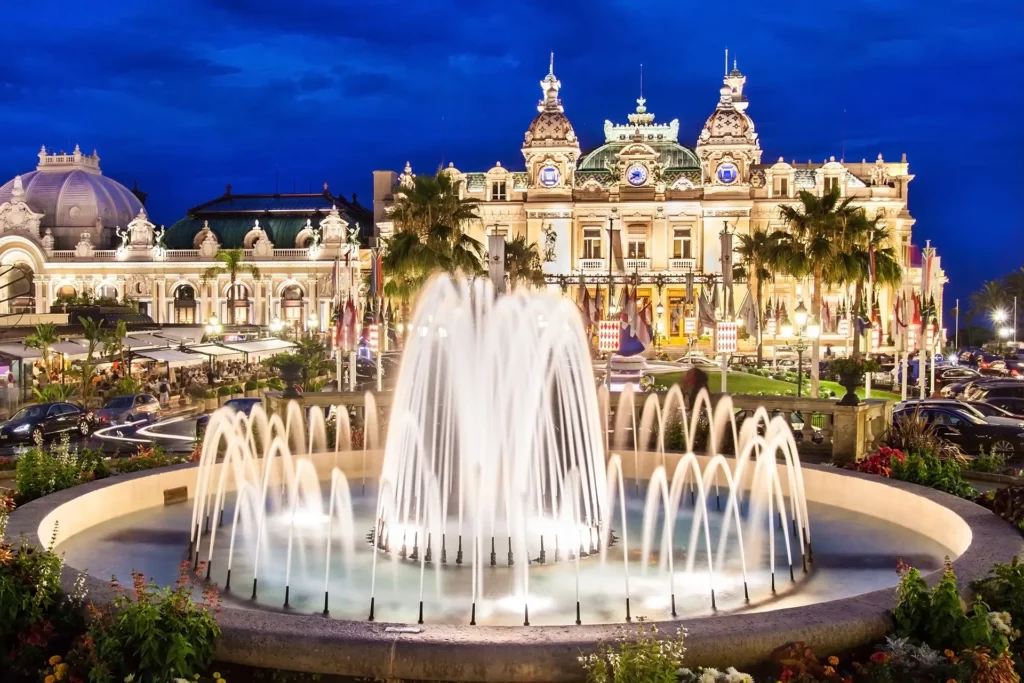
The ward most people picture when they think of Monaco: the Casino de Monte-Carlo, opened in 1863, its Belle Epoque gaming rooms open to visitors for a fee even if you never place a bet, and the grand hotels around Casino Square, the Hotel de Paris and the Hotel Hermitage, both still operated by the same Societe des Bains de Mer group that built the casino. This is also the principality's fine-dining core: the group's hotels alone hold six Michelin-starred restaurants and ten stars between them, including Le Louis XV - Alain Ducasse, Monaco's only three-star restaurant. Boulevard des Moulins and the streets around it hold the designer shopping most people expect from the name Monte-Carlo.
La Condamine, the working port
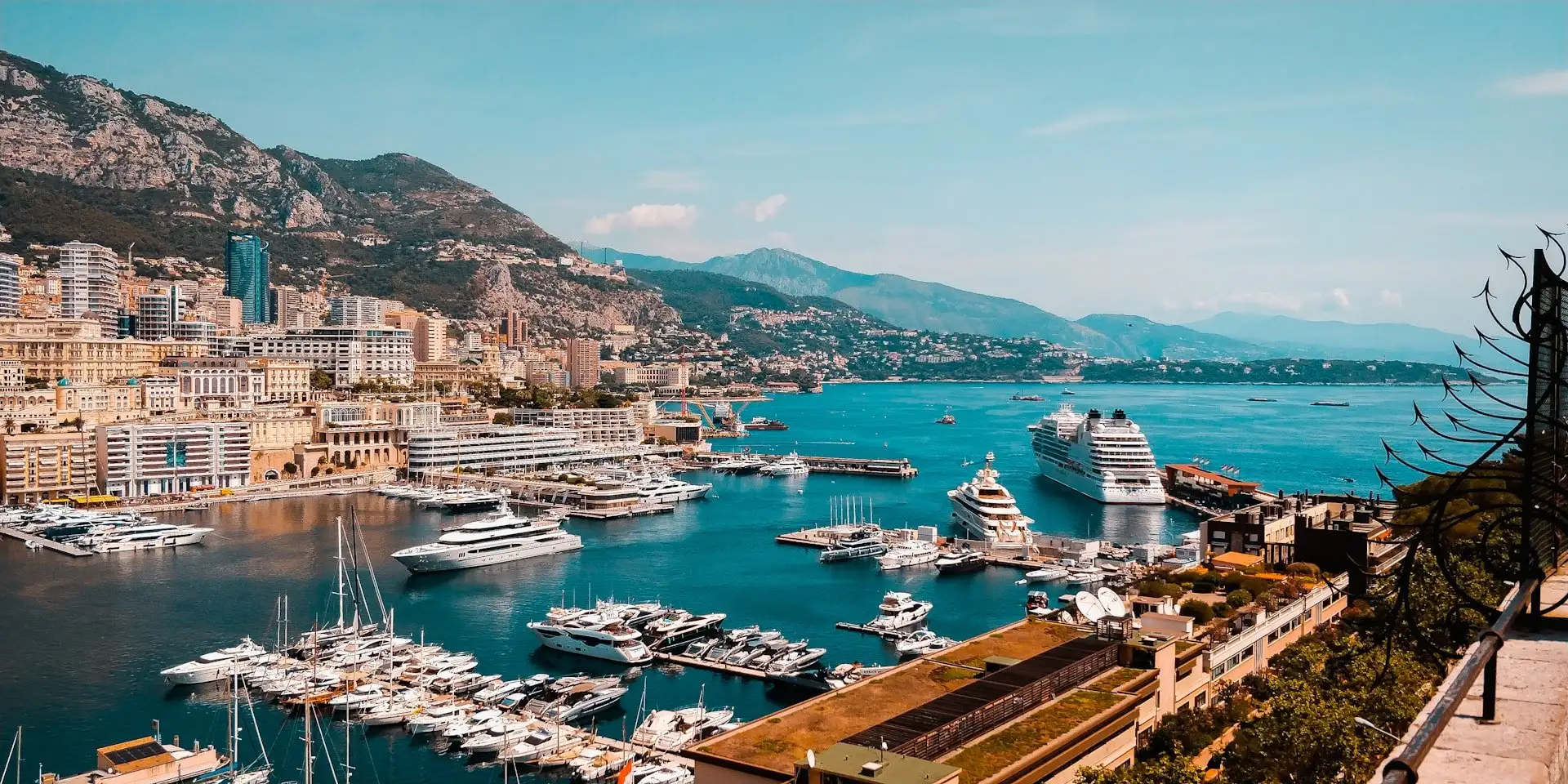
The ward between the Rock and Monte-Carlo, built around Port Hercule, Monaco's harbor and the setting for the Formula 1 pit straight every June. This is the most lived-in part of the principality: the daily market at Place d'Armes, more everyday restaurants and bars than the glossier districts, and the best vantage points for watching superyachts dock during the Monaco Yacht Show each September. It's also where several of the Grand Prix's most famous corners, Sainte-Devote and the harbor chicane, actually sit.
Fontvieille & Larvotto
Fontvieille, entirely built on land reclaimed from the sea under Prince Rainier III, is Monaco's modern, quieter district: a marina, the Stade Louis II football stadium, the heliport, and the Princess Grace Rose Garden. Larvotto, on the country's eastern edge, has Monaco's only real public beaches, free and sandy (partly imported), with the Grimaldi Forum convention center and the Monte-Carlo Beach Club, technically just over the border in France but branded and run as part of Monaco's resort scene, nearby.
Beyond the postcard sights
The wards above cover a first visit thoroughly. These three reward a slightly closer look.
Princess Grace Rose Garden
A quiet, free rose garden created in tribute to Princess Grace after her death, with over 8,000 rose bushes and a bronze statue of the princess at its center. Almost nobody visiting for the casino makes it out here.
The ramparts walk
The fortified walls around the old town give free views over the harbor and the Mediterranean that rival the paid Jardin Exotique viewpoint, without an entry fee or opening hours to plan around.
Eze village
A medieval hilltop village just over the French border, reachable by the 602 bus, with its own exotic garden and panoramic views over the coast Monaco itself is built into.
Culture & Etiquette
French is Monaco's sole official language, but the country is a genuine minority in its own capital: native Monegasques make up a small fraction of residents, outnumbered by French, Italian and a large international population drawn by the tax regime. Monegasque, a Ligurian dialect related to the languages spoken across the old border with Italy, survives mostly in street names and among older families rather than daily conversation, and English works easily in hotels, restaurants and shops.
Do
- Carry a passport or national ID. The Casino de Monte-Carlo requires it for entry, and French border police occasionally carry out spot checks even though there's no formal checkpoint.
- Dress up for the casino in the evening. Shorts, sportswear and beachwear are turned away after 2pm, and the private salons require a jacket for men.
- Book Le Louis XV and other top restaurants well ahead. Monaco's Michelin-starred dining rooms, especially the Societe des Bains de Mer's six, fill up weeks in advance.
- Use the free public elevators. They save real effort on a cliffside country and are genuinely one of Monaco's more charming quirks.
- Check the calendar before booking. The Grand Prix (early June) and Yacht Show (late September) close streets, spike prices several times over, and transform the whole country for the week.
Don't
- Expect Monaco to be cheap anywhere. Even a casual coffee near Casino Square costs noticeably more than an identical one a few hundred meters over the French border.
- Assume the Monte-Carlo Country Club or Monte-Carlo Beach are technically inside Monaco. Both carry the Monte-Carlo name and are run by Monegasque institutions, but sit just across the border in Roquebrune-Cap-Martin, France.
- Photograph the Palace guards up close or try to engage them. They are on active ceremonial duty, not performers.
- Drive during the weeks the Grand Prix grandstands go up or come down. Large parts of the country become a closed construction site for several weeks either side of the race.
- Confuse Monaco with being in the EU. It isn't, and it isn't formally in Schengen either, even though the open French border and the euro make it feel that way.
Deeper culture: Monegasque identity, the national day and the police state reputation
Monegasque identity. Native Monegasques, the descendants of the pre-tourism population, are a small minority in their own country and hold specific hereditary privileges, including guaranteed public-sector jobs and exemption from the income tax rules that apply to French residents. Monaco's National Day, also called the Sovereign Prince's Day or Saint-Rainier Day, falls on 19 November and combines a religious ceremony, a military parade and fireworks over Port Hercule the evening before, the closest thing the country has to a unifying civic festival.
The security reputation. Monaco is sometimes described as the world's most surveilled country: roughly one police officer for every 62 residents and a network of over 1,300 CCTV and facial-recognition cameras covering the entire 2.02 square kilometers from a central command center. This is a genuine and deliberate policy choice, not an accident, and it is the main reason Monaco has one of the lowest crime rates in Europe.
Tax status and residency. Monaco has had no personal income tax since 1869, a policy that draws wealthy residents from around the world, though French nationals living in Monaco are a specific exception under a 1963 bilateral tax convention with France. None of this affects visitors directly, but it explains the density of luxury cars, yachts and property prices you'll notice immediately on arrival.
Food & Drink
Monegasque cooking is Ligurian and Nicoise at its roots, chickpeas, chard, olive oil and fresh vegetables, before it gets layered with the most concentrated fine-dining scene per square kilometer anywhere on earth. The principality holds 14 Michelin stars across nine restaurants in just over 2 square kilometers, and the Societe des Bains de Mer group alone runs six starred restaurants with ten stars between them, making it the most Michelin-starred hotel group in the world.
Barbagiuan
Monaco's signature dish: a fried turnover filled with chard or spinach, rice, leeks and ricotta-style cheese. The name means "Uncle John" in Monegasque, and it's the closest thing the principality has to street food.
Socca
A thin chickpea-flour pancake cooked on a large copper plate over a wood fire, shared with neighboring Nice. Simple, cheap by Monaco standards, and genuinely good.
Le Louis XV 3 Michelin stars
Alain Ducasse's flagship at the Hotel de Paris is Monaco's only three-star restaurant and one of the most celebrated dining rooms in the world, built around Mediterranean seafood and seasonal produce.
Elsa 1 Michelin star
At the Monte-Carlo Beach, chef Marcel Ravin runs the world's first fully organic restaurant to earn a Michelin star, built around seafood and vegetables with the Mediterranean as its backdrop.
Blue Bay 1 Michelin star
Marcel Ravin's second Monaco restaurant, at the Monte-Carlo Bay Hotel, mixes Caribbean influences from the chef's native Martinique into French technique.
Cafe de Paris
The historic brasserie on Casino Square, credited as the birthplace of crepes Suzette, and still the classic spot to watch the square over a coffee without booking a table months out.
When to Go & Itineraries
April through June and September give the best weather without August's heat, humidity and cruise-ship crowds on the coast. The exception that swallows everything else on the calendar is the Formula 1 Grand Prix, held in early June: spectacular if that's what you came for, but it closes streets for weeks either side of the race and multiplies hotel prices several times over. The Monaco Yacht Show in late September and the Rolex Monte-Carlo Masters tennis in early April are smaller but similarly price-moving events.
All four seasons compared, with temperatures
| Season | Verdict | Temps | Prices & crowds |
|---|---|---|---|
| Apr-Jun & Sep | Best | 16-26°C | Mid prices outside events; book ahead around the Grand Prix and Masters |
| Jul-Aug | Hot & crowded | 24-30°C | Peak Riviera season; beaches and streets busiest |
| Grand Prix week (early Jun) | Spectacular, expensive | ~20-24°C | Hotel prices several times normal; book 6+ months out |
| Nov-Mar | Quiet | 8-16°C | Lowest prices; some beach-club and outdoor venues scale back |
Monaco's Mediterranean climate keeps winters mild by European standards; the coldest months rarely drop below freezing, and the sea stays swimmable roughly June through September.
Itineraries
Monaco doesn't reward long stays on its own. These two lengths cover realistically how people visit: as a focused day trip, or a slower overnight paired with the wider Riviera.
- Morning
Monaco-Ville. The Changing of the Guard at 11:55am, the Palace's State Apartments (in season), and the Cathedral.
- Midday
Lunch near Place d'Armes, then a walk down to the Oceanographic Museum on the cliff edge.
- Afternoon
Monte-Carlo. Casino Square, a look inside the Casino de Monte-Carlo's gaming rooms, and Boulevard des Moulins.
- Evening
Port Hercule at sunset before the train back to Nice.
- Day 1
The one-day route above, at a gentler pace, with dinner reserved ahead at a Michelin-starred table if that's the plan.
- Day 2 morning
Jardin Exotique for the caves and the best view in the country, then the Princess Grace Rose Garden in Fontvieille.
- Day 2 afternoon
Larvotto Beach or a half-day trip to Eze village, 15 minutes away by bus.
Getting there & around
Monaco has no airport of its own. Nice Cote d'Azur Airport (NCE), about 30 kilometers west, is the gateway: the direct Bus 80 express runs from Terminal 2 in 45-50 minutes for €20.50, the train via Nice takes the fastest ground route at roughly 20-25 minutes for a few euros once you reach a Nice station, and a helicopter transfer with Monacair or Heli Air Monaco covers the same distance in about 7 minutes at a premium price. Inside the country, everything is walkable, helped enormously by 79 free public elevators, 35 escalators and 8 travelators built into the cliffs; the local CAM bus network covers the rest for €2 on board or €1.50 pre-purchased, with a day pass at €5.50.
All transport options with prices: airport transfers, buses, taxis
| Option | Price | Notes |
|---|---|---|
| Bus 80 from Nice Airport | ~€20.50 | Direct express, every 30 min, Terminal 2 to Monaco in 45-50 minutes. |
| Train via Nice | ~€4-5 | Fastest ground option, 20-25 minutes once at a Nice station; requires reaching Nice-Saint-Augustin or Nice-Ville first. |
| Bus 600 (regular coastal) | ~€2.50 | Cheapest option from Nice; around an hour and often crowded. |
| Helicopter transfer | Premium fare | ~7 minutes from Nice Airport with Monacair or Heli Air Monaco. |
| Taxi / rideshare | €45-100 | Uber roughly €45-60 from the airport; the official Monaco taxi fixed fare is about €100. |
| CAM local bus | €1.50-2 | Six lines cover the whole country; day pass €5.50. |
Free public elevators: look for unmarked glass doors signed "ascenseur public," usually set into retaining walls near car parks, operating roughly 6am to 1am. They're the easiest way to move between Monaco-Ville, the harbor and Monte-Carlo without climbing the cliffs on foot.
Practical prep: pick up an eSIM before landing in Nice, since French and Monegasque networks both work seamlessly across the open border. A fixed-price transfer from Nice Airport avoids negotiating a fare on arrival, especially useful around the Grand Prix when demand spikes hard.
Where to stay
Just over the border: Beausoleil
The genuine budget play: a French commune that borders Monte-Carlo directly, walkable into Monaco in minutes, with three-stars and aparthotels at a fraction of in-principality prices.
Roquebrune-Cap-Martin
A few minutes further along the coast by train or bus, with sea-view options and the Monte-Carlo Beach Club and Monte-Carlo Country Club, despite their names, both technically located here.
Mid-range inside Monaco
Four-star hotels inside the principality itself, mostly in La Condamine and Fontvieille, sit in this range outside event weeks and climb sharply during them.
The Casino Square legends
Hotel de Paris and Hotel Hermitage, both Societe des Bains de Mer properties on Casino Square, occasionally offer promotional rates from around €480 booked well ahead; standard and Grand Prix-week rates run into the thousands.
Budget Planning
Monaco is one of the most expensive places in Europe to sleep, and there is no honest way to present it as a budget destination for an overnight stay inside the principality itself. The one genuine escape valve is accommodation: sleep in Beausoleil or Roquebrune-Cap-Martin, just over the French border, and the rest of the trip, food, transport, sights, runs at prices closer to the wider French Riviera.
- Beausoleil or Roquebrune-Cap-Martin room €150-200
- Socca, barbagiuan & market meals €10-18
- Walking, free elevators & local buses
- Free sights: Changing of the Guard, Cathedral, ramparts
- 4-star hotel inside Monaco €460-775 (or less over the border)
- Restaurant meals €50-100/person
- Casino de Monte-Carlo entry & museums
- Occasional taxi or private transfer
- Casino Square hotel (Hotel de Paris, Hermitage)
- A table at Le Louis XV or another Michelin-starred room
- Private salon access at the casino
- Grand Prix or Yacht Show week pricing
Quick reference prices: transport, food, attractions
| Coffee near Casino Square | ~€4-6 |
| Socca or barbagiuan at a market stall | €3-6 |
| Mid-range restaurant meal | €40-80 |
| CAM local bus ride | €1.50-2 |
| Casino de Monte-Carlo entry | ~€20 (incl. €10 table voucher) |
| Prince's Palace State Apartments | €13 adult |
| Oceanographic Museum | €22.50 adult |
| Jardin Exotique | €12-18 depending on combo ticket |
Prices reflect August 2026 research and shift hard around the Grand Prix (early June) and Yacht Show (late September), when accommodation especially can run several times these figures. Treat them as a planning baseline, not a quote.
Visa & Entry
Monaco issues no visas of its own: it has no independent border control and can only be reached by land through France, so entry is governed entirely by French and Schengen rules. In practice that means visa-free entry for up to 90 days in any 180-day period for US, UK, EU, Australian, Canadian and New Zealand passport holders, with no passport check at the Monaco-France line itself, though French border police do occasionally carry out spot checks nearby.
✓ Valid passport
Issued within the last 10 years and valid for at least 3 to 6 months beyond your planned exit date from the Schengen Area, per standard French entry rules.
✓ Meet France's entry rules
Since Monaco has no independent checkpoint, you must satisfy French and Schengen requirements to reach it in the first place.
✓ Multi-entry Schengen visa if required
Non-exempt nationalities need a Type C Schengen visa via a French consulate; a single-entry visa can complicate crossing in and out of Monaco.
✓ ETIAS, expected 2027
Visa-exempt travelers entering via France will eventually need ETIAS pre-authorization; the EU pushed its 2026 launch target back, with 2027 now the likely window. Check current status before booking.
| Monaco | San Marino | |
|---|---|---|
| Getting there | No airport; via Nice (France), 20-30 min | No airport; via Rimini (Italy), ~30-45 min |
| Daily budget | €150+ minimum; often much more | Noticeably cheaper; genuine budget option exists inside the country |
| Signature draw | The Casino de Monte-Carlo and the F1 circuit | Medieval fortress towers and a mountaintop old town |
| Size | 2.02 km², the world's second-smallest country | 61 km², roughly 30 times larger |
| Schengen | Not a member; open, informal border with France | Not a member; open, informal border with Italy |
Safety, Solo Women & Family
Monaco is exceptionally safe, arguably the safest square kilometer in Europe by design. It maintains roughly one police officer for every 62 residents and a network of over 1,300 CCTV and facial-recognition cameras across the entire 2.02 square kilometers, monitored around the clock from a central command center. The US State Department groups Monaco with France for its Level 2, "Exercise Increased Caution" advisory, a rating that reflects general European baseline risk rather than anything specific to Monaco, which has one of the lowest crime rates on the continent.
Pickpocketing
Concentrated in the busiest tourist crowds around the Casino and the palace during the Changing of the Guard, still rare by European standards but not zero. Keep bags zipped and in front of you.
Grand Prix week traffic
Street closures, grandstand construction and heavy pedestrian crowds around the circuit make early June the one time normal getting-around advice doesn't fully apply. Plan extra time for everything.
Casino etiquette, not danger
The Casino de Monte-Carlo is heavily monitored and genuinely safe; the only real risk is losing money you didn't plan to, not personal safety.
Solo women travelers
Monaco rates very well for solo women, arguably better than almost anywhere else in Europe given the density of policing and surveillance: street harassment is uncommon, the entire country is well-lit and heavily watched, and walking anywhere at night, including between Monte-Carlo and the harbor, feels comfortable. The one practical note is cost rather than safety: taxis and even short transfers add up fast, so factor that into an evening out rather than assuming Albania or Andorra-level transport prices.
Emergency numbers
Hospital and consular support
112 works from any phone and reaches emergency dispatch regardless of which service you need. Princess Grace Hospital, Monaco's main hospital, has a switchboard at +377 97 98 99 00 and an emergency line at +377 97 98 97 69.
Consular support: Monaco has very limited resident diplomatic presence given its size. US citizens are served by a Consular Agent in Nice (+33 4 93 88 89 55) under the US Embassy in Paris; most other nationalities are covered from consulates in Nice or embassies in Paris. Canada maintains a consular office inside Monaco itself. Check your government's current travel advisory page for the nearest post before you go.
Family travel & pets
Monaco is a fine half-day or full-day stop with kids rather than a dedicated family destination: the Oceanographic Museum's aquarium is a genuine highlight for children, the Changing of the Guard has obvious appeal, and Larvotto Beach gives a place to burn energy, but the casino-and-Michelin-stars core of the country skews adult. EU pet passport holders can bring dogs and cats with valid rabies vaccination and a microchip under the same rules that apply to entering France; non-EU visitors need the standard EU-entry veterinary paperwork.
Monaco FAQ
Is Monaco safe to visit?
Yes, Monaco is one of the safest places in Europe. It has roughly one police officer for every 62 residents and over 1,300 CCTV cameras covering just 2.02 square kilometers, and violent crime against visitors is essentially unheard of. The main practical risks are pickpocketing in tourist crowds and traffic around the Grand Prix circuit streets.
Do I need a visa for Monaco?
No separate Monaco visa exists. Since Monaco has no border control of its own and can only be reached by land through France, entry is governed by French and Schengen rules: visa-free for up to 90 days in any 180-day period for US, UK, EU, Australian and Canadian passport holders.
Is Monaco in the Schengen Area?
Not as a formal member, but there are no border posts between Monaco and France, so in practice it functions as part of the Schengen area for entry purposes. You still need to meet French entry requirements to get there.
What currency does Monaco use?
The euro. Monaco is not an EU member but uses the euro under a monetary agreement with the EU, and can mint a small number of its own euro coins each year, which collectors seek out.
How do you get to Monaco?
Monaco has no airport. Nice Cote d'Azur Airport (NCE), about 30 kilometers away, is the gateway: a direct express bus takes 45-50 minutes for about 20.50 euros, a train via Nice takes roughly 20-25 minutes for a few euros, and a helicopter transfer takes about 7 minutes.
Is Monaco expensive?
Yes, it's one of the most expensive places in Europe, especially for accommodation. Genuine budget travelers typically base themselves just over the French border in Beausoleil or Roquebrune-Cap-Martin and walk in, rather than staying inside the principality itself.
When is the best time to visit Monaco?
April through June and September for good weather without August's heat and crowds. Late May or early June brings the Formula 1 Grand Prix, which is spectacular but multiplies hotel prices several times over and closes streets for days.
How many days do you need in Monaco?
One full day covers the essentials since the entire country is 2.02 square kilometers. Two days lets you add the Oceanographic Museum, the Jardin Exotique and a slower pace, and most visitors combine it with day trips into the wider French Riviera.
Can you visit the Casino de Monte-Carlo if you don't gamble?
Yes. Entry to the public gaming rooms costs around 20 euros and includes a betting voucher, but you're free to simply walk through and look without playing. You must be at least 18 and bring a passport or national ID card.
What language is spoken in Monaco?
French is the sole official language. Monegasque, a Ligurian dialect, survives alongside Italian among older residents, and English is widely spoken in hotels, restaurants and shops given the international population.
Is Monaco part of the European Union?
No. Monaco is a sovereign microstate, not an EU member, though it uses the euro and has close customs and monetary ties with France and the EU.
Is Monaco good for a day trip from Nice?
Yes, and it's an easy one: the train from Nice takes about 20-25 minutes and the whole country is walkable, so a day trip comfortably covers the palace, the casino and the old town. An overnight stay only makes sense if you're timing it around the Grand Prix or the Yacht Show.
What Stays With You
Monaco shouldn't work as a country. It is smaller than most airports, has no farmland, no natural resources and, for most of its history, no money, and yet it has survived 700 years of larger neighbors on the strength of a casino, a royal marriage to a Hollywood star, and a tax policy written in 1869. Standing in the Place du Palais watching the Changing of the Guard, or looking down from the Jardin Exotique at a harbor full of superyachts that dwarf the buildings around them, the improbability of the whole thing is the actual attraction, more than any single sight inside it.
Give it a day, or two if the pace suits you, and don't mistake the size for a lack of substance. Few places on earth pack this much history, wealth and sheer strangeness into a space you can walk across before lunch.