
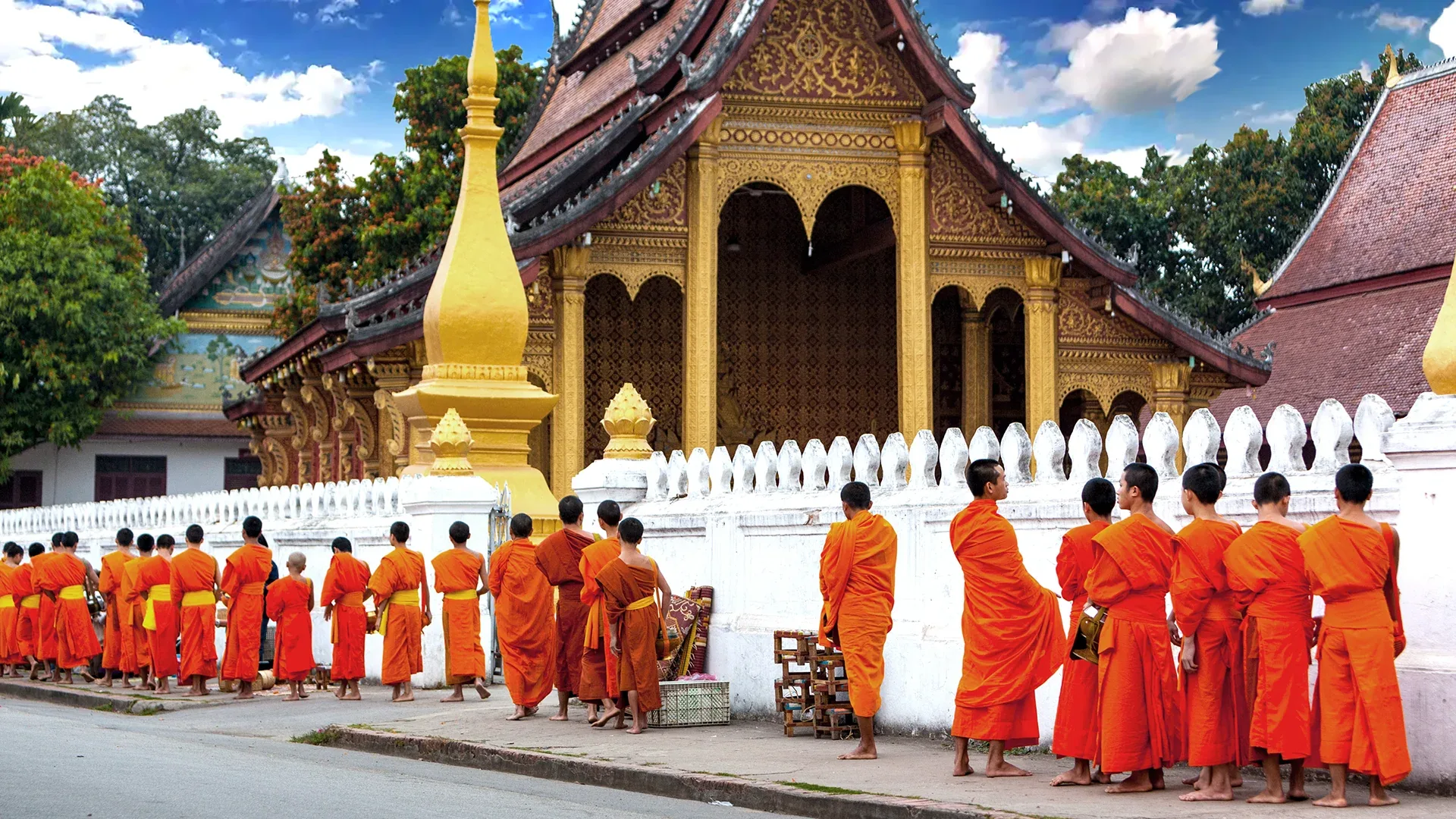
A royal capital that never rushes
Luang Prabang sits at the confluence of the Mekong and Nam Khan rivers, its old town confined to a narrow peninsula that has kept it small, walkable and remarkably intact. It was the seat of the Lan Xang kings from the 14th century and, later, the ceremonial capital of the Kingdom of Laos until the monarchy ended in 1975. What survives is a genuinely rare combination: dozens of working Buddhist temples, French colonial shophouses from the protectorate era, and a daily rhythm still set by the monks rather than the tour buses.
Tourism has grown fast here since UNESCO listed the town in 1995, and the peninsula's main streets can feel busy in December and January. Walk two streets back from Sisavangvong Road, or cross either river, and the pace drops immediately: cracked pavements, family noodle stalls, and a version of the town that isn't performing for anyone.
The honest complications
The alms-giving ceremony has become a genuine point of tension: overtourism around it has led to pushy tour groups, flash photography, and vendors selling low-quality "instant" sticky rice for tourists to offer, none of which the ceremony was designed for. A strict 11:30pm bar curfew across the UNESCO core, enforced to protect the town's character, means Luang Prabang is not a nightlife destination and closes early by regional standards. And despite the tourism, this remains one of the poorest provinces in one of Southeast Asia's poorest countries, worth keeping in mind outside the well-restored core.
Small enough to walk in an afternoon
Luang Prabang's entire tourist core fits on a peninsula you can walk end to end in under 30 minutes. Where you stay matters less for distance than for how much peninsula noise and light you want at night.
The UNESCO Peninsula
The historic core between the two rivers holds nearly every major sight: the Royal Palace Museum, Wat Xieng Thong, Mount Phousi and Sisavangvong Road's night market. It's also where the alms-giving ceremony passes each dawn and where most restaurants and boutique hotels cluster. Staying here means everything is walkable, at the cost of being in the thick of the day-tripper traffic.
Across the Nam Khan
A bamboo footbridge (rebuilt each year after the rainy season) connects the peninsula to a quieter residential bank with cheaper guesthouses, a handful of good riverside restaurants, and none of the peninsula's crowds. A short, atmospheric walk from the old town rather than a separate trip.
Ban Xieng Muan & the artisan quarter
The southern end of the peninsula, around Ban Xieng Muan and Wat Xieng Muan, holds textile and paper workshops and a more residential feel just a few minutes from the busiest streets, a good base for travelers who want peninsula convenience without the density of the night market strip.
Outside the peninsula
Luang Prabang's larger luxury resorts, including riverside properties with more space and privacy, sit outside the peninsula along the Mekong or the road toward Kuang Si Falls. Beautiful and quiet, but you'll rely on hotel shuttles or tuk-tuks for everything.
From riverside luxury to $20 guesthouses
Luang Prabang has Laos's strongest hotel scene by far, from internationally ranked luxury resorts to simple family-run guesthouses, nearly all of it within a short walk or tuk-tuk ride of the peninsula.
At the top, Rosewood Luang Prabang, set on the Nam Khan with tented pavilions, private plunge pools and its own waterfall, and Amantaka, built around a former hospital compound inside the UNESCO zone, are consistently ranked among the best hotels in the country, both from roughly $400 a night. La Résidence Phou Vao, on a hilltop just outside the old town with views over the peninsula, is the more established luxury option and slightly better value at the same tier.
In the mid-range, Baan Pila and Maison Dalabua are both well-reviewed boutique guesthouses from around $35-75 a night, with the garden and pond setting at Maison Dalabua a particular draw for a town this compact. At the budget end, Tingkham Guesthouse (from around $20) and Apple Guesthouse (from around $20) are both simple, well-located, family-run picks that show up repeatedly in traveler reviews for value.
Northern Lao cooking, French bread, and a curfew on the fun
Luang Prabang eats like the rest of northern Laos, sticky rice, laap, herb-heavy soups, with a French colonial streak running through the coffee and the baguette sandwiches sold from carts across town. The best meals are often the cheapest: a market noodle stall doing one dish well beats most of the tourist-menu restaurants on the main strip.
Tamarind
Long the reference point for approachable, well-explained Lao cuisine, running cooking classes alongside a menu that walks nervous first-timers through sai oua sausage, jeow dips and Lao-style barbecue with confidence.
Khaiphaen
A consistently well-reviewed Lao restaurant on the peninsula serving refined, ingredient-forward versions of northern classics, including river weed (khai phaen, the dish it's named for), laap and Mekong fish.
Night market food stalls
The alley of food stalls just off the main night market strip is the cheapest, most reliably good meal in town: a plate piled from a buffet of Lao and Lao-Thai dishes, or fresh barbecue skewers cooked to order, both a fraction of restaurant prices.
Joma Bakery Café
A reliable, air-conditioned stop for good coffee, baked goods and a Western breakfast when you need a break from the heat, part of a small regional chain that started in Laos.
Temples at dawn, a hill at sunset, and the market in between
Luang Prabang's sights are concentrated enough that a single day covers the essentials, though the town rewards a slower pace. This chapter walks through it roughly the way a good three days would.
The alms-giving ceremony (Tak Bat)
Every morning just before dawn, around 5:30-6am year-round, lines of monks walk barefoot and in silence along Sisavangvong Road and the surrounding streets to receive food offerings from kneeling locals. It's a genuinely moving, centuries-old ritual, not a staged event, and treating it that way matters: stay several meters back, dress modestly, stay silent, never use flash, and don't photograph yourself giving alms. Women should not touch the monks or their robes, and no one should follow the procession or stand physically above it. If you want to participate rather than just observe, buy sticky rice from a trusted local vendor rather than the plastic-wrapped "instant" rice sold to tourists near the main strip, which monks have said is not the food they'd choose to receive.
Wat Xieng Thong and the temple circuit
Wat Xieng Thong, built in 1560, is Luang Prabang's most important temple: low sweeping roofs in classic Luang Prabang style, a "tree of life" glass mosaic on the rear wall, and a funeral chapel holding the royal funeral carriage. It anchors a walkable circuit of dozens of working temples across the peninsula, most with no or minimal entry fees; Wat Mai, next to the Royal Palace Museum, and Wat Visoun, the town's oldest surviving temple structure, are the other two worth prioritizing if time is short.
Royal Palace Museum & Mount Phousi
The Royal Palace Museum (Haw Kham), built in 1904 for King Sisavang Vong and converted to a museum after the 1975 revolution, holds royal regalia, gifts from foreign governments and the Pha Bang, the gold Buddha image the town is named for. Entry is around 30,000 kip. From there it's a short climb up Mount Phousi, around 300 steps past small shrines to Wat Chomsi at the summit, timed by most visitors for sunrise or sunset over the rivers and the peninsula below.
The night market
Sisavangvong Road closes to traffic each evening and fills with stalls selling handwoven textiles, silver, paper lanterns and souvenirs until around 9pm; the food alley just off the main strip, see the Food chapter, is the better reason to go. Prices are set for negotiation, though gently, not aggressively, by regional standards.
One, two or three days, planned around the dawn
Three full days covers Luang Prabang properly, including both half-day trips outside town. Even a single well-planned day delivers the essentials.
- Dawn
Alms-giving ceremony, observed respectfully from a quieter side street off Sisavangvong Road.
- Morning
Wat Xieng Thong and the Royal Palace Museum, then a coffee stop at Joma before the midday heat.
- Afternoon
Kuang Si Falls, a half-day round trip, swim in the pools and stop at the bear rescue centre at the entrance.
- Sunset
Mount Phousi, then dinner and the night market food alley back on the peninsula.
- Day 1
The one-day route: alms ceremony, temples, Kuang Si Falls, Mount Phousi at sunset.
- Day 2 morning
Pak Ou Caves by boat. A slow Mekong cruise upriver to the Buddha-filled caves, with a stop at a whiskey-making village.
- Day 2 afternoon
Across the Nam Khan. The footbridge to the quieter riverbank, a wander through the artisan quarter back on the peninsula.
- Day 2 evening
A proper sit-down dinner at Tamarind or Khaiphaen before the peninsula's 11:30pm curfew closes things down.
- Days 1-2
The two-day route above, at a gentler pace.
- Day 3
A slower final day: a weaving village along the Nam Khan, a Lao cooking class, or simply a repeat visit to Kuang Si Falls' upper pools, which are far quieter than the crowded lower tier.
Compact enough to walk, with the Mekong for everything else
Luang Prabang International Airport (LPQ) sits about 4km from the peninsula, with flights to Vientiane, Bangkok, Chiang Mai and Siem Reap; a tuk-tuk into town costs a few dollars. The Laos-China Railway connects Luang Prabang to Vientiane in around two hours for roughly $18-25, a dramatic improvement on the old road trip, and to Vang Vieng in a similar window.
Inside town, walking covers almost everything on the peninsula. Bicycles ($2-4/day from countless rental shops) are the best way to reach Ban Xieng Muan or cross the footbridge without the heat of walking, and tuk-tuks ($2-6 for most in-town trips, more for Kuang Si Falls or the Pak Ou Caves) handle everything further out. Agree tuk-tuk fares before getting in.
Best time to visit and the alms-ceremony schedule
November to February is Luang Prabang's cool, dry high season: comfortable days, cool evenings, and the town at its most crowded and expensive by local standards. March and April are the hottest months, sometimes hazy from agricultural burning in the surrounding hills. May to October is wetter but greener, with Kuang Si Falls at its fullest and noticeably fewer visitors.
The alms-giving ceremony runs daily, year-round, starting just before dawn (roughly 5:30-6am; Laos does not observe daylight saving, so the time doesn't shift seasonally). It draws the largest crowds in December and January.
Laos's most expensive town is still inexpensive
Luang Prabang costs more than the rest of Laos, it has the country's best restaurants and hotels, but it remains cheap by international standards. The main cost trap is eating exclusively at the tourist-facing restaurants directly on Sisavangvong Road instead of the market stalls and side streets.
- Guesthouse room $12-20
- Market and street food $5-10
- Bicycle rental and walking
- Free temples, one paid sight
- Boutique guesthouse $35-75
- Restaurant meals $10-20/person
- Tuk-tuks plus the odd tour
- Kuang Si Falls and Pak Ou Caves trips
- Rosewood, Amantaka or equivalent
- Fine dining and cooking classes
- Private guides and drivers
- Sunrise balloon or private boat charters
One of Southeast Asia's calmest towns, with a few specific things to know
Luang Prabang is safe by any regional measure: violent crime against tourists is rare, and the town's slow pace and early curfew mean it doesn't have the late-night risk profile of a bigger backpacker hub. Laos overall carries a Level 2 (Exercise Increased Caution) US State Department rating, and Luang Prabang province itself is flagged only for unexploded ordnance in rural areas well outside the town, not for crime.
The three things that actually catch visitors: traffic around the night market and river roads, where tuk-tuks and motorbikes move fast on uneven surfaces, so cross carefully and skip renting a motorbike without real experience; tap water and ice from informal vendors, stick to bottled or purified water and be cautious with ice outside busy, high-turnover restaurants; and alms-ceremony etiquette, which isn't a safety issue so much as a cultural one, but getting it wrong (crowding monks, using flash, buying tourist-grade rice) draws real, deserved criticism. Emergency numbers are the national ones: ambulance 1195, police 1191, though English-language phone support can be limited; your guesthouse is usually the fastest route to help.
Waterfalls, caves and the river that built the town
Luang Prabang's two classic half-day trips, Kuang Si Falls and the Pak Ou Caves, are both easily done from town without an overnight stay. Vang Vieng and the Plain of Jars are real destinations in their own right, not day trips, covered in the main Laos country guide.
Kuang Si Falls
A three-tiered waterfall dropping into a series of turquoise limestone pools, the single most popular trip from town and worth the crowds. Swim in the lower pools, climb further up for quieter water, and stop at the Tat Kuang Si Bear Rescue Centre at the entrance, home to Asiatic black (moon) bears rescued from the illegal wildlife trade, included in the same ticket.
Pak Ou Caves
Two caves in a limestone cliff above the Mekong, packed with thousands of Buddha statues left by pilgrims over centuries. Most visitors go by slow boat, roughly two hours upriver, often combined with a stop at Ban Xang Hai, a village known for producing lao-lao rice whiskey, and kayaking tours that combine the Nam Ou and Mekong rivers with the caves are a more active alternative to the standard boat trip.
Luang Prabang FAQ
Is Luang Prabang safe for tourists?
Yes, it's one of the safest, calmest towns in Southeast Asia. Violent crime against tourists is rare; the main concerns are traffic around the night market, respecting the alms-giving ceremony's etiquette, and standard water and food precautions.
How many days do I need in Luang Prabang?
Three full days covers it well: one for the peninsula's temples and Mount Phousi, one for Kuang Si Falls, one for the Pak Ou Caves and the night market. Two days works if you skip one of the two half-day trips.
What time is the alms-giving ceremony in Luang Prabang?
Just before dawn, typically starting around 5:30-6am year-round since Laos doesn't observe daylight saving. Arrive 15-20 minutes early and choose a spot along Sisavangvong Road or a quieter side street.
How much does Luang Prabang cost per day?
Budget travellers manage on $20-35 a day with guesthouses and street food; mid-range runs $50-90. Luang Prabang is inexpensive by international standards even though it's Laos's most expensive town.
When is the best time to visit Luang Prabang?
November to February: cool, dry and comfortable, and the town's high season. March-April is hot and can be hazy from agricultural burning. May-October is wetter but greener, with Kuang Si Falls at its fullest.
How far is Kuang Si Falls from Luang Prabang?
About 30 kilometers south, roughly 45 minutes to an hour by tuk-tuk or car. Entry is around 20,000 kip (about $2.50), which also covers the Tat Kuang Si Bear Rescue Centre at the entrance.
What is the etiquette for the alms-giving ceremony?
Stay at least a few meters back, dress modestly, keep silent and don't use flash photography. Women shouldn't touch the monks or their robes. Only take part if you genuinely want to give alms respectfully, not as a photo opportunity, and never follow the procession or stand above the monks.
Is Luang Prabang walkable?
Very. The UNESCO peninsula is compact and flat, easily covered on foot or by bicycle. Kuang Si Falls and the Pak Ou Caves both require a tuk-tuk, car or boat, since they're outside town.
How do I get to Luang Prabang?
Fly into Luang Prabang International Airport (LPQ), about 4km from the center, with connections to Vientiane, Bangkok, Chiang Mai and Siem Reap. The Laos-China Railway also connects Luang Prabang to Vientiane in about two hours.
What time do bars close in Luang Prabang?
Most bars in the UNESCO old town close by 11:30pm under a long-standing local ordinance that protects the town's quiet character. A handful of venues further from the center stay open later.
What Stays With You
Luang Prabang gives you exactly one non-negotiable appointment each day, the alms-giving ceremony at dawn, and asks almost nothing else of you. Everyone who's stood quietly on a side street and watched two hundred monks walk past in silence describes it the same way: smaller, and stranger, and more moving than the photographs suggested. It isn't staged, it wasn't built for visitors, and the fact that it keeps happening at the same hour regardless of who shows up is the whole point.
Climb Mount Phousi on your last evening, watch the Mekong and the Nam Khan go gold at the same time, and understand why a town this small earned a UNESCO listing entirely on its own terms.