
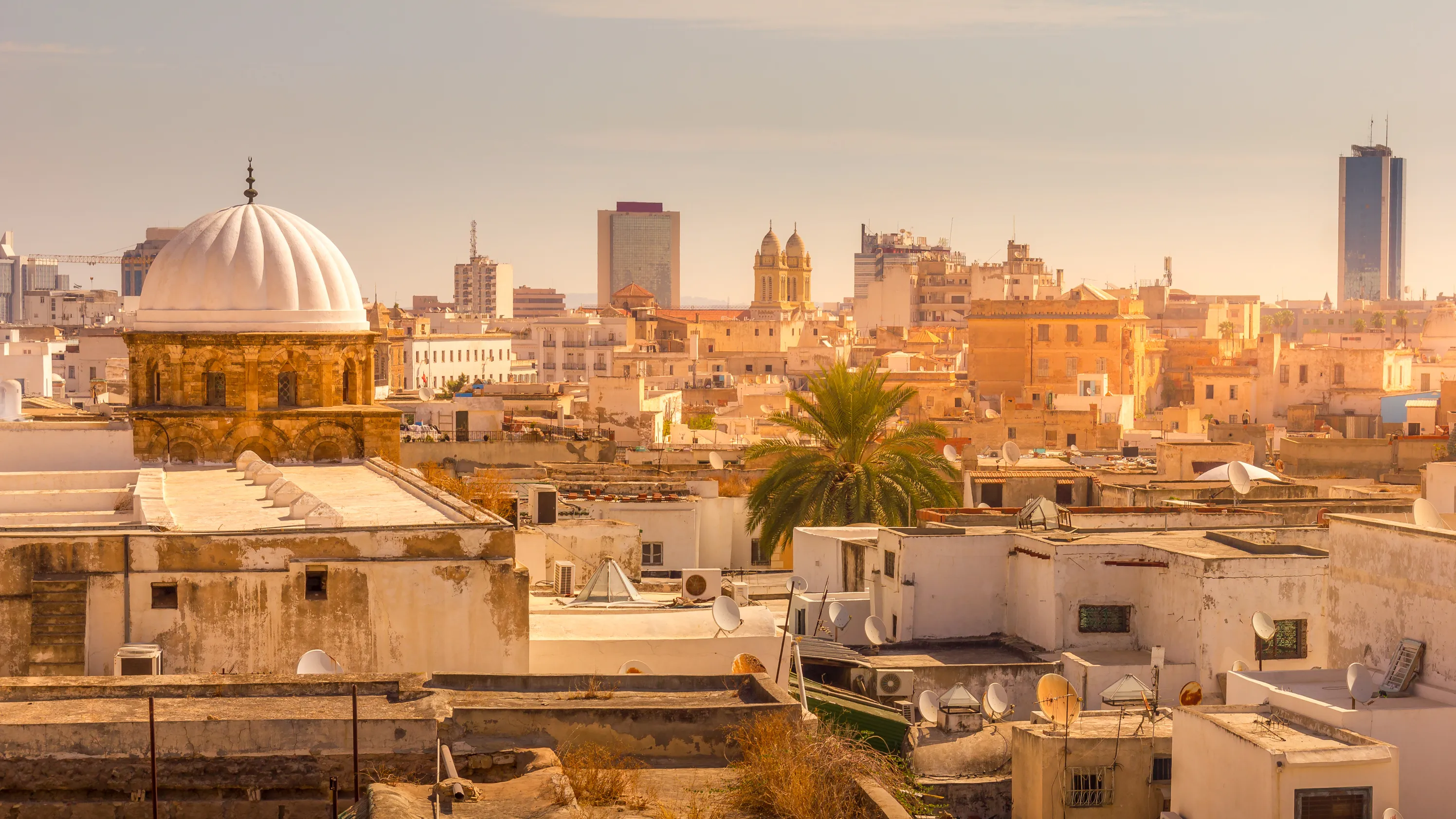
Africa's oldest medina still works for a living
Tunis sits on a lagoon a few kilometres inland from the Mediterranean, its walled medina, one of the best-preserved old cities in North Africa, still functioning as a genuine market rather than a reconstructed set piece. Perfumers, spice sellers and jewellers work the same covered lanes their families have worked for generations, and the Zitouna Mosque at the centre of it dates its core to the 8th century. Outside the walls, Avenue Habib Bourguiba is wide, tree-lined and unmistakably French in feel, a legacy of 75 years of colonial administration that gave the modern city its European-style boulevards and cafe culture.
What makes Tunis unusually rewarding for a short trip is how much sits within a 40-minute train ride of the centre. Carthage, the city that once rivalled Rome, has ruins scattered through a leafy modern suburb. Sidi Bou Said, all whitewashed walls and cobalt-blue doors on a clifftop above the sea, is one of the most photographed villages in North Africa and earns it. And the Bardo Museum holds the largest collection of Roman mosaics on earth, assembled from sites across the country into a former beylical palace.
The honest complications
Tunis is not a polished European capital, and it doesn't pretend to be. Traffic is heavy and chaotic in the centre, pavements are inconsistent, and the medina's touts, offering unsolicited directions or a shop recommendation then asking for payment, are persistent enough to need a standard, practiced decline. Security is visibly heavier than at most European capitals: the Bardo Museum suffered a coordinated terror attack in March 2015 that killed over 20 people, mostly tourists, and airport-style bag checks are now standard there and at other major sites. There has been no repeat incident in the decade since, but the checkpoints are a reminder of why they exist. None of this should stop a visit; it's simply the honest texture of the city rather than a polished postcard version of it.
Five areas, one train line connecting most of them
Tunis proper, the medina and Ville Nouvelle, sits inland from the coast; the TGM light rail then strings together the coastal suburbs of La Goulette, Carthage, Sidi Bou Said and La Marsa in a single 40-minute run. Where you base yourself comes down to whether you want medina atmosphere or coastal calm.
Medina
The walled old city is Tunis at its most concentrated: covered souks, the Zitouna Mosque, centuries-old dar courtyard houses, many now converted into guesthouses and restaurants. It's genuinely alive with local commerce rather than staged for visitors, though that also means narrow, crowded lanes and a steady stream of touts near the main entrances.
Ville Nouvelle / Centre Ville
The French-built new town around Avenue Habib Bourguiba is wide boulevards, colonial-era architecture, cafes and the Cathedral of St Vincent de Paul, a five-minute walk from the medina gates. For a first visit, this is the practical base: central, well connected to the TGM at Tunis Marine, and quieter at night than the medina.
La Marsa
An upscale coastal suburb popular with diplomats and affluent Tunisians, with a corniche, boutique hotels and some of the city's best restaurants, a short walk or taxi from Sidi Bou Said. The TGM terminates here, making it an easy, calmer alternative base to the city centre.
Sidi Bou Said
Whitewashed walls, cobalt-blue doors and steep cobbled lanes climbing to a clifftop above the Mediterranean. It is Tunisia's most photographed village and is genuinely worth the hype, though it's also the most tourist-oriented stop on the TGM line; visiting early morning or at sunset avoids the worst of the day-trip crowds.
Carthage
Modern Carthage is a leafy, upmarket residential suburb with the ancient city's ruins, the Antonine Baths, Byrsa Hill, the Punic ports, scattered across it rather than concentrated in a single fenced site. It rewards a half-day with the TGM connecting several stops directly to different ruin clusters.
From clifftop boutique stays to a reliable city-centre base
Tunis's best accommodation clusters in La Marsa, Gammarth and Sidi Bou Said along the coast, with straightforward international-standard options in the city centre for travelers who'd rather walk to the medina than commute in.
Up the coast in Gammarth, Mövenpick Hotel Gammarth Tunis is the area's resort-style luxury pick, with sea-facing rooms and full spa and pool facilities a short drive from Sidi Bou Said. In La Marsa itself, Dar El Marsa Hotel and Spa is the upscale sea-view choice, while Dar Corniche La Marsa is the better-value option with direct sea access and a calmer, more residential setting.
In Sidi Bou Said, Dar Said is a well-regarded boutique conversion of a traditional house in the heart of the village, while La Menara Hotel & Spa is the five-star option with sweeping Mediterranean views from the clifftop. Back in the centre, Radisson Hotel Tunis, City Center is the reliable international base, walking distance from Avenue Habib Bourguiba and the medina gates, with an airport shuttle and fitness facilities.
Medina dars, coastal terraces and a citywide love of harissa
Tunis's best traditional cooking is inside converted medina courtyard houses, while the coastal suburbs of La Marsa and Sidi Bou Said carry the city's most scenic dining, terraces looking straight out over the Mediterranean at sunset.
Medina dars
Dar El Jeld, set inside a converted 18th-century house deep in the medina, is the classic address for an elegant, full Tunisian meal in genuinely atmospheric surroundings. Fondouk El Attarine, in a restored former caravanserai near the perfume souk, and Dar Belhadj, another historic medina house conversion, are both well-regarded alternatives with the same courtyard-dining format.
Sidi Bou Said & La Marsa
Cafe des Delices in Sidi Bou Said, spread across two open-air terraces above the village, is the classic stop for mint tea and a sunset view over the Mediterranean rather than a full meal. In La Marsa, The Cliff serves Mediterranean dishes on a terrace with genuine sea views, and The Zink is the reliable pick for a gourmet burger when you want a break from Tunisian cuisine.
International options
DaPietro L'Antica Pizzeria is the city's best-reviewed Italian spot for a straightforward pizza night, and Sultan Ahmet covers Turkish cuisine for travelers wanting a change from harissa and couscous after a few days.
A city, a museum and a coastline, all in one metro line
Tunis rewards a slow walk through the medina followed by a full day riding the TGM up the coast. A handful of sights benefit from timing, and this chapter walks through the city roughly the way a good two to three days would.
The medina
Start at Bab el Bhar (the Porte de France), the gateway between the French-built Ville Nouvelle and the old city, and head into the covered souks. Souk El Attarine, the perfume and spice market, and Souk El Berka, historically the jewelry and former slave market, are the two most atmospheric lanes to wander with no fixed plan. The Zitouna Mosque at the centre of the medina dates its core to the 8th century and is the oldest in the country; non-Muslim visitors can view the courtyard from the entrance, though the prayer hall itself is restricted. Give the medina at least two unhurried hours, and expect to get pleasantly lost at least once.
The Bardo Museum
The National Bardo Museum, inside a former beylical palace, holds the world's largest collection of Roman mosaics, floor after floor of scenes gathered from ruins across the country, alongside Punic, Byzantine and Islamic-era collections. Entry runs around 15 TND and the museum is open Tuesday to Sunday, 9am to 5pm, closed Monday. Security is heavy since the 2015 attack, expect a bag check and a wait at busier times, but the collection alone justifies a half day.
Carthage by TGM
Take the TGM train from Tunis Marine toward La Marsa and get off at any of the Carthage stops to reach the scattered ruins: the Antonine Baths, once among the largest bath complexes in the Roman world, sit right by the water, while Byrsa Hill and its museum give the clearest overview of the site's Punic and Roman layers. The ruins are spread across a modern residential suburb rather than fenced into one park, so budget a half day of walking and train-hopping between clusters.
Sidi Bou Said
Continue on the TGM one stop further to Sidi Bou Said, the whitewashed clifftop village that is Tunisia's most photographed spot. Cafe des Delices, spread across two terraces above the village, has the best panoramic view over the sea and is worth timing for sunset. Ennejma Ezzahra, Baron d'Erlanger's early 20th-century palace with green Carrara marble columns and Arabo-Andalusian gardens cascading toward the Mediterranean, and Dar El Annabi, a restored 18th-century family house laid out as it would have been lived in, both give a deeper look at the village beyond its postcard lanes. Visit early morning or at sunset to beat the day-trip crowds that build from mid-morning.
One, two or three days, planned around the TGM
Two to three full days covers Tunis properly; even a single well-planned day delivers the medina and one coastal stop. These routes lean on the TGM train to link the city centre with the coast.
- Morning
The medina. Bab el Bhar, Souk El Attarine and Souk El Berka, the Zitouna Mosque courtyard, then a brik lunch nearby.
- Midday
The Bardo Museum. A taxi or short walk from the medina; two hours minimum for the mosaic halls.
- Afternoon
TGM to Sidi Bou Said. Train from Tunis Marine, straight through to the village for a wander through the blue-and-white lanes.
- Sunset
Cafe des Delices. Mint tea on the terrace as the light goes gold over the Mediterranean.
- Day 1
The one-day route: medina, Bardo Museum, TGM to Sidi Bou Said, sunset at Cafe des Delices.
- Day 2 morning
Carthage. TGM to the Carthage stops for the Antonine Baths and Byrsa Hill museum.
- Day 2 afternoon
La Marsa. Continue to the TGM terminus for the corniche and a late lunch.
- Day 2 evening
Centre ville. Avenue Habib Bourguiba and dinner back near the medina gates.
- Days 1-2
The two-day route above, at a gentler pace, adding Ennejma Ezzahra and Dar El Annabi in Sidi Bou Said.
- Day 3
A Roman day trip. Dougga or El Jem by rental car or organized tour, one of the best-preserved Roman sites anywhere, a genuinely worthwhile use of a third day.
One train line covers most of what you'll want to see
Tunis-Carthage Airport (TUN) sits about 8km from the centre. Bus lines 35 and 635 run roughly every 30 minutes to Tunis Marine bus station in about 25 minutes for around 1 TND, connecting there to the metro and the TGM. A metered taxi to the centre costs roughly 10-15 TND depending on traffic; agree the meter is running before you set off, or book ahead through a fixed-price transfer.
Inside the city, the TGM (Tunis-Goulette-Marsa) light rail is the single most useful piece of transport infrastructure for a visitor: it runs from Tunis Marine, at the edge of the medina, out to La Goulette, Carthage, Sidi Bou Said and La Marsa in about 40 minutes end to end, for under 1 TND, with trains every 15-20 minutes from early morning until around 10pm. Metered taxis are cheap for short hops within the centre but the "broken meter" claim is the most common tourist scam; insist on the meter or use the inDrive or Yassir ride-hailing apps, both active in Tunis, to sidestep the negotiation entirely. The medina itself is walking-only, with uneven stone lanes that reward flat, grippy shoes.
Best time to visit Tunis
Tunis has a Mediterranean climate. April-May and September-October are the sweet spots: warm days, manageable crowds, comfortable for walking the medina and the coastal suburbs. July and August are hot and humid, regularly into the mid-30s°C, while still busy with regional tourism. Winter (December-February) is quiet and mild by northern European standards, good for sightseeing at a relaxed pace with lower hotel prices, though some coastal restaurants reduce hours.
One of the most affordable capitals on the Mediterranean
Tunis is significantly cheaper than most European capitals. The main cost trap is tourist-oriented restaurants directly inside Sidi Bou Said and along the busiest medina lanes, where prices run noticeably higher than a few streets away for comparable food.
- Medina guesthouse or budget hotel 35-70 TND
- Market meals and brik 15-25 TND
- TGM and metered taxis 5-15 TND
- Free medina wandering, one paid museum
- Boutique hotel in La Marsa or Sidi Bou Said
- Restaurant dinners 40-70 TND
- Occasional taxi or ride-hailing app
- Bardo Museum plus a Roman day trip
- La Menara or Mövenpick Gammarth
- Dar El Jeld and similar fine dining
- Private guide and driver
- Chauffeured day trips to Dougga or El Jem
Safe for the areas you'll actually spend time in
Tunis rates 7.0/10 on our safety scale. Violent crime against tourists is rare; the practical concerns are pickpocketing in crowded medina lanes and around busy transport hubs, and the taxi meter scam described above. The Bardo Museum suffered a coordinated terror attack in March 2015 that killed over 20 people, mostly tourists; security has been rebuilt substantially since, with visible checkpoints and bag checks now standard at the museum and other major sites, and no repeat incident in the decade since.
Tunis is reasonably comfortable for solo female travelers by regional standards: serious incidents are uncommon, but catcalling and persistent staring happen, particularly in busier medina areas, and tend to ease in the more cosmopolitan Ville Nouvelle, La Marsa and Sidi Bou Said. Dress modestly outside the coastal, tourist-facing areas, avoid walking alone late at night, and use a metered taxi or a ride-hailing app after dark rather than an unmarked car. Emergency numbers are the national 197 for police, 190 for ambulance (SAMU) and 198 for fire and civil protection, all working the same throughout the country.
The Roman sites alone justify a rental car out of Tunis
Tunis's position in northern Tunisia puts several of the country's best sites within a single day's round trip. All four are reachable by rental car, organized tour or a combination of louage and taxi.
Dougga
Widely considered the best-preserved Roman town in North Africa: a capitol, working theater, temples and residential streets on a hillside with genuine shade and minimal crowds. No reconstruction here, this is the real ruin rather than a rebuilt approximation.
El Jem
A Roman amphitheater that held an estimated 35,000 spectators and is in better structural condition than Rome's Colosseum, with underground passages open to visitors, a level of access most Roman sites don't allow. Combine with Dougga for a long single day if you have your own transport.
Kairouan
The Great Mosque of Kairouan, one of the oldest in the Islamic world, has a courtyard and column-filled prayer hall (viewable by non-Muslims from the courtyard) that make it a foundational piece of Islamic architecture. The medina here is quieter than Tunis's and famous for makroudh, semolina pastries filled with dates, sold throughout the old town.
Hammamet
The closest beach escape from Tunis, with a compact, well-kept medina attached to a long stretch of resort hotels. A straightforward half or full day if you want sand without a longer drive.
Tunis FAQ
Is Tunis safe for tourists?
Tunis is generally safe for tourists, rated within the same Level 2 caution zone as the rest of the standard tourist circuit in Tunisia. The main concerns are pickpocketing in crowded medina lanes and the occasional taxi meter scam, not violent crime. Security at major sites like the Bardo Museum has been heavy since a 2015 attack, with no repeat incident since.
How many days do I need in Tunis?
Two to three full days covers the city well: one for the medina and the Bardo Museum, one for Carthage and Sidi Bou Said via the TGM train, and a third for La Marsa or a Roman day trip to Dougga or El Jem.
How much does Tunis cost per day?
Budget travelers manage on 80-140 dinars a day (about $25-45) with guesthouses and market meals; mid-range runs 230-350 dinars ($75-110). Tunis is significantly cheaper than most European capitals.
When is the best time to visit Tunis?
April-May and September-October: warm, manageable crowds, comfortable for walking the medina. July and August are hot and humid on the coast; winter is quiet and good for sightseeing but cooler.
How do I get from Tunis-Carthage Airport to the centre?
Bus lines 35 and 635 run roughly every 30 minutes to Tunis Marine bus station in about 25 minutes for around 1 TND, connecting to the metro and TGM train. A metered taxi costs roughly 10-15 TND depending on traffic.
What is the best area to stay in Tunis?
Central Tunis (Ville Nouvelle) for first-timers who want to walk to the medina; La Marsa or Sidi Bou Said for a quieter, more upscale coastal base with easy TGM access into the centre.
Can I enter the Zitouna Mosque in the medina?
Non-Muslim visitors can view the mosque's courtyard from the entrance but access to the prayer hall is restricted. It's still worth the stop as part of a medina walk.
Is Tunis walkable?
The medina and Ville Nouvelle are compact and walkable, though the medina's stone lanes are uneven and crowded, so wear comfortable shoes with grip. Carthage, Sidi Bou Said and La Marsa are best reached by the TGM train rather than on foot.
What is the TGM and do I need it?
The TGM is the light rail line linking central Tunis (Tunis Marine) with La Goulette, Carthage, Sidi Bou Said and La Marsa. It costs under 1 TND, runs every 15-20 minutes, and is the easiest way to see the coastal suburbs in a day.
What Stays With You
Tunis doesn't dress itself up for visitors. The medina sells perfume and spices to Tunisians who live there, not tourist trinkets dressed as heritage, the Bardo's mosaics were pulled from real Roman floors rather than assembled for a gallery, and the fishermen's boats still work the water below Sidi Bou Said's blue-and-white lanes every morning before the day-trippers arrive. That unselfconsciousness, a capital that carries three thousand years of history without performing any of it, is the thing that sticks after the trip is over.
Ride the TGM out to Sidi Bou Said on your last evening, find a table at Cafe des Delices, and watch the Mediterranean go gold the way it has for everyone who's sat there before you.