
Lesotho's capital is a stopover, and that's fine
Maseru sits at about 1,600 meters on the Caledon River, directly against the South African border, with roughly 330,000 people serving as the country's political and commercial heart. It grew up around the border crossing rather than around a historic old town, so it lacks the layered architecture or waterfront drama that make some African capitals destinations in themselves. What it has instead is function: the only real airport, the best hospitals, the rental cars and 4x4s, and the roads that lead out to everywhere in Lesotho actually worth seeing.
That's not a knock on the city so much as a useful piece of trip planning. Treat Maseru as a launchpad: a night to land, stock up on cash and supplies, see the Basotho Hat market and Thaba Bosiu, then head for the highlands. A night on the way back out, for a hot shower and a real bed, completes the loop.
The honest complications
Maseru's dining and nightlife scene is genuinely limited, a handful of hotel restaurants and a couple of independent cafes rather than a food scene to explore. The city also has a real crime problem after dark: the US State Department specifically flags Maseru for armed robbery and carjacking risk, concentrated at night and in poorly lit areas. None of this makes a short, sensible visit unsafe, but it does mean treating Maseru like the practical, slightly rough capital it is rather than a resort town.
A small, spread-out city built around one main road
Maseru doesn't really divide into distinct tourist neighbourhoods the way a European or Asian capital might. It divides into a compact central business district and a much larger, more spread-out residential and suburban area around it, and where you base yourself comes down to how much you want to walk versus drive.
Central Maseru
The CBD along Kingsway holds most of what a short visit needs within walking distance: the Basotho Hat market, government buildings, banks and ATMs, and the city's best-known hotel-restaurants including Lancers Inn. For a one- or two-night stay, this is the practical choice.
Maseru Bridge
The Maseru Bridge border post, right at the edge of the CBD, is the busiest land crossing between Lesotho and South Africa and can back up with queues at peak times. It's not a destination, but it's worth knowing its location if you're timing a self-drive arrival or departure.
Ha Abia & the golf course fringe
The area around Maseru Golf Club and out toward Ha Abia is quieter and more residential, home to some of the newer boutique accommodation. A reasonable alternative if you want distance from the CBD's traffic and don't mind a short taxi ride in.
A short list, because Maseru only has a short list
Maseru's hotel scene is small compared to most capitals its size, and that's actually useful: there isn't a confusing sprawl of options to sort through. These are the names that come up again and again, across every price point that exists here.
At the top of what's available, Avani Maseru (formerly the Lesotho Sun) is the city's main full-service hotel, with a casino, the Mohokare Restaurant serving regional cuisine, a poolside bar and views over the city from its hillside position, the default choice for business travelers and anyone wanting a familiar international-standard stay. Mpilo Boutique Hotel, a few minutes from Maseru Golf Course, is the newer boutique alternative, with two in-house restaurants and a full buffet breakfast, generally quieter than the CBD hotels.
Right in the center, Lancers Inn is Maseru's long-running institution: a hotel and restaurant on the main road through the CBD, popular with local business travelers as much as tourists, with poolside dinner service and a menu built around steaks and highland trout. The Palace Hotel is a solid mid-range option nearby for travelers who want a central, no-frills base without hotel prices. For breakfast or a light lunch near any of the central hotels, Ouh La La Cafe, right next to Lancers Inn, is the go-to for coffee and pastries.
A small scene, honestly assessed
Maseru is not a food-destination capital, and pretending otherwise would do visitors a disservice. What exists is solid and worth knowing rather than extensive: mostly hotel restaurants, a couple of independent cafes, and the same highland trout and papa-based dishes you'll find at guesthouses across the country, done at capital-city standard.
Lancers Inn
Lancers Inn's restaurant is the closest thing Maseru has to a signature dining room: steaks, notably a well-regarded pepper-monkeygland version, and highland trout on a menu that mixes local and international dishes, served with poolside table service. It's where visiting business travelers and long-time residents both end up, and reliably the safest recommendation in the city.
Mohokare Restaurant, Avani Maseru
The in-house restaurant at Avani Maseru serves regional cuisine across breakfast, lunch and dinner, with a poolside bar attached, a dependable choice if you're staying at the hotel or want a full-service dinner without leaving the property.
Ouh La La Cafe
A genuinely useful daytime stop right in the CBD: coffee, pastries and light meals at reasonable prices, the easiest place to grab breakfast before a day trip or a coffee break between the Basotho Hat market and Thaba Bosiu.
A short, honest list: half a day in the city, half a day at Thaba Bosiu
Maseru itself has one real must-see and one essential half-day trip. Neither takes long, which is exactly the point: this is where you get organized, not where you spend your trip.
The Basotho Hat
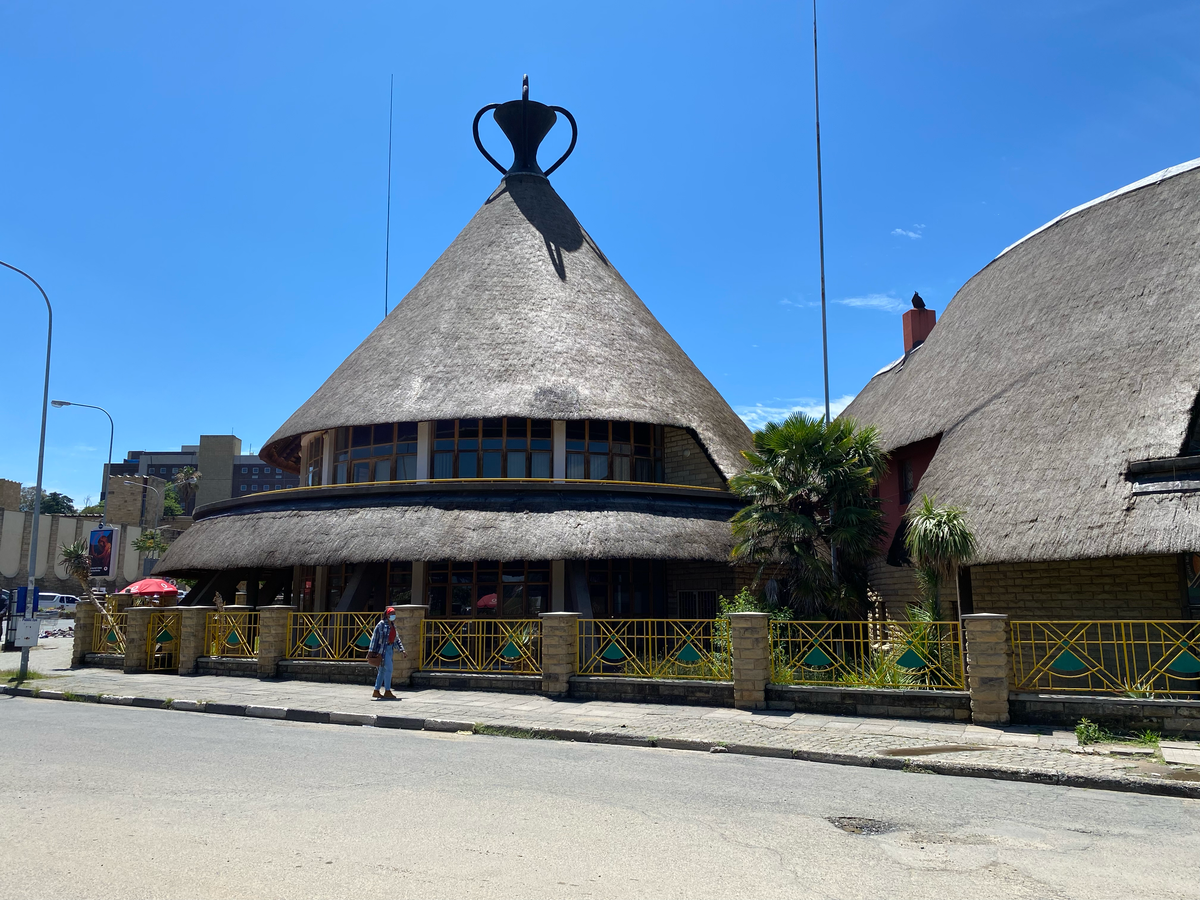
A two-story crafts building shaped like the mokorotlo, Lesotho's iconic conical straw hat and a national symbol prominent enough to appear on the flag, the Basotho Hat is both a landmark in its own right and the single best place in the city to buy authentic wool blankets, woven baskets and mokorotlo hats made across the highlands rather than imported souvenirs. Worth an hour, more if you're shopping seriously for a blanket to take home.
Thaba Bosiu
A short drive from central Maseru, Thaba Bosiu ("mountain of the night") is the flat-topped sandstone plateau where King Moshoeshoe I founded the Basotho nation in 1824 and successfully defended it against Zulu and Boer attacks for decades. The Thaba Bosiu Cultural Village at the base runs guided tours covering the site's history and Basotho traditions, and the climb to the plateau itself, roughly an hour round trip, is the closest thing to a pilgrimage site the country has. Budget half a day including the drive.
Maseru Golf Club
An unpretentious, functioning golf course near Ha Abia, a pleasant way to spend an afternoon if you play and want something other than driving or shopping, and a reasonable indicator of how Maseru's small expat and business community actually spends its downtime.
One or two days, exactly as much as Maseru needs
Maseru rewards efficiency more than lingering. These two routes cover it properly without padding out a capital that's better used as a base than a destination.
- Morning
The Basotho Hat. Browse the craft market, buy a blanket or a mokorotlo hat, then coffee at Ouh La La Cafe.
- Midday
Thaba Bosiu. Drive out, tour the Cultural Village, and climb to the plateau if time and weather allow.
- Evening
Dinner at Lancers Inn. Steak or highland trout, poolside if the weather holds, then an early night before heading for the highlands.
- Day 1
The one-day route above: Basotho Hat, Thaba Bosiu, dinner at Lancers Inn.
- Day 2
Morija. A half-day trip 35km south to the Morija Museum & Archives and its dinosaur footprint displays, an easy add-on before continuing toward Malealea or Semonkong the same afternoon.
A car-first city with two ways in
Moshoeshoe I International Airport (MSU) sits about 18km from central Maseru and handles mostly regional connections, chiefly to Johannesburg. There's no train or metro link; a taxi or hotel-arranged transfer takes 25-35 minutes depending on traffic near the Maseru Bridge area, agree the fare in advance if not using a pre-arranged transfer. Many visitors instead fly into OR Tambo in Johannesburg and drive or shuttle 4-5 hours south, crossing at Maseru Bridge, the busiest of Lesotho's land border posts with South Africa.
Within the city, the compact CBD along Kingsway is walkable by day. Beyond the center, Maseru spreads out with inconsistent pavements, so taxis are the practical choice, and the only sensible choice after dark. For onward highland travel, a rental car handles Thaba Bosiu, Morija and the paved or graded-gravel routes toward Semonkong and Malealea in dry conditions; book a 4x4 if Sani Pass or off-route highland exploring is on the itinerary, and confirm with the rental company that your contract actually permits highland travel.
Best time to visit and what the seasons feel like in Maseru
Maseru sits lower and milder than the highlands, around 1,600m, so it rarely sees the extreme cold or heavy snow that closes passes further east. April to June and September to November are the sweet spots: dry, mild days and clear views out toward the mountains. December to February brings summer thunderstorms most afternoons, dramatic but usually brief. June to August is the coldest stretch, with night temperatures sometimes near freezing even in the city, worth packing for regardless of what the daytime forecast promises.
Inexpensive by any regional standard
Maseru is cheap relative to most African capitals and on par with or below comparable South African towns just across the border. The main cost variable is which hotel tier you pick; food and local transport stay affordable across the board.
- Guesthouse or budget hotel $20-35
- Local meals and cafe food $8-15
- Shared taxis around the city $1-3
- Basotho Hat market plus Thaba Bosiu entry
- Lancers Inn or Mpilo Boutique $60-100
- Restaurant dinners $15-25/person
- Private taxi or short car rental
- Thaba Bosiu guided tour
- Avani Maseru $100-160+
- Hotel dining every meal
- Private driver for day trips
- 4x4 rental for onward highland travel
Fine by day, deliberate after dark
Maseru is the specific place the US State Department's Level 2 advisory for Lesotho is really about: armed robbery and carjacking occur here more than anywhere else in the country, concentrated at night, on poorly lit or unlit roads, and at locations frequented by foreigners. By day, with normal city awareness, the CBD around Kingsway and the main sights are straightforward to visit.
The practical rule that covers most of it: don't walk after dark. Use hotel-arranged transport or a known taxi service for any evening movement, keep car doors locked and windows up while driving through the city, and avoid displaying cash, phones or cameras openly in traffic or on the street. None of this requires special expertise, it's the same big-city caution that applies in plenty of capitals, just worth stating plainly for a destination that doesn't come with the reputation to make it obvious.
The real reason to fly into Maseru isn't Maseru
Most of what makes Lesotho worth visiting sits hours from the capital on gravel and mountain roads, closer to overnight excursions than same-day round trips. Morija is the one genuine day trip from Maseru; everything else here is best planned as a multi-day highland leg rather than squeezed into a single long day.
Morija
The Morija Museum & Archives, built around a genuine dinosaur footprint discovery and covering Basotho history more broadly, is an easy half-day from Maseru and the closest thing to a conventional day trip the area offers. Time it for the first week of October if possible, when the Morija Arts & Cultural Festival, Lesotho's premier cultural event, takes over the town.
Malealea
Lesotho's main pony trekking hub, reachable in a long half-day from Maseru but genuinely worth staying at least one night for a proper trek rather than a rushed there-and-back ride.
Semonkong & Maletsunyane Falls
Home to one of southern Africa's highest single-drop waterfalls and its own pony trekking and hiking network. The drive alone makes a same-day round trip impractical; plan at least one night.
Katse Dam & the Highlands Water Project
Africa's second-highest dam and the engineering centerpiece of the water project that supplies Johannesburg. The LHWP Visitors' Centre runs tours of the dam wall; the drive through Bokong Nature Reserve and the high central plateau is much of the reason to go.
Sani Pass & Afriski
Both sit in the eastern Maluti and Drakensberg highlands, far enough from Maseru that either is better approached as its own overnight leg, or in Sani Pass's case, often more easily reached from South Africa's Underberg side than across the country from the capital.
Maseru FAQ
Is Maseru safe for tourists?
By day, yes, with normal city awareness. After dark, the US State Department flags Maseru specifically for armed robbery and carjacking risk, so use hotel-arranged transport or a known taxi at night rather than walking, and avoid poorly lit or isolated areas.
How many days do I need in Maseru?
One full day covers the city itself: the Basotho Hat market, a visit to Thaba Bosiu, and a good dinner. Most visitors use Maseru as a one- or two-night base before or after a highland trip rather than a standalone destination.
How much does Maseru cost per day?
Budget travelers manage on $25-40 a day with a guesthouse and local meals; mid-range with a proper hotel and restaurant dinners runs $60-100. Maseru is inexpensive by regional standards, comparable to or cheaper than nearby South African towns.
When is the best time to visit Maseru?
April to June and September to November: dry and mild, with clear views toward the highlands. December to February brings summer thunderstorms, and June to August is cold, sometimes near freezing at night, though that's also when Afriski's ski season runs a few hours away.
How do I get from Maseru airport to the city center?
Moshoeshoe I International Airport (MSU) is about 18km from central Maseru. There's no train or metro link; a taxi or hotel transfer takes 25-35 minutes depending on traffic at the Maseru Bridge area. Agree a fare before getting in if not using a hotel-arranged transfer.
What is the best area to stay in Maseru?
Central Maseru along Kingsway, near Lancers Inn and the Basotho Hat, is the most practical base: walkable to the main sights and close to the Maseru Bridge border post. The Avani and Mpilo Boutique Hotel areas offer a quieter, slightly more residential alternative a short drive out.
Do I need to speak Sesotho in Maseru?
No. English is an official language and widely spoken in hotels, restaurants and among guides in Maseru. A few Sesotho words, lumela (hello) and kea leboha (thank you), are appreciated but not necessary to get by.
Can I cross into South Africa easily from Maseru?
Yes. Maseru Bridge, right at the edge of the city, is the busiest land border crossing between Lesotho and South Africa, connecting to Ladybrand and on to Bloemfontein. Expect queues at peak times and keep your passport and any vehicle paperwork ready.
Is Maseru walkable?
The compact CBD around Kingsway is walkable by day. Maseru is spread out beyond the center, though, and pavements are inconsistent, so taxis are the practical choice for anything outside the core and for all travel after dark.
Is Maseru a good base for the Lesotho highlands?
Yes, it's effectively the only realistic one. Maseru has the country's main airport, its best-equipped hospitals, rental car and 4x4 options, and the road connections to Thaba Bosiu, Morija, Malealea, Semonkong and, further out, Katse Dam and Afriski.
What Stays With You
Maseru isn't going to be the highlight of your Lesotho trip, and every honest guide to the city, including this one, should say so plainly. What it does well is get you ready: a blanket from the Basotho Hat, an afternoon on Moshoeshoe's mountain, a proper dinner and a good night's sleep before the roads get rougher and the phone signal disappears. That's not a small thing. It's the difference between arriving in the highlands prepared and arriving there scrambling.
Buy the blanket. You'll need it sooner than you think, and it makes a better souvenir than anything you'll find once you leave the city.