
The Kingdom in the Sky, and That's Not a Marketing Line
Lesotho is the only country on the planet that lies entirely above 1,000 meters, and it shows in everything from the climate to the way people dress: sheep-wool blankets in July are practical clothing here, not costume. Encircled completely by South Africa, it's one of only three countries in the world surrounded by a single neighbor, alongside San Marino and Vatican City, and it has stayed stubbornly its own place: its own king, its own currency, its own language, its own mountain roads that South African rental companies still won't insure you to drive.
What draws visitors is the landscape and what it takes to move through it. The Maluti and Drakensberg ranges cover most of the country in sandstone peaks and river canyons, crossed by dirt roads, 4x4 passes and centuries-old pony trails rather than highways. Maletsunyane Falls drops onto a gorge floor near Semonkong. Sani Pass switchbacks up to 2,874 meters and a pub that claims to be Africa's highest. And Lesotho is genuinely cheap: a guesthouse bed with dinner included runs $15 to $25, a full day of pony trekking with a guide costs less than a single museum ticket in Cape Town.
The honest complications
Lesotho is not a polished destination and doesn't pretend to be one. Tourism infrastructure outside Maseru and a handful of established lodges is thin: expect gravel roads, patchy phone signal in the highlands, and weather that closes mountain passes on short notice, snow on Sani Pass is possible even outside the depths of winter. Maseru itself has a real crime problem after dark, armed robbery and carjacking, that the highlands mostly don't share. Health care is basic outside the capital, so evacuation-inclusive travel insurance is not optional. None of this makes Lesotho difficult to visit responsibly, but it does mean planning with a guide or lodge who knows current road and weather conditions, rather than winging it with a rental sedan and an old map.
A History Worth Knowing
Modern Lesotho exists because one 19th-century leader, Moshoeshoe I, gathered refugees from the Lifaqane wars onto a defensible mountain and out-negotiated everyone who tried to take it from him, Zulu impis, Boer commandos and eventually the British Empire itself, whose protection he requested rather than waited to be conquered. That founding act, choosing diplomacy and a mountain fortress over annihilation, still shapes how Basotho talk about their own history.
- Early 1800s
The Lifaqane. Waves of displacement and conflict across southern Africa, triggered partly by Zulu expansion under Shaka, scatter refugee clans across the highlands.
- 1824
Moshoeshoe I at Thaba Bosiu. The founding king establishes his stronghold on a flat-topped mountain near modern Maseru, gathering displaced clans into what becomes the Basotho nation.
- 1868
British protectorate. Facing land loss to Boer expansion, Moshoeshoe requests British protection. Basutoland is administered separately from the future South Africa, the decision that keeps Lesotho independent today.
- 1966
Independence. Basutoland becomes the Kingdom of Lesotho on 4 October, with Moshoeshoe II as king.
- 1970-1998
Political instability. Coups, suspended constitutions and a disputed 1998 election that triggers a SADC military intervention, mostly South African troops, to restore order in Maseru.
- 1991-present
The Highlands Water Project. Katse Dam and later Mohale Dam are built to export highland water to South Africa's Gauteng province, becoming Lesotho's largest single source of export revenue.
Read the full history: Moshoeshoe, colonial administration, and water diplomacy
Moshoeshoe I's genius was defensive geography combined with genuine diplomatic skill. Thaba Bosiu, "mountain of the night," has a flat summit reachable by only a few narrow passes, all of which he fortified. He survived attacks from Zulu forces under Shaka's general and, later, repeated wars with Boer trekkers over land in the fertile lowlands west of the mountains, land Lesotho never recovered and that today sits inside South Africa's Free State province. His 1868 request for British protection, made directly to prevent Boer annexation, is why Basutoland was administered as a separate territory rather than absorbed into what became South Africa in 1910, and it is the single decision most responsible for Lesotho existing as an independent country today.
Independence in 1966 was followed by a difficult few decades: Chief Leabua Jonathan's government suspended the constitution in 1970 after losing an election, a 1986 military coup installed a monarchy-military council, and democratic elections resumed only in the 1990s. The 1998 election dispute brought South African and Botswanan troops into Maseru under a SADC mandate, an intervention still debated locally, and led to constitutional reforms including the current mixed electoral system. Since 2012, Lesotho has run through a series of coalition governments, none especially stable, but the country has avoided the wholesale institutional collapse of some regional neighbors.
Water as an export. The Lesotho Highlands Water Project, anchored by Katse Dam (completed 1991-1996) and Mohale Dam, channels highland water through tunnels into South Africa's Vaal River system, supplying much of industrial Gauteng including Johannesburg. In return, Lesotho earns royalties that are one of its largest sources of foreign revenue, an unusual arrangement in which a small landlocked kingdom exports its single most abundant resource, water from its own mountains, to the country that surrounds it.
Top Destinations
Lesotho divides into the capital and its immediate surroundings, and the highlands, which is most of the country and where the real reason to visit lives. Distances look short on a map and take far longer in practice: mountain roads, gravel surfaces and river crossings mean 100 kilometers can be a three-hour drive. Budget accordingly rather than trying to see everything from a single Maseru base.
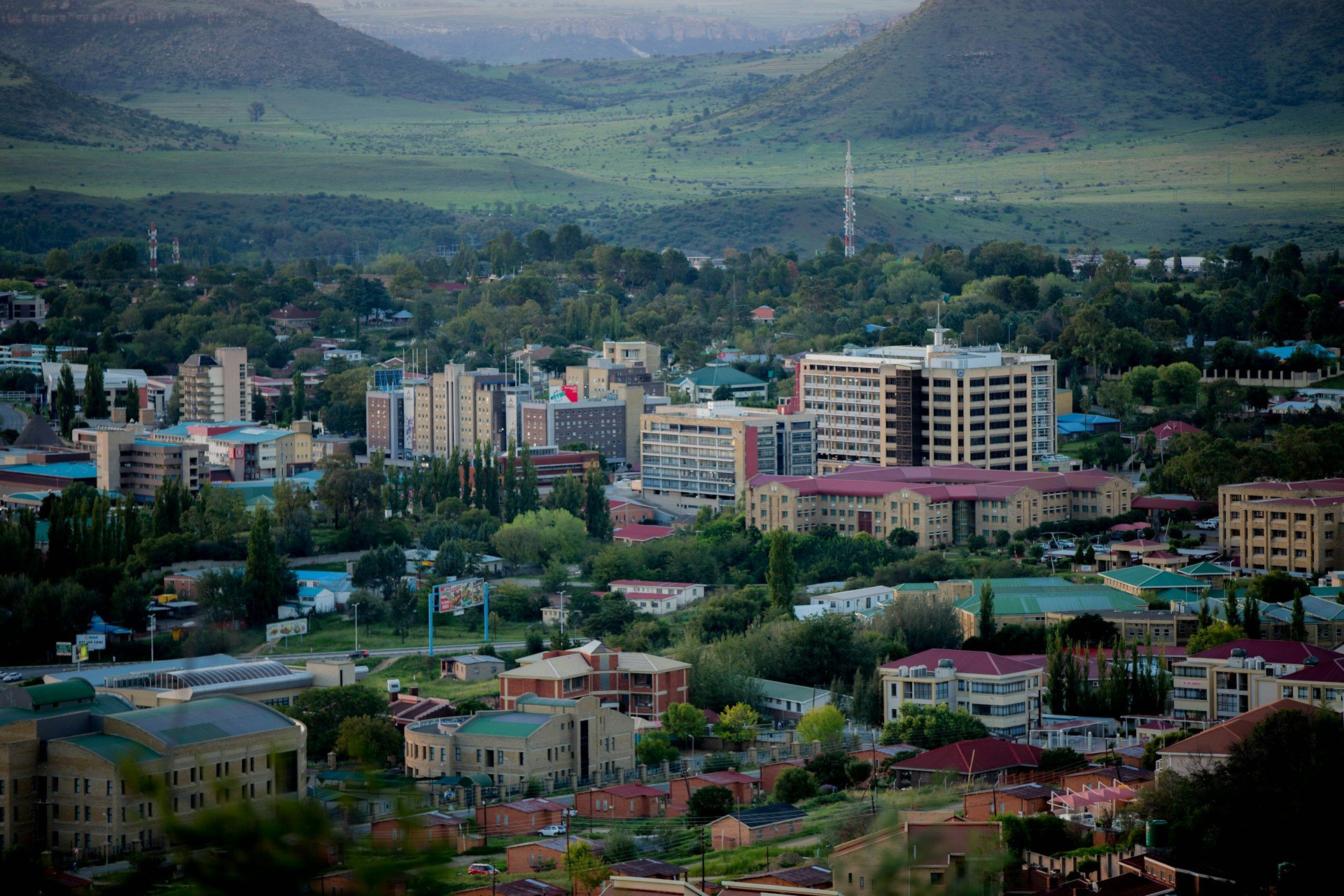
Maseru, the working capital
Maseru is Lesotho's political and commercial center, a functional rather than beautiful city that most visitors use as a base for a night or two rather than a destination in itself. The Basotho Hat building, a craft market shaped like the country's iconic conical straw mokorotlo, is the best single stop for weavings, blankets and baskets made across the highlands. See the full city guide for where to stay and eat.
Sani Pass, the classic 4x4 crossing
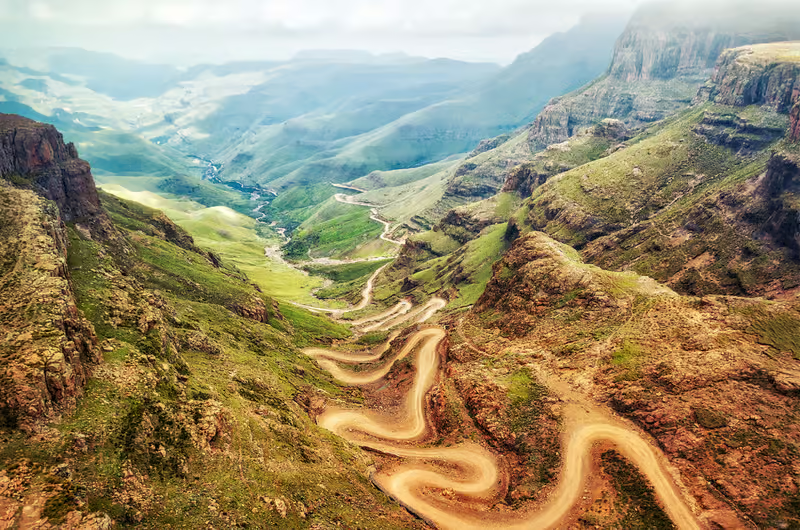
Sani Pass climbs from South Africa's KwaZulu-Natal side up roughly 139 switchbacks to the Lesotho border post at 2,874 meters, the only entry point into Lesotho that requires a 4x4 by law: about 8 kilometers of the upper pass remain unpaved gravel with real drop-offs. At the top, Sani Mountain Escape bills itself as Africa's highest pub, and it's a legitimate destination in its own right, not just a photo stop, with basic rooms if you want to stay at altitude. Most visitors approach from the South African side around Underberg; reaching it from Maseru means a long cross-country drive through the central highlands rather than a same-day trip.
Afriski Mountain Resort
Near Oxbow in the Maluti mountains, roughly three hours from Maseru by road, Afriski is one of only two operating ski resorts in mainland sub-Saharan Africa. The season runs roughly June to August depending on snow and snowmaking, the terrain suits beginners and intermediates, and in summer the same slopes work for hiking and mountain biking. It's a genuinely odd, worthwhile detour: skiing in Africa is a real thing, just a small-scale one.
Malealea, the pony trekking hub
Malealea, about 80 kilometers south of Maseru in the Mafeteng district, has been the country's main pony trekking base for decades. Sure-footed Basotho ponies carry riders along trails that villages have used for generations, from half-day rides to multi-day treks that reach Ketane Falls. It's the most direct way to experience rural highland Lesotho, staying in village guesthouses along the route rather than passing through by car.
Semonkong & Maletsunyane Falls
Semonkong, roughly 130 kilometers and about three hours from Maseru, sits beside Maletsunyane Falls, one of the highest single-drop waterfalls in southern Africa, spectacular after summer rain and half-frozen in winter. Semonkong also runs its own pony trekking, hiking and trout fishing, and the trail network connects west toward Malealea for travelers doing a multi-day highland crossing rather than an out-and-back.
Katse Dam & the Lesotho Highlands Water Project
Katse Dam, about 225 kilometers and up to four hours from Maseru via Leribe, is Africa's second-highest dam and one of the world's largest double-curvature arch dams, the centerpiece of the water project that supplies Johannesburg's industrial heartland. The LHWP Visitors' Centre above the dam wall runs tours explaining the engineering and the tunnel system, and boat trips onto the reservoir can be arranged on-site. It's a long drive for a dam, but the drive itself, through some of Lesotho's highest and most dramatic terrain, is a large part of the reason to go.
A hidden gem worth the detour
One stop rarely makes the standard highland circuit but is easy to add from Maseru.
Morija
Home to the Morija Museum & Archives, built around a genuine dinosaur footprint discovery, and the country's premier cultural event, the Morija Arts & Cultural Festival, held the first week of October. An easy half-day trip from the capital.
Culture & Etiquette
Basotho identity is unusually cohesive for a country this size: one dominant ethnic group, one indigenous language, Sesotho, spoken alongside English, and a set of symbols, the mokorotlo hat and the wool blanket, that everyone recognizes as national rather than regional. The wool blanket in particular is not a tourist prop: seanamarena blankets, worn draped over the shoulder, are everyday cold-weather clothing in the highlands and a marker of status and life stage at ceremonies.
Do
- Greet before asking anything. "Lumela" (hello) and a moment of small talk before getting to business is standard courtesy, especially in villages.
- Ask before photographing people, particularly at initiation ceremonies or in rural villages. A friendly ask is almost always granted; a candid shot without asking is not well received.
- Dress for the cold you don't expect. Even in summer, highland nights and altitude can turn cold fast. Locals wearing wool blankets in what looks like mild weather are a useful cue.
- Tip guides and pony handlers directly and in cash. Trekking guides and lodge staff rely heavily on tips; small notes in loti or rand are appreciated.
- Learn a few Sesotho phrases. Lumela (hello), Kea leboha (thank you), Ke phela hantle (I'm well). Attempted Sesotho gets a warm reaction almost everywhere.
Don't
- Assume Lesotho is culturally South African. Basotho identity, language and history are distinct, and conflating the two is a common and noticeable misstep.
- Underestimate mountain weather. Sudden temperature drops, snow outside deep winter, and afternoon thunderstorms in summer are all normal at altitude; always check conditions before a highland drive or trek.
- Drive highland gravel roads after dark if you can avoid it. Unlit livestock, potholes and unmarked drop-offs are a real hazard at night.
- Photograph or approach initiation school sites (lebollo). These traditional rites of passage are private and not intended for outside observation.
- Expect fast service. Rural Lesotho runs on its own clock; a meal or a repair takes as long as it takes.
Deeper culture: the blanket tradition, the Basotho pony and King Letsie III
The Basotho blanket. Introduced through 19th-century trade and adopted so thoroughly it's now considered a national dress, the wool blanket, especially the seanamarena pattern with its corn-cob motif, is worn for warmth, at weddings, funerals, and by initiates completing traditional rites. Different patterns and how a blanket is worn (over one shoulder versus both) can signal age, marital status or occasion to those who know how to read them.
The Basotho pony. A distinct breed developed from horses brought by early traders and adapted over generations to highland terrain and altitude, small, sturdy and famously sure-footed on narrow mountain paths. Pony trekking isn't staged for tourists, it's the same transport method herders and villagers have used for generations where roads don't reach.
The monarchy today. King Letsie III has reigned since 1996 (a second reign, following a brief 1990-1995 tenure by his father Moshoeshoe II). The monarchy is constitutional, with day-to-day governance run by an elected prime minister and parliament, but the king remains a genuine unifying figure and head of state for ceremonial and cultural purposes.
Food & Drink
Basotho food is built around maize and mountain produce: hearty, simple, and shaped by a climate too cold and high for much beyond staple crops and livestock. It won't be the reason you come to Lesotho, but it's honest, filling, and a genuine part of understanding how highland life works.
Papa & Moroho
Papa, a stiff maize porridge, is the everyday staple, served with moroho (cooked wild or garden greens) and a meat or bean stew called seshebo. The combination appears at nearly every village guesthouse dinner.
Highland Trout $8-15
Cold mountain rivers around Semonkong and the highlands support real trout farming, and fresh trout shows up on menus at lodges and at Maseru restaurants like Lancers Inn, a genuine highland specialty rather than an imported idea.
Joala & Maluti Lager
Joala, home-brewed sorghum beer, is the traditional village drink, sour and low-alcohol, usually shared from a communal container. Maluti, a mainstream lager, is the easy modern equivalent at bars and lodges.
When to Go & Getting Around
April to June and September to November are Lesotho's dry, mild shoulder seasons: stable weather, clear highland views and passes that stay open. December to February brings summer rain and afternoon thunderstorms, beautiful and green but muddier trekking. July and August are genuinely cold, cold enough that some highland passes close after snow, but that's also Afriski's ski season, so the "worst" months for general touring are the best months for one specific activity.
All four seasons compared, with temperatures
| Season | Verdict | Temps | Notes |
|---|---|---|---|
| Apr-Jun & Sep-Nov | Best | 8-22°C lowlands, colder highlands | Dry, stable, clearest highland views |
| Dec-Feb | Good (wet) | 18-28°C lowlands | Summer rain, thunderstorms, green landscape, muddier trails |
| Jul-Aug | Good for skiing | -5 to 12°C, colder at altitude | Coldest months; some passes close with snow; Afriski season |
Maseru sits around 1,600m and rarely sees extreme cold; the eastern highlands around Sani Pass and Afriski regularly drop well below freezing in winter and can see snow outside the core winter months too.
Getting there & around
Moshoeshoe I International Airport (MSU), about 18 kilometers from Maseru, handles mostly regional connections, chiefly to Johannesburg. Many visitors instead fly into OR Tambo in Johannesburg and drive or shuttle 4-5 hours south to Maseru via the Maseru Bridge border post, the busiest of several land crossings with South Africa, which also include Ficksburg, Van Rooyen's Gate, Qacha's Nek and, for 4x4s only, Sani Pass. Once in Lesotho, a rental car handles Maseru, Thaba Bosiu, Morija and the paved or graded-gravel routes to Semonkong and Malealea in dry conditions; a 4x4 is legally required for Sani Pass and strongly advisable for anything beyond the main routes, especially after rain or snow.
Practical prep: SIM cards, insurance, and driving highland gravel
Buy a Lesotho or South African SIM at the airport or border for data; signal thins out fast in the highlands, so download offline maps before leaving Maseru. Standard travel insurance is not enough here, confirm your policy covers medical evacuation, since highland medical facilities are basic and serious injuries mean transport to Maseru or Bloemfontein. South African rental agreements sometimes exclude Lesotho or specific passes like Sani, check the fine print before booking, and consider a dedicated Lesotho-based 4x4 operator for Sani Pass itself rather than a standard cross-border rental.
Where to stay
Highland trekking lodges
Family-run guesthouses at Malealea and Semonkong, dinner included and built around organizing pony treks and hikes rather than standalone stays. The cheapest and most specifically Basotho way to sleep in the highlands.
Maseru hotels
The capital's main options, from the casino hotel Avani Maseru to the boutique Mpilo and the long-running Lancers Inn. See the full Maseru city guide for details on each.
Afriski slopeside rooms
Afriski Mountain Resort runs its own on-site accommodation for the June-August ski season; rooms sell out around good-snow weekends, so book ahead if skiing is the goal.
Katse Dam area
Limited formal accommodation near the dam itself; most visitors either day-trip from further afield or stay at a guesthouse in Leribe or along the A25 en route.
Budget Planning
Lesotho is genuinely cheap by regional standards, on par with or below its neighbor South Africa for accommodation and food, though 4x4 rental, fuel for long highland drives, and multi-day pony trekking with a guide are where costs add up.
- Highland guesthouse incl. dinner $15-25
- Local meals and market food $3-6
- Shared taxis (bakkies) between towns
- Half-day pony trek $15-25
- Maseru hotel or lodge $60-140
- Restaurant meals $10-20/person
- 4x4 rental $50-90/day
- Multi-day guided trek incl. guide & ponies
- Best available Maseru hotel
- Private guide and driver
- Afriski ski package in season
- Katse Dam and Sani Pass as private day trips
Quick reference prices
| Local meal (papa & seshebo) | $3-6 |
| Restaurant meal, Maseru | $10-20 |
| Highland guesthouse incl. dinner | $15-25/night |
| Maseru mid-range hotel | $60-100/night |
| Half-day pony trek | $15-25 |
| Multi-day trek w/ guide & ponies | $40-60/day |
| 4x4 rental | $50-90/day |
| Katse Dam tour entry | $5-10 |
Prices reflect July 2026 research in US dollar equivalents and drift over time. Treat them as a planning baseline, not a quote.
Visa & Entry
Lesotho's visa-free allowance is short by regional standards: US, UK, Canadian and Australian citizens can enter without a visa, but only for 14 days, not the 90-day norm common elsewhere in southern Africa. A visa exemption for all EU citizens has been approved but implementation was still pending as of mid-2026, so European travelers should confirm current status before flying rather than assume it's live. Travelers from countries without an exemption need a visa arranged in advance through a Lesotho embassy or high commission, since the online e-visa system has been suspended.
✓ Valid passport
At least 3 months' validity beyond entry and a minimum of two blank pages.
✓ 14-day limit for exempt nationalities
US, UK, Canadian and Australian citizens: 14 days visa-free. Longer stays require a visa arranged in advance.
✓ Confirm EU status before travel
The EU-wide exemption was approved but not yet confirmed as fully implemented as of this writing; check the Lesotho Ministry of Home Affairs before booking.
✓ No e-visa currently
Lesotho's e-visa system has been suspended. Non-exempt nationalities need to apply through a Lesotho diplomatic mission ahead of travel.
| Lesotho | Eswatini | |
|---|---|---|
| Terrain | Entirely above 1,000m, the "Kingdom in the Sky" | Rolling hills and lower-altitude bushveld |
| Signature activity | Pony trekking, Sani Pass, highland hiking | Wildlife reserves like Hlane and Mkhaya |
| Size | ~30,355 km², pop. ~2.2 million | ~17,360 km², pop. ~1.2 million |
| Encirclement | Fully surrounded by South Africa only | Bordered by South Africa and Mozambique |
| Visa-free stay | 14 days (US/UK/CAN/AUS) | Typically longer for most Western passports |
Safety, Solo Women & Family
The US State Department rates Lesotho Level 2, Exercise Increased Caution, for crime and health rather than anything approaching a Do Not Travel designation. The crime risk is concentrated: armed robbery and carjacking happen in and around Maseru, especially after dark, at poorly lit locations and places frequented by foreigners, and foreign visitors are sometimes specifically targeted. The highlands, where most visitors spend their time trekking or driving between lodges, see comparatively little of this; the safety conversation there is really about roads and weather, not crime.
Maseru after dark
Armed robbery and carjacking are the specific, named risks. Use hotel-arranged transport or a known taxi rather than walking after dark, and avoid isolated or poorly lit areas.
Health infrastructure
Facilities, hygiene standards and quality of care fall well short of US or European norms outside Maseru's main hospitals. Evacuation-inclusive travel insurance is essential for highland trips.
Mountain roads & weather
Gravel surfaces, unmarked drop-offs, sudden snow and unlit livestock at night are the real hazards in the highlands. Drive by daylight, tell your lodge your route, and don't attempt Sani Pass in anything but a 4x4.
Two more things worth knowing: altitude and remote-area response times
Altitude. Sani Pass and Afriski both sit above 2,800 meters. Mild altitude effects, headache and shortness of breath, are possible for visitors coming directly from sea-level cities; take the first day at elevation easy and stay hydrated.
Remote-area emergency response. Police and ambulance response in the highlands is genuinely slow given the terrain and distances involved; a lodge or guide who knows the area and can coordinate locally is often faster than calling a national number from a remote trailhead. Confirm your expected return time with your guesthouse before any hike or trek.
Solo women travelers
Lesotho's organized trekking lodges at Malealea and Semonkong host solo female travelers regularly and are set up for it, guides and hosts are used to pairing solo riders and travelers with groups. The specific caution that matters is Maseru at night, where the State Department's crime guidance applies regardless of gender, so arrange transport after dark rather than walking, the same practical rule that applies to any visitor. Rural highland villages are conservative in dress and manner; modest clothing and a friendly greeting go a long way.
Emergency numbers
US Embassy in Maseru and a caveat on these numbers
The US Embassy sits at 254 Kingsway Avenue, Maseru (+266 22 312 666; after-hours emergency +266 5888 4035). Local emergency numbers are reported inconsistently across sources, a pattern we've also flagged on other small-country pages, so confirm the current numbers with your hotel or lodge on arrival rather than relying solely on this list in a genuine emergency.
Family travel
Lesotho works well for families comfortable with an active, low-infrastructure trip: pony trekking suits older kids and teenagers, Thaba Bosiu's climb and cultural village engage school-age children, and Afriski's beginner slopes are approachable for first-time skiers. It's a poor fit for families wanting resort-style convenience, expect gravel roads, basic plumbing at highland lodges, and cold nights even outside winter.
Lesotho FAQ
Is Lesotho safe to visit?
Mostly, yes, with normal city caution. The US State Department rates Lesotho Level 2 (Exercise Increased Caution), mainly for armed robbery and carjacking risk in Maseru after dark, not for anything specific to the highlands. Outside the capital, the main risks are road conditions and mountain weather, not crime.
Do I need a visa for Lesotho?
Citizens of the US, UK, Canada and Australia can enter visa-free for up to 14 days, noticeably shorter than the 90-day allowances common elsewhere in Africa. EU citizens are set to gain a similar exemption but implementation was still pending as of mid-2026, so EU travelers should confirm before flying. Other nationalities need a visa arranged in advance through a Lesotho diplomatic mission, since the e-visa system has been suspended.
What currency does Lesotho use?
The Lesotho loti (plural maloti, LSL), pegged 1:1 to the South African rand. Rand notes and coins are accepted everywhere alongside loti, though change may come back in loti. Cards work in Maseru hotels and larger shops; carry cash for the highlands.
Do I need a 4x4 to visit Lesotho?
For the highlands, yes. Sani Pass requires 4x4 by law and isn't passable in an ordinary car. Routes to Semonkong, Malealea and Katse Dam are mostly paved or graded gravel and manageable in a normal car in dry conditions, but a 4x4 gives real flexibility beyond the main routes or after rain or snow.
What is pony trekking and where do I do it?
Riding sure-footed Basotho ponies along mountain trails between villages, the traditional way to travel Lesotho's highlands before roads existed. Malealea is the main hub, with treks from a few hours to multi-day routes to Ketane Falls. Semonkong also runs trekking, often combined with visiting Maletsunyane Falls.
Is Lesotho part of South Africa?
No. Lesotho is an independent kingdom, one of only three countries in the world entirely surrounded by a single other country, alongside San Marino and Vatican City. It has its own king, currency, passport and government despite the total encirclement by South Africa.
When is the best time to visit Lesotho?
April to June and September to November: dry, mild and stable, with clear highland views. December to February brings summer rain and afternoon thunderstorms, while July and August are cold enough to close some mountain passes with snow, though that's exactly when Afriski's ski season runs.
How many days do you need in Lesotho?
Three to four days covers Maseru, Thaba Bosiu and one highland trip such as Malealea or Semonkong. A week to ten days allows a proper highland circuit: pony trekking, Katse Dam and, conditions permitting, Sani Pass.
Is Lesotho good for skiing?
Afriski Mountain Resort, about three hours from Maseru in the Maluti mountains, is one of only two ski operations in mainland sub-Saharan Africa. The season runs roughly June to August, weather and snowmaking dependent, and the terrain suits beginners and intermediates rather than experts.
What language is spoken in Lesotho?
Sesotho and English are both official languages. English is widely spoken in Maseru, at lodges and among guides; Sesotho is the everyday language in villages and the highlands, where a few basic phrases go a long way.
Is Lesotho safe for solo female travelers?
Generally manageable with standard precautions. The highlands and organized lodges see relatively little crime; the caution that matters most is in Maseru, where State Department guidance flags night-time robbery risk, so arrange transport after dark rather than walking.
What Stays With You
Lesotho doesn't try to be an easy country to visit, and that's exactly why the people who make the trip come back describing it differently than almost anywhere else in southern Africa. It's the pony ride into a valley with no road, the guesthouse family who fed you papa and trout and refused a second helping of payment, the pub at 2,874 meters where the beer is warm and the view isn't. None of it is staged, because there isn't really an audience big enough yet to stage it for.
Go before the roads get paved and the passes get easier. The difficulty is most of the point.