
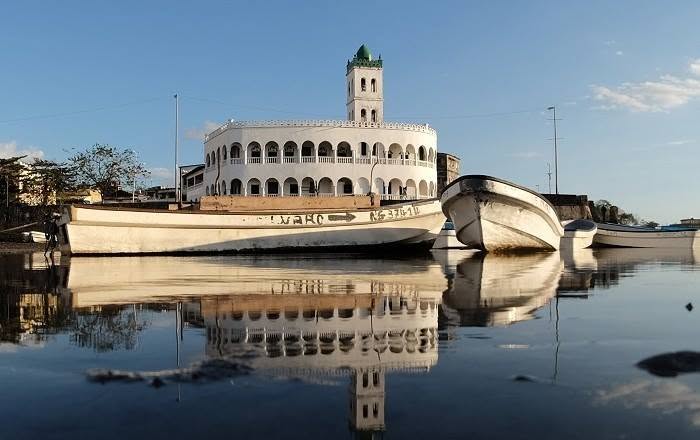
One of the least-visited capitals on earth, and it shows in the best way
Moroni sits on the western coast of Grande Comore, its coral-stone medina wrapped around a natural harbor where wooden dhows are still built by hand, the same way they have been for generations. Mount Karthala's slopes rise green behind the rooftops, and the Corniche waterfront road is where the whole city seems to gather once the heat breaks in the evening. There is no tourist quarter here, no strip of souvenir stalls, because there simply aren't enough visitors to support one.
That absence is the point. What Moroni offers instead is a functioning capital: the Badjanani Juma Mosque, standing since 1427, doubles as a working harbor landmark and an active place of worship, not a roped-off monument. The Volo Volo Market runs on the same commercial logic it always has, spices and fish and fabric rather than crafts made for export. Come with patience for irregular power, cash-only transactions and a city that isn't trying to sell itself to you, and it rewards that patience with something genuinely unmediated.
The honest complications
Moroni has very little formal tourist infrastructure: a handful of hotels, three restaurants worth seeking out by name, and no organized city tours in the way most capitals in this guide have. ATMs are limited even here, the capital, so arrive with euro or dollar cash. Power cuts happen. Healthcare is limited and a serious medical issue usually means evacuation to Nairobi or Antananarivo. None of this makes Moroni dangerous, but it does mean the city asks more self-sufficiency of a visitor than most African capitals.
A small, walkable core and one beach strip north of town
Moroni is compact enough that most of what matters fits into two zones: the old town around the harbor, and Itsandra's beach strip a short drive north. Where you base yourself is mostly a question of medina access versus beach access.
The Medina & Old Port
The old town is a maze of coral-stone buildings and narrow alleys built up over centuries, with the Badjanani Juma Mosque marking the harbor edge and the Old Port still active with hand-built wooden dhows. This is Moroni at its most distinctive: unrestored, still lived-in, and easily explored on foot in a morning.
Volo Volo & City Center
North of the old town, Volo Volo Market is Grande Comore's largest and busiest, and the surrounding streets are where daily Moroni life actually happens: government buildings, banks, and the everyday commerce a visitor doesn't see in the medina.
The Corniche
The coastal road connecting the old town to the newer parts of the city is Moroni's real public square: locals stroll it every evening once the heat breaks, and it holds most of the restaurants worth naming, including L'Escale and Le New Select, along with the Retaj Moroni Hotel, the most central of the city's proper hotels.
Itsandra
A short drive north of central Moroni, Itsandra combines a 14th-century medina of its own, the 18th-century Gereza fortress, the Beit-Salam palace that still serves as the president's official residence, and the beach hotel strip where most visitors who aren't staying downtown end up: the Golden Tulip Grande Comore Moroni Resort & Spa and Itsandra Beach Hotel & Resort both sit directly on the sand here, and Comores Plongée, one of only two dive operations in the entire country, runs its boats from this beach.
Three hotels, and each one is the obvious pick for a different traveler
Moroni's hotel scene is small by the standards of this guide, three properties cover nearly everyone, but each is a genuinely solid, well-reviewed option rather than a compromise.
On the Corniche in the city center, Retaj Moroni Hotel is the most polished business-style option within walking distance of the medina, run to the Qatari Retaj group's international service standards, with a pool, a kids' pool and playground, and private parking; the practical base if the old town is your priority.
North at Itsandra, Golden Tulip Grande Comore Moroni Resort & Spa is the most complete resort in the country: a large outdoor pool, direct beach access, and a restaurant serving African, French and Indian dishes with halal and dietary options, plus a sunset cocktail bar overlooking the water that's become a genuine local institution, not just a hotel amenity. Also on Itsandra Beach and only five minutes from central Moroni, Itsandra Beach Hotel & Resort has direct private-beach access, sea-view balconies, a pool and a family-friendly restaurant spanning African, French, Indian, Mediterranean and seafood menus, about 15 minutes from Prince Said Ibrahim International Airport.
Vanilla lobster, market fried fish, and three restaurants that earn a special trip
Moroni's food scene is small and mostly hotel-adjacent, but what's here is genuine rather than tourist-facing, since there are barely enough visitors to support a tourist-facing restaurant in the first place. The best cheap eating is at the market; the best sit-down meals are on the Corniche and at Itsandra.
L'Escale
One of Moroni's most consistently well-reviewed restaurants, praised for fresh food and friendly service in a simple, unpretentious setting. A reliable choice for straightforward Comorian and French-influenced cooking without a hotel markup.
Restaurant Grill Le Coraya
Right on the Indian Ocean next to Itsandra Beach, with some of the best restaurant views in the country and a menu running from grilled seafood and lobster to burgers, pizza and pasta, with halal options. Reviewers single out the lobster specifically; go for sunset and stay for dinner.
Le New Select
A French restaurant in the heart of Moroni serving classic bistro-style dishes alongside local ingredients, a steady, well-regarded choice for a sit-down dinner in the city center rather than out at the beach hotels.
Volo Volo Market
Grande Comore's biggest market is also its cheapest meal: small stalls in the heart of the market sell fried fish and plantains or rice with meat for a couple of euros, alongside stalls piled with vanilla, cloves and the colorful chiromani fabric worn by Comorian women. Go in the morning when it's busiest, bring cash, and treat lunch here as part of the sightseeing rather than a separate errand.
A city sized for two unhurried days, plus a volcano if you have a third
Moroni's sights are concentrated enough that a visitor without a car can cover the essentials on foot, with a taxi run out to Itsandra for the beach and diving. This chapter walks through the city roughly the way a good two or three days would.
The medina and the Old Port
Start at the Badjanani Juma Mosque, built in 1427 with a minaret added in 1921, standing directly at the edge of the old harbor; dress modestly if you go inside, and expect it to function as an active mosque rather than a sight with fixed visiting hours. From there, the medina's narrow coral-stone alleys reward slow, aimless walking more than a fixed route, past carved wooden doors and the old public bangwe squares where men once gathered to talk and play board games. Walk down to the Old Port itself to watch shipwrights build wooden dhows by hand using techniques passed down for generations, best in the morning when the yards are active.
Volo Volo Market
Grande Comore's largest market, just north of the city center, is a working market rather than a tourist attraction, and better for it: fresh fish, tropical fruit, vanilla, cloves and chiromani fabric fill a maze of narrow aisles. Visit in the morning when it's at its busiest, bring cash, and expect to be one of very few foreign faces there.
The Corniche at sunset
The waterfront road is where Moroni actually relaxes: families walking, the harbor's dhows silhouetted against the water, and the heat finally breaking. It costs nothing and needs no planning, just timing, arrive as the light starts to go gold.
Diving and snorkeling at Itsandra
Comores Plongée, based on Itsandra Beach and run by PADI/SDI/TDI instructor Nazir Farid since 2012, is one of only two dive operations in the entire country and the easiest way to get in the water around Moroni. Trips run to sites along the west coast with bottlenose dolphins, green turtles, and manta rays from April to November; groups run up to 10 people with two to three dives a day. Snorkelers can join the same boats for the shallower sites.
Itsandra's own medina and the Beit-Salam palace
Itsandra has a smaller-scale version of Moroni's old town: a 14th-century medina, the 18th-century Gereza fortress, and the Beit-Salam palace, which still functions as the sitting president's official residence rather than a museum, so expect to view it from outside rather than enter. Combine it with the beach and the dive center for a full day north of the city.
One, two or three days, base by base
Two full days covers Moroni properly; a third adds either a day trip or the first leg of the Karthala volcano trek.
- Morning
The medina and Badjanani mosque. Walk the old town's alleys, see the mosque from the harbor edge, and watch the dhow builders at the Old Port.
- Midday
Volo Volo Market. Fried fish or rice with meat from one of the market's small stalls, plus a look at the spice and fabric traders.
- Afternoon
Itsandra. Taxi north for the beach, a swim, and a look at the Beit-Salam palace and Gereza fortress from outside.
- Sunset
The Corniche or Le Coraya. A walk on the waterfront or dinner at Le Coraya with the ocean a few meters away.
- Day 1
The one-day route: medina, Badjanani mosque, Old Port, Volo Volo Market, Itsandra beach, sunset on the Corniche.
- Day 2
Diving and Iconi. Morning dive or snorkel trip with Comores Plongée, afternoon taxi to Iconi's Kapviridjeo palace ruins and black-lava cliffs, dinner at L'Escale or Le New Select back in the city center.
- Days 1-2
The two-day route above, at a gentler pace.
- Day 3, option A
Start the Karthala volcano trek. Arrange a guide in Moroni, drive to the Mitsoudjé trailhead, and begin the 6-8 hour ascent; this extends into an overnight trip rather than a single added day.
- Day 3, option B
Northern beaches. Chomoni and the Lac Salé crater lake, or Mitsamiouli and Maloudja beach, all reachable by shared taxi in 30-45 minutes.
Compact enough to walk, remote enough to need patience getting there
There are no direct flights to Moroni from North America, the UK or continental Europe; nearly every route connects through Nairobi (Kenya Airways), Addis Ababa (Ethiopian Airlines) or Antananarivo. Prince Said Ibrahim International Airport (HAH) is about 15 minutes from central Moroni and a similar distance from the Itsandra hotels; taxis meet arrivals, and agreeing the fare before getting in is standard practice since meters aren't used.
Within the city, the medina and Corniche are walkable. Getting to Itsandra, Iconi or the northern beaches means a taxi, a shared taxi-brousse minibus (€1-3 a ride, though international road-safety reviews flag them as overcrowded and risky), or a rental car (€40-70 a day, international license required). Driving yourself is workable in daylight around Moroni but not recommended after dark or on the rougher roads further out.
Best time to visit and practical prep
May to November is the dry season and the best window to visit, with August to October the coolest and driest. December to April is hot, humid and falls within cyclone season, which peaks from late December to mid-April and can disrupt both roads and the already-thin flight schedule.
Practical prep: ATMs exist in Moroni but are not abundant, so carry euro or US dollar cash as a backup even in the capital. An unlocked phone with a local SIM, bought in the city, or an eSIM arranged before landing, is worth having, since connectivity is patchy once you're out of the center. Power is 220V, plug types C and E.
Cheap on the street, pricier at the hotels
Moroni's cost of living splits sharply: market food and shared taxis are genuinely inexpensive, while hotel restaurants and rooms, dependent on imported goods and serving a small, mostly business and NGO clientele, run closer to regional East African city prices than to the country's poverty statistics.
- Guesthouse €20-30
- Market meals at Volo Volo €2-5
- Shared taxi-brousse rides
- Free medina walk and Corniche sunset
- Retaj Moroni or Itsandra Beach Hotel
- Restaurant meals €15-30
- Private taxi or rental car
- A dive or snorkel trip with Comores Plongée
- Golden Tulip Grande Comore Resort & Spa
- Seafood and lobster at Le Coraya
- Private driver throughout
- Guided Karthala volcano trek
Level 2 caution, mostly for theft and thin infrastructure, not violence
Moroni carries the same Level 2, "exercise increased caution," rating the US State Department applies to Comoros as a whole. Violent crime targeting visitors is uncommon. The real, specific risks are petty theft, particularly around Volo Volo Market and crowded areas, occasional political protests that are concentrated in Moroni itself and can turn confrontational, and healthcare that is limited even in the capital.
Practically: don't display cash or valuables in the market or the old town, avoid walking alone after dark, and steer clear of any demonstration or gathering regardless of its apparent mood. Comoros does not have a single standardized nationwide emergency number; save your hotel's front desk line and, if needed, France's embassy in Moroni (+269-773-06-15), the closest major foreign mission with a physical presence in the city. Comprehensive travel insurance that explicitly covers medical evacuation matters more here than in most capitals in this guide, since serious care usually means flying to Nairobi or Antananarivo.
Palace ruins nearby, a volcano if you have the time
Grande Comore's other highlights sit within a range from a short taxi ride to a full overnight trip. Three are realistic single-day outings from Moroni; the fourth, Karthala, needs its own overnight.
Iconi
A village just south of the capital and the seat of the last sultanate on Grande Comore: the ruins of Kapviridjeo Palace, where Sultan Tibe Mlanao and his wife once lived, sit above black-lava cliffs and beaches, with traditional Swahili architecture still visible in the village itself.
Chomoni & Lac Salé
A small white-sand beach on the east coast with black volcanic rock nearby, no entrance fee, and often paired with a stop at Lac Salé, a crater lake whose water level shifts with the tides through underground channels.
Mitsamiouli & Maloudja
The northern tip of Grande Comore, with the calmer Maloudja beach and the country's other beach-resort cluster. A shared taxi from Moroni's taxi-brousse station takes about half an hour.
Mount Karthala
One of the largest active volcanoes on earth, 2,361 meters with a caldera 3 by 4 kilometers, reachable via the Mitsoudjé trailhead under an hour from Moroni. The ascent itself is 6 to 8 hours each way through rainforest, cloud forest and bare volcanic rock, so this is realistically an overnight add-on with a local guide rather than a single day out from the city, best attempted in the May-November dry season.
Moroni FAQ
Is Moroni safe for tourists?
Moroni carries the same Level 2 caution rating as the rest of Comoros: petty theft in crowded areas like Volo Volo Market and occasional political protests are the main concerns, not violent crime against visitors. Normal city awareness and avoiding demonstrations covers most of it.
How many days do I need in Moroni?
Two full days covers the city itself: one for the medina, Badjanani mosque and the Old Port, one for Itsandra's beaches and a dive or snorkel trip. A third day fits Iconi's palace ruins or the start of a Karthala volcano trek.
How much does Moroni cost per day?
Budget travelers manage on roughly €35-55 a day with guesthouses and market food; a comfortable stay at a Corniche or Itsandra hotel with restaurant meals runs €90-180. Card acceptance is inconsistent, so carry cash.
When is the best time to visit Moroni?
May to November, the dry season, with August to October the coolest and driest. December to April is hot and humid and falls within cyclone season.
What is the best area to stay in Moroni?
The Corniche for walking distance to the medina and harbor. Itsandra, a short drive north, for beach hotels, the dive center and easier airport access, at the cost of needing transport into the old town.
How do I get from Moroni airport to the city?
Prince Said Ibrahim International Airport (HAH) is about 15 minutes from central Moroni and a similar distance from the Itsandra hotels. Taxis are the standard option; agree the fare before getting in, since meters are not standard.
Can I dive or snorkel in Moroni?
Yes. Comores Plongée, based on Itsandra Beach, runs PADI dives to sites with dolphins, manta rays (April-November) and green turtles, and is one of only two dive operators in the entire country.
Is Moroni walkable?
The old medina and Corniche are compact and walkable. Itsandra and Iconi require a taxi or car; there is no public transit network, and taxi-brousse minibuses cover main routes but are crowded.
Can I visit Mount Karthala from Moroni?
Yes, it's the standard base. The trailhead near Mitsoudjé is under an hour from the city, but the hike itself is a full 6-8 hour ascent, so most visitors treat it as an overnight trip with a guide rather than a single day out.
Do I need a visa to visit Moroni?
Most nationalities get a 45-day visa on arrival at Moroni's airport, paid in cash in euros or US dollars. There is no online e-visa system as of 2026.
What Stays With You
Moroni doesn't have the tourism infrastructure to stage anything for you, and that turns out to be exactly why it works. The mosque at the harbor edge has been standing since 1427 and is still where people actually pray. The dhows at the Old Port are still built to be used, not photographed. The Corniche fills with families every evening regardless of whether a single visitor is watching. None of it was arranged, which is why it holds up.
Go to the Corniche on your last evening, watch Karthala's silhouette darken behind the rooftops, and understand why so few people who make it here forget the trip.