
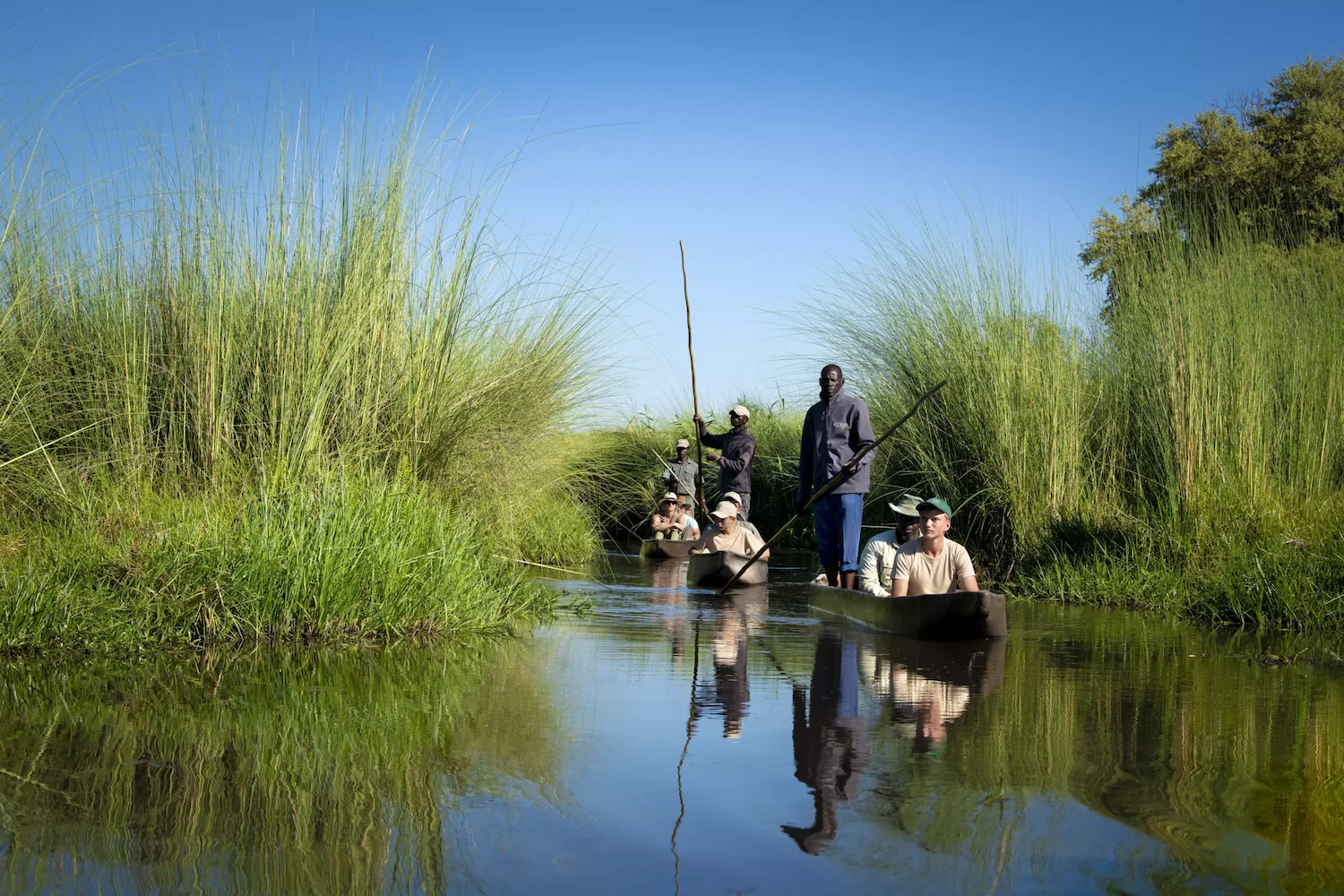
A working safari town, not a destination in itself
Maun grew up where the Thamalakane River meets the edge of the Okavango Delta, and everything about the town still points outward, toward the water, the sand tracks and the airstrip, rather than inward at itself. It has none of the polish of a purpose-built tourist town: shopping centres, filling stations and a scatter of hotels and lodges strung along the river, connected by roads that turn to sand within a few blocks of the centre. What Maun has instead is function, it is genuinely the only place most Delta and Moremi trips can realistically begin, whether that means boarding a light aircraft to a fly-in camp, picking up a rented 4x4, or walking down to a riverside launch point for a mokoro.
Most visitors give Maun itself no more than a day, using it to sort logistics, stock up on supplies for a self-drive trip, or simply overnight before or after a Delta stay. That's the right call for a first visit: the town's own attractions, a community museum, a couple of good restaurants and river sundowners, are worth an afternoon, not a week. The real reason to be here is everything Maun makes possible just beyond its edges.
The honest complications
Maun is not walkable in the way a compact old-town destination is; distances between the airport, the centre and the riverside lodge areas run several kilometres, and there's no reliable public transport, so budget for taxis, a rental car, or lodge shuttles. Card acceptance is fine at hotels and larger shops but thins out quickly elsewhere, so carry Pula in cash. And because nearly everyone here is either arriving for or departing from a safari, prices for anything tourism-adjacent, activities, transfers, rental gear, run noticeably higher than they would in a non-safari Botswanan town.
A town strung along the Thamalakane River
Maun spreads along the Thamalakane River rather than around a single centre, and where to base yourself depends mostly on whether you want to walk to shops and restaurants or wake up on the riverbank.
Central Maun & Riley's
The historic heart of Maun, built up around Cresta Riley's Hotel, the town's oldest, standing on this spot since the early 1900s. Shops, the Old Mall, banks and a handful of restaurants are all within walking distance, making this the most convenient base for anyone without their own vehicle.
Matlapaneng
A village-like stretch along the Thamalakane River northeast of the centre, Matlapaneng holds most of Maun's budget campsites and backpacker lodges, plus self-catering houses and local supermarkets. It trades walkable convenience for river frontage and lower prices.
Sedie
Sitting between central Maun and Matlapaneng, Sedie is where a good share of Maun's tour operators and safari booking offices are based, alongside a residential, comparatively peaceful atmosphere away from the town centre's bustle.
Airport Strip
A cluster of cheaper lodges close to Maun Airport, useful for travelers with an early light-aircraft transfer to a Delta camp who'd rather minimise the morning drive than save money on the room itself.
From riverside backpacker camps to the town's oldest hotel
Maun's accommodation splits cleanly by budget and location: central hotels for convenience, riverside lodges for atmosphere, and a genuine backpacker scene on the Thamalakane that keeps a Delta trip affordable even when the safari itself isn't cheap.
In the town centre, Cresta Riley's Hotel is Maun's original hotel, a landmark since the early 1900s, walking distance to the Old Mall's shops and restaurants, with buffet breakfast and dinner and rooms typically running from around $75 to $150 a night depending on season. On the Thamalakane River about 10km from the airport, Island Safari Lodge sits on a 300-acre private island reserve with its own walking trails, a genuinely different pace from anything in town. Thamalakane River Lodge, also on the river, leans into a slower, wellness-oriented stay with river views from most rooms.
At the budget end, Old Bridge Backpackers, right on the Thamalakane's bank, is Maun's best-known backpacker base: dome tents and camping from roughly $5-8 a person a night, simple en-suite chalets for a bit more, a communal kitchen, small pool, and a riverside bar and restaurant that's a genuine social hub for independent travelers passing through. Discovery Bed and Breakfast is a smaller, family-run guesthouse with an African-inspired style, a good option for travelers wanting a proper room without hotel prices, and Maun Executive Inn is a small guesthouse on Sedia Road near the Matlapana Bridge, with breakfast included.
A small but genuine restaurant scene for a safari town
Maun isn't a food destination, most visitors eat where their lodge or camp puts them, but the town centre has enough of a scene to make a night or two in Maun itself worthwhile, from steakhouse pub food to a quiet garden breakfast spot.
Bull and Bush Pub
Widely considered the best expat pub in town, Bull and Bush shares its site with the working Okavango Craft Brewery and pours its beers on tap alongside hot steaks and a lively, sociable atmosphere that peaks on quiz nights. It's the closest thing Maun has to a proper night out.
Hilary's Coffee Shop
A small coffee shop in the town centre, a vegetarian haven with home-made bread, soups, salads and bean specialties. Listings give differing opening hours, so check before you go.
Nando's
The familiar Afro-Portuguese peri-peri chicken chain has a branch right in Maun's town centre, a reliable, fast option between errands or before an early departure.
A town best used as a launch point, with a couple of real stops
Maun's in-town attractions are modest by design, the point of being here is what the town leads to, but a handful of stops are genuinely worth the time before you head out to the Delta.
Nhabe Museum
Housed in a 1939 building originally built by the British military as a WWII surveillance post watching the German presence in neighbouring Namibia, Nhabe Museum, also known as Maun Museum, outlines the culture and natural history of the Okavango Delta region through historical crafts, Bayei fishing nets, basket-weaving, photography and rotating art exhibitions. Listings give differing opening hours (Monday to Friday or Monday to Saturday), so check before you go.
A short mokoro trip on the Thamalakane
Before or instead of a full Delta excursion, several operators run shorter mokoro outings directly from launch points near Matlapaneng and Sedie, a good introduction to the flat-bottomed dugout canoe experience without committing a full day.
Thamalakane River sundowners
Riverside lodges and the Old Bridge Backpackers bar both make the most of Maun's one real scenic asset, the river itself, with sundowner drinks as the sun drops over the water a low-key, genuinely pleasant way to close out a day in town.
Maun Old Mall & craft shopping
Walking distance from Cresta Riley's, the Old Mall has the town's main concentration of shops, useful for last-minute safari supplies, and a scattering of curio and craft stalls selling basketry and beadwork from the wider Ngamiland region.
One day in town, then out to the Delta
A single day covers Maun itself comfortably. What follows depends entirely on how many days you've budgeted for the Okavango Delta and Moremi beyond it.
- Morning
Nhabe Museum, then a coffee and a light bite at Hilary's in the town centre.
- Midday
Old Mall shopping for any last supplies before heading out to the Delta or Moremi.
- Afternoon
A short mokoro outing from a launch point near Matlapaneng or Sedie, if you're not doing a longer Delta trip.
- Evening
Sundowners on the Thamalakane, then dinner at Bull and Bush Pub in town.
- Day 1
The one-day route above: Nhabe Museum, the Old Mall, and sundowners on the river.
- Day 2
Okavango Delta mokoro day trip. A one to two hour road transfer to the Delta's edge, then a half or full day by dugout canoe through the delta's channels.
- Day 1
The one-day Maun route, at a relaxed pace before heading out.
- Days 2-3
Moremi Game Reserve. Self-drive or a guided safari into the reserve, roughly 2 hours to South Gate, for genuine multi-day game viewing.
- Day 4+
Extend into the Delta proper with a fly-in camp stay, or head further to the Central Kalahari or Makgadikgadi Pans depending on season and interest.
Fly in, then a shuttle, a taxi, or your own 4x4
Maun Airport (MUB) is Botswana's real safari gateway, with connections from Johannesburg and onward light-aircraft links to Delta camps. The airport sits only a few kilometres from central Maun and most riverside lodges, so transfers are short; a hotel shuttle or pre-arranged transfer is the standard way in, and taxis are available but should have their fare agreed before you get in, since meters aren't really a thing here.
Within town, distances are workable by taxi or a short rental-car hop, but there's no real public transport network, so budget for transfers between the centre, Matlapaneng and Sedie rather than expecting to walk. For anywhere beyond Maun itself, Moremi, the Delta, or further afield, a rented 4x4 or a guided tour is essential; ordinary sedans can't handle the sand tracks and seasonal river crossings.
Best time to visit and practical prep
Maun follows Botswana's dry-season pattern: June to August is coolest, clearest and lowest-malaria, with the Delta's flood typically at its highest given rain that fell in Angola months earlier. April, May, September and October are strong shoulder months with fewer crowds. November through March brings the rains, newborn wildlife and higher malaria risk.
Practical prep: pick up a local SIM (Mascom or Orange) in town, carry Pula in cash since card acceptance thins out fast beyond hotels and the Old Mall, and if you're self-driving, book and pay for your Moremi campsite through the private operator that runs it (for example Kwalate Safaris at South Gate) well ahead of arrival, then pay park fees to the Department of Wildlife and National Parks, since walk-up camping inside the reserve isn't reliable.
Cheap in town, expensive the moment you head into the Delta
Maun town itself is affordable by regional standards, backpacker lodges, self-catering and local restaurants keep daily costs modest, but the safaris that bring people here in the first place are priced at the high end of what African travel costs anywhere. Plan the two parts of the trip, town and safari, as separate budgets.
- Old Bridge Backpackers camping or dorm
- Self-catering, local restaurant meals
- Short mokoro outing near town
- Nhabe Museum, Old Mall browsing
- Cresta Riley's or Island Safari Lodge
- Restaurant meals at Bull and Bush
- Guided half-day mokoro or cultural trip
- 4x4 rental if self-driving onward
- $80-150 self-drive camping, Moremi
- $300-650 classic lodge, all-inclusive
- $800+ fly-in luxury Delta camps
- See our Botswana country guide for the full breakdown
Ordinary town caution, plus real wildlife awareness
Maun sits comfortably within Botswana's generally safe, Level 2 security picture. The practical concerns are the ordinary ones of any small regional town, opportunistic theft and vehicle break-ins, rather than anything organized or targeting tourists specifically, plus a genuinely different category of risk once you're near the river or heading into the bush: wildlife.
The things that actually catch visitors out: vehicle break-ins at unattended parking, so don't leave valuables visible in a rental car, even briefly; walking near the riverbank after dark, since hippos and crocodiles use the Thamalakane and its banks at night, a real hazard rather than a theoretical one, so stick to lit, populated paths after sunset; and underestimating self-drive logistics, since a stuck or stranded vehicle on a remote sand track is a genuine emergency given how far apart help can be. Emergency numbers are 999 for police, 998 for fire and 997 for ambulance, though response outside the town centre is limited, one more reason a reputable operator matters for anything beyond Maun itself.
The Delta and Moremi, both realistically reachable from town
Maun's entire reason for existing is what's within reach of it, and two destinations in particular work well as trips out of the town rather than requiring you to relocate entirely.
Okavango Delta (NG32 area)
The accessible edges of the Delta can be visited as a genuine day trip: a road transfer of one to two hours to the NG32 concession area, followed by a mokoro excursion through reed-lined channels, with June to August, when water levels run highest, the best window. Reaching Chief's Island and the Delta's deeper interior generally requires a multi-night fly-in camp rather than a day trip.
Moremi Game Reserve
A long but doable day safari: guided trips typically depart Maun around 5am and return after dark to make the most of the drive, or self-drivers with a 4x4 can head in independently. Either way, Moremi's mix of permanent water, islands and woodland delivers some of the most reliable game viewing anywhere in Botswana.
Makgadikgadi & Nxai Pan
Further out and better suited to an overnight than a rushed day trip, the Makgadikgadi salt pans and neighbouring Nxai Pan National Park offer a completely different landscape from the Delta, a seasonal zebra and wildebeest migration, and Baines' Baobabs, a stand of ancient trees first painted in 1862.
Central Kalahari Game Reserve
Genuinely too far for a day trip from Maun, but reachable as a multi-day extension via Rakops or Ghanzi, the CKGR pairs vast wilderness game viewing with guided walks led by San trackers, one of the more meaningful cultural experiences available anywhere in the region when arranged through a reputable operator.
Maun FAQ
Is Maun safe for tourists?
Yes, with normal precautions. Maun sits well within Botswana's generally safe Level 2 security picture; the main concerns are ordinary opportunistic theft and vehicle break-ins rather than anything targeting tourists specifically. Keep valuables out of sight, use reputable operators for delta and safari trips, and take standard nighttime caution in town.
How many days do I need in Maun?
Maun town itself needs only a day, most visitors use it purely as a base. Budget at least 3 to 4 days total for a worthwhile Okavango Delta and Moremi Game Reserve trip departing from Maun, more if you're adding the Central Kalahari or Makgadikgadi Pans.
How much does Maun cost per day?
In town, budget travellers manage on $30-60 a day with a backpacker lodge and self-catering; a mid-range hotel runs $75-150 a night. Once you factor in the Delta itself, self-drive camping safaris run $80-150 a day while guided lodge stays start around $300 and climb steeply from there.
When is the best time to visit Maun?
June to August, Botswana's dry season peak, when the Okavango Delta's flood is typically highest, temperatures are cool and clear, and malaria risk is lowest. May, September and October are strong shoulder months with fewer crowds and lower rates.
Do I need a visa to visit Maun?
Most nationalities, including the US, UK, EU, Canada and Australia, can enter Botswana visa-free for up to 90 days. See our Botswana country guide for the full visa picture and requirements for other nationalities.
How do I get from Maun Airport to town?
Maun Airport (MUB) sits only a few kilometres from central Maun and most riverside lodges. A hotel shuttle or pre-arranged transfer is standard; taxis are available but agree the fare before you get in, since metered taxis are essentially nonexistent.
What is the best area to stay in Maun?
Central Maun near Riley's for walkable access to shops, restaurants and the Old Mall. Matlapaneng or Sedie, both along the Thamalakane River a short drive from the centre, for riverside lodges and easier access to mokoro launch points and tour operators.
Can I do the Okavango Delta as a day trip from Maun?
Yes, for the accessible edges of the Delta. A typical day trip includes a road transfer of one to two hours followed by a mokoro canoe excursion through the delta's channels; June to August, when water levels are highest, is the best window. Deeper into the Delta and Chief's Island generally requires a multi-night fly-in camp stay instead.
Is Moremi Game Reserve easy to visit from Maun?
Yes. Moremi's South Gate is about 100km, roughly 2 hours by road, from Maun, reachable by self-drive 4x4 or a guided day safari that typically departs before dawn and returns after dark to maximise game-viewing time.
What Stays With You
Maun doesn't ask to be liked for itself, and it's honest about that in a way a lot of gateway towns aren't. Its dusty streets and sand-track roads exist because everyone here, the pilots, the guides, the lodge staff, the 4x4 rental agents, is oriented toward the same thing: getting you out to somewhere genuinely extraordinary, whether that's a mokoro gliding silently through Delta reeds or a Moremi game drive at first light. Nhabe Museum's collection of Bayei fishing nets and Delta photography is a fitting first stop precisely because it explains, in a single small building, why the water beyond town matters as much as it does.
Spend your day in Maun well, then get out to the Delta or Moremi with time properly budgeted for it. What's left, once the logistics are sorted, is the reason people fly a very long way to stand in a river town at the edge of the Kalahari.