
A frontier town that happens to sit beside the world's biggest salt flat
Uyuni was founded in 1890 as a trading post and grew because of the railway: British engineers built the lines between 1888 and 1892 for the mining companies, and the town became a junction for routes towards La Paz, Potosí, Calama in Chile and the Argentine border. It had 29,672 inhabitants at the 2012 census, and it sits at about 3,700 metres on the edge of the Salar de Uyuni, 10,582 square kilometres of salt at roughly 3,650 metres, the largest salt flat on Earth.
The numbers show why it matters to Bolivia. Official INE figures count 1,145,165 foreign visitors in 2025, and the Correo del Sur report of 10 August 2026 on those figures names the Salar de Uyuni as the country's leading tourist site. Almost every visitor arrives in Uyuni town, books a 4x4 tour, and leaves within a day or three. That makes the town functional rather than charming: tour agencies, pizza places, hostels, and a cold wind off the plain. The reward is what lies beyond it.
The honest complications
Bolivia is in a difficult year. The government declared a nationwide state of exception on 20 June 2026 to deal with road blockades and protests, and the Assembly extended it in September until around mid-December. The country also ended its long-standing dollar peg in late June 2026 and moved to a flexible exchange rate. Flights have kept running, but overland journeys can be disrupted with little warning, so keep a buffer day before any international departure and ask your operator and hotel about the current road situation.
The other honest complications are physical. Uyuni is high, cold and dry, tours climb above 4,800 metres, and unregulated operators are a real problem: published advice warns of drunk-driving incidents, unregistered operators and bait-and-switch changes to the itinerary or vehicle after payment, and Wikipedia notes that tour-related accidents on the salt flat have caused more than 30 deaths. Choosing the operator is the most important decision of your trip.
Four places that make up a visit
Uyuni town is small and you will spend most of your time in the tour agencies, a hotel and a restaurant. The sights are on the edge of town or out on the salt, and almost all are reached by 4x4 tour.
Uyuni town
A grid of low buildings, with the tour agencies, hostels and restaurants clustered near the centre. Joya Andina Airport is close to town, and the Tonito Hotel's listing notes a central location near the airport. Expect cold nights all year, wind, and a town that wakes up early because tours depart in the morning.
Train cemetery
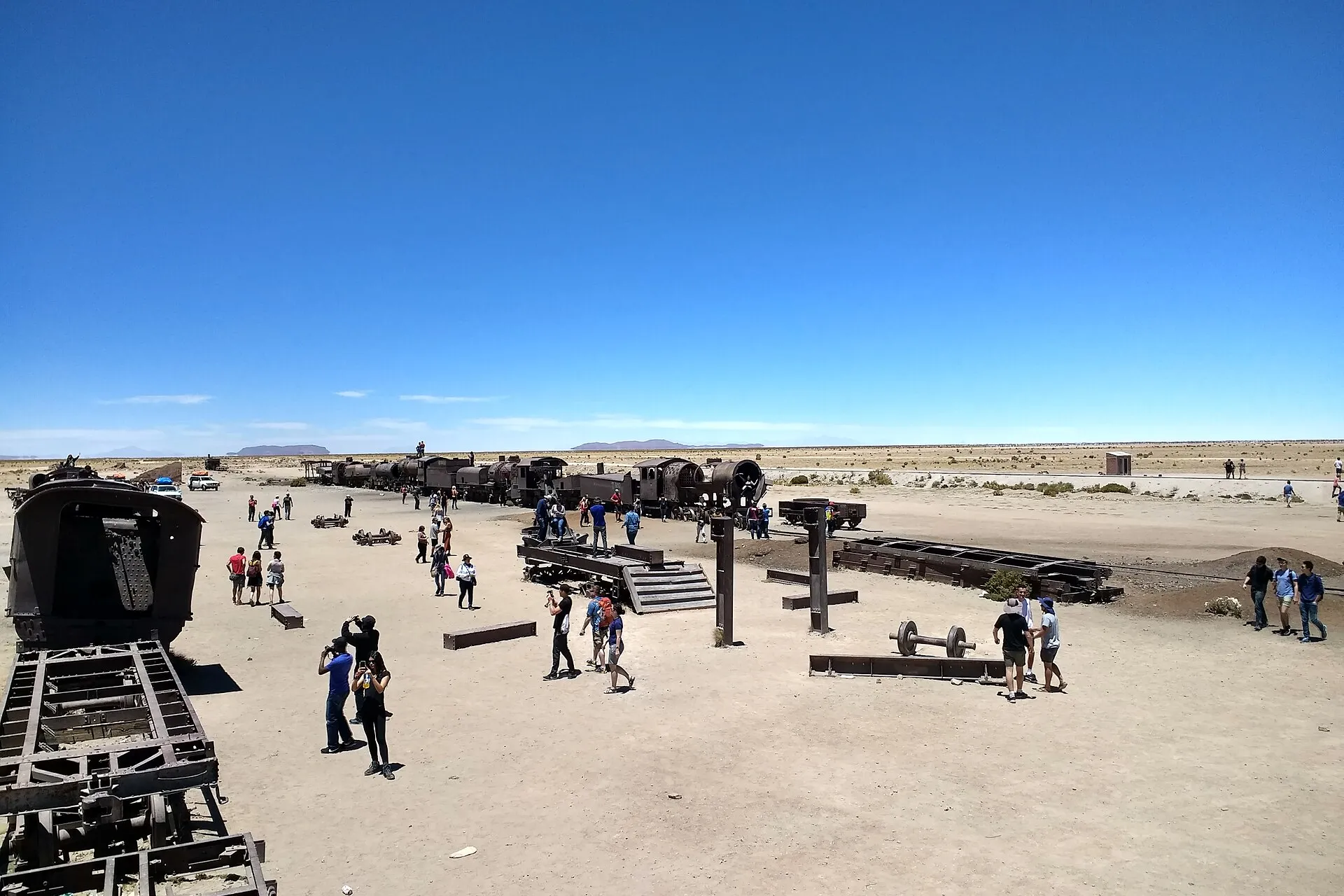
The Cementerio de Trenes lies about 3 km outside Uyuni, reached along the old railway tracks. The locomotives were left behind when the mining industry collapsed in the 1940s, and the salt wind has corroded the steel. One visitor listing reports no gate or fence and free access at any time, while tours usually stop here at the start of the trip. It is the easiest sight in Uyuni.
Colchani
Colchani is the village at the entrance to the salt desert, where you can see artisanal salt extraction by the Colchani cooperative of salt workers. Tours normally stop here for souvenirs and to watch the salt being gathered and processed before driving onto the flat.
Isla Incahuasi
A rocky island in the middle of the salt flat covered in giant cacti and home to colonies of viscachas. It is one of the standard stops on both the 1-day and 3-day routes. At least one operator's published itinerary lists it among the highlights of day one, together with the Salt Hotel and the sunset over the flat.
Town hotels, salt hotels and basic lodges on the route
Uyuni's accommodation is built around tour departures. Early breakfasts, luggage storage and a warm room matter more here than a view, and many small hotels do not take cards.
In town, Tonito Hotel is the best-documented option: listings describe it as central and near the airport, with breakfast served from 5 am, which suits early tour departures, and reviewers praise the staff while noting that room comfort is the weaker point. On the salt itself, the first salt hotel, Palacio de Sal, was built from salt blocks in 1993-1995 and dismantled in 2002 because of sanitation problems; a newer salt hotel opened around 2007 on the eastern edge of the flat, roughly 25 km from Uyuni. One listing describes Hotel de Sal Luna Salada as built almost entirely of salt blocks, with rooms overlooking the salar. The 3-day route uses simple hostels and a remote desert lodge, so pack a warm sleeping layer.
Pizza, set lunches and a lot of coca tea
Uyuni is a tour town, so food is simple and reliable rather than adventurous. Meals on multi-day tours are normally included in the price, so you eat in town mainly before and after.
Minuteman Pizza
The on-site restaurant of the Tonito Hotel is the best-known pizza place in Uyuni, with reviewers praising it for both dinner and breakfast. Listings also name Sal Negra and Hotaru among the restaurants nearby.
Altitude and drinking
Coca tea is widely available and the standard local remedy for altitude. Drink plenty of water, avoid alcohol on arrival, and carry extra water and snacks on tours in case of a breakdown, as published advice recommends.
The salt flat, in one day or three
Almost everything worth doing is a tour: a 1-day trip onto the salar, or the 3-day route that continues south into the Eduardo Avaroa reserve. Both start from Uyuni.
The salt flat and the mirror effect
In the dry season the surface is a hard white crust of salt hexagons, ideal for forced-perspective photographs. In the rainy season, roughly December to April, a thin layer of water turns the flat into a huge mirror reflecting the sky. January is Uyuni's wettest month, averaging 79.3 mm in the climate table, and the town's annual precipitation is 190.9 mm in total. The mirror brings the famous photographs and also the risk of cancelled tours and disrupted flights, and published advice notes that the December to March rainy season can affect flight schedules. Each November the salar is also a breeding ground for Chilean, Andean and James's flamingos.
The 3-day Lagunas route
One UK-based operator's published itinerary (Bolivian Mountains) is typical of the classic route. Day one: the train cemetery, Colchani, the salt flat with the Salt Hotel and Isla Incahuasi, sunset and an overnight in San Juan. Day two: enter the Eduardo Avaroa reserve, see the Stone Tree in the Siloli Desert, Laguna Colorada with its flamingos, the volcanic landscape and geysers at Sol de Mañana, and the Polques hot springs, with an overnight at a remote desert lodge. Day three: an early start through the Dali Desert to Laguna Verde at the foot of Licancabur volcano, then back to Uyuni. Sol de Mañana and Laguna Colorada lie above 4,800 metres.
Choosing an operator
Book in advance, either online or in La Paz, and favour operators that publish driver names and have many recent reviews. Be wary of the cheapest agency that approaches you near the bus terminal. Ask what is included, in particular whether the park entrance fees are, how many passengers share a vehicle (the operator above lists a maximum of six), and what happens to the itinerary if roads or weather change. The La Paz guide covers booking from the capital, and the Bolivia scam guide has a section on tour operator risks.
One, two or three days around Uyuni
The routes below follow the usual tour structure. Exact stops, order and prices vary by operator, so confirm yours before paying.
- Morning
Train cemetery and Colchani. The locomotives on the edge of town, then the salt village at the entrance to the salar.
- Midday
Onto the salt. The flat itself, a salt hotel stop and Isla Incahuasi with its giant cacti.
- Evening
Sunset over the flat, then back to town for pizza and an early night.
- Day 1
The one-day route described in the first tab.
- Day 2
A buffer day. Rain or road disruption can change plans, so keep time in hand before a flight or bus out.
- Day 1
Salar de Uyuni. Train cemetery, Colchani, the salt flat, Isla Incahuasi, sunset, overnight in San Juan.
- Day 2
Lagunas and Eduardo Avaroa. Siloli Desert and the Stone Tree, Laguna Colorada, Sol de Mañana geysers and the Polques hot springs, overnight at a desert lodge.
- Day 3
Laguna Verde and back. An early start through the Dali Desert, Laguna Verde under Licancabur, then the drive back to Uyuni.
By air, bus or rail from La Paz
Most visitors come from the capital. Read the La Paz city guide first if you are starting there, because it covers altitude acclimatisation and booking tours before you travel.
By air. Flight listings show BoA and EcoJet both serving La Paz (El Alto) to Uyuni, a flight of about an hour. One published guide lists BoA fares of roughly $125-130 one way and warns that schedules can shift in the rainy season. No official 2026 timetable was available to check, so confirm routes and times with the airlines before planning around them. Given the 2026 blockade situation, flying is the more reliable option if you have a fixed departure date.
By bus. Overnight buses connect La Paz and Uyuni. One published guide lists Todo Turismo fares from around $43 one way for semi-cama or cama seats, and describes cheaper companies as having mixed safety records. Buses that arrive from La Paz between 6 and 7 am are described as a known theft hotspot near the terminal, so keep bags zipped and in front of you. During blockades, buses can be delayed or stopped.
By rail. Uyuni is a railway junction, with lines towards Oruro, Potosí, Calama and Villazon. Passenger services have changed: older sources describe the Expreso del Sur and Wara Wara del Sur, while a March 2024 report describes a weekly Ferrobus between Tupiza, Uyuni and Oruro. Check the current timetable with Ferroviaria Andina before you plan around the train.
Best time to visit and what to pack
The dry season, roughly May to September, brings the white crust and the most reliable roads. The rainy season, roughly December to April, can bring the mirror effect, with January and February the usual peak, at the cost of cancelled tours and muddy roads. Nights are cold all year: published advice says temperatures on the 3-day route regularly drop to -10°C and winter lows can reach -20°C, and the town's record low is -25.7°C.
Practical prep: mobile data is unreliable outside town, so download offline maps, and an eSIM before landing helps in Uyuni itself. Bring sun protection, warm layers, extra water and snacks, and enough bolivianos for several days.
Sourced prices, not averages
Prices in Bolivia are moving. The government ended the dollar peg of 6.96 bolivianos in late June 2026, and a Rio Times report of 2 September put the official rate at 12.26 per dollar, so treat any dollar price as a snapshot and ask for the boliviano price. The figures below are the ones that could be sourced; no daily budget is estimated.
- One UK operator's price for groups of 5+
- Includes all entrance fees and meals
- Max 6 passengers per 4x4
- Not included: breakfast day one, dinner day three
- Eduardo Avaroa reserve, per operator listings
- Isla Incahuasi 30 Bs per person
- Polques hot springs 6 Bs per person
- Toilets and showers about 20 Bs
- Todo Turismo bus, one way, from about $43
- BoA flight roughly $125-130 one way
- Cheaper bus companies cost about $15-26
- Fares vary by season and rate
A Level 2 country with a few specific risks
The US State Department rates Bolivia Level 2, Exercise Increased Caution (advisory issued 18 August 2026), for crime, unrest and health, with Level 4, Do Not Travel, only for Chapare Province, which is nowhere near Uyuni. In Uyuni, violent crime is not the main concern: the real risks are altitude, operator quality, cold, and travel disruption.
The nationwide state of exception, declared on 20 June 2026 and extended in September, restricts blockades and movement on strategic infrastructure, and reporting links the blockades to deaths and heavy economic losses. Check local news before long road journeys. Emergency numbers are 110 for police and 119 for fire; verify the ambulance number locally, because published sources disagree. Medical help can be hours away on the multi-day route, so choose operators with a satellite phone or emergency equipment, and read the Bolivia scam and safety guide before you book. For altitude: spend at least two nights acclimatising, and descend immediately if symptoms become severe.
Where to go after Uyuni
Uyuni connects to the rest of southwest Bolivia and to Chile. These are the natural next steps.
San Pedro de Atacama
Some 3-day tours finish at the Chilean border and continue to San Pedro de Atacama instead of returning to Uyuni. Operators list this as a separate itinerary, so decide when you book.
Potosí and Sucre
Potosí is on the railway lines that meet at Uyuni, and the country guide describes it with Sucre as the colonial-silver part of a classic Bolivian circuit.
La Paz
Most visitors return to La Paz by air or bus after the tour. See the La Paz city guide for the next leg.
Uyuni FAQ
Is Uyuni safe for tourists?
The US State Department rates Bolivia Level 2, Exercise Increased Caution (advisory issued 18 August 2026), with Level 4 Do Not Travel only for Chapare Province, far from Uyuni. In Uyuni the practical risks are altitude sickness, unregulated 4x4 tour operators and theft around the bus terminal on early-morning arrivals, not violent crime. Police are on 110.
How many days do I need in Uyuni?
One day covers the town, the train cemetery and a 1-day salt flat tour. The 3-day route through the Siloli Desert and the coloured lagoons is the classic trip, so plan for three days if you can, plus a buffer day if you have a flight out.
When is the best time to visit the Salar de Uyuni?
It depends on what you want. The dry season, roughly May to September, gives the white salt crust and the most reliable roads. The rainy season, roughly December to April, can turn the salt flat into a mirror, with January and February the usual peak, but rain can disrupt tours and flights.
How do I get from La Paz to Uyuni?
By air, BoA and EcoJet are reported to fly La Paz (El Alto) to Uyuni in about an hour, or by overnight bus. Schedules change, so confirm with the airline or bus company. Trains also serve Uyuni, but check the current timetable with Ferroviaria Andina.
Is the train cemetery worth visiting?
Yes, and it is the easiest sight in town: about 3 km outside Uyuni, a field of rusting steam locomotives left after the mining industry collapsed in the 1940s. Most tours stop here at the start of day one.
What is the 3-day Uyuni tour?
A 4x4 route that crosses the salt flat, then continues into the Eduardo Avaroa reserve: Laguna Colorada, geysers at Sol de Mañana, hot springs, Laguna Verde, and back to Uyuni. Overnights are in basic lodges and nights are very cold. Check whether park fees are included in the price.
Do I need cash in Uyuni?
Yes. Uyuni has only a few ATMs and they can run out of cash or refuse foreign cards, and many small hotels and restaurants do not take cards. Bring bolivianos from La Paz before you go.
How bad is the altitude in Uyuni?
Uyuni sits at about 3,700 m and the 3-day tour climbs above 4,800 m. Spend at least two nights in La Paz or another high town first, drink plenty of water, avoid alcohol on arrival, and descend if symptoms become severe.
Is Bolivia's current unrest a problem for visiting Uyuni?
Bolivia has been under a nationwide state of exception since 20 June 2026, extended to mid-December, to deal with road blockades and protests. Flights have continued but overland routes can be disrupted without warning, so check local news and keep a buffer day before any international departure.
What Stays With You
Uyuni the town is a stopover, and the Salar is the reason you came. Nothing prepares you for the scale: a horizon with nothing on it, a salt crust cracked into hexagons, a line of rusting locomotives in the wind. It is cold, high and logistically fiddly, and it is also one of the few places where the photographs do not exaggerate.
Plan the logistics carefully, choose your operator well, and then stand on the salt and look at nothing for a while.