
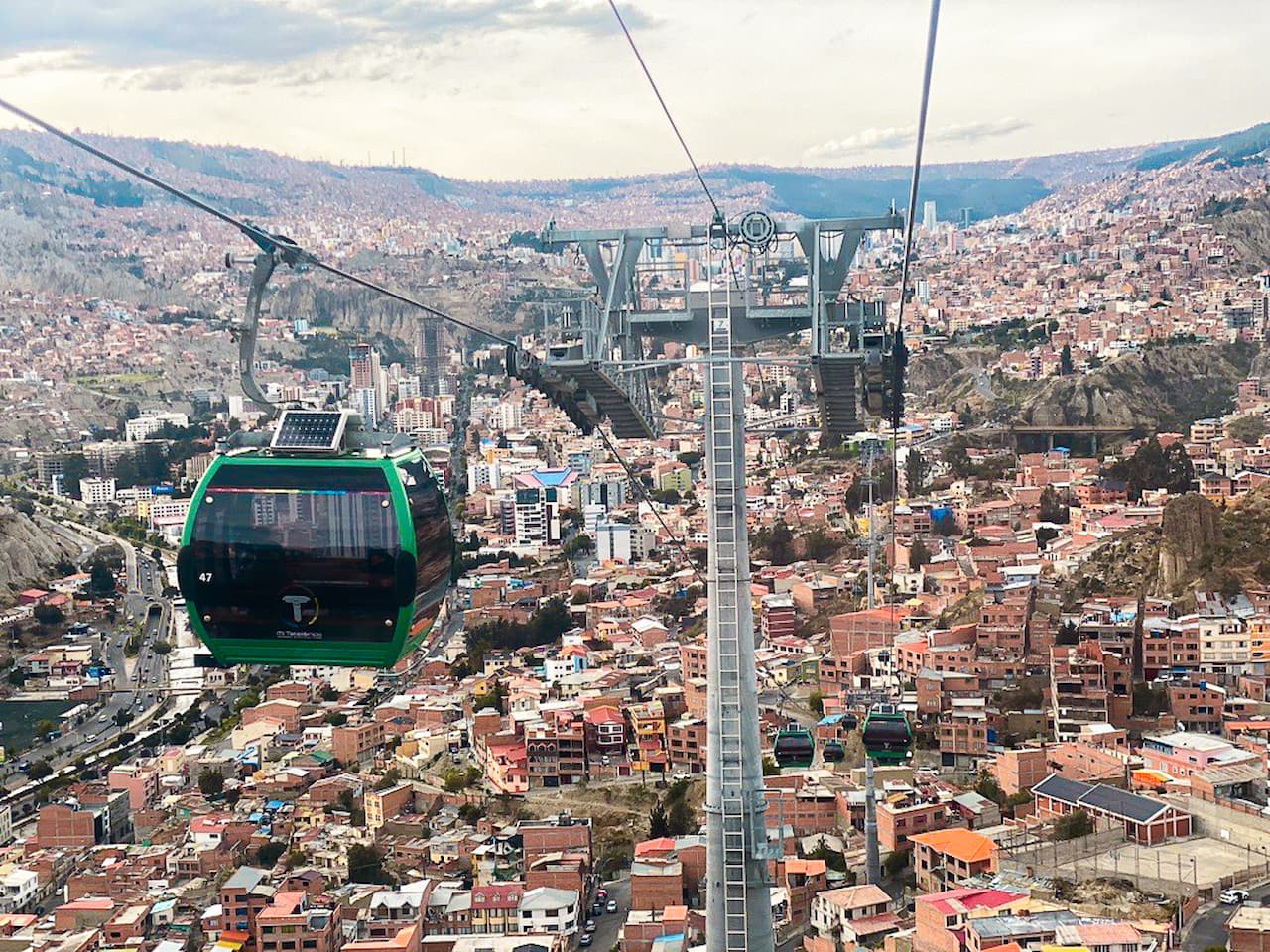
The highest seat of government on Earth doesn't do easy
La Paz sits inside a canyon carved into the Bolivian altiplano, the city spilling down the slopes from El Alto's rim at 4,150 meters to the slightly gentler Zona Sur at the canyon floor. Every direction you look, red-brick houses climb impossibly steep hillsides, and above them the snow-capped peak of Illimani watches over the whole scene. It is chaotic, unplanned-looking and completely unlike any other capital in South America, precisely because it never had the flat land to be anything else.
The altitude is the first thing every visitor has to negotiate, and it is not a minor detail: most first-time arrivals feel it within hours, whether that's a mild headache or genuine breathlessness climbing a single flight of stairs. Once your body adjusts, usually within a day or two, La Paz opens up as one of the most rewarding, least sanitized cities on the continent: a working Aymara market economy, cable cars used by commuters rather than tourists, and a food scene built on saltenas and market counters rather than fine dining.
The honest complications
Bolivia's 2026 fuel and currency crisis is felt directly in La Paz: occasional fuel queues, a currency situation that means the exchange rate you get can vary by where you change money, and the possibility of a road blockade disrupting a day trip or a bus connection with little warning. None of this has closed the city to tourism, but it means building slack into your plans matters more here than in most capitals. The other complication is one the city can't fix: at this altitude, even fit travelers get tired faster, sleep worse for the first night or two, and should genuinely expect the first day to be slower than planned.
A city measured in altitude, not blocks
La Paz's neighbourhoods are defined by how far down the canyon they sit. As a rule, the lower you go, the warmer, calmer and more upscale the city becomes.
Centro / Casco Viejo
The historic center around Plaza Murillo and the Prado is where most budget travellers land: cheap hostels, the main bus terminal within reach, and the classic sights (the Witches' Market, San Francisco Church, the narrow colonial streets of Calle Jaen) all walkable. It's also the busiest, noisiest part of the city, and the one where the fake-police scam and pickpocketing are most reported, so keep valuables secured and be alert around crowded market streets.
Sopocachi
South of the center and noticeably calmer, Sopocachi is where much of La Paz's best eating and drinking happens, with the Mi Teleferico's Sopocachi station putting the rest of the city within easy reach. For a first visit, this is the neighbourhood that balances atmosphere, safety and convenience best.
Zona Sur
Down at the canyon floor, Zona Sur sits roughly 500 meters lower than the center, which makes a real difference to how you feel after a long day, and has become La Paz's most modern, affluent district: embassies, the city's best restaurants and design-forward hotels, and a noticeably different pace. Best reached by cable car or taxi from the center.
El Alto
Technically its own city, El Alto sprawls across the rim above La Paz at 4,150 meters and is home to the airport, the enormous twice-weekly Feria 16 de Julio street market, and cholita wrestling on Sunday afternoons. It's a working, largely Aymara city rather than a tourist district, best visited on a guided excursion or the cable car rather than wandered alone after dark.
From design hotels in Zona Sur to the best hostel scene in the Andes
La Paz's accommodation splits cleanly by altitude and budget: design-forward hotels down in Zona Sur, character-driven mid-range stays in Sopocachi, and a strong backpacker hostel scene in and around the historic center built around the Uyuni and Death Road tour crowd.
At the top of the market, Atix Hotel in Zona Sur's Calacoto district is La Paz's most striking piece of hotel architecture: a parallelogram of native wood and Comanche stone with 53 rooms, a rooftop pool and mountain views, from around $150 a night. Directly across the street, Hotel Casa Grande is a well-regarded, slightly more traditional alternative in the same safe, embassy-lined pocket of Zona Sur.
In Sopocachi, Stannum Boutique Hotel & Spa is one of the very few 5-star properties in the central city, with a fitness centre and a genuinely good on-site restaurant, a short walk from the neighbourhood's best independent eating.
At the budget end, two hostels built the city's backpacker reputation: Adventure Brew Hostel, five minutes from the bus terminal with its own in-house craft brewery and a rooftop terrace with city views, and Wild Rover La Paz, home to the highest Irish bar in the world at 3,600 meters and the more social, party-oriented option of the two. Both run tour desks that can book Uyuni and Death Road trips directly.
Saltenas, market counters, and one serious tasting menu
La Paz's food scene runs on two tracks: an extraordinary everyday market and street-food culture, and a small but genuinely world-class fine-dining scene led by one restaurant that has put Bolivian cooking on the international map.
Saltenas
The city's essential snack: a baked pastry parcel filled with a juicy beef or chicken stew, olive, egg and potato, eaten before 1pm, after which most vendors have sold out. Paceña la Saltena, a small local chain with several branches around the city, is where La Paz actually eats theirs; skip the paler versions sold to tourists on Calle Sagarnaga.
Gustu
Founded by Noma co-creator Claus Meyer and led by chef Marsia Taha, named Latin America's Best Female Chef in 2024, Gustu is Bolivia's defining modern restaurant: tasting menus built entirely from Bolivian ingredients sourced across the Andes, altiplano and Amazon, and a training programme for young Bolivians entering the industry. Reserve well ahead; this is the meal to plan the trip's budget around.
Mercado Lanza
Mercado Lanza in the city center is not a restaurant but a market, and its lunch counters consistently outclass restaurants charging three times as much two blocks away. A full almuerzo (soup, main, juice) runs $2-4; follow the queue of locals rather than the menu with English translations.
Anticuchos
Skewers of marinated beef heart grilled over charcoal and served with boiled potato and spicy peanut sauce. Vendors set up carts in Sopocachi and along the Prado from around 7pm; this is the city's defining evening street food.
A city best seen from above, then walked at a slower pace than usual
La Paz rewards a mix of registers: the cable cars for scale and orientation, the markets for texture, and at least one full day given over to the Death Road or a trip out to Tiwanaku. Pace yourself more than you think you need to; the altitude makes even easy days feel longer.
Mi Teleferico, the city from above
The Mi Teleferico cable car network is the world's highest and longest urban gondola system and doubles as the best sightseeing in the city: ten lines, colour-coded, connecting La Paz to El Alto and Zona Sur for a flat fare of 3 bolivianos a line (about 40 cents). Ride the Red Line to Mirador station for a full panorama of the canyon city with Mount Illimani behind it; go near sunset for the best light, or early morning to avoid the haze.
The Witches' Market
The Witches' Market (Mercado de las Brujas) along Calle Linares and Calle Jimenez is run largely by Aymara yatiri healers selling dried llama fetuses, herbal remedies and ritual items used in Pachamama offerings, a genuine window into Andean belief rather than a staged tourist prop. It's free to wander, open daily, and worth an unhurried hour.
Death Road
The old La Paz to Coroico road, nicknamed Death Road for its single-lane cliffside stretches and history of accidents when it carried cargo trucks, is now mostly bypassed by a newer, safer highway and used almost exclusively by guided mountain bike groups descending from around 4,650 meters down into the Yungas valley. Gravity Bolivia, the original operator and still the safety benchmark, runs full-day trips from around $125-170 including bikes, gear and meals; Barracuda Biking is a well-reviewed, more affordable option from around $80. Don't attempt it without a guided operator.
Valle de la Luna & El Alto
Valle de la Luna, an eroded moonscape of clay spires on the edge of Zona Sur, makes an easy half-day combined with the neighbourhood's restaurants. In El Alto, Sunday afternoon cholita wrestling, an Aymara-women-led take on lucha libre wrestling, has become one of the city's most talked-about experiences; go with a tour that includes transport, since the venue sits well outside the tourist center.
One, two or three days, paced for the altitude
Three full days covers La Paz itself properly; even one well-planned day delivers the essentials. Whatever the length, plan the first afternoon as genuinely light: this city does not reward arriving and immediately sprinting.
- Morning
Center & Witches' Market. A slow walk through Casco Viejo, the Witches' Market on Calle Linares, coffee in Sopocachi.
- Midday
Saltenas. Lunch at Paceña la Salteña before 1pm, then a market lunch at Mercado Lanza if you're still hungry later.
- Afternoon
Mi Teleferico. Ride the Red Line to Mirador station for the full canyon panorama.
- Evening
Anticuchos in Sopocachi. Dinner from a street cart, or Gustu if you booked ahead.
- Day 1
The one-day route: Witches' Market, saltenas, Mi Teleferico to Mirador, anticuchos at dusk.
- Day 2 morning
Valle de la Luna. A half-day out to the eroded moonscape on the edge of Zona Sur.
- Day 2 afternoon
Zona Sur. Cable car down to the lower, warmer district for a slower afternoon and an early dinner.
- Days 1-2
The two-day route above, at a gentler pace to respect the altitude.
- Day 3, option A
Death Road. A full-day guided mountain bike descent with Gravity Bolivia or Barracuda Biking, one of the signature Bolivia experiences.
- Day 3, option B
Tiwanaku. A half-day trip to the pre-Inca ruins, with the afternoon free for El Alto's Feria 16 de Julio market if it falls on a Thursday or Sunday.
Cable cars over the hills, careful taxis on the ground
El Alto International Airport (LPB), one of the highest international airports in the world at 4,061 meters, sits above the city on the rim. An official taxi to the center costs roughly 80-120 bolivianos (about $8-12) and takes 30-40 minutes; shared minibuses run for a few bolivianos but are crowded with little luggage room. A pre-booked transfer or the Yango ride-hailing app are the easiest, safest options, especially on a first arrival while you're still adjusting to the altitude.
Inside the city, the Mi Teleferico cable car network is the best way to cover long vertical distances: a flat 3 bolivianos per line, with each connecting line adding 2 more, and ten color-coded lines covering most of the city (though not the airport itself, whose closest stations are on the Purple Line near Avenida 6 de Marzo). Minibuses and shared "trufi" taxis cover routes the cable cars don't, cheaply but with no English signage; for point-to-point trips, use a radio taxi with the company name printed on the roof or the Yango app rather than hailing a car on the street.
Best time to visit and altitude acclimatization
La Paz has a cool, dry climate shaped entirely by altitude rather than latitude. May to September, the dry season, brings clear skies and the most reliable conditions for day trips; nights are cold year-round, sometimes below freezing, even in the dry season. November to March brings more rain and a higher chance of weather affecting overland travel.
Altitude acclimatization matters more here than almost anywhere else in South America. Rest on arrival rather than sightseeing immediately, hydrate well beyond your normal habit, avoid alcohol for the first day or two, and try coca tea, sold everywhere and genuinely helpful for many people. If you're arriving directly by flight rather than overland from lower-altitude Santa Cruz or Sucre, treat the first 24 hours as a deliberate rest day.
One of South America's most affordable capitals
La Paz is significantly cheaper than Lima, Bogota or Quito. The hostel scene is excellent value, market food is both cheap and good, and the main cost trap is simply overpaying an unofficial taxi at the airport.
- Hostel dorm $8-14
- Market meals and saltenas $8-12
- Mi Teleferico and minibuses $2-4
- Free markets plus one paid activity
- Sopocachi or Zona Sur hotel $50-90
- Restaurant meals $15-30
- Yango rides plus Mi Teleferico
- Death Road or a Tiwanaku tour
- Atix Hotel or equivalent $150+
- Dinner at Gustu
- Private guided tours
- Domestic flights over long bus rides
Manageable with real precautions, not a place to relax the usual rules
La Paz carries Bolivia's Level 2, exercise increased caution, rating. Violent crime against tourists is uncommon, but La Paz has two specific, well-documented scams aimed squarely at foreigners, on top of the altitude, which causes more ruined trips than crime does.
The two things to actually know: fake police stops, where plainclothes "officers" approach tourists claiming to check for counterfeit currency or drugs, then rob them, real Bolivian police cannot legally stop and search you on the street without a prosecutor's written order, so walk to a real police station or a busy public place instead of complying; and express kidnapping, short opportunistic abductions that have occurred around the Cementerio General and Sopocachi areas, particularly targeting travellers alone or getting into unmarked cars. Use radio taxis with a company name on the roof or the Yango app exclusively, and never share a taxi that already has other passengers. Petty theft is otherwise common in crowded markets and bus terminals; keep bags zipped and in front of you.
La Paz is a base for three of South America's biggest bucket-list trips
Almost every visitor uses La Paz as a launchpad rather than a final destination. Three trips are worth building real time around.
Salar de Uyuni
The world's largest salt flat is reachable by a short flight or an overnight bus to Uyuni town, followed by a 1 or 3-day 4WD tour. Given the 2026 fuel and blockade situation, the flight is the more reliable option; book the return with a buffer day before any international departure.
Copacabana & Isla del Sol
The lakeside town of Copacabana and the Inca-era Isla del Sol make either a rushed day trip or, better, an overnight stay on the island itself. Direct buses are safer than mixed transport if travelling from Copacabana onward, given occasional targeting of tourists on that route.
Tiwanaku
One of South America's most significant, least-visited archaeological sites, with the Gate of the Sun and the Kalasasaya temple's carved stone heads dating from between 300 and 1000 CE. An easy half-day by tour or minibus from the cemetery district.
Rurrenabaque & the Amazon
A complete change of register: pampas tours for easy wildlife spotting (pink river dolphins, caimans) or deeper jungle immersion in Madidi National Park. Fly rather than face the rough 18 to 20-hour bus.
La Paz FAQ
Is La Paz safe for tourists?
La Paz is generally safe for tourists who take standard precautions. The specific, documented risks are fake police stops and, rarer, express kidnapping attempts around Cementerio General and Sopocachi, so use radio taxis or ride apps rather than hailing cars on the street.
How many days do I need in La Paz?
Two to three full days covers the city itself: one to acclimatize and see the center and Witches' Market, one for Mi Teleferico and Zona Sur, one for Valle de la Luna or the Death Road. Most visitors use La Paz as a base for Uyuni, Titicaca or the Amazon too.
How much does La Paz cost per day?
Budget travellers manage on $30-45 a day with hostels and market food; mid-range runs $70-110. La Paz is one of the most affordable capital cities in South America.
When is the best time to visit La Paz?
May to September, the dry season: clear skies and the most reliable road conditions for day trips. Nights are cold year-round due to the altitude, even in the dry season.
How do I deal with the altitude in La Paz?
Rest on arrival, hydrate heavily, avoid alcohol and strenuous exercise for the first 24-48 hours, and try coca tea. Symptoms like headache, nausea and shortness of breath are common and usually pass; seek help if they worsen.
What is the best area to stay in La Paz?
Sopocachi for a central, walkable base with good restaurants. Zona Sur for the most comfortable, lower-altitude hotels. The historic center for budget hostels close to the bus terminal and main sights.
How do I get from El Alto airport to La Paz?
An official taxi costs roughly 80-120 bolivianos (about $8-12) and takes 30-40 minutes. Shared minibuses are cheaper but crowded with little luggage space; a pre-booked transfer or the Yango app are the easiest options.
Is the Death Road mountain bike ride safe?
With a reputable operator, yes: the modern route is largely bypassed by cargo traffic and used mainly by guided cycling groups. Choose an established company like Gravity Bolivia or Barracuda Biking, confirm the bikes are well maintained, and don't attempt it without a guide.
Do I need Spanish to get around La Paz?
It helps a great deal outside hotels and tour agencies. English is limited in markets, on minibuses and with most taxi drivers, so basic Spanish phrases or a translation app make daily logistics much easier.
What Stays With You
La Paz does not ease you in gently, and that is the whole point. The first breathless walk up a hill you'd normally not notice. The cable car gliding silently over a canyon of red rooftops that shouldn't be able to support a city and somehow does. The saltena eaten standing up, juice threatening to run down your wrist, in a queue made up entirely of locals who couldn't care less that you're there. None of it was built for visitors, which is exactly why it works on you the way it does.
Give the altitude the respect it demands, and La Paz will hand you some of the most vivid, unfiltered days of a South American trip.