
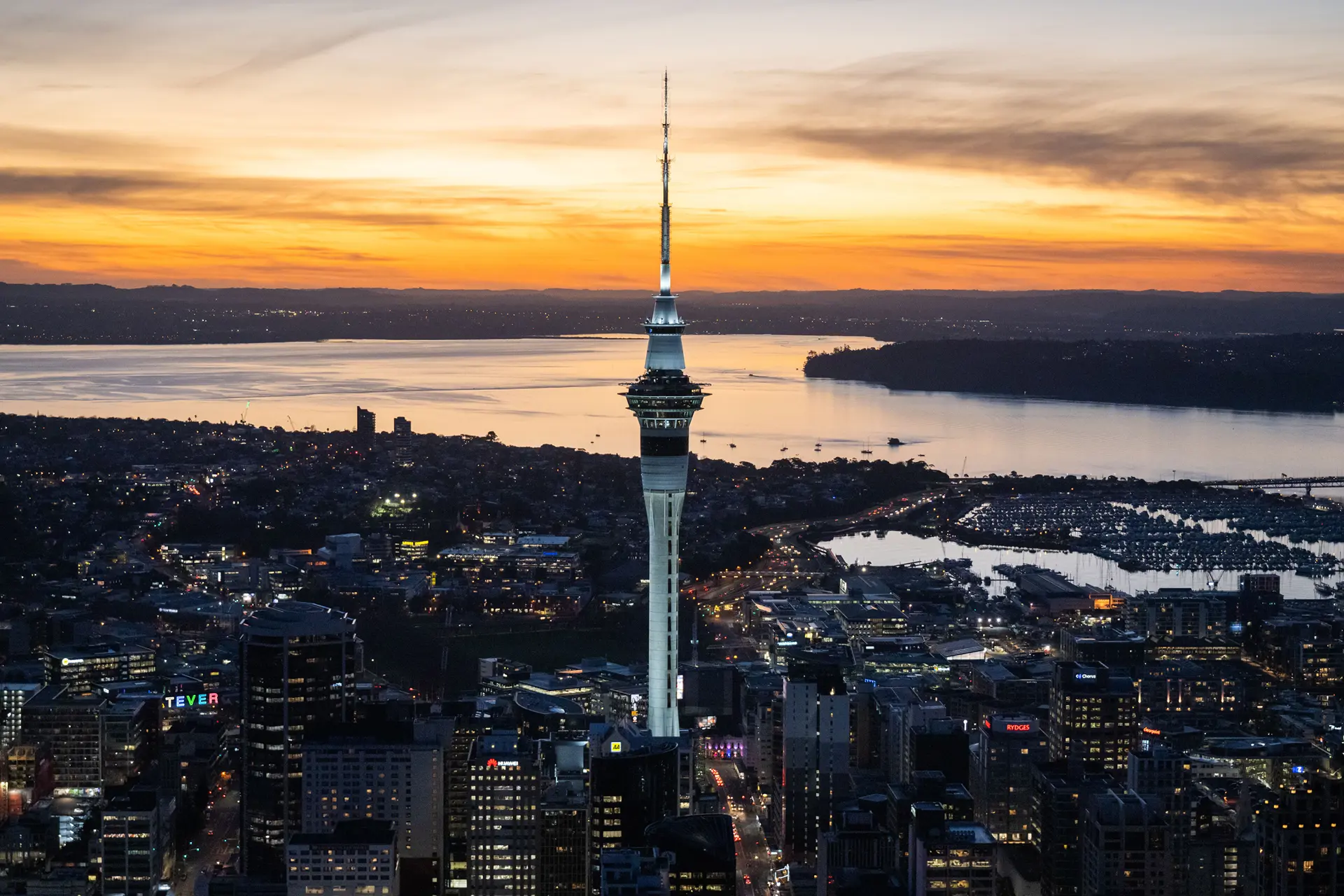
New Zealand's biggest city is not its capital, and doesn't mind
Auckland holds nearly a third of New Zealand's population, the country's main international airport, and its biggest economy, while Wellington keeps the parliament three hours south. Locals call it the "City of Sails" for the roughly 135,000 yachts and launches registered here, and it's built directly on top of an active volcanic field: about fifty individually extinct cones that give the city genuine hills, harbour views and even a working farm on top of one of them, One Tree Hill.
What surprises first-time visitors most is the scale of the Pacific presence: Auckland has the largest Polynesian population of any city in the world, and for several Pacific island nations, more of their people now live here than in the home country. That mix, layered onto Māori and European Auckland, shows up constantly in the food, the festivals and the general texture of the place, and it's a big part of why the city rewards more time than the one rushed night most itineraries give it before heading to Rotorua or Queenstown.
The honest complications
Auckland sprawls: the four former separate cities that merged into one council in 2010 (the old Auckland City, Manukau, Waitakere and North Shore) still function like distinct districts, and getting across town rather than in and out of the CBD can be slower than the map suggests. Traffic on the motorways clogs badly at rush hour, the harbour bridge included, and cross-town bus routes are patchy compared with the frequent radial routes into the centre. Weather is mild but genuinely wet in winter, and summer humidity surprises visitors expecting a cooler South Pacific climate. None of this is a reason to skip Auckland; it's a reason to base yourself centrally and not assume every "20-minute" trip on the map will be twenty minutes on the ground.
Two harbours, five neighbourhoods that matter
Auckland's neighbourhoods split between the dense central isthmus and the quieter suburbs across the water. Where you base yourself comes down to how much nightlife you want outside your door versus how much quiet you want to come home to.
Viaduct Harbour & the CBD
The Viaduct's marina, lined with superyachts and upmarket restaurants, sits right against the compact downtown grid around Queen Street. It's the most convenient base for first-timers: the ferry terminal, Britomart transport hub and Sky Tower are all a short walk away, though weekend nights on Queen Street get loud with a young, sometimes heavily intoxicated crowd.
Ponsonby
A steep, leafy strip of Victorian villas turned into Auckland's most concentrated run of restaurants, bars and boutiques along Ponsonby Road. Ten minutes from the CBD by bus or a flat-ish walk, it's the pick for travellers who want a genuine neighbourhood feel with dinner options on every block.
Parnell
One of Auckland's oldest suburbs, with a village-like main street of galleries, boutiques and cafes and easy walking access to the Auckland Domain and the War Memorial Museum. Quieter than Ponsonby at night, and popular with visitors who want charm without the CBD's noise.
Devonport
A Victorian seaside village on the North Shore, twelve minutes from downtown by passenger ferry, with its own volcanic cone (Mount Victoria), naval history and a relaxed main street of cafes. The best pick for a quieter, more scenic base that's still genuinely close to everything.
Karangahape Road (K Road)
Auckland's grittier, more alternative strip, with South Asian, Polynesian and vintage stores by day and the city's best LGBTQ+ nightlife by night. Interesting to visit, worth a little more street awareness late at night than Ponsonby or Parnell.
From an art deco boutique to a bunk near the Sky Tower
Auckland's hotel scene runs from design-led boutiques in converted heritage buildings to the country's largest hotel tower, with a solid backpacker scene clustered around the CBD and Freemans Bay. These picks cover the range, and each earns its place.
In the boutique bracket, Hotel DeBrett occupies a 1920s art deco building in Britomart, New Zealand's most characterful boutique hotel with just 25 individually decorated rooms, a well-regarded bistro and bar, and a private art gallery, from about NZ$300 a night.
At the top end for scale, Cordis Auckland (formerly The Langham) is New Zealand's largest hotel, a five-minute walk from Karangahape Road, with a newly opened Pinnacle Tower, a day spa and a buffet restaurant locals rate for its dessert spread, from around NZ$280 a night. The Grand by SkyCity puts you in the heart of the CBD seconds from the Sky Tower and SkyCity's restaurants and casino, with a genuinely upscale lobby and spacious rooms, from about NZ$260.
At the budget end, Surf 'N' Snow Backpackers, in a refurbished historic building near the Sky Tower, has some of the cheapest dorm beds in the city centre with unlimited free Wi-Fi, and Lylo Auckland is consistently rated one of the best hostels in the city for solo and female travellers, with a sociable common area without tipping into party-hostel chaos.
Ponsonby Road, Wynyard Quarter and the best flat white you'll have all trip
Auckland's food scene punches well above what its size might suggest, driven by the city's Pacific, Asian and European mix and a coffee culture that takes the flat white seriously. Ponsonby Road is the main event, but Wynyard Quarter's waterfront strip and the roastery cafes of Grey Lynn are just as worth planning around.
Ponsonby Road
Ponsonby Road carries the city's densest run of good restaurants: Prego, Saan and Azabu anchor the mid-to-upper range, while Ahi serves exceptional modern New Zealand cuisine built around Māori and Pacific ingredients, The Grove holds down classic fine-dining elegance, MASU by Nic Watt does a showstopping robata dinner, Cocoro offers an intimate omakase experience, and Sidart runs a creative multi-course tasting menu for a special-occasion night.
Wynyard Quarter
Baduzzi is known for some of the best meatballs in the city and anchors the Wynyard Quarter dining strip, The Good Luck Coconut serves Pacific-Asian dishes and tiki-inspired cocktails including flamed prawn cutlets and fresh ika mata, and Mibo Bakery is the pick for pastries and coffee on a slow waterfront morning.
Coffee & brunch
Ozone Coffee's Grey Lynn roastery on Westmoreland Street is the flagship of a specialty roaster that sources beans direct from origin, from Colombia to Ethiopia, and serves an all-day breakfast and lunch menu built around seasonal, low-waste ingredients. It's a fair benchmark for the flat white debate Auckland will happily have with Melbourne at length.
A tower, fifty volcanoes and a ferry to the vineyards
Auckland's sights split cleanly between the city centre, the volcanic cones scattered through the suburbs, and the Hauraki Gulf just offshore. A little planning around ferry times turns two ordinary days into a genuinely varied trip.
The city centre
The Sky Tower, at 328m the tallest freestanding structure in the Southern Hemisphere, gives views up to 80km on a clear day, with the revolving Orbit restaurant if you want dinner with the view rather than just an observation deck ticket. The SkyWalk, an outdoor walk around a 1.2m-wide ledge with no handrails, and the SkyJump, a cable-controlled base jump from 192m, are the two ways to make the tower considerably more adrenaline-filled. The Auckland Art Gallery, free to enter, holds the country's largest collection of national and international art in an award-winning building on the edge of Albert Park, and the Voyager New Zealand Maritime Museum on Viaduct Harbour covers the maritime and America's Cup history behind the "City of Sails" nickname.
Auckland Domain & the museum
The Auckland War Memorial Museum sits inside the Auckland Domain, a large park built on another extinct volcanic cone, and despite the name is a general museum covering natural history and an excellent collection of Māori and Pacific arts and crafts, including a full wharenui (meeting house) visitors can enter. Budget at least half a day.
Volcanoes & harbour views
Mount Eden and One Tree Hill, both free and open year-round, are the easiest of Auckland's roughly fifty volcanic cones to climb for a panoramic city view, complete with grazing sheep or cattle on some slopes, a genuinely odd sight in a major city. Offshore, Rangitoto Island, a roughly 600-year-old dormant volcano reachable by a short ferry from downtown, has a summit walk over black lava rock rewarded with views back across the whole Waitemata Harbour.
Waiheke Island wineries
A 40-minute passenger ferry from downtown puts you on Waiheke Island, home to around thirty boutique wineries and a noticeably slower pace than the city. Mudbrick Vineyard is the island's most photographed cellar door, with tastings from about $30 for four wines against a Hauraki Gulf backdrop; Cable Bay Vineyards pairs wine with food and rotating art on a hilltop overlooking Auckland; and Stonyridge Vineyard is the legendary stop for its Bordeaux-style Larose, with an Icon Tasting around $35 including a glass of it. Rent a scooter or book a wine-tour shuttle rather than trying to combine tastings with driving yourself.
One, two or three days, planned around the ferry timetable
Two full days covers Auckland's essentials well; a third adds either Waiheke at a slower pace or Devonport and Rangitoto. Build the day around ferry departure times, since they're the one fixed constraint in an otherwise flexible schedule.
- Morning
Sky Tower & the CBD. Views from the observation deck, then a coffee and browse through the Britomart precinct.
- Midday
Auckland War Memorial Museum. Walk or bus to the Domain; give the Māori and Pacific galleries proper time.
- Afternoon
Ponsonby Road. Wander the shops and cafes, save an appetite for dinner.
- Evening
Dinner at Ahi or Prego. Book ahead if you can; both fill up on weekends.
- Day 1
The one-day route above: Sky Tower, the museum, Ponsonby Road, dinner.
- Day 2
Waiheke Island. Early ferry across, a scooter or shuttle between two or three cellar doors (Mudbrick, Cable Bay, Stonyridge), and the last practical ferry back for dinner in the city.
- Days 1-2
The two-day route above, at a slightly gentler pace.
- Day 3, option A
Devonport & Rangitoto. A short ferry to Devonport for Mount Victoria and the seaside cafes, or on to Rangitoto Island for the lava-field summit walk.
- Day 3, option B
West coast beaches. A rental car out to Piha or Karekare for black-sand surf beaches and the Waitakere Ranges' waterfall walks.
Spread out, but manageable with an AT HOP card
Auckland Airport (AKL), in the southern suburb of Mangere, is the country's main international gateway, with separate domestic and international terminals linked by a free shuttle bus or an uncovered 800m walk. The Airbus Express runs 24/7 between the airport and the CBD via Queen Street in 40-50 minutes for about $16 one way (cheaper with a multi-ride ticket); an Uber or taxi to the central city typically runs $35-55 depending on traffic and time of day.
Within the city, get an AT HOP card (a small upfront cost, then top-up credit) for a discount on buses, trains and most ferries. Buses are the most-used public transport and run every 5-15 minutes on popular routes, though cross-town journeys are slower than routes running straight into the CBD. Ferries are both transport and sightseeing: the Devonport service takes 12 minutes, Waiheke Island 40 minutes, both from the downtown ferry terminal at Britomart. A rental car is worth it for west coast beaches and further day trips, but expect real congestion on the motorways and Harbour Bridge at peak times.
Best time to visit and Auckland's climate
Auckland has a mild, temperate climate with warm, humid summers (December-February) and mild, damp winters (June-August) that rarely drop below freezing. April-May and September-November are the shoulder seasons: still comfortable, noticeably less crowded and cheaper than the December-February peak, when accommodation prices climb sharply around the school holidays.
In line with other major Pacific Rim cities
Auckland isn't a budget destination; prices sit closer to Sydney or a mid-tier US city than to most of Southeast Asia. The hostel scene keeps the low end accessible, while dining and activities can climb quickly if you're not tracking them.
- Hostel dorm NZ$30-55
- Self-catering & food court meals
- AT HOP bus/train/ferry travel
- Free volcanoes, museums by donation
- Boutique hotel or B&B NZ$180-320
- Restaurant meals with wine NZ$40-70
- AT HOP plus the occasional Uber
- A Waiheke wine tour, the museum, the Sky Tower
- Hotel DeBrett or equivalent NZ$300+
- Tasting menus at Sidart or MASU
- Private Waiheke wine tour
- Scenic flights and harbour cruises
A safe city in one of the world's safest countries
Auckland benefits from New Zealand's overall safety record, the country ranks second on the Global Peace Index, and violent crime against tourists here is genuinely rare. The main things worth knowing are specific and manageable rather than alarming.
Karangahape Road and Queen Street get rowdy with intoxicated crowds late on Friday and Saturday nights; nobody is likely to bother you beyond the occasional plea for change, but it's not the most relaxed stretch to linger on at 2am. Rental car and campervan break-ins, a rising nationwide issue, hit Auckland too, particularly at beach car parks and walking-track trailheads on the west coast: never leave visible luggage or electronics in a parked car. Standard city awareness after dark, especially around Fort Street's cluster of hostels and bars, is all most visitors need. Emergency number nationwide is 111.
Auckland is the easiest base for the North Island's greatest hits
Auckland's position at the top of the North Island makes it a workable base for some of the country's best-known attractions, though several are really a full day given the driving distances involved.
Waiheke Island
The easiest and most rewarding Auckland day trip by far: cellar doors, beaches and art galleries a world away from the city, covered in Ch.05 above.
Bay of Islands
The Waitangi Treaty Grounds, dolphin cruises and some of the North Island's best sailing, best treated as an overnight rather than a rushed there-and-back given the drive.
Hobbiton Movie Set
The Shire from the Lord of the Rings and Hobbit films, near Matamata, with 44 handcrafted hobbit holes and a guided tour ending at the Green Dragon Inn. Book the tour in advance; it regularly sells out.
Waitomo Glowworm Caves
Limestone caves lit by thousands of native glowworms, one of New Zealand's oldest tourist attractions and still genuinely atmospheric. Combine with Hobbiton (about 1.5 hours apart) for a long but efficient single day, or split across two.
Rotorua
Geothermal fields and Māori cultural experiences are really a stay of at least one night rather than a day trip from Auckland, but it anchors the natural next stop on almost every North Island itinerary; see our New Zealand country guide for the full Rotorua chapter.
Auckland FAQ
Is Auckland safe for tourists?
Auckland is a safe city by international standards. Violent crime against tourists is rare; the main concerns are late-night intoxication around Karangahape Road and Queen Street on weekends, and break-ins at cars left visibly loaded at ferry and walking-track car parks.
How many days do I need in Auckland?
Two full days covers the city centre and Waiheke Island well; three lets you add Devonport and Rangitoto at a relaxed pace. Most visitors treat Auckland as a one-to-three-day gateway before heading further into New Zealand.
How much does Auckland cost per day?
Budget travellers manage on NZ$130-190 a day with hostel dorms and self-catering; mid-range runs NZ$250-400. Auckland is broadly in line with other major Western Pacific cities and noticeably pricier than most of Southeast Asia.
When is the best time to visit Auckland?
December to March is Auckland's summer: warm, humid and the most reliable weather, but also the busiest and most expensive. April-May and September-November are shoulder seasons with good weather and better value.
Is Waiheke Island worth a day trip from Auckland?
Yes. It's a 40-minute passenger ferry from downtown Auckland to a genuinely different pace: cellar doors like Mudbrick, Cable Bay and Stonyridge, art galleries and beaches. A day trip works, though an overnight lets you slow down and avoid the last ferry rush.
How do I get from Auckland Airport to the city centre?
The Airbus Express runs 24/7 between the airport and the CBD in 40-50 minutes for about $16 one way. An Uber or taxi to the central city runs roughly $35-55 depending on traffic and time of day.
What is the best area to stay in Auckland?
The Viaduct Harbour and CBD for waterfront convenience and dining, Ponsonby or Parnell for a more local, walkable neighbourhood feel, and Devonport for a quieter, scenic base a short ferry from downtown.
Is Auckland walkable?
The central city, Ponsonby and Parnell are walkable, but Auckland sprawls widely across its isthmus and harbours. Buses, trains and ferries with an AT HOP card cover most visitor needs; a rental car helps for west coast beaches and further-flung day trips.
What is the AT HOP card and do I need one?
Auckland's reloadable transit card, which costs a small upfront fee and then gives a discount on cash fares across buses, trains and most ferries. Worth getting if you're using public transport more than once or twice.
Can I see a volcano in Auckland?
Yes, several. Auckland is built across roughly 50 extinct volcanic cones; Mount Eden and One Tree Hill are free city viewpoints, and Rangitoto Island, a 600-year-old dormant volcano, is a short ferry ride away with a summit walk over black lava rock.
What Stays With You
Auckland rarely gets the star billing New Zealand's fiords and glaciers do, and most itineraries treat it as a place to sleep off jet lag before the real trip starts. That undersells a city where you can climb a genuine volcano before breakfast, hear four Pacific languages before lunch, and be tasting Bordeaux-style red on a vineyard terrace by mid-afternoon, all without leaving the metro area.
Take the ferry to Waiheke at least once, even if it's the only detour you make. Watching the city recede across the Waitemata Harbour, sails everywhere, is the moment Auckland's nickname stops being a slogan and starts making sense.