
Small enough to walk, big enough to matter
Lucerne sits at the northwestern tip of Lake Lucerne, where the Reuss River drains out toward the Rhine, ringed by mountains close enough to feel like part of the streetscape rather than a backdrop. The Old Town is small: covered bridges, frescoed building facades, and squares that were laid out for foot traffic and horses centuries before anyone thought to widen them for cars. You can walk the entire historic center in under half an hour, which is exactly why most visitors underrate how much time it deserves.
What sets Lucerne apart from Switzerland's other cities is what surrounds it, not just what's in it. Mount Pilatus, Mount Rigi and Mount Titlis are all reachable as a half-day or full-day round trip by train, cogwheel railway, cable car or a combination of the three, each with a genuinely different personality. No other Swiss city puts three legitimately different mountain experiences this close to a walkable, lake-side old town, which is why Lucerne, rather than the larger Zurich or Geneva, is the base most seasoned Switzerland travelers actually recommend for a first visit.
The honest complications
Chapel Bridge and the streets immediately around it are genuinely crowded with day-trip tour groups from about 10am to 4pm in July and August, arriving by the coachload from Zurich and Interlaken. The mountain excursions are not cheap even by Swiss standards, a single Pilatus round trip runs past CHF 100, and cloud cover can erase a summit view with no warning and no refund. And Lucerne, like the rest of Switzerland, keeps Sunday hours: most shops are closed, and restaurants outside the main tourist strip can be surprisingly quiet.
A small city, four pockets that matter
Lucerne's compact size means the choice of base matters less for logistics than it does elsewhere and more for atmosphere and budget. Everything below is within a 15 to 20 minute walk of the train station.
Altstadt (Old Town)
The medieval core on both banks of the Reuss, home to Chapel Bridge, the frescoed Weinmarkt and Kornmarkt squares, and most of the postcard views. It's genuinely beautiful and genuinely busy with day-trip groups from mid-morning to late afternoon; staying here means an easy walk to everything and a much quieter, more atmospheric version of the same streets once the tour buses leave in the evening.
Nationalquai & the lakefront
The promenade running east from the Old Town along Lake Lucerne, lined with the city's grand 19th-century hotels and the boat piers for the paddle steamers. Slightly removed from the densest crowds but still a five-minute walk to the bridge.
Hirschmatt-Neustadt
South of the train station, this is where Lucerne residents actually eat and shop: fewer tour groups, better prices, and a concentration of genuinely good, unpretentious restaurants. The single best area for travelers who want to be central without paying Old Town premiums.
Kriens
A separate municipality just southwest of the center and the lower station for the Pilatus aerial cableway. Quieter and cheaper than staying centrally, and useful specifically if an early Pilatus start is the priority, though it trades away easy access to the lakefront and Old Town evenings.
From lakefront grand dames to lakeside hostels
Lucerne's accommodation runs from genuinely historic lakefront hotels to a small but solid hostel scene, with the mid-range dominated by family-run properties in and around the Old Town. These picks cover every budget and each earns its place on the list.
At the top, Hotel Schweizerhof Luzern has stood directly on the lakefront since 1845, with individually decorated rooms, two restaurants and a spa, and is as close as Lucerne gets to a grand European hotel, from around CHF 350 a night. On the hillside above town, the Art Deco Hotel Montana (from CHF 220), reached by its own funicular, pairs genuine 1910s Art Deco styling with the best panoramic view over the lake and Old Town of any hotel in the city.
In the Old Town itself, Hotel Wilden Mann (from CHF 180) occupies a historic inn a few minutes' walk from Chapel Bridge, individually furnished rooms with genuine period character, and Hotel des Balances (from CHF 200) sits directly on the Reuss with rooms looking straight across the river to the Old Town facades.
At the budget end, Backpackers Lucerne (from CHF 40 dorm) sits directly on the lakeshore a short walk from the center with a shared kitchen and lounge, and the Luzern Youth Hostel (from CHF 45 dorm), part of the official Swiss network, is a short bus ride from the center with clean, no-frills rooms and one of the more reliable budget bases in an expensive city.
Fondue on the water, and a pastry that only exists here
Lucerne's food scene runs through traditional guild-house restaurants that have fed the city for centuries and a genuine local specialty, Chügelipastetli, that almost never travels beyond central Switzerland. Prices sit at the higher end of Swiss normal, but a smart weekday lunch still comes in reasonably.
Chügelipastetli
A puff-pastry vol-au-vent filled with veal, mushrooms and cream sauce, Lucerne's genuine local specialty and rarely found outside the canton. Zunfthausrestaurant Pfistern, in a 16th-century guild house on the riverfront, does a well-regarded version in a genuinely historic dining room.
Cheese fondue on the lake
Fondue House du Pont, right on the Reuss near Chapel Bridge, serves organic Alpine cheese fondue with river views and several variations including a chocolate fondue for dessert. For a different setting entirely, Schiffrestaurant Wilhelm Tell, a boat restaurant moored on the lake, serves fondue tableside from October to March only.
Traditional Swiss cooking
Wirtshaus Galliker is a genuine local institution rather than a tourist stop: unfussy Lucerne home cooking, rösti and schnitzel done properly, and a regular crowd of locals that tells you everything about the quality. Rathaus Brauerei, Lucerne's own brewery and restaurant next to the Town Hall, pairs house-made beer with hearty Swiss plates.
Max Chocolatier
A small, sleek chocolate boutique beside the Hotel Schweizerhof making handmade pralines and drinking chocolate from natural ingredients; a 45-minute tasting session explains the sourcing and process for anyone who wants more than a quick purchase.
A bridge, a lion, a wall and a concert hall shaped like a ship
Lucerne's sights are compact enough to see without much planning, but each has a specific best time and a specific detail worth knowing before you arrive. This chapter walks through the city roughly the way a good day or two would.
Chapel Bridge and the Water Tower
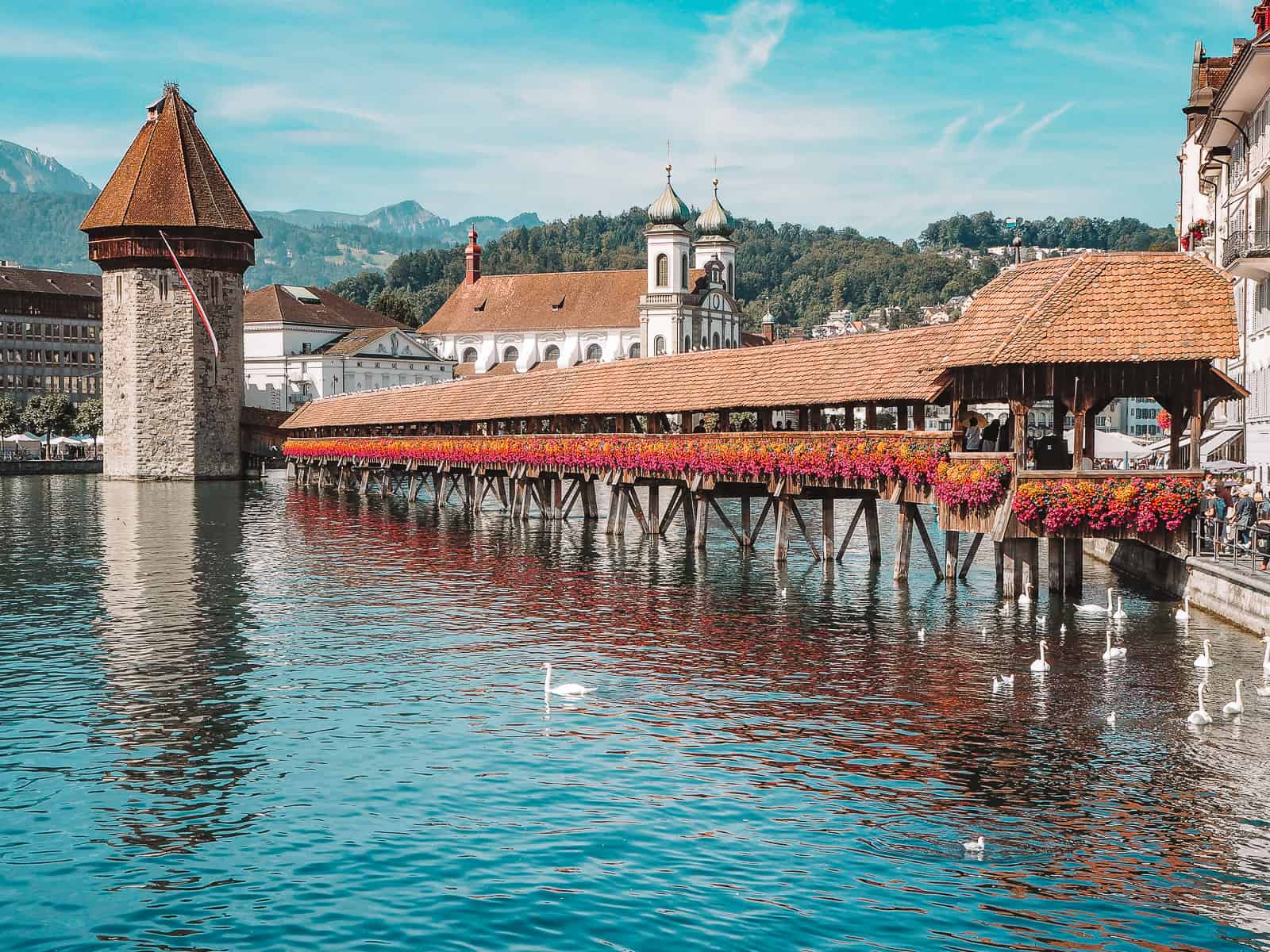
The Kapellbrücke, first built around 1333, was Europe's oldest covered wooden bridge until a fire on the night of 18 August 1993 destroyed roughly two-thirds of the structure and 85 of its original 110 painted roof panels; the cause was never conclusively established. The city rebuilt it in eight months, reopening in April 1994, and it remains the single defining image of Lucerne, best photographed early morning before the crowds arrive, with the octagonal Water Tower, older than the bridge itself and once used as a prison and treasury, at its bend.
The Lion Monument
A short walk from the Old Town, the Löwendenkmal is a mortally wounded lion carved directly into a sandstone cliff face by Lukas Ahorn in 1820-21, from a design by the Danish sculptor Bertel Thorvaldsen. It commemorates the roughly 760 Swiss Guards killed defending King Louis XVI at the Tuileries Palace during the 1792 storming in the French Revolution. Mark Twain called it "the most mournful and moving piece of stone in the world," and the small park around it is worth sitting in rather than rushing through.
Musegg Wall
Free and open April through November, the 870-metre Musegg Wall is the longest surviving medieval city wall in Switzerland, with four of its nine remaining towers, the Männliturm, Zytturm, Wachtturm and Schirmerturm, open to climb. The Zytturm holds central Switzerland's oldest tower clock, which strikes the hour a full minute before every other clock in the city, a deliberate historic privilege nobody has bothered to change.
KKL Luzern
Jean Nouvel's Culture and Convention Centre, completed in 2000, is one of the most acclaimed pieces of contemporary architecture in Switzerland: a 45-metre cantilevered roof with no visible support, its aluminium underside reflecting the lake, and a concert hall regarded as one of the best-sounding rooms in Europe, home to the annual Lucerne Festival. The building also houses the Museum of Art (Kunstmuseum Luzern); guided architecture tours run regularly for anyone who wants the structural detail behind the design.
Swiss Museum of Transport
The Verkehrshaus, a short bus or lake-boat ride from the center, is Switzerland's most-visited museum: full-size locomotives, aircraft and a genuine Concorde, a planetarium and a Swiss Chocolate Adventure add-on that walks through cacao to bar. Entry is CHF 37 for adults, with the Planetarium, Chocolate Adventure and Filmtheatre each a further CHF 18; it easily fills half a day and is one of the better rainy-day options in the region.
One, two or three days, mountains included
Three full days is the right amount for Lucerne done properly: the city itself takes half a day, and each mountain excursion is close to a full day on its own. These routes are sequenced to dodge the worst crowds and use the mountain cable cars in the clearer morning light whenever possible.
- Morning
Chapel Bridge and the Old Town. Walk the bridge early, the Water Tower, Weinmarkt and Kornmarkt squares, then up to the Musegg Wall towers for the skyline view.
- Midday
The Lion Monument. A short walk from the Old Town, then Chügelipastetli for lunch at Zunfthausrestaurant Pfistern.
- Afternoon
Pick one mountain. Pilatus for the most dramatic single excursion, back down in time for an early dinner.
- Evening
Lakefront stroll. The Nationalquai promenade as the day-trip crowds thin out, dinner in Hirschmatt away from the tourist strip.
- Day 1
The one-day route: Chapel Bridge, Musegg Wall, Lion Monument, Chügelipastetli lunch, Pilatus in the afternoon.
- Day 2 morning
Mount Rigi. Boat from the lakefront piers to Vitznau, cogwheel railway to Rigi Kulm for gentler summit walking trails and a different, slower pace than Pilatus.
- Day 2 afternoon
KKL Luzern. The architecture and lakefront setting, plus the Museum of Art if there's time, before an evening fondue dinner at Fondue House du Pont.
- Days 1-2
The two-day route above, at a slightly gentler pace.
- Day 3, option A
Swiss Museum of Transport. A half-day at the Verkehrshaus, reached by lake boat, then an easy afternoon back in the Old Town for last-minute shopping and Max Chocolatier.
- Day 3, option B
Mount Titlis. The train to Engelberg and the revolving cable car to the glacier, the most dramatic and most expensive of the three mountains, best saved for a clear-weather day.
Flat, compact, and one train station away from everything
Lucerne is unusually flat and walkable for a Swiss city, with the Old Town, lakefront and train station (Luzern Bahnhof) all within a 10 to 15 minute walk of each other. From Zurich Airport, a direct IR70 train runs roughly every 30 minutes and takes about 70 minutes with no changes, one of the most convenient airport-to-city rail connections in Europe, and about CHF 25-27 for a second-class single (roughly half that with the Half Fare Card).
Within the city, walking covers almost everything; the local bus network (part of the same transit system as the trains) reaches the Pilatus and Rigi base stations and outlying neighbourhoods like Kriens. The lakefront piers just past Chapel Bridge are the departure point for boats to Vitznau (for Rigi), Weggis, Alpnachstad (for the Pilatus cogwheel railway) and round-the-lake cruises on the historic paddle steamers, all covered free with the Swiss Travel Pass.
Best time to visit and the Christmas market
Lucerne has a mild, lake-moderated climate. May, June and September are the sweet spots: mountain lifts fully operating, cooler and clearer for hiking than peak summer, and noticeably fewer coach-tour crowds than July and August. Winter is quiet and atmospheric in the Old Town, though some mountain-summit trails close and the boats run a reduced schedule.
The Lucerne Christmas market, held on the Franziskanerplatz through most of December, is smaller and more local in feel than the giant markets in Zurich or Basel, wooden stalls, mulled wine, and the frescoed Old Town backdrop doing most of the work.
Expensive by any standard except the rest of Switzerland
Lucerne runs on the same price level as the rest of urban Switzerland, roughly in line with Zurich and cheaper than Zermatt or St. Moritz. The single biggest variable in any Lucerne budget isn't the hotel or the food, it's how many mountain excursions go on the itinerary.
- Hostel dorm CHF 40-55
- Supermarket meals and the market CHF 15-25
- Walking plus occasional bus
- Old Town, Musegg Wall and Lion Monument, all free
- 3-star Old Town hotel CHF 180-220
- Restaurant meals CHF 25-40/person
- One mountain excursion every other day
- Lake boat cruise, Museum of Transport
- Hotel Schweizerhof or equivalent CHF 350+
- Fine dining, guided KKL architecture tour
- Multiple mountain excursions
- Private transfers and premium seating
One of the safest cities anywhere, with two things to know
Lucerne rates 9.3/10 on our safety scale, in line with Switzerland's national reputation as one of the safest countries in the world. Violent crime against tourists is essentially unheard of, the city is comfortable to walk at night including the Old Town and lakefront, and Lucerne is excellent for solo female travellers specifically: well-lit streets, reliable late buses, and a generally low-key, unbothered social atmosphere.
The two things that actually catch visitors: pickpocketing, concentrated in the most crowded pockets of the Old Town and around the train station during peak coach-tour hours, so keep bags closed in dense crowds; and mountain weather, which is a safety issue rather than just an inconvenience above the tree line on Pilatus and Rigi, where conditions can shift fast even on a hike that starts sunny. Emergency number is the EU-standard 112 from any phone; local police can also be reached at 117.
Three mountains, and a fourth almost nobody mentions
Lucerne's position at the edge of the lake and the mountains makes it the best-connected base in the country for Alpine day trips. Four excursions are worth a day each, and all run directly from the city by train, boat or a combination of both.
Mount Pilatus
The steepest cogwheel railway in the world climbs from Alpnachstad to the 2,128-metre summit, with the classic "Golden Round Trip" combining a lake boat out, the cogwheel train up, and the aerial cableway down through Kriens (or the reverse). The most dramatic of the three mountains and the one most worth doing first.
Mount Rigi
Known as the "Queen of the Mountains," Rigi is reached by boat to Vitznau then Europe's oldest mountain cogwheel railway to Rigi Kulm. Gentler summit trails and a slower pace than Pilatus make it the better choice for an unhurried half-day rather than a checklist summit.
Mount Titlis
A 45-minute train to Engelberg, then a revolving cable car up to a genuine glacier and snow cave at 3,020 metres, open even in summer. The most dramatic and most weather-dependent of the three; check conditions before committing a full day to it.
Stanserhorn
The lesser-known fourth option and a genuinely different experience: an 1893 open-carriage funicular up to Stans, then the CabriO, the world's only open-top double-decker cable car, to a 1,898-metre summit with a revolving restaurant and panoramic trail. Quieter than the big three and worth it specifically for travelers who've already done Pilatus or Rigi.
Lucerne FAQ
Is Lucerne safe for tourists?
Yes, Lucerne is one of the safest cities in Switzerland, itself one of the safest countries in the world. Violent crime against visitors is essentially unheard of; the only real concern is pickpocketing in the most crowded pockets of the Old Town and around the train station in peak season.
How many days do I need in Lucerne?
Three days covers it well: one for the Old Town and the lakefront, one for a mountain excursion (Pilatus or Rigi), and one for either a second mountain or a lake cruise and the Swiss Museum of Transport. Two days works if you pick one mountain instead of two.
How much does Lucerne cost per day?
Budget travellers manage on CHF 90-140 a day with a hostel bed and supermarket meals; mid-range runs CHF 220-320, and that's before a mountain excursion, which can add CHF 80-120 to any single day.
When is the best time to visit Lucerne?
May, June and September are the sweet spots: mountain cable cars fully running, manageable crowds, and cooler hiking weather than peak summer. July and August are busiest and priciest; December has a well-regarded Christmas market on the lakefront.
Should I do Pilatus, Rigi or Titlis?
Pilatus for the most dramatic single excursion and the steepest cogwheel railway in the world; Rigi for gentler summit walking trails and a slower pace; Titlis for a glacier and snow at altitude even in summer. Most visitors with two days do Pilatus plus one of the other two.
How do I get from Zurich Airport to Lucerne?
A direct train runs roughly every 30 minutes and takes about 70 minutes, with no changes required. It's one of the most convenient airport-to-city rail links in Europe.
What is the best area to stay in Lucerne?
The Old Town (Altstadt) for first-timers: walkable, scenic, and close to the train station and lake piers. The Hirschmatt quarter near the station is a quieter, slightly cheaper alternative with excellent local restaurants.
Do I need to speak German in Lucerne?
No. English is widely spoken in hotels, restaurants and at the mountain railways. Everyday Swiss German dialect is what you'll hear on the street; standard written German appears on signage and menus.
Is Lucerne walkable?
Yes, and it's genuinely flat by Swiss standards. The Old Town, lakefront and train station are all within a 10 to 15 minute walk of each other; buses cover anything further, including the base stations for Pilatus and Rigi.
Is the Swiss Travel Pass worth it for a Lucerne trip?
If you're doing two or more mountain excursions plus the lake steamer, it can pay for itself fast given how expensive individual mountain tickets are. For a single mountain and mostly walking around the Old Town, the Half Fare Card is the better value.
What Stays With You
Lucerne is a city that does the postcard thing without feeling like a postcard once you've spent an evening there. The bridge at dawn before the coach tours arrive, the lion in its quiet park, the way the mountains just sit there at the end of every street like they're waiting their turn: none of it needs embellishment, which is unusual for a place this photographed. The tour groups get the bridge; the early risers and late stayers get the city underneath it.
Pick one mountain, ride it up on the clearest day of your trip, and understand in about ninety minutes why people keep coming back to a country this expensive.