
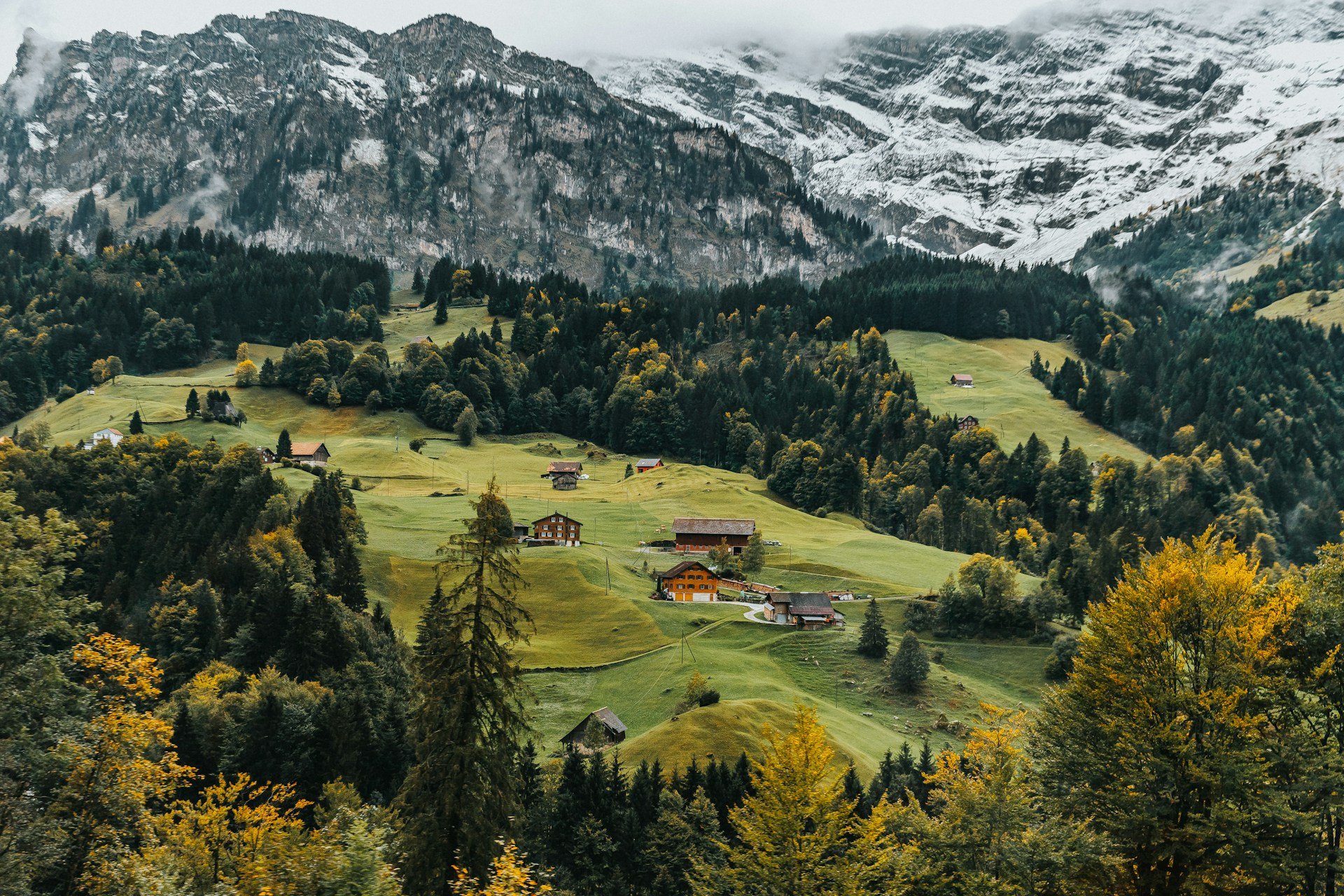
The Country That Runs on Time, Literally
Switzerland is a confederation of 26 cantons that never quite became a single unified culture, and that's the point. Cross a valley and the language changes from German to French, or the Sunday quiet turns into an Italian espresso bar left open. What holds it together is a habit of function over flash: trains that leave and arrive to the minute, direct democracy that puts real questions to a public vote several times a year, and a landscape, the Matterhorn, the Aletsch Glacier, lakes the color of glass, that the country has spent two centuries learning how to make accessible without ruining it.
None of this is cheap. Switzerland is reliably ranked among the most expensive countries on earth to visit, and a lot of first-time visitors underestimate by how much. A basic restaurant meal runs CHF 25-40, a dorm bed CHF 35-55, and a return cable car ticket up a single mountain can run past CHF 100. What you get for it is infrastructure that simply works: a train timed to the minute that connects to a boat timed to the same minute, mountain restaurants with electricity and running water at 3,000 meters, and a level of predictability that turns "just wing it" into a genuinely viable travel style.
The honest complications
The cost is real and it compounds fast: a week that looks reasonable on paper becomes two or three times a comparable week in Portugal or Poland by the time meals, mountain excursions and a hotel room are added up. Lucerne, Interlaken and Zermatt are genuinely overwhelmed with day-trippers in July and August, and the postcard views come with a queue for the cable car. Most shops close on Sundays and many close early on weekdays, which surprises visitors used to cities that never sleep. And the weather in the high mountains is the real decision-maker on any trip: a cloud bank can erase a Jungfraujoch or Pilatus view that cost CHF 100 to reach, with no refund for bad luck.
A History Worth Knowing
Switzerland's founding myth and its modern identity are the same story: small, mountainous communities banding together for mutual defense and then refusing, for seven centuries and counting, to be told what to do by anyone outside the valley. From an alliance of three cantons in 1291 to a modern federal state that still lets citizens vote directly on federal law, the throughline is local control and armed neutrality, and both still shape how the country runs today.
- 1291
The Rütli Oath. The cantons of Uri, Schwyz and Unterwalden swear a mutual defense pact against Habsburg rule, the founding document of the Swiss Confederacy and the source of the national holiday, 1 August.
- 1315-1499
Expansion and de facto independence. Victories at Morgarten and elsewhere draw in more cantons; the 1499 Swabian War ends with Switzerland effectively independent of the Holy Roman Empire, though not yet formally recognized.
- 1648
Formal independence. The Peace of Westphalia legally recognizes Swiss independence from the Holy Roman Empire, ending any ambiguity about the confederacy's status.
- 1815
Permanent neutrality. The Congress of Vienna, following the upheaval of the Napoleonic Wars and a brief French-imposed Helvetic Republic, guarantees Switzerland's perpetual neutrality, a status the country has maintained through two world wars.
- 1848
The modern federal state. A new constitution, drafted after a brief civil war (the Sonderbundskrieg), creates the federal system and direct-democracy tools, referendums and popular initiatives, that still define Swiss politics.
- 1971-2002
Catching up and opening up. Women win the right to vote in federal elections in 1971 (the last canton to grant it at local level held out until 1990), and Switzerland joins the United Nations in 2002 after decades of principled non-membership.
Read the full history: neutrality's limits, the cantons and Swiss democracy
Swiss neutrality is often misunderstood as passivity. It is closer to armed non-alignment: Switzerland maintains a citizen militia and mandatory service for men, and its neutrality has always been backed by a credible defense rather than an absence of one. That neutrality also has a genuinely complicated history. During the Second World War, Switzerland's wartime banking practices and its restrictive stance on Jewish refugees fleeing Nazi persecution came under sustained international scrutiny decades later, in the 1990s, prompting formal apologies and a fund for Holocaust survivors. The country's wartime record is treated today with more honesty than it was for the fifty years after 1945.
The cantonal system. Switzerland's 26 cantons retain far more independent power than a typical province or state: each sets its own tax rates, school systems and even, in some cases, whether same-canton citizens can carry firearms differently. This is why a trip from Zurich to Ticino can feel like crossing into a different country twice, in language and in the texture of daily life.
Direct democracy. Swiss citizens vote on federal, cantonal and municipal questions up to four times a year, everything from EU relations to minimum wage laws to (famously) whether to ban minarets. A citizen-gathered petition with enough signatures can force a binding national referendum on almost any law, a level of direct public input that is unusual anywhere else in the world.
Not the EU, but not isolated. Swiss voters rejected joining the European Economic Area in a 1992 referendum, and EU membership has never come close to a serious vote since. Instead, Switzerland accesses the EU single market through more than 120 bilateral treaties, and joined the Schengen Area in 2008, a decision that does put its external borders and 90-day tourist rule on the same clock as the rest of Schengen Europe.
Top Destinations
Switzerland divides naturally into five travel zones: Zurich and the north, Lucerne and central Switzerland, the Bernese Oberland's high peaks, Geneva and the French-speaking west, and Zermatt, the Valais and Italian-speaking Ticino in the south. The country is small enough that any two zones connect by train in half a day, but each one deserves at least two nights: this is not a country built for a one-night stand in every town.

Zurich, the polished gateway
Zurich is Switzerland's largest city and its financial center, and it plays that role in the townscape: glass banking towers along Bahnhofstrasse give way, a few blocks over, to the medieval alleys of Niederdorf and the reliably interesting Zurich West district, a former industrial zone now full of galleries and bars. Lake Zurich and the Limmat River both run straight through the center, and swimming off one of the free public lidos in summer is a genuinely local thing to do, not a tourist stunt. Zurich Airport is the country's main international hub, so most itineraries start or end here whether they plan to linger or not; two nights is enough to see the old town, the Kunsthaus art museum and one lakeside afternoon.
Lucerne, the classic first base
Lucerne is where most first-time visitors should actually start: a walkable old town on Lake Lucerne with three iconic mountains, Pilatus, Rigi and Titlis, all reachable as a day trip, and a direct train from Zurich Airport in about 70 minutes. The covered Chapel Bridge and its Water Tower are the defining image, and the Lion Monument, a rock-cut memorial to Swiss Guards killed in 1792, is one of the more genuinely moving pieces of public sculpture in Europe. We cover Lucerne in full in our dedicated Lucerne city guide.
Engelberg & the Titlis glacier
A 45-minute train from Lucerne, Engelberg is the valley town beneath Mount Titlis, whose revolving cable car and glacier cave make it the most dramatic of the three Lucerne-area mountains, and also the most crowded and most expensive to reach.
Interlaken & the Jungfrau region
Interlaken sits between two lakes, Thun and Brienz, and functions as the gateway to the Jungfrau region rather than a destination in itself: this is Switzerland's adventure sports hub, with paragliding launching directly over the town and canyoning, via ferrata and skydiving all bookable from the main street. The real draw is above it: Grindelwald and Lauterbrunnen, two of the most photographed valleys in the Alps, and Jungfraujoch, "Top of Europe," the highest railway station in Europe at 3,454 meters, with views over the Aletsch Glacier, the largest ice sheet in the Alps. Book the Jungfraujoch train in advance in summer; seat reservations are mandatory from May to October and it sells out.
Geneva, the international city
Geneva is Switzerland's most cosmopolitan city, French-speaking, headquarters to the UN's European offices and the Red Cross, and built around the Jet d'Eau, the 140-meter fountain that has become the city's unofficial symbol. It feels less "Swiss" than Zurich or Lucerne in the postcard sense and more like a small, tidy international capital, which is its own kind of appeal.
Lausanne, Montreux & the Lavaux terraces
The rest of Lake Geneva's northern shore is the Vaud Riviera: Lausanne, the Olympic capital with the IOC museum, Montreux, home to the lakefront Château de Chillon and the annual jazz festival, and between them the Lavaux vineyard terraces, a UNESCO World Heritage site of steeply stacked vines that date to the 11th century, best seen on foot along the marked walking trail between villages.
Zermatt & the Matterhorn
Zermatt is a car-free village beneath the single most photographed mountain in the Alps, the Matterhorn's near-perfect pyramid visible from the main street. Electric taxis and horse-drawn carriages are the only traffic; everyone else arrives by train to Täsch and a short shuttle. The Gornergrat cogwheel railway, running since 1898, is the classic way up for the closest Matterhorn views without technical climbing.
Ticino: Lugano & Locarno
South of the Alps, Ticino is Switzerland's Italian-speaking canton and feels like it: palm trees, espresso culture and a Mediterranean pace around Lake Lugano and Lake Maggiore. Lugano has the lake promenade and a genuinely good gelato scene; Locarno's Piazza Grande hosts one of Europe's major film festivals every August. It's the part of Switzerland most visitors skip and most who make it there wish they'd budgeted more time for.

Hidden gems beyond the main circuit
The zones above cover a first or second trip well. With extra days, these are the spots that rarely make the standard itinerary and reward the detour.
Appenzellerland
Rolling green hills, decorated farmhouse facades and a canton (Appenzell Innerrhoden) so traditional it only granted women the vote at the local level in 1990. The Alpstein massif above the village has some of the least-crowded ridge hiking in the country.
Lavaux on foot
Walking the marked trail through the terraces, rather than viewing them from the train, is the way to actually understand the UNESCO listing: steep stone-walled vineyards, lake views the whole way, and small cellar doors selling the Chasselas wine you're walking through.
Aletsch Glacier viewpoints
The largest glacier in the Alps, a UNESCO World Heritage Site, is best seen from the Eggishorn or Bettmerhorn cable cars above Fiesch: a genuinely different, quieter Alpine experience than the Jungfraujoch crowds two valleys over.
Stein am Rhein
A small medieval town on the Rhine with painted-facade houses that rival anything in the bigger cities, and a fraction of the visitors. Combine with the Rhine Falls for a full day from Zurich.
Valle Verzasca
A valley of granite riverbeds and impossibly clear turquoise swimming holes, plus a 220-meter dam made famous by the opening bungee jump in the 1995 film "GoldenEye."
Creux du Van
A natural rock amphitheater carved into the Jura mountains, roughly 1.4 kilometers wide, reachable by a moderate day hike and one of the country's most dramatic non-Alpine landscapes.
Culture & Etiquette
Swiss culture runs on precision, privacy and a fairly formal baseline of politeness that can read as coldness to visitors from warmer social cultures. It isn't: it's a culture that values function, punctuality and not imposing on others, and it opens up considerably once a Swiss person decides they know you. The country's four languages also mean etiquette varies: what's normal small talk in French-speaking Geneva can feel intrusive in German-speaking Zurich.
Do
- Be on time, exactly. Five minutes early is normal; five minutes late needs an apology. This applies to trains as much as social plans, and the trains really are that punctual.
- Greet with a handshake and use titles (Herr/Frau, Monsieur/Madame) until invited to first names, especially with older people or in business contexts.
- Validate your train ticket before boarding if it isn't a QR-code mobile ticket already checked in, and carry ID; conductors do check and fines for unvalidated tickets are not symbolic.
- Respect Sunday quiet. Most shops close, and loud activities like mowing a lawn or doing laundry in an apartment building are genuinely frowned upon, sometimes by local ordinance.
- Sort your recycling. Switzerland has strict, canton-specific waste rules, and mixing recyclables in a residential building's bins draws real social disapproval from neighbors.
Don't
- Jaywalk. Fines exist and are enforced, and Swiss pedestrians overwhelmingly wait for the signal even on empty streets. Following suit avoids both a fine and a pointed look.
- Assume "Swiss German" is just German. Everyday Swiss German is a set of spoken dialects distinct enough that standard German speakers often can't follow it; it's rarely written, with High German used for that instead.
- Compare the language regions unfavorably to each other. The German-French cultural divide, nicknamed the Röstigraben, is a real and sometimes sensitive fault line, not a joke locals enjoy from outsiders.
- Expect shops open on Sunday or, in many towns, much past 6:30 or 7pm on weekdays. Plan grocery runs accordingly; train station supermarkets have longer hours.
- Underestimate alpine weather. Conditions above 2,000 meters change fast regardless of the forecast at valley level; check current conditions before any serious hike, not just the morning forecast.
Deeper culture: direct democracy, the Swiss Guard and cantonal identity
Direct democracy in practice. Citizens vote on federal referendums up to four times a year, and a petition with 100,000 valid signatures can force a binding national vote on almost any proposed law. This isn't ceremonial: past referendums have decided EU relations, minimum wage proposals and infrastructure projects, and the results are binding, not advisory.
The Swiss Guard. The Pontifical Swiss Guard, protecting the Pope in Vatican City since 1506, is the last survivor of a centuries-old Swiss tradition of mercenary service to European courts, now Switzerland's only remaining foreign military service and a matter of considerable national pride.
Cantonal identity over national identity. Ask a Swiss person where they're from and they'll often name their canton or even village before "Switzerland." The federal government handles foreign policy and the army; cantons handle education, taxation and much of daily governance, and Swiss people generally feel that arrangement is exactly right.
Precision as culture, not stereotype. The watchmaking industry, centered in the Jura valleys around La Chaux-de-Fonds and Geneva, isn't a tourist-brochure detail: it genuinely shaped a national self-image around mechanical precision that shows up in everything from train timetables to the country's engineering-heavy education system.
Food & Drink
Swiss food draws on German, French and Italian traditions depending on the region, but the dishes everyone associates with the country, fondue, raclette and rösti, are all built around one thing: Alpine dairy. None of it is cheap, but a supermarket picnic from Coop or Migros is one of the few genuinely affordable ways to eat well here.
Cheese Fondue CHF 25-32
The closest thing to a national dish: melted Gruyère and Emmental with white wine and a little kirsch, eaten by dipping bread cubes on long forks from a shared pot (caquelon). Traditionally a winter dish, though tourist restaurants serve it year-round.
Raclette CHF 28-38
A wheel of raclette cheese melted and scraped directly onto boiled potatoes, pickles and dried meat. Communal, unhurried and, like fondue, most authentically a cold-weather meal, though many restaurants run it seasonally into spring.
Rösti CHF 15-24
Grated potato pan-fried into a crisp cake, the dish that gives the German-French cultural divide its nickname, the Röstigraben. Served plain as a side or loaded with cheese, egg or bacon as a full meal.
Cervelat CHF 4-8
Called the "Swiss national sausage," a beef-and-pork sausage grilled and split at both ends, sold at kiosks and grilled at virtually every summer barbecue and public event in the country.
Swiss Chocolate CHF 3-8/bar
Switzerland both consumes and, historically, helped invent smooth milk chocolate in the late 19th century. Lindt and Läderach both have flagship stores worth the detour over supermarket bars.
Wine & Beer CHF 6-12/glass
Swiss wine, mostly Chasselas whites from Lavaux and the Valais, rarely leaves the country and is worth seeking out for that reason. Local breweries in every region make it easy to drink regionally rather than internationally.
When to Go & Itineraries
June through September is the classic window: hiking trails clear of snow, lake towns at their best, and long daylight hours for mountain excursions. December through March flips the appeal toward skiing and snow sports in resorts like Zermatt, Verbier and St. Moritz. May and October are shoulder months, cheaper and quieter, but with real odds that a high pass or cable car is closed for maintenance or snow.
All four seasons compared, with temperatures
| Season | Verdict | Temps | Prices & crowds |
|---|---|---|---|
| Jun-Sep | Best for hiking & lakes | 18-26°C lowlands, cooler in the Alps | Peak prices and crowds in Jul-Aug |
| Dec-Mar | Best for skiing | -5 to 5°C in resort towns | Peak prices in ski resorts over Christmas/New Year |
| May & Oct | Good value | 10-18°C lowlands | Lower prices; some high cable cars closed |
| Nov & Apr | Quietest, riskiest | 2-12°C, variable | Lowest prices; many mountain lifts shut for maintenance |
Rough summer averages: Zurich 19°C, Geneva 20°C, Lugano 22°C, Zermatt (1,600m) 14°C, Jungfraujoch (3,454m) around 0°C even in July. Pack layers regardless of season if the itinerary includes any cable car above 2,000 meters.
Itineraries
Ten to fourteen days is the sweet spot for a first trip: enough to cover cities, lakes and mountains without a different hotel bed every night. A week forces hard choices between regions; three weeks lets the country's slower rhythms actually sink in.
- Days 1-2
Zurich. Arrive, Niederdorf old town, Kunsthaus, a lake swim if the season allows. Optional Rhine Falls half-day.
- Days 3-4
Lucerne. Direct train from Zurich (1 hr). Chapel Bridge, Lion Monument and Old Town on arrival day; one full day for Pilatus or Rigi.
- Days 5-7
Interlaken & Jungfrau region. Train via the scenic Lucerne-Interlaken route; base in Interlaken or Lauterbrunnen for a Jungfraujoch day and a slower valley-walk day before flying out of Zurich.
- Days 1-2
Zurich. Old town, Kunsthaus, a half-day at the Rhine Falls near Schaffhausen.
- Days 3-5
Lucerne & central Switzerland. Old town, Pilatus one day, Rigi or Titlis another, a Lake Lucerne paddle steamer cruise.
- Days 6-8
Bernese Oberland. Base in Grindelwald or Lauterbrunnen; Jungfraujoch, a valley hike, and the waterfalls of Lauterbrunnen.
- Days 9-11
Zermatt. Train via Visp; Gornergrat railway for the closest Matterhorn views, a rest day in the car-free village.
- Days 12-14
Lake Geneva. Montreux and Château de Chillon, the Lavaux terraces on foot, finish in Geneva for the flight home.
- Days 1-3
Zurich extended. Add Stein am Rhein and the Rhine Falls as a full day, plus Zurich West for a modern contrast to the old town.
- Days 4-7
Central Switzerland. Lucerne, all three mountains (Pilatus, Rigi, Titlis) over separate days, and Engelberg's glacier cave.
- Days 8-11
Bernese Oberland, unhurried. Grindelwald, Lauterbrunnen, Jungfraujoch, and at least one full rest-and-hike day with no train schedule to chase.
- Days 12-15
Valais. Zermatt and the Matterhorn, then north to Fiesch for the Aletsch Glacier viewpoints, a quieter alternative to the Jungfraujoch crowds.
- Days 16-18
Ticino. Lugano and Locarno, a different pace and climate entirely, reached by one of the most scenic rail routes in the country.
- Days 19-21
Lake Geneva & Geneva. Lavaux terraces, Montreux, Château de Chillon, finishing in Geneva.
Getting there & around
Zurich Airport (ZRH) is the main international gateway, with Geneva (GVA) a strong second for anyone starting in the west. Both connect directly to the national rail network from inside the terminal, so the trip into the city, or straight on to a first destination like Lucerne, starts the moment you land. Inside the country, the train is almost always the right call: the SBB network is dense, extraordinarily punctual, and reaches nearly every town worth visiting, including most of the mountain excursions via connecting cogwheel railways and cable cars.
The Swiss Travel Pass, Half Fare Card and driving, explained
| Option | Price (2026) | Best for |
|---|---|---|
| Swiss Half Fare Card | CHF 150 / month | Most itineraries: 50% off nearly all public transport, valid a full calendar month |
| Swiss Travel Pass | From CHF 254 / 3 days | Fast-moving trips with 4+ big travel days: unlimited trains, buses and boats plus free museum entry and partial mountain-railway discounts |
| Single tickets | Varies by route | Short trips or a single excursion where a pass wouldn't pay for itself |
Driving: a rental car needs a Swiss motorway vignette (an annual sticker, not a daily toll, currently around CHF 40) and rarely saves time over the train on the main tourist routes. It's worth it mainly for reaching remote valleys with limited rail service, or for a slower, self-paced mountain-pass road trip.
Practical prep: buy a Swiss SIM at the airport or an eSIM before landing; coverage is excellent almost everywhere, including most hiking trails. Standard travel insurance works for city travel, but confirm it covers mountain rescue and glacier hiking if the itinerary includes serious alpine terrain. GetTransfer offers fixed-price airport transfers if the train timing doesn't work for a late arrival.
Where to stay
Hostels & SYHA youth hostels
The most viable way to keep costs down: Switzerland's official youth hostel network (SYHA) runs clean, well-located properties in nearly every major town, including Zurich, Lucerne and Interlaken, often with private rooms available alongside dorms.
Mountain huts (SAC)
Swiss Alpine Club huts along the major hiking routes offer basic dorm beds and half-board dinner, the classic multi-day trekking accommodation. Book well ahead in July and August; many require reservations months out.
Mid-range city & village hotels
Family-run three-star hotels in old towns and mountain villages are the most reliably comfortable option without luxury pricing; breakfast is usually included and often genuinely good.
Lakefront & resort hotels
Lucerne's lakefront, Zermatt's village center and the grand hotels of Geneva and Montreux sit at the top of the market, with views and service to match the price.
Budget Planning
Switzerland is genuinely one of the most expensive countries in the world to visit, consistently priced 30-50% above neighboring Austria for comparable experiences. There's no real way around the cost, only ways to manage it: hostels and mountain huts instead of hotels, supermarket lunches instead of restaurant meals, and a transit pass matched honestly to how much ground the itinerary actually covers.
- Hostel dorm or SAC hut CHF 35-65
- Supermarket meals and delis CHF 15-25
- Half Fare Card for transport
- Free lake swims, hikes and city walking
- 3-star hotel or guesthouse CHF 120-220
- Restaurant meals CHF 25-40/person
- One mountain excursion every few days
- Swiss Travel Pass on travel-heavy days
- Lakefront or resort hotels
- Fine dining and reserved mountain excursions
- First-class rail and private transfers
- Peak-season Zermatt or St. Moritz stays
Quick reference prices: coffee, mountains, museum entry
| Coffee (espresso) | CHF 4-5 |
| Supermarket sandwich or hot deli meal | CHF 8-14 |
| Restaurant meal (mid) | CHF 25-40 |
| Half Fare Card (1 month) | CHF 150 |
| Swiss Travel Pass, 3 days | from CHF 254 |
| Zurich-Lucerne train | ~CHF 27 (half fare ~CHF 13.50) |
| Mount Pilatus Golden Round Trip | ~CHF 120 |
| Hostel dorm bed | CHF 35-55 |
Prices reflect August 2026 research and drift over time, especially mountain-railway tickets, which are revised most years. Treat them as a planning baseline, not a quote.
Visa & Entry
Switzerland is a full member of the Schengen Area but not the European Union, an unusual combination worth understanding before arrival. US, UK, Canadian, Australian and New Zealand citizens, among others, can enter visa-free for up to 90 days in any 180-day period, but unlike Albania or other non-Schengen countries, that time counts against the same shared Schengen clock used everywhere from France to Estonia. Rules do change; the Swiss State Secretariat for Migration is the authoritative source.
✓ Valid passport
At least 3 months validity beyond the planned departure date from the Schengen Area. Keep a photocopy separate from the original.
✓ Proof of funds & onward travel
May be requested at the border, particularly if entering Switzerland first on a Schengen trip. Rarely checked in practice for most Western passport holders.
✓ ETIAS from late 2026
Visa-exempt travelers will need to apply for ETIAS, a digital travel authorization, before entry once it becomes mandatory; the EU's Entry/Exit System (EES) is being phased in through April 2026 for the same travelers.
✓ It's Schengen, not extra
Days spent in Switzerland count toward, not in addition to, the 90-day Schengen allowance used in France, Italy, Germany and the rest of the zone.
| Switzerland | Austria | |
|---|---|---|
| Daily budget | CHF 120-350+; the most expensive country in the Alps | €80-130 gets a comparable trip; roughly 30-40% cheaper |
| Scenery | The Matterhorn, Jungfrau region, sharper and more dramatic peaks | Tyrol and the Salzkammergut, still spectacular, gentler |
| Cities | Zurich, Geneva, Lucerne: polished, expensive, efficient | Vienna, Salzburg, Innsbruck: cheaper, culturally rich |
| Trains | SBB, the global benchmark for punctuality | ÖBB, excellent value with genuinely useful night trains |
| Crowds | Lucerne, Interlaken and Zermatt are packed in July-August | Comparably beautiful valleys with noticeably fewer visitors |
Safety, Solo Women & Family
Switzerland is one of the safest countries in the world to visit, rated Level 1, exercise normal precautions, by the US State Department. Violent crime against visitors is genuinely rare, cities are comfortable to walk at night, and the country's real hazards are environmental rather than criminal: mountain weather and terrain, not people.
Pickpocketing
The main crime concern for visitors, concentrated in train stations and crowded tourist spots in Zurich, Geneva and Bern during peak season. Keep bags closed and valuables secured in crowds, the same as any major European city.
Alpine hazards
Avalanches, sudden weather shifts and altitude are the real risks in the mountains. Check current conditions before hiking above 2,000 meters, stick to marked trails, and don't rely on a morning forecast that's several hours and 2,000 vertical meters out of date by the time you're up there.
Traffic & trains
Drivers are disciplined and generally yield to pedestrians at marked crossings, but don't assume this at unmarked crossings outside town centers. Never run for a closing train door; the doors close on schedule, not when it's safe to squeeze through.
One more thing worth knowing: mountain rescue costs
Rescue insurance matters here specifically. Switzerland doesn't have free universal emergency healthcare for visitors the way some European countries do, and helicopter mountain rescue, while excellent and fast, is not free. Rega, the Swiss air rescue service, offers an annual "patron" membership for around CHF 40 that covers rescue costs for the holder; otherwise confirm travel insurance explicitly covers mountain and glacier rescue before any serious hiking, skiing or glacier activity.
The 3 scams to actually know about
Switzerland is not a high-scam destination, low crime generally extends to low con-artistry too, but a few patterns do target tourists in the busiest spots. The full country list lives on our Switzerland travel alerts page.
The "free" bracelet or flower
Someone offers a "free" friendship bracelet or flower, ties or hands it over before you can decline, then demands payment and can make a scene if you refuse. Politely but firmly decline any unsolicited item before it's physically handed to you.
Distraction theft
A bump, a dropped map, or a request for directions from one person while a second lifts a wallet or phone. Common at Zurich HB and Geneva's main station during rush hour and festival crowds.
Overpriced "tourist menu" restaurants
A handful of restaurants right next to major sights price well above the neighborhood average for mediocre food. Walk two streets back from any landmark before choosing where to eat; prices usually drop noticeably.
Solo women travelers
Switzerland rates very well for solo women, low crime across the board, efficient and well-monitored public transport that runs late into the evening, and a culture where strangers generally keep a respectful distance rather than the reverse. Trains and stations feel comfortable even late at night in major cities, and hitchhiking-style informal transport is neither common nor necessary given how good the rail network is. The main practical note is cost rather than safety: solo travel in Switzerland is expensive since so few costs (hotel rooms, private transport) split between two people. Full detail on our Solo Woman Explorer pages.
Emergency numbers
US Embassy contact and mountain rescue protocol
112 is the European standard number and works from any phone, including without a SIM card. The US Embassy in Bern can be reached at +41-31-357-7011, including for after-hours emergencies involving US citizens; other nationalities should check their own government's travel advisory page for their nearest embassy or consulate, several of which maintain a consular presence in Zurich or Geneva as well as Bern.
Mountain and glacier emergencies: call 1414, the dedicated Rega air rescue number, or 112, and give your exact location if you have it (many Swiss trail signs include reference points for this purpose). Always tell your accommodation or hiking partner your planned route and return time before setting out on any serious trail.
Family travel & pets
Switzerland is an excellent, if expensive, family destination. Trains have designated family compartments with play areas, most museums and mountain railways offer family or child-discount tickets, and the outdoor-first culture, lake swimming, gentle valley walks, cable cars that do the climbing for you, suits a wide range of ages without requiring serious hiking fitness. Lucerne's lakefront and the Swiss Museum of Transport, Interlaken's easier valley trails, and Zermatt's car-free streets (no traffic to watch for) are all reliably kid-friendly.
Bringing pets and traveling with young children
Pets: EU pet passport holders can enter with dogs, cats and ferrets given valid rabies vaccination and microchip, matching the standard rules across the Schengen Area. Non-EU visitors need a veterinary health certificate issued shortly before travel and current rabies vaccination. Dogs are welcome on Swiss trains (a reduced-fare dog ticket applies to larger dogs) and on many, though not all, mountain cable cars, worth checking per operator before planning a day around it.
Young children: children under 6 travel free on most Swiss public transport when accompanied by a parent with a valid ticket, and a Junior Travelcard or Kids Travelcard extends discounted or free child travel further. Altitude and cold are the main practical concerns above 2,500 meters; check age recommendations before bringing infants to the highest cable car stations.
Switzerland FAQ
Is Switzerland safe to visit?
Yes. Switzerland is one of Europe's safest countries, rated Level 1 (exercise normal precautions) by the US State Department. Petty theft in city crowds is the main risk; violent crime against visitors is rare.
How expensive is Switzerland really?
Genuinely one of the most expensive countries in the world to visit. Budget travelers manage on CHF 120-180 a day, mid-range on CHF 250-350. A restaurant meal averages CHF 25-40 and a supermarket sandwich costs CHF 8-10.
Do I need a visa for Switzerland?
Switzerland is in the Schengen Area but not the EU. Citizens of the US, UK, Canada, Australia and New Zealand can enter visa-free for up to 90 days in any 180-day period, and that time counts against the same Schengen clock used across the rest of Europe.
Is Switzerland in the European Union?
No. Switzerland has never joined the EU, voters rejected even EEA membership in a 1992 referendum, but it participates in the single market through a web of bilateral treaties and is a full member of the Schengen Area.
When is the best time to visit Switzerland?
June through September for hiking, lakes and mountain weather; December through March for skiing. May and October are cheaper, quieter shoulder months, but higher passes and some cable cars can be closed or limited.
How many days do you need in Switzerland?
Ten to fourteen days covers a proper circuit of cities, lakes and mountains. A week hits two or three regions well; anything shorter is a rushed sampler of a country built to be seen slowly.
Should I get the Swiss Travel Pass?
Only if you're covering ground fast. The Swiss Half Fare Card (CHF 150/month, 50% off nearly everything) suits most itineraries; the Swiss Travel Pass (from CHF 254 for 3 days) pays off if you're taking four or more big train or cable-car days and want free museum entry too.
What languages are spoken in Switzerland?
Four national languages: German in the majority (though everyday Swiss German dialects differ sharply from the standard written German used in schools and signage), French in the west, Italian in Ticino in the south, and Romansh spoken by under 1% in the southeast. English is widely understood in cities and tourist areas.
Is Switzerland safe for solo female travelers?
Yes, Switzerland rates highly for solo women: low crime, well-lit and reliable public transport even late at night, and a culture where strangers generally keep to themselves rather than a threatening one.
Is Switzerland good for families with kids?
Yes. Trains have family compartments and play areas, many attractions offer family tickets, and the outdoor-first culture of lakes, cable cars and easy valley walks suits kids well, though the cost of a family trip adds up fast.
Is Switzerland more expensive than Austria?
Yes, noticeably. Austria delivers a large share of the same Alpine scenery for roughly 30-40% less money; Switzerland is consistently ranked the most expensive Alpine country to visit.
Is it better to rent a car or take the train in Switzerland?
Take the train almost every time. The SBB network is extraordinarily punctual and reaches nearly everywhere worth going. A rental car adds parking costs and vignette fees without saving meaningful time on most routes; it only pays off for remote valleys off the rail network.
What Stays With You
Every traveler who visits Switzerland leaves with the same small, specific memories: a train that pulled into the platform at the exact minute the timetable said it would, a lake so clear the boats looked like they were floating on air, a mountain restaurant at 3,000 meters with a menu, a wine list and a functioning espresso machine, as though gravity and altitude had simply been negotiated with rather than fought. None of it is an accident. It's the product of a country that decided, generations ago, that things should simply work, and then built an entire national identity around making sure they do.
Bring more money than you think you'll need, and less of a rush than you think you can afford. Switzerland rewards patience: the view is usually one stop, one cable car, or one quiet valley further than the itinerary allows for.