
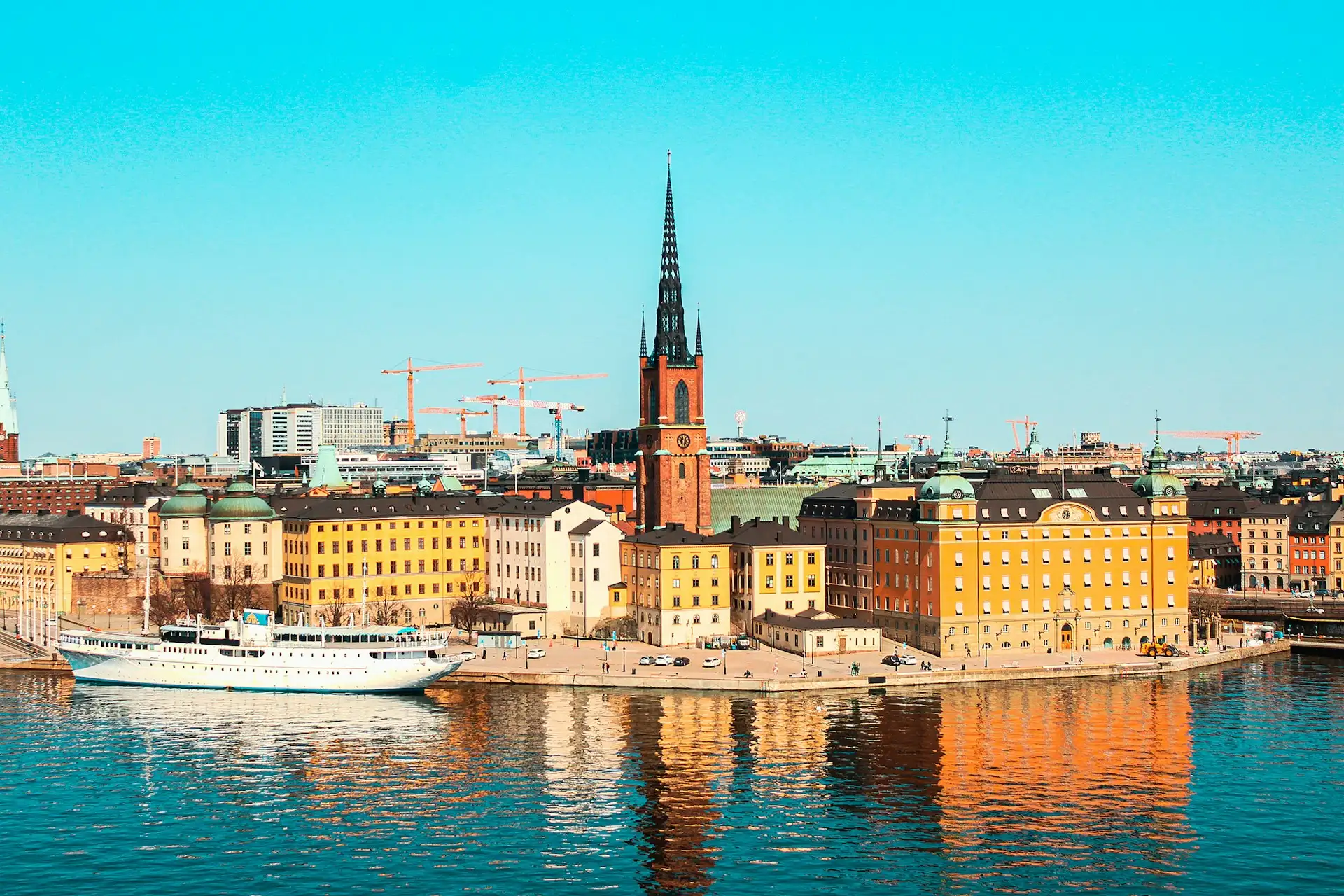
Fourteen islands and a warship that shouldn't exist
Stockholm is built across an archipelago rather than around a river or a hill, and the geography shapes everything about how the city feels: water is always somewhere in view, bridges and ferries do the work a normal street grid would elsewhere, and the pace is unhurried without ever feeling slow. Gamla Stan's medieval alleys, still a genuine residential neighbourhood rather than a preserved stage set, sit a short walk from the design galleries of Östermalm and the record shops and vintage stores of Södermalm.
The single object most worth planning a day around is the Vasa, a 17th-century warship that sank on its maiden voyage in 1628, sat on the harbor floor for 333 years, and was raised in 1961 96 percent intact. It is the best-preserved ship of its age anywhere in the world, and the museum built around it is Stockholm's most visited attraction for good reason. That single extraordinary object, paired with a genuinely walkable, well-run city around it, is what makes Stockholm work as a short break rather than just a stopover on the way to the fjords.
The honest complications
Stockholm is expensive, closer to London or Zurich prices than to the rest of Northern Europe, and that reality doesn't ease up much even for budget travellers who cook their own meals. Winter days are short and dark, useful to know if the visit is a pure city break rather than a base for a Lapland extension. And the city's calm, orderly reputation can tip into feeling a little reserved: Swedes are friendly once you're talking to them, but unsolicited small talk from strangers is rare, and newcomers sometimes mistake that for coldness rather than a different social default.
Six islands, six different cities
Stockholm's neighbourhoods are defined by which island they sit on, and each has a genuinely distinct character rather than being interchangeable inner-city districts. Where you base yourself comes down to how much atmosphere versus quiet you want, and how far you're willing to walk to dinner.
Gamla Stan
The medieval core of Stockholm, all cobblestones, ochre facades and narrow lanes, with the Royal Palace and Stortorget square at its center. It is genuinely beautiful and genuinely crowded with day-trippers by mid-morning; staying here means postcard views out the window and restaurant prices to match, with noise from the bars easing only after the tour groups clear out in the evening.
Norrmalm
Stockholm's downtown, home to Central Station, the main shopping streets and a cluster of well-regarded mid-range hotels. Less scenic than Gamla Stan but central enough to walk to almost everything, and the natural base for a first visit built around efficiency.
Södermalm
South of the old town, Södermalm is Stockholm's most interesting neighbourhood for eating, drinking and browsing: independent restaurants, vintage shops and some of the best viewpoints in the city over Gamla Stan and the water. If dinner matters more than the view from your hotel window, stay here.
Östermalm
Stockholm's most elegant residential district, with tree-lined streets, the Östermalms Saluhall food market, and the city's highest concentration of design boutiques and fine dining. A quieter, more residential pace than Norrmalm or Södermalm, still an easy walk or short transit ride from the center.
Djurgården
A green royal park island holding most of Stockholm's major museums, the Vasa Museum, Skansen, ABBA The Museum and Gröna Lund amusement park among them, plus walking and cycling paths along the water. Very few visitors stay here, but almost everyone spends the better part of a day on it.
Kungsholmen
Home to Stockholm City Hall, where the Nobel Prize banquet is held every December, and otherwise a mostly residential island with a genuinely local waterfront promenade. Good value accommodation and a real Stockholm neighbourhood feel, a short transit ride from the center.
From a ship-turned-hostel to a Nobel Prize institution
Stockholm's accommodation runs from a genuinely historic grand hotel to one of Europe's most unusual hostels, a 19th-century sailing ship. These picks cover the range, and each one has real character rather than chain-hotel sameness.
At the top, Grand Hôtel Stockholm, open since 1874 directly across the water from the Royal Palace, has hosted every Nobel laureate since the first Nobel Banquet was held there in 1901; rooms run from roughly $500 a night and the hotel's own history is worth a look even if you're staying elsewhere.
In the design bracket, Miss Clara by Nobis occupies an Art Nouveau building on Sveavägen in Norrmalm, a 20-minute walk from Gamla Stan, with a lively bar and genuinely stylish rooms, while Ett Hem in Östermalm, three converted early-20th-century townhouses with just 22 rooms, is built to feel like staying in a well-appointed private home rather than a hotel.
For genuine novelty, af Chapman & Skeppsholmen is a 285-bed hostel aboard a full-rigged 1888 sailing ship permanently moored on Skeppsholmen island, run by the Swedish Tourist Association since 1947, with harbor views most hotels can't match at any price. And at the budget end without the novelty premium, Generator Stockholm in Norrmalm offers clean dorms and private rooms with a sociable lounge and bar, a ten-minute walk from Central Station.
Meatballs, fika and a fermented fish you're allowed to skip
Stockholm's food scene runs from serious New Nordic fine dining to unpretentious neighbourhood spots where the day's köttbullar comes with mashed potato, lingonberry and a cream sauce that makes the whole plate work. Fika, the coffee-and-pastry ritual, is not optional background noise here: it's a genuine daily habit, and skipping it means missing part of how the city actually operates.
Köttbullar (meatballs)
Stockholm's defining comfort dish, done properly. Restaurant Pelikan on Blekingegatan in Södermalm, a working-class institution with roots back to the 1600s, serves oversized meatballs the size of golf balls in a bed of gravy-like brown sauce. Meatballs for the People on Nytorgsgatan, also in Södermalm, is Sweden's only meatball-focused restaurant, with handmade organic versions including beef, pork, moose and reindeer. Restaurang Prinsen, open since 1897, serves its "home-rolled" köttbullar with a rich cream sauce made from meat stock and port.
Fika: kanelbulle & semla
Fika is a full sitting-down ritual, not a coffee grabbed on the move. Vete-Katten on Kungsgatan, a patisserie and cafe founded in 1928, is one of Stockholm's most beloved traditional spots for a cinnamon bun (kanelbulle) or, from January to Easter, a cardamom-and-almond semla.
Smörgåsbord & sill
Pickled herring (sill) in mustard or dill marinades, eaten on crispbread with boiled potatoes and sour cream, is a smörgåsbord staple, especially around midsummer and Christmas. The Östermalms Saluhall food market is a good place to try a small plate without committing to a full spread.
A city best explored island by island
Stockholm's sights cluster naturally by island, which makes planning a day simple: pick an island, walk it, take the ferry or metro to the next one. A few things need advance booking in peak summer, and this chapter walks through the city roughly the way a good three days would.
Gamla Stan and the Royal Palace
Start in the old town early, before the cruise-ship crowds arrive. The Royal Palace, one of the largest palaces in Europe still in royal use, holds state apartments, the treasury and the armoury; the ceremonial changing of the guard takes place in the outer courtyard on a regular schedule worth checking on arrival, and it's free to watch even without an interior ticket. Stortorget, the old town's main square, is the prettiest spot for a coffee once the day-trip groups thin out, and the narrow lane of Mårten Trotzigs Gränd, Stockholm's narrowest street, is worth the short detour.
Djurgården's museums
Give Djurgården the better part of a full day. The Vasa Museum houses the 1628 warship raised nearly intact from the harbor floor in 1961, the best-preserved vessel of its age anywhere in the world (170-190 SEK). Skansen, the world's oldest open-air museum, combines historic Swedish buildings moved from around the country with a zoo of Nordic wildlife, a solid full day for families on its own (185-305 SEK depending on season). ABBA The Museum is an interactive, unabashedly fun tribute to Sweden's best-known pop export (roughly 250-330 SEK). Round out the island with Fotografiska, a photography museum with strong rotating exhibitions and one of the city's best café views, back across the water in Södermalm (200 SEK weekdays, 230 SEK weekends).
City Hall and Kungsholmen
Stockholm City Hall (Stadshuset), a red-brick landmark completed in 1923, hosts the Nobel Prize banquet in its Blue Hall every December 10th; guided tours run through the Blue Hall and the gold-mosaic Golden Hall, and the tower offers one of the best panoramic views in the city in summer months when it's open to climb.
Södermalm's viewpoints and street life
Södermalm rewards wandering more than any checklist: the hilltop viewpoint at Monteliusvägen looks back across the water to Gamla Stan and City Hall, especially good at sunset, and the streets around Nytorget and Skanstull hold the independent shops, record stores and cafes that give the island its character. This is also where much of Stockholm's best casual eating happens, well away from the tourist-menu prices near the old town.
One, two or three days, island by island
Three full days covers Stockholm properly, including a taste of the archipelago; even one well-planned day delivers the essentials. These routes are sequenced to dodge the worst crowds and end each day somewhere worth being at golden hour.
- Morning
Gamla Stan. The Royal Palace courtyard, Stortorget, and the narrow lanes before the crowds build.
- Midday
Vasa Museum. Ferry or bus across to Djurgården; give the ship at least 90 unhurried minutes.
- Afternoon
Skansen or ABBA The Museum. Pick one based on whether you're travelling with kids (Skansen) or want the pure fun option (ABBA).
- Evening
Södermalm. Dinner and the Monteliusvägen viewpoint at sunset, looking back across the water to Gamla Stan.
- Day 1
The one-day route: Gamla Stan, Vasa Museum, Djurgården, Södermalm at sunset.
- Day 2 morning
City Hall. A guided tour of the Blue and Golden Halls, then a fika stop at Vete-Katten.
- Day 2 afternoon
Östermalm. The Saluhall food market, design boutiques, and a slower browse through the neighbourhood's quieter streets.
- Day 2 evening
Meatballs, properly. Dinner at Restaurant Pelikan or Meatballs for the People in Södermalm.
- Days 1-2
The two-day route above, at a gentler pace.
- Day 3
Archipelago. A ferry to Fjäderholmarna for a half-day taste of the islands, or further out to Vaxholm for a full day; both run on public transport.
Compact, well-run, and built around water
Stockholm's central islands are compact enough to walk between in most cases, and the Tunnelbana metro, buses and SL ferries handle everything else efficiently. From Arlanda Airport (ARN), the Arlanda Express train reaches Central Station in 18 minutes for 340 SEK one-way (cheaper booked ahead or split between two travellers); airport buses (Flygbussarna) take around 45 minutes for less, and a taxi runs a fixed rate typically higher than either.
In the city, get the SL travel card: a single ticket costs around 42-43 SEK, valid for 75 minutes across the metro, buses and trams, while a 24-hour pass (roughly 165-175 SEK) or 72-hour pass (roughly 350-415 SEK) pays for itself quickly for anyone doing more than a couple of rides a day. Inner-archipelago SL ferries, including the route to Fjäderholmarna, run on the same ticket system as the metro. Stockholm's bike-share network and the flat central islands make cycling a genuinely good option outside winter.
Best time to visit and midsummer
Stockholm has a temperate climate with a real seasonal swing. June to August is warm and light, including near-24-hour daylight close to the summer solstice; May and September are quieter with lower prices and still-decent weather. Winter is cold and dark, useful mainly as a base for a short excursion rather than the main event, unless you're specifically after a quiet, snowy city break.
Midsummer, the Friday closest to the summer solstice in late June, is one of Sweden's most important holidays. Many Stockholmers leave the city for the countryside, so some restaurants and shops close for the long weekend even as the city itself stays beautiful and unusually quiet.
One of Northern Europe's pricier capitals
Stockholm is genuinely expensive, closer to London or Zurich than to most other European capitals. The hostel and mid-range hotel scene is solid, but the main cost trap for budget travellers is eating out for every meal; grocery stores and market halls stretch a food budget much further than restaurants do.
- Hostel dorm 300-500 SEK
- Grocery meals + one fika
- SL 24-hour transit pass
- Free viewpoints, palace courtyard
- Mid-range hotel 1,500-3,000 SEK
- Restaurant meals 150-250 SEK
- One or two museum entries
- Archipelago ferry day trip
- Grand Hôtel or equivalent
- Fine dining, tasting menus
- Private guided tours
- Taxis over transit
One of Europe's safer capitals, with one thing to know
Stockholm rates well on independent safety indexes and consistently outranks other major European capitals like London, Paris or Rome. Violent crime against tourists is rare, and the city center, Södermalm and Östermalm all feel safe to walk at night with normal urban awareness. Sweden's well-documented gang violence is real but concentrated among criminal networks in specific outer suburbs, essentially never affecting the areas visitors actually spend time in.
The one thing that actually catches visitors: pickpocketing, concentrated around Gamla Stan, Central Station, the airport and crowded summer public transport, so keep bags closed and in front of you in these specific spots. Stockholm is also excellent for solo female travellers: harassment is uncommon and the city consistently scores near the top of European safety indexes for women travelling alone. Emergency number is the EU-standard 112 from any phone.
The archipelago is the reason to add an extra day
Stockholm's position at the edge of a Baltic archipelago of tens of thousands of islands makes it an outstanding base for day trips, several of them reachable on ordinary public transport rather than a booked tour.
Fjäderholmarna
The closest archipelago island to the city center, with craft workshops, a small museum and a handful of restaurants. The easiest, shortest possible "taste of the archipelago" for a half day.
Vaxholm
Often called the capital of the archipelago, Vaxholm has a 16th-century fortress guarding the main shipping channel and streets of pastel wooden houses with summer cafes. A comfortable full day out and back.
Drottningholm Palace
The private residence of the Swedish royal family and a UNESCO World Heritage Site, with formal gardens and a beautifully preserved 18th-century court theatre. Palace entry runs around 70 SEK for adults; reach it via the T-bana to Brommaplan then a connecting bus, or a direct boat from central Stockholm in summer.
Uppsala
Sweden's oldest university city, with a Gothic cathedral, a hilltop castle and a lively student-town atmosphere. Frequent SJ trains make it an easy half-day or full-day trip from Stockholm Central.
Stockholm FAQ
Is Stockholm safe for tourists?
Yes. Stockholm is one of the safer capital cities in Europe; violent crime against tourists is rare. The main practical concern is pickpocketing around Gamla Stan, Central Station and crowded public transport.
How many days do I need in Stockholm?
Three full days covers the city well: one for Gamla Stan and the Royal Palace, one for the Djurgården museums, one for Södermalm and an archipelago day trip. A fourth day fits Uppsala or Drottningholm.
How much does Stockholm cost per day?
Budget travellers manage on 700-1,000 SEK a day with hostels and grocery meals; mid-range runs 1,800-2,800 SEK. Stockholm is one of the pricier capitals in Europe, closer to London or Zurich than to most of the Nordics' neighbours.
When is the best time to visit Stockholm?
June through August for long daylight and warm weather, including midsummer in late June. May and September are quieter with lower prices. Winter is cold and dark but atmospheric, and a reasonable base for a short Lapland extension.
What is the best area to stay in Stockholm?
Norrmalm or Södermalm for first-timers: central, well connected by transit, and close to both the sights and the best eating. Gamla Stan is the most atmospheric but noisier and pricier; Östermalm suits a quieter, more upscale stay.
How do I get from Arlanda Airport to central Stockholm?
The Arlanda Express train reaches Central Station in 18 minutes for 340 SEK one-way, cheaper booked ahead or for two travellers together. Airport buses and taxis are slower and not necessarily cheaper once transfer time and fixed rates are factored in.
Is Stockholm expensive?
Yes, among the pricier cities in Europe. A casual lunch runs 120-180 SEK, a beer 70-90 SEK, and hotel prices sit closer to London or Zurich than to most of the rest of Northern Europe.
Can I do a day trip to the archipelago from Stockholm?
Yes, easily. Inner archipelago islands like Fjäderholmarna or Vaxholm are reachable on regular public ferries, some covered by a standard SL transit ticket, making an island day trip as simple as riding the metro.
Is Stockholm walkable?
Yes, the central islands are compact and flat by Nordic capital standards, and the metro (Tunnelbana) and ferries cover the rest efficiently. Gamla Stan's cobblestones are the only real obstacle, so comfortable shoes help.
What is the SL card and do I need one?
Stockholm's public transport card, covering the metro, buses, trams, commuter trains and inner-archipelago SL ferries. A single ticket costs around 42-43 SEK; a 24-hour pass (roughly 165-175 SEK) pays for itself after about four rides.
What Stays With You
Stockholm doesn't perform for visitors, and that restraint is exactly what makes it memorable. The city runs on its own quiet competence, the trains arrive when they say they will, the parks are genuinely full of locals rather than staged for photos, and lets you walk through the middle of it. The Vasa looming intact in its dim museum hall. The particular gold light on Gamla Stan's facades from the Södermalm viewpoints at nine on a June evening. The meatballs that turned out to be better than the ones from the tourist-menu place two streets over.
Take the ferry out to Fjäderholmarna on your last afternoon, even if it's just for an hour, and understand why Stockholmers never really think of the archipelago as a separate trip. It's just Stockholm, further out.