
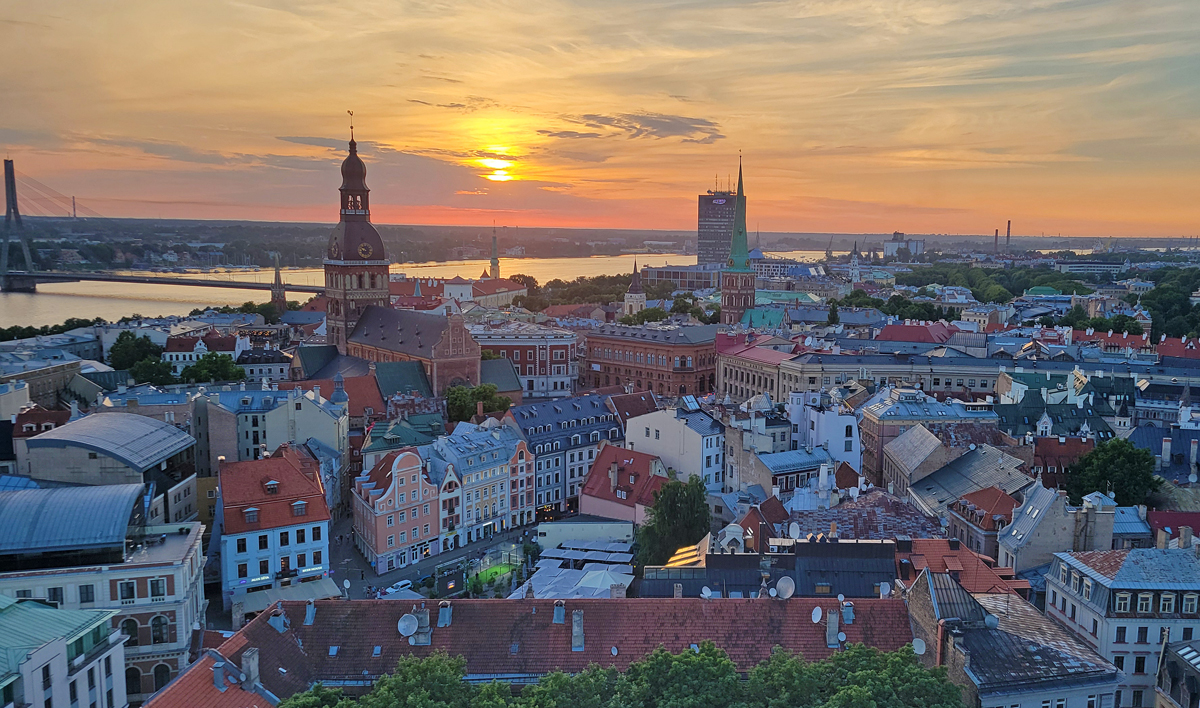
The Baltics' most architecturally ambitious capital
Riga sits on the Daugava River a few kilometers from the Gulf of Riga, its Old Town a genuine medieval survivor wrapped by a ring of parks where the city walls used to stand, and beyond that, block after block of Art Nouveau apartment buildings from a building boom around 1900 that nobody got around to tearing down. The result is a UNESCO World Heritage listing that covers both halves of the city's identity at once: the crusader-and-Hanseatic core, and the largest concentration of Art Nouveau architecture found anywhere in Europe, over 800 buildings by most counts.
What's changed in the last decade is the food. Riga's restaurant scene has gone from an afterthought to genuinely serious, with two Michelin-starred kitchens and a handful of Bib Gourmand addresses as of 2026, all still priced well below their Stockholm or Copenhagen equivalents. The city rewards walking: the Old Town, the Art Nouveau district and the Central Market's Zeppelin-hangar pavilions all sit within twenty minutes of each other on foot.
The honest complications
Riga's Old Town bar streets get genuinely rowdy on summer weekend nights, and a handful of venues there have had reports of drink spiking and pushy attention toward solo women; it's not a citywide problem, but it's worth knowing before a late night out. The city is also proud in a specific, understated way about not being Tallinn or Vilnius, and Latvians will occasionally bring up the comparison unprompted. Winters are long, dark and cold, useful context if your only mental image of the Baltics comes from a July photo, and Latvia's history under Soviet occupation is not a closed subject; it shapes both the built environment and the conversation more than a short visit might suggest.
Four districts that matter
Riga's neighbourhoods split cleanly between the tourist-dense historic core, the residential districts around it, and the left bank across the Daugava. Where you base yourself comes down to how much nightlife noise you want under your window.
Vecrīga (Old Town)
The UNESCO-listed medieval core: the Freedom Monument, House of the Blackheads, St. Peter's Church and Riga Castle all sit within its narrow streets, alongside the city's densest cluster of restaurants and bars. Staying here means everything is a five-minute walk, at the cost of weekend bar noise that runs late into a short summer night.
Centrs
Riga's downtown wraps around the Old Town on its landward side and holds the Art Nouveau district, Alberta iela included, plus the Central Station and the Central Market. Quieter at night than Vecrīga, still a ten-to-fifteen-minute walk to everything, and the practical choice for a first visit.
Miera iela
A single corridor north of the center that's become Riga's independent-culture strip: galleries, vintage shops and a growing wine bar scene built into what was a grim Soviet-era industrial area. A short tram ride from the Old Town, worth an afternoon even if you don't stay here.
Āgenskalns
Across the Daugava, Riga's oldest suburb: 19th-century wooden houses, the Kalnciema Quarter weekend market, and a slower pace five minutes from the center by tram. Best for a second visit or travellers who want the city with fewer other tourists in the frame.
From Art Nouveau hotels to the Baltics' most-awarded hostel
Riga's accommodation runs from converted Art Nouveau apartment buildings to a hostel that has repeatedly been named the best in Latvia. These picks cover every budget, each earning its place rather than filling a slot.
At the top, Grand Palace Hotel, a member of Small Luxury Hotels of the World barely 100 meters from Riga Castle, is the city's standout luxury address, from about €200 a night for a genuinely central, quietly grand stay. Pullman Riga Old Town (from €150), a sleek contemporary property just inside the old city gates, adds a rooftop bar with views over the Old Town's spires and a large fitness suite, worth the small premium over a period property if modern comfort matters more to you than historic character.
In the boutique bracket, Neiburgs Hotel (from €110) puts the Art Nouveau theme into the building itself, an early-1900s property overlooking Dome Square with air-conditioned rooms and kitchenette apartments, a smart choice for a longer stay in the heart of the Old Town.
At the budget end, The Naughty Squirrel Backpackers (from €15), roughly 300 meters from the main Old Town square, has been named Latvia's best hostel more times than any other property in the city and is the default first stop for solo travellers looking to meet people. Cinnamon Sally Backpackers (from €14), also in the Old Town, is the quieter, more homely alternative when you want a hostel without the party reputation.
Grey peas, rye bread and Black Balsam, roughly in that order
Riga's food scene has quietly become one of Northern Europe's most interesting, built on hearty Latvian staples at one end and a new generation of chefs applying real technique to those same ingredients at the other. The city earned two Michelin stars and several Bib Gourmand nods in the 2026 guide, still at prices that would be a fraction of a comparable meal in Stockholm.
Grey peas with bacon
Pelēkie zirņi ar speķi, Latvia's closest thing to a national dish: field peas stewed with smoked bacon and onion. Milda, on Kungu iela in the Old Town and named for the figure atop the Freedom Monument, does a well-regarded version alongside cepelinai, the Baltic potato dumplings, with generous portions and warm, genuine service.
Riga Black Balsam
A bitter 45%-proof herbal liqueur invented in 1752 by pharmacist Abraham Kunze, sold in its distinctive black ceramic bottle in every souvenir shop and behind most bars. Drink it neat, warmed into hot black currant juice, or mixed into a coffee at the end of a meal.
New Nordic-Latvian fine dining
Max Cekot Kitchen and JOHN Chef's Hall both hold a Michelin star as of the 2026 guide, the latter led by chef Kristaps Sīlis with a contemporary, author-driven approach to Latvian ingredients. SMØR Bistro, whose chef Kaspars Barsukovs personally shops the Central Market every morning, earned both a Bib Gourmand and the guide's "Opening of the Year" recognition; Snatch and Shōyu have each held Bib Gourmand status for three consecutive years.
Rupjmaize & smoked fish
Dense, dark rye bread and smoked Baltic herring or sprats, sold across the Central Market's meat, dairy and fish pavilions, five vast halls built in the 1920s from repurposed German Zeppelin hangars. Riga sprats in oil are the classic edible souvenir; the gastronomy pavilion added in recent years is where working Rigans actually eat lunch, a few euros a plate, standing at a counter.
A city best explored on foot, one facade at a time
Riga rewards unhurried walking more than ticking off a list. Most of the best experiences don't need advance booking; a handful do, and this chapter walks through the city roughly the way a good two or three days would.
The Old Town landmarks
Start at the Freedom Monument, the 42-meter column topped by the bronze figure Latvians call Milda, guarded around the clock and the emotional center of the city since 1935. From there it's a short walk to Town Hall Square and the House of the Blackheads, a Gothic merchant guild hall rebuilt after wartime destruction, and on to St. Peter's Church, whose 123-meter tower has an elevator to an observation deck (around €10) with the best rooftop view over the Old Town's red roofs and the Daugava beyond. Riga Castle, founded in 1330 on the riverbank and now the official residence of Latvia's president, rounds out the historic core.
Alberta iela and the Art Nouveau district
Walk north out of the Old Town into Centrs and the architecture changes completely. Alberta iela holds five buildings designed by Mikhail Eisenstein (father of filmmaker Sergei Eisenstein), their facades covered in sphinxes, screaming masks, peacocks and sculptural reliefs within 500 meters of street, the single densest stretch of Art Nouveau anywhere in Europe. Elizabetes and Strēlnieku streets nearby carry the movement into a calmer National Romantic style; give the whole district an unhurried morning, camera out, looking up more than you'd expect to.
The Central Market
Five pavilions built in the 1920s from repurposed German Zeppelin hangars, part of the same UNESCO listing as the Old Town and one of Europe's largest markets. Meat, dairy, fish and produce each get their own hall; go hungry, and budget an hour for wandering plus lunch at the newer gastronomy pavilion.
Evenings in Riga
The Old Town's bar streets around Vecpilsētas iela and Kalēju iela stay busy until the early hours on summer weekends; for a calmer evening, Miera iela's wine bars and Centrs' quieter cafes are the better bet. The Latvian National Opera and Ballet, housed in a restored 1863 building, is genuinely world-class and considerably cheaper than equivalent seats in Western Europe; book ahead in peak season.
One, two or three days, planned street by street
Two to three full days covers Riga properly; even one well-planned day delivers the essentials. These routes are walkable and sequenced to dodge the worst midday crowds around the main square.
- Morning
Old Town landmarks. Freedom Monument, Town Hall Square and the House of the Blackheads, then up St. Peter's tower before the midday queues build.
- Midday
Grey peas at Milda. Lunch in the Old Town, then a walk to Riga Castle along the riverbank.
- Afternoon
Alberta iela. The short walk north into Centrs for the Art Nouveau district's five Eisenstein buildings.
- Evening
Central Market for a Black Balsam, then dinner back in the Old Town or Centrs.
- Day 1
The one-day route: Freedom Monument, St. Peter's tower, Riga Castle, Alberta iela, Central Market.
- Day 2 morning
Miera iela. A slower morning in the hip north-of-center corridor, galleries and coffee.
- Day 2 afternoon
Āgenskalns. Tram across the Daugava for the wooden architecture and the Kalnciema Quarter market on weekends.
- Day 2 evening
A tasting menu at one of the city's Michelin-recognized kitchens, booked ahead.
- Days 1-2
The two-day route above, at a gentler pace.
- Day 3, option A
Jūrmala by train. 25-30 minutes to the beach, Dzintari forest park and the observation tower, dinner on Jomas iela before the last train back.
- Day 3, option B
Sigulda and Gauja National Park. Turaida Castle, Gutmanis Cave and, if timing allows, a bobsled run through the forested valley.
Compact enough to walk, well-connected enough to skip a car
Riga's historic center is genuinely walkable, flat, and small enough that most first-time visitors barely need public transport inside it. Riga International Airport (RIX) is the Baltic region's busiest airport and airBaltic's home hub, with direct connections to roughly 80 to 100 destinations depending on season. From the airport, bus 22 reaches the city center in 25 to 35 minutes for €1.50; Bolt costs roughly €10-15; a fixed-rate taxi runs about €33.50. There's no rail link between the airport and downtown as of 2026.
Within the city, trams, trolleybuses and buses run on a single ticketing system: a 90-minute e-ticket costs about €1.50, a day pass around €5. Bolt is cheap and reliable for trips beyond walking distance, especially to Āgenskalns or Miera iela late at night. For Jūrmala and Sigulda, the regional train from Riga Central Station is the easiest option; Rundāle Palace, further south, is realistically a rental-car or organized-tour trip rather than an independent one.
Best time to visit and daylight hours
Riga has a temperate, distinctly Baltic climate. Late May through June and September are the sweet spots: mild days, long daylight (close to 18 hours around the summer solstice) and manageable crowds. July and August are the warmest months and the only realistic Jūrmala beach weather, but also the busiest. Winter brings only around six hours of daylight in December but a genuinely atmospheric Christmas market in Town Hall Square.
One of Northern Europe's best-value capitals
Riga is significantly cheaper than Stockholm, Copenhagen or Amsterdam, and similar to or a shade below Tallinn. The hostel scene is excellent at the budget end, and the main cost trap is the handful of Old Town restaurants that quietly price for tourists rather than locals.
- Hostel dorm €15-25
- Market and bakery meals €10-18
- Tram/bus tickets €1.50
- Free Old Town and Alberta iela walking
- Boutique or Art Nouveau hotel €90-160
- Restaurant meals €25-45
- Bolt plus the occasional transit pass
- St. Peter's tower, a museum, a day trip
- Grand Palace Hotel or equivalent €200+
- Michelin-starred tasting menus
- Private guided day trips
- Opera or ballet at the National Opera
One of the Baltics' safest capitals, with two things to know
Riga rates 8.7/10 on our safety scale and is regularly considered the safest capital in the Baltics for women. Violent crime against tourists is extremely rare, and the city center feels safe to walk at night with normal urban awareness, including in Centrs and along the Old Town's main routes.
The two things that actually catch visitors: pickpocketing, concentrated around the Old Town's busiest squares, Riga Central Station, the central bus station and the Central Market, especially during the June-to-September peak season, so keep bags closed and in front of you; and nightlife caution, since some Old Town bars have had reports of drink spiking and persistent unwanted attention toward women traveling alone, so watch your drink and use Bolt rather than an unmarked taxi late at night. That's the whole list. Emergency number is the EU-standard 112 from any phone.
The Baltic coast and a national park, both under an hour away
Riga's position makes it an excellent base for the rest of Latvia. Three trips are worth a day each, and the first two run easily by train from Riga Central Station.
Jūrmala
Twenty-six kilometers of white sand along the Gulf of Riga, with a 19th-century spa-town atmosphere along the pedestrian Jomas iela. Dzintari has the liveliest beach stretch, a forest park with a rope course, and a 38-meter observation tower. Best June through August; a quiet, moody walk along an empty shore the rest of the year.
Sigulda & Gauja National Park
Latvia's oldest national park, with Turaida Castle (built 1214, climbable tower) and Gutmanis Cave, the largest cave in the Baltic states, both a short walk from the Sigulda train station. The Olympic-standard bobsleigh track, built for the 1993 World Championships, offers rides up to 80 km/h with a professional driver.
Rundāle Palace
One of the finest Baroque and Rococo buildings in the Baltics, built 1736-1740 to a design by Bartolomeo Rastrelli, the architect behind St. Petersburg's Winter Palace. Public transport requires a bus change at Bauska that makes it impractical for a single day; go by rental car or an organized day tour instead.
Riga FAQ
Is Riga safe for tourists?
Riga is one of the safest capitals in the Baltics. Violent crime against tourists is extremely rare; the main concerns are pickpocketing around the Old Town and central station, and drink safety in some nightlife venues. Standard city awareness is all you need.
How many days do I need in Riga?
Two to three full days covers the city well: one for the Old Town's landmarks, one for the Art Nouveau district and the Central Market, and a third for Jurmala or Sigulda. A fourth day fits a second day trip and is worth adding.
How much does Riga cost per day?
Budget travellers manage on €35-50 a day with hostels and market food; mid-range runs €80-120. Riga is noticeably cheaper than Stockholm, Copenhagen or Amsterdam and similar to or slightly below Tallinn.
When is the best time to visit Riga?
Late May through June and September: long daylight, mild weather, manageable crowds. July and August are warmest and busiest, especially around Jurmala's beach; the Riga Christmas Market in Town Hall Square in December has its own considerable charm.
Is Riga better than Tallinn or Vilnius?
They're different cities for different tastes. Riga has the boldest architecture, the largest concentration of Art Nouveau in Europe, and the liveliest food scene of the three Baltic capitals; Tallinn's Old Town is more tightly preserved and closer to Helsinki by ferry; Vilnius leans more Baroque and is closer to Poland. All three are close enough to combine on one trip.
How do I get from Riga airport to the centre?
Bus 22 runs from the airport to the city centre in 25-35 minutes for €1.50. Bolt rideshares cost roughly €10-15, and a fixed-rate taxi runs about €33.50. There's no rail link between the airport and downtown as of 2026.
What is the best area to stay in Riga?
Vecriga (Old Town) or Centrs for first-timers: central, walkable and close to everything. Centrs, home to the Art Nouveau district, is slightly quieter at night than the Old Town's bar streets. Miera iela suits travellers who want a more local, less touristy base a short tram ride out.
Do I need to speak Latvian in Riga?
No. English is widely spoken in Riga's hotels, restaurants and tourist-facing businesses, especially among people under 40. A few words, paldies (thank you) and lūdzu (please), go a long way and are genuinely appreciated.
What is Alberta iela?
A single street in Riga's Quiet Center district with the densest concentration of Art Nouveau architecture in Europe, including five buildings designed by Mikhail Eisenstein, father of filmmaker Sergei Eisenstein. It's free to walk and one of the best 30 minutes in the city.
What Stays With You
Riga doesn't ask to be your whole trip, and that's exactly why it works as one. The city gets on with its own life, market vendors weighing out grey peas by the kilo, teenagers cutting through Alberta iela without a glance upward at the sphinxes above them, the Freedom Monument's honor guard changing shifts with nobody in the square particularly watching, and lets you walk through the middle of it. The market's Zeppelin hangars, the first Black Balsam of the trip, the facade you didn't expect to stop you mid-sentence: none of it was staged for you, which is why all of it sticks.
Walk Alberta iela once in the morning light and once at dusk before you leave, and understand why Latvians insist their capital, not a more famous one two borders over, has the best architecture in the Baltics.