

What You're Actually Getting Into
Latvia is the middle of the three Baltic states, geographically and, in a sense the Latvians would probably not thank you for pointing out, in reputation: less internationally famous than Estonia's tech-forward Tallinn, less romanticized than Lithuania's baroque Vilnius, and quietly better than both at the one thing that actually matters for a short trip, which is a capital city dense enough with things worth seeing that you never have to manufacture a reason to walk somewhere. Riga's Old Town is a UNESCO World Heritage Site twice over in the same listing: once for a medieval street plan that traders, Teutonic knights and Hanseatic merchants fought over from the 13th century onward, and once for the largest concentration of Art Nouveau architecture found anywhere in Europe, the accidental result of a building boom around 1900 that Riga's 20th-century wars and Soviet decades never got around to demolishing.
Latvia is also, deliberately, an easy country to be a tourist in. It has been an EU and NATO member since 2004, joined the Schengen Area in 2007 and adopted the euro in 2014, so nothing about entry, payment or connectivity requires research most visitors would think to do. English is close to universal among people under 40 in Riga, the tourism infrastructure is excellent for a city its size, and prices sit comfortably below Stockholm, Copenhagen or Amsterdam, a fact regular visitors to the Nordic countries notice immediately.
The honest complications
Latvia spent 1940 to 1991 under Soviet occupation (with a brutal Nazi German interruption from 1941 to 1944), and that history is not a museum exhibit, it's a living political fact: roughly a quarter of Latvia's population is ethnically Russian, the country sits on NATO's eastern frontier, and since Russia's full-scale invasion of Ukraine in 2022 Latvia has recorded periodic stray drones crossing from Russian and Belarusian airspace into its eastern border regions, intercepted by NATO air policing rather than anything that reaches Riga or the tourist circuit. It's worth understanding before you arrive, not because it should change your plans, but because Latvians will occasionally reference it in a way that assumes you already know the outline. Riga's winters are also genuinely dark and cold, useful information if your only reference point for the Baltics is a July travel photo, and Jurmala's beach season is shorter than the postcards imply, essentially June to August.
A History Worth Knowing
Latvian is one of only two surviving Baltic languages, alongside Lithuanian, an ancient linguistic family with roots that some historical linguists trace closer to Sanskrit than to neighboring Slavic or Germanic tongues. German crusaders and merchants founded Riga in 1201; the centuries since have run through Livonian, Polish-Lithuanian, Swedish and Russian imperial rule before a brief window of independence from 1918 to 1940, brutal Soviet and Nazi occupations through the Second World War, nearly fifty more years under the USSR, and a 1991 return to independence that Latvians won, in large part, by singing.
- 1201
Riga founded. German Bishop Albert establishes the city as a base for the crusading Livonian Brothers of the Sword, and it joins the Hanseatic League soon after.
- 1918
First independence. The Republic of Latvia is declared on 18 November as the Russian and German empires collapse at the end of the First World War.
- 1940–1991
Occupation. Soviet annexation in 1940, Nazi German occupation from 1941, Soviet reoccupation from 1944. Mass deportations to Siberia, including roughly 15,000 people on a single night, 14 June 1941, remain a defining national wound.
- 1987–1991
The Singing Revolution. Mass gatherings built around Latvian folk song, culminating in the Baltic Way of 23 August 1989, a human chain of roughly two million people across Estonia, Latvia and Lithuania, and full independence recognized on 21 August 1991.
- 2004
EU and NATO. Latvia joins both in the same year, cementing its westward turn after half a century under Moscow.
- 2014–present
Eurozone and growth. Latvia adopts the euro in 2014; Riga's tourism, tech and startup sectors expand through the 2010s and 2020s.
Read the full history: crusaders, empires, occupation and the Singing Revolution
Before German crusaders arrived, the territory of modern Latvia was home to Baltic and Finnic tribes, Livs, Latgalians, Selonians, Semigallians and Curonians, whose names survive today in Latvia's historical regions. Riga's founding in 1201 brought it quickly into the German-dominated Livonian Confederation and the Hanseatic trading network, and the Old Town's street plan still traces those medieval merchant origins.
Centuries of shifting overlordship followed: Polish-Lithuanian rule after the Livonian Confederation's collapse in the 1560s, Swedish control of much of the territory through the 17th century, and absorption into the Russian Empire following the Great Northern War in the early 1700s, where Latvia remained until 1918. The First World War's collapse of both the Russian and German empires opened a narrow window for Latvian independence, declared on 18 November 1918 and defended through a brutal war of independence against both Soviet and German forces.
That independence lasted barely two decades. The 1939 Molotov-Ribbentrop Pact between Nazi Germany and the Soviet Union assigned Latvia to the Soviet sphere; Soviet occupation began in 1940, followed by Nazi German occupation from 1941 to 1944 and the Holocaust's near-total destruction of Latvia's Jewish community, then renewed Soviet occupation until 1991. Mass deportations to Siberia, most infamously on the night of 13 to 14 June 1941, when close to 15,000 people, including children, were loaded onto cattle cars with almost no warning, remain one of the defining traumas in Latvian national memory, marked annually on 14 June.
The Singing Revolution. Mikhail Gorbachev's glasnost reforms in the late 1980s allowed long-suppressed Latvian, Estonian and Lithuanian nationalism to surface through mass public singing of folk songs banned or discouraged under Soviet rule. It built toward the Baltic Way on 23 August 1989, when an estimated two million people joined hands in a continuous human chain roughly 675 kilometers long, stretching from Tallinn through Riga to Vilnius, marking the 50th anniversary of the Molotov-Ribbentrop Pact. Latvia declared the restoration of independence in May 1990, and the Soviet Union formally recognized it on 21 August 1991, days after a failed hardline coup in Moscow.
The post-independence decades brought rapid Westward realignment: EU and NATO membership in 2004, Schengen entry in 2007, and the euro in 2014. Roughly a quarter of Latvia's population remains ethnically Russian, a legacy of Soviet-era migration policy, and questions of language, citizenship and history remain live political topics, especially since 2022.
Top Destinations
Latvia is small enough, and Riga central enough, that almost everything worth seeing sits within a day trip of the capital. Five zones cover it: Riga's Old Town, the Art Nouveau district that spreads out from it, the Baltic coast at Jurmala, the forests and castles of Gauja National Park, and the Baroque palace country to the south. A week covers all five without rushing; four days covers the first three comfortably.
Vecrīga, the medieval core
Riga's Old Town is compact enough to cross on foot in twenty minutes and dense enough that you won't want to. The Freedom Monument, a 42-meter column topped by a bronze figure Latvians call Milda, holding three stars representing the country's historic regions, is the emotional center: built in 1935, it survived the Soviet era as an unofficial gathering point for national sentiment and is guarded around the clock. The House of the Blackheads, a Gothic merchant guild hall on Town Hall Square rebuilt after wartime destruction, and St. Peter's Church, whose 123-meter tower has an elevator to an observation deck with the best rooftop view of the Old Town's red roofs, anchor the historic center. Riga Castle, founded in 1330 on the Daugava riverbank, is the official residence of Latvia's president. Budget two full days.
Alberta iela and the Quiet Center
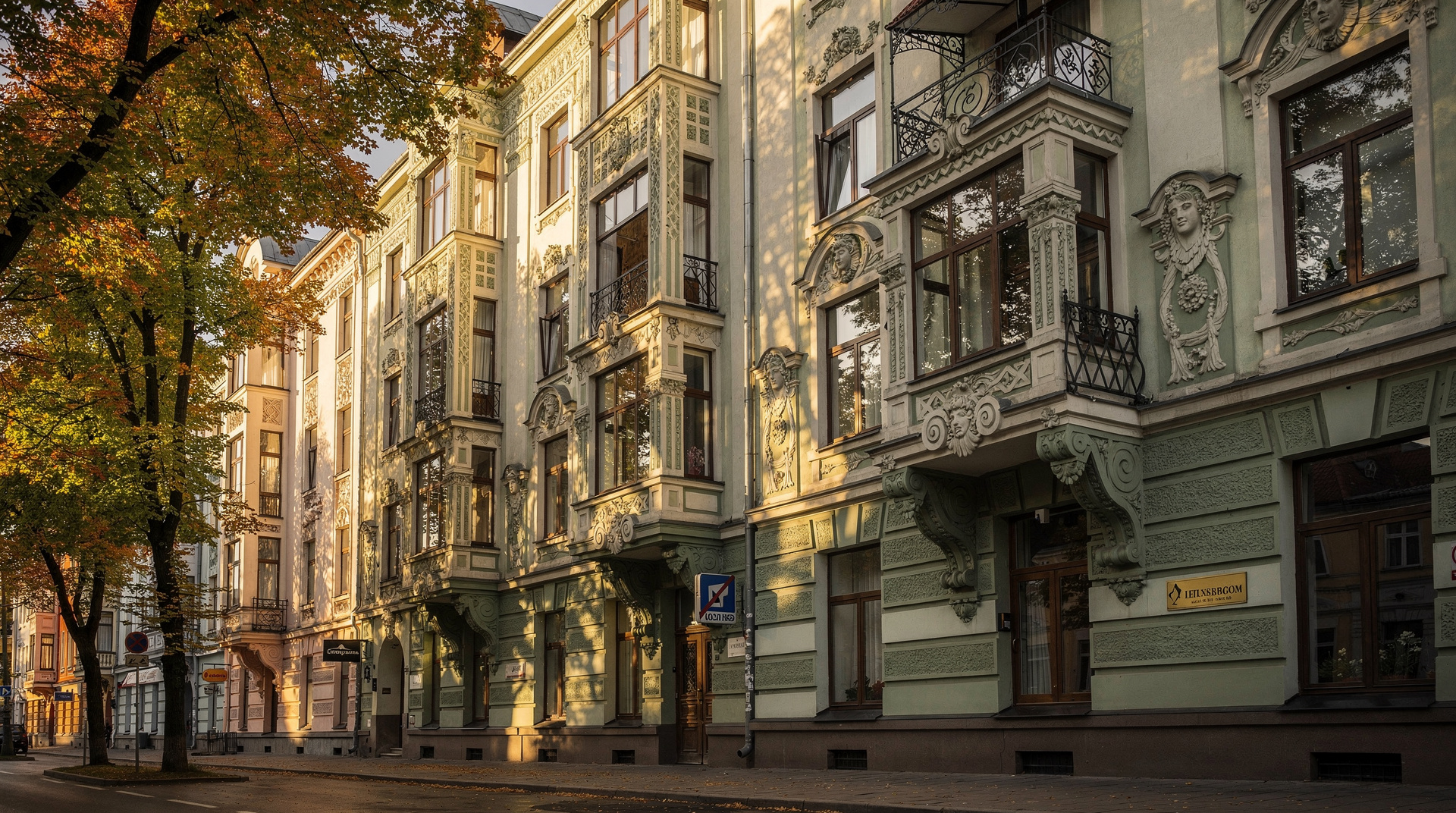
Riga has the finest collection of Art Nouveau buildings in Europe, with more than 800 across the city and around 50 in the Old Town alone. The single best concentration is Alberta iela in the district locals call the Quiet Center, just north of the Old Town: five buildings on this one street were designed by Mikhail Eisenstein (father of the filmmaker Sergei Eisenstein), their facades covered in sphinxes, screaming masks, peacocks and sculptural reliefs that verge on theatrical excess. Elizabetes and Strēlnieku streets nearby carry the movement further, in a calmer, more geometric National Romantic style that developed as a specifically Latvian answer to the Viennese and Parisian original.
Jūrmala, the Baltic beach resort
Jūrmala is a strip of seaside towns roughly 25 to 30 minutes from central Riga by train, with 26 kilometers of soft white sand along the Gulf of Riga and a 19th-century spa-town heritage that once drew Russian imperial nobility and later Soviet-era elites. Dzintari has the liveliest stretch of beach, a forest park with a Tarzan-style rope course, and a 38-meter observation tower with panoramic views over the pines and coastline. Jomas iela, the pedestrian main street, is lined with cafes and wooden villas, some restored, some gently decaying, that give the town its particular faded-grandeur atmosphere. June through August is genuine beach weather; outside those months it's a quieter walk along an empty shore.
Sigulda, the "Switzerland of Latvia"
Sigulda sits inside Gauja National Park, Latvia's oldest and largest protected area, roughly an hour from Riga by train or bus. Turaida Castle, a red-brick tower dating to 1214, has a climbable tower with views across the pine-forested Gauja valley. Gutmanis Cave, the largest cave in the Baltic states at 19 meters deep, has drawn visitors for centuries, its sandstone walls carved with names and dates going back to the 1600s. For something less contemplative, Sigulda's Olympic-standard bobsleigh, luge and skeleton track, built for the 1993 World Championships, lets visitors ride a real bobsled with a professional driver, reaching speeds up to 80 km/h; a natural-ice version runs in winter.
Rundāle Palace
Rundāle Palace, built between 1736 and 1740 as the summer residence of Ernst Johann von Biron, Duke of Courland, is one of the finest Baroque and Rococo buildings in the Baltics, designed by Bartolomeo Rastrelli, the architect behind St. Petersburg's Winter Palace. The restored state rooms and formal French gardens sit about 80 kilometers south of Riga near the town of Bauska. Public transport requires a bus change at Bauska that makes it awkward for a single day, so this is one destination best reached by rental car or an organized tour rather than independently.
Hidden gems beyond the main circuit
The zones above cover a first trip well. With extra days, these reward the detour.
Āgenskalns
Riga's oldest suburb, across the Daugava from the Old Town: 19th-century wooden houses, a slower residential pace, and the Kalnciema Quarter market on weekends for craft and produce stalls with almost no tourists.
Miera iela
A single street that's become Riga's hipster corridor: independent galleries, vintage shops and a wine bar culture that grew up around what was once a grim Soviet-era industrial district.
Cēsis
A small medieval town with a genuine ruined castle you can explore by candlelit lantern in the evening, and a compact old center that feels like Riga's Old Town without the crowds.
Culture & Etiquette
Latvians have a reputation, which Latvians themselves generally accept, for reserve: minimal small talk with strangers, a fondness for personal space, and a preference for showing warmth through action rather than conversation. This isn't coldness so much as a different default setting, and it thaws quickly once a real conversation starts. Latvia's deepest cultural export is the Song and Dance Festival tradition, recognized by UNESCO as Intangible Cultural Heritage alongside Estonia's and Lithuania's equivalents: a nationwide choral and folk-dance celebration, held roughly every five years, that gathers tens of thousands of amateur performers and is treated with a seriousness that outsiders sometimes underestimate.
Do
- Remove your shoes when entering a Latvian home; it's an automatic, unspoken expectation.
- Try Riga Black Balsam, the bitter 45%-proof herbal liqueur invented in 1752, straight, mixed into coffee, or in a cocktail. It's a genuine point of national pride, not a tourist gimmick.
- Learn a few Latvian words. Paldies (thank you), lūdzu (please), sveiki (hello). The effort registers, even briefly.
- Visit in June for Jāņi (Midsummer) if your dates allow it: bonfires, oak-leaf wreaths, folk singing through the night on 23-24 June, one of the most deeply felt holidays in the Latvian calendar.
- Tip 10% in restaurants for good service; it's appreciated but not always automatically added.
Don't
- Assume Latvian and Russian identity are interchangeable. Given the occupation-era history and the size of Latvia's Russian-speaking minority, this is a genuinely sensitive topic; let Latvians raise it if they want to discuss it.
- Expect immediate friendliness from strangers. Shop and cafe interactions can read as brusque by Southern European or American standards; it's a cultural norm, not personal.
- Jaywalk carelessly. Latvia enforces pedestrian crossing rules more strictly than many visitors expect, and fines are real.
- Skip the queue or push in line. Orderly queuing is a genuine social expectation, a holdover partly from the Soviet era and partly just Baltic culture.
- Litter in Gauja or Ķemeri national parks. Latvians take their forests seriously; pack out what you bring in.
Deeper culture: the Song and Dance Festival, dievturi and pirts sauna culture
The Song and Dance Festival tradition. First held in 1873 and continued, with interruptions, through both World Wars and Soviet occupation, the festival gathers tens of thousands of singers and dancers from across Latvia and the global Latvian diaspora. UNESCO recognized the shared Estonian, Latvian and Lithuanian tradition as Intangible Cultural Heritage in 2003. It functioned, particularly under Soviet rule, as one of the few permitted outlets for open Latvian national feeling, which is part of why the Singing Revolution took the form it did.
Dievturība. A modern revival of pre-Christian Latvian folk religion, centered on ancient deities like Dievs (sky father) and Māra (earth mother) and expressed through the daina, short folk verses numbering in the hundreds of thousands, that form the core of Latvian oral tradition. Actively practiced by a small minority, but its symbols and songs run through mainstream Latvian culture far more broadly.
Pirts. The Latvian sauna tradition, distinct from the Finnish sauna in its use of birch, oak or juniper branch whisks (called slotas) and herbal steam rituals, often performed by a pirtnieks who guides the session. Several spas around Jūrmala and in Riga offer an authentic version rather than a generic hotel sauna.
Food & Drink
Latvian food is built on what the climate and the Baltic Sea provide: dense dark rye bread, potatoes, dairy, smoked fish and forest mushrooms and berries, prepared simply and without much spice. It's hearty, unpretentious cooking that's genuinely improved in Riga over the last decade, with a new generation of chefs applying serious technique to traditional ingredients without losing what makes them Latvian.
Rupjmaize ~€2-3/loaf
Dense, dark, slightly sour rye bread that Latvians consider close to a national symbol. Appears at every meal, often as the base for open sandwiches or a simple dessert of rye bread, cream and berries.
Grey peas with bacon €8-14
Pelēkie zirņi ar speķi: grey (field) peas stewed with smoked bacon and onion, the closest thing Latvia has to a national dish. Milda in the Old Town does a well-regarded version alongside cepelinai, the Baltic potato dumplings.
Riga Black Balsam €4-8/shot
A bitter 45% herbal liqueur invented in 1752 by pharmacist Abraham Kunze, originally sold as a medicinal tonic. Drink it neat, warmed with hot black currant juice in winter, or in a coffee.
Smoked fish €6-12
Baltic herring, sprats and eel, smoked and sold at the Central Market's fish pavilion or served with rye bread and butter at traditional restaurants. Riga sprats in oil are the classic edible souvenir.
Speķa pīrāgi €1-2 each
Small yeasted buns filled with bacon and onion, the Latvian answer to a savory pastry, sold at bakeries and market stalls across Riga.
Forest berries & mushrooms
Foraging is a genuine national pastime, not a marketing angle; expect wild mushroom soups, lingonberry and bilberry desserts, and preserves at any market stall in late summer and autumn.
When to Go & Itineraries
Late May through June and September are the sweet spot: long daylight hours (Riga gets close to 18 hours of light around the summer solstice), mild temperatures and manageable crowds. July and August are the warmest months and the only realistic beach weather at Jūrmala, but also the busiest and most expensive. Winter is cold and dark, with only around six hours of daylight in December, but Riga's Christmas market in Town Hall Square and the Old Town's snow-dusted spires have their own considerable charm.
All four seasons compared, with temperatures
| Season | Verdict | Temps | Prices & crowds |
|---|---|---|---|
| Late May-Jun & Sep | Best | 15-22°C | Mid prices, manageable crowds, long daylight |
| Jul-Aug | Good (warm) | 18-25°C | Peak Jūrmala season, busiest and priciest |
| Mar-Apr & Oct | Good (quiet) | 3-13°C | Low prices, few tourists, unpredictable weather |
| Nov-Feb | Cold but atmospheric | -6-3°C | Lowest prices; Riga Christmas market in Dec |
Riga's summer solstice brings close to 18 hours of daylight; the winter solstice barely 6. Jūrmala's sea stays swimmable roughly June through August only.
Itineraries
Latvia's small size means the constraint is rarely distance, it's deciding how many of the day-trip options to fit in. Four days covers Riga properly; a week adds the coast and the national park without feeling rushed.
- Days 1–2
Riga Old Town. Freedom Monument, House of the Blackheads, St. Peter's tower, Riga Castle, the Central Market, dinner in the Old Town.
- Day 3
Art Nouveau Riga. A slow morning on Alberta and Elizabetes streets, then the Quiet Center's cafes and galleries.
- Day 4
Jūrmala. Train out for the beach, Dzintari forest park and the observation tower, Jomas iela for dinner before the last train back.
- Days 1–3
Riga in full. Old Town, Art Nouveau district, Central Market, one evening of fine dining or Black Balsam tasting.
- Day 4
Jūrmala & Ķemeri. Beach and forest park in the morning, the bog boardwalk at Ķemeri National Park in the late afternoon.
- Days 5–6
Sigulda & Gauja National Park. Turaida Castle, Gutmanis Cave, a bobsled run, and hiking trails through the Gauja valley.
- Day 7
Rundāle Palace. A rental car or organized tour south to the Baroque palace and gardens, returning to Riga by evening.
- Days 1–4
Riga extended. The full week-one Riga itinerary at a gentler pace, adding Āgenskalns and Miera iela.
- Days 5–6
Jūrmala & Ķemeri, with an extra night in Jūrmala itself for the beach at both ends of the day.
- Days 7–8
Sigulda & Cēsis. Gauja National Park's castles and caves, then the quieter medieval town of Cēsis for a night away from Riga entirely.
- Days 9–10
Rundāle & onward. The palace and gardens, with the option to continue south into Lithuania or north into Estonia given how close both borders sit.
Getting there & around
Riga International Airport (RIX) is the Baltic region's busiest airport and airBaltic's home hub, with direct connections to around 80 to 100 destinations depending on season, including most major European cities. From the airport, bus 22 runs to the city center in 25 to 35 minutes for €1.50; Bolt rideshares cost roughly €10-15; a metered or fixed-rate taxi runs about €33.50. There's no rail link between the airport and downtown as of 2026.
All transport options with prices: trams, trains, day trips
| Option | Price | Notes |
|---|---|---|
| City tram/bus/trolleybus | ~€1.50 (90 min) | Buy an e-talons card at any kiosk or metro-style stand; day tickets run about €5. |
| Train to Jūrmala | ~€2-3 one way | 25-30 minutes from Riga Central Station, frequent departures in summer. |
| Train/bus to Sigulda | ~€3-5 one way | About an hour by train from Riga Central Station. |
| Rental car | €25-45/day | Needed for Rundāle Palace and the most flexible way to combine Sigulda and Ķemeri in one day. |
Practical prep: buy a Latvian or EU-wide eSIM before landing, or a local SIM at the airport; signal is reliable across the whole standard tourist circuit, including Gauja National Park. Standard travel insurance is sufficient for this trip; nothing about the standard circuit requires specialist cover.
Where to stay
Old Town & Centrs hostels
Riga's hostel scene is compact but solid, clustered in the Old Town and the central Centrs district within easy walking distance of everything on the standard circuit.
Art Nouveau boutique hotels
Neiburgs Hotel, an Art Nouveau-style property overlooking Dome Square, puts you inside the same architectural tradition the district is known for, steps from the Old Town's landmarks.
Old Town luxury
Grand Palace Hotel, a member of Small Luxury Hotels of the World barely 100 meters from Riga Castle, and Pullman Riga Old Town, a contemporary property just inside the old city gates with a rooftop bar over the rooftops, are the two standout upper-tier picks.
Jūrmala spa stays
Jūrmala's spa hotels, a direct continuation of its 19th-century wellness-resort tradition, are worth a night if you want the beach at both ends of a day rather than a rushed round trip from Riga.
Budget Planning
Latvia is a mid-range European destination: noticeably cheaper than Stockholm, Copenhagen or Amsterdam, and similar to or a shade below Tallinn. It isn't a shoestring destination in the way Southeast Europe or the Balkans can be, but it's honest value, especially for food and drink.
- Hostel dorm €15-25
- Market and bakery meals €3-8
- City tram/bus tickets
- Free Old Town wandering, Central Market
- Boutique or Art Nouveau hotel
- Restaurant meals €12-25/person
- Bolt rides plus transit pass
- Bobsled run, cellar or museum tickets
- Old Town luxury hotels
- Michelin-starred dining
- Private guided day trips
- Jūrmala spa treatments
Quick reference prices: coffee, transport, entry fees
| Coffee (espresso) | ~€2.50-3.50 |
| Restaurant meal (mid) | €12-20 |
| Riga Black Balsam shot | €4-8 |
| City transit ticket (90 min) | ~€1.50 |
| Riga-Jūrmala train | ~€2-3 one way |
| Airport bus 22 | €1.50 |
| St. Peter's Church tower | ~€10 |
| Hostel dorm bed | €15-25/night |
Prices reflect August 2026 research and drift over time. Treat them as a planning baseline, not a quote.
Visa & Entry
Latvia has been a full Schengen Area member since 2007. US, UK, Canadian, Australian and New Zealand citizens, along with citizens of dozens of other visa-exempt countries, can enter visa-free for up to 90 days within any 180-day period, but unlike a non-Schengen country such as Albania, that time counts fully against your overall Schengen 90/180-day allowance across all Schengen states combined. The EU's ETIAS pre-travel authorization system, a roughly €20 online registration valid for three years, is expected to become mandatory for visa-exempt travelers from Q4 2026; as of this guide's publication it has not yet launched, so check the current requirement before booking.
✓ Valid passport
Valid for at least 3 months beyond your planned departure from the Schengen Area, issued within the last 10 years.
✓ Track your Schengen days
Time in Latvia counts against the shared 90/180-day Schengen limit if you're also visiting France, Germany, Italy or other Schengen members on the same trip.
✓ Proof of accommodation
Hotels and most short-term rentals register guests automatically; have your first night's address ready at the border if asked.
✓ ETIAS from Q4 2026
Not required at time of writing, but expected to launch for all visa-exempt Schengen travelers before the end of 2026. Confirm current status before you fly.
| Latvia | Estonia | |
|---|---|---|
| Capital's draw | The world's finest Art Nouveau district plus a genuine medieval core | A tighter, more perfectly preserved medieval Old Town |
| Daily budget | €35-50 gets you far; slightly below Tallinn | A touch pricier, especially accommodation |
| Beach & nature | 26km of sand at Jūrmala, Gauja's castles and caves | Lahemaa National Park, a shorter coastline |
| Ferry links | No direct Helsinki ferry; better road links south to Lithuania | 2hr15min ferry to Helsinki, a genuine add-on |
| Vibe | Warmer, more theatrical architecture; livelier food scene | Cooler, more minimalist, tech-forward |
Safety, Solo Women & Family
Latvia carries the US State Department's lowest advisory tier, Level 1, Exercise Normal Precautions, and Riga is regularly rated the safest capital in the Baltics for women, with a very low reported rate of violence against women. Violent crime against tourists is rare. The real, if modest, risks are opportunistic property crime in crowded tourist areas and Latvia's genuinely high rate of road traffic accidents and fatalities, among the higher rates in Europe.
Pickpocketing
Concentrated in the Old Town (Vecrīga), Riga Central Station, the central bus station and the Central Market, especially during the busy June-to-September tourist season. Keep bags closed and in front of you in crowds.
Nightlife caution
Drink spiking and persistent unwanted attention toward solo travelers, particularly women, have been reported in some Old Town bars and clubs. Watch your drink, and use Bolt rather than an unmarked taxi late at night.
Road safety
Latvia's per-capita traffic fatality rate is among the higher ones in Europe. If self-driving, be cautious of rural roads, wildlife crossings and drivers overtaking aggressively.
The honest context: drones on the eastern border and what it means for visitors
Since Russia's 2022 invasion of Ukraine, Latvia, as a NATO frontier state, has recorded a number of stray drones crossing into its airspace from Russian and Belarusian territory through 2026, most intercepted or shot down by NATO air-policing aircraft. These incidents have all occurred in remote eastern border municipalities hundreds of kilometers from Riga and the standard tourist circuit, and have not affected the US State Department's Level 1 rating or triggered any change to normal travel. It's worth knowing the context, and worth not treating a headline about a Baltic drone incident as a reason to reconsider a trip to Riga specifically, but it is not something a typical visitor will encounter or need to plan around.
The 2 scams to actually know about
Latvia is not a high-scam destination. Two patterns are worth knowing before you land.
Old Town menu tricks
A handful of tourist-facing bars and restaurants around the main square use unclear pricing on drinks menus or push expensive "recommended" items verbally. Ask the price before ordering anything not clearly listed, and check the bill line by line.
Unmetered taxi overcharging
Unofficial drivers occasionally approach arrivals at RIX before the official rank. Use Bolt, the official taxi rank, or the €1.50 airport bus rather than negotiating with an unmarked driver.
Solo women travelers
Riga rates well for solo women travelers and is generally considered the safest Baltic capital for women, with street harassment uncommon in daylight and in the well-trafficked Old Town and Centrs districts. The caveat is nightlife: some Old Town bars have had reports of drink spiking and persistent unwanted attention toward women traveling alone, so treat late-night bar crawls with the same caution you'd use in any European capital, watch your drink, and prearrange transport home. Full detail on our Solo Woman Explorer pages.
Emergency numbers
Family travel & pets
Family travel. Riga is straightforward with kids: flat, walkable Old Town streets, Dzintari's forest park and rope course in Jūrmala, and the bobsled experience at Sigulda (with a minimum age and height requirement, check ahead) all work well for families. Latvians are generally reserved with strangers but genuinely warm toward children once engaged.
Pets. EU pet passport holders can enter with dogs, cats and ferrets given valid rabies vaccination and microchipping. Non-EU visitors need an EU animal health certificate issued by an accredited vet within the required pre-travel window, current rabies vaccination, and to enter through a designated travelers' point of entry. Riga is a walkable, dog-friendly city with pet-welcoming cafes in the Centrs and Miera iela areas.
Latvia FAQ
Is Latvia safe to visit?
Yes. Latvia carries the US State Department's lowest advisory tier, Level 1, Exercise Normal Precautions. Violent crime against visitors is rare; the main risks are pickpocketing in crowded tourist spots and Latvia's high rate of road accidents.
Do I need a visa for Latvia?
Citizens of the US, UK, Canada, Australia and New Zealand can enter visa-free for up to 90 days within any 180-day period. Latvia is in the Schengen Area, so this time counts against your overall Schengen 90-day allowance.
What currency does Latvia use?
The euro. Latvia adopted the euro on 1 January 2014, replacing the lats. Cards are accepted almost everywhere, including small cafes and market stalls.
Is Latvia in the Schengen Area?
Yes, since 2007. Latvia is also an EU and NATO member (both since 2004) and joined the eurozone in 2014. Time spent in Latvia counts toward your Schengen 90/180-day limit.
How many days do you need in Latvia?
Four days covers Riga properly with one day trip. A week adds the Baltic coast at Jūrmala and Gauja National Park's castles and forests without feeling rushed.
When is the best time to visit Latvia?
Late May through June and September: long daylight, mild temperatures and manageable crowds. July and August are warmest and busiest around Jūrmala's beaches; winter is cold but atmospheric, especially around the December Christmas markets.
Is Riga worth visiting?
Yes. Riga's Old Town is a UNESCO World Heritage Site for both its medieval core and the largest concentration of Art Nouveau architecture in Europe, with over 800 buildings across the city. It's compact, walkable and rewards two to three unhurried days.
What language is spoken in Latvia?
Latvian, one of only two surviving Baltic languages alongside Lithuanian. English is widely spoken in Riga's tourism industry and among younger Latvians; Russian is also common, though its use is a sensitive topic given Latvia's history.
Is Latvia safe given the war in Ukraine and drone incidents?
For visitors, yes. Latvia has recorded stray drones crossing from Russian and Belarusian airspace in its eastern border regions in 2026, intercepted by NATO air policing, but these incidents are confined to remote frontier areas hundreds of kilometers from Riga and the standard tourist circuit, and have not changed the US State Department's Level 1 rating.
Is Latvia expensive?
It's mid-range for Europe: cheaper than Stockholm, Copenhagen or Amsterdam, similar to or slightly less than Tallinn. Budget travelers manage on €35-50 a day; a hostel dorm runs €15-25 and a solid restaurant meal €10-18.
What Stays With You
Most travelers arrive in Riga expecting a stopover, one Baltic capital on the way to somewhere else, and leave wondering why they'd budgeted so little time for it. The Art Nouveau facades that seem to multiply the longer you look at them, the Central Market's Zeppelin hangars still doing the job they were built for a century ago, a country that sang its way to independence and still means it when it does: none of it announces itself the way a more famous European capital would. It simply sits there, fully formed, waiting for you to notice.
Latvia's own word for it might be daba, nature, or valoda, language, both of which run deeper here than the tourist-brochure version suggests. Go before the rest of Europe catches on to what the Baltics have actually built since 1991.