
What You're Actually Getting Into
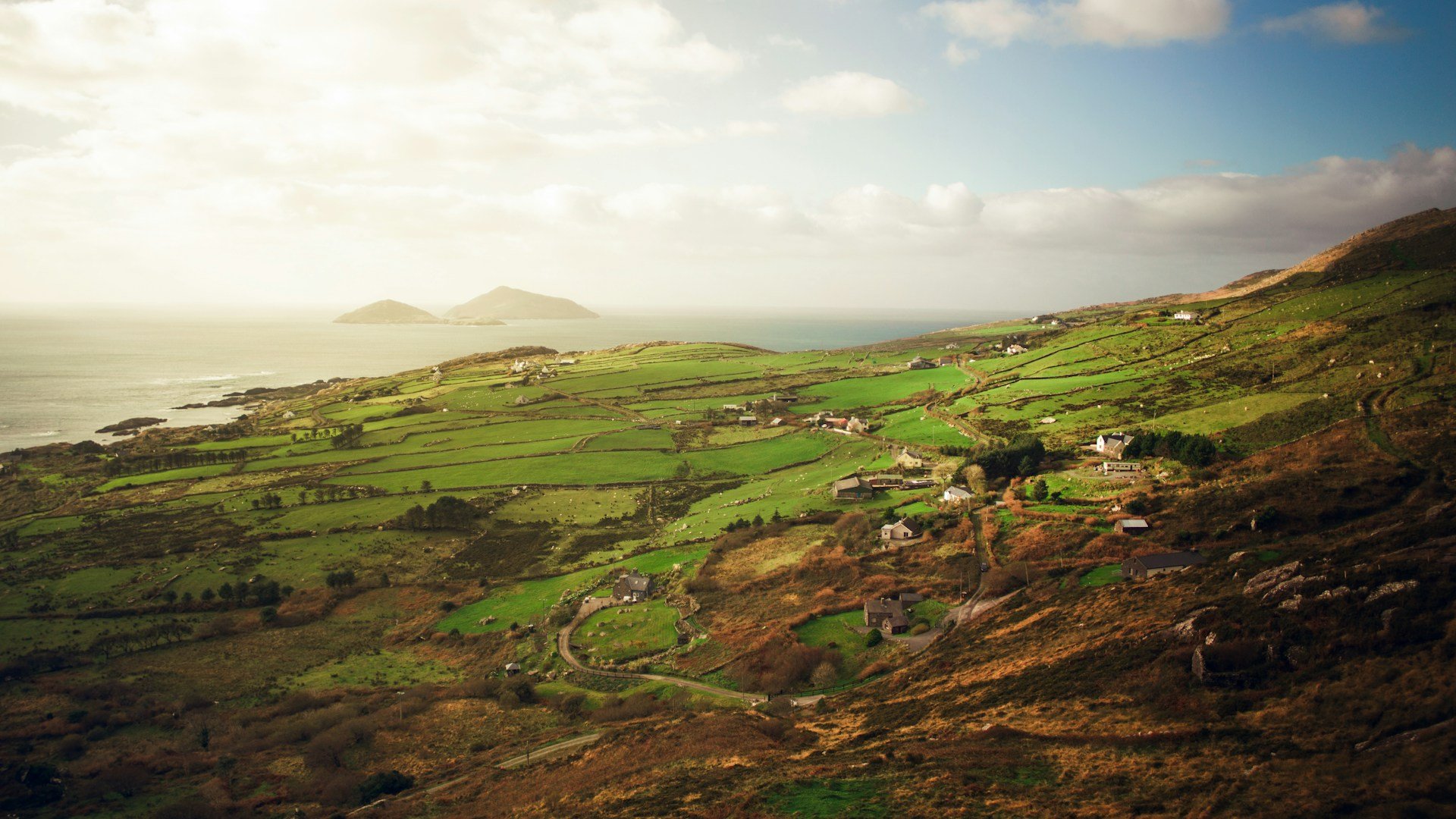
Ireland punches enormously above its weight in cultural export relative to its size: a country of about 5.4 million people that gave the world four Nobel laureates in literature, a music and pub culture recognizable everywhere, and a diaspora numbering in the tens of millions who consider it a spiritual home they may never have visited. The landscape does the rest of the work: the Wild Atlantic Way is one of the longest defined coastal routes on earth, the Ring of Kerry and the Dingle Peninsula deliver cliff and ocean views that don't photograph as well as they feel in person, and the interior is a patchwork of stone walls, sheep and genuinely startling green.
It is also, by any honest measure, an expensive country to visit relative to its European neighbors. Dublin hotel prices sit among the highest in the EU, a pint of Guinness in the capital runs €6-7, and a rental car is close to essential once you leave the cities. What you get for it: a country where English is the default language, road signs and menus need no translation, and the friendliness that shows up in every guidebook cliche is, more often than not, genuinely there.
The honest complications
Ireland's weather is genuinely changeable, four seasons in one afternoon is not an exaggeration, and rain gear is not optional even in July. Rural roads, including some marked as primary routes, are narrower and windier than they look on a map or a GPS screen, and driving on the left catches out visitors from left-hand-drive countries. Dublin's cost of living, especially accommodation, has become a real complaint among visitors and locals alike, and the most photographed sights, the Cliffs of Moher and Trinity College among them, are genuinely crowded from June through August. None of this changes the fundamental appeal, but budgeting extra time and money for both weather and crowds is realistic planning, not pessimism.
A History Worth Knowing
Ireland's history runs from Neolithic tomb-builders who predate the Egyptian pyramids, through Celtic tribal kingdoms, Viking-founded port towns, nearly 800 years of English and then British involvement, a famine that halved the population through death and emigration, and a 20th-century path to independence that still shapes the island's politics today. The short version of how the country you're visiting got here.
- c. 3200 BCE
Newgrange. The passage tomb at Brú na Bóinne is built, older than Stonehenge and the Great Pyramid of Giza, aligned precisely to the winter solstice sunrise.
- 841 CE
Viking Dublin. Norse raiders establish a longphort, a ship encampment, at the mouth of the Liffey, founding what becomes Dublin as a trading town.
- 1169
Norman invasion. Anglo-Norman lords land at the invitation of an exiled Irish king, beginning centuries of English crown involvement in Ireland.
- 1845–1852
The Great Famine. Potato blight and a catastrophic British policy response kill roughly one million people and drive mass emigration; the population never recovered its pre-Famine peak.
- 1916–1922
Rising to independence. The Easter Rising, the War of Independence and a subsequent civil war lead to the Irish Free State, partitioning the island and leaving Northern Ireland within the UK.
- 1973–present
EU membership & the Celtic Tiger. Ireland joins the EEC in 1973, transforms into one of Europe's fastest-growing economies from the 1990s, and becomes a major European tech and pharma hub.
Read the full history: Newgrange, the Vikings, the Famine and independence
Before written history, Ireland's Neolithic farmers built passage tombs at Newgrange, Knowth and Dowth in the Boyne Valley, engineering feats that predate the Egyptian pyramids by roughly five centuries. Celtic culture and the Irish language arrived over subsequent centuries, organizing the island into rival kingdoms under a nominal High King at the Hill of Tara, a political structure that persisted, with considerable local variation, until the Anglo-Norman period.
Viking raiders arrived from the late 8th century, and their 841 encampment at the Liffey's mouth grew into Dublin, which they ran as an independent Norse-Gaelic trading kingdom until the Battle of Clontarf in 1014, where the High King Brian Boru broke Viking political power on the island, though Norse-founded towns like Dublin, Waterford and Wexford endured. The 1169 Anglo-Norman invasion, initially invited by an ousted Irish king seeking allies, began a slow process of English crown involvement that hardened over centuries into direct rule, plantation of English and Scottish settlers, and the penal laws that suppressed Catholic Irish political and economic life.
The Great Famine of 1845 to 1852, triggered by potato blight but made catastrophic by the British government's response and continued food exports during the crisis, killed roughly a million people and triggered an emigration wave that continued for a century; Ireland's population still hasn't recovered its pre-Famine level. The Famine's political legacy fed directly into a nationalist movement that produced the 1916 Easter Rising, a militarily unsuccessful but symbolically decisive rebellion whose executed leaders became martyrs, the subsequent War of Independence, and the 1921 treaty that created the Irish Free State while partitioning six northern counties as Northern Ireland within the UK, a division that triggered the Irish Civil War and remains, in modified form, the political map today.
Modern Ireland. The Republic was formally declared in 1949, EEC (later EU) membership followed in 1973, and the "Celtic Tiger" boom of the 1990s and 2000s transformed a historically poor, emigration-driven economy into one of Europe's wealthiest per capita, anchored by US tech and pharmaceutical investment drawn by low corporate tax rates. The Good Friday Agreement of 1998 largely ended three decades of violent conflict in Northern Ireland (the Troubles), a separate jurisdiction from the Republic covered in this guide, and Brexit has since made the open Irish border one of Europe's more closely watched political fault lines.
Top Destinations
Ireland divides naturally into four travel zones: the capital and the east, the Wild Atlantic Way along the west coast, the Ring of Kerry and the southwest, and Ireland's Ancient East inland. The country is compact, roughly the size of South Carolina, but the roads are slow, so pick two or three zones rather than trying for all four in a single trip under two weeks.
Dublin, the literary capital
Dublin is compact, walkable and dense with things to see: Trinity College and the Book of Kells, the Guinness Storehouse, Georgian Merrion Square, Kilmainham Gaol's unsettling history of the independence movement, and a pub scene that runs from tourist-thronged Temple Bar to the trad-session backroom of the Cobblestone in Smithfield. It's a genuinely literary city, four Nobel laureates in literature called it home, and it wears that history in plaques and statues rather than museums alone. Budget at least three days; see our full Dublin city guide for neighborhoods, hotels and a street-by-street itinerary.
Galway & the Cliffs of Moher
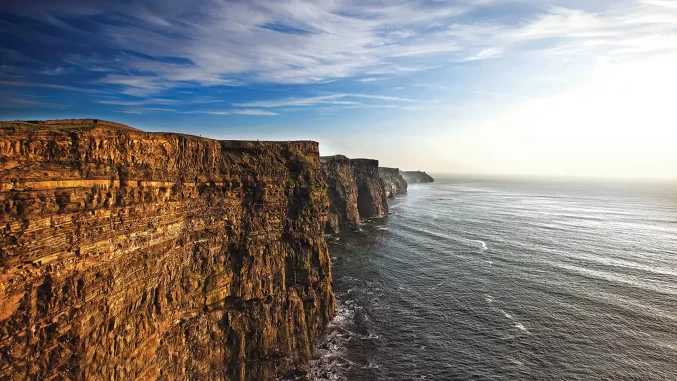
Galway is Ireland's most purely enjoyable city to wander: a compact medieval core, buskers on every corner of the Latin Quarter, and a live-music pub scene that rivals Dublin's at a fraction of the price. The Cliffs of Moher, an hour south in County Clare, rise 214 meters straight out of the Atlantic and are, deservedly, one of the most photographed sights in Ireland; arrive at opening or in the last two hours before closing to avoid the worst of the coach-tour crowds. The Burren, the lunar limestone landscape just inland, and the Aran Islands, a short ferry from Galway or Doolin, reward an extra day each.
Connemara
West of Galway, Connemara is bog, mountain and coastline with barely a fence line to interrupt the view, anchored by Kylemore Abbey's lakeside setting and the quiet fishing village of Roundstone. Fewer big-name sights than the Cliffs, more the kind of place you pull over every ten minutes anyway.
The Ring of Kerry & Dingle Peninsula
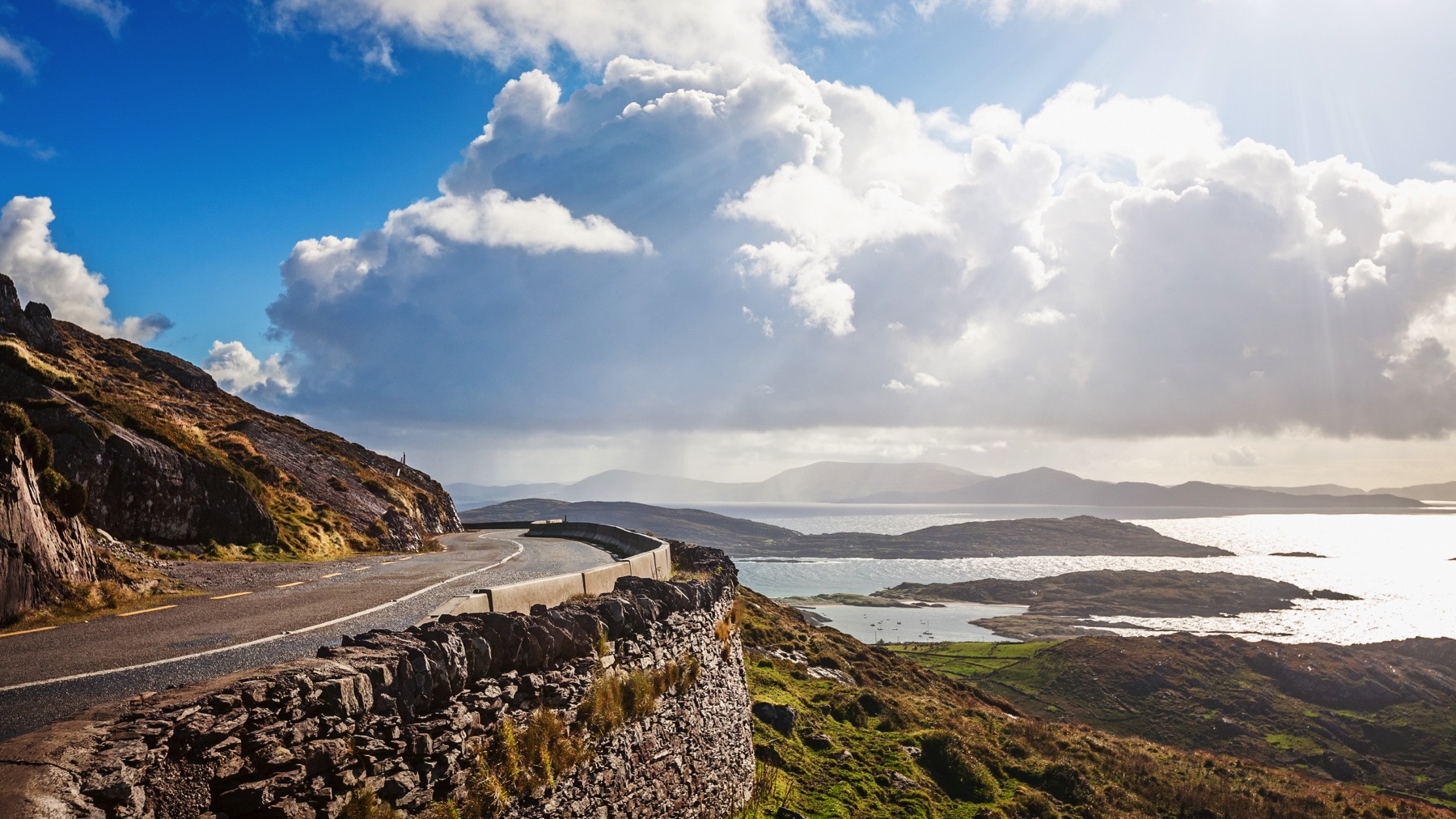
The Ring of Kerry, a 179-kilometer loop around the Iveragh Peninsula through Killarney, Kenmare, Waterville and Glenbeigh, is Ireland's classic scenic drive: mountains, lakes and Atlantic coast in a single day's circuit, best driven counter-clockwise from Killarney to get ahead of the tour coaches, which by convention run clockwise. Killarney National Park, with Ross Castle and the Gap of Dunloe, deserves a half-day on its own. The Dingle Peninsula, smaller and less crowded, has arguably better views per kilometer and the genuinely Irish-speaking town of Dingle itself as a base.
Cork & the south coast
Cork, Ireland's second city, has an English Market worth an hour on its own and a livelier, more local food and pub scene than its size suggests. Kinsale, a short drive south, is a colorful harbor town known for seafood, and the Rock of Cashel, further north, is one of Ireland's most dramatic medieval sites.
Newgrange & the Boyne Valley
Newgrange, the 5,200-year-old passage tomb in the Boyne Valley an hour north of Dublin, predates Stonehenge and the Great Pyramid of Giza and is engineered so precisely that sunlight floods the inner chamber only at the winter solstice sunrise. Access is by guided tour from the Brú na Bóinne visitor center only; book well ahead, especially for the December solstice lottery.
Kilkenny & the Rock of Cashel
Kilkenny is a compact medieval city built around its castle and a genuinely walkable historic core, a comfortable base for a night. The Rock of Cashel, further south, is a cluster of medieval ecclesiastical buildings on a limestone outcrop that dominates the surrounding plain, the traditional seat of the Kings of Munster and one of Ireland's most striking single sites.
Donegal, the wild northwest
County Donegal, in the Republic's far northwest, is the least-visited corner of the Wild Atlantic Way relative to its scenery: Slieve League has sea cliffs higher than the Cliffs of Moher and a fraction of the visitors, and the Fanad and Inishowen Peninsulas are the kind of empty, dramatic coastline that the west coast further south no longer quite offers in summer.
Hidden gems beyond the main circuit
The zones above cover a first or second trip well. With extra days, these are the spots that rarely make the standard guides but reward the detour.
The Burren
A vast expanse of exposed limestone pavement that looks lunar rather than Irish, with rare arctic-alpine flora growing in the cracks and Poulnabrone Dolmen, a 5,800-year-old portal tomb, standing alone in the middle of it.
Benbulben & Yeats Country
The distinctive flat-topped mountain that dominates Sligo's landscape and appears throughout W.B. Yeats's poetry; the poet is buried nearby at Drumcliffe, at his own request, under Benbulben's shadow.
Achill Island
Ireland's largest island, connected by bridge, with Keem Bay's turquoise water backed by cliffs that look implausibly Mediterranean under the right light, and a fraction of the Ring of Kerry's crowds.
The Copper Coast
A quieter stretch of southeast coastline with sea caves, small coves and old copper-mining ruins, a scenic drive that most itineraries skip entirely in favor of Kerry.
Jerpoint Abbey
A ruined 12th-century Cistercian abbey with intricately carved medieval tombs and cloister arcades, usually visited by almost no one despite being a short detour from Kilkenny city.
Mizen Head
Ireland's southwesternmost point, a dramatic signal station reached by a footbridge over a churning Atlantic inlet, further from Dublin than Kerry and correspondingly emptier.
Culture & Etiquette
Irish social culture runs on conversation, or "the craic," a word that covers everything from a good chat to a genuinely great night out. Pubs are the primary social institution, not just for drinking but for music, storytelling and simply being seen; a local pub is closer to a community living room than a bar in the American or continental European sense. Self-deprecation is the default mode of humor, and directness delivered with a joke attached is more common than direct confrontation.
Do
- Buy your round. If you're drinking with a group, buying a round when it's your turn is a real social expectation, not a suggestion, even if you personally drink slower than everyone else.
- Make conversation with strangers. Chatting with the person next to you at a pub bar, in a taxi or in a shop queue is normal and welcomed, not an imposition.
- Tip modestly. 10% at restaurants for good service is generous and appreciated; rounding up is fine at pubs and cafes. Tipping is not the American-style expectation.
- Learn a few Irish words. Slàinte (cheers), go raibh maith agat (thank you). Road signs are bilingual and place names carry real history worth a little curiosity.
- Book ahead for headline sights. Book of Kells, Guinness Storehouse, Kilmainham Gaol and Newgrange all sell out same-day slots in peak season.
Don't
- Bring up the Troubles casually. Northern Ireland's conflict is recent, personal history for many families on both sides of the border; it's a legitimate topic but not small talk.
- Assume "Irish" and "British" are interchangeable. The Republic is an independent country; conflating the two, especially regarding Northern Ireland, lands badly.
- Rush a pub conversation. Ordering and leaving quickly reads as unfriendly in a culture where the chat is often the point of being there.
- Underestimate rural driving distances. A route that looks like an hour on the map can take two on narrow, winding roads, especially in Kerry, Donegal and Connemara.
- Expect Dublin prices everywhere. Cork, Galway and rural towns run noticeably cheaper; don't budget the whole trip at capital-city rates.
Deeper culture: the Irish language, GAA and traditional music
The Irish language. Gaeilge is the constitutional first official language and compulsory in schools, though English is the daily language for the large majority. Gaeltacht regions, concentrated along the west coast in Connemara, the Dingle Peninsula, Donegal and parts of Kerry, use Irish as the primary community language, and road signage nationwide is bilingual.
GAA and Gaelic games. The Gaelic Athletic Association runs hurling and Gaelic football, amateur sports played at a fiercely competitive county level that draw crowds rivaling professional leagues elsewhere. A championship match at Croke Park in Dublin, if the schedule aligns with your visit, is one of the most genuine cultural experiences available to a visitor.
Traditional music. A "session" (seisiún) is informal live traditional music, typically fiddle, flute, tin whistle, bodhrán drum and uilleann pipes, played in a pub circle rather than on a stage. Genuine sessions happen most reliably in Doolin, Dingle, Galway and specific Dublin pubs like the Cobblestone; tourist-oriented "trad shows" with a paid ticket and a set list are a different, more polished product, fine on their own terms but not the same thing.
Food & Drink
Irish food has moved well past its stodgy reputation: the raw materials, Atlantic seafood, grass-fed beef and lamb, and dairy, are genuinely excellent, and a wave of chefs over the past two decades has built a modern Irish food scene on top of them. The classics are still worth seeking out on their own terms, especially away from the most touristed streets, where prices climb and quality doesn't always follow.
Irish Stew & Boxty €14-20
Lamb or beef stew with root vegetables in a thick broth is the classic pub main. Boxty, a potato pancake often wrapped around a filling, is a specifically Irish dish worth ordering over the more generic options on a pub menu.
Guinness & the Full Irish €6-7/pint
Guinness tastes different, and by most accounts better, poured in Ireland, a function of freshness rather than folklore. The Full Irish breakfast, eggs, rashers, sausages, black and white pudding, beans and toast, is a genuine institution and a filling, cheap way to start a day of sightseeing.
Seafood Chowder & Oysters €8-16
Thick, cream-based chowder loaded with white fish, salmon and mussels is a coastal-town staple worth prioritizing over inland. Galway Bay and Kilmore Quay oysters, often served with brown bread and a pint of stout, are among Europe's best.
Irish Whiskey €6-10/measure
Triple-distilled and generally smoother than Scotch, with Midleton, Teeling and Redbreast as reliable mid-to-premium picks. Distillery tours in Dublin, Midleton and around the country are a good rainy-day activity.
Brown Bread & Dairy
Dense, slightly sweet soda bread served with nearly every meal, and butter that visitors from butter-poor countries often mention specifically. A simple thing done exceptionally well.
Fish and Chips €10-15
A coastal-town staple; Leo Burdock in Dublin is the historic name, though newer spots across Galway and Cork's coastal towns often use fresher catch.
When to Go & Itineraries
May, June, September and October give the best combination of mild weather, long daylight hours and manageable prices and crowds. July and August are warmest but busiest and priciest, especially on the Wild Atlantic Way and around Dublin's headline sights. Winter (November to February) is quiet and cheap, but daylight drops to 7-8 hours and some rural attractions reduce hours or close.
All four seasons compared, with temperatures
| Season | Verdict | Temps | Prices & crowds |
|---|---|---|---|
| May-Jun & Sep-Oct | Best | 12-18°C | Moderate prices, manageable crowds |
| Jul-Aug | Good (busy) | 15-20°C | Peak prices and crowds nationwide |
| Mar-Apr | Good | 8-14°C | Lower prices, few tourists; some sites open shorter hours |
| Nov-Feb | Quiet | 4-9°C | Lowest prices; only 7-8 hours of daylight |
Year-round averages: Dublin 10°C, Galway 10°C, Cork 11°C, Killarney 10°C. Rain is possible in any month; the west coast sees more of it than the east.
Itineraries
Seven days covers Dublin plus one region well. Two weeks allows a full loop combining the west coast, the southwest and a return through Ireland's Ancient East. The constraint is road speed more than distance: Ireland is small on a map and slow in a car.
- Days 1–3
Dublin. Trinity College and the Book of Kells, Kilmainham Gaol, the Guinness Storehouse, an evening trad session in Smithfield or Temple Bar.
- Days 4–5
Galway & the Cliffs of Moher. Train or drive from Dublin (2.5 hours), a night in Galway's Latin Quarter, morning at the Cliffs of Moher and the Burren.
- Days 6–7
Ring of Kerry. Drive south via the Wild Atlantic Way to Killarney, one full day circling the Ring counter-clockwise, then back to Dublin via Cork or a return flight from Kerry Airport.
- Days 1–3
Dublin. Full three days including a day trip to Newgrange and the Boyne Valley.
- Days 4–6
Galway, the Cliffs & Connemara. Two nights in Galway, a full day for the Cliffs of Moher and the Burren, a day in Connemara via Kylemore Abbey.
- Days 7–9
Dingle Peninsula. Drive south via Connemara and the coast, two nights in Dingle town for the Slea Head loop and fewer crowds than Kerry.
- Days 10–11
Ring of Kerry & Killarney. The full Ring counter-clockwise, a day in Killarney National Park with the Gap of Dunloe.
- Days 12–14
Cork & Ireland's Ancient East. Cork's English Market, Kinsale for seafood, then Kilkenny and the Rock of Cashel on the drive back to Dublin.
Getting there & around
Dublin Airport (DUB) is the main international gateway, with direct flights from most major European, North American and Middle Eastern hubs; Aer Lingus and Ryanair are the dominant domestic and short-haul carriers. Shannon and Cork airports also take transatlantic and European routes and are useful if your trip focuses on the west or south. A rental car (€35-60/day, standard EU or international license, remember to drive on the left) is close to essential for the Ring of Kerry, the Wild Atlantic Way and most of Ireland's Ancient East: intercity buses and trains connect the main towns well but rarely reach the scenic routes themselves.
All transport options with prices: trains, buses and driving notes
| Option | Price | Notes |
|---|---|---|
| Irish Rail (Iarnród Éireann) | €15-45/route | Connects Dublin to Cork, Galway, Killarney and Belfast. Dublin-Galway is about 2.5 hours. |
| Bus Éireann & private coaches | €10-30/route | Cheaper and slower than rail, with wider rural coverage. Citylink and GoBus also serve main intercity routes. |
| Rental car | €35-60/day | Essential for the Ring of Kerry, Wild Atlantic Way and rural Ancient East sites. Manual transmission is the default; automatics cost more and should be booked ahead. |
| Domestic flights | €30-90 | Dublin to Kerry or Donegal airports save a long drive on a tight two-region itinerary. |
Driving in Ireland: traffic drives on the left, speed limits are posted in kilometers in the Republic (miles in Northern Ireland, a genuine trap for cross-border drivers), and many rural and coastal roads are single-track with passing bays. Fuel runs about €1.70-1.85/liter. Toll roads (notably the M50 around Dublin) use an automatic camera system billed after the fact, not a barrier.
Practical prep: an Irish or EU SIM (€15-25 for a data package) or an eSIM before landing covers most of the country; rural mobile coverage on the west coast can be patchy. Standard travel insurance works well nationwide. GetTransfer offers fixed-price airport pickups from Dublin.
Where to stay
Hostels & budget guesthouses
Dublin's Generator hostel in Smithfield and Galway's hostel scene around the Latin Quarter are the standard budget picks, with dorm beds and free breakfast at some properties bringing costs down further outside July-August.
Bed & breakfasts
The classic Irish accommodation, especially outside the cities: a family-run guesthouse with a full Irish breakfast included, often the best-value and most personal way to experience rural Ireland.
Mid-range city & countryside hotels
Dublin, Galway and Killarney all have strong boutique and mid-range options; countryside manor hotels near Kerry and Connemara often include grounds and activities in the rate.
Castle & luxury hotels
Ireland's converted-castle hotel category, Ashford Castle in Mayo and Dromoland Castle in Clare among the best known, is a specifically Irish luxury experience most visitors won't replicate elsewhere.
Budget Planning
Ireland runs pricier than most of Western Europe, and Dublin runs pricier than the rest of Ireland. Budget travelers eat and sleep well on €70-95 a day outside the capital; expect to add 20-30% for Dublin-heavy itineraries. Car rental and fuel are the other major line item once you head outside the cities.
- Hostel dorm or B&B €35-55
- Pub lunches & self-catering €20-30
- Bus or rail between towns
- Free walking tours, cliffs & beaches
- 3-star hotel or B&B €100-160
- Restaurant dinners €25-40/person
- Rental car €35-60/day
- Paid attractions & a tour or two
- 4-5 star hotels or a castle stay
- Fine dining & whiskey tastings
- Private drivers or guided tours
- Golf, falconry & countryside activities
Quick reference prices: pints, transport, entry fees
| Pint of Guinness (pub) | €6-7 |
| Coffee | €3.50-4.50 |
| Pub lunch (mid) | €14-20 |
| Restaurant dinner, mid-range | €25-40/person |
| Dublin-Galway train | ~€25-40 |
| Rental car | €35-60/day |
| Guinness Storehouse entry | ~€26-36 |
| Book of Kells entry | ~€20-26 |
Prices reflect August 2026 research and drift over time, especially Dublin accommodation and headline attraction tickets, which use dynamic pricing. Treat them as a planning baseline, not a quote.
Visa & Entry
Ireland has a permissive visa regime for most Western passports: US, EU, UK, Australian, Canadian and New Zealand citizens enter the Republic visa-free for up to 90 days. No ETA is required to enter the Republic itself; that requirement only kicks in if your trip continues into Northern Ireland or the wider UK. Rules do change; the Irish Immigration Service is the authoritative source.
✓ Valid passport
Valid for the duration of your stay; airlines and immigration typically also expect it to cover your full onward itinerary.
✓ Return/onward ticket
May be requested at immigration, along with proof of sufficient funds for the stay.
✓ Accommodation details
Have your first night's booking address handy; it's sometimes asked for at the border.
✓ Not Schengen
Ireland is outside Schengen and inside the UK-Ireland Common Travel Area; time here does not count against a Schengen 90-day allowance.
| Ireland | Scotland | |
|---|---|---|
| Daily budget | €70-95 gets you far outside Dublin | Broadly comparable, Edinburgh and the Highlands run similar to Dublin and rural Ireland |
| Coast & scenery | Wild Atlantic Way, Ring of Kerry, Cliffs of Moher | North Coast 500, the Isle of Skye, similarly dramatic and similarly weather-dependent |
| Currency & entry | Euro, EU member, visa-free 90 days for most Western passports, no ETA | Pound sterling, part of the UK, ETA required for most non-EU/UK visitors |
| Pub & music culture | Trad sessions, Guinness, a pub in nearly every village | Ceilidh culture, whisky over whiskey, similarly central to social life |
| Getting around | Left-hand drive Ireland, car needed outside cities | Also left-hand drive, similarly rural-road-dependent |
Safety, Solo Women & Family
Ireland is consistently ranked among the safest countries in the world, including for solo travelers, and the US State Department rates it Level 1, its lowest risk category. Violent crime against visitors is rare. The real, practical risks are pickpocketing in Dublin's busiest tourist areas and rural roads that are narrower and more demanding than they appear on a map, not crime in the usual sense.
Rural roads
Single-track roads with blind bends and passing bays are the norm on the Ring of Kerry, Dingle and Wild Atlantic Way. Drive slower than instinct suggests and never assume an oncoming car can see you.
Weather on hikes
Conditions on the Cliffs of Moher, Slieve League and mountain trails change fast; wind gusts near unfenced cliff edges are a genuine hazard. Stay on marked paths and check forecasts before coastal walks.
Pickpocketing & nightlife
Occurs at the level of any European capital in Dublin's Temple Bar and along O'Connell Street, especially late at night. Standard city awareness, secured bags, is sufficient.
One more thing worth knowing: Northern Ireland
Northern Ireland is a separate jurisdiction, part of the United Kingdom, and outside the scope of this guide. It's safe for tourists and Belfast and the Giant's Causeway are popular add-ons from the Republic, but it operates under different currency, entry rules and, for some visitors, an ETA requirement covered in the visa chapter above.
Solo women travelers
Ireland rates very well for solo women (9.0/10 on our scale) and has repeatedly ranked among the world's safest countries for solo female travel in independent surveys. Street harassment is uncommon, pub and hostel culture make it easy to meet other travelers, and rural B&B hosts are generally attentive without being intrusive. The usual precautions apply around late-night transport and nightlife areas in Dublin and Cork, no different from any other European capital. Full detail on our Solo Woman Explorer pages.
Emergency numbers
How the emergency system works & embassies in Dublin
Both 112 and 999 reach the same Emergency Call Answering Service free from any phone, mobile or landline, and are then routed to An Garda Síochána (police), fire brigade, ambulance or the coastguard as needed; there's no need to know which number to use for which service. Most national embassies maintain offices in Dublin; check your own government's travel advisory page for current contact details, since numbers and locations do change.
Family travel & pets
Ireland is a strong family destination: English-speaking, low-crime, and full of castles, cliffs and animals that land well with kids of any age. Dublin Zoo in Phoenix Park, the interactive exhibits at EPIC The Irish Emigration Museum, and the open-air jaunting cars through Killarney National Park all work well for families, and B&B hosts are generally warm toward traveling children.
Kids on the coast, and bringing pets
Coastal safety with kids: the Cliffs of Moher and Slieve League have unfenced sections; keep children well back from edges, especially in wind. Beaches on the Atlantic coast have strong currents and are generally better for walking than swimming outside a handful of lifeguarded spots.
Pets: EU pet passport holders can enter with dogs, cats and ferrets given valid rabies vaccination, a microchip and, for dogs, tapeworm treatment before arrival. Non-EU visitors need an EU health certificate from an accredited vet issued within 10 days of travel. Ireland is rabies-free and enforces these rules strictly at ports and airports; check requirements well ahead, since a missed step can mean the animal is refused entry.
Ireland FAQ
Is Ireland safe to visit?
Yes. Ireland is consistently ranked one of the safest countries in the world, including for solo travelers. Violent crime against visitors is rare; the main risks are pickpocketing in Dublin's busiest areas and rural roads that are narrower and windier than they look on a map.
Do I need a visa for Ireland?
Citizens of the US, UK, EU, Australia, Canada and New Zealand can enter the Republic of Ireland visa-free for up to 90 days. No ETA is required to enter the Republic; that only applies if you continue on into Northern Ireland or the rest of the UK.
Is Ireland in the Schengen Area?
No. Ireland is not in Schengen and never joined it, operating instead inside the Common Travel Area with the UK. Time spent in Ireland does not count against a Schengen 90-day allowance.
How much does a trip to Ireland cost?
Ireland is one of the pricier countries in Western Europe. Budget travelers manage on €70-95 a day, mid-range on €160-230. Dublin runs noticeably higher than Galway, Cork or rural towns.
When is the best time to visit Ireland?
May, June, September and October give the best mix of mild weather, long daylight and manageable crowds and prices. July and August are warmest but busiest and most expensive; winter is quiet but daylight drops to 7-8 hours.
How many days do you need in Ireland?
Seven days covers Dublin plus one region well, most commonly the Wild Atlantic Way or the Ring of Kerry. Two weeks allows a full clockwise or counter-clockwise loop of the west and southwest coasts.
Is it better to rent a car in Ireland?
Yes for anywhere outside Dublin. The Ring of Kerry, the Wild Atlantic Way and Ireland's Ancient East are all difficult or impractical by public transport. Rentals run about €35-60 a day; remember driving is on the left.
What language is spoken in Ireland?
English is the everyday language nearly everywhere. Irish (Gaeilge) is the constitutional first official language and the daily language in Gaeltacht regions along the west coast, and appears on all road signs alongside English.
Is Ireland part of the UK?
No. The Republic of Ireland is a fully independent country and EU member, separate from the United Kingdom. Northern Ireland, in the north of the island, is part of the UK. There's no hard border or passport check between them for most travelers.
Is Ireland safe for solo female travelers?
Very safe by international standards; Ireland has repeatedly ranked among the world's safest countries for solo women. Normal precautions around nightlife areas and late-night transport apply, same as any country.
Do I need an ETA to visit Northern Ireland from the Republic?
Non-EU visitors who are not Irish or UK citizens generally need a UK ETA before crossing into Northern Ireland, even though there's no physical border post on the road. Republic-only itineraries don't need one.
Is Ireland expensive compared to the UK?
Broadly comparable to Scotland and England for accommodation and dining, and noticeably pricier than most of continental Europe. Dublin is one of the most expensive capitals in the EU for hotels.
What Stays With You
Most visitors arrive in Ireland expecting the postcard, cliffs, pints, a fiddle in the corner of a pub, and are surprised to find how much of it is true without feeling staged. The conversation that starts because you asked for directions and doesn't end for twenty minutes. The Cliffs of Moher in fog, when the tour buses give up and leave and the view opens for the ten people who waited. The B&B host who remembers your name at breakfast on day two. None of it required much beyond showing up and being willing to talk to strangers.
Ireland doesn't hide what it is. Go expecting rain, a pub that becomes the best part of the day, and a country smaller than it feels once you've actually tried to drive across it.