
What You're Actually Getting Into
Georgia sits at the point where Europe stops being sure it's Europe: a small mountainous country wedged between the Black Sea and the high Caucasus, bordered by Russia, Turkey, Armenia and Azerbaijan, with a written history stretching back to the ancient kingdoms of Colchis and Iberia and a Christian tradition dating to 337 AD, among the oldest state conversions on earth. It has its own 33-letter alphabet, related to no other writing system in use today, and a winemaking tradition, fermenting grapes in buried clay qvevri vessels, that predates the pyramids by a few centuries and has never stopped.
What travelers discover, usually within a day of arriving, is a hospitality culture that borders on confrontational in its generosity: Georgians have a proverb that a guest is a gift from God, and the supra, the long ceremonial feast run by a toastmaster called the tamada, is where that proverb gets tested against an actual dinner table. Add mountain scenery that genuinely rivals the Alps, a wine region producing some of the most interesting orange and amber wines on the planet, and prices that are still a fraction of Western Europe, and it's clear why Georgia has quietly become one of the most talked-about destinations in the region over the last decade.
The honest complications
Georgia is currently living through a prolonged domestic political crisis: daily pro-EU protests have continued in Tbilisi since the government suspended EU accession talks in November 2024, concentrated on Rustaveli Avenue near parliament and mostly in the evenings. This has not affected the country's Level 1, safe classification with the US State Department, and it is largely invisible outside that specific stretch of one street, but it is a real, ongoing situation worth knowing about before you go, not something to discover once you're there. Outside Tbilisi, infrastructure is variable: mountain roads in Svaneti and Tusheti are unpaved and seasonal, English drops off sharply outside the capital and main tourist towns, and the occupied regions of Abkhazia and South Ossetia, roughly a fifth of the country's internationally recognized territory, are entirely off-limits to a normal visit. None of this should be a deterrent so much as a reason to plan with current information rather than an outdated blog post.
A History Worth Knowing
Georgians call their country Sakartvelo and trace their history to the ancient kingdoms of Colchis, the setting of the Greek myth of Jason and the Golden Fleece, and Iberia, which adopted Christianity as a state religion in 337 AD. A golden age under Queen Tamar in the 12th and 13th centuries gave way to Mongol, Persian and Ottoman domination, then absorption into the Russian Empire in 1801. Soviet rule, a brief independence in between, the 2008 war with Russia, and an unresolved present-day political crisis over the country's direction toward Europe: the short version of how the country you're visiting got here.
- Antiquity
Colchis & Iberia. The ancient kingdoms of the Georgian Black Sea coast and eastern highlands, the setting of the Golden Fleece myth and among the first Christian states on earth.
- 337 AD
Christianity adopted. The kingdom of Iberia converts under King Mirian III, guided by St. Nino; Georgia becomes one of the first nations to make Christianity its state religion.
- 12th–13th century
The Golden Age. Queen Tamar rules over Georgia's medieval peak: territorial expansion, literature, and the architecture still standing in Vardzia and across the country.
- 1801–1991
Russian Empire, then Soviet Georgia. Annexation in 1801, a brief independent republic from 1918 to 1921, then seven decades as a Soviet republic, birthplace of both Stalin and Beria.
- 1991–2008
Independence and conflict. Independence in 1991, civil war, wars in Abkhazia and South Ossetia, then the 2008 Russo-Georgian War, after which Russia recognized and militarily occupies both breakaway regions.
- 2003–present
Rose Revolution to today. The 2003 Rose Revolution brings sweeping anti-corruption reform; EU candidate status follows in December 2023, but the government suspends accession talks in November 2024, triggering daily protests that continue into 2026.
Read the full history: Colchis, Tamar, Soviet Georgia and the road to today
The Greek myth of the Golden Fleece is set in Colchis, the western Georgian kingdom on the Black Sea coast, and reflects a real ancient trade in gold panned from mountain rivers using sheepskins, an origin story Georgians take some pride in. Iberia, the eastern kingdom centered near present-day Tbilisi and Mtskheta, converted to Christianity in 337 AD under King Mirian III after the missionary work of St. Nino, making Georgia one of the first states on earth to adopt Christianity officially, alongside Armenia.
Queen Tamar, who ruled from 1184 to 1213, presided over Georgia's medieval golden age: military expansion across the South Caucasus, a flourishing of literature epitomized by the epic poem "The Knight in the Panther's Skin," and the cave monasteries and hilltop churches that still define the country's architecture. The centuries after her death brought Mongol invasions, then a long period split between Persian and Ottoman spheres of influence, with Georgian kingdoms and principalities playing larger powers against each other to survive.
The Treaty of Georgievsk in 1783 brought the eastern Georgian kingdom under Russian protection, and full annexation followed in 1801, with the rest of Georgia absorbed by the 1860s. A short-lived Democratic Republic of Georgia declared independence in 1918, one of the more progressive states of its era, before the Red Army invaded in 1921 and Georgia became a Soviet republic. Two of the 20th century's most consequential and brutal figures, Joseph Stalin and Lavrentiy Beria, were both Georgian, a legacy the country still processes unevenly: Stalin's hometown of Gori has a museum that has shifted, gradually and incompletely, from tribute to more honest reckoning.
Independence returned in 1991 amid civil war and the secession of Abkhazia and South Ossetia, both of which fought bloody wars against the central government in the early 1990s and have functioned as unrecognized, Russian-backed territories since. Eduard Shevardnadze, the former Soviet foreign minister, led Georgia through a difficult decade before the 2003 Rose Revolution, a peaceful uprising against a fraudulent election, brought Mikheil Saakashvili to power and a wave of anti-corruption reform that genuinely transformed the country's institutions and made it a regional case study in reducing everyday corruption.
In August 2008, a five-day war with Russia over South Ossetia ended with Russian forces occupying both South Ossetia and Abkhazia, which Russia then recognized as independent states, a status almost no other country accepts. Georgia has pursued EU and NATO integration since, receiving EU candidate status in December 2023. In November 2024, the ruling Georgian Dream government announced it would suspend EU accession negotiations until 2028, a decision widely seen as a pivot away from the West that triggered sustained daily protests in Tbilisi, still ongoing as this guide was written in 2026.
Top Destinations
Georgia divides naturally into five travel zones: the capital, the eastern highlands toward Russia, the eastern wine country, the western high-mountain region, and the Black Sea coast. The country is small, smaller than Ireland, but the roads are slow and the terrain is vertical, so distance is measured in hours of mountain driving more than kilometers. A two-week trip covers all five zones comfortably; a week covers three well.
Tbilisi, warm springs and a hilltop fortress
Tbilisi takes its name from "tbili," the Georgian word for warm, after the natural sulfur springs that still steam beneath the Abanotubani bathhouse district at the foot of Narikala Fortress. The old town's balconied wooden houses, the fortress views, and a food and wine scene that has exploded in the last decade make it one of the most rewarding capitals in the wider region and easily worth three to four days on their own. This guide has a full separate Tbilisi city guide covering neighborhoods, hotels, restaurants and a street-by-street itinerary.
Stepantsminda & the Georgian Military Highway
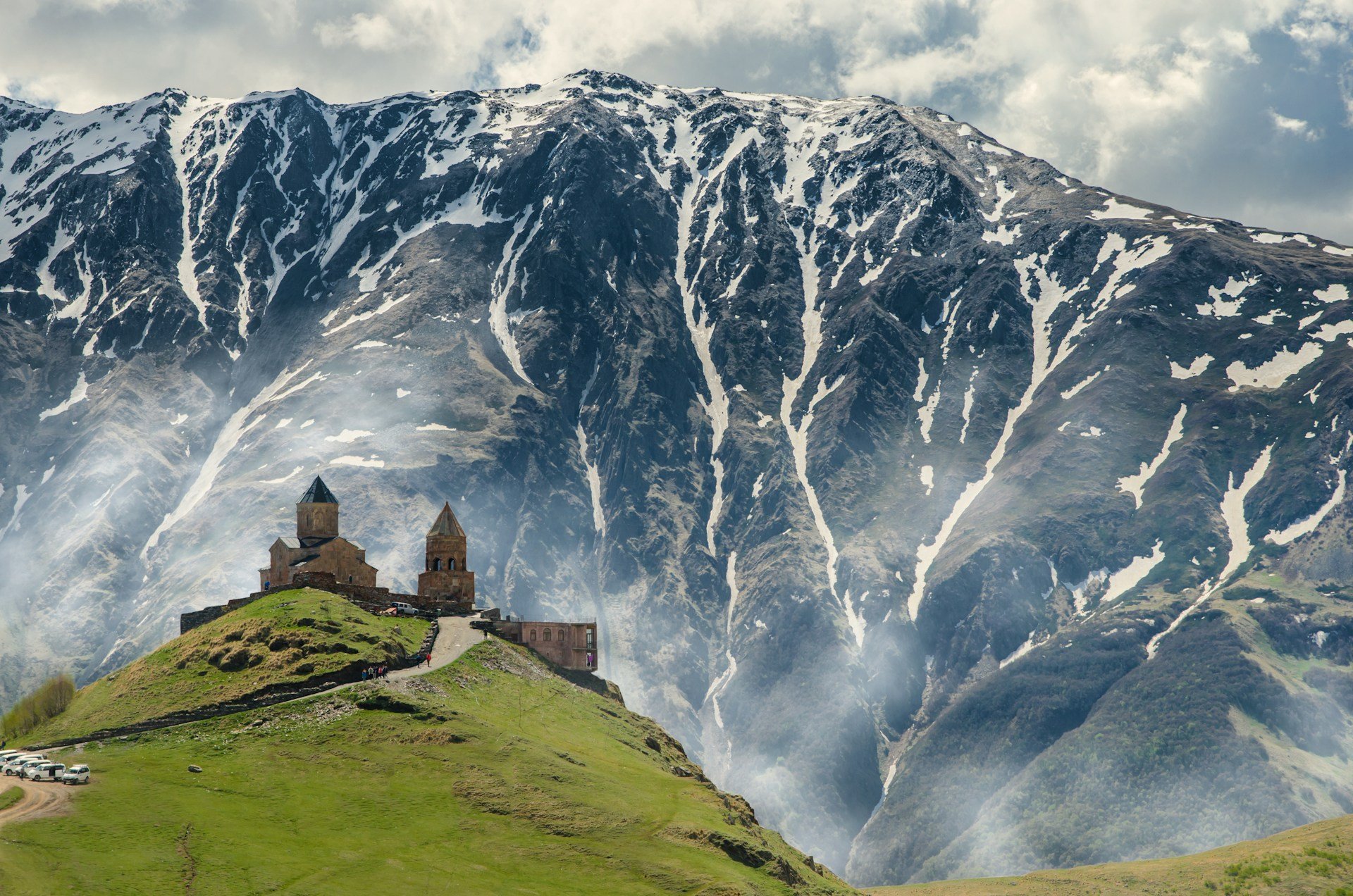
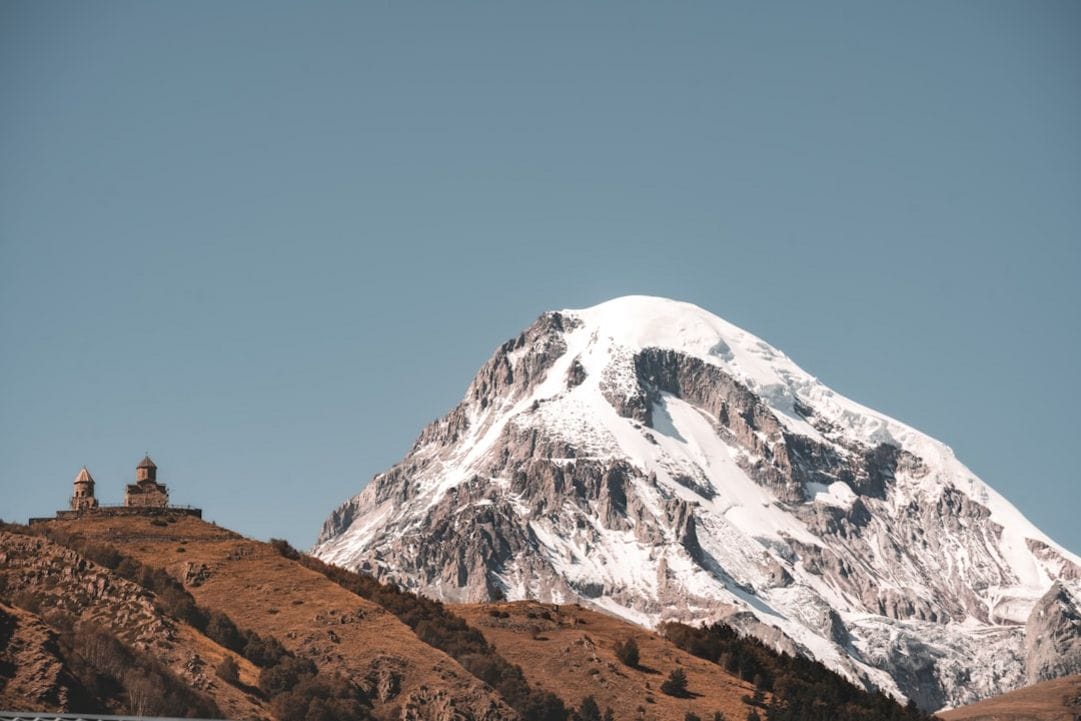
The Georgian Military Highway runs north from Tbilisi toward the Russian border through some of the most dramatic mountain scenery in the Caucasus, past the medieval Ananuri fortress on its reservoir and the Gudauri ski resort, to Stepantsminda (still commonly called Kazbegi), a small highland town below the 5,047-meter Mount Kazbek. The reason everyone makes the roughly 2.5-hour drive is Gergeti Trinity Church, a 14th-century church on a solitary hilltop with the glacier-streaked peak behind it, reachable by 4x4 taxi from town or a steep hour-long hike. Snow can close the Jvari Pass road at short notice even outside deep winter, so build in a spare day if this is a bucket-list stop.
Sighnaghi, Telavi & the wine villages
Kakheti, roughly 1.5 to 2 hours east of Tbilisi, is where most of Georgia's wine comes from and where the qvevri tradition, fermenting and aging wine in buried clay vessels, is still an everyday practice rather than a museum piece. Sighnaghi, a hill town above the Alazani Valley with a restored 18th-century wall, is the region's most atmospheric base; Telavi is the practical regional hub and the road out to the wineries. Family cellars around Kvareli and Napareuli will pour a tasting for the price of a bottle, and the 6th-century Alaverdi Cathedral and Bodbe Monastery, burial place of St. Nino, are both worth the detour on the way through.
Mestia & Ushguli, the highest villages in Europe
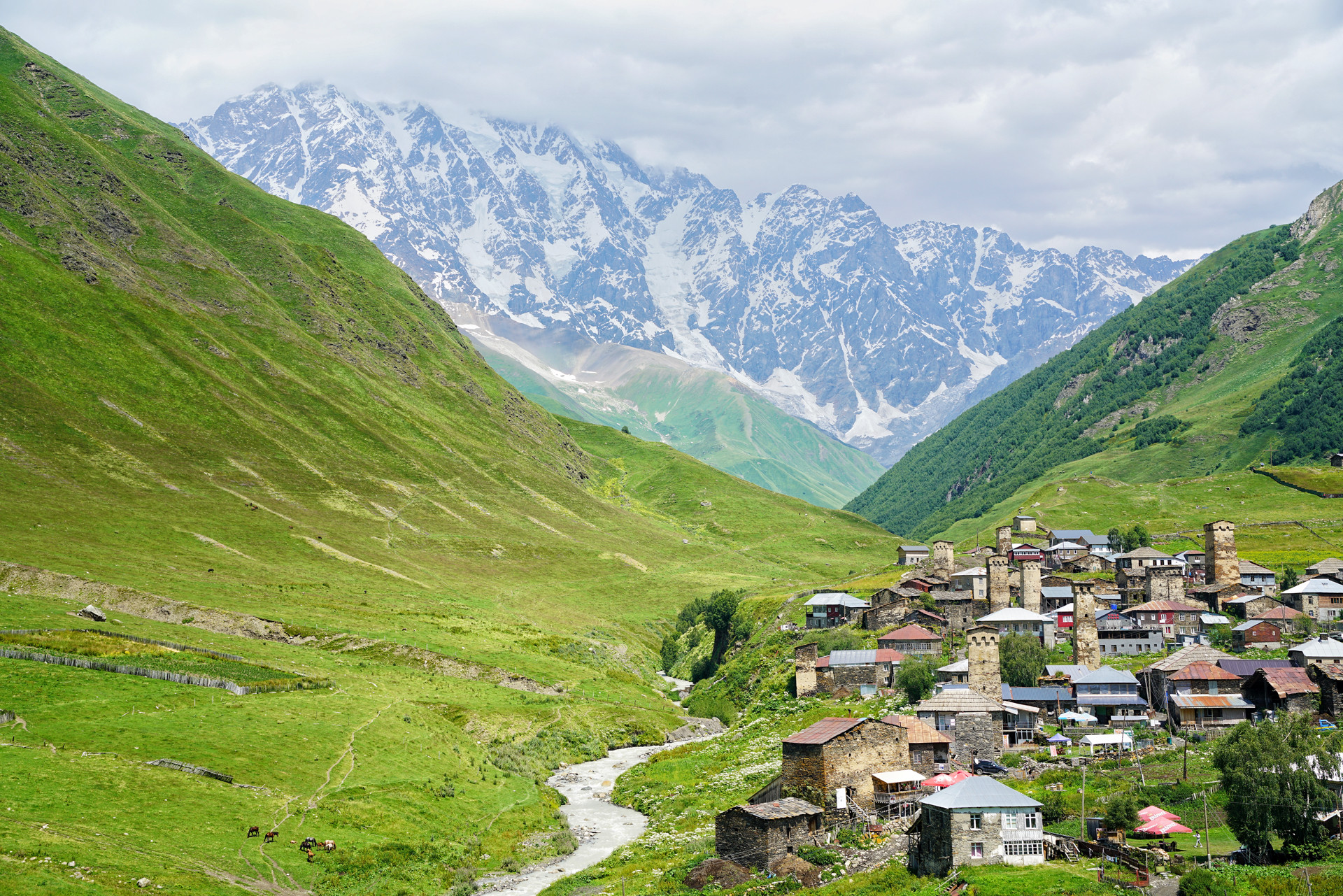
Svaneti, in the far northwest against the Russian border, is Georgia's most dramatic and least accessible region: a cluster of medieval villages defined by stone defensive towers, built by families over centuries against blood feuds and invaders, set against 5,000-meter peaks. Mestia is the regional hub, reachable by a spectacular but long mountain road or a short domestic flight from Tbilisi, and the base for hikes to glaciers and viewpoints. Ushguli, a cluster of four villages roughly two hours further by unpaved road, is among the highest continuously inhabited settlements in Europe and a UNESCO World Heritage Site; the road there is snow-closed most of the year outside June to September.
Batumi, the subtropical coast
Batumi, Georgia's third-largest city and main Black Sea resort, has a genuinely odd skyline: Soviet-era sanatoriums, a candy-colored old town, and a wave of glassy 21st-century towers built on casino and tourism money from neighboring Turkey. The seafront boulevard is one of the longest in the region, the Batumi Botanical Garden spreads across subtropical hillside above the coast, and the beaches themselves are pebble rather than sand, better for a stroll than a beach holiday. Most visitors treat it as a two-to-three-day coastal add-on rather than the centerpiece of a Georgia trip.
Hidden gems beyond the main circuit
The zones above cover a first or second trip well. With extra days, these are the spots that rarely make the standard guides but reward the detour.
Vardzia Cave Monastery
A 12th-century cave city cut directly into a cliff face, once home to thousands of monks across nineteen tiers, built during Queen Tamar's reign. Far fewer visitors than the mountain circuit, and the scale is genuinely startling in person.
Uplistsikhe
A rock-hewn town near Gori that predates Christianity in Georgia by centuries, carved directly into volcanic rock and inhabited from the early Iron Age into the Middle Ages. An easy half-day combined with Gori's Stalin Museum.
David Gareja Monastery
A cave monastery complex carved into a semi-desert ridge that straddles the disputed Georgia-Azerbaijan border, with faded medieval frescoes in some of the cave churches. Bring water; there's no shade for most of the site.
Borjomi
A 19th-century spa town famous across the former Soviet Union for its mineral water, set in a forested gorge with a national park behind it. Quieter and greener than the mountain circuit, with genuinely good hiking.
Tusheti
A shepherd region beyond an infamous unpaved mountain pass, open only in summer, with stone villages that feel a century removed from Tbilisi. For travelers with extra time and a taste for genuinely remote places.
Chiatura's Soviet Cable Cars
A mining town strung with rusting Soviet-era cable cars still in daily use by residents to reach hillside neighborhoods, an odd and striking piece of living industrial history rather than a museum piece.
Culture & Etiquette
Georgian hospitality is organized, ritualized and genuinely central to how the culture works. The supra, a long feast presided over by a tamada, or toastmaster, who leads a structured series of toasts, honoring guests, ancestors, peace, women, is the clearest window into Georgian values available to a visitor, and being invited to one, even by strangers, is common enough that most travelers experience it. Georgia is over 80 percent Orthodox Christian, and the church is woven tightly into national identity in a way that shapes everything from public holidays to how seriously people take a monastery visit.
Do
- Accept a toast graciously. You don't have to finish every glass, but wait for the tamada to toast before drinking, hold your glass with both hands when honored directly, and never clink glasses over a toast to the dead.
- Dress modestly at churches and monasteries. Women should carry a headscarf and a wrap skirt; men should avoid shorts. Most major churches keep loaner scarves at the door.
- Learn a few Georgian words. Gamarjoba (hello), madloba (thank you), and diakh/ara (yes/no) go a long way in a language that gets very little tourist effort.
- Bring a small gift if invited to a home, pastries, chocolate or good wine. Refusing an invitation to eat or drink outright can read as a real rebuff rather than politeness.
- Carry cash (lari) for villages, marshrutkas and market stalls, though cards work fine in Tbilisi, Batumi and most tourist businesses.
Don't
- Bring up the 2008 war or Abkhazia/South Ossetia casually. It's a live, painful subject for most Georgians, not ancient history, and dismissive framing lands badly.
- Assume Russian is a neutral default. Older Georgians often speak it fluently and use it practically, but given current politics, leading with English and a few Georgian words is the safer instinct with younger people.
- Photograph border areas, checkpoints or military installations, particularly anywhere near the administrative boundaries with Abkhazia and South Ossetia.
- Drink and drive. Georgia enforces a near-zero blood alcohol limit strictly, and mountain roads are unforgiving even sober.
- Expect the highland circuit to run on a fixed schedule. Weather closes mountain passes with little notice; build slack into any Kazbegi or Svaneti plan.
Deeper culture: the tamada, polyphonic singing, the alphabet and Stalin's legacy
The tamada tradition. The toastmaster role at a supra is a genuine social skill, part performance, part moral instruction, usually filled by a respected older man though this is slowly changing. A skilled tamada can keep a table of strangers laughing and half-drunk on toasts to friendship and ancestors for five or six hours without repeating a theme.
Georgian polyphonic singing. Traditional multi-part vocal music, recognized by UNESCO as Intangible Cultural Heritage, is heard at supras, church services and folk performances, with regional styles varying sharply between Svaneti, Kakheti and Guria.
The Georgian alphabet. Mkhedruli, the 33-letter script used today, is one of only 14 writing systems in current use worldwide unrelated to any other, with no distinction between upper and lower case. It appears on every sign in the country and is worth at least learning to recognize, if not read.
Stalin's complicated legacy. Joseph Stalin was born in Gori, and the Stalin Museum there has moved gradually, if unevenly, from Soviet-era hagiography toward a more honest reckoning with the Great Terror. Most Georgians hold a complicated, unresolved relationship with the fact that one of history's most brutal dictators was a countryman.
Food & Drink
Georgian food runs on cheese, walnuts, fresh herbs and a wine tradition older than almost any other on earth. The best of it is unfussy: a khachapuri and a carafe of house wine at a village restaurant will outperform a lot of fine dining, and the supra table, with its dozen small dishes appearing at once, is designed for slow, communal eating rather than a plated tasting menu.
Khachapuri $3-6
Cheese-filled bread in regional styles: Imeruli is a round closed loaf, Megruli adds cheese on top, and Adjaruli, the boat-shaped version from Batumi with a raw egg and butter melted in at the table, is the one that goes viral for a reason.
Khinkali $0.40-0.70 each
Twisted, hand-pleated dumplings filled with spiced meat or mushroom broth. Hold by the topknot, bite a small opening, sip the broth first, then eat the rest; the topknot itself is traditionally left uneaten and doubles as a tally of how many you've had.
Qvevri Wine $2-4/glass
Wine fermented and aged in buried clay vessels, a roughly 8,000-year-old method recognized by UNESCO, produces the amber "orange" wines Georgia is now internationally known for. Kakheti is the region to taste it at the source.
Churchkhela $1-2
Walnuts threaded on a string, dipped repeatedly in thickened grape juice and dried into a firm, chewy rope, sold at every market. Sometimes called Georgian Snickers, unfairly, since it predates the candy bar by centuries.
Pkhali & Lobio
Pkhali are cold vegetable pates, spinach, beetroot or cabbage, ground with walnuts and spices; lobio is a slow-cooked kidney bean stew, often served bubbling in its own clay pot with cornbread on the side.
Chacha $1-3/shot
Georgian grape brandy, a byproduct of winemaking distilled from the pomace, ranges from smooth to genuinely fierce depending on who made it. Homemade versions at family guesthouses are usually stronger than anything sold in a shop.
When to Go & Itineraries
May, June and September are the best months for most itineraries: warm weather in Tbilisi and Kakheti, high mountain passes open, and crowds still manageable. Late June through mid-September is the specific window for high-altitude hiking in Svaneti, since the road to Ushguli and the higher trails hold snow outside it. Winter is quiet and cold in Tbilisi but genuinely good for skiing at Gudauri, on the way to Kazbegi.
All four seasons compared, with temperatures
| Season | Verdict | Temps | Prices & crowds |
|---|---|---|---|
| May-Jun & Sep | Best | 18-27°C Tbilisi, cooler in mountains | Mid prices, manageable crowds |
| Jul-Aug | Good (hot) | 28-36°C Tbilisi/Kakheti | Peak coast and highland season; Tbilisi is hot and best paired with mountain time |
| Oct | Good | 14-22°C Tbilisi | Harvest season in Kakheti, lower prices, fewer crowds |
| Nov-Mar | Quiet (skiing) | 2-9°C Tbilisi, snow in mountains | Lowest city prices; Gudauri ski season runs Dec-Apr |
Year-round averages: Tbilisi 14°C, Batumi 15°C (subtropical, wetter), Sighnaghi 12°C, Mestia 5°C, Stepantsminda 4°C. Ushguli and the high Svaneti trails are only reliably snow-free from June to September.
Itineraries
Seven days covers Georgia's essential mix adequately. Two weeks adds Svaneti's remote villages and the Batumi coast without feeling rushed. The constraint is mountain road conditions and pass closures more than raw distance.
- Days 1–3
Tbilisi. Old town, Narikala Fortress, the sulfur baths, food and wine bars, a half-day in Mtskheta.
- Days 4–5
Kakheti. Day tour or overnight to Sighnaghi and Telavi, family winery tastings, Bodbe Monastery.
- Days 6–7
Kazbegi. The Georgian Military Highway to Stepantsminda, Ananuri fortress en route, the hike or 4x4 to Gergeti Trinity Church.
- Days 1–3
Tbilisi. Full exploration, add Fabrika and the Dry Bridge Market, a wine bar crawl in Vera or Sololaki.
- Days 4–5
Kakheti. Two nights based in Sighnaghi or Telavi, multiple wineries, Alaverdi Cathedral and David Gareja.
- Days 6–7
Kazbegi. Stepantsminda, Gergeti Trinity Church, a day hike if weather allows.
- Days 8–11
Svaneti. Fly or drive to Mestia, tower villages, glacier hikes, the long road out to Ushguli.
- Days 12–14
Batumi. The coast, the botanical garden, the boulevard, a slower finish before flying home from Batumi or back via Tbilisi.
- Days 1–4
Tbilisi extended. Add Uplistsikhe and Gori as a day trip, and a full day dedicated to the sulfur baths and old town food scene.
- Days 5–7
Kakheti slow. Sighnaghi, Telavi, Kvareli, Napareuli, more wineries than a first-timer would attempt, David Gareja.
- Days 8–10
Kazbegi & the highway. Stepantsminda with a spare weather day, plus Gudauri and Ananuri properly rather than as drive-bys.
- Days 11–15
Svaneti extended. Mestia as a base for multi-day hikes, the full drive to Ushguli, and time in smaller villages between the two.
- Days 16–18
Vardzia & the south. The cave monastery, Borjomi's national park and mineral springs, a genuinely quiet region most itineraries skip.
- Days 19–21
Batumi slow. A relaxed finish on the coast with day trips into the Adjara highlands behind the city.
Getting there & around
Shota Rustaveli Tbilisi International Airport (TBS) is the main gateway, with over 45 airlines connecting from Europe, the Middle East and Central Asia; Kutaisi International Airport (KUT) is the budget-carrier hub, popular with Wizz Air routes from Europe. From TBS, bus 337 runs to the center for 1 GEL, or a taxi costs 20-30 GEL for the 20-30 minute ride. Inside the country, marshrutka minibuses connect every town from Tbilisi's Didube station and are cheap and frequent but cramped; a rental car (from about $30-45/day) gives far more control over the mountain regions, though winter driving in Svaneti and on the Military Highway requires real experience and, ideally, a 4x4.
All transport options with prices: marshrutkas, trains, domestic flights
| Option | Price | Notes |
|---|---|---|
| Marshrutkas | 5-25 GEL/route | Leave when full from town bus stations. Tbilisi to Sighnaghi: about 2.5 hrs, 10 GEL. Cheap but crowded and not for anyone prone to car sickness on mountain roads. |
| Taxis & ride apps | 5-15 GEL (Tbilisi) | Bolt and Yandex Go both work well in Tbilisi and Batumi; agree a fare upfront for intercity trips outside the apps. |
| Trains | 10-40 GEL | Tbilisi-Batumi runs several times daily in around 5 hours; comfortable and a good alternative to the highway drive. |
| Domestic flights | from ~$50 | Tbilisi-Mestia (Svaneti) saves a full day of mountain driving each way; weather-dependent and sometimes cancelled. |
Mandatory insurance: since 1 January 2026, Georgia requires all tourists to carry travel or health insurance covering at least 30,000 GEL for the length of their stay. Enforcement at the border has reportedly been inconsistent, but arrive with a valid policy regardless.
Practical prep: buy a Georgian SIM at the airport (around 20-30 GEL for a generous data package) or an eSIM before landing; signal drops out in parts of Svaneti and Tusheti, so download offline maps first. Standard travel insurance works for most of the country, but confirm mountain rescue and evacuation coverage if you're hiking above Mestia. GetTransfer offers fixed-price airport pickups from TBS.
Where to stay
Tbilisi boutique hotels & design stays
Vera and Sololaki have Tbilisi's most interesting design hotels, converted industrial buildings and Belle Époque townhouses within easy walking distance of the old town. Full picks are in the separate Tbilisi city guide.
Kakheti wine-estate guesthouses
Family-run guesthouses attached to working wineries around Sighnaghi, Telavi and Kvareli, often with dinner and a wine tasting included in the room rate. The most direct way to experience the qvevri tradition outside a formal tour.
Svaneti family guesthouses
Simple, warm, and typically the only accommodation option in Mestia and Ushguli's smaller villages, with home-cooked dinners built into the price. Book ahead in July and August, the region's short peak season.
Batumi seafront hotels
A mix of Soviet-era sanatoriums and new towers along the boulevard, with prices dropping sharply outside the June-to-September coastal season.
Budget Planning
Georgia remains good value by European standards, though accommodation prices have climbed noticeably as tourism has grown. Budget travelers eat and sleep well on $30 to 45 a day; the main place costs escalate is boutique Tbilisi hotels and organized multi-day mountain tours.
- Guesthouse or hostel dorm $10-20
- Khinkali and khachapuri meals $4-8
- Marshrutka minibuses between towns
- Free churches, viewpoints and markets
- Boutique hotel or wine-estate guesthouse
- Restaurant dinners with wine $15-25/person
- Rental car $30-45/day
- Guided wine or mountain day tours
- Design hotels in Vera or Sololaki
- Fine dining and premium qvevri wines
- Private drivers and guides
- Domestic flights to Svaneti
Quick reference prices: coffee, marshrutkas, entry fees
| Khinkali (each) | $0.40-0.70 |
| Coffee (espresso) | $1.50-2.50 |
| Restaurant meal (mid) | $8-15 |
| Glass of qvevri wine | $2-4 |
| Tbilisi-Sighnaghi marshrutka | ~$4 |
| Narikala cable car | ~$1 one way |
| Kakheti guesthouse incl. dinner | $25-40/night |
| Tbilisi boutique hotel | $70-150/night |
| Chreli-Abano private bath room | ~$30-50/hour |
| Tbilisi-Mestia domestic flight | from ~$50 |
Prices reflect August 2026 research and drift over time, especially Tbilisi accommodation and organized mountain tours. Treat them as a planning baseline, not a quote.
Visa & Entry
Georgia has one of the most generous visa regimes in the world: citizens of the US, EU, UK, Australia, Canada and dozens of other countries can enter visa-free for up to 365 days, at Tbilisi or Kutaisi airports or by land. Rules do change, and since 1 January 2026 Georgia has required all tourists to carry travel or health insurance covering at least 30,000 GEL for their stay, so verify current requirements on the Georgian Ministry of Foreign Affairs site directly rather than a third-party "e-visa" service, since most travelers need no visa or fee at all.
✓ Valid passport
Georgia does not officially require a minimum validity period beyond the length of stay, but 6 months' validity is the safe practical standard for onward travel and airline check-in.
✓ Travel/health insurance
Mandatory since 1 January 2026, covering at least 30,000 GEL for the full stay including arrival and departure days.
✓ Accommodation address
Not always requested but worth having on hand, particularly if entering by land border.
✓ Not Schengen or EU
Time in Georgia doesn't count toward your Schengen 90-day allowance, and Georgia is not an EU member despite holding EU candidate status since December 2023.
| Georgia | Armenia | |
|---|---|---|
| Daily budget | $30-45 covers most trips comfortably | Similar or slightly lower on average |
| Signature draw | 8,000-year qvevri wine tradition, Kakheti | Ancient monasteries, Areni wine region |
| Mountains | Svaneti and Kazbegi, higher and more developed for tourism | Dilijan and Tatev, quieter and less visited |
| Coast | Batumi on the Black Sea | Landlocked, no coastline |
| Visa | 365 days visa-free for most Western passports | 180 days visa-free for most Western passports |
Safety, Solo Women & Family
Georgia rates Level 1, exercise normal precautions, on the US State Department scale, and violent crime against tourists is genuinely rare. The country is currently living through a prolonged domestic political crisis, daily protests against the government's decision to suspend EU accession talks, but this has not changed its underlying safety classification and is concentrated on one street in Tbilisi rather than spread across the country.
The Tbilisi protests
Ongoing demonstrations concentrate on Rustaveli Avenue near parliament, mostly in the evenings, and have continued since November 2024. Avoid the immediate protest area after dark, follow local news for the day's situation, and treat it as you would any large gathering: watch from a distance, don't linger if police move to disperse a crowd.
Occupied territories
Abkhazia and South Ossetia are occupied by Russia and off-limits to a normal visit. Entering from the Georgian side without separatist authorization risks arrest or fines, and both the US and UK advise against all travel there due to landmines and civil unrest.
Mountain roads
The Georgian Military Highway and Svaneti's roads are dramatic and occasionally hair-raising, with rockfall and snow closures possible outside deep winter. Drive defensively, check pass conditions before setting out, and don't push through a closure notice.
Two more things worth knowing: chacha strength and stray dogs
Homemade chacha at family guesthouses and supras can be considerably stronger than commercial versions, and hospitality culture means declining a toast outright can feel abrupt. It's fine to sip rather than drain a glass, or to explain you're driving; genuine hosts will not push.
Stray and free-roaming dogs are common in Tbilisi and rural areas, most wearing ear tags showing they're vaccinated and part of a managed street-dog program. They are generally docile, but as anywhere, don't approach unfamiliar dogs closely or feed them by hand.
The 3 scams to actually know about
Georgia is not a high-scam destination, and hospitality culture generally works against cheating a guest. But three patterns catch uninformed visitors, and knowing them going in avoids nearly all of it. The full country list lives on our Georgia travel alerts page.
Taxi overcharging
Unmetered taxis at the airport and train stations sometimes quote inflated fares to travelers unfamiliar with lari prices. Use Bolt or Yandex Go, which show the fare upfront, rather than hailing a taxi directly.
Currency confusion overcharging
Some market vendors and small shops round up prices for tourists who don't yet know the exchange rate. Learn a few common price points early, count change, and don't be afraid to ask the price before you commit to a purchase.
Unlicensed intercity taxi touts
Drivers approach arrivals at Didube bus station and intercity terminals offering "faster" private transport at a marked-up price. Stick to marked marshrutkas or a pre-booked ride app for known routes.
Solo women travelers
Georgia rates reasonably well for solo women overall, particularly in Tbilisi and Batumi, where neighborhoods like Vake, Vera and the Old Town are well-lit, busy and fine to walk after dark with normal awareness. The caveat is more conservative rural areas and highland villages, where a solo woman may draw persistent, unwanted attention more often than in the capital; this is a social texture issue more than a safety statistic, and traveling with at least one other person through remote parts of Svaneti or Tusheti is a reasonable choice. Practically: use Bolt or Yandex Go rather than hailed taxis, dress modestly around churches and rural villages, and keep a charged phone with offline maps in the mountains. Full detail on our Solo Woman Explorer pages.
Emergency numbers
Embassies in Tbilisi and mountain emergency protocol
112 is Georgia's single unified emergency number, operating since 2012, and dispatches ambulance, fire and police from one line with English-language capability. Most embassies cluster in and around central Tbilisi, in the Vake and Vera districts.
- USA
- +995-32-227-7000
- UK
- +995-32-227-4747
- Germany
- +995-32-244-7300
- France
- +995-32-272-1490
- Netherlands
- +995-32-227-6900
- Australia
- via Ankara, +90-312-459-9500
- Canada
- via Kyiv, +380-44-590-3100
Mountain emergency: for hiking emergencies in Svaneti or Kazbegi, call 112 and notify your guesthouse host, who typically knows the terrain and local rescue contacts better than a dispatcher unfamiliar with the specific trail. Always tell someone your planned route and return time before setting out.
Family travel & pets
Georgia works well for families: hospitality extends readily to children, Tbilisi's cable cars, the Narikala funicular area and the Mtatsminda Park funfair are easy wins, and most food, khachapuri, dumplings, fresh fruit and bread, suits younger palates without much adjustment. The mountain regions ask more of kids: Kazbegi's hike to Gergeti Trinity Church is manageable for older, fitter children, but Svaneti's longer treks and unpaved roads are better suited to teens.
Kids in Tbilisi, supra etiquette for children, and bringing pets
Kids at a supra: children are welcome and doted on at Georgian family meals, though the toasting itself is an adult tradition; expect a warm, noisy, multi-generational table rather than a quiet restaurant meal, which works well for kids who are comfortable with that kind of energy.
Pets: EU pet passport holders can enter with dogs, cats and ferrets given valid rabies vaccination and microchipping. Non-EU visitors need a veterinary health certificate issued shortly before travel and current rabies vaccination; check current requirements with the National Food Agency of Georgia before departure, as rules have shifted in recent years. Guesthouses in wine and mountain regions generally welcome well-behaved dogs if asked in advance.
Georgia FAQ
Is Georgia safe to visit?
Yes. Georgia sits at Level 1, exercise normal precautions, on the US State Department scale, and violent crime against tourists is rare. Ongoing pro-EU protests near parliament on Rustaveli Avenue are a practical evening detail to plan around, not a reason to avoid the country, and the occupied regions of Abkhazia and South Ossetia are the one area to stay out of entirely.
Do I need a visa for Georgia?
Citizens of the US, EU, UK, Australia, Canada and many other countries can enter visa-free for up to 365 days. Since 1 January 2026, all tourists must also carry travel or health insurance covering at least 30,000 GEL for the full stay.
How much does Georgia cost per day?
Budget travelers manage on $30-45 a day, mid-range on $65-85. A khinkali and khachapuri lunch costs $4-6, a glass of qvevri wine $2-4, and a Tbilisi guesthouse room $20-35 a night.
When is the best time to visit Georgia?
May, June and September are best: warm weather, high mountain passes open, and manageable crowds. Late June to mid-September is the window for high-altitude hiking in Svaneti and Kazbegi.
How many days do you need in Georgia?
Seven days covers Tbilisi, Kakheti wine country and one mountain trip well. Two weeks adds Svaneti's remote villages and the Batumi coast without rushing.
What is Georgian wine and why is it famous?
Georgia has made wine in buried clay qvevri vessels for roughly 8,000 years, the longest continuous winemaking tradition on record, recognized by UNESCO. The Kakheti region east of Tbilisi produces most of it, including the amber orange wines fermented on their grape skins.
Is Georgia in the European Union?
No. Georgia was granted EU candidate status in December 2023, but the government suspended accession talks in November 2024, a decision that triggered ongoing protests. Georgia is not in the EU or Schengen Area.
What language is spoken in Georgia?
Georgian (Kartuli), written in its own 33-letter Mkhedruli script found nowhere else on earth. English is widely spoken in Tbilisi and tourist areas; Russian is understood by older generations but carries political sensitivity for some.
Can I visit Abkhazia or South Ossetia?
No, not as part of a normal Georgia trip. Both regions are occupied by Russia following the 2008 war, entering from the Georgian side without separatist authorization can lead to arrest or fines, and the US and UK advise against all travel there due to landmines and civil unrest.
Is Georgia safe for solo female travelers?
Generally yes, particularly in Tbilisi and Batumi, where neighborhoods like Vake, Vera and the Old Town are well-lit and busy at night. Persistent attention is more common in conservative rural areas, and licensed ride-hailing apps are the safer choice over hailed taxis.
Is Georgia good for families with kids?
Yes. Hospitality extends readily to children, Tbilisi's cable cars and Mtatsminda funfair are easy wins, and the food, cheesy khachapuri, dumplings, fruit, is largely kid-friendly. Mountain hikes in Svaneti and Kazbegi need older, fitter children.
Is Georgia cheaper than Armenia or Azerbaijan?
Georgia and Armenia run close on budget, both cheaper than most of Europe, with Georgia's wine and mountain infrastructure slightly more developed for tourists. Azerbaijan tends to run more expensive, particularly in Baku.
What Stays With You
Every traveler who visits Georgia comes back talking about the same things in different order: the wine that tastes like nothing else in Europe because it's made like nothing else in Europe, a hilltop church against a glacier that looks staged and isn't, and a dinner table where strangers became something closer to family for a few hours because a tamada decided it should be so. None of it feels like a country performing hospitality for tourists. It feels like a country that has always done things this way, and happens to now let outsiders sit at the table.
Georgia is in the middle of writing its next chapter, still deciding, loudly and in the streets, which direction it faces. Go with that context in mind, and the country will give you more honesty in return than most destinations bother to offer.